

- Market Size (2026)
- USD 480.5 Mn
- Forecast (2036)
- USD 885.2 Mn
- CAGR (2026 to 2036)
- 6.3%
How big is Paper-Based Layer Pads Market in 2026?
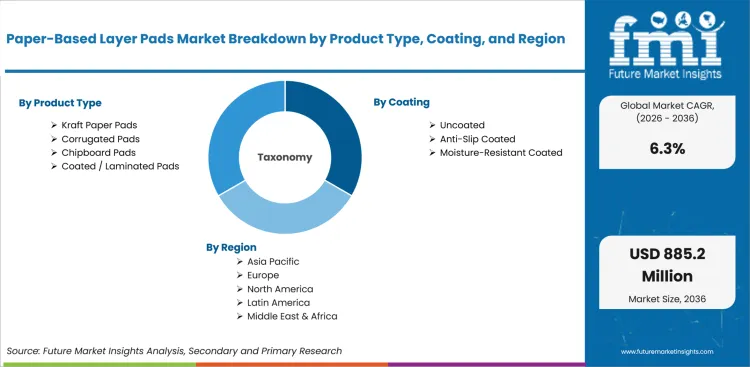
USD 480.5 million in 2026 and USD 885.2 million by 2036 at a 6.3% CAGR.
Demand for Paper-Based Layer Pads expands when high-throughput palletizing lines need a low-cost separator that prevents can, bottle, carton, or bag layers from abrading and shifting without creating a reusable asset pool.
Country adoption follows different operating constraints. India's food-processing capacity build supports first-time specification at new plants, while China's 199.0 billion courier parcels in 2025 push converters toward standardized sheets that can be replenished at automated-line scale. A related comparison is in the Paper-Based Pallet Pads Market.
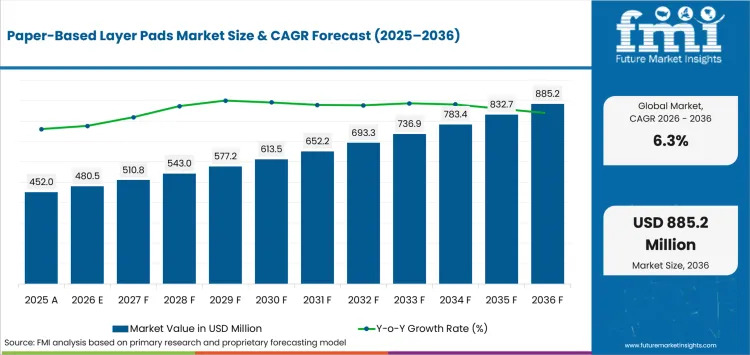
Key Takeaways of Paper-based Layer Pads Market
- Higher food, beverage, industrial, and parcel throughput increases the number of pallet tiers that require repeatable separation and damage control.
- Direct / OEM leads the sales channel because dimensions, caliper, friction, moisture behavior, and palletizer settings are interdependent.
- Uncoated and Medium (300-600 gsm) pads each lead their categories at 47.0%, while Kraft Paper Pads lead product type at 36.0%.
- Layer Separation and Food & Beverage lead the application and end-use categories.
- Moisture exposure, variable board flatness, and coating-related recycling questions can delay qualification or narrow acceptable specifications.
- India leads the profiled country growth rates at 8.5% through 2036, followed by China at 7.7%.
- Smurfit WestRock, International Paper, DS Smith, Sonoco, Mondi Group, and Stora Enso compete through board supply, functional converting, recycled fiber, and regional service.
Analyst Perspective
“Paper-based layer pads look simple, but their value depends on consistent performance at production speed. A sheet that curls, absorbs moisture or feeds poorly can disrupt palletizing and increase product movement. Buyers should therefore test flatness, friction, basis weight and humidity response on the actual line before approving a lower-cost or lower-material specification.”
- Nandini Roy Choudhury, Principal Consultant, Future Market Insights
How is the paper-based layer pads market segmented?
Product Type separates kraft, corrugated, chipboard, and coated or laminated constructions by fiber structure and converting route. Coating distinguishes untreated sheets from anti-slip and moisture-resistant surfaces that change pallet behavior or barrier performance. Basis Weight groups pads by the stiffness and material mass required for handling.
What makes Kraft Paper Pads central to the Product Type category?
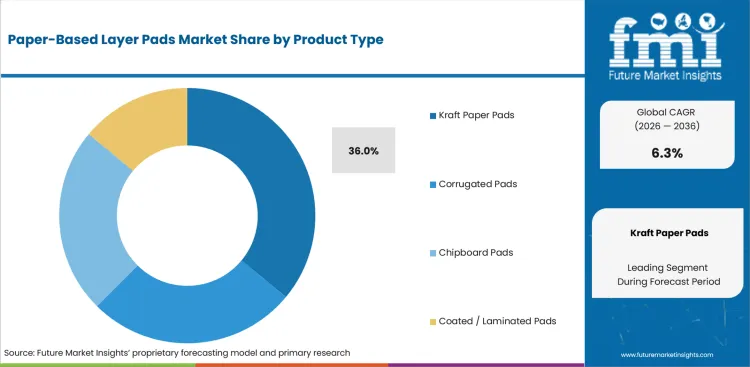
Kraft paper pads lead because tensile integrity, surface toughness, and converting flexibility match the most common job: separating stacked units while spreading point loads across a tier.
Why does Uncoated lead the Coating category?
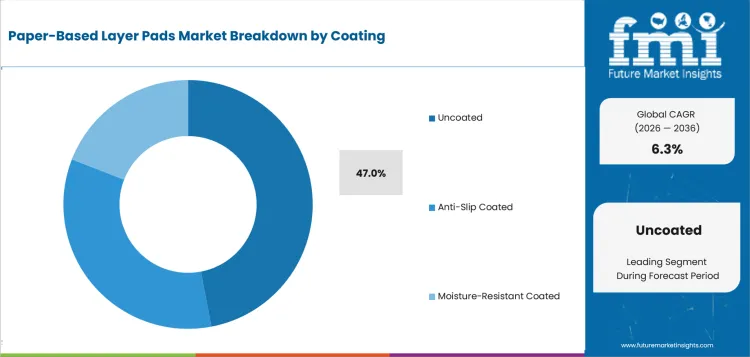
Uncoated leads because many palletized goods need clean separation and load distribution rather than a specialized barrier. Leaving the surface untreated preserves straightforward repulpability, avoids coating premiums, and reduces the documentation burden for buyers whose loads remain in dry indoor environments.
How does Medium (300-600 gsm) set the Basis Weight benchmark?
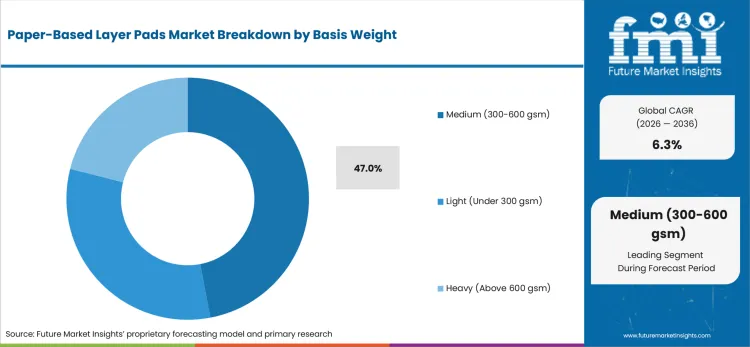
Medium basis weight sets the practical balance between stiffness and material efficiency. Pads must remain flat enough for manual or automated placement, resist edge curl, bridge small gaps between units, and distribute vertical pressure without becoming unnecessarily heavy.
What supports Layer Separation in the Application category?
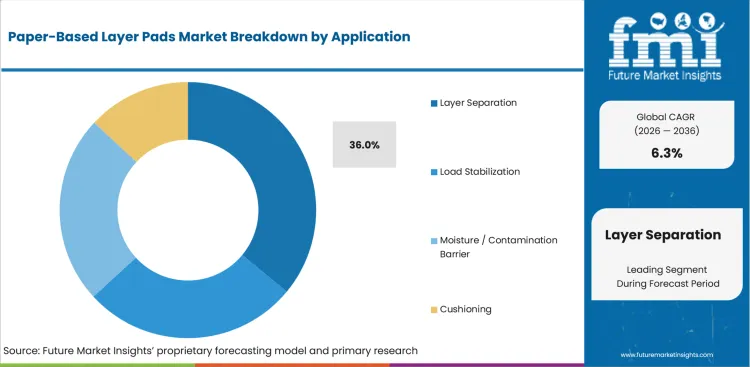
Layer separation is central because a single sheet prevents direct product contact, spreads vertical load, stabilizes tier geometry, and creates a clean interface for robotic or manual depalletization. It addresses repeated unit-level problems without adding a permanent pallet component.
What drives Food & Beverage demand within End Use?
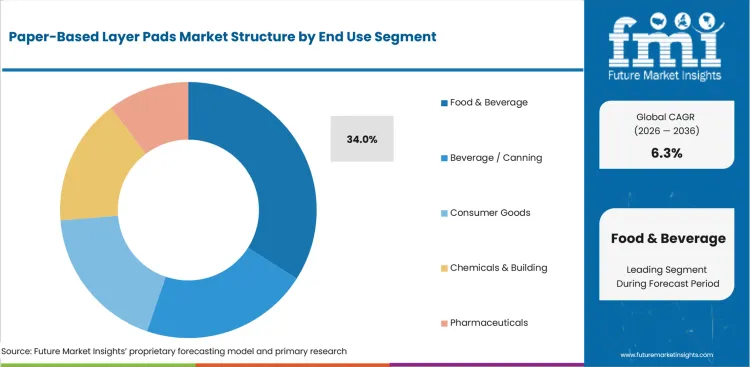
Food and beverage leads because production lines generate high unit counts, repeat pallet patterns, and surface-sensitive containers. Beverage cans, bottles, jars, multipacks, and cases create dense tiers where small alignment errors can propagate into load instability.
Why does Direct / OEM lead the Sales Channel category?
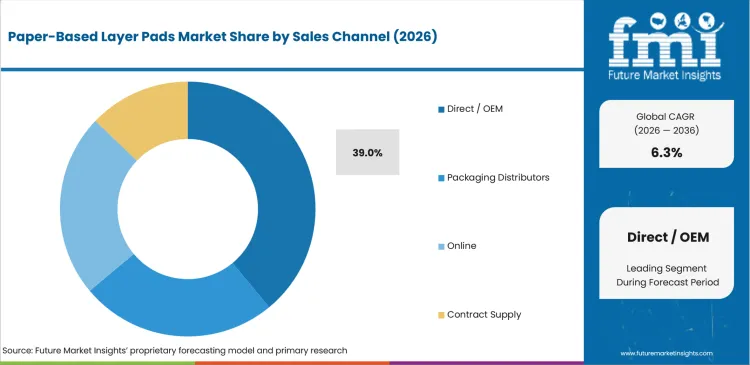
Direct/OEM leads because dimensions, caliper, coefficient of friction, moisture behavior, print, and palletizer settings are interdependent. Plant packaging engineers commonly need samples, line trials, and corrective changes before a pad is released for routine procurement.
What are the drivers, restraints, and opportunities in the paper-based layer pads market?
- Driver: Higher food, beverage, industrial, and parcel throughput increases the number of pallet tiers that require repeatable separation and damage control.
- Restraint: Moisture exposure, variable board flatness, and coating-related recycling questions can delay qualification or narrow acceptable specifications.
- Opportunity: Repulpable anti-slip and moisture-resistant grades can replace heavier or plastic-intensive solutions where performance is proven on existing lines.
Driver. Buyers increase pad consumption when faster palletizing and denser loads make unit movement, abrasion, or stack deformation expensive. The USA Restraint. A paper pad can meet dry-load requirements yet lose stiffness, flatness, or friction consistency after humidity exposure, especially during long storage or cross-climate transport. Opportunity. Suppliers can capture more value by combining lower basis weight with repulpable friction or moisture functionality, rather than simply adding material.
How do country-level CAGRs compare in the paper-based layer pads market?
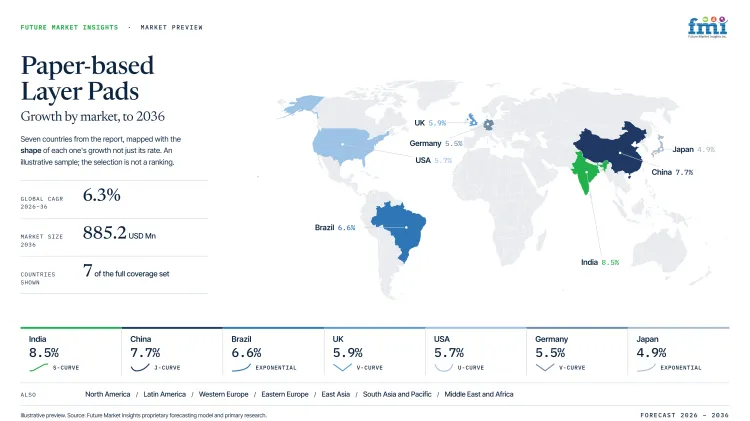
| Country | CAGR |
|---|---|
| USA | 5.7% |
| China | 7.7% |
| Germany | 5.5% |
| Japan | 4.9% |
| India | 8.5% |
| UK | 5.9% |
| Brazil | 6.6% |
The seven country forecasts separate into four defensible bands. India at 8.5% and China at 7.7% form the high-growth group, reflecting capacity addition and higher processing or parcel throughput. Brazil stands alone at 6.6%, where channel reach and climate-ready specifications matter.
Country-wise Analysis
- USA: USA buyers often source through integrated paper and corrugated networks, then qualify pad dimensions and board performance at plant level.
- China: Chinese converters and manufacturers favor repeatable standard sizes, high-speed feeding, and delivered cost across very large pallet and parcel volumes.
- Germany: German procurement teams test material efficiency, recyclability, and documentation alongside strength and damage prevention. Adoption of Paper-Based Layer Pads in Germany is poised to expand at 5.5% CAGR from 2026 to 2036.
- Japan: Japanese buyers emphasize dimensional precision, low dust, predictable flatness, and continuity from approved suppliers. Demand for Paper-Based Layer Pads in Japan is set to rise at 4.9% CAGR from 2026 to 2036.
- India: Indian food processors and contract packers increasingly specify transport components while commissioning new processing and preservation capacity. Sales of Paper-Based Layer Pads in India are set to expand at 8.5% CAGR from 2026 to 2036.
- UK: buyers increasingly compare transport-packaging performance with producer-responsibility cost and recyclability documentation. Adoption of Paper-Based Layer Pads in the UK is on track to rise at 5.9% CAGR from 2026 to 2036.
- Brazil: Brazilian buyers balance pallet protection with long domestic routes, variable humidity, and uneven access to nearby converting capacity.
Who are the notable companies in the paper-based layer pads market?
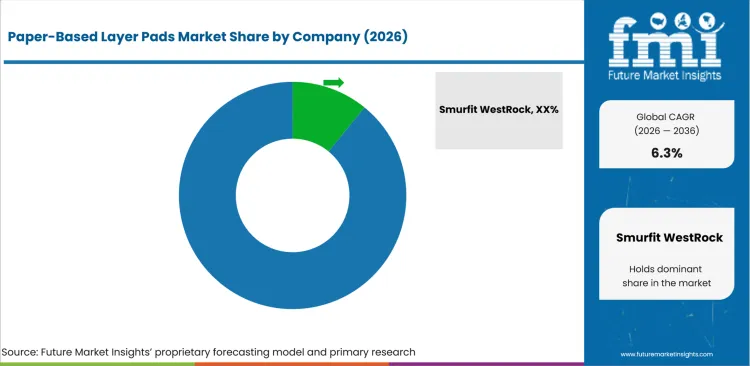
Competition divides into integrated global board-and-corrugated platforms, diversified fiber and protective-packaging specialists, and regional recycled-fiber networks. Smurfit WestRock accounts for 10.9% and combines board, corrugated converting, coatings, and customer-facing packaging engineering.
Competitive Benchmarking: Paper-Based Layer Pads Market
| Company | Capability profile | Geographic reach |
|---|---|---|
| Smurfit WestRock | Integrated Board Supply: High; Cut-to-Size / Functional Converting: High; Recycled-Fiber and Circularity: High | Americas, Europe, Middle East, Africa, and Asia-Pacific |
| International Paper | Integrated Board Supply: High; Cut-to-Size / Functional Converting: High; Recycled-Fiber and Circularity: High | North America and EMEA |
| DS Smith | Integrated Board Supply: High; Cut-to-Size / Functional Converting: High; Recycled-Fiber and Circularity: High | Europe and selected North American markets |
| Sonoco | Integrated Board Supply: High; Cut-to-Size / Functional Converting: Medium; Recycled-Fiber and Circularity: High | Americas, Europe, and Asia-Pacific |
| Mondi Group | Integrated Board Supply: High; Cut-to-Size / Functional Converting: High; Recycled-Fiber and Circularity: High | Europe, Middle East and Africa, with selected global markets |
| Stora Enso | Integrated Board Supply: High; Cut-to-Size / Functional Converting: Medium; Recycled-Fiber and Circularity: High | Europe and selected Asian markets |
| Georgia-Pacific | Integrated Board Supply: High; Cut-to-Size / Functional Converting: High; Recycled-Fiber and Circularity: High | United States and selected North American markets |
| Cascades | Integrated Board Supply: High; Cut-to-Size / Functional Converting: Medium; Recycled-Fiber and Circularity: High | United States and Canada |
| Packaging Corporation of America | Integrated Board Supply: High; Cut-to-Size / Functional Converting: Medium; Recycled-Fiber and Circularity: Medium | United States |
| Klingele Papierwerke | Integrated Board Supply: High; Cut-to-Size / Functional Converting: Medium; Recycled-Fiber and Circularity: High | Europe and Brazil |
Scoring basis: Integrated Board Supply measures documented access to paper, paperboard, containerboard, or solid-board production relevant to layer-pad conversion.
Key Developments in the Paper-Based Layer Pads Market
- In June 2025, Mondi launched re/cycle PaperPlus Bag Advanced, a paper-based package for humidity-sensitive products using a thin high-performance barrier film.
- In June 2026, Stora Enso received FSSC 22000 certification for pulp production at its Oulu site, extending food-safety controls across pulp, board machines, sheeting, and the port terminal.
- In January 2025, International Paper completed the acquisition of DS Smith. The transaction combined corrugated packaging and paper operations across North America and EMEA.
- In May 2023, Cascades produced the first roll of 100% recycled containerboard at its Bear Island, Virginia mill and entered the ramp-up phase.
Key Players in the Paper-Based Layer Pads Market
Integrated Global Board and Corrugated Platforms
- Smurfit WestRock
- International Paper
- DS Smith
- Mondi Group
Fiber, Paperboard, and Protective Packaging Specialists
- Sonoco
- Stora Enso
- Georgia-Pacific
Regional Recycled-Fiber and Corrugated Networks
- Cascades
- Packaging Corporation of America
- Klingele Papierwerke
Paper-Based Layer Pads Market - Report Scope
| Coverage field | Report scope |
|---|---|
| Market breakdown | Product Type, Coating, Basis Weight, Application, End Use, and Sales Channel |
| Quantitative Units | USD Million |
| Market Definition | Revenue from expendable paper or paperboard sheets sold as interlayers, tier dividers, top or bottom pads, and layer separators for palletized or stacked goods, including cut-to-size kraft, corrugated, chipboard, and coated or laminated pads. |
| Regions Covered | North America; Latin America; Western Europe; Eastern Europe; East Asia; South Asia and Pacific; Middle East and Africa |
| Countries Covered | USA, China, Germany, Japan, India, UK, Brazil, and more than twenty-five additional countries in the full report |
| Key Companies Profiled | Smurfit WestRock; International Paper; DS Smith; Sonoco; Mondi Group; Stora Enso; Georgia-Pacific; Cascades; Packaging Corporation of America; Klingele Papierwerke |
| Forecast Period | 2026 to 2036 |
| Approach | Hybrid bottom-up and top-down sizing using supplier activity, converting capacity, average selling prices, application demand, end-use output, channel checks, country indicators, and scope-consistent triangulation. |
Paper-Based Layer Pads Market - Research Methodology
| Method | Approach |
|---|---|
| Primary Research | Structured discussions with paper and board producers, layer-pad converters, packaging distributors, palletizing-line integrators, procurement teams, packaging engineers, operations personnel, and subject-matter experts. |
| Desk Research | Review of official statistics, packaging and recycling regulations, standards, trade and industry documents, corporate filings, first-party product documentation, and dated company announcements. |
| Market Sizing and Forecasting | Hybrid bottom-up and top-down analysis using supplier revenue and volume indicators, converting capacity, board consumption, average selling prices, application intensity, end-use production, country operating indicators, policy changes, material substitution, and channel development over 2026-2036. |
| Data Validation | Supply-side, demand-side, and channel findings were triangulated against the market totals and segment definitions. |
Paper-Based Layer Pads Market by Segments
Paper-Based Layer Pads Market segmented by Product Type:
- Kraft Paper Pads
- Corrugated Pads
- Chipboard Pads
- Coated / Laminated Pads
Paper-Based Layer Pads Market segmented by Coating:
- Uncoated
- Anti-Slip Coated
- Moisture-Resistant Coated
Paper-Based Layer Pads Market segmented by Basis Weight:
- Medium (300-600 gsm)
- Light (Under 300 gsm)
- Heavy (Above 600 gsm)
Paper-Based Layer Pads Market segmented by Application:
- Layer Separation
- Load Stabilization
- Moisture / Contamination Barrier
- Cushioning
Paper-Based Layer Pads Market segmented by End Use:
- Food & Beverage
- Beverage / Canning
- Consumer Goods
- Chemicals & Building
- Pharmaceuticals
Paper-Based Layer Pads Market segmented by Sales Channel:
- Direct / OEM
- Packaging Distributors
- Online
- Contract Supply
Research Sources and Bibliography
- USA Census Bureau. Quarterly Retail E-Commerce Sales: First Quarter 2026. May 18, 2026.
- State Post Bureau of China. 2025 Postal and Courier Industry Operating Results. January 8, 2026.
- Ministry of Food Processing Industries, Government of India. Scheme Guidelines for Creation or Expansion of Food Processing and Preservation Capacities. January 22, 2025.
- European Commission, Directorate-General for Environment. Packaging and Packaging Waste Regulation: Regulation (EU) 2025/40. 2025.
- International Organization for Standardization. ISO 536:2019: Paper and Board - Determination of Grammage. 2019.
- International Organization for Standardization. ISO 187:2022: Paper, Board and Pulps - Standard Atmosphere for Conditioning and Testing and Procedure for Monitoring the Atmosphere and Conditioning of Samples. 2022.
- Technical Association of the Pulp and Paper Industry. TAPPI/ANSI T 815: Coefficient of Static Friction of Packaging and Packaging Materials, Including Shipping Sack Papers, Corrugated Board and Solid Fiberboard. Latest applicable edition.
- Confederation of European Paper Industries. Cepi Recyclability Laboratory Test Method, Version 3. February 2025.
- Mondi Group. Mondi Launches re/cycle PaperPlus Bag Advanced, a High-Barrier Paper Bag for Humidity-Sensitive Products. June 12, 2025.
- Stora Enso. Stora Enso’s Oulu Pulp Production Granted Internationally Recognized Food-Safety Certification. June 17, 2026.
- International Paper. Acquisition of DS Smith. Transaction completed January 31, 2025.
- Cascades Inc. Successful Start-Up of Cascades Containerboard Packaging Plant at Bear Island, Virginia. May 2, 2023.
This Report Answers
- What is the Paper-Based Layer Pads Market size in 2026 and what value is forecast for 2036?
- Which palletized-transport, recycling, and operating pressures support demand for paper-based layer pads?
- Why do Kraft Paper Pads hold the leading position within Product Type?
- How does Uncoated influence downstream specification and recycling decisions within the Coating category?
- Why does Medium (300-600 gsm) hold the leading position within Basis Weight?
- How do growth rates differ across the USA, China, Germany, Japan, India, UK, and Brazil?
- Which profiled companies provide integrated board supply, converting, coating, recycled-fiber, or regional service capabilities?
- How do humidity, coating compatibility, dimensional variation, and qualification cycles limit adoption?
- What should packaging engineers and procurement teams evaluate before selecting a layer-pad supplier?
Frequently Asked Questions
What is driving growth in the Paper-Based Layer Pads Market?
Growth comes from higher palletized throughput and the need to separate, stabilize, and protect product tiers with a recyclable, low-cost component.
Who are the key players in the Paper-Based Layer Pads Market?
Profiled companies are Smurfit WestRock, International Paper, DS Smith, Sonoco, Mondi Group, Stora Enso, Georgia-Pacific, Cascades, Packaging Corporation of America, and Klingele Papierwerke.
What notable restraint affects the Paper-Based Layer Pads Market?
Humidity can reduce flatness, stiffness, or friction consistency, while functional coatings can add recyclability and product-adjacent documentation requirements.
Why should executives track the Paper-Based Layer Pads Market?
The market links transport damage, palletizing productivity, material reduction, and recycling policy in a frequently replenished packaging component.
What business problem does the Paper-Based Layer Pads Market address?
Paper-based layer pads keep stacked units separated, spread vertical pressure, reduce surface abrasion, and help preserve tier geometry during handling and transport.
What should packaging engineers evaluate in the Paper-Based Layer Pads Market?
Packaging engineers should test dimensions, basis weight, flatness, edge quality, dust, static friction, moisture response, and automated-line feedability against the actual pallet pattern.
What limits return on investment in the Paper-Based Layer Pads Market?
Return weakens when a pad is over-specified, generates line jams, arrives warped, or fails to reduce damage enough to offset its delivered cost.
What supports long-term commercial confidence in the Paper-Based Layer Pads Market?
Long-term confidence depends on recurring palletized production, established paper recovery routes, measurable friction and board-performance tests, and broad converter access.
Preview the report firsthand - request a free sample
Get SampleGet the brochure for pricing and purchase details.
Get PDFTable of Content
- Key Takeaways
- Market Size and CAGR
- Top Growth Driver
- Fastest Growing Segment
- Leading Region
- Key Companies
- Emerging Opportunities
- Executive Summary
- Global Market Outlook
- Demand-side Trends
- Supply-side Trends
- Technology Roadmap Analysis
- Analysis and Recommendations
- Analyst Perspective (What is happening? Why now? What should investors know?)
- Key Questions Answered
- How large is the market?
- What is the CAGR?
- What are key trends?
- Which region dominates?
- Who are the leaders?
- Market Overview
- Market Coverage / Taxonomy
- Market Definition / Scope / Limitations
- Research Methodology
- Chapter Orientation
- Analytical Lens and Working Hypotheses
- Market Structure, Signals, and Trend Drivers
- Benchmarking and Cross-market Comparability
- Market Sizing, Forecasting, and Opportunity Mapping
- Research Design and Evidence Framework
- Desk Research Programme (Secondary Evidence)
- Expert Input and Fieldwork (Primary Evidence)
- Tooling, Models, and Reference Databases
- Data Engineering and Model Build
- Quality Assurance and Audit Trail
- Market Background
- Market Dynamics (Drivers, Restraints, Opportunity, Trends)
- Scenario Forecast (Optimistic, Likely, Conservative)
- Impact Analysis
- AI Impact
- Sustainability Impact
- Regulatory Impact
- Technology Impact
- Consumer / Buyer Analysis
- Purchase Drivers
- Adoption Barriers
- Buyer Journey
- Opportunity Map Analysis
- Product Life Cycle Analysis
- Supply Chain Analysis
- Investment Feasibility Matrix
- Value Chain Analysis
- PESTLE and Porter's Analysis
- Regulatory Landscape
- Regional Parent Market Outlook
- Production and Consumption Statistics
- Import and Export Statistics
- Global Market Analysis and Forecast, 2021 to 2036
- Historical Market Size Value (USD Million) Analysis, 2021 to 2025
- Current and Future Market Size Value (USD Million) Projections, 2026 to 2036
- Y-o-Y Growth Trend Analysis
- Absolute $ Opportunity Analysis
- Global Market Pricing Analysis, 2021 to 2036
- Global Market Analysis and Forecast, By Product Type, 2021 to 2036
- Introduction / Key Findings
- Historical Market Size Value (USD Million) Analysis By Product Type, 2021 to 2025
- Current and Future Market Size Value (USD Million) Analysis and Forecast By Product Type, 2026 to 2036
- Kraft Paper Pads
- Corrugated Pads
- Chipboard Pads
- Coated / Laminated Pads
- Kraft Paper Pads
- Y-o-Y Growth Trend Analysis By Product Type, 2021 to 2025
- Absolute $ Opportunity Analysis By Product Type, 2026 to 2036
- Global Market Analysis and Forecast, By Coating, 2021 to 2036
- Introduction / Key Findings
- Historical Market Size Value (USD Million) Analysis By Coating, 2021 to 2025
- Current and Future Market Size Value (USD Million) Analysis and Forecast By Coating, 2026 to 2036
- Uncoated
- Anti-Slip Coated
- Moisture-Resistant Coated
- Uncoated
- Y-o-Y Growth Trend Analysis By Coating, 2021 to 2025
- Absolute $ Opportunity Analysis By Coating, 2026 to 2036
- Global Market Analysis and Forecast, By Basis Weight, 2021 to 2036
- Introduction / Key Findings
- Historical Market Size Value (USD Million) Analysis By Basis Weight, 2021 to 2025
- Current and Future Market Size Value (USD Million) Analysis and Forecast By Basis Weight, 2026 to 2036
- Medium (300-600 gsm)
- Light (Under 300 gsm)
- Heavy (Above 600 gsm)
- Medium (300-600 gsm)
- Y-o-Y Growth Trend Analysis By Basis Weight, 2021 to 2025
- Absolute $ Opportunity Analysis By Basis Weight, 2026 to 2036
- Global Market Analysis and Forecast, By Application, 2021 to 2036
- Introduction / Key Findings
- Historical Market Size Value (USD Million) Analysis By Application, 2021 to 2025
- Current and Future Market Size Value (USD Million) Analysis and Forecast By Application, 2026 to 2036
- Layer Separation
- Load Stabilization
- Moisture / Contamination Barrier
- Cushioning
- Layer Separation
- Y-o-Y Growth Trend Analysis By Application, 2021 to 2025
- Absolute $ Opportunity Analysis By Application, 2026 to 2036
- Global Market Analysis and Forecast, By End Use, 2021 to 2036
- Introduction / Key Findings
- Historical Market Size Value (USD Million) Analysis By End Use, 2021 to 2025
- Current and Future Market Size Value (USD Million) Analysis and Forecast By End Use, 2026 to 2036
- Food & Beverage
- Beverage / Canning
- Consumer Goods
- Chemicals & Building
- Pharmaceuticals
- Food & Beverage
- Y-o-Y Growth Trend Analysis By End Use, 2021 to 2025
- Absolute $ Opportunity Analysis By End Use, 2026 to 2036
- Global Market Analysis and Forecast, By Sales Channel
- Introduction / Key Findings
- Historical Market Size Value (USD Million) Analysis By Sales Channel, 2021 to 2025
- Current and Future Market Size Value (USD Million) Analysis and Forecast By Sales Channel, 2026 to 2036
- Direct / OEM
- Packaging Distributors
- Online
- Contract Supply
- Direct / OEM
- Y-o-Y Growth Trend Analysis By Sales Channel, 2021 to 2025
- Absolute $ Opportunity Analysis By Sales Channel, 2026 to 2036
- Global Market Analysis and Forecast, By Region, 2021 to 2036
- Introduction
- Historical Market Size Value (USD Million) Analysis By Region, 2021 to 2025
- Current Market Size Value (USD Million) Analysis and Forecast By Region, 2026 to 2036
- North America
- Latin America
- Western Europe
- Eastern Europe
- East Asia
- South Asia and Pacific
- Middle East & Africa
- Market Attractiveness Analysis By Region
- North America Market Analysis and Forecast, By Country, 2021 to 2036
- Historical Market Size Value (USD Million) Trend Analysis By Market Taxonomy, 2021 to 2025
- Market Size Value (USD Million) Forecast By Market Taxonomy, 2026 to 2036
- By Country
- USA
- Canada
- By Product Type
- By Coating
- By Basis Weight
- By Application
- By End Use
- By Sales Channel
- By Country
- Market Attractiveness Analysis
- By Country
- By Product Type
- By Coating
- By Basis Weight
- By Application
- By End Use
- By Sales Channel
- Key Takeaways
- Latin America Market Analysis and Forecast, By Country
- Historical Market Size Value (USD Million) Trend Analysis By Market Taxonomy, 2021 to 2025
- Market Size Value (USD Million) Forecast By Market Taxonomy, 2026 to 2036
- By Country
- Brazil
- Mexico
- Chile
- Rest of Latin America
- By Product Type
- By Coating
- By Basis Weight
- By Application
- By End Use
- By Sales Channel
- By Country
- Market Attractiveness Analysis
- By Country
- By Product Type
- By Coating
- By Basis Weight
- By Application
- By End Use
- By Sales Channel
- Key Takeaways
- Western Europe Market Analysis and Forecast, By Country
- Historical Market Size Value (USD Million) Trend Analysis By Market Taxonomy, 2021 to 2025
- Market Size Value (USD Million) Forecast By Market Taxonomy, 2026 to 2036
- By Country
- Germany
- UK
- Italy
- Spain
- France
- Nordic
- BENELUX
- Rest of Western Europe
- By Product Type
- By Coating
- By Basis Weight
- By Application
- By End Use
- By Sales Channel
- By Country
- Market Attractiveness Analysis
- By Country
- By Product Type
- By Coating
- By Basis Weight
- By Application
- By End Use
- By Sales Channel
- Key Takeaways
- Eastern Europe Market Analysis and Forecast, By Country
- Historical Market Size Value (USD Million) Trend Analysis By Market Taxonomy, 2021 to 2025
- Market Size Value (USD Million) Forecast By Market Taxonomy, 2026 to 2036
- By Country
- Russia
- Poland
- Hungary
- Balkan & Baltic
- Rest of Eastern Europe
- By Product Type
- By Coating
- By Basis Weight
- By Application
- By End Use
- By Sales Channel
- By Country
- Market Attractiveness Analysis
- By Country
- By Product Type
- By Coating
- By Basis Weight
- By Application
- By End Use
- By Sales Channel
- Key Takeaways
- East Asia Market Analysis and Forecast, By Country
- Historical Market Size Value (USD Million) Trend Analysis By Market Taxonomy, 2021 to 2025
- Market Size Value (USD Million) Forecast By Market Taxonomy, 2026 to 2036
- By Country
- China
- Japan
- South Korea
- By Product Type
- By Coating
- By Basis Weight
- By Application
- By End Use
- By Sales Channel
- By Country
- Market Attractiveness Analysis
- By Country
- By Product Type
- By Coating
- By Basis Weight
- By Application
- By End Use
- By Sales Channel
- Key Takeaways
- South Asia and Pacific Market Analysis and Forecast, By Country
- Historical Market Size Value (USD Million) Trend Analysis By Market Taxonomy, 2021 to 2025
- Market Size Value (USD Million) Forecast By Market Taxonomy, 2026 to 2036
- By Country
- India
- ASEAN
- Australia & New Zealand
- Rest of South Asia and Pacific
- By Product Type
- By Coating
- By Basis Weight
- By Application
- By End Use
- By Sales Channel
- By Country
- Market Attractiveness Analysis
- By Country
- By Product Type
- By Coating
- By Basis Weight
- By Application
- By End Use
- By Sales Channel
- Key Takeaways
- Middle East & Africa Market Analysis and Forecast, By Country
- Historical Market Size Value (USD Million) Trend Analysis By Market Taxonomy, 2021 to 2025
- Market Size Value (USD Million) Forecast By Market Taxonomy, 2026 to 2036
- By Country
- Kingdom of Saudi Arabia
- Other GCC Countries
- Türkiye
- South Africa
- Other African Union
- Rest of Middle East & Africa
- By Product Type
- By Coating
- By Basis Weight
- By Application
- By End Use
- By Sales Channel
- By Country
- Market Attractiveness Analysis
- By Country
- By Product Type
- By Coating
- By Basis Weight
- By Application
- By End Use
- By Sales Channel
- Key Takeaways
- Key Countries Market Analysis
- USA
- Pricing Analysis
- Market Share Analysis, 2025
- By Product Type
- By Coating
- By Basis Weight
- By Application
- By End Use
- By Sales Channel
- Canada
- Pricing Analysis
- Market Share Analysis, 2025
- By Product Type
- By Coating
- By Basis Weight
- By Application
- By End Use
- By Sales Channel
- Mexico
- Pricing Analysis
- Market Share Analysis, 2025
- By Product Type
- By Coating
- By Basis Weight
- By Application
- By End Use
- By Sales Channel
- Brazil
- Pricing Analysis
- Market Share Analysis, 2025
- By Product Type
- By Coating
- By Basis Weight
- By Application
- By End Use
- By Sales Channel
- Chile
- Pricing Analysis
- Market Share Analysis, 2025
- By Product Type
- By Coating
- By Basis Weight
- By Application
- By End Use
- By Sales Channel
- Germany
- Pricing Analysis
- Market Share Analysis, 2025
- By Product Type
- By Coating
- By Basis Weight
- By Application
- By End Use
- By Sales Channel
- UK
- Pricing Analysis
- Market Share Analysis, 2025
- By Product Type
- By Coating
- By Basis Weight
- By Application
- By End Use
- By Sales Channel
- Italy
- Pricing Analysis
- Market Share Analysis, 2025
- By Product Type
- By Coating
- By Basis Weight
- By Application
- By End Use
- By Sales Channel
- Spain
- Pricing Analysis
- Market Share Analysis, 2025
- By Product Type
- By Coating
- By Basis Weight
- By Application
- By End Use
- By Sales Channel
- France
- Pricing Analysis
- Market Share Analysis, 2025
- By Product Type
- By Coating
- By Basis Weight
- By Application
- By End Use
- By Sales Channel
- India
- Pricing Analysis
- Market Share Analysis, 2025
- By Product Type
- By Coating
- By Basis Weight
- By Application
- By End Use
- By Sales Channel
- ASEAN
- Pricing Analysis
- Market Share Analysis, 2025
- By Product Type
- By Coating
- By Basis Weight
- By Application
- By End Use
- By Sales Channel
- Australia & New Zealand
- Pricing Analysis
- Market Share Analysis, 2025
- By Product Type
- By Coating
- By Basis Weight
- By Application
- By End Use
- By Sales Channel
- China
- Pricing Analysis
- Market Share Analysis, 2025
- By Product Type
- By Coating
- By Basis Weight
- By Application
- By End Use
- By Sales Channel
- Japan
- Pricing Analysis
- Market Share Analysis, 2025
- By Product Type
- By Coating
- By Basis Weight
- By Application
- By End Use
- By Sales Channel
- South Korea
- Pricing Analysis
- Market Share Analysis, 2025
- By Product Type
- By Coating
- By Basis Weight
- By Application
- By End Use
- By Sales Channel
- Russia
- Pricing Analysis
- Market Share Analysis, 2025
- By Product Type
- By Coating
- By Basis Weight
- By Application
- By End Use
- By Sales Channel
- Poland
- Pricing Analysis
- Market Share Analysis, 2025
- By Product Type
- By Coating
- By Basis Weight
- By Application
- By End Use
- By Sales Channel
- Hungary
- Pricing Analysis
- Market Share Analysis, 2025
- By Product Type
- By Coating
- By Basis Weight
- By Application
- By End Use
- By Sales Channel
- Kingdom of Saudi Arabia
- Pricing Analysis
- Market Share Analysis, 2025
- By Product Type
- By Coating
- By Basis Weight
- By Application
- By End Use
- By Sales Channel
- Türkiye
- Pricing Analysis
- Market Share Analysis, 2025
- By Product Type
- By Coating
- By Basis Weight
- By Application
- By End Use
- By Sales Channel
- South Africa
- Pricing Analysis
- Market Share Analysis, 2025
- By Product Type
- By Coating
- By Basis Weight
- By Application
- By End Use
- By Sales Channel
- USA
- Market Structure Analysis
- Competition Dashboard
- Competition Benchmarking
- Market Share Analysis of Top Players
- By Regional
- By Product Type
- By Coating
- By Basis Weight
- By Application
- By End Use
- By Sales Channel
- Emerging Startups
- Innovation Benchmarking
- Competition Analysis
- Competition Deep Dive
- Smurfit WestRock
- Overview
- Product Portfolio
- Profitability by Market Segments
- Sales Footprint
- Strategy Overview
- Marketing Strategy
- Product Strategy
- Channel Strategy
- International Paper
- DS Smith
- Sonoco
- Mondi Group
- Stora Enso
- Georgia-Pacific
- Cascades
- Packaging Corporation of America
- Klingele Papierwerke
- Smurfit WestRock
- Case Studies
- Success Stories
- Recent Developments
- Competition Deep Dive
- Assumptions & Acronyms Used


