

- Market Size (2026)
- USD 389.8 Mn
- Forecast (2036)
- USD 752.6 Mn
- CAGR (2026 to 2036)
- 6.8%
How big is Fiber-Based Layer Pads Market in 2026?
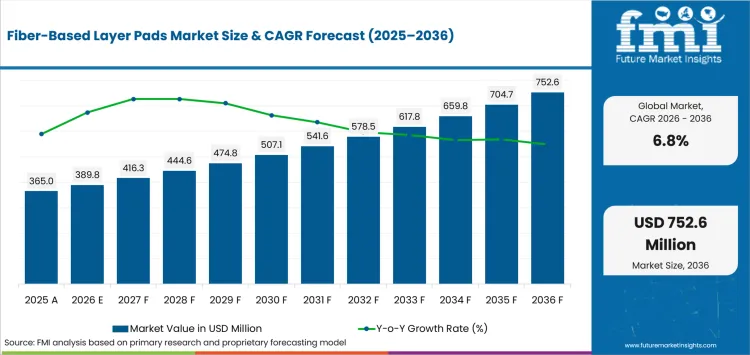
USD 389.8 million in 2026 and USD 752.6 million by 2036 at a 6.8% CAGR.
Demand for fiber-based layer pads stands at USD 389.8 million in 2026 and rises to USD 752.6 million by 2036, growing at a 6.8% CAGR. Growth is driven by packaging engineers who need to stabilize repeated pallet patterns across beverage, food, and consumer goods supply chains without introducing a separate plastic component or redesigning the primary pack. A layer pad that sits between pallet tiers does straightforward structural work, distributing load weight and preventing layer-to-layer shifting during transit, but it has to do that work consistently across every production run without driving up material cost or complicating end-of-life handling for the receiver.
Substitution risk from thinner or lower-grade alternatives and price pressure in high-volume commodity channels work against faster adoption of premium recycled-fiber formats, while board consistency across large runs remains a real qualification threshold in markets where production scale is high. The stronger opportunities lie in high-recycled-content grades that meet food-contact or export-adjacent specifications, pre-cut formats suited for automated pallet-building lines, and board weights calibrated to specific load profiles rather than a one-size default. By pad type, material grade, and end-use industry, load requirements and cost thresholds differ enough to warrant separate treatment. Regionally, India and China combine expanding packaged-goods throughput with pressure to cut unnecessary plastic, which pushes suppliers to offer local conversion capacity, short replenishment cycles, and board grades that hold specification across large production runs.
Key Takeaways of Fiber-based Layer Pads Market
- Demand grows when packaging engineers must stabilize repeated pallet patterns without adding a separate plastic component or redesigning the primary pack.
- Direct / OEM leads the sales channel at 41.0% because high-volume users require coordinated design approval, controlled specifications, and scheduled supply.
- Full-Size Layer Pads lead product type at 44.0%, while Corrugated Fiberboard leads material at 42.0%.
- The 2-4 mm band leads thickness at 45.0%; Layer Separation and Food & Beverage lead application and end use at 38.0% and 34.0%.
- Humidity, creep, coatings, and lot-to-lot variability can extend qualification and limit substitution.
- India leads the profiled country growth rates at 9.0% through 2036, followed by China at 8.2%.
- Smurfit WestRock, DS Smith, International Paper, Sonoco, Mondi Group, and Cascades compete through material integration, layer-pad engineering, and multi-region supply.
Analyst Perspective
“Fiber-based layer pads are a small component with a direct effect on pallet stability, product damage and line efficiency. Buyers will judge them on friction, stiffness, moisture response and consistency across production lots, not simply on whether they replace plastic. Suppliers that can prove performance under actual warehouse and transport conditions will be better positioned for long-term OEM contracts.”
- Nandini Roy Choudhury, Principal Consultant, Future Market Insights
How is the Fiber-based Layer Pads Market segmented?
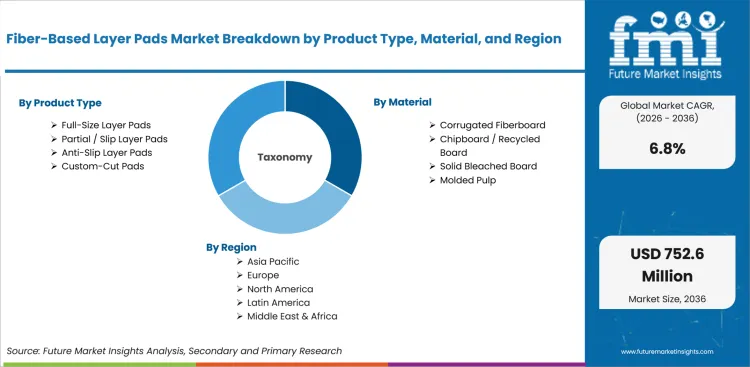
The fiber-based layer pads industry is segmented by Product Type, Material, Thickness, Application, End Use, and Sales Channel.
Product Type distinguishes how much of a pallet tier a pad covers and whether its surface is engineered for friction control or a specific footprint geometry. Material separates corrugated, recycled solid-board, bleached-board, and molded-pulp constructions by stiffness, cleanliness, and recovery route. Thickness identifies the trade-off between tier support, ease of handling, and how much pallet height the pad consumes. Application shows the specific job the pad performs within a pallet stack, since layer separation and other functions carry different structural demands. End Use separates the industry consuming the pad, because production volume and hygiene requirements vary by sector. Sales Channel captures the buying route through which large or small buyers source the product, each carrying different specification and validation needs.
What makes Full-Size Layer Pads central to the Product Type category?
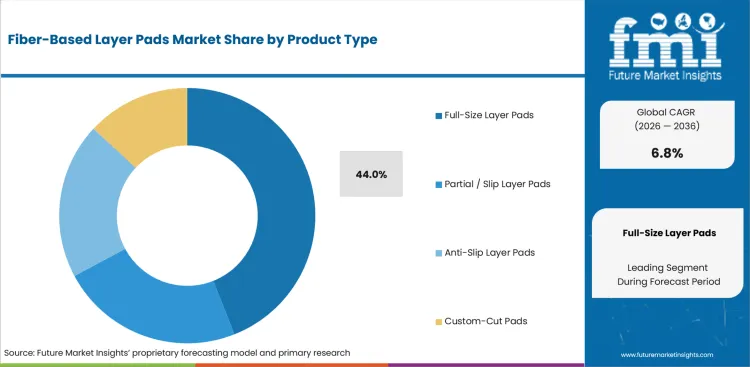
Full-size pads create a continuous interface beneath an entire pallet tier, spreading compression from upper layers evenly and limiting point contact between individual packages. Automated depalletizing operations are a key beneficiary, and the deciding factor is whether the pad's consistent footprint lets handling equipment detect and grip it reliably across repeated cycles without manual correction.
- Full-size layer pads hold 44.0% share of Product Type in 2026, reflecting how a complete footprint supports the broadest range of pallet patterns and simplifies line-side handling relative to partial-coverage formats.
- Repeatable equipment interaction is what automated facilities value most, since a pad with inconsistent dimensions or warping disrupts a depalletizer's grip pattern. Suppliers holding tight dimensional tolerance retain accounts running high-speed automated lines.
Why does Corrugated Fiberboard lead the Material category?
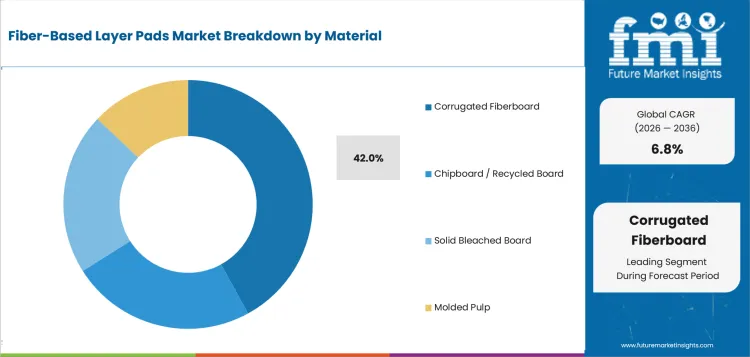
Corrugated fiberboard converts a small amount of material into meaningful bending stiffness through its fluted internal structure, letting it separate pallet tiers without the added mass a dense solid board would need to achieve the same performance. Converters running standard corrugated equipment are the primary producers, and the deciding factor is whether the fluted structure holds its stiffness consistently after slitting, scoring, or die-cutting into pad-specific dimensions.
- Corrugated fiberboard accounts for 42.0% share of Material in 2026, driven by its stiffness-to-weight ratio and compatibility with established corrugated converting equipment already common across the packaging supply chain.
- Converting flexibility supports faster program turnaround, since corrugated stock can be printed, surface-treated, or custom die-cut on existing lines without new tooling investment. That flexibility helps converters respond quickly to a buyer's specific size or branding request.
How does 2-4 mm balance performance in the Thickness category?
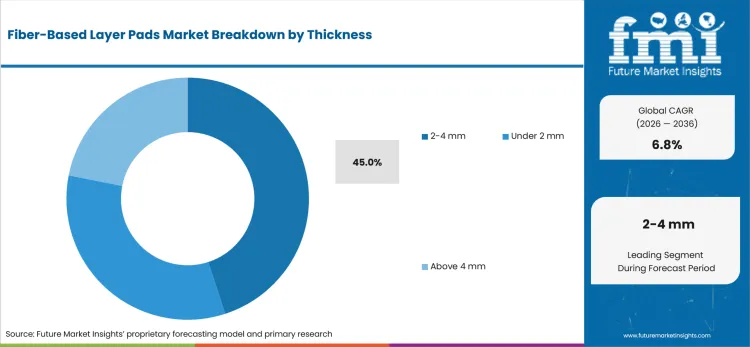
A 2-4 mm pad adds enough section depth to support tier isolation and handling durability while limiting the pallet height it consumes across a multi-layer stack, a balance that matters most when cube utilization and stretch-wrap patterns are already fixed. Packaging engineers optimizing pallet configurations are the primary decision-makers, and the deciding factor is whether that thickness performs consistently across the depalletizer settings and pallet heights already locked into a facility's process.
- The 2-4 mm band holds 45.0% share of Thickness in 2026, reflecting its position as the practical middle ground between adequate tier support and the cube efficiency high-volume operations require.
- Fixed-process compatibility drives specification here, since a facility with set depalletizer settings and pallet height standards needs a pad thickness that fits those parameters without requiring a process change. Suppliers matching that constraint retain business over pads requiring adjustment.
What supports Layer Separation as the leading Application?
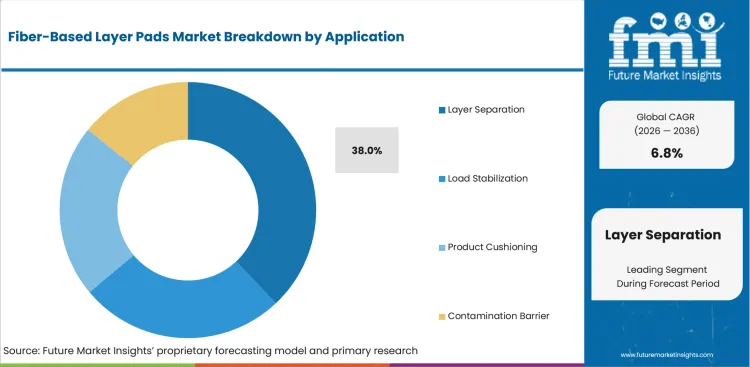
Layer separation is the most universally required job a fiber pad performs, preventing direct contact between packages, distributing pressure from the tier above, and giving a visual boundary that manual or automated depalletizing can rely on. Facilities running any tiered pallet configuration are the primary users, and the deciding factor is whether the pad performs that separation function consistently regardless of the specific product pattern loaded on a given tier.
- Layer separation represents 38.0% share of Application in 2026, reflecting its status as the one function required across the widest range of tiered pallet configurations, unlike more specialized applications tied to a specific product type.
- Broad compatibility across pallet patterns is what keeps this application dominant, since a facility running mixed SKUs needs a pad that performs the same separation function regardless of what's stacked above it. That versatility keeps demand steady across changing production runs.
What drives Food & Beverage leadership in the End Use category?
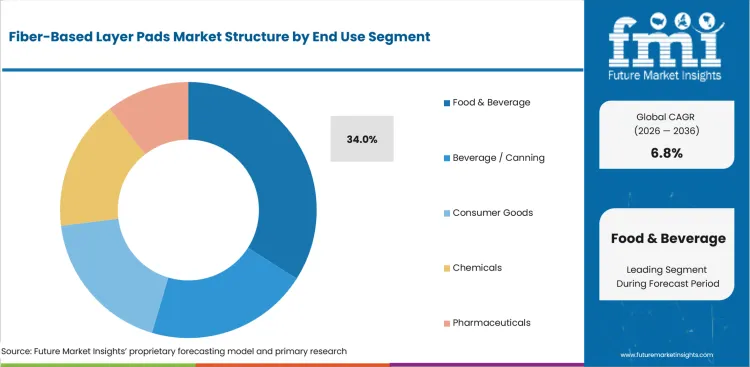
Food and beverage plants combine high pallet throughput with demanding surface, hygiene, and moisture conditions that fewer other end-use sectors face at the same scale, since cans, bottles, jars, and multipacks typically repeat in fixed patterns that make consumption predictable. Plant operations and packaging line managers are the primary buyers, and the deciding factor is whether the pad holds its structural and hygiene performance under wet or high-humidity production conditions common in this sector.
- Food & Beverage holds 34.0% share of End Use in 2026, driven by repetitive pallet patterns and demanding moisture conditions that generate steady, predictable consumption tied directly to production volume.
- Moisture resistance is the practical performance test in this sector, since a pad that weakens or degrades in a wet production environment fails at exactly the point it's needed most. Suppliers demonstrating reliable wet-condition performance retain accounts through renewal.
Why does Direct / OEM lead the Sales Channel category?
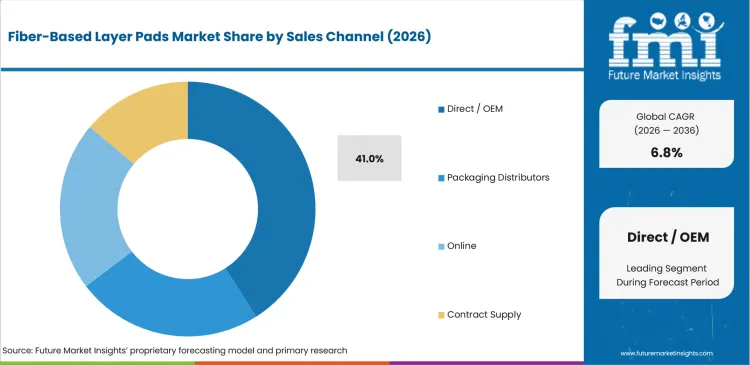
Direct and OEM supply is favored once a layer pad becomes part of a validated pallet recipe rather than an occasional consumable, a shift that happens when packaging engineering works directly with a converter to define size, corner treatment, board grade, and friction behavior. Large-volume packaging engineering teams are the primary buyers through this channel, and the deciding factor is whether the direct relationship can support coordinated design approval and scheduled supply without the delay a distributor relationship might add.
- Direct/OEM represents 41.0% share of Sales Channel in 2026, reflecting how high-volume users with a validated pallet specification require the coordinated design approval and controlled supply a direct relationship provides.
- Scheduled supply reliability matters most for these accounts, since a validated pallet recipe depends on consistent, on-time delivery to keep the packing line running without interruption. Converters meeting that cadence retain the account through the specification's full lifecycle.
What are the drivers, restraints, and opportunities in the fiber-based layer pads market?
- Driver: Producer-responsibility economics and the need for stable automated pallet loads favor specified fiber interlayers.
- Restraint: Humidity, creep, coatings, and lot-to-lot variability can extend qualification and limit substitution.
- Opportunity: Recyclable anti-slip and barrier treatments, local custom cutting, and direct OEM programs can unlock higher-value applications.
The driver begins with a buyer who must lower packaging-system risk and account for material after use. The restraint appears during validation. Fiber stiffness and friction change with board construction, moisture, storage time, and coating chemistry, so a sample that performs in a dry laboratory may behave differently in a humid warehouse or cold chain. The opportunity is to make fiber pads easier to approve for difficult loads.
How do country-level CAGRs compare in the Fiber-Based Layer Pads Market?
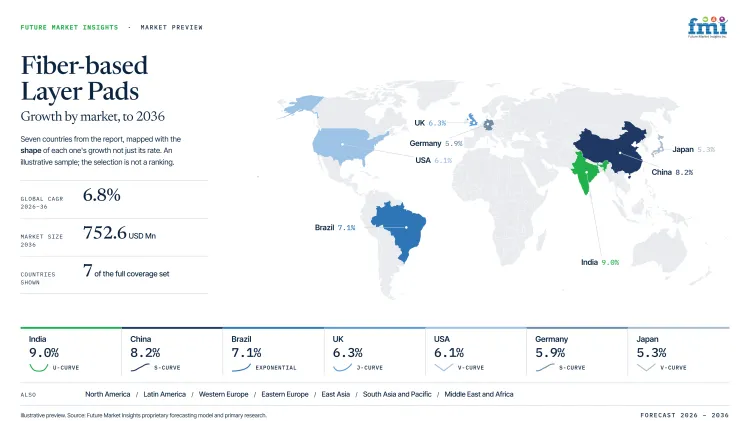
| Country | CAGR |
|---|---|
| USA | 6.1% |
| China | 8.2% |
| Germany | 5.9% |
| Japan | 5.3% |
| India | 9.0% |
| UK | 6.3% |
| Brazil | 7.1% |
The seven-country comparison spans 3.7 percentage points, from India at 9.0% to Japan at 5.3%. India and China represent the highest-growth markets, while Brazil stands between the leading Asian markets and the mature economies. The United Kingdom, the United States and Germany remain closely grouped between 5.9% and 6.3%, with Japan recording the lowest CAGR.
- India leads with a CAGR of 9.0%. Demand reflects wider use of fiber-based layer pads for palletized transport, where packaging systems require product separation and load protection.
- China follows at 8.2%, 0.8 percentage points below India. Packaging manufacturers are increasing production of fiber-based protective formats to support industrial shipping and distribution requirements.
- Brazil records a CAGR of 7.1%, creating a midpoint between the faster-growing Asian markets and the remaining countries. Market activity reflects broader adoption of protective paper-based packaging across manufacturing and logistics.
- The United Kingdom posts a CAGR of 6.3%, while the United States reaches 6.1% and Germany records 5.9%. The narrow 0.4 percentage point range indicates a similar pace of market expansion, although packaging applications and industrial demand differ across these economies.
- Japan records a CAGR of 5.3%, 0.6 percentage points below Germany. Market growth is associated with established industrial packaging applications and steady replacement demand for fiber-based protective materials.
Differences in manufacturing output, logistics activity, packaging specifications and investment priorities influence market development across these countries. The full report provides country-level CAGR analysis across North America, Latin America, Europe, East Asia, South Asia, Oceania and the Middle East and Africa.
Country-wise Analysis
- USA: buyers often centralize package engineering for national brands, then validate the pad at individual plants and distribution routes.
- China: Chinese beverage, food, and consumer-goods plants buy large repeat runs but expect converters to meet tight dimensions, fast replenishment, and aggressive cost targets.
- Germany: German buyers typically involve packaging development, sustainability, and waste-compliance teams before approving a new interlayer, especially when coatings or composites affect recovery.
- Japan: Japanese packaging programs often favor stable dimensions, clean edges, low dust, and controlled change management over rapid supplier switching.
- India: Indian purchasing combines direct OEM contracts for large food, beverage, pharmaceutical, and fast-moving consumer-goods plants with distributor supply for smaller converters.
- UK: buyers increasingly connect packaging-material choice to producer data reporting and disposal-fee exposure, while retailers and beverage companies still require dependable pallet performance.
- Brazil: Brazilian food, beverage, agricultural-input, and consumer-goods shippers use long distribution lanes that place moisture resistance and pallet integrity at the center of the specification.
Who are the notable companies in the fiber-based layer pads market?
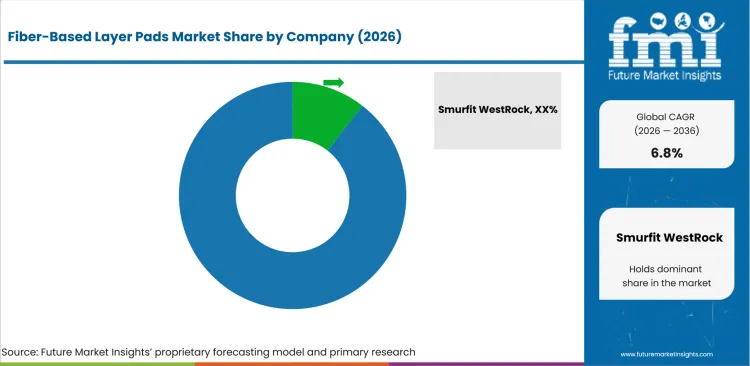
The competitive field is shaped by access to paperboard, converting control, treatment capability, and the ability to serve a repeat OEM specification. Smurfit WestRock, International Paper, DS Smith, and Mondi Group operate broad fiber platforms that connect mills, corrugated conversion, design support, and multinational accounts.
Competitive Benchmarking: Fiber-Based Layer Pads Market
| Company | Capability profile | Geographic reach |
|---|---|---|
| Smurfit WestRock | Board and Material Integration: High; Layer-Pad Engineering and Treatments: High; Direct OEM and Multi-Region Supply: High | Global paper and packaging network across North America, Latin America, Europe, and Asia-Pacific |
| DS Smith | Board and Material Integration: High; Layer-Pad Engineering and Treatments: High; Direct OEM and Multi-Region Supply: High | Pan-European paper and corrugated network with selected wider customer supply through International Paper |
| International Paper | Board and Material Integration: High; Layer-Pad Engineering and Treatments: Medium; Direct OEM and Multi-Region Supply: High | North America and EMEA, with broader European corrugated reach following the DS Smith acquisition |
| Sonoco | Board and Material Integration: High; Layer-Pad Engineering and Treatments: Medium; Direct OEM and Multi-Region Supply: High | North America, Latin America, Europe, Asia, and other industrial-packaging markets |
| Mondi Group | Board and Material Integration: High; Layer-Pad Engineering and Treatments: High; Direct OEM and Multi-Region Supply: High | Europe-centered corrugated and solid-board network with presence in Africa and North America |
| Cascades | Board and Material Integration: High; Layer-Pad Engineering and Treatments: Medium; Direct OEM and Multi-Region Supply: Medium | Canada and United States, with regional recycled-fiber and packaging operations |
| Klingele Papierwerke | Board and Material Integration: High; Layer-Pad Engineering and Treatments: Medium; Direct OEM and Multi-Region Supply: Medium | Europe with selected operations and partnerships in Latin America and Africa |
| Georgia-Pacific | Board and Material Integration: High; Layer-Pad Engineering and Treatments: Medium; Direct OEM and Multi-Region Supply: Medium | North American paper, board, and corrugated customer base |
| Menasha Packaging | Board and Material Integration: Medium; Layer-Pad Engineering and Treatments: Medium; Direct OEM and Multi-Region Supply: Medium | United States, Canada, and Mexico through a North American packaging and packout network |
| Conitex Sonoco | Board and Material Integration: Medium; Layer-Pad Engineering and Treatments: Medium; Direct OEM and Multi-Region Supply: Medium | Americas, Europe, and Asia through industrial packaging and supply-chain service channels |
Key Developments in the Fiber-Based Layer Pads Market
- In July 2024, Smurfit WestRock completed the previously announced combination of Smurfit Kappa and WestRock on July 5 and began trading in New York and London on July 8.
- In September 2024, Menasha Packaging announced an investment exceeding USD 50 million in a North American preprint hub, including an eight-color plus varnish press, facility automation, and robotics.
- In January 2025, International Paper completed its acquisition of DS Smith, combining North American and European sustainable-packaging operations.
- In November 2025, Mondi Group launched an extended food-packaging portfolio covering corrugated and solid-board solutions, with added digital-printing capability and production assets obtained through the Schumacher Packaging acquisition.
Key Players in the Fiber-Based Layer Pads Market
Integrated Global Fiber Platforms
- Smurfit WestRock
- International Paper
- DS Smith
- Mondi Group
Regional Corrugated and Recycled-Board Converters
- Cascades
- Klingele Papierwerke
- Georgia-Pacific
Specialized Industrial and Contract Packaging Networks
- Sonoco
- Menasha Packaging
- Conitex Sonoco
Fiber-Based Layer Pads Market - Report Scope
| Coverage field | Report scope |
|---|---|
| Market breakdown | Product Type, Material, Thickness, Application, End Use, Sales Channel, and Region |
| Quantitative Units | Revenue in USD Million, CAGR in %. |
| Market Definition | Revenue includes first-sale manufacturer or converter revenue from fiber-based flat sheets and pads sold for layer separation, load stabilization, cushioning, or contamination control within the defined segmentation universe. |
| Regions Covered | North America; Latin America; Western Europe; Eastern Europe; East Asia; South Asia and Pacific; Middle East and Africa |
| Countries Covered | USA, China, Germany, Japan, India, UK, Brazil, and more than twenty-five additional countries in the full report |
| Key Companies Profiled | Smurfit WestRock; DS Smith; International Paper; Sonoco; Mondi Group; Cascades; Klingele Papierwerke; Georgia-Pacific; Menasha Packaging; Conitex Sonoco |
| Forecast Period | 2026 to 2036 |
| Approach | Hybrid bottom-up and top-down sizing using manufacturer sales, application volumes, price checks, trade and production indicators, and buyer-side validation. |
Fiber-Based Layer Pads Market - Research Methodology
| Method | Approach |
|---|---|
| Primary Research |
FMI analysts gathered input from manufacturers, service providers, technology developers, distributors, end users, sourcing teams, and subject-matter experts. Interviews examined purchasing decisions, product or service evaluation, adoption barriers, approval requirements, pricing considerations, and expectations for technical or commercial support. Respondents were also asked what evidence is required before a trial, pilot, or initial order develops into regular purchasing. |
| Desk Research | Desk research covered government statistics, regulatory publications, trade data, industry associations, technical literature, standards, company filings, product information, and official corporate announcements. Sources were reviewed for relevance, publication date, geographic coverage, and consistency with the defined market scope. Claims relating to performance, applications, approvals, capacity, investment, and commercial activity were retained only when supported by credible public evidence. |
| Market Sizing and Forecasting | The market model combined the baseline value with historical performance, segment structure, pricing and volume indicators, adoption levels, company participation, and country-level demand conditions. Forecast assumptions considered economic activity, investment trends, regulatory developments, technology adoption, purchasing cycles, supply availability, and barriers to wider market use. Segment and regional estimates were reconciled before the final market total was calculated. |
| Data Validation | Estimates were checked against multiple independent indicators, including public data, company activity, trade patterns, industry developments, and findings from primary interviews. Validation also tested whether products, services, applications, and company revenues fell within the defined market boundaries. Adjacent categories, unsupported claims, overlapping revenues, and activities without direct market relevance were excluded to reduce double counting and maintain consistency across segments and countries. |
Fiber-Based Layer Pads Market by Segments
Fiber-Based Layer Pads Market segmented by Product Type:
- Full-Size Layer Pads
- Partial / Slip Layer Pads
- Anti-Slip Layer Pads
- Custom-Cut Pads
Fiber-Based Layer Pads Market segmented by Material:
- Corrugated Fiberboard
- Chipboard / Recycled Board
- Solid Bleached Board
- Molded Pulp
Fiber-Based Layer Pads Market segmented by Thickness:
- 2-4 mm
- Under 2 mm
- Above 4 mm
Fiber-Based Layer Pads Market segmented by Application:
- Layer Separation
- Load Stabilization
- Product Cushioning
- Contamination Barrier
Fiber-Based Layer Pads Market segmented by End Use:
- Food & Beverage
- Beverage / Canning
- Consumer Goods
- Chemicals
- Pharmaceuticals
Fiber-Based Layer Pads Market segmented by Sales Channel:
- Direct / OEM
- Packaging Distributors
- Online
- Contract Supply
Research Sources and Bibliography
- European Commission (2025, February 11).
- US Food and Drug Administration (2025, January 3).
- California Department of Resources Recycling and Recovery (2026, May 1).
- State Administration for Market Regulation of China (2021, August 10).
- Central Agency Packaging Register (2025, August 28).
- Ministry of the Environment, Government of Japan (2024, September 27).
- Press Information Bureau, Government of India (2023, March 23).
- PackUK and Department for Environment, Food & Rural Affairs (2025, June 30).
- Presidency of the Republic of Brazil (2024, June 27).
- Smurfit WestRock (2024, July 8).
- International Paper (2025, January 31).
- Mondi Group (2025, November 18).
- Menasha Packaging (2024, September 3).
- Smurfit WestRock (Accessed 2026, July 27).
- DS Smith (Accessed 2026, July 27). Coullons Paper Mill.
This Report Answers
- What is the Fiber-Based Layer Pads Market size in 2026 and what value is forecast for 2036?
- Which packaging, circularity, and unit-load pressures support demand for fiber-based layer pads?
- Why do Full-Size Layer Pads hold the leading position within Product Type?
- How does Corrugated Fiberboard influence converting flexibility, pallet performance, and downstream demand?
- Why does the 2-4 mm thickness band hold its leading position?
- How do growth rates differ across USA, China, Germany, Japan, India, UK, and Brazil?
- Which companies provide integrated board, conversion, treatment, direct-supply, or contract-packaging capabilities?
- How do moisture, creep, coating compatibility, and qualification requirements limit adoption?
- What should packaging engineers and procurement teams evaluate before purchasing fiber-based layer pads?
Frequently Asked Questions
How big is the Fiber-Based Layer Pads Market in 2026?
The fiber-based layer pads market is valued at USD 389.8 million in 2026 and is forecast to reach USD 752.6 million by 2036.
What is the CAGR of the Fiber-Based Layer Pads Market from 2026 to 2036?
The fiber-based layer pads market is projected to grow at a CAGR of 6.8% between 2026 and 2036, supported by rising demand for fiber-based pallet stabilization, automated warehouse operations, and sustainable transport packaging solutions.
Which segment leads the Fiber-Based Layer Pads Market?
Full-size layer pads account for 44.0% of the market by product type in 2026, while corrugated fiberboard leads the material segment with a 42.0% share. Their broad compatibility with palletized loads and established paper recovery systems supports continued market leadership.
How much will the Fiber-Based Layer Pads Market add between 2026 and 2036?
The fiber-based layer pads market is expected to add approximately USD 362.8 million between 2026 and 2036, increasing from USD 389.8 million to USD 752.6 million as manufacturers expand the use of recyclable pallet-layer protection across food, beverage, consumer goods, and industrial supply chains.
Who are the leading companies in the Fiber-Based Layer Pads Market?
Leading companies in the fiber-based layer pads market include Smurfit WestRock, DS Smith, International Paper, Sonoco, and Mondi Group. These companies compete through integrated paperboard production, converting capabilities, custom layer-pad engineering, and extensive global supply networks.
Preview the report firsthand - request a free sample
Get SampleGet the brochure for pricing and purchase details.
Get PDFTable of Content
- Key Takeaways
- Market Size and CAGR
- Top Growth Driver
- Fastest Growing Segment
- Leading Region
- Key Companies
- Emerging Opportunities
- Executive Summary
- Global Market Outlook
- Demand-side Trends
- Supply-side Trends
- Technology Roadmap Analysis
- Analysis and Recommendations
- Analyst Perspective (What is happening? Why now? What should investors know?)
- Key Questions Answered
- How large is the market?
- What is the CAGR?
- What are key trends?
- Which region dominates?
- Who are the leaders?
- Market Overview
- Market Coverage / Taxonomy
- Market Definition / Scope / Limitations
- Research Methodology
- Chapter Orientation
- Analytical Lens and Working Hypotheses
- Market Structure, Signals, and Trend Drivers
- Benchmarking and Cross-market Comparability
- Market Sizing, Forecasting, and Opportunity Mapping
- Research Design and Evidence Framework
- Desk Research Programme (Secondary Evidence)
- Expert Input and Fieldwork (Primary Evidence)
- Tooling, Models, and Reference Databases
- Data Engineering and Model Build
- Quality Assurance and Audit Trail
- Market Background
- Market Dynamics (Drivers, Restraints, Opportunity, Trends)
- Scenario Forecast (Optimistic, Likely, Conservative)
- Impact Analysis
- AI Impact
- Sustainability Impact
- Regulatory Impact
- Technology Impact
- Consumer / Buyer Analysis
- Purchase Drivers
- Adoption Barriers
- Buyer Journey
- Opportunity Map Analysis
- Product Life Cycle Analysis
- Supply Chain Analysis
- Investment Feasibility Matrix
- Value Chain Analysis
- PESTLE and Porter's Analysis
- Regulatory Landscape
- Regional Parent Market Outlook
- Production and Consumption Statistics
- Import and Export Statistics
- Global Market Analysis and Forecast, 2021 to 2036
- Historical Market Size Value (USD Million) Analysis, 2021 to 2025
- Current and Future Market Size Value (USD Million) Projections, 2026 to 2036
- Y-o-Y Growth Trend Analysis
- Absolute $ Opportunity Analysis
- Global Market Pricing Analysis, 2021 to 2036
- Global Market Analysis and Forecast, By Product Type, 2021 to 2036
- Introduction / Key Findings
- Historical Market Size Value (USD Million) Analysis By Product Type, 2021 to 2025
- Current and Future Market Size Value (USD Million) Analysis and Forecast By Product Type, 2026 to 2036
- Full-Size Layer Pads
- Partial / Slip Layer Pads
- Anti-Slip Layer Pads
- Custom-Cut Pads
- Full-Size Layer Pads
- Y-o-Y Growth Trend Analysis By Product Type, 2021 to 2025
- Absolute $ Opportunity Analysis By Product Type, 2026 to 2036
- Global Market Analysis and Forecast, By Material, 2021 to 2036
- Introduction / Key Findings
- Historical Market Size Value (USD Million) Analysis By Material, 2021 to 2025
- Current and Future Market Size Value (USD Million) Analysis and Forecast By Material, 2026 to 2036
- Corrugated Fiberboard
- Chipboard / Recycled Board
- Solid Bleached Board
- Molded Pulp
- Corrugated Fiberboard
- Y-o-Y Growth Trend Analysis By Material, 2021 to 2025
- Absolute $ Opportunity Analysis By Material, 2026 to 2036
- Global Market Analysis and Forecast, By Thickness, 2021 to 2036
- Introduction / Key Findings
- Historical Market Size Value (USD Million) Analysis By Thickness, 2021 to 2025
- Current and Future Market Size Value (USD Million) Analysis and Forecast By Thickness, 2026 to 2036
- 2-4 mm
- Under 2 mm
- Above 4 mm
- 2-4 mm
- Y-o-Y Growth Trend Analysis By Thickness, 2021 to 2025
- Absolute $ Opportunity Analysis By Thickness, 2026 to 2036
- Global Market Analysis and Forecast, By Application, 2021 to 2036
- Introduction / Key Findings
- Historical Market Size Value (USD Million) Analysis By Application, 2021 to 2025
- Current and Future Market Size Value (USD Million) Analysis and Forecast By Application, 2026 to 2036
- Layer Separation
- Load Stabilization
- Product Cushioning
- Contamination Barrier
- Layer Separation
- Y-o-Y Growth Trend Analysis By Application, 2021 to 2025
- Absolute $ Opportunity Analysis By Application, 2026 to 2036
- Global Market Analysis and Forecast, By End Use, 2021 to 2036
- Introduction / Key Findings
- Historical Market Size Value (USD Million) Analysis By End Use, 2021 to 2025
- Current and Future Market Size Value (USD Million) Analysis and Forecast By End Use, 2026 to 2036
- Food & Beverage
- Beverage / Canning
- Consumer Goods
- Chemicals
- Pharmaceuticals
- Food & Beverage
- Y-o-Y Growth Trend Analysis By End Use, 2021 to 2025
- Absolute $ Opportunity Analysis By End Use, 2026 to 2036
- Global Market Analysis and Forecast, By Sales Channel
- Introduction / Key Findings
- Historical Market Size Value (USD Million) Analysis By Sales Channel, 2021 to 2025
- Current and Future Market Size Value (USD Million) Analysis and Forecast By Sales Channel, 2026 to 2036
- Direct / OEM
- Packaging Distributors
- Online
- Contract Supply
- Direct / OEM
- Y-o-Y Growth Trend Analysis By Sales Channel, 2021 to 2025
- Absolute $ Opportunity Analysis By Sales Channel, 2026 to 2036
- Global Market Analysis and Forecast, By Region, 2021 to 2036
- Introduction
- Historical Market Size Value (USD Million) Analysis By Region, 2021 to 2025
- Current Market Size Value (USD Million) Analysis and Forecast By Region, 2026 to 2036
- North America
- Latin America
- Western Europe
- Eastern Europe
- East Asia
- South Asia and Pacific
- Middle East & Africa
- Market Attractiveness Analysis By Region
- North America Market Analysis and Forecast, By Country, 2021 to 2036
- Historical Market Size Value (USD Million) Trend Analysis By Market Taxonomy, 2021 to 2025
- Market Size Value (USD Million) Forecast By Market Taxonomy, 2026 to 2036
- By Country
- USA
- Canada
- By Product Type
- By Material
- By Thickness
- By Application
- By End Use
- By Sales Channel
- By Country
- Market Attractiveness Analysis
- By Country
- By Product Type
- By Material
- By Thickness
- By Application
- By End Use
- By Sales Channel
- Key Takeaways
- Latin America Market Analysis and Forecast, By Country
- Historical Market Size Value (USD Million) Trend Analysis By Market Taxonomy, 2021 to 2025
- Market Size Value (USD Million) Forecast By Market Taxonomy, 2026 to 2036
- By Country
- Brazil
- Mexico
- Chile
- Rest of Latin America
- By Product Type
- By Material
- By Thickness
- By Application
- By End Use
- By Sales Channel
- By Country
- Market Attractiveness Analysis
- By Country
- By Product Type
- By Material
- By Thickness
- By Application
- By End Use
- By Sales Channel
- Key Takeaways
- Western Europe Market Analysis and Forecast, By Country
- Historical Market Size Value (USD Million) Trend Analysis By Market Taxonomy, 2021 to 2025
- Market Size Value (USD Million) Forecast By Market Taxonomy, 2026 to 2036
- By Country
- Germany
- UK
- Italy
- Spain
- France
- Nordic
- BENELUX
- Rest of Western Europe
- By Product Type
- By Material
- By Thickness
- By Application
- By End Use
- By Sales Channel
- By Country
- Market Attractiveness Analysis
- By Country
- By Product Type
- By Material
- By Thickness
- By Application
- By End Use
- By Sales Channel
- Key Takeaways
- Eastern Europe Market Analysis and Forecast, By Country
- Historical Market Size Value (USD Million) Trend Analysis By Market Taxonomy, 2021 to 2025
- Market Size Value (USD Million) Forecast By Market Taxonomy, 2026 to 2036
- By Country
- Russia
- Poland
- Hungary
- Balkan & Baltic
- Rest of Eastern Europe
- By Product Type
- By Material
- By Thickness
- By Application
- By End Use
- By Sales Channel
- By Country
- Market Attractiveness Analysis
- By Country
- By Product Type
- By Material
- By Thickness
- By Application
- By End Use
- By Sales Channel
- Key Takeaways
- East Asia Market Analysis and Forecast, By Country
- Historical Market Size Value (USD Million) Trend Analysis By Market Taxonomy, 2021 to 2025
- Market Size Value (USD Million) Forecast By Market Taxonomy, 2026 to 2036
- By Country
- China
- Japan
- South Korea
- By Product Type
- By Material
- By Thickness
- By Application
- By End Use
- By Sales Channel
- By Country
- Market Attractiveness Analysis
- By Country
- By Product Type
- By Material
- By Thickness
- By Application
- By End Use
- By Sales Channel
- Key Takeaways
- South Asia and Pacific Market Analysis and Forecast, By Country
- Historical Market Size Value (USD Million) Trend Analysis By Market Taxonomy, 2021 to 2025
- Market Size Value (USD Million) Forecast By Market Taxonomy, 2026 to 2036
- By Country
- India
- ASEAN
- Australia & New Zealand
- Rest of South Asia and Pacific
- By Product Type
- By Material
- By Thickness
- By Application
- By End Use
- By Sales Channel
- By Country
- Market Attractiveness Analysis
- By Country
- By Product Type
- By Material
- By Thickness
- By Application
- By End Use
- By Sales Channel
- Key Takeaways
- Middle East & Africa Market Analysis and Forecast, By Country
- Historical Market Size Value (USD Million) Trend Analysis By Market Taxonomy, 2021 to 2025
- Market Size Value (USD Million) Forecast By Market Taxonomy, 2026 to 2036
- By Country
- Kingdom of Saudi Arabia
- Other GCC Countries
- Türkiye
- South Africa
- Other African Union
- Rest of Middle East & Africa
- By Product Type
- By Material
- By Thickness
- By Application
- By End Use
- By Sales Channel
- By Country
- Market Attractiveness Analysis
- By Country
- By Product Type
- By Material
- By Thickness
- By Application
- By End Use
- By Sales Channel
- Key Takeaways
- Key Countries Market Analysis
- USA
- Pricing Analysis
- Market Share Analysis, 2025
- By Product Type
- By Material
- By Thickness
- By Application
- By End Use
- By Sales Channel
- Canada
- Pricing Analysis
- Market Share Analysis, 2025
- By Product Type
- By Material
- By Thickness
- By Application
- By End Use
- By Sales Channel
- Mexico
- Pricing Analysis
- Market Share Analysis, 2025
- By Product Type
- By Material
- By Thickness
- By Application
- By End Use
- By Sales Channel
- Brazil
- Pricing Analysis
- Market Share Analysis, 2025
- By Product Type
- By Material
- By Thickness
- By Application
- By End Use
- By Sales Channel
- Chile
- Pricing Analysis
- Market Share Analysis, 2025
- By Product Type
- By Material
- By Thickness
- By Application
- By End Use
- By Sales Channel
- Germany
- Pricing Analysis
- Market Share Analysis, 2025
- By Product Type
- By Material
- By Thickness
- By Application
- By End Use
- By Sales Channel
- UK
- Pricing Analysis
- Market Share Analysis, 2025
- By Product Type
- By Material
- By Thickness
- By Application
- By End Use
- By Sales Channel
- Italy
- Pricing Analysis
- Market Share Analysis, 2025
- By Product Type
- By Material
- By Thickness
- By Application
- By End Use
- By Sales Channel
- Spain
- Pricing Analysis
- Market Share Analysis, 2025
- By Product Type
- By Material
- By Thickness
- By Application
- By End Use
- By Sales Channel
- France
- Pricing Analysis
- Market Share Analysis, 2025
- By Product Type
- By Material
- By Thickness
- By Application
- By End Use
- By Sales Channel
- India
- Pricing Analysis
- Market Share Analysis, 2025
- By Product Type
- By Material
- By Thickness
- By Application
- By End Use
- By Sales Channel
- ASEAN
- Pricing Analysis
- Market Share Analysis, 2025
- By Product Type
- By Material
- By Thickness
- By Application
- By End Use
- By Sales Channel
- Australia & New Zealand
- Pricing Analysis
- Market Share Analysis, 2025
- By Product Type
- By Material
- By Thickness
- By Application
- By End Use
- By Sales Channel
- China
- Pricing Analysis
- Market Share Analysis, 2025
- By Product Type
- By Material
- By Thickness
- By Application
- By End Use
- By Sales Channel
- Japan
- Pricing Analysis
- Market Share Analysis, 2025
- By Product Type
- By Material
- By Thickness
- By Application
- By End Use
- By Sales Channel
- South Korea
- Pricing Analysis
- Market Share Analysis, 2025
- By Product Type
- By Material
- By Thickness
- By Application
- By End Use
- By Sales Channel
- Russia
- Pricing Analysis
- Market Share Analysis, 2025
- By Product Type
- By Material
- By Thickness
- By Application
- By End Use
- By Sales Channel
- Poland
- Pricing Analysis
- Market Share Analysis, 2025
- By Product Type
- By Material
- By Thickness
- By Application
- By End Use
- By Sales Channel
- Hungary
- Pricing Analysis
- Market Share Analysis, 2025
- By Product Type
- By Material
- By Thickness
- By Application
- By End Use
- By Sales Channel
- Kingdom of Saudi Arabia
- Pricing Analysis
- Market Share Analysis, 2025
- By Product Type
- By Material
- By Thickness
- By Application
- By End Use
- By Sales Channel
- Türkiye
- Pricing Analysis
- Market Share Analysis, 2025
- By Product Type
- By Material
- By Thickness
- By Application
- By End Use
- By Sales Channel
- South Africa
- Pricing Analysis
- Market Share Analysis, 2025
- By Product Type
- By Material
- By Thickness
- By Application
- By End Use
- By Sales Channel
- USA
- Market Structure Analysis
- Competition Dashboard
- Competition Benchmarking
- Market Share Analysis of Top Players
- By Regional
- By Product Type
- By Material
- By Thickness
- By Application
- By End Use
- By Sales Channel
- Emerging Startups
- Innovation Benchmarking
- Competition Analysis
- Competition Deep Dive
- Smurfit WestRock
- Overview
- Product Portfolio
- Profitability by Market Segments
- Sales Footprint
- Strategy Overview
- Marketing Strategy
- Product Strategy
- Channel Strategy
- DS Smith
- International Paper
- Sonoco
- Mondi Group
- Cascades
- Klingele Papierwerke
- Georgia-Pacific
- Menasha Packaging
- Conitex Sonoco
- Smurfit WestRock
- Case Studies
- Success Stories
- Recent Developments
- Competition Deep Dive
- Assumptions & Acronyms Used


