

- Market Size (2026)
- USD 648.4 Mn
- Forecast (2036)
- USD 1194.5 Mn
- CAGR (2026 to 2036)
- 6.3%
How big is Recyclable Pallet Pads Market in 2026?
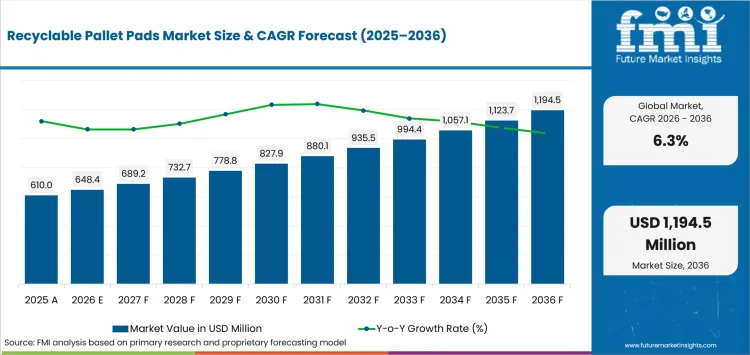
USD 648.4 million in 2026 and USD 1,194.5 million by 2036 at a 6.3% CAGR.
Demand for Recyclable Pallet Pads is poised to grow from USD 648.4 million in 2026 to USD 1,194.5 million by 2036, at a 6.3% CAGR. Shippers need to prevent cases, bottles, bags, components, and drums from moving inside a pallet load while choosing a protective layer with a credible recovery or reuse route. This makes caliper, friction, compression, moisture tolerance, debris, and palletizer performance part of the same decision. USA cargo-securement rules require cargo to be contained or immobilized against movement, reinforcing the cost of poor unit-load preparation without specifying the material used.
Open distribution favors recyclable paperboard and molded fiber because the pad leaves the shipper's control. Closed loops can support reusable HDPE or PP when collection, cleaning, tracking, and return turns are dependable. Germany's 68.5% packaging recycling rate in 2022 does not make every laminated or contaminated pad recyclable in practice. For an alternative to a pad at the pallet interface, the recyclable slip sheets market is relevant where warehouse equipment can handle a thinner pallet-replacement format.
Key Takeaways of Recyclable Pallet Pads Market
- Load security, automation, product protection, and recovery expectations support demand for recyclable pallet pads.
- Direct / OEM Supply leads the sales channel at 41.0% because pads are qualified within a larger packaging and automation specification.
- Recyclable Paperboard leads material at 44.0%, while Tier / Layer Pads lead product type at 40.0%.
- Single-Use Recyclable leads reusability at 56.0%; Load Stabilization and Food & Beverage lead application and end use at 35.0% and 30.0%.
- Route-specific trials and a practical end-of-life route are required; moisture, contamination, coatings, cleaning, and return logistics affect the commercial case.
- India leads the profiled country growth rates at 8.4% through 2036, followed by China at 7.6%.
- Integrated fiber suppliers, reusable-plastic specialists, and regional converters compete on application fit.
Analyst Perspective
“The recyclable pallet pads market is moving from broad sustainability claims toward measurable operating performance. Buyers want pads that protect loads, run reliably on automated lines, and have a practical recycling or reuse route after delivery. Paperboard will remain central to open distribution networks, while reusable HDPE and PP pads will gain ground in controlled return loops. Suppliers that connect load stability with recovery economics will be better positioned as the market grows from USD 648.4 million in 2026 to USD 1,194.5 million by 2036.”
- Nandini Roy Choudhury, Principal Consultant, Future Market Insights
How is the recyclable pallet pads market segmented?
The market is analyzed by Material, Product Type, Reusability, Application, End Use, Sales Channel, and Region. Material distinguishes recyclable paperboard, HDPE, PP, and molded fiber. Product Type identifies the protection supplied. Reusability separates one-way recovery from return-loop assets, while Application records the failure mode being controlled.
What makes Recyclable Paperboard central to the Material category?
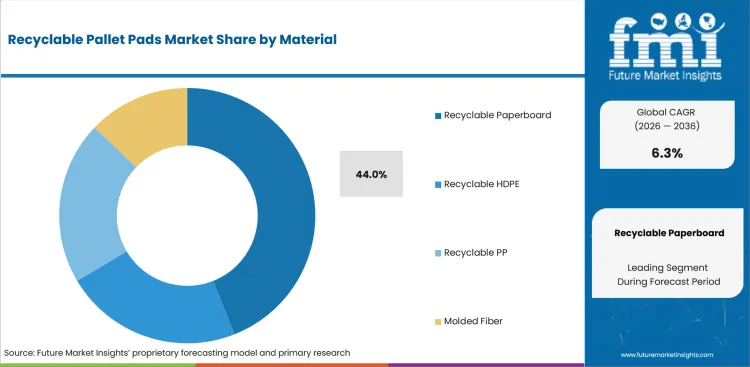
Recyclable Paperboard holds 44.0% share, since converters can vary caliper, dimensions, die cuts, corners, and surfaces without needing a return network. It fits open distribution where pads enter local collection systems after one trip. Moisture, waxes, polymer coatings, contamination, and compression can limit recovery, so the board grade remains part of the load design.
Why do Tier / Layer Pads lead the Product Type category?
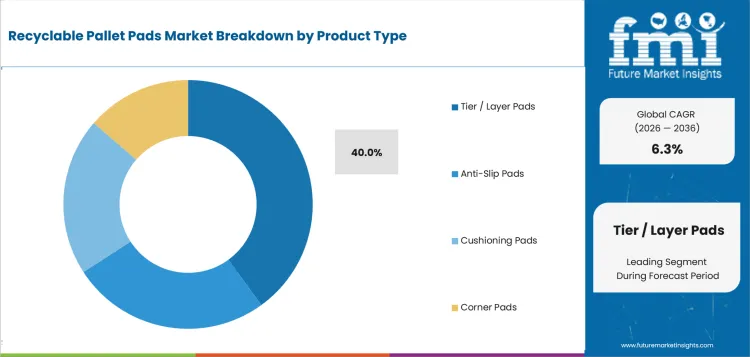
Tier / Layer Pads represent 40.0% of 2026 revenue. They separate product levels, spread pressure, reduce abrasion, and create a predictable stacking and depalletizing surface. Their broad interface makes them easier to standardize than corner-only or cushioning designs, provided thickness, flatness, dust, edge quality, and moisture behavior are controlled.
How does Single-Use Recyclable retain the Reusability lead?
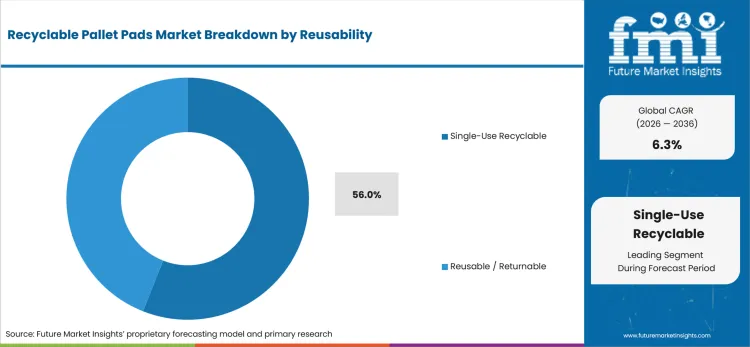
Single-Use Recyclable holds 56.0% share, as many pallet flows are open. One-way pads avoid deposits, backhaul space, sorting, cleaning, tracking, and loss charges. Reusable pads can win in captive loops, but only when the operator controls enough returns to keep assets clean, available, and economically viable.
What supports Load Stabilization in the Application category?
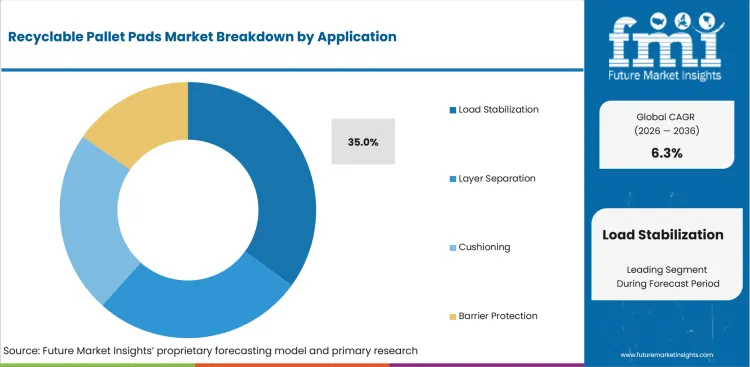
Load Stabilization accounts for 35.0% share. Pads contribute friction, stiffness, pressure distribution, and a consistent interface between layers. Buyers assess the full unit load under acceleration, braking, vibration, handling, and humidity. A high-friction format has little value if it misfeeds or transfers residue to the load.
What drives Food & Beverage demand within End Use?
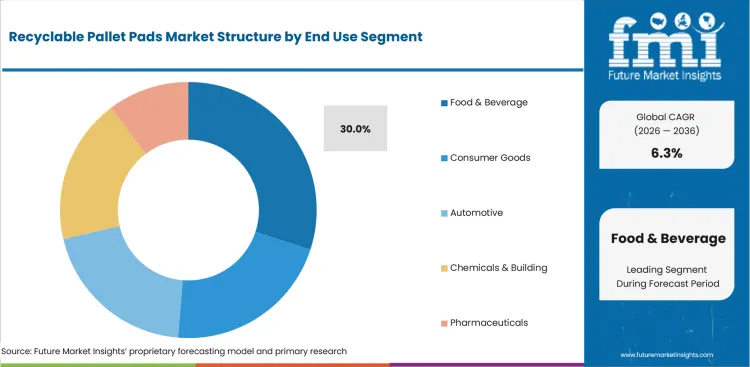
Food & Beverage holds 30.0% share. Bottles, cans, jars, cartons, trays, and bags are moved through repetitive, high-volume pallet patterns. The pad must remain clean, flat, moisture-tolerant, and compatible with fast automated equipment. Paperboard suits one-way dry shipments; washable PP or HDPE may be suitable in controlled brewery or reusable-container loops.
Why does Direct / OEM lead the Sales Channel category?
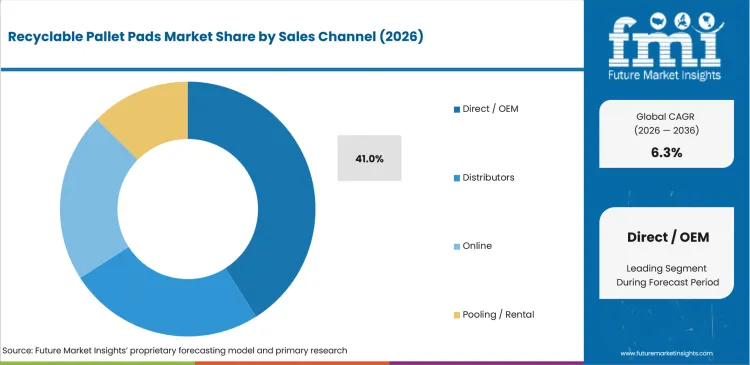
Direct / OEM holds 41.0% share, since pads are qualified within a larger packaging and automation specification. Dimensions, friction treatment, pallet pattern, line speed, stack height, final recovery, and change control require technical engagement. Distributors and online channels serve standard replenishment, while pooling or rental applies to reusable loops.
What are the drivers, restraints, and opportunities in the recyclable pallet pads market?
- Driver: Shippers need to control load damage while documenting recyclable or reusable protective packaging.
- Restraint: Qualification, contamination, coating compatibility, cleaning, loss, collection, and reverse-logistics economics are uncertain.
- Opportunity: Match repulpable paperboard and molded fiber to open networks, and tracked HDPE or PP pads to closed loops.
The driver begins with operating loss. A shifting load can damage saleable product, disrupt a line, trigger rework, or fail receipt criteria. California's packaging rules, effective May 2026, add pressure for plastic reduction and recyclable or compostable covered packaging. The restraint emerges during qualification and after use. Fiber pads can curl or shed debris; functional coatings may complicate recycling; reusable systems need inspection, cleaning, tracking, return freight, and adequate asset turns. The strongest offering is therefore an operating model, not a generic recyclable sheet.
How do country-level CAGRs compare in the recyclable pallet pads market?
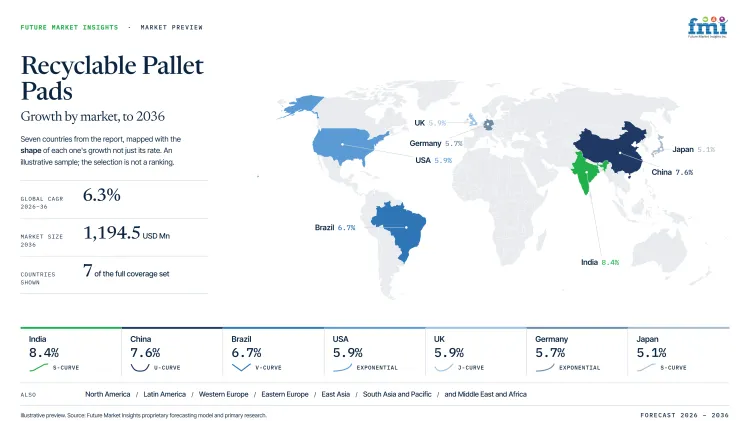
| Country | CAGR, 2026 to 2036 |
|---|---|
| USA | 5.9% |
| China | 7.6% |
| Germany | 5.7% |
| Japan | 5.1% |
| India | 8.4% |
| UK | 5.9% |
| Brazil | 6.7% |
India and China form the fastest band, followed by Brazil. The USA, UK, Germany, and Japan are mature markets with a narrow range of growth rates. CAGR must be read with the installed manufacturing base, shipment volume, pallet-loop structure, recovery access, and price realization.
Country-wise Analysis
- USA: Demand is set to rise at 5.9% CAGR. State rules, retailer requirements, and uneven collection access make national specifications and local recovery guidance important.
- China: Sales are on track to grow at 7.6% CAGR. Exporters prioritize thin, consistent, high-speed formats, local converting, lot control, and clear material identification.
- Germany: Adoption is projected at 5.7% CAGR. Material declarations, moisture data, coating evidence, and controlled changes are required before approval.
- Japan: Demand is set to grow at 5.1% CAGR. Precise dimensions, low debris, flatness, and pilot programmes linking customers and recyclers help manage conservative qualification.
- India: Sales are poised to advance at 8.4% CAGR. Price, load performance, segregation simplicity, and channel partnerships matter across fast-growing distribution networks.
- UK: Demand is on track to increase at 5.9% CAGR. Modulated packaging fees from 2026-2027 elevate the value of coating disclosure and evidence-based recyclability.
- Brazil: The market is poised to grow at 6.7% CAGR. Long lanes, humidity, and uneven backhaul economics favor regional conversion and reusable-plastic programmes only where loops are controlled.
Who are the notable companies in the recyclable pallet pads market?
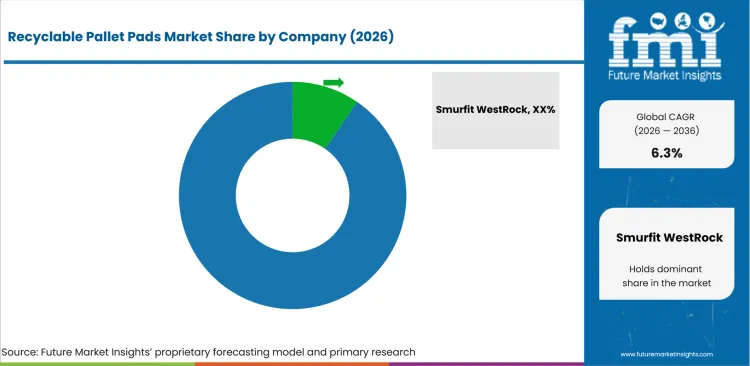
Smurfit WestRock, DS Smith, International Paper, and Mondi Group provide integrated fiber and converting capability. Sonoco, ORBIS Corporation, and Signode compete through engineered sheets, reusable plastics, and unit-load support. Cascades, Menasha Packaging, and Litco International add regional service and customization. Open networks reward converting reach and recovery compatibility; closed loops reward durability, tracking, cleaning, and asset control.
Competitive Benchmarking: Recyclable Pallet Pads Market
| Company | Recyclable Fiber Pads | Reusable Plastic Pads | Automation and Application Engineering | Reach |
|---|---|---|---|---|
| Smurfit WestRock / DS Smith / International Paper | High | Unscored | High | Major global regions |
| Sonoco | High | Unscored | High | Americas, Europe, Asia-Pacific |
| ORBIS Corporation | Unscored | High | High | North America and Europe |
| Signode | High | High | High | Americas, Europe, Asia-Pacific |
| Mondi / Cascades / Menasha / Litco | Medium to High | Unscored | Medium | Regional networks |
High represents broad documented capability, Medium reflects narrower coverage, and Unscored means public evidence was insufficient for a rating. The comparison does not rank suppliers.
Key Developments in the Recyclable Pallet Pads Market
- In April 2024, ORBIS launched ORBIShield Eco dunnage using recovered and reprocessed resins; the company describes it as recyclable at end of life.
- In May 2023, Cascades produced its first roll of 100% recycled containerboard at its Bear Island, Virginia, mill.
- In April 2024, International Paper and DS Smith announced their all-share combination, extending their North American and European packaging footprints.
- Signode documented anti-slip recyclable paper sheets and washable polypropylene tier sheets for palletized applications in 2026.
Key Players in the Recyclable Pallet Pads Market
Integrated Fiber and Board Platforms
- Smurfit WestRock
- DS Smith
- International Paper
- Mondi Group
Engineered Sheet and Reusable Unit-Load Specialists
- Sonoco
- ORBIS Corporation
- Signode
Regional Converting and Load-Securement Providers
- Cascades
- Menasha Packaging
- Litco International
Recyclable Pallet Pads Market - Report Scope
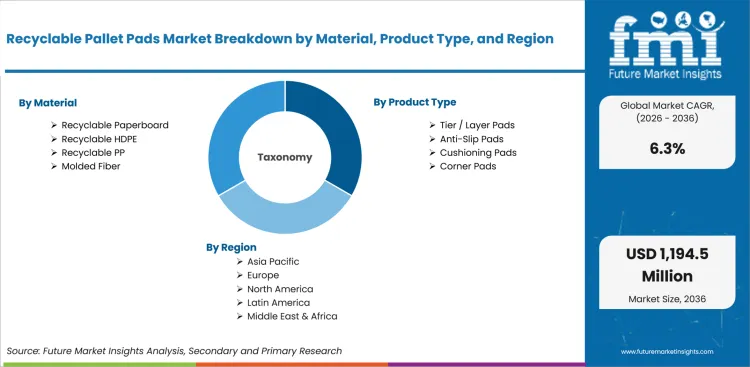
| Coverage field | Report scope |
|---|---|
| Market breakdown | Material, Product Type, Reusability, Application, End Use, Sales Channel, and Region |
| Quantitative units | USD Million |
| Market definition | Revenue from recyclable paperboard, HDPE, PP, and molded-fiber pads or sheets used on, between, or around palletized layers. Excludes pallets, pallet-substitute slip sheets, stretch film, strapping, dunnage bags, transport services, and adjacent protective packaging. |
| Regions covered | North America, Latin America, Western Europe, Eastern Europe, East Asia, South Asia and Pacific, and Middle East and Africa |
| Countries covered | USA, China, Germany, Japan, India, UK, Brazil, and more than twenty-five additional countries |
| Forecast period | 2026 to 2036 |
Recyclable Pallet Pads Market - Research Methodology
| Method | Approach |
|---|---|
| Primary Research | FMI gathers input from manufacturers, converters, distributors, packaging and logistics specialists, procurement teams, end users, and subject-matter experts on specifications, reuse turns, recovery, pricing, channels, and adoption barriers. |
| Desk Research | Research covers transport and packaging regulation, statistics, official product documentation, company records, standards material, and public sustainability programmes. |
| Market Sizing and Forecasting | Supplier and product estimates are reconciled with palletized shipment, material, channel, end-use, and country indicators. |
| Data Validation | Analysis excludes double counting, unsupported claims, finished-product value, pallets, pallet-substitute systems, and adjacent protective products outside scope. |
Recyclable Pallet Pads Market by Segments
Recyclable Pallet Pads Market segmented by Material:
- Recyclable Paperboard
- Recyclable HDPE
- Recyclable PP
- Molded Fiber
Recyclable Pallet Pads Market segmented by Product Type:
- Tier / Layer Pads
- Anti-Slip Pads
- Cushioning Pads
- Corner Pads
Recyclable Pallet Pads Market segmented by Reusability:
- Single-Use Recyclable
- Reusable / Returnable
Recyclable Pallet Pads Market segmented by Application:
- Load Stabilization
- Layer Separation
- Cushioning
- Barrier Protection
Recyclable Pallet Pads Market segmented by End Use:
- Food & Beverage
- Consumer Goods
- Automotive
- Chemicals & Building
- Pharmaceuticals
Recyclable Pallet Pads Market segmented by Sales Channel:
- Direct / OEM
- Distributors
- Online
- Pooling / Rental
Research Sources and Bibliography
- Electronic Code of Federal Regulations: 49 CFR 393.100.
- California Department of Resources Recycling and Recovery: packaging rules, May 2026.
- German Environment Agency: packaging consumption and recycling, December 2024.
- UK Department for Environment, Food & Rural Affairs: EPR announcements, June 2025.
- ORBIS, Cascades, Signode, Sonoco, Smurfit WestRock, International Paper, Mondi, Menasha, and Litco publications.
This Report Answers
- What is the 2026 market size and 2036 forecast?
- Why do recyclable paperboard, tier pads, and single-use recyclable formats lead?
- How do open and closed loops change the buying decision?
- How do country growth rates and supplier capabilities compare?
- What should teams evaluate before adopting recyclable pallet pads?
Frequently Asked Questions
What is driving growth in the Recyclable Pallet Pads Market?
Demand comes from the need to control movement and damage in automated pallet flows while meeting recyclable-packaging and producer-responsibility expectations.
Who are the key players in the Recyclable Pallet Pads Market?
Key companies include Smurfit WestRock, DS Smith, Sonoco, ORBIS Corporation, Signode, International Paper, Mondi Group, Cascades, Menasha Packaging, and Litco International.
What notable restraint affects the Recyclable Pallet Pads Market?
The key restraint is the difference between theoretical recyclability and actual destination recovery conditions, combined with moisture, coatings, contamination, cleaning, loss, and backhaul issues.
Why should executives track the Recyclable Pallet Pads Market?
Pallet pads link product damage, automation, freight efficiency, material choices, and recovery obligations. They reveal where one-way fiber or returnable plastics reduce lifecycle cost.
What business problem does the Recyclable Pallet Pads Market address?
It addresses movement, abrasion, compression, contamination, and separation failures inside palletized loads while aligning the protective interface with its disposal, recycling, or reuse route.
What should managers evaluate in the Recyclable Pallet Pads Market?
They should compare friction, stiffness, tolerance, moisture response, cleanliness, line compatibility, load tests, declarations, damage, disposal, cleaning, return freight, loss, reuse turns, and recovery acceptance.
What limits return on investment in the Recyclable Pallet Pads Market?
Return falls when pads tear, curl, shed debris, misfeed, or fail in transit. Reusable systems also underperform when returns, cleaning discipline, tracking, or utilization miss assumptions.
What supports long-term commercial confidence in the Recyclable Pallet Pads Market?
Confidence depends on durable palletized flows, automation, measurable damage economics, and credible recovery evidence. Buyers assessing a renewable structural alternative can examine the fiber-based layer pads market.
Preview the report firsthand - request a free sample
Get SampleGet the brochure for pricing and purchase details.
Get PDFTable of Content
- Key Takeaways
- Market Size and CAGR
- Top Growth Driver
- Fastest Growing Segment
- Leading Region
- Key Companies
- Emerging Opportunities
- Executive Summary
- Global Market Outlook
- Demand-side Trends
- Supply-side Trends
- Technology Roadmap Analysis
- Analysis and Recommendations
- Analyst Perspective (What is happening? Why now? What should investors know?)
- Key Questions Answered
- How large is the market?
- What is the CAGR?
- What are key trends?
- Which region dominates?
- Who are the leaders?
- Market Overview
- Market Coverage / Taxonomy
- Market Definition / Scope / Limitations
- Research Methodology
- Chapter Orientation
- Analytical Lens and Working Hypotheses
- Market Structure, Signals, and Trend Drivers
- Benchmarking and Cross-market Comparability
- Market Sizing, Forecasting, and Opportunity Mapping
- Research Design and Evidence Framework
- Desk Research Programme (Secondary Evidence)
- Expert Input and Fieldwork (Primary Evidence)
- Tooling, Models, and Reference Databases
- Data Engineering and Model Build
- Quality Assurance and Audit Trail
- Market Background
- Market Dynamics (Drivers, Restraints, Opportunity, Trends)
- Scenario Forecast (Optimistic, Likely, Conservative)
- Impact Analysis
- AI Impact
- Sustainability Impact
- Regulatory Impact
- Technology Impact
- Consumer / Buyer Analysis
- Purchase Drivers
- Adoption Barriers
- Buyer Journey
- Opportunity Map Analysis
- Product Life Cycle Analysis
- Supply Chain Analysis
- Investment Feasibility Matrix
- Value Chain Analysis
- PESTLE and Porter's Analysis
- Regulatory Landscape
- Regional Parent Market Outlook
- Production and Consumption Statistics
- Import and Export Statistics
- Global Market Analysis and Forecast, 2021 to 2036
- Historical Market Size Value (USD Million) Analysis, 2021 to 2025
- Current and Future Market Size Value (USD Million) Projections, 2026 to 2036
- Y-o-Y Growth Trend Analysis
- Absolute $ Opportunity Analysis
- Global Market Pricing Analysis, 2021 to 2036
- Global Market Analysis and Forecast, By Material, 2021 to 2036
- Introduction / Key Findings
- Historical Market Size Value (USD Million) Analysis By Material, 2021 to 2025
- Current and Future Market Size Value (USD Million) Analysis and Forecast By Material, 2026 to 2036
- Recyclable Paperboard
- Recyclable HDPE
- Recyclable PP
- Molded Fiber
- Recyclable Paperboard
- Y-o-Y Growth Trend Analysis By Material, 2021 to 2025
- Absolute $ Opportunity Analysis By Material, 2026 to 2036
- Global Market Analysis and Forecast, By Product Type, 2021 to 2036
- Introduction / Key Findings
- Historical Market Size Value (USD Million) Analysis By Product Type, 2021 to 2025
- Current and Future Market Size Value (USD Million) Analysis and Forecast By Product Type, 2026 to 2036
- Tier / Layer Pads
- Anti-Slip Pads
- Cushioning Pads
- Corner Pads
- Tier / Layer Pads
- Y-o-Y Growth Trend Analysis By Product Type, 2021 to 2025
- Absolute $ Opportunity Analysis By Product Type, 2026 to 2036
- Global Market Analysis and Forecast, By Reusability, 2021 to 2036
- Introduction / Key Findings
- Historical Market Size Value (USD Million) Analysis By Reusability, 2021 to 2025
- Current and Future Market Size Value (USD Million) Analysis and Forecast By Reusability, 2026 to 2036
- Single-Use Recyclable
- Reusable / Returnable
- Single-Use Recyclable
- Y-o-Y Growth Trend Analysis By Reusability, 2021 to 2025
- Absolute $ Opportunity Analysis By Reusability, 2026 to 2036
- Global Market Analysis and Forecast, By Application, 2021 to 2036
- Introduction / Key Findings
- Historical Market Size Value (USD Million) Analysis By Application, 2021 to 2025
- Current and Future Market Size Value (USD Million) Analysis and Forecast By Application, 2026 to 2036
- Load Stabilization
- Layer Separation
- Cushioning
- Barrier Protection
- Load Stabilization
- Y-o-Y Growth Trend Analysis By Application, 2021 to 2025
- Absolute $ Opportunity Analysis By Application, 2026 to 2036
- Global Market Analysis and Forecast, By End Use, 2021 to 2036
- Introduction / Key Findings
- Historical Market Size Value (USD Million) Analysis By End Use, 2021 to 2025
- Current and Future Market Size Value (USD Million) Analysis and Forecast By End Use, 2026 to 2036
- Food & Beverage
- Consumer Goods
- Automotive
- Chemicals & Building
- Pharmaceuticals
- Food & Beverage
- Y-o-Y Growth Trend Analysis By End Use, 2021 to 2025
- Absolute $ Opportunity Analysis By End Use, 2026 to 2036
- Global Market Analysis and Forecast, By Sales Channel
- Introduction / Key Findings
- Historical Market Size Value (USD Million) Analysis By Sales Channel, 2021 to 2025
- Current and Future Market Size Value (USD Million) Analysis and Forecast By Sales Channel, 2026 to 2036
- Direct / OEM
- Distributors
- Online
- Pooling / Rental
- Direct / OEM
- Y-o-Y Growth Trend Analysis By Sales Channel, 2021 to 2025
- Absolute $ Opportunity Analysis By Sales Channel, 2026 to 2036
- Global Market Analysis and Forecast, By Region, 2021 to 2036
- Introduction
- Historical Market Size Value (USD Million) Analysis By Region, 2021 to 2025
- Current Market Size Value (USD Million) Analysis and Forecast By Region, 2026 to 2036
- North America
- Latin America
- Western Europe
- Eastern Europe
- East Asia
- South Asia and Pacific
- Middle East & Africa
- Market Attractiveness Analysis By Region
- North America Market Analysis and Forecast, By Country, 2021 to 2036
- Historical Market Size Value (USD Million) Trend Analysis By Market Taxonomy, 2021 to 2025
- Market Size Value (USD Million) Forecast By Market Taxonomy, 2026 to 2036
- By Country
- USA
- Canada
- By Material
- By Product Type
- By Reusability
- By Application
- By End Use
- By Sales Channel
- By Country
- Market Attractiveness Analysis
- By Country
- By Material
- By Product Type
- By Reusability
- By Application
- By End Use
- By Sales Channel
- Key Takeaways
- Latin America Market Analysis and Forecast, By Country
- Historical Market Size Value (USD Million) Trend Analysis By Market Taxonomy, 2021 to 2025
- Market Size Value (USD Million) Forecast By Market Taxonomy, 2026 to 2036
- By Country
- Brazil
- Mexico
- Chile
- Rest of Latin America
- By Material
- By Product Type
- By Reusability
- By Application
- By End Use
- By Sales Channel
- By Country
- Market Attractiveness Analysis
- By Country
- By Material
- By Product Type
- By Reusability
- By Application
- By End Use
- By Sales Channel
- Key Takeaways
- Western Europe Market Analysis and Forecast, By Country
- Historical Market Size Value (USD Million) Trend Analysis By Market Taxonomy, 2021 to 2025
- Market Size Value (USD Million) Forecast By Market Taxonomy, 2026 to 2036
- By Country
- Germany
- UK
- Italy
- Spain
- France
- Nordic
- BENELUX
- Rest of Western Europe
- By Material
- By Product Type
- By Reusability
- By Application
- By End Use
- By Sales Channel
- By Country
- Market Attractiveness Analysis
- By Country
- By Material
- By Product Type
- By Reusability
- By Application
- By End Use
- By Sales Channel
- Key Takeaways
- Eastern Europe Market Analysis and Forecast, By Country
- Historical Market Size Value (USD Million) Trend Analysis By Market Taxonomy, 2021 to 2025
- Market Size Value (USD Million) Forecast By Market Taxonomy, 2026 to 2036
- By Country
- Russia
- Poland
- Hungary
- Balkan & Baltic
- Rest of Eastern Europe
- By Material
- By Product Type
- By Reusability
- By Application
- By End Use
- By Sales Channel
- By Country
- Market Attractiveness Analysis
- By Country
- By Material
- By Product Type
- By Reusability
- By Application
- By End Use
- By Sales Channel
- Key Takeaways
- East Asia Market Analysis and Forecast, By Country
- Historical Market Size Value (USD Million) Trend Analysis By Market Taxonomy, 2021 to 2025
- Market Size Value (USD Million) Forecast By Market Taxonomy, 2026 to 2036
- By Country
- China
- Japan
- South Korea
- By Material
- By Product Type
- By Reusability
- By Application
- By End Use
- By Sales Channel
- By Country
- Market Attractiveness Analysis
- By Country
- By Material
- By Product Type
- By Reusability
- By Application
- By End Use
- By Sales Channel
- Key Takeaways
- South Asia and Pacific Market Analysis and Forecast, By Country
- Historical Market Size Value (USD Million) Trend Analysis By Market Taxonomy, 2021 to 2025
- Market Size Value (USD Million) Forecast By Market Taxonomy, 2026 to 2036
- By Country
- India
- ASEAN
- Australia & New Zealand
- Rest of South Asia and Pacific
- By Material
- By Product Type
- By Reusability
- By Application
- By End Use
- By Sales Channel
- By Country
- Market Attractiveness Analysis
- By Country
- By Material
- By Product Type
- By Reusability
- By Application
- By End Use
- By Sales Channel
- Key Takeaways
- Middle East & Africa Market Analysis and Forecast, By Country
- Historical Market Size Value (USD Million) Trend Analysis By Market Taxonomy, 2021 to 2025
- Market Size Value (USD Million) Forecast By Market Taxonomy, 2026 to 2036
- By Country
- Kingdom of Saudi Arabia
- Other GCC Countries
- Türkiye
- South Africa
- Other African Union
- Rest of Middle East & Africa
- By Material
- By Product Type
- By Reusability
- By Application
- By End Use
- By Sales Channel
- By Country
- Market Attractiveness Analysis
- By Country
- By Material
- By Product Type
- By Reusability
- By Application
- By End Use
- By Sales Channel
- Key Takeaways
- Key Countries Market Analysis
- USA
- Pricing Analysis
- Market Share Analysis, 2025
- By Material
- By Product Type
- By Reusability
- By Application
- By End Use
- By Sales Channel
- Canada
- Pricing Analysis
- Market Share Analysis, 2025
- By Material
- By Product Type
- By Reusability
- By Application
- By End Use
- By Sales Channel
- Mexico
- Pricing Analysis
- Market Share Analysis, 2025
- By Material
- By Product Type
- By Reusability
- By Application
- By End Use
- By Sales Channel
- Brazil
- Pricing Analysis
- Market Share Analysis, 2025
- By Material
- By Product Type
- By Reusability
- By Application
- By End Use
- By Sales Channel
- Chile
- Pricing Analysis
- Market Share Analysis, 2025
- By Material
- By Product Type
- By Reusability
- By Application
- By End Use
- By Sales Channel
- Germany
- Pricing Analysis
- Market Share Analysis, 2025
- By Material
- By Product Type
- By Reusability
- By Application
- By End Use
- By Sales Channel
- UK
- Pricing Analysis
- Market Share Analysis, 2025
- By Material
- By Product Type
- By Reusability
- By Application
- By End Use
- By Sales Channel
- Italy
- Pricing Analysis
- Market Share Analysis, 2025
- By Material
- By Product Type
- By Reusability
- By Application
- By End Use
- By Sales Channel
- Spain
- Pricing Analysis
- Market Share Analysis, 2025
- By Material
- By Product Type
- By Reusability
- By Application
- By End Use
- By Sales Channel
- France
- Pricing Analysis
- Market Share Analysis, 2025
- By Material
- By Product Type
- By Reusability
- By Application
- By End Use
- By Sales Channel
- India
- Pricing Analysis
- Market Share Analysis, 2025
- By Material
- By Product Type
- By Reusability
- By Application
- By End Use
- By Sales Channel
- ASEAN
- Pricing Analysis
- Market Share Analysis, 2025
- By Material
- By Product Type
- By Reusability
- By Application
- By End Use
- By Sales Channel
- Australia & New Zealand
- Pricing Analysis
- Market Share Analysis, 2025
- By Material
- By Product Type
- By Reusability
- By Application
- By End Use
- By Sales Channel
- China
- Pricing Analysis
- Market Share Analysis, 2025
- By Material
- By Product Type
- By Reusability
- By Application
- By End Use
- By Sales Channel
- Japan
- Pricing Analysis
- Market Share Analysis, 2025
- By Material
- By Product Type
- By Reusability
- By Application
- By End Use
- By Sales Channel
- South Korea
- Pricing Analysis
- Market Share Analysis, 2025
- By Material
- By Product Type
- By Reusability
- By Application
- By End Use
- By Sales Channel
- Russia
- Pricing Analysis
- Market Share Analysis, 2025
- By Material
- By Product Type
- By Reusability
- By Application
- By End Use
- By Sales Channel
- Poland
- Pricing Analysis
- Market Share Analysis, 2025
- By Material
- By Product Type
- By Reusability
- By Application
- By End Use
- By Sales Channel
- Hungary
- Pricing Analysis
- Market Share Analysis, 2025
- By Material
- By Product Type
- By Reusability
- By Application
- By End Use
- By Sales Channel
- Kingdom of Saudi Arabia
- Pricing Analysis
- Market Share Analysis, 2025
- By Material
- By Product Type
- By Reusability
- By Application
- By End Use
- By Sales Channel
- Türkiye
- Pricing Analysis
- Market Share Analysis, 2025
- By Material
- By Product Type
- By Reusability
- By Application
- By End Use
- By Sales Channel
- South Africa
- Pricing Analysis
- Market Share Analysis, 2025
- By Material
- By Product Type
- By Reusability
- By Application
- By End Use
- By Sales Channel
- USA
- Market Structure Analysis
- Competition Dashboard
- Competition Benchmarking
- Market Share Analysis of Top Players
- By Regional
- By Material
- By Product Type
- By Reusability
- By Application
- By End Use
- By Sales Channel
- Emerging Startups
- Innovation Benchmarking
- Competition Analysis
- Competition Deep Dive
- Smurfit WestRock
- Overview
- Product Portfolio
- Profitability by Market Segments
- Sales Footprint
- Strategy Overview
- Marketing Strategy
- Product Strategy
- Channel Strategy
- DS Smith
- Sonoco
- ORBIS Corporation
- Signode
- International Paper
- Mondi Group
- Cascades
- Menasha Packaging
- Litco International
- Smurfit WestRock
- Case Studies
- Success Stories
- Recent Developments
- Competition Deep Dive
- Assumptions & Acronyms Used


