

- Market Size (2026)
- USD 1977.2 Mn
- Forecast (2036)
- USD 3642.4 Mn
- CAGR (2026 to 2036)
- 6.3%
How big is Paper-Based Frozen Food Packaging Market in 2026?
USD 1977.2 million in 2026 and USD 3642.4 million by 2036 at a 6.3% CAGR.
Demand for paper-based frozen food packaging is projected to expand at 6.3% CAGR between 2026 and 2036, increasing valuation from USD 1977.2 million in 2026 to USD 3642.4 million by 2036. Packaging qualifications are shaped by recyclability requirements alongside traditional performance criteria. Regulation (EU) 2025/40 places phased recyclability requirements on packaging sold in the EU and pushes paper packaging specifications toward documented recovery performance. Frozen-food processors therefore evaluate freezer integrity, food-contact compliance and machine compatibility during approval for commercial line conversion.
National recovery frameworks influence how quickly paper-based formats progress from trials to commercial adoption. United Kingdom frozen food packaging programs face greater producer-responsibility visibility than Japan’s mature processor-led qualification route. The Department for Environment, Food & Rural Affairs reported in April 2026 that 1.88 million tonnes of paper and card packaging were placed on the UK market for 2024 calculations. The UK’s projected CAGR of 6.2% through 2036 therefore reflects stronger recovery-cost exposure than Japan’s 4.9% CAGR, although both markets require application-level freezer and food-contact qualification.
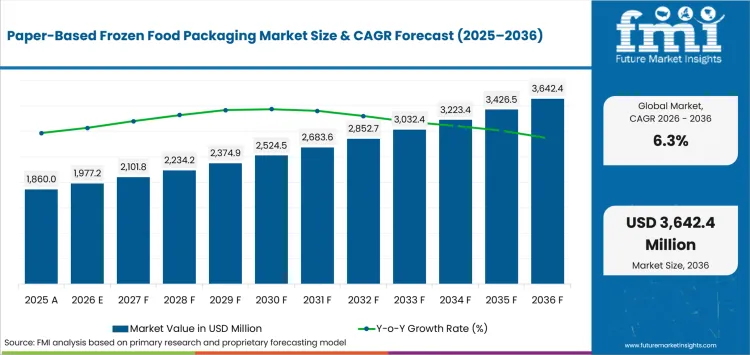
Key Takeaways of Paper-Based Frozen Food Packaging Market
- Frozen-food processors increase paper packaging use as recyclability rules reshape choices while preserving freezer protection and food-contact safety.
- Based on product type, folding cartons are projected to account for 38.0% in 2026 due to forming and storage.
- By material, SBS paperboard is estimated to hold 30.0% in 2026 owing to consistent scoring and print surfaces.
- The PE-coated segment is likely to capture 34.0% share in 2026 attributable to sealing and moisture-control performance.
- Qualification risk slows conversion as new structures must preserve board strength and seal integrity during frozen distribution.
- Graphic Packaging, Smurfit Westrock, International Paper, Billerud, Mondi, Sonoco, Cascades and Huhtamaki are some of the key companies serving paperboard and food-packaging roles.
Analyst Perspective
“Frozen-food formats qualify once board strength and barrier chemistry remain stable during filling and freezing. Repeat programs depend on line performance plus compatibility with paper-recovery systems across processor networks.”
- Nandini Roy Choudhury, Principal Consultant, Future Market Insights
How is the Paper-Based Frozen Food Packaging Market segmented?
The paper-based frozen food packaging market is segmented by product type, material, barrier technology, application, end use, sales channel and region.
The taxonomy covers product type (folding cartons, paper bags & pouches, paperboard trays, sleeves & wraps, others), material (SBS paperboard, CUK - wet-strength board, recycled board, kraft paper, others), barrier technology (PE-coated, dispersion-coated, uncoated, bio-coated), application (frozen ready meals, frozen pizza & bakery, frozen meat & seafood, frozen vegetables, others), end use (food processors, grocery private label, foodservice, others), sales channel (direct - OEM supply, packaging distributors, others, online - e-commerce).
Why do food processors lead the end use category?
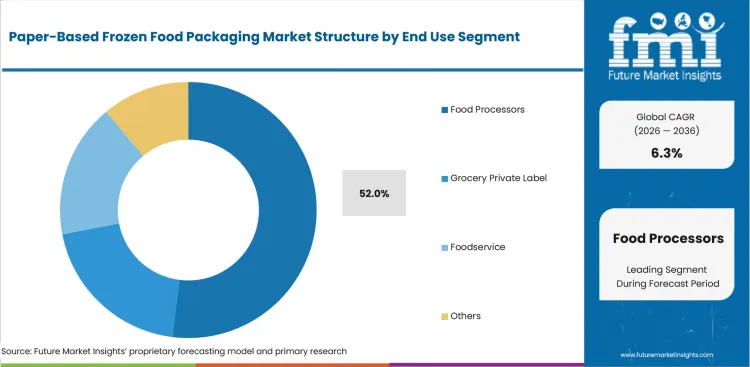
Food processors control the validation step that connects package performance with frozen recipes and production-line settings across repeat commercial runs. Their approval work covers seals, food contact and material handling during routine packaging qualification before full-volume national commercial orders begin.
- Food processors are set to lead the end-use category with 52.0% share in 2026 due to direct control over food-contact approval and production trials.
- Smurfit Westrock reported in May 2025 that frozen-food contract packer Sivafrost recycles about 75 tons of paper and cardboard monthly, linking processor-led food grade packaging choices with a measurable recovery route.
What makes folding cartons central to the product type category?
Folding cartons provide a printable rigid shell that protects frozen products during stacking and retail handling without changing familiar blank-fed converting steps. Graphic Packaging’s March 2026 annual filing identifies frozen and refrigerated prepared foods among applications served by its paperboard cartons and containers.
- Based on product type, folding cartons are projected to account for 38.0% in 2026 due to established folding carton packaging equipment and efficient flat-blank logistics.
- Failed folds or warped panels can interrupt high-volume packing runs, so processors favor carton structures with stable scoring and dimensions at low temperatures across repeated product changeovers.
Why does SBS paperboard lead the material category?
SBS paperboard gives frozen brands a controlled stiffness profile and clean printing surface for cartons carrying preparation instructions and retail graphics. Its consistent sheet structure helps converters manage scoring and glue performance at commercial line speeds during frequent artwork changes across repeated production runs.
- By material, SBS paperboard is estimated to hold 30.0% in 2026 owing to predictable scoring and print consistency across branded paperboard packaging formats.
- Billerud formally launched Voyager Pts SB in July 2025 for folding-carton and foodservice-board applications, giving North American converters a current SBS route for trials requiring predictable forming and print performance.
How does PE-coated technology hold the barrier technology lead?
PE-coated paper protects board strength by limiting moisture penetration as frozen packages encounter condensation and temperature cycling during distribution and retail handling across repeated seasonal programs. FDA’s January 2025 action made 35 PFAS food-contact notifications ineffective for grease-proofing coatings previously authorized on paper and paperboard.
- The barrier technology category is forecast to be led by PE-coated formats at 34.0% share in 2026 due to familiar sealing and moisture-control performance.
- Freezer reliability cannot offset unsupported food-contact or recycling claims, so packaging engineers compare coating weight with repulpability and barrier-coating performance during processor approval and retailer specification review.
What are the drivers, restraints and opportunities in the Paper-Based Frozen Food Packaging Market?
Regulatory cost pressure encourages fiber conversion while barrier qualification slows switching and improved coating systems create a route toward recyclable freezer-ready formats.
- Driver: Producer-responsibility rules make recyclability classification part of recurring packaging economics for frozen-food brands and private-label programs.
- Restraint: Food-contact authorization and line validation lengthen conversion cycles as barrier chemistry must remain safe and reliable under intended use conditions.
- Opportunity: Lower-polymer coating systems can expand paper-based frozen applications if commercial production reproduces barrier performance and recovery compatibility.
Producer-responsibility systems now connect recyclability classification with recurring packaging cost for frozen-food and private-label programs. PackUK’s December 2025 Year 2 model places red-rated packaging fees 20% above amber rates under its recyclability-based modulation method. Frozen-food brands therefore compare sustainable packaging changes against waste-fee exposure and product-protection risk during redesign approval.
Food-contact authorization directly limits which barrier chemistries can enter commercial paperboard qualification for frozen-food packaging. FDA food-contact notification 2409 became effective in February 2025 and permits microfibrillated cellulose at levels up to 100% for specified polymer-coated paper uses. Competing paper coating materials need their own compliance records plus line evidence, which extends validation for frozen-food programs.
Coating development can lower polymer content while retaining the moisture control required during frozen storage and handling. Huhtamaki launched ice cream cups in July 2025 using paperboard with a bio-based coating and less than 10% plastic content. Commercial conversion in polycoated paper packaging depends on reproducing barrier performance at scale and meeting the recovery rules that apply in each sales market.
Which country CAGRs are profiled in the Paper-Based Frozen Food Packaging Market?
| Country | CAGR |
|---|---|
| Brazil | 6.7% |
| United Kingdom | 6.2% |
| Germany | 6.1% |
| United States | 5.7% |
| Japan | 4.9% |
How do country-level CAGRs compare in the Paper-Based Frozen Food Packaging Market?
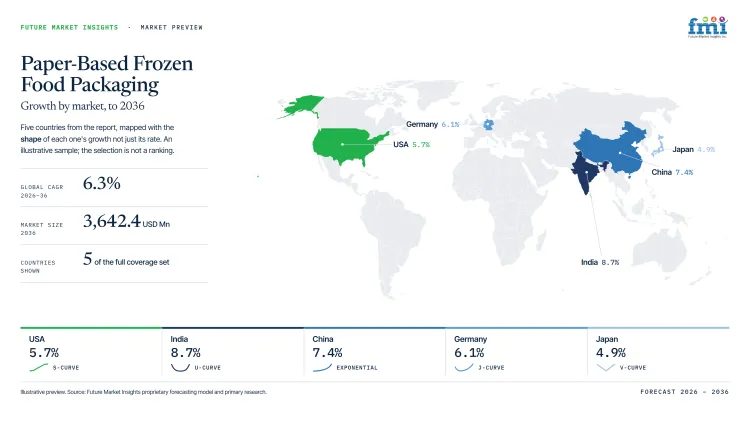
Brazil and the United Kingdom form the upper forecast group while Germany follows within one tenth of a percentage point. The United States forms a lower transition position while Japan records the 4.9% endpoint. This 1.8-point spread reflects different national recovery rules and processor qualification burdens beyond current market size.
- Brazil combines long distribution routes with registration transitions and uneven regional recovery.
- United Kingdom economics increasingly depend on producer-responsibility classification and material-specific recycling obligations.
- Germany’s dual-system network raises documentation expectations for coated paper qualification programs.
- United States processors emphasize food-contact authorization and repeat validation across national production.
- Japan’s mature frozen-food base rewards consistency and low failure rates across retail programs.
Comparable CAGRs require entry plans as validation and recovery rules shape orders. The full report provides country-level CAGR analysis across North America, Latin America, Europe, East Asia, South Asia, Oceania and the Middle East and Africa.
Country-wise Analysis
- Brazilian frozen-food processors manage long distribution routes and registration changeovers under Anvisa rules that allow already-produced food packaging to remain usable for up to 180 days following approval from July 2025 nationwide. Brazil is estimated to post 6.7% CAGR over the forecast period, supported by local converting capacity that lets processors adjust paperboard specifications nationally across retail and foodservice programs without importing every finished format. Regional recovery systems remain uneven across Brazil and coated structures need local recyclability evidence plus dependable board supply to limit write-offs during recurring frozen-food portfolio changes and artwork updates across regional markets in practice.
- United Kingdom private-label frozen-food programs increasingly price paper packaging against producer-responsibility classification, and the Environment Agency’s July 2025 RPS allowed forthcoming paper and board definitions including a 5% plastic-by-mass threshold for qualifying paper or board. Documented material composition and recovery performance determine barrier-layer classification, making coated structures a local approval friction across frozen distribution and retail presentation within major national grocery and private-label chains. Paper-based frozen food packaging sales in the United Kingdom are forecast to expand at 6.2% CAGR by 2036, supported by established retail scale as recyclability evidence affects annual fee exposure and specification approval across annual private-label sourcing cycles.
- German frozen-food processors operate inside a mature dual-system recycling network, and the German Environment Agency reported in January 2026 that about 5.5 million tonnes of dual-system packaging waste were recycled during 2024. Germany’s paper-based frozen food packaging outlook is anticipated to advance at 6.1% CAGR over the assessment period, aided by established collection routes and technical converting capacity across national food-packaging programs and retailer networks. Collection volume does not establish repulpability, so moisture barriers remain a qualification friction requiring coating-composition evidence that preserves freezer protection and line speed during retailer and processor approvals across multi-plant frozen-food packaging programs nationwide.
- United States frozen-food processors rely on plant-level food-contact records and multi-site trials during paperboard changes across national programs that use repeated recipes and different packaging equipment configurations at several domestic manufacturing locations. FDA food-contact notification 2457 became effective in October 2025 for a paper-strength additive limited to 0.75% of finished dry paper or paperboard, making formulation control a direct requirement for current commercial packaging qualification. Adoption of paper-based frozen food packaging in the United States is estimated to expand at 5.7% CAGR through 2036, supported by domestic technical service as supplier-specific authorization and change-control work shape repeat orders consistently.
- Japanese frozen-food manufacturers operate within a mature domestic category that rewards precise converting and repeat package performance across established retail programs, cold-chain distribution and scheduled production runs nationwide. Paper-based frozen food packaging demand in Japan is forecast to rise at 4.9% CAGR over the forecast period, supported by recurring processor volumes and low tolerance for package deformation across major national brands. The Japan Frozen Food Association reported in June 2026 that 2025 production reached 1.574 million tonnes, sustaining recurring packaging orders while seal or print variation raises qualification risk for material providers serving stable national processor production programs.
Who are the notable companies in the Paper-Based Frozen Food Packaging Market?
Graphic Packaging, Smurfit Westrock, International Paper, Billerud, Mondi, Sonoco, Cascades and Huhtamaki are the notable companies serving this market.
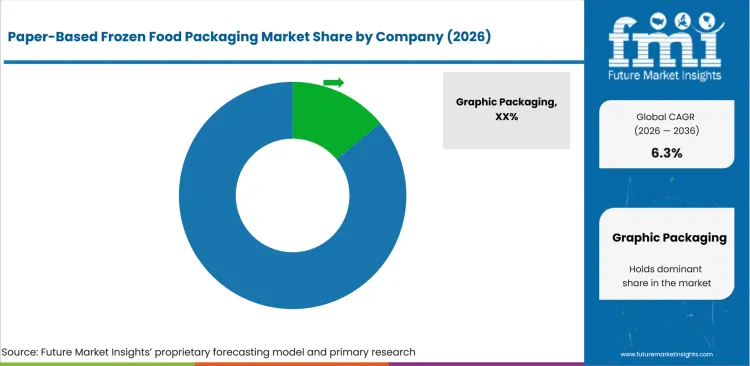
Competition centers on paperboard producers and converters linking fiber supply with qualified food-packaging operations across regions. Entry barriers arise from freezer-performance evidence and converting support near processor plants. Adjacent food-packaging capabilities become relevant once they transfer into frozen-food specifications with suitable barrier and line evidence.
- Integrated paperboard and converting platforms: Graphic Packaging, Smurfit Westrock, International Paper and Mondi combine broad fiber-based networks with downstream packaging operations.
- Board and recycled-fiber specialists: Billerud and Cascades provide paperboard depth that supports converter qualification across demanding food packaging programs.
- Converted food-packaging specialists: Sonoco and Huhtamaki add formed paper structures and barrier experience for application-specific food programs.
Competitive Benchmarking: Paper-Based Frozen Food Packaging Market
| Company | Paperboard Converting Breadth | Food-Application Qualification | Fiber and Board Integration | Geographic Reach |
|---|---|---|---|---|
| Graphic Packaging | High | High | High | Americas, Europe and Asia-Pacific |
| Smurfit Westrock | High | High | High | North America, Europe, Latin America and Asia-Pacific |
| International Paper | High | Medium | High | North America and EMEA |
| Billerud | Medium | Medium | High | Europe and North America |
| Mondi | High | High | High | Europe, Africa, Middle East and selected North American markets |
| Sonoco | Medium | Medium | High | Americas, Europe and Asia-Pacific |
| Cascades | Medium | Medium | High | Canada and United States |
| Huhtamaki | High | High | Medium | Europe, North America and Asia-Pacific |
Key Developments in the Paper-Based Frozen Food Packaging Market
- In November 2025, Mondi launched an extended food-packaging portfolio that added solid-board boxes for frozen deep-freeze applications and expanded regional production coverage after integrating Schumacher Packaging facilities.
- In November 2025, Graphic Packaging officially launched its Waco recycled-paperboard facility in Texas, establishing expanded recycled-board capacity for food and other consumer-packaging markets across North America.
- In January 2025, International Paper completed its acquisition of DS Smith and combined North American and EMEA fiber-packaging networks under one global business.
Key Players in the Paper-Based Frozen Food Packaging Market
Integrated Paperboard and Converting Platforms
- Graphic Packaging
- Smurfit Westrock
- International Paper
- Mondi
Board and Recycled-Fiber Specialists
- Billerud
- Cascades
Converted Food-Packaging Specialists
- Sonoco
- Huhtamaki
Paper-Based Frozen Food Packaging Market - Report Scope
| Coverage field | Report scope |
|---|---|
| Market breakdown | By product type, material, barrier technology, application, end use, sales channel and region. |
| Quantitative Units | Revenue in USD million and CAGR in %. |
| Market Definition | Commercial paper-based packaging sold for frozen food applications across the listed product, material, barrier, application, end-use and channel categories. |
| Regions Covered | North America, Latin America, Europe, East Asia, South Asia and Pacific and Middle East and Africa. |
| Countries Covered | Brazil, United Kingdom, Germany, United States, Japan, and 20+ countries included in the full report. |
| Key Companies Profiled | Graphic Packaging, Smurfit Westrock, International Paper, Billerud, Mondi, Sonoco, Cascades, Huhtamaki. |
| Forecast Period | 2026 to 2036. |
| Approach | Primary and secondary research with market triangulation. |
Paper-Based Frozen Food Packaging Market - Research Methodology
| Method | Approach |
|---|---|
| Primary Research | FMI analysts gathered input from manufacturers, service providers, technology developers, distributors, end users, procurement teams, and subject-matter experts. Interviews examined purchasing decisions, product or service evaluation, adoption barriers, approval requirements, pricing considerations, and expectations for technical or commercial support. Respondents were also asked what evidence is required before a trial, pilot, or initial order develops into regular purchasing. |
| Desk Research | Desk research covered government statistics, regulatory publications, trade data, industry associations, technical literature, standards, company filings, product information, and official corporate announcements. Sources were reviewed for relevance, publication date, geographic coverage, and consistency with the defined market scope. Claims relating to performance, applications, approvals, capacity, investment, and commercial activity were retained only when supported by credible public evidence. |
| Market Sizing and Forecasting | The market model combined the baseline value with historical performance, segment structure, pricing and volume indicators, adoption levels, company participation, and country-level demand conditions. Forecast assumptions considered economic activity, investment trends, regulatory developments, technology adoption, purchasing cycles, supply availability, and barriers to wider market use. Segment and regional estimates were reconciled before the final market total was calculated. |
| Data Validation | Estimates were checked against multiple independent indicators, including public data, company activity, trade patterns, industry developments, and findings from primary interviews. Validation also tested whether products, services, applications, and company revenues fell within the defined market boundaries. Adjacent categories, unsupported claims, overlapping revenues, and activities without direct market relevance were excluded to reduce double counting and maintain consistency across segments and countries. |
Paper-Based Frozen Food Packaging Market by Segments
Paper-Based Frozen Food Packaging Market segmented by Product Type:
- Folding Cartons
- Paper Bags & Pouches
- Paperboard Trays
- Sleeves & Wraps
- Others
Paper-Based Frozen Food Packaging Market segmented by Material:
- SBS Paperboard
- CUK - Wet-Strength Board
- Recycled Board
- Kraft Paper
- Others
Paper-Based Frozen Food Packaging Market segmented by Barrier Technology:
- PE-Coated
- Dispersion-Coated
- Uncoated
- Bio-Coated
Paper-Based Frozen Food Packaging Market segmented by Application:
- Frozen Ready Meals
- Frozen Pizza & Bakery
- Frozen Meat & Seafood
- Frozen Vegetables
- Others
Paper-Based Frozen Food Packaging Market segmented by End Use:
- Food Processors
- Grocery Private Label
- Foodservice
- Others
Paper-Based Frozen Food Packaging Market segmented by Sales Channel:
- Direct - OEM Supply
- Packaging Distributors
- Others
- Online - E-commerce
Paper-Based Frozen Food Packaging Market by Region:
- North America
- United States
- Canada
- Latin America
- Brazil
- Mexico
- Chile
- Rest of Latin America
- Western Europe
- Germany
- United Kingdom
- Italy
- Spain
- France
- Nordics
- Benelux
- Rest of Western Europe
- Eastern Europe
- Russia
- Poland
- Hungary
- Balkan and Baltic States
- Rest of Eastern Europe
- East Asia
- China
- Japan
- South Korea
- South Asia and Pacific
- India
- ASEAN
- Australia and New Zealand
- Rest of South Asia and Pacific
- Middle East and Africa
- Kingdom of Saudi Arabia
- Other GCC Countries
- Türkiye
- South Africa
- Other African Union Countries
- Rest of Middle East and Africa
Research Sources and Bibliography
- European Union. (2025, January 22). Regulation (EU) 2025/40 of the European Parliament and of the Council of 19 December 2024 on packaging and packaging waste, amending Regulation (EU) 2019/1020 and Directive (EU) 2019/904, and repealing Directive 94/62/EC (Text with EEA relevance).
- Department for Environment, Food & Rural Affairs. (2026, April 20). Local authority payments and material base fees: breakdown of costs and tonnages.
- Graphic Packaging Holding Company. (2026, March 2). March 2, 2026 - 10-K: Annual report [Section 13 and 15(d), not S-K Item 405].
- Billerud. (2025, July 24). Billerud advances investments in Michigan mills to drive innovation, sustainability, and economic growth.
- USA Food and Drug Administration. (2025, January 3). FDA Determines Authorization for 35 Food Contact Notifications Related to PFAS Are No Longer Effective.
- Smurfit Westrock. (2025, May 26). Closing the loop: Smurfit Westrock and Sivafrost build a sustainable future.
- PackUK. (2025, December 19). Year 2 illustrative waste disposal fees: Extended producer responsibility for packaging.
- USA Food and Drug Administration. (2025, February 8). Inventory of Effective Food Contact Substance (FCS) Notifications: FCN No. 2409.
- Huhtamaki. (2025, July 16). Huhtamaki launches new compostable ice cream cups.
- Agência Nacional de Vigilância Sanitária. (2025, July 31). Anvisa autoriza esgotamento de embalagens já produzidas após regularização de alimentos.
- Environment Agency. (2025, July 7). Extended producer responsibility for packaging: fibre-based composite and paper and board obligations: RPS 351.
- German Environment Agency & Central Agency Packaging Register. (2026, January 27). Facts against myths: Packaging waste recycling in Germany is working.
- USA Food and Drug Administration. (2025, October 10). Inventory of Effective Food Contact Substance (FCS) Notifications: FCN No. 2457.
- Japan Frozen Food Association Editorial Team. (2026, June 15). <令和7年 冷凍食品年間生産・消費量調査発表>冷凍食品の消費量が300万トン超え。出荷額も2年連続で過去最高を更新!
- Sonoco Products Company. (2025, November 10). Sonoco Consolidating Consumer Packaging Businesses Under Two Geographies.
- Cascades. (2026). Key Operational Details. Retrieved August 9, 2026.
- Mondi. (2025, November 18). Mondi launches extended corrugated and solid board portfolio for the food packaging industry.
- Graphic Packaging International. (2025, November 5). Graphic Packaging Launches Advanced Recycled Paperboard Facility in Waco, Texas.
- International Paper Company. (2025, January 31). International Paper Completes Acquisition of DS Smith.
This bibliography is provided for reader reference and is not exhaustive. The full report contains the complete reference list and detailed citations
This Report Answers
- What are the 2026 and 2036 values for the paper-based frozen food packaging market?
- What conditions shift frozen-food packs toward paper-based formats?
- Why do folding cartons lead product type demand in 2026?
- How do board and barrier choices affect frozen-food qualification?
- Why do food processors hold the largest end-use share?
- Why do the five profiled countries follow different forecast paths?
- Which local frictions change order conversion across profiled countries?
- Which companies combine board, converting and barrier capabilities?
- What evidence should processors test before approving paper-based frozen-food packaging?
Frequently Asked Questions
How big is the Paper-Based Frozen Food Packaging Market in 2026?
The paper-based frozen food packaging market is projected to be valued at USD 1977.2 million in 2026. Growth is driven by increasing demand for sustainable packaging solutions, stricter recyclability requirements, and the need for packaging that maintains product integrity under frozen storage and distribution conditions.
What is the CAGR of the Paper-Based Frozen Food Packaging Market from 2026 to 2036?
The paper-based frozen food packaging market is expected to expand at a CAGR of 6.3% between 2026 and 2036. Market growth is supported by rising adoption of fiber-based packaging formats, evolving sustainability regulations, and continuous advancements in barrier technologies that improve freezer performance and food safety.
Which product type is projected to dominate the Paper-Based Frozen Food Packaging Market?
Folding cartons are projected to account for 38.0% of the market in 2026. Their strong market position is attributed to established converting infrastructure, efficient flat-pack transportation and storage, excellent printability, and suitability for a wide range of frozen food applications.
Which application segment is expected to lead the Paper-Based Frozen Food Packaging Market?
The frozen ready meals segment is projected to account for 32.0% of the market in 2026. Demand is supported by the segment's need for packaging that provides freezer protection, accommodates product information and branding, and delivers effective barrier performance for products containing sauces, oils, and fats.
Which companies are active in the Paper-Based Frozen Food Packaging Market?
Key companies operating in the paper-based frozen food packaging market include Graphic Packaging, Smurfit Westrock, International Paper, Billerud, Mondi, Sonoco, Cascades, and Huhtamaki. These companies offer capabilities across paperboard manufacturing, packaging conversion, recycled-fiber solutions, and food-packaging applications, helping drive innovation and market development.
Preview the report firsthand - request a free sample
Get SampleGet the brochure for pricing and purchase details.
Get PDFTable of Content
- Key Takeaways
- Market Size and CAGR
- Top Growth Driver
- Fastest Growing Segment
- Leading Region
- Key Companies
- Emerging Opportunities
- Executive Summary
- Global Market Outlook
- Demand-side Trends
- Supply-side Trends
- Technology Roadmap Analysis
- Analysis and Recommendations
- Analyst Perspective (What is happening? Why now? What should investors know?)
- Key Questions Answered
- How large is the market?
- What is the CAGR?
- What are key trends?
- Which region dominates?
- Who are the leaders?
- Market Overview
- Market Coverage / Taxonomy
- Market Definition / Scope / Limitations
- Research Methodology
- Chapter Orientation
- Analytical Lens and Working Hypotheses
- Market Structure, Signals, and Trend Drivers
- Benchmarking and Cross-market Comparability
- Market Sizing, Forecasting, and Opportunity Mapping
- Research Design and Evidence Framework
- Desk Research Programme (Secondary Evidence)
- Expert Input and Fieldwork (Primary Evidence)
- Tooling, Models, and Reference Databases
- Data Engineering and Model Build
- Quality Assurance and Audit Trail
- Market Background
- Market Dynamics (Drivers, Restraints, Opportunity, Trends)
- Scenario Forecast (Optimistic, Likely, Conservative)
- Impact Analysis
- AI Impact
- Sustainability Impact
- Regulatory Impact
- Technology Impact
- Consumer / Buyer Analysis
- Purchase Drivers
- Adoption Barriers
- Buyer Journey
- Opportunity Map Analysis
- Product Life Cycle Analysis
- Supply Chain Analysis
- Investment Feasibility Matrix
- Value Chain Analysis
- PESTLE and Porter's Analysis
- Regulatory Landscape
- Regional Parent Market Outlook
- Production and Consumption Statistics
- Import and Export Statistics
- Global Market Analysis and Forecast, 2021 to 2036
- Historical Market Size Value (USD Million) Analysis, 2021 to 2025
- Current and Future Market Size Value (USD Million) Projections, 2026 to 2036
- Y-o-Y Growth Trend Analysis
- Absolute $ Opportunity Analysis
- Global Market Pricing Analysis, 2021 to 2036
- Global Market Analysis and Forecast, By Product Type, 2021 to 2036
- Introduction / Key Findings
- Historical Market Size Value (USD Million) Analysis By Product Type, 2021 to 2025
- Current and Future Market Size Value (USD Million) Analysis and Forecast By Product Type, 2026 to 2036
- Folding Cartons
- Paper Bags & Pouches
- Paperboard Trays
- Sleeves & Wraps
- Others
- Folding Cartons
- Y-o-Y Growth Trend Analysis By Product Type, 2021 to 2025
- Absolute $ Opportunity Analysis By Product Type, 2026 to 2036
- Global Market Analysis and Forecast, By Material, 2021 to 2036
- Introduction / Key Findings
- Historical Market Size Value (USD Million) Analysis By Material, 2021 to 2025
- Current and Future Market Size Value (USD Million) Analysis and Forecast By Material, 2026 to 2036
- SBS Paperboard
- CUK - Wet-Strength Board
- Recycled Board
- Kraft Paper
- Others
- SBS Paperboard
- Y-o-Y Growth Trend Analysis By Material, 2021 to 2025
- Absolute $ Opportunity Analysis By Material, 2026 to 2036
- Global Market Analysis and Forecast, By Barrier Technology, 2021 to 2036
- Introduction / Key Findings
- Historical Market Size Value (USD Million) Analysis By Barrier Technology, 2021 to 2025
- Current and Future Market Size Value (USD Million) Analysis and Forecast By Barrier Technology, 2026 to 2036
- PE-Coated
- Dispersion-Coated
- Uncoated
- Bio-Coated
- PE-Coated
- Y-o-Y Growth Trend Analysis By Barrier Technology, 2021 to 2025
- Absolute $ Opportunity Analysis By Barrier Technology, 2026 to 2036
- Global Market Analysis and Forecast, By Application, 2021 to 2036
- Introduction / Key Findings
- Historical Market Size Value (USD Million) Analysis By Application, 2021 to 2025
- Current and Future Market Size Value (USD Million) Analysis and Forecast By Application, 2026 to 2036
- Frozen Ready Meals
- Frozen Pizza & Bakery
- Frozen Meat & Seafood
- Frozen Vegetables
- Others
- Frozen Ready Meals
- Y-o-Y Growth Trend Analysis By Application, 2021 to 2025
- Absolute $ Opportunity Analysis By Application, 2026 to 2036
- Global Market Analysis and Forecast, By End Use, 2021 to 2036
- Introduction / Key Findings
- Historical Market Size Value (USD Million) Analysis By End Use, 2021 to 2025
- Current and Future Market Size Value (USD Million) Analysis and Forecast By End Use, 2026 to 2036
- Food Processors
- Grocery Private Label
- Foodservice
- Others
- Food Processors
- Y-o-Y Growth Trend Analysis By End Use, 2021 to 2025
- Absolute $ Opportunity Analysis By End Use, 2026 to 2036
- Global Market Analysis and Forecast, By Sales Channel
- Introduction / Key Findings
- Historical Market Size Value (USD Million) Analysis By Sales Channel, 2021 to 2025
- Current and Future Market Size Value (USD Million) Analysis and Forecast By Sales Channel, 2026 to 2036
- Direct - OEM Supply
- Packaging Distributors
- Others
- Online - E-commerce
- Direct - OEM Supply
- Y-o-Y Growth Trend Analysis By Sales Channel, 2021 to 2025
- Absolute $ Opportunity Analysis By Sales Channel, 2026 to 2036
- Global Market Analysis and Forecast, By Region, 2021 to 2036
- Introduction
- Historical Market Size Value (USD Million) Analysis By Region, 2021 to 2025
- Current Market Size Value (USD Million) Analysis and Forecast By Region, 2026 to 2036
- North America
- Latin America
- Western Europe
- Eastern Europe
- East Asia
- South Asia and Pacific
- Middle East & Africa
- Market Attractiveness Analysis By Region
- North America Market Analysis and Forecast, By Country, 2021 to 2036
- Historical Market Size Value (USD Million) Trend Analysis By Market Taxonomy, 2021 to 2025
- Market Size Value (USD Million) Forecast By Market Taxonomy, 2026 to 2036
- By Country
- USA
- Canada
- By Product Type
- By Material
- By Barrier Technology
- By Application
- By End Use
- By Sales Channel
- By Country
- Market Attractiveness Analysis
- By Country
- By Product Type
- By Material
- By Barrier Technology
- By Application
- By End Use
- By Sales Channel
- Key Takeaways
- Latin America Market Analysis and Forecast, By Country
- Historical Market Size Value (USD Million) Trend Analysis By Market Taxonomy, 2021 to 2025
- Market Size Value (USD Million) Forecast By Market Taxonomy, 2026 to 2036
- By Country
- Brazil
- Mexico
- Chile
- Rest of Latin America
- By Product Type
- By Material
- By Barrier Technology
- By Application
- By End Use
- By Sales Channel
- By Country
- Market Attractiveness Analysis
- By Country
- By Product Type
- By Material
- By Barrier Technology
- By Application
- By End Use
- By Sales Channel
- Key Takeaways
- Western Europe Market Analysis and Forecast, By Country
- Historical Market Size Value (USD Million) Trend Analysis By Market Taxonomy, 2021 to 2025
- Market Size Value (USD Million) Forecast By Market Taxonomy, 2026 to 2036
- By Country
- Germany
- UK
- Italy
- Spain
- France
- Nordic
- BENELUX
- Rest of Western Europe
- By Product Type
- By Material
- By Barrier Technology
- By Application
- By End Use
- By Sales Channel
- By Country
- Market Attractiveness Analysis
- By Country
- By Product Type
- By Material
- By Barrier Technology
- By Application
- By End Use
- By Sales Channel
- Key Takeaways
- Eastern Europe Market Analysis and Forecast, By Country
- Historical Market Size Value (USD Million) Trend Analysis By Market Taxonomy, 2021 to 2025
- Market Size Value (USD Million) Forecast By Market Taxonomy, 2026 to 2036
- By Country
- Russia
- Poland
- Hungary
- Balkan & Baltic
- Rest of Eastern Europe
- By Product Type
- By Material
- By Barrier Technology
- By Application
- By End Use
- By Sales Channel
- By Country
- Market Attractiveness Analysis
- By Country
- By Product Type
- By Material
- By Barrier Technology
- By Application
- By End Use
- By Sales Channel
- Key Takeaways
- East Asia Market Analysis and Forecast, By Country
- Historical Market Size Value (USD Million) Trend Analysis By Market Taxonomy, 2021 to 2025
- Market Size Value (USD Million) Forecast By Market Taxonomy, 2026 to 2036
- By Country
- China
- Japan
- South Korea
- By Product Type
- By Material
- By Barrier Technology
- By Application
- By End Use
- By Sales Channel
- By Country
- Market Attractiveness Analysis
- By Country
- By Product Type
- By Material
- By Barrier Technology
- By Application
- By End Use
- By Sales Channel
- Key Takeaways
- South Asia and Pacific Market Analysis and Forecast, By Country
- Historical Market Size Value (USD Million) Trend Analysis By Market Taxonomy, 2021 to 2025
- Market Size Value (USD Million) Forecast By Market Taxonomy, 2026 to 2036
- By Country
- India
- ASEAN
- Australia & New Zealand
- Rest of South Asia and Pacific
- By Product Type
- By Material
- By Barrier Technology
- By Application
- By End Use
- By Sales Channel
- By Country
- Market Attractiveness Analysis
- By Country
- By Product Type
- By Material
- By Barrier Technology
- By Application
- By End Use
- By Sales Channel
- Key Takeaways
- Middle East & Africa Market Analysis and Forecast, By Country
- Historical Market Size Value (USD Million) Trend Analysis By Market Taxonomy, 2021 to 2025
- Market Size Value (USD Million) Forecast By Market Taxonomy, 2026 to 2036
- By Country
- Kingdom of Saudi Arabia
- Other GCC Countries
- Türkiye
- South Africa
- Other African Union
- Rest of Middle East & Africa
- By Product Type
- By Material
- By Barrier Technology
- By Application
- By End Use
- By Sales Channel
- By Country
- Market Attractiveness Analysis
- By Country
- By Product Type
- By Material
- By Barrier Technology
- By Application
- By End Use
- By Sales Channel
- Key Takeaways
- Key Countries Market Analysis
- USA
- Pricing Analysis
- Market Share Analysis, 2025
- By Product Type
- By Material
- By Barrier Technology
- By Application
- By End Use
- By Sales Channel
- Canada
- Pricing Analysis
- Market Share Analysis, 2025
- By Product Type
- By Material
- By Barrier Technology
- By Application
- By End Use
- By Sales Channel
- Mexico
- Pricing Analysis
- Market Share Analysis, 2025
- By Product Type
- By Material
- By Barrier Technology
- By Application
- By End Use
- By Sales Channel
- Brazil
- Pricing Analysis
- Market Share Analysis, 2025
- By Product Type
- By Material
- By Barrier Technology
- By Application
- By End Use
- By Sales Channel
- Chile
- Pricing Analysis
- Market Share Analysis, 2025
- By Product Type
- By Material
- By Barrier Technology
- By Application
- By End Use
- By Sales Channel
- Germany
- Pricing Analysis
- Market Share Analysis, 2025
- By Product Type
- By Material
- By Barrier Technology
- By Application
- By End Use
- By Sales Channel
- UK
- Pricing Analysis
- Market Share Analysis, 2025
- By Product Type
- By Material
- By Barrier Technology
- By Application
- By End Use
- By Sales Channel
- Italy
- Pricing Analysis
- Market Share Analysis, 2025
- By Product Type
- By Material
- By Barrier Technology
- By Application
- By End Use
- By Sales Channel
- Spain
- Pricing Analysis
- Market Share Analysis, 2025
- By Product Type
- By Material
- By Barrier Technology
- By Application
- By End Use
- By Sales Channel
- France
- Pricing Analysis
- Market Share Analysis, 2025
- By Product Type
- By Material
- By Barrier Technology
- By Application
- By End Use
- By Sales Channel
- India
- Pricing Analysis
- Market Share Analysis, 2025
- By Product Type
- By Material
- By Barrier Technology
- By Application
- By End Use
- By Sales Channel
- ASEAN
- Pricing Analysis
- Market Share Analysis, 2025
- By Product Type
- By Material
- By Barrier Technology
- By Application
- By End Use
- By Sales Channel
- Australia & New Zealand
- Pricing Analysis
- Market Share Analysis, 2025
- By Product Type
- By Material
- By Barrier Technology
- By Application
- By End Use
- By Sales Channel
- China
- Pricing Analysis
- Market Share Analysis, 2025
- By Product Type
- By Material
- By Barrier Technology
- By Application
- By End Use
- By Sales Channel
- Japan
- Pricing Analysis
- Market Share Analysis, 2025
- By Product Type
- By Material
- By Barrier Technology
- By Application
- By End Use
- By Sales Channel
- South Korea
- Pricing Analysis
- Market Share Analysis, 2025
- By Product Type
- By Material
- By Barrier Technology
- By Application
- By End Use
- By Sales Channel
- Russia
- Pricing Analysis
- Market Share Analysis, 2025
- By Product Type
- By Material
- By Barrier Technology
- By Application
- By End Use
- By Sales Channel
- Poland
- Pricing Analysis
- Market Share Analysis, 2025
- By Product Type
- By Material
- By Barrier Technology
- By Application
- By End Use
- By Sales Channel
- Hungary
- Pricing Analysis
- Market Share Analysis, 2025
- By Product Type
- By Material
- By Barrier Technology
- By Application
- By End Use
- By Sales Channel
- Kingdom of Saudi Arabia
- Pricing Analysis
- Market Share Analysis, 2025
- By Product Type
- By Material
- By Barrier Technology
- By Application
- By End Use
- By Sales Channel
- Türkiye
- Pricing Analysis
- Market Share Analysis, 2025
- By Product Type
- By Material
- By Barrier Technology
- By Application
- By End Use
- By Sales Channel
- South Africa
- Pricing Analysis
- Market Share Analysis, 2025
- By Product Type
- By Material
- By Barrier Technology
- By Application
- By End Use
- By Sales Channel
- USA
- Market Structure Analysis
- Competition Dashboard
- Competition Benchmarking
- Market Share Analysis of Top Players
- By Regional
- By Product Type
- By Material
- By Barrier Technology
- By Application
- By End Use
- By Sales Channel
- Emerging Startups
- Innovation Benchmarking
- Competition Analysis
- Competition Deep Dive
- Graphic Packaging
- Overview
- Product Portfolio
- Profitability by Market Segments
- Sales Footprint
- Strategy Overview
- Marketing Strategy
- Product Strategy
- Channel Strategy
- Smurfit Westrock
- International Paper
- Billerud
- Mondi
- Sonoco
- Cascades
- Georgia-Pacific
- Huhtamaki
- TC Transcontinental
- Graphic Packaging
- Case Studies
- Success Stories
- Recent Developments
- Competition Deep Dive
- Assumptions & Acronyms Used


