

- Market Size (2026)
- USD 285.4 Mn
- Forecast (2036)
- USD 535.7 Mn
- CAGR (2026 to 2036)
- 6.5%
How big is Paper-Based Frozen Food Liners Market in 2026?
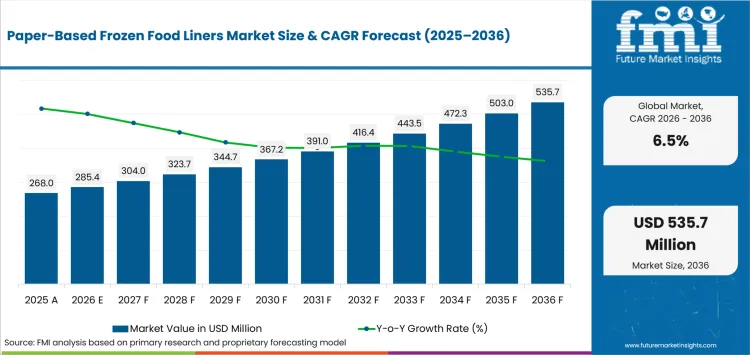
USD 285.4 million in 2026 and USD 535.7 million by 2036 at a 6.5% CAGR.
Demand for paper-based frozen food liners is projected to expand at 6.5% CAGR between 2026 and 2036, increasing valuation from USD 285.4 million to USD 535.7 million. Frozen-food programs favor barrier packaging that protects food during storage without slowing converting or complicating recovery. In September 2025 Sappi launched two high-barrier papers and said Guard Duo was being tested by ice-cream manufacturers for cone sleeves, linking frozen food packaging trials with barrier qualification.
Brazil’s modelled rate exceeds the United States as protein-processing growth meets a less mature liner supply base. USDA recorded 931 refrigerated warehouses in February 2026, documenting a mature US cold-storage network that rewards dependable kraft paper specifications. The difference describes forecast pace rather than current scale as paper packaging programs in both countries depend on qualified moisture resistance and repeatable supply.
Key Takeaways of Paper-Based Frozen Food Liners Market
- Frozen-food throughput sustains repeat liner orders as wrapping and interleaving paper is consumed during every production run.
- In 2026, freezer paper liners are expected to lead product type with 32.0% share as direct wrapping covers varied frozen-food handling tasks.
- By paper grade, coated kraft is estimated to hold 34.0% in 2026 owing to fiber strength and adjustable barrier treatment.
- The to -18 C segment is projected to hold 46.0% share in 2026 due to its mainstream frozen-storage duty range.
- Barrier coatings slow qualification if moisture control conflicts with food-contact chemistry or the intended paper-recovery route.
- Mondi, Smurfit Westrock, Sappi, Billerud, Cascades, Seaman Paper, Twin Rivers Paper and Koehler Paper.
Analyst Perspective
"Processors should compare coating adhesion and clean release at the intended storage temperature ahead of unit-price review. Grades that run consistently on existing lines and carry food-contact plus recovery documentation reduce qualification work for recurring programs."
- Nandini Roy Choudhury, Principal Consultant, Future Market Insights
How is the Paper-Based Frozen Food Liners Market segmented?
The paper-based frozen food liners market is segmented by product type, paper grade, temperature rating, application, end use, sales channel and region.
Product type covers freezer paper liners, wet-strength carton liners, coated tray liners, interleaving sheets and others. Paper grade includes coated kraft, wet-strength kraft, greaseproof, recycled liner and others while temperature rating separates to -18 C, to -30 C and below -30 C. Application covers frozen meat and seafood, frozen ready meals, frozen bakery, frozen fruits and vegetables and others across food loads. End use includes food processors, grocery retail, foodservice and others while sales channel distinguishes direct - OEM supply, packaging distributors, online - e-commerce and others.
What supports frozen meat and seafood within the application category?
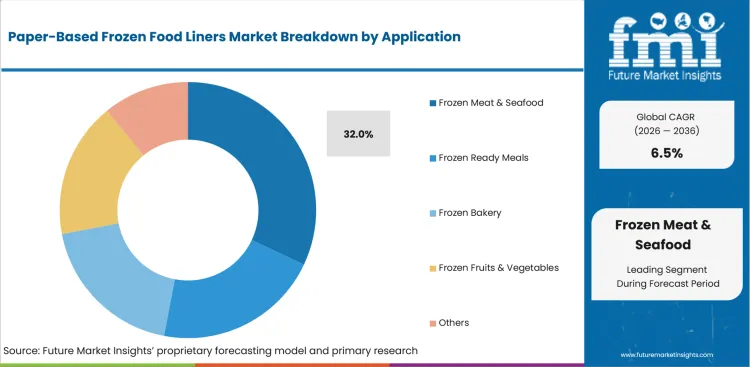
Frozen meat and seafood expose liners to purge, surface fat and sharp product edges during portioning and storage. Food packaging also needs clean release as torn interleaving slows portioning and reduces usable yield on high-throughput lines.
- Frozen meat and seafood are likely to capture 32.0% share in 2026 attributable to repeated wrap and interleaving needs under demanding moisture and grease conditions.
- USDA reported in July 2026 that 1.16 billion pounds of frozen poultry were in cold storage on June 30, documenting frozen inventory that repeatedly requires separation and protective packaging.
What makes freezer paper liners central to the product type category?
Freezer paper liners handle direct wrapping and interleaving under condensation that can weaken untreated sheets during cold storage. Sappi demonstrated Guard Duo on ice cream cone wrappers in April 2026 and identified a 105 gsm grade for that application.
- By product type, freezer paper liners are estimated to hold 32.0% in 2026 owing to broad compatibility with wrapping and separation tasks across existing converting routines.
- Processors can specify rolls or sheets to existing line dimensions, so recurring orders depend on clean release and wet strength instead of dedicated liner machinery.
Why does coated kraft influence selection within the paper grade category?
Coated kraft combines fiber strength with barrier coatings that manage moisture during frozen handling. Food processors qualify coating adhesion and wet strength against release behavior while comparing greaseproof paper sheets used in adjacent food-contact duties.
- Coated kraft is projected to hold 34.0% share in 2026 owing to strength retention and adjustable barrier chemistry across multiple frozen-food formats.
- The Environment Agency stated in July 2025 that fiber-based packaging with plastic at or below 5% by mass can be treated as paper or board. Coating content therefore becomes a material-classification condition during commercial paper qualification programs.
How does the to -18 C segment shape temperature rating demand?
The to -18 C rating gives processors a test point for liner flexibility and food-grade packaging integrity during frozen storage. A March 2026 UK Maritime and Coastguard Agency notice states freezer cabinets should operate at -18 C or colder and suitable packaging is essential to prevent surface moisture loss.
- Based on temperature rating, the to -18 C segment is projected to account for 46.0% in 2026 due to its broad mainstream frozen-food duty range.
- Lower-temperature duties require extra checks for brittleness and delamination, separating mainstream qualification from deeper-freeze specifications with narrower use cases.
What are the drivers, restraints and opportunities in the Paper-Based Frozen Food Liners Market?
Frozen-food processing capacity sustains recurring liner demand as qualification rules narrow acceptable coatings and heat-sealable recyclable paper creates a conversion route.
- Driver: Additional cold-chain processing sites raise recurring consumption of wraps and interleaving sheets across frozen-food packing programs.
- Restraint: Food-contact chemistry and recyclability rules remove coating structures that cannot satisfy freezer performance alongside end-of-life requirements.
- Opportunity: Heat-sealable paper can reduce machinery-change requirements during fiber substitution if the final liner passes food-contact and low-temperature qualification.
Frozen-Product Throughput Sustains Repeat Liner Orders
Cold-chain capacity adds sites that freeze and pack food in formats needing paperboard packaging separation or surface protection. India’s Ministry of Food Processing Industries listed 408 approved cold-chain projects as of March 31 2026, covering infrastructure that can add recurring liner-use points. Liner producers convert that activity into repeat orders by matching sheet specifications with each processor’s pack format and replenishment cycle.
Qualification Rules Narrow Acceptable Barrier Structures
Food-contact coatings must control moisture and grease without introducing chemistry that blocks legal sale or the intended paper-recovery route. From August 12 2026 Regulation (EU) 2025/40 bars food-contact packaging containing any targeted PFAS at or above 25 ppb, making coating chemistry a direct qualification condition. Frozen-food processors therefore require compliance documentation alongside freezer-performance evidence for coated fiber structures entering recurring production programs.
Heat-Sealable Paper Provides a Conversion Route
Wet-strength interleaving paper gives frozen-food converters a direct route to improve separation without changing the surrounding pack format. In July 2025 Mondi introduced Ad/Vantage Smooth White WS as a 50 gsm wet-strength base paper for food-grade interleaving. Frozen programs can test coating and release requirements on that base during qualification for recurring line volumes.
Which country CAGRs are profiled in the Paper-Based Frozen Food Liners Market?
| Country | CAGR |
|---|---|
| Brazil | 6.9% |
| United Kingdom | 6.4% |
| Germany | 6.3% |
| United States | 5.9% |
| Japan | 5.1% |
How do country-level CAGRs compare in the Paper-Based Frozen Food Liners Market?
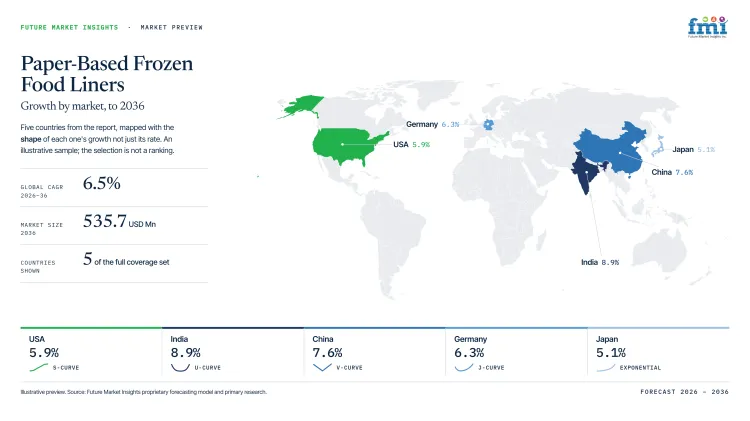
The five-country range separates Brazil from a European middle group and places the United States plus Japan in a slower band. The 1.8-point spread reflects conversion conditions and does not measure current market size as protein throughput, recovery rules and qualification intensity change how quickly paper liners enter repeat programs.
- Brazil’s pace follows protein throughput rewarding moisture-resistant conversion and shorter replenishment cycles.
- United Kingdom packaging fees increase scrutiny of fiber structures with documented recovery classification.
- Germany’s rate reflects tighter review of grease-resistant food-contact chemistry during qualification programs.
- United States growth rests on mature cold-storage networks rewarding dependable replenishment across established processor accounts.
- Japan’s pace reflects detailed composition review lengthening qualification for coated food-contact materials.
Comparable CAGRs can mask approval timelines and service requirements across profiled countries. The full report provides country-level CAGR analysis across North America, Latin America, Europe, East Asia, South Asia, Oceania and the Middle East and Africa.
Country-wise Analysis
- Brazilian frozen-protein plants span humid production zones and long domestic routes that make regional liner conversion plus dependable local stocks useful for poultry and pork packers serving national distribution networks across several processing regions. Paper-based frozen food liner sales in Brazil are forecast to expand at 6.9% CAGR by 2036 as IBGE reported 1.71 billion chickens slaughtered during first-quarter 2026 in June 2026 across the national processing base. Humidity and transport distance remain material frictions as qualified paper must reach dispersed processors without weakening moisture control or forcing large inventory buffers across regional production and distribution networks during recurring shipment cycles.
- United Kingdom food processors currently compare coated paper structures against producer-responsibility costs as PackUK set the 2025-2026 paper and card base fee at GBP 196 per tonne in June 2025 for national packaging programs. By 2036 the United Kingdom is projected to grow at 6.4% CAGR, aided by an established retail frozen-food sector and a waste-fee system that makes material classification commercially visible during packaging selection. Preserving paper classification without weakening freezer durability remains the main friction as liner producers need moisture-resistant coatings and clean release plus recyclability evidence accepted across recurring national retail programs and high-volume frozen-food accounts nationwide.
- German food manufacturers scrutinize grease-barrier chemistry during liner qualification for fatty frozen products that need oil resistance during thawing plus food-contact compliance across established national retail programs and repeated frozen handling routines nationwide. Paper-based frozen food liner demand in Germany is forecast to rise at 6.3% CAGR over the forecast period, shaped by processor emphasis on documented chemistry and stable barrier performance during commercial qualification trials nationwide. The German Environment Agency reported in February 2025 that PFAS concentrations in paper applications typically range from 0.5% to 1.5% of paper mass, defining the chemistry burden replacement coatings must avoid during qualification.
- United States frozen-food processors operate inside a mature refrigerated network as USDA recorded about 1.00 billion pounds of frozen poultry in storage on December 31 2025 across national cold-storage facilities serving major processing regions. Established warehouse routes make dependable replenishment and repeatable converting specifications useful during qualification, but incumbent coated papers already meet many line dimensions and release targets across national meat and prepared-food accounts during recurring programs. The United States paper-based frozen food liners sector is projected to record 5.9% CAGR during the assessment period, so new grades need measurable freezer-performance gains without adding trial complexity or replenishment risk.
- Japanese food packers place strong weight on material traceability and composition records for coated food-contact structures used in controlled frozen distribution programs that depend on consistent converter documentation across national retail supply cycles. The Consumer Affairs Agency lists 840 additive entries in the positive-list framework applied to regulated synthetic-resin food-contact components from June 1 2025, making coating composition a formal qualification input whenever those components are present. Adoption of paper-based frozen food liners in Japan is estimated to expand at 5.1% CAGR through 2036, but detailed material review favors producers with local technical support and precise migration documentation for recurring qualification.
Who are the notable companies in the Paper-Based Frozen Food Liners Market?
Mondi, Smurfit Westrock, Sappi, Billerud, Cascades, Seaman Paper, Twin Rivers Paper and Koehler Paper are the notable companies profiled in this market.
Competition centers on documented food-contact performance plus technical support during frozen-food line qualification. Integrated fiber groups coordinate substrate development with regional supply whereas specialty producers compete on flexible packaging paper grades with grease resistance, wet strength and heat-seal behavior. Entry barriers rise if a grade must prove food-contact suitability and converting consistency ahead of recurring orders.
- Mondi, Smurfit Westrock and Cascades combine fiber platforms with food-packaging development and regional converting support.
- Sappi, Billerud and Koehler Paper offer barrier or moisture-resistant paper and board for demanding food-packaging conditions.
- Seaman Paper and Twin Rivers Paper provide lightweight food-contact papers with converting or mill-based development support.
Competitive Benchmarking: Paper-Based Frozen Food Liners Market
| Company | Frozen-Food Application Evidence | Barrier and Wet-Strength Platform | Conversion and Line Support | Geographic Reach |
|---|---|---|---|---|
| Mondi | High | High | High | Europe, Americas and Asia |
| Smurfit Westrock | High | Medium | High | Americas, Europe and Asia-Pacific |
| Sappi | High | High | High | Europe, North America, Asia-Pacific and South Africa |
| Billerud | Medium | High | High | Europe and North America |
| Cascades | Medium | Medium | High | Canada and United States |
| Seaman Paper | Medium | Medium | High | United States, Germany and China |
| Twin Rivers Paper | Medium | High | Medium | United States and Canada |
| Koehler Paper | Medium | High | High | Europe and selected international markets |
Key Developments in the Paper-Based Frozen Food Liners Market
- In March 2026, Cascades installed new equipment at its Kingsey Falls uncoated recycled boxboard plant to increase capacity and improve sheet properties for food-packaging applications.
- In November 2025, Mondi launched an extended food-packaging portfolio that includes solid board boxes for frozen products requiring deep-freeze performance across European supply programs.
- In May 2025, Smurfit Westrock documented a closed-loop packaging partnership with Belgian frozen-food contract packer Sivafrost that recycles used paper and cardboard into new packaging.
Key Players in the Paper-Based Frozen Food Liners Market
Integrated Fiber and Packaging Platforms
- Mondi
- Smurfit Westrock
- Cascades
Functional Barrier and Heat-Seal Paper Developers
- Sappi
- Billerud
- Koehler Paper
Specialty Food-Contact Paper Producers
- Seaman Paper
- Twin Rivers Paper
Paper-Based Frozen Food Liners Market - Report Scope
| Coverage field | Report scope |
|---|---|
| Market breakdown | By product type, paper grade, temperature rating, application, end use, sales channel and region. |
| Quantitative Units | Revenue in USD million and CAGR in %. |
| Market Definition | Revenue from paper-based liners sold as rolls, sheets or converted components for wrapping and separating frozen food within the stated segmentation. |
| Regions Covered | North America, Latin America, Europe, East Asia, South Asia and Pacific, and Middle East and Africa. |
| Countries Covered | Brazil, United Kingdom, Germany, United States, Japan, and 20+ countries included in the full report. |
| Key Companies Profiled | Mondi, Smurfit Westrock, Sappi, Billerud, Cascades, Seaman Paper, Twin Rivers Paper, Koehler Paper. |
| Forecast Period | 2026 to 2036. |
| Approach | Primary and secondary research with market triangulation. |
Paper-Based Frozen Food Liners Market - Research Methodology
| Method | Approach |
|---|---|
| Primary Research | FMI analysts gathered input from manufacturers, service providers, technology developers, distributors, end users, procurement teams, and subject-matter experts. Interviews examined purchasing decisions, product or service evaluation, adoption barriers, approval requirements, pricing considerations, and expectations for technical or commercial support. Respondents were also asked what evidence is required before a trial, pilot, or initial order develops into regular purchasing. |
| Desk Research | Desk research covered government statistics, regulatory publications, trade data, industry associations, technical literature, standards, company filings, product information, and official corporate announcements. Sources were reviewed for relevance, publication date, geographic coverage, and consistency with the defined market scope. Claims relating to performance, applications, approvals, capacity, investment, and commercial activity were retained only when supported by credible public evidence. |
| Market Sizing and Forecasting | The market model combined the baseline value with historical performance, segment structure, pricing and volume indicators, adoption levels, company participation, and country-level demand conditions. Forecast assumptions considered economic activity, investment trends, regulatory developments, technology adoption, purchasing cycles, supply availability, and barriers to wider market use. Segment and regional estimates were reconciled before the final market total was calculated. |
| Data Validation | Estimates were checked against multiple independent indicators, including public data, company activity, trade patterns, industry developments, and findings from primary interviews. Validation also tested whether products, services, applications, and company revenues fell within the defined market boundaries. Adjacent categories, unsupported claims, overlapping revenues, and activities without direct market relevance were excluded to reduce double counting and maintain consistency across segments and countries. |
Paper-Based Frozen Food Liners Market by Segments
Paper-Based Frozen Food Liners Market segmented by Product Type:
- Freezer Paper Liners
- Wet-Strength Carton Liners
- Coated Tray Liners
- Interleaving Sheets
- Others
Paper-Based Frozen Food Liners Market segmented by Paper Grade:
- Coated Kraft
- Wet-Strength Kraft
- Greaseproof
- Recycled Liner
- Others
Paper-Based Frozen Food Liners Market segmented by Temperature Rating:
- To -18 C
- To -30 C
- Below -30 C
Paper-Based Frozen Food Liners Market segmented by Application:
- Frozen Meat & Seafood
- Frozen Ready Meals
- Frozen Bakery
- Frozen Fruits & Vegetables
- Others
Paper-Based Frozen Food Liners Market segmented by End Use:
- Food Processors
- Grocery Retail
- Foodservice
- Others
Paper-Based Frozen Food Liners Market segmented by Sales Channel:
- Direct - OEM Supply
- Packaging Distributors
- Online - E-commerce
- Others
Paper-Based Frozen Food Liners Market by Region:
- North America
- United States
- Canada
- Latin America
- Brazil
- Mexico
- Chile
- Rest of Latin America
- Western Europe
- Germany
- United Kingdom
- Italy
- Spain
- France
- Nordics
- Benelux
- Rest of Western Europe
- Eastern Europe
- Russia
- Poland
- Hungary
- Balkan and Baltic States
- Rest of Eastern Europe
- East Asia
- China
- Japan
- South Korea
- South Asia and Pacific
- India
- ASEAN
- Australia and New Zealand
- Rest of South Asia and Pacific
- Middle East and Africa
- Kingdom of Saudi Arabia
- Other GCC Countries
- Türkiye
- South Africa
- Other African Union Countries
- Rest of Middle East and Africa
Research Sources and Bibliography
- Sappi. (2025, September 4). Sappi expands recyclable, high-barrier paper portfolio for primary packaging.
- USA Department of Agriculture, National Agricultural Statistics Service. (2026, February 9). Capacity of Refrigerated Warehouses.
- Goltz, M. (2026, April 24). Ice cream meets barrier papers at Interpack: a fresh take on sustainable packaging.
- Environment Agency. (2025, July 7). Extended producer responsibility for packaging: fibre-based composite and paper and board obligations: RPS 351.
- Maritime and Coastguard Agency. (2026, March 19). MSN 1845 (M) Amendment 2 Food and catering, provision of food and fresh water.
- USA Department of Agriculture, National Agricultural Statistics Service. (2026, July 24). Cold Storage.
- Ministry of Food Processing Industries, Government of India. (2026, April 9). Consolidated List of State-Wise 408 Approved Cold Chain Projects as on 31.03.2026.
- European Parliament and Council of the European Union. (2025, January 22). Regulation (EU) 2025/40 of the European Parliament and of the Council of 19 December 2024 on packaging and packaging waste, amending Regulation (EU) 2019/1020 and Directive (EU) 2019/904, and repealing Directive 94/62/EC (Text with EEA relevance).
- Mondi. (2025, July 29). From flexible to corrugated: Mondi showcases its unique range of sustainable packaging solutions at Fachpack 2025.
- Brazilian Institute of Geography and Statistics. (2026, June 16). Slaughter of cattle, hogs and pigs and chickens has the best result for a Q1.
- Department for Environment, Food & Rural Affairs. (2025, June 27). Extended Producer Responsibility for Packaging: 2025 base fees.
- German Environment Agency. (2025, February 18). Einsatz von PFAS in der Papierindustrie.
- USA Department of Agriculture, National Agricultural Statistics Service. (2026, February 27). Cold Storage Annual Summary.
- Consumer Affairs Agency, Government of Japan. (2025, June 1). 食品用器具・容器包装のポジティブリスト制度について(2025年6月1日以降).
- Mondi. (2025, August 14). Mondi ramps up FunctionalBarrier Paper Ultimate to meet growing demand for sustainable high-barrier paper-based packaging.
- Billerud. (2025, September 8). Billerud launches recyclable cartonboards built for strength and moisture resistance.
- Seaman Paper. (2025, September 18). Seaman Paper Launches Heat-Sealable Paper Packaging: A Scalable, Recyclable Alternative to Single-Use Plastics.
- Twin Rivers Paper. (2025, September 4). Twin Rivers Paper Celebrates 100 Years of Papermaking.
- Koehler Paper. (2026, April 20). RUF Lebensmittelwerk KG Chooses Koehler Paper Barrier Paper for Its Porridge Packaging.
- Cascades. (2026, March 5). Cascades invests $6.9 million in its Kingsey Falls uncoated recycled boxboard plant.
- Mondi. (2025, November 18). Mondi launches extended corrugated and solid board portfolio for the food packaging industry.
- Smurfit Westrock. (2025, May 26). Closing the loop: Smurfit Westrock and Sivafrost build a sustainable future.
This bibliography is provided for reader reference and is not exhaustive. The full report contains the complete reference list and detailed citations.
This Report Answers
- How does the 2026-2036 valuation change alter material qualification priorities for frozen-food liner producers?
- Which operating conditions turn frozen-food throughput into recurring liner orders?
- Why do freezer paper liners remain central to direct wrapping and interleaving programs?
- What makes coated kraft practical for moisture-sensitive frozen-food applications?
- How does the to -18 C duty range shape mainstream liner qualification?
- Why do similar country CAGRs produce different entry conditions for paper-based liner producers?
- Which verified companies combine barrier-paper capability with line or converting support?
- Which coating and recyclability constraints can delay fiber substitution in frozen-food liner programs?
Frequently Asked Questions
How big is the Paper-Based Frozen Food Liners Market in 2026?
USD 285.4 million is the 2026 value of the paper-based frozen food liners market worldwide. Recurring wrapping and interleaving use is projected to support expansion toward USD 535.7 million by 2036.
What is the CAGR of the Paper-Based Frozen Food Liners Market from 2026 to 2036?
A 6.5% CAGR is projected for the paper-based frozen food liners market between 2026 and 2036. Growth depends on qualified paper grades retaining moisture resistance and clean release during repeated frozen-food handling.
Which product type is projected to account for 32.0% of the Paper-Based Frozen Food Liners Market?
32.0% is the projected 2026 share for freezer paper liners within the paper-based frozen food liners market. Their position reflects broad direct wrapping and interleaving use without requiring dedicated liner machinery at processor sites.
Which different exhaustive segment is projected to grow fastest through 2036?
The report does not assign a fastest-growing segment as no second exhaustive segment CAGR is published for 2026–2036. Current segment data establish 2026 leadership by share but do not support a fastest-growth ranking across another dimension.
Which companies are active in the Paper-Based Frozen Food Liners Market?
Eight companies are profiled in the paper-based frozen food liners market: Mondi, Smurfit Westrock, Sappi, Billerud, Cascades, Seaman Paper, Twin Rivers Paper and Koehler Paper. Their documented positions span barrier papers, food-contact conversion and technical support for qualification across recurring applications.
Preview the report firsthand - request a free sample
Get SampleGet the brochure for pricing and purchase details.
Get PDFTable of Content
- Key Takeaways
- Market Size and CAGR
- Top Growth Driver
- Fastest Growing Segment
- Leading Region
- Key Companies
- Emerging Opportunities
- Executive Summary
- Global Market Outlook
- Demand-side Trends
- Supply-side Trends
- Technology Roadmap Analysis
- Analysis and Recommendations
- Analyst Perspective (What is happening? Why now? What should investors know?)
- Key Questions Answered
- How large is the market?
- What is the CAGR?
- What are key trends?
- Which region dominates?
- Who are the leaders?
- Market Overview
- Market Coverage / Taxonomy
- Market Definition / Scope / Limitations
- Research Methodology
- Chapter Orientation
- Analytical Lens and Working Hypotheses
- Market Structure, Signals, and Trend Drivers
- Benchmarking and Cross-market Comparability
- Market Sizing, Forecasting, and Opportunity Mapping
- Research Design and Evidence Framework
- Desk Research Programme (Secondary Evidence)
- Expert Input and Fieldwork (Primary Evidence)
- Tooling, Models, and Reference Databases
- Data Engineering and Model Build
- Quality Assurance and Audit Trail
- Market Background
- Market Dynamics (Drivers, Restraints, Opportunity, Trends)
- Scenario Forecast (Optimistic, Likely, Conservative)
- Impact Analysis
- AI Impact
- Sustainability Impact
- Regulatory Impact
- Technology Impact
- Consumer / Buyer Analysis
- Purchase Drivers
- Adoption Barriers
- Buyer Journey
- Opportunity Map Analysis
- Product Life Cycle Analysis
- Supply Chain Analysis
- Investment Feasibility Matrix
- Value Chain Analysis
- PESTLE and Porter's Analysis
- Regulatory Landscape
- Regional Parent Market Outlook
- Production and Consumption Statistics
- Import and Export Statistics
- Global Market Analysis and Forecast, 2021 to 2036
- Historical Market Size Value (USD Million) Analysis, 2021 to 2025
- Current and Future Market Size Value (USD Million) Projections, 2026 to 2036
- Y-o-Y Growth Trend Analysis
- Absolute $ Opportunity Analysis
- Global Market Pricing Analysis, 2021 to 2036
- Global Market Analysis and Forecast, By Product Type, 2021 to 2036
- Introduction / Key Findings
- Historical Market Size Value (USD Million) Analysis By Product Type, 2021 to 2025
- Current and Future Market Size Value (USD Million) Analysis and Forecast By Product Type, 2026 to 2036
- Freezer Paper Liners
- Wet-Strength Carton Liners
- Coated Tray Liners
- Interleaving Sheets
- Others
- Freezer Paper Liners
- Y-o-Y Growth Trend Analysis By Product Type, 2021 to 2025
- Absolute $ Opportunity Analysis By Product Type, 2026 to 2036
- Global Market Analysis and Forecast, By Paper Grade, 2021 to 2036
- Introduction / Key Findings
- Historical Market Size Value (USD Million) Analysis By Paper Grade, 2021 to 2025
- Current and Future Market Size Value (USD Million) Analysis and Forecast By Paper Grade, 2026 to 2036
- Coated Kraft
- Wet-Strength Kraft
- Greaseproof
- Recycled Liner
- Others
- Coated Kraft
- Y-o-Y Growth Trend Analysis By Paper Grade, 2021 to 2025
- Absolute $ Opportunity Analysis By Paper Grade, 2026 to 2036
- Global Market Analysis and Forecast, By Temperature Rating, 2021 to 2036
- Introduction / Key Findings
- Historical Market Size Value (USD Million) Analysis By Temperature Rating, 2021 to 2025
- Current and Future Market Size Value (USD Million) Analysis and Forecast By Temperature Rating, 2026 to 2036
- To -18 C
- To -30 C
- Below -30 C
- To -18 C
- Y-o-Y Growth Trend Analysis By Temperature Rating, 2021 to 2025
- Absolute $ Opportunity Analysis By Temperature Rating, 2026 to 2036
- Global Market Analysis and Forecast, By Application, 2021 to 2036
- Introduction / Key Findings
- Historical Market Size Value (USD Million) Analysis By Application, 2021 to 2025
- Current and Future Market Size Value (USD Million) Analysis and Forecast By Application, 2026 to 2036
- Frozen Meat & Seafood
- Frozen Ready Meals
- Frozen Bakery
- Frozen Fruits & Vegetables
- Others
- Frozen Meat & Seafood
- Y-o-Y Growth Trend Analysis By Application, 2021 to 2025
- Absolute $ Opportunity Analysis By Application, 2026 to 2036
- Global Market Analysis and Forecast, By End Use, 2021 to 2036
- Introduction / Key Findings
- Historical Market Size Value (USD Million) Analysis By End Use, 2021 to 2025
- Current and Future Market Size Value (USD Million) Analysis and Forecast By End Use, 2026 to 2036
- Food Processors
- Grocery Retail
- Foodservice
- Others
- Food Processors
- Y-o-Y Growth Trend Analysis By End Use, 2021 to 2025
- Absolute $ Opportunity Analysis By End Use, 2026 to 2036
- Global Market Analysis and Forecast, By Sales Channel
- Introduction / Key Findings
- Historical Market Size Value (USD Million) Analysis By Sales Channel, 2021 to 2025
- Current and Future Market Size Value (USD Million) Analysis and Forecast By Sales Channel, 2026 to 2036
- Direct - OEM Supply
- Packaging Distributors
- Online - E-commerce
- Others
- Direct - OEM Supply
- Y-o-Y Growth Trend Analysis By Sales Channel, 2021 to 2025
- Absolute $ Opportunity Analysis By Sales Channel, 2026 to 2036
- Global Market Analysis and Forecast, By Region, 2021 to 2036
- Introduction
- Historical Market Size Value (USD Million) Analysis By Region, 2021 to 2025
- Current Market Size Value (USD Million) Analysis and Forecast By Region, 2026 to 2036
- North America
- Latin America
- Western Europe
- Eastern Europe
- East Asia
- South Asia and Pacific
- Middle East & Africa
- Market Attractiveness Analysis By Region
- North America Market Analysis and Forecast, By Country, 2021 to 2036
- Historical Market Size Value (USD Million) Trend Analysis By Market Taxonomy, 2021 to 2025
- Market Size Value (USD Million) Forecast By Market Taxonomy, 2026 to 2036
- By Country
- USA
- Canada
- By Product Type
- By Paper Grade
- By Temperature Rating
- By Application
- By End Use
- By Sales Channel
- By Country
- Market Attractiveness Analysis
- By Country
- By Product Type
- By Paper Grade
- By Temperature Rating
- By Application
- By End Use
- By Sales Channel
- Key Takeaways
- Latin America Market Analysis and Forecast, By Country
- Historical Market Size Value (USD Million) Trend Analysis By Market Taxonomy, 2021 to 2025
- Market Size Value (USD Million) Forecast By Market Taxonomy, 2026 to 2036
- By Country
- Brazil
- Mexico
- Chile
- Rest of Latin America
- By Product Type
- By Paper Grade
- By Temperature Rating
- By Application
- By End Use
- By Sales Channel
- By Country
- Market Attractiveness Analysis
- By Country
- By Product Type
- By Paper Grade
- By Temperature Rating
- By Application
- By End Use
- By Sales Channel
- Key Takeaways
- Western Europe Market Analysis and Forecast, By Country
- Historical Market Size Value (USD Million) Trend Analysis By Market Taxonomy, 2021 to 2025
- Market Size Value (USD Million) Forecast By Market Taxonomy, 2026 to 2036
- By Country
- Germany
- UK
- Italy
- Spain
- France
- Nordic
- BENELUX
- Rest of Western Europe
- By Product Type
- By Paper Grade
- By Temperature Rating
- By Application
- By End Use
- By Sales Channel
- By Country
- Market Attractiveness Analysis
- By Country
- By Product Type
- By Paper Grade
- By Temperature Rating
- By Application
- By End Use
- By Sales Channel
- Key Takeaways
- Eastern Europe Market Analysis and Forecast, By Country
- Historical Market Size Value (USD Million) Trend Analysis By Market Taxonomy, 2021 to 2025
- Market Size Value (USD Million) Forecast By Market Taxonomy, 2026 to 2036
- By Country
- Russia
- Poland
- Hungary
- Balkan & Baltic
- Rest of Eastern Europe
- By Product Type
- By Paper Grade
- By Temperature Rating
- By Application
- By End Use
- By Sales Channel
- By Country
- Market Attractiveness Analysis
- By Country
- By Product Type
- By Paper Grade
- By Temperature Rating
- By Application
- By End Use
- By Sales Channel
- Key Takeaways
- East Asia Market Analysis and Forecast, By Country
- Historical Market Size Value (USD Million) Trend Analysis By Market Taxonomy, 2021 to 2025
- Market Size Value (USD Million) Forecast By Market Taxonomy, 2026 to 2036
- By Country
- China
- Japan
- South Korea
- By Product Type
- By Paper Grade
- By Temperature Rating
- By Application
- By End Use
- By Sales Channel
- By Country
- Market Attractiveness Analysis
- By Country
- By Product Type
- By Paper Grade
- By Temperature Rating
- By Application
- By End Use
- By Sales Channel
- Key Takeaways
- South Asia and Pacific Market Analysis and Forecast, By Country
- Historical Market Size Value (USD Million) Trend Analysis By Market Taxonomy, 2021 to 2025
- Market Size Value (USD Million) Forecast By Market Taxonomy, 2026 to 2036
- By Country
- India
- ASEAN
- Australia & New Zealand
- Rest of South Asia and Pacific
- By Product Type
- By Paper Grade
- By Temperature Rating
- By Application
- By End Use
- By Sales Channel
- By Country
- Market Attractiveness Analysis
- By Country
- By Product Type
- By Paper Grade
- By Temperature Rating
- By Application
- By End Use
- By Sales Channel
- Key Takeaways
- Middle East & Africa Market Analysis and Forecast, By Country
- Historical Market Size Value (USD Million) Trend Analysis By Market Taxonomy, 2021 to 2025
- Market Size Value (USD Million) Forecast By Market Taxonomy, 2026 to 2036
- By Country
- Kingdom of Saudi Arabia
- Other GCC Countries
- Türkiye
- South Africa
- Other African Union
- Rest of Middle East & Africa
- By Product Type
- By Paper Grade
- By Temperature Rating
- By Application
- By End Use
- By Sales Channel
- By Country
- Market Attractiveness Analysis
- By Country
- By Product Type
- By Paper Grade
- By Temperature Rating
- By Application
- By End Use
- By Sales Channel
- Key Takeaways
- Key Countries Market Analysis
- USA
- Pricing Analysis
- Market Share Analysis, 2025
- By Product Type
- By Paper Grade
- By Temperature Rating
- By Application
- By End Use
- By Sales Channel
- Canada
- Pricing Analysis
- Market Share Analysis, 2025
- By Product Type
- By Paper Grade
- By Temperature Rating
- By Application
- By End Use
- By Sales Channel
- Mexico
- Pricing Analysis
- Market Share Analysis, 2025
- By Product Type
- By Paper Grade
- By Temperature Rating
- By Application
- By End Use
- By Sales Channel
- Brazil
- Pricing Analysis
- Market Share Analysis, 2025
- By Product Type
- By Paper Grade
- By Temperature Rating
- By Application
- By End Use
- By Sales Channel
- Chile
- Pricing Analysis
- Market Share Analysis, 2025
- By Product Type
- By Paper Grade
- By Temperature Rating
- By Application
- By End Use
- By Sales Channel
- Germany
- Pricing Analysis
- Market Share Analysis, 2025
- By Product Type
- By Paper Grade
- By Temperature Rating
- By Application
- By End Use
- By Sales Channel
- UK
- Pricing Analysis
- Market Share Analysis, 2025
- By Product Type
- By Paper Grade
- By Temperature Rating
- By Application
- By End Use
- By Sales Channel
- Italy
- Pricing Analysis
- Market Share Analysis, 2025
- By Product Type
- By Paper Grade
- By Temperature Rating
- By Application
- By End Use
- By Sales Channel
- Spain
- Pricing Analysis
- Market Share Analysis, 2025
- By Product Type
- By Paper Grade
- By Temperature Rating
- By Application
- By End Use
- By Sales Channel
- France
- Pricing Analysis
- Market Share Analysis, 2025
- By Product Type
- By Paper Grade
- By Temperature Rating
- By Application
- By End Use
- By Sales Channel
- India
- Pricing Analysis
- Market Share Analysis, 2025
- By Product Type
- By Paper Grade
- By Temperature Rating
- By Application
- By End Use
- By Sales Channel
- ASEAN
- Pricing Analysis
- Market Share Analysis, 2025
- By Product Type
- By Paper Grade
- By Temperature Rating
- By Application
- By End Use
- By Sales Channel
- Australia & New Zealand
- Pricing Analysis
- Market Share Analysis, 2025
- By Product Type
- By Paper Grade
- By Temperature Rating
- By Application
- By End Use
- By Sales Channel
- China
- Pricing Analysis
- Market Share Analysis, 2025
- By Product Type
- By Paper Grade
- By Temperature Rating
- By Application
- By End Use
- By Sales Channel
- Japan
- Pricing Analysis
- Market Share Analysis, 2025
- By Product Type
- By Paper Grade
- By Temperature Rating
- By Application
- By End Use
- By Sales Channel
- South Korea
- Pricing Analysis
- Market Share Analysis, 2025
- By Product Type
- By Paper Grade
- By Temperature Rating
- By Application
- By End Use
- By Sales Channel
- Russia
- Pricing Analysis
- Market Share Analysis, 2025
- By Product Type
- By Paper Grade
- By Temperature Rating
- By Application
- By End Use
- By Sales Channel
- Poland
- Pricing Analysis
- Market Share Analysis, 2025
- By Product Type
- By Paper Grade
- By Temperature Rating
- By Application
- By End Use
- By Sales Channel
- Hungary
- Pricing Analysis
- Market Share Analysis, 2025
- By Product Type
- By Paper Grade
- By Temperature Rating
- By Application
- By End Use
- By Sales Channel
- Kingdom of Saudi Arabia
- Pricing Analysis
- Market Share Analysis, 2025
- By Product Type
- By Paper Grade
- By Temperature Rating
- By Application
- By End Use
- By Sales Channel
- Türkiye
- Pricing Analysis
- Market Share Analysis, 2025
- By Product Type
- By Paper Grade
- By Temperature Rating
- By Application
- By End Use
- By Sales Channel
- South Africa
- Pricing Analysis
- Market Share Analysis, 2025
- By Product Type
- By Paper Grade
- By Temperature Rating
- By Application
- By End Use
- By Sales Channel
- USA
- Market Structure Analysis
- Competition Dashboard
- Competition Benchmarking
- Market Share Analysis of Top Players
- By Regional
- By Product Type
- By Paper Grade
- By Temperature Rating
- By Application
- By End Use
- By Sales Channel
- Emerging Startups
- Innovation Benchmarking
- Competition Analysis
- Competition Deep Dive
- Georgia-Pacific
- Overview
- Product Portfolio
- Profitability by Market Segments
- Sales Footprint
- Strategy Overview
- Marketing Strategy
- Product Strategy
- Channel Strategy
- Smurfit Westrock
- Mondi
- Sappi
- Billerud
- Cascades
- Seaman Paper
- McNairn Packaging
- Twin Rivers Paper
- Koehler Paper
- Georgia-Pacific
- Case Studies
- Success Stories
- Recent Developments
- Competition Deep Dive
- Assumptions & Acronyms Used


