

- Market Size (2026)
- USD 155.1 Mn
- Forecast (2036)
- USD 374.0 Mn
- CAGR (2026 to 2036)
- 9.2%
How big is Compostable Frozen Food Liners Market in 2026?
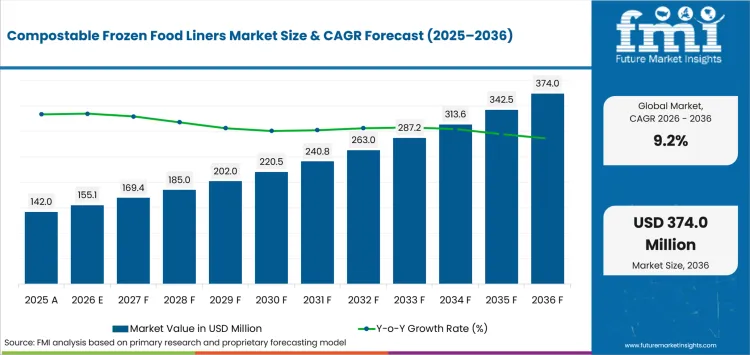
USD 155.1 million in 2026 and USD 374.0 million by 2036 at a 9.2% CAGR.
Demand for compostable frozen food liners is projected to expand at 9.2% CAGR between 2026 and 2036, rising from USD 155.1 million to USD 374.0 million. Frozen food processors need contact layers that hold seals and barriers during freezing without slowing packing lines. The European Commission reported in February 2025 that Regulation (EU) 2025/40 had entered into force. That compliance shift raises specification work across frozen food packaging, although orders depend on food-contact files and validated freezer performance.
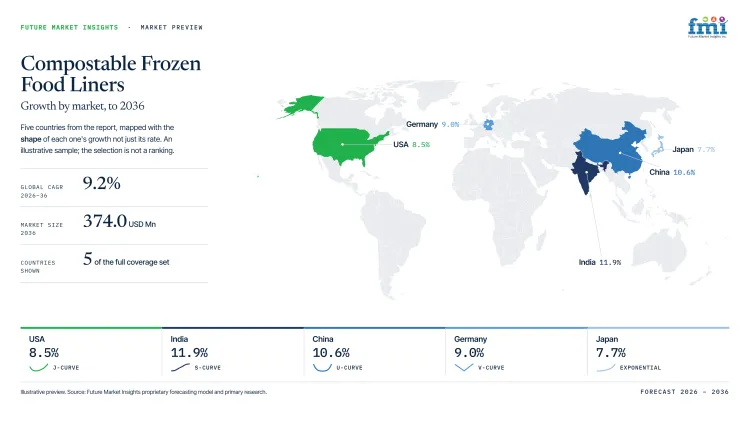
Germany’s 9.0% forecast exceeds the United States at 8.5%, although the gap reflects approval and recovery conditions rather than current market size. Germany’s environment ministry set a 0.5% plastics control value for bio-waste entering treatment from May 2025 and discouraged biodegradable plastic products in bio bins. The rule narrows disposal claims for biodegradable food packaging and forces suppliers to document facility acceptance before frozen-food programs convert.
Key Takeaways
- Packaging rules increase liner qualification as frozen-food barriers must remain stable at commercial packing speeds.
- Certified compostable coated liners are likely to capture 34.0% of product type demand in 2026 attributable to combined barrier qualification.
- By material, paper - fiber is estimated to hold 44.0% in 2026 owing to familiar printing and barrier conversion.
- Industrial compostable is set to lead certification with 56.0% share in 2026 due to standardized managed-treatment qualification.
- Limited collection acceptance raises switching costs as certification cannot guarantee that finished liners reach the treatment route named on packs.
- Futamura, TIPA, Vegware (Novolex), Ahlstrom, Delfort, Novamont, BioBag and Sappi are some key players in this market.
Analyst Perspective
"Frozen-food liners earn approval when compostability survives freezer and sealing tests applied to conventional materials. Packaging teams should compare line-trial evidence first, then verify the claimed composting route at each operating site."
- Nandini Roy Choudhury, Principal Consultant, Future Market Insights
How is the compostable frozen food liners market segmented?
Segmentation covers product type, material, certification, application, end use, sales channel and region.
Product type: certified compostable coated liners, uncoated wet-strength compostable liners, PLA-laminated liners, cellulose film liners and others. Material: paper - fiber, PLA, regenerated cellulose, bagasse - agri-fiber and others. Certification: industrial compostable, home compostable and uncertified. Application: frozen ready meals, frozen meat & seafood, frozen fruits & vegetables, frozen bakery and others. End use: food processors, grocery retail, foodservice and others. Sales channel: direct - OEM supply, packaging distributors, online - e-commerce and others.
What supports frozen ready meals within the application category?
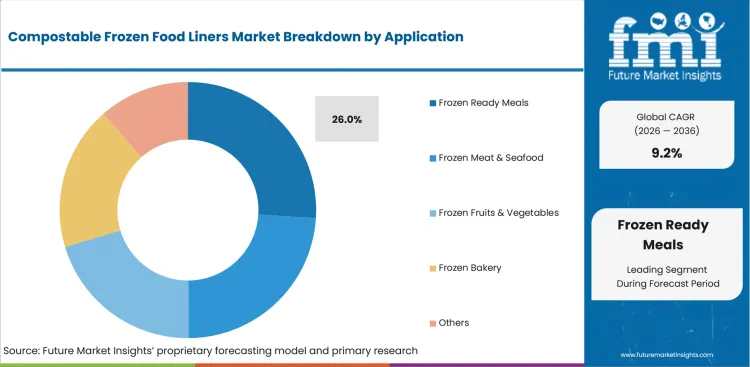
Frozen ready meals place moisture and sealing demands on the same liner during filling plus cold distribution. High-volume lines also require predictable feeding across recipes and tray formats before a material change reaches regular production.
- In 2026, frozen ready meals are expected to lead application with 26.0% share because high-volume lines require reliable food-contact protection.
- Futamura and Biopap reported in April 2026 that NatureFlex-lined compostable foodservice trays tolerate -90°C to +175°C. That range covers frozen storage and reheating, although food grade packaging approval still needs migration plus sealing checks for each liner specification.
What makes certified compostable coated liners central to the product type category?
Certified compostable coated liners need a base that accepts barrier treatment without losing food-contact or end-of-life qualification. Ahlstrom launched LamiBak Flex in March 2025 for pouches and flow packs with coating or extrusion routes and regional compostability suitability.
- By product type, certified compostable coated liners are forecast to represent 34.0% in 2026 driven by barrier and compostability qualification.
- Frozen-food processors move suitable compostable plastic packaging into line trials once sealing and moisture control remain stable at line speed. Repeat orders require food-contact documentation plus a composting route accepted for the finished liner.
How does paper - fiber influence material selection?
Paper - fiber gives converters a familiar surface for printing and coating with enough stiffness for automated handling. Its commercial advantage depends on applying barrier layers without losing the compostability claim assigned to the finished liner.
- Paper - fiber is projected to hold 44.0% share in 2026 owing to established converting knowledge and adaptable food-contact barrier treatments.
- Delfort’s June 2025 thinbarrier 303 launch gives flexible packaging paper a verified food-contact reference from -18°C to +38°C. Converters still need separate compostability evidence for finished coated liners during routine frozen-food approval across processor programs at commercial scale.
What role does industrial compostable play within the certification category?
Industrial compostable certification gives packaging teams a managed-treatment test basis and a defined labeling boundary for finished liners. BPI unveiled its Commercial & Home Compostable Certification program in September 2025 to distinguish disposal conditions for food-contact packaging.
- Based on certification, industrial compostable is projected to account for 56.0% in 2026 due to standardized qualification under controlled treatment conditions.
- Frozen-food processors approve biodegradable packaging claims more confidently once certifiers and waste operators recognize the intended treatment route. The same approval can fail if local facilities reject food-soiled formats covered by the label during normal commercial collection.
What are the drivers, restraints and opportunities in the Compostable Frozen Food Liners Market?
Packaging compliance increases qualification activity, limited collection acceptance slows repeat adoption and higher-barrier compostable structures create the clearest route into demanding frozen-food programs.
- Driver: Packaging rules are pushing frozen-food processors to qualify contact layers that reduce conventional plastic without weakening line performance.
- Restraint: Collection rules and freezer-performance validation raise switching costs when a certified liner lacks an accepted treatment route.
- Opportunity: High-barrier compostable structures can win repeat programs if technical files and existing-equipment trials meet processor approval requirements.
Packaging Rules Pull Qualification Forward
Regulatory deadlines are accelerating packaging replacement decisions across frozen-food categories. California's May 2026 SB 54 requirements call for reductions in single-use plastic and a transition toward recyclable or compostable packaging by 2032. Frozen-food manufacturers therefore need alternative liner formats that protect product quality while maintaining packing-line efficiency. Commercial adoption follows after seal integrity and production-line compatibility are confirmed through qualification trials.
Collection Rules Raise the Switching Threshold
End-of-life infrastructure can determine whether a compostable packaging format is commercially viable. In February 2026, the London Borough of Hackney directed compostable plastics to general waste because local de-packaging systems separate packaging from organics streams. Certification alone is therefore insufficient to support conversion decisions. Frozen-food processors increasingly examine collection arrangements and treatment routes before approving a packaging change. The business case weakens when disposal pathways do not align with sustainability claims.
High-Barrier Films Expand Qualified Use Cases
Advances in barrier performance are widening the range of frozen-food applications that compostable materials can address. TIPA introduced its 312MET home-compostable film in February 2025 with resistance to moisture, oil and salt exposure. Improved barrier properties give liner developers more flexibility when targeting demanding frozen-food formulations. Repeat specifications become more likely when final structures combine freezer performance with a credible recovery pathway and documented end-of-life compatibility.
Which country CAGRs are profiled in the compostable frozen food liners market?
| Country | CAGR |
|---|---|
| Brazil | 9.7% |
| United Kingdom | 9.3% |
| Germany | 9.0% |
| United States | 8.5% |
| Japan | 7.7% |
How do country-level CAGRs compare in the compostable frozen food liners market?
The five forecasts form a tight band around the global 9.2% CAGR across profiled markets, with Brazil and the United Kingdom above that benchmark while Japan forms a slower qualification market. The 2.0-point spread reflects recovery rules and approval routes instead of current revenue or installed liner volume today.
- Brazil links rollout to plastic-recovery obligations and local reverse-logistics planning.
- United Kingdom programs depend on dedicated collection routes for compostable packaging.
- Germany’s contamination controls reward precise disposal claims in mature organic-waste systems.
- United States qualification varies by state rules and uneven organics recovery.
- Japan’s slower pace reflects deliberate approval and tightly specified local disposal instructions.
Similar CAGRs can still carry different market-entry requirements. The full report provides country-level CAGR analysis across North America, Latin America, Europe, East Asia, South Asia, Oceania and the Middle East and Africa.
Country-wise Analysis
- Brazilian food processors serve large urban markets across uneven municipal recovery systems, and the Presidency’s October 2025 Decree 12,688 set a 32% national plastic-packaging recovery target for 2026 under expanded reverse-logistics obligations. Domestic converting options can shorten line trials for national brands during commercial packaging approval cycles, but composting acceptance still varies across municipalities and can break the disposal claim attached to a certified finished liner. Compostable frozen food liner sales in Brazil are forecast to expand at 9.7% CAGR by 2036, supported by programs that pair repeat packaging orders with verified local recovery routes and collection partners.
- United Kingdom retailers and food manufacturers apply detailed packaging specifications across centralized national programs, giving qualified liners access to large accounts but requiring a documented disposal service for each operating site. The United Kingdom’s compostable frozen food liners outlook is anticipated to advance at 9.3% CAGR over the assessment period, aided by experienced converters that can scale successful line trials across several product ranges. Defra reported in March 2025 that workplaces with at least ten employees had to separate food waste from residual waste, so packaging teams must confirm collection-contract acceptance before compostable liner orders expand across multiple facilities.
- German packaging teams work beside substantial organic-waste collection infrastructure, and Destatis reported in December 2025 that 10.7 million tonnes of biowaste represented 28% of household waste collected during 2024. Germany is estimated to post 9.0% CAGR over the forecast period, shaped by capable paper converters and structured compliance programs that can coordinate repeated qualification across large food accounts nationwide. Treatment operators maintain tight contamination controls for incoming biowaste, so liner providers need precise disposal claims plus coating evidence before certified formats convert from processor trials into repeat national retail and foodservice orders across major regions and national markets.
- United States frozen-food processors can run material trials across large national packing networks, although state-level organics services and packaging rules create different recovery conditions for each rollout and finished disposal claim. In the United States compostable frozen food liner demand is predicted to advance at 8.5% CAGR through 2036, as EPA’s March 2026 map update identified more than 15,000 potential food-waste recipient facilities nationwide. Centralized processor qualification can scale successful trials across several plants, but national specifications still need state-ready labels and local facility acceptance before repeat orders reach dispersed production sites and retailer programs across major regions.
- Japanese food manufacturers use detailed supplier qualification and controlled resource-circulation programs, favoring complete technical files even as diverse municipal waste routes slow broad substitution across established frozen-food packaging systems nationwide. In April 2026, Japan’s Environment Ministry reported eight plastic-circulation projects covering design and recovery plus recycling and biomass plastics, reinforcing experimentation without establishing universal acceptance for compostable food-contact formats across municipalities. By 2036 Japan is projected to grow at 7.7% CAGR, influenced by deliberate application testing while broader purchasing depends on disposal instructions that match local systems and finished-liner performance that survives processor approval across national retail programs nationwide.
Who are the notable companies in the compostable frozen food liners market?
Futamura, TIPA, Vegware (Novolex), Ahlstrom, Delfort, Novamont, BioBag and Sappi are the notable companies profiled in this market.
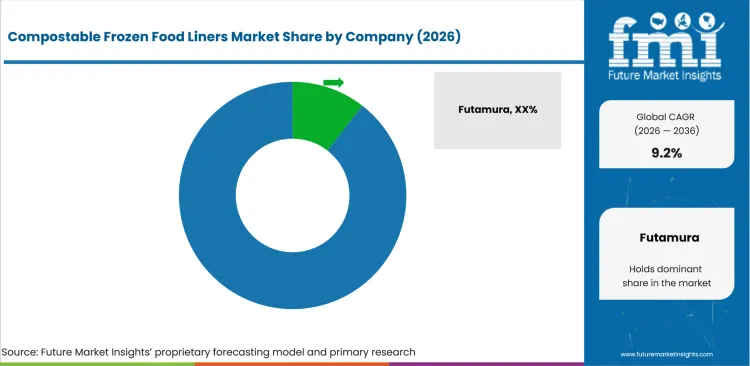
Competition spans compostable film platforms plus fiber barrier papers and converted food formats that can support liner qualification. Frozen-food processors compare compostability with cold-condition protection plus sealing behavior and line compatibility. Related bio-based packaging materials provide upstream options, but a company remains adjacent to this market until its verified evidence covers the finished food-contact or liner use.
- Futamura, TIPA and Novamont provide compostable film or biopolymer platforms used by packagers developing converted food-contact liner structures.
- Ahlstrom, BioBag and Vegware (Novolex) provide certified fiber or converted compostable formats with established food-facing channels.
- Delfort and Sappi supply barrier-paper capability with documented food-contact performance and different levels of frozen-condition evidence.
Competitive Benchmarking: Compostable Frozen Food Liners Market
| Company | Frozen-Condition Barrier and Seal Performance | Certified Compostability Coverage | Conversion and Food-Packaging Integration | Geographic Reach |
|---|---|---|---|---|
| Futamura | High | High | High | Europe, Americas and Asia-Pacific |
| TIPA | Medium | High | High | Europe, North America and Australia |
| Vegware (Novolex) | Medium | High | High | United Kingdom, Europe and North America |
| Ahlstrom | Medium | High | Medium | Global specialty-material sales |
| Novamont | Medium | High | Medium | Europe, North America and Asia |
| BioBag | Medium | High | Medium | Europe with international group distribution |
| Delfort | High | Medium | High | Europe, North America and Australia |
| Sappi | Medium | High | High | Europe and North America with global sales |
Scoring basis: High frozen-condition performance requires documented frozen use plus barrier or sealing evidence. Medium requires current food-contact barrier evidence without direct frozen proof. Low requires a documented cold-use limitation. High compostability coverage requires third-party certification across relevant formats. Medium identifies narrower certified coverage and Low requires a documented non-compostable limitation. High integration requires converted-format or production-line evidence. Medium reflects upstream material support and Low requires a documented conversion limitation. Geographic reach lists verified regions instead of scores.
Key Developments in the Compostable Frozen Food Liners Market
- In April 2026, Sappi North America launched LusterFSB OGR as a grease-resistant food-service board designed for home compostability without polyethylene film.
- In September 2025, TIPA launched four high-barrier compostable film and laminate products for food sachets and snack formats while preserving compatibility with conventional packaging machinery.
- In April 2025, Ahlstrom received home-compostable certification in Australia and New Zealand for Sulpack flexible packaging used in grease-resistant food-contact applications.
Key Players in the Compostable Frozen Food Liners Market
Compostable Film and Biopolymer Platforms
- Futamura
- TIPA
- Novamont
Certified Fiber and Converted Compostable Formats
- Ahlstrom
- BioBag
- Vegware (Novolex)
Food-Barrier Paper Specialists
- Delfort
- Sappi
Compostable Frozen Food Liners Market - Report Scope
| Coverage field | Report scope |
|---|---|
| Market breakdown | By product type, material, certification, application, end use, sales channel and region. |
| Quantitative Units | USD million. |
| Market Definition | Revenue includes compostable liners, sheets, inserts, wraps and inner contact layers sold for frozen food protection or separation. It excludes conventional plastic liners, recyclable-only substitutes and complete finished packs when liner revenue cannot be isolated. |
| Regions Covered | North America, Latin America, Europe, East Asia, South Asia and Pacific, and Middle East and Africa. |
| Countries Covered | Brazil, United Kingdom, Germany, United States, Japan, and 20+ countries included in the full report. |
| Key Companies Profiled | Futamura, TIPA, Vegware (Novolex), Ahlstrom, Delfort, Novamont, BioBag and Sappi. |
| Forecast Period | 2026 to 2036. |
| Approach | Primary and secondary research with market triangulation. |
Compostable Frozen Food Liners Market - Research Methodology
| Method | Approach |
|---|---|
| Primary Research | FMI analysts gathered input from manufacturers, service providers, technology developers, distributors, end users, procurement teams, and subject-matter experts. Interviews examined purchasing decisions, product or service evaluation, adoption barriers, approval requirements, pricing considerations, and expectations for technical or commercial support. Respondents were also asked what evidence is required before a trial, pilot, or initial order develops into regular purchasing. |
| Desk Research | Desk research covered government statistics, regulatory publications, trade data, industry associations, technical literature, standards, company filings, product information, and official corporate announcements. Sources were reviewed for relevance, publication date, geographic coverage, and consistency with the defined market scope. Claims relating to performance, applications, approvals, capacity, investment, and commercial activity were retained only when supported by credible public evidence. |
| Market Sizing and Forecasting | The market model combined the baseline value with historical performance, segment structure, pricing and volume indicators, adoption levels, company participation, and country-level demand conditions. Forecast assumptions considered economic activity, investment trends, regulatory developments, technology adoption, purchasing cycles, supply availability, and barriers to wider market use. Segment and regional estimates were reconciled before the final market total was calculated. |
| Data Validation | Estimates were checked against multiple independent indicators, including public data, company activity, trade patterns, industry developments, and findings from primary interviews. Validation also tested whether products, services, applications, and company revenues fell within the defined market boundaries. Adjacent categories, unsupported claims, overlapping revenues, and activities without direct market relevance were excluded to reduce double counting and maintain consistency across segments and countries. |
Compostable Frozen Food Liners Market by Segments
Compostable Frozen Food Liners Market segmented by Product Type:
- Certified Compostable Coated Liners
- Uncoated Wet-Strength Compostable Liners
- PLA-Laminated Liners
- Cellulose Film Liners
- Others
Compostable Frozen Food Liners Market segmented by Material:
- Paper - Fiber
- PLA
- Regenerated Cellulose
- Bagasse - Agri-Fiber
- Others
Compostable Frozen Food Liners Market segmented by Certification:
- Industrial Compostable
- Home Compostable
- Uncertified
Compostable Frozen Food Liners Market segmented by Application:
- Frozen Ready Meals
- Frozen Meat & Seafood
- Frozen Fruits & Vegetables
- Frozen Bakery
- Others
Compostable Frozen Food Liners Market segmented by End Use:
- Food Processors
- Grocery Retail
- Foodservice
- Others
Compostable Frozen Food Liners Market segmented by Sales Channel:
- Direct - OEM Supply
- Packaging Distributors
- Online - E-commerce
- Others
Compostable Frozen Food Liners Market by Region:
- North America
- United States
- Canada
- Latin America
- Brazil
- Mexico
- Chile
- Rest of Latin America
- Western Europe
- Germany
- United Kingdom
- Italy
- Spain
- France
- Nordics
- Benelux
- Rest of Western Europe
- Eastern Europe
- Russia
- Poland
- Hungary
- Balkan and Baltic States
- Rest of Eastern Europe
- East Asia
- China
- Japan
- South Korea
- South Asia and Pacific
- India
- ASEAN
- Australia and New Zealand
- Rest of South Asia and Pacific
- Middle East and Africa
- Kingdom of Saudi Arabia
- Other GCC Countries
- Türkiye
- South Africa
- Other African Union Countries
- Rest of Middle East and Africa
Research Sources and Bibliography
- European Commission, Directorate-General for Environment. (2025, February 11). New rules enter into force for a more sustainable and competitive packaging economy.
- Federal Ministry for the Environment, Climate Action, Nature Conservation and Nuclear Safety. (2025, April 22). Weniger Kunststoffe im Bioabfall ab Mai 2025.
- Ahlstrom. (2025, March 17). Ahlstrom expands LamiBak™ portfolio with a new base paper for flexible food packaging.
- delfort. (2025, June 17). new barrier paper for varying temperatures: thinbarrier 303 protects food from frozen to tropical.
- Biodegradable Products Institute. (2025, September 18). BPI Launches Commercial & Home Compostable Certification Program, Bringing Food Waste Diversion to Our Backyards.
- Futamura. (2026, April 24). Futamura and Biopap Advance Compostable Food Service Solutions.
- CalRecycle. (2026, May 1). California approves new plastic and packaging rules that put consumers first.
- London Borough of Hackney. (2026, February 2). Garden waste.
- TIPA. (2025, February 12). TIPA Unveils Advanced Home Compostable High-Barrier Film for Sustainable Snack Packaging.
- Presidency of the Federative Republic of Brazil. (2025, October 21). Decreto nº 12.688, de 21 de outubro de 2025.
- Department for Environment, Food & Rural Affairs & Environment Agency. (2025, March 31). New rules simplifying recycling for workplaces in England come into force.
- Statistisches Bundesamt (Destatis). (2025, December 16). 2,8 % mehr Haushaltsabfälle im Jahr 2024.
- USA Environmental Protection Agency. (2026, March 22). Frequent Questions about the USA EPA Excess Food Opportunities Map.
- Ministry of the Environment, Government of Japan. (2026, April 14). 令和7年度プラスチック資源循環に関する先進的社会実装モデル形成支援事業の結果について.
- TIPA. (2025, September 22). TIPA® Compostable Packaging Launches Breakthrough High-Barrier Solutions for Flexible Packaging.
- Vegware. (2026, January 6). 20 Years of Vegware: It started with a spoon.
- Ahlstrom. (2025, April 7). Ahlstrom receives home compostable certification in Australia and New Zealand for Sulpack® Flexible packaging.
- Novamont. (2026, January 15). MATER-BI TAKES ON A NEW LOOK: NOVAMONT UNVEILS ITS REBRANDING AND COMMUNICATION CAMPAIGN.
- Biodegradable Products Institute. (n.d.). BioBag Americas Inc. Retrieved August 8, 2026.
- Sappi North America. (2026, April 13). Sappi North America Introduces LusterFSB OGR, a Grease Resistant Food Service Board Designed for Compostability.
- TIPA. (2025, October 20). TIPA® Acquires SEALPAP®: Delivering Full-Service Sustainable Packaging for a Circular Future.
- delfort. (2025, October 13). paper packaging for ice lollies: delfort and Rieusset Gerosa Group join forces.
- Vegware. (2025, January 20). New Vegware and Food4Soil composting partnership.
- Ahlstrom. (2026, June 17). Ahlstrom renews CMA-W compostability certification for GVP food-grade portfolio.
- TIPA. (2025, September 4). TIPA® Compostable Packaging Launches Home Compostable Label for Fresh Produce.
- BioBag. (n.d.). Certifications. Retrieved August 9, 2026.
- Sappi. (n.d.). Sappi at Interpack 2026: Addressing confectionery packaging recyclability under PPWR. Retrieved August 9, 2026.
- Novamont. (2022, October 19). BIO-BASED AND LOW ENVIRONMENTAL FOOTPRINT: APPLICATIONS IN NOVAMONT’S MATER-BI BIOPLASTIC FOR THE FOOD PACKAGING, CATERING, RETAIL AND AGRICULTURAL SECTORS ON DISPLAY AT K.
- Futamura. (n.d.). Media Centre. Retrieved August 9, 2026.
- Futamura. (n.d.). Compostable alternatives for produce labelling. Retrieved August 9, 2026.
This bibliography is provided for reader reference and is not exhaustive. The full report contains the complete reference list and detailed citations.
This Report Answers
- How do packaging rules change frozen-liner qualification?
- Why do coated compostable liners lead product type?
- What makes paper - fiber attractive to converters?
- Why does industrial compostable certification lead its category?
- How do collection rules affect repeat liner orders?
- Why do country CAGRs imply different entry conditions?
- Which companies cover films, papers and converted formats?
- Which recent developments changed qualified packaging options?
- What should processors compare beyond unit liner price?
Frequently Asked Questions
How big is the compostable frozen food liners market in 2026?
The compostable frozen food liners market is valued at USD 155.1 million in 2026 and is projected to reach USD 374.0 million by 2036. Growth is driven by increasing adoption of compostable packaging solutions that maintain frozen-food protection while supporting sustainability goals.
What is the CAGR of the compostable frozen food liners market from 2026 to 2036?
The compostable frozen food liners market is projected to grow at a CAGR of 9.2% between 2026 and 2036. Expansion is supported by evolving packaging regulations and rising demand for sustainable food-contact materials.
Which product type is projected to account for 34.0% of the compostable frozen food liners market?
Certified compostable coated liners are projected to account for 34.0% of the market in 2026. Their leading share is supported by their ability to provide grease and moisture resistance while meeting compostability requirements.
Which application segment is projected to account for 26.0% of the compostable frozen food liners market?
Frozen ready meals are projected to account for 26.0% of the market in 2026. Their leading position is driven by high-volume production and the need for reliable sealing and product protection throughout frozen distribution.
Which companies are active in the compostable frozen food liners market?
Key companies operating in the market include Futamura, TIPA, Vegware (Novolex), Ahlstrom, Delfort, Novamont, BioBag, and Sappi. These companies provide compostable films, barrier papers, and food-contact packaging solutions for frozen-food applications.
Preview the report firsthand - request a free sample
Get SampleGet the brochure for pricing and purchase details.
Get PDFTable of Content
- Key Takeaways
- Market Size and CAGR
- Top Growth Driver
- Fastest Growing Segment
- Leading Region
- Key Companies
- Emerging Opportunities
- Executive Summary
- Global Market Outlook
- Demand-side Trends
- Supply-side Trends
- Technology Roadmap Analysis
- Analysis and Recommendations
- Analyst Perspective (What is happening? Why now? What should investors know?)
- Key Questions Answered
- How large is the market?
- What is the CAGR?
- What are key trends?
- Which region dominates?
- Who are the leaders?
- Market Overview
- Market Coverage / Taxonomy
- Market Definition / Scope / Limitations
- Research Methodology
- Chapter Orientation
- Analytical Lens and Working Hypotheses
- Market Structure, Signals, and Trend Drivers
- Benchmarking and Cross-market Comparability
- Market Sizing, Forecasting, and Opportunity Mapping
- Research Design and Evidence Framework
- Desk Research Programme (Secondary Evidence)
- Expert Input and Fieldwork (Primary Evidence)
- Tooling, Models, and Reference Databases
- Data Engineering and Model Build
- Quality Assurance and Audit Trail
- Market Background
- Market Dynamics (Drivers, Restraints, Opportunity, Trends)
- Scenario Forecast (Optimistic, Likely, Conservative)
- Impact Analysis
- AI Impact
- Sustainability Impact
- Regulatory Impact
- Technology Impact
- Consumer / Buyer Analysis
- Purchase Drivers
- Adoption Barriers
- Buyer Journey
- Opportunity Map Analysis
- Product Life Cycle Analysis
- Supply Chain Analysis
- Investment Feasibility Matrix
- Value Chain Analysis
- PESTLE and Porter's Analysis
- Regulatory Landscape
- Regional Parent Market Outlook
- Production and Consumption Statistics
- Import and Export Statistics
- Global Market Analysis and Forecast, 2021 to 2036
- Historical Market Size Value (USD Million) Analysis, 2021 to 2025
- Current and Future Market Size Value (USD Million) Projections, 2026 to 2036
- Y-o-Y Growth Trend Analysis
- Absolute $ Opportunity Analysis
- Global Market Pricing Analysis, 2021 to 2036
- Global Market Analysis and Forecast, By Product Type, 2021 to 2036
- Introduction / Key Findings
- Historical Market Size Value (USD Million) Analysis By Product Type, 2021 to 2025
- Current and Future Market Size Value (USD Million) Analysis and Forecast By Product Type, 2026 to 2036
- Certified Compostable Coated Liners
- Uncoated Wet-Strength Compostable Liners
- PLA-Laminated Liners
- Cellulose Film Liners
- Others
- Certified Compostable Coated Liners
- Y-o-Y Growth Trend Analysis By Product Type, 2021 to 2025
- Absolute $ Opportunity Analysis By Product Type, 2026 to 2036
- Global Market Analysis and Forecast, By Material, 2021 to 2036
- Introduction / Key Findings
- Historical Market Size Value (USD Million) Analysis By Material, 2021 to 2025
- Current and Future Market Size Value (USD Million) Analysis and Forecast By Material, 2026 to 2036
- Paper - Fiber
- PLA
- Regenerated Cellulose
- Bagasse - Agri-Fiber
- Others
- Paper - Fiber
- Y-o-Y Growth Trend Analysis By Material, 2021 to 2025
- Absolute $ Opportunity Analysis By Material, 2026 to 2036
- Global Market Analysis and Forecast, By Certification, 2021 to 2036
- Introduction / Key Findings
- Historical Market Size Value (USD Million) Analysis By Certification, 2021 to 2025
- Current and Future Market Size Value (USD Million) Analysis and Forecast By Certification, 2026 to 2036
- Industrial Compostable
- Home Compostable
- Uncertified
- Industrial Compostable
- Y-o-Y Growth Trend Analysis By Certification, 2021 to 2025
- Absolute $ Opportunity Analysis By Certification, 2026 to 2036
- Global Market Analysis and Forecast, By Application, 2021 to 2036
- Introduction / Key Findings
- Historical Market Size Value (USD Million) Analysis By Application, 2021 to 2025
- Current and Future Market Size Value (USD Million) Analysis and Forecast By Application, 2026 to 2036
- Frozen Ready Meals
- Frozen Meat & Seafood
- Frozen Fruits & Vegetables
- Frozen Bakery
- Others
- Frozen Ready Meals
- Y-o-Y Growth Trend Analysis By Application, 2021 to 2025
- Absolute $ Opportunity Analysis By Application, 2026 to 2036
- Global Market Analysis and Forecast, By End Use, 2021 to 2036
- Introduction / Key Findings
- Historical Market Size Value (USD Million) Analysis By End Use, 2021 to 2025
- Current and Future Market Size Value (USD Million) Analysis and Forecast By End Use, 2026 to 2036
- Food Processors
- Grocery Retail
- Foodservice
- Others
- Food Processors
- Y-o-Y Growth Trend Analysis By End Use, 2021 to 2025
- Absolute $ Opportunity Analysis By End Use, 2026 to 2036
- Global Market Analysis and Forecast, By Sales Channel
- Introduction / Key Findings
- Historical Market Size Value (USD Million) Analysis By Sales Channel, 2021 to 2025
- Current and Future Market Size Value (USD Million) Analysis and Forecast By Sales Channel, 2026 to 2036
- Direct - OEM Supply
- Packaging Distributors
- Online - E-commerce
- Others
- Direct - OEM Supply
- Y-o-Y Growth Trend Analysis By Sales Channel, 2021 to 2025
- Absolute $ Opportunity Analysis By Sales Channel, 2026 to 2036
- Global Market Analysis and Forecast, By Region, 2021 to 2036
- Introduction
- Historical Market Size Value (USD Million) Analysis By Region, 2021 to 2025
- Current Market Size Value (USD Million) Analysis and Forecast By Region, 2026 to 2036
- North America
- Latin America
- Western Europe
- Eastern Europe
- East Asia
- South Asia and Pacific
- Middle East & Africa
- Market Attractiveness Analysis By Region
- North America Market Analysis and Forecast, By Country, 2021 to 2036
- Historical Market Size Value (USD Million) Trend Analysis By Market Taxonomy, 2021 to 2025
- Market Size Value (USD Million) Forecast By Market Taxonomy, 2026 to 2036
- By Country
- USA
- Canada
- By Product Type
- By Material
- By Certification
- By Application
- By End Use
- By Sales Channel
- By Country
- Market Attractiveness Analysis
- By Country
- By Product Type
- By Material
- By Certification
- By Application
- By End Use
- By Sales Channel
- Key Takeaways
- Latin America Market Analysis and Forecast, By Country
- Historical Market Size Value (USD Million) Trend Analysis By Market Taxonomy, 2021 to 2025
- Market Size Value (USD Million) Forecast By Market Taxonomy, 2026 to 2036
- By Country
- Brazil
- Mexico
- Chile
- Rest of Latin America
- By Product Type
- By Material
- By Certification
- By Application
- By End Use
- By Sales Channel
- By Country
- Market Attractiveness Analysis
- By Country
- By Product Type
- By Material
- By Certification
- By Application
- By End Use
- By Sales Channel
- Key Takeaways
- Western Europe Market Analysis and Forecast, By Country
- Historical Market Size Value (USD Million) Trend Analysis By Market Taxonomy, 2021 to 2025
- Market Size Value (USD Million) Forecast By Market Taxonomy, 2026 to 2036
- By Country
- Germany
- UK
- Italy
- Spain
- France
- Nordic
- BENELUX
- Rest of Western Europe
- By Product Type
- By Material
- By Certification
- By Application
- By End Use
- By Sales Channel
- By Country
- Market Attractiveness Analysis
- By Country
- By Product Type
- By Material
- By Certification
- By Application
- By End Use
- By Sales Channel
- Key Takeaways
- Eastern Europe Market Analysis and Forecast, By Country
- Historical Market Size Value (USD Million) Trend Analysis By Market Taxonomy, 2021 to 2025
- Market Size Value (USD Million) Forecast By Market Taxonomy, 2026 to 2036
- By Country
- Russia
- Poland
- Hungary
- Balkan & Baltic
- Rest of Eastern Europe
- By Product Type
- By Material
- By Certification
- By Application
- By End Use
- By Sales Channel
- By Country
- Market Attractiveness Analysis
- By Country
- By Product Type
- By Material
- By Certification
- By Application
- By End Use
- By Sales Channel
- Key Takeaways
- East Asia Market Analysis and Forecast, By Country
- Historical Market Size Value (USD Million) Trend Analysis By Market Taxonomy, 2021 to 2025
- Market Size Value (USD Million) Forecast By Market Taxonomy, 2026 to 2036
- By Country
- China
- Japan
- South Korea
- By Product Type
- By Material
- By Certification
- By Application
- By End Use
- By Sales Channel
- By Country
- Market Attractiveness Analysis
- By Country
- By Product Type
- By Material
- By Certification
- By Application
- By End Use
- By Sales Channel
- Key Takeaways
- South Asia and Pacific Market Analysis and Forecast, By Country
- Historical Market Size Value (USD Million) Trend Analysis By Market Taxonomy, 2021 to 2025
- Market Size Value (USD Million) Forecast By Market Taxonomy, 2026 to 2036
- By Country
- India
- ASEAN
- Australia & New Zealand
- Rest of South Asia and Pacific
- By Product Type
- By Material
- By Certification
- By Application
- By End Use
- By Sales Channel
- By Country
- Market Attractiveness Analysis
- By Country
- By Product Type
- By Material
- By Certification
- By Application
- By End Use
- By Sales Channel
- Key Takeaways
- Middle East & Africa Market Analysis and Forecast, By Country
- Historical Market Size Value (USD Million) Trend Analysis By Market Taxonomy, 2021 to 2025
- Market Size Value (USD Million) Forecast By Market Taxonomy, 2026 to 2036
- By Country
- Kingdom of Saudi Arabia
- Other GCC Countries
- Türkiye
- South Africa
- Other African Union
- Rest of Middle East & Africa
- By Product Type
- By Material
- By Certification
- By Application
- By End Use
- By Sales Channel
- By Country
- Market Attractiveness Analysis
- By Country
- By Product Type
- By Material
- By Certification
- By Application
- By End Use
- By Sales Channel
- Key Takeaways
- Key Countries Market Analysis
- USA
- Pricing Analysis
- Market Share Analysis, 2025
- By Product Type
- By Material
- By Certification
- By Application
- By End Use
- By Sales Channel
- Canada
- Pricing Analysis
- Market Share Analysis, 2025
- By Product Type
- By Material
- By Certification
- By Application
- By End Use
- By Sales Channel
- Mexico
- Pricing Analysis
- Market Share Analysis, 2025
- By Product Type
- By Material
- By Certification
- By Application
- By End Use
- By Sales Channel
- Brazil
- Pricing Analysis
- Market Share Analysis, 2025
- By Product Type
- By Material
- By Certification
- By Application
- By End Use
- By Sales Channel
- Chile
- Pricing Analysis
- Market Share Analysis, 2025
- By Product Type
- By Material
- By Certification
- By Application
- By End Use
- By Sales Channel
- Germany
- Pricing Analysis
- Market Share Analysis, 2025
- By Product Type
- By Material
- By Certification
- By Application
- By End Use
- By Sales Channel
- UK
- Pricing Analysis
- Market Share Analysis, 2025
- By Product Type
- By Material
- By Certification
- By Application
- By End Use
- By Sales Channel
- Italy
- Pricing Analysis
- Market Share Analysis, 2025
- By Product Type
- By Material
- By Certification
- By Application
- By End Use
- By Sales Channel
- Spain
- Pricing Analysis
- Market Share Analysis, 2025
- By Product Type
- By Material
- By Certification
- By Application
- By End Use
- By Sales Channel
- France
- Pricing Analysis
- Market Share Analysis, 2025
- By Product Type
- By Material
- By Certification
- By Application
- By End Use
- By Sales Channel
- India
- Pricing Analysis
- Market Share Analysis, 2025
- By Product Type
- By Material
- By Certification
- By Application
- By End Use
- By Sales Channel
- ASEAN
- Pricing Analysis
- Market Share Analysis, 2025
- By Product Type
- By Material
- By Certification
- By Application
- By End Use
- By Sales Channel
- Australia & New Zealand
- Pricing Analysis
- Market Share Analysis, 2025
- By Product Type
- By Material
- By Certification
- By Application
- By End Use
- By Sales Channel
- China
- Pricing Analysis
- Market Share Analysis, 2025
- By Product Type
- By Material
- By Certification
- By Application
- By End Use
- By Sales Channel
- Japan
- Pricing Analysis
- Market Share Analysis, 2025
- By Product Type
- By Material
- By Certification
- By Application
- By End Use
- By Sales Channel
- South Korea
- Pricing Analysis
- Market Share Analysis, 2025
- By Product Type
- By Material
- By Certification
- By Application
- By End Use
- By Sales Channel
- Russia
- Pricing Analysis
- Market Share Analysis, 2025
- By Product Type
- By Material
- By Certification
- By Application
- By End Use
- By Sales Channel
- Poland
- Pricing Analysis
- Market Share Analysis, 2025
- By Product Type
- By Material
- By Certification
- By Application
- By End Use
- By Sales Channel
- Hungary
- Pricing Analysis
- Market Share Analysis, 2025
- By Product Type
- By Material
- By Certification
- By Application
- By End Use
- By Sales Channel
- Kingdom of Saudi Arabia
- Pricing Analysis
- Market Share Analysis, 2025
- By Product Type
- By Material
- By Certification
- By Application
- By End Use
- By Sales Channel
- Türkiye
- Pricing Analysis
- Market Share Analysis, 2025
- By Product Type
- By Material
- By Certification
- By Application
- By End Use
- By Sales Channel
- South Africa
- Pricing Analysis
- Market Share Analysis, 2025
- By Product Type
- By Material
- By Certification
- By Application
- By End Use
- By Sales Channel
- USA
- Market Structure Analysis
- Competition Dashboard
- Competition Benchmarking
- Market Share Analysis of Top Players
- By Regional
- By Product Type
- By Material
- By Certification
- By Application
- By End Use
- By Sales Channel
- Emerging Startups
- Innovation Benchmarking
- Competition Analysis
- Competition Deep Dive
- Futamura
- Overview
- Product Portfolio
- Profitability by Market Segments
- Sales Footprint
- Strategy Overview
- Marketing Strategy
- Product Strategy
- Channel Strategy
- TIPA
- Vegware (Novolex)
- Ahlstrom
- Delfort
- Novamont
- BioBag
- Koehler Paper
- Sappi
- Seaman Paper
- Futamura
- Case Studies
- Success Stories
- Recent Developments
- Competition Deep Dive
- Assumptions & Acronyms Used


