

- Market Size (2026)
- USD 449.6 Mn
- Forecast (2036)
- USD 1064.4 Mn
- CAGR (2026 to 2036)
- 9.0%
How big is Compostable Dunnage Market in 2026?
USD 449.6 million in 2026 and USD 1,064.4 million by 2036 at a 9.0% CAGR.
Demand for compostable dunnage stands at USD 449.6 million in 2026 and climbs to USD 1064.4 million by 2036, growing at a 9.0% CAGR. Growth is driven by e-commerce and industrial shippers needing tested cushioning, separation, blocking, wrapping, and void-fill formats that meet sustainability commitments without slowing pack lines. China's parcel volume alone illustrates the scale of the underlying shipping base: State Post Bureau data shows the country's courier sector handled 199 billion parcels in 2025, and every one of those shipments needs some form of protective packaging, which puts sustained pressure on fiber and certified biopolymer formats to perform at pack-line speed rather than just on a sustainability checklist.
Switching from conventional to compostable dunnage plays out differently by country and route, which slows any single global rollout plan. US fulfillment centers weigh dispensing speed and equipment uptime above most other factors, German buyers require clear material classifications and system-participation documentation before adoption, Indian buyers face sharper price and humidity constraints, and Japanese buyers prioritize precise fit and clean presentation over cost alone. Total packed cost, covering labor, damage, storage, freight, fees, and end-of-life handling, ends up mattering more to adoption than the sticker price of the material itself. The stronger opportunities lie in formats engineered for high-speed dispensing equipment, certified biopolymers that meet varied national compostability standards, and dunnage designed to pair with other protective packaging in mixed-load shipments. By material type, format, and end-use industry, cost and performance requirements differ enough to warrant separate treatment. Regionally, adoption moves fastest where e-commerce volume and packaging regulation are both climbing together, since that combination gives compostable formats their clearest business case.
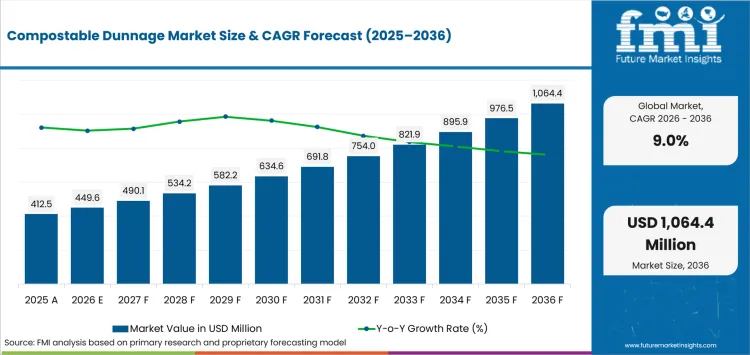
Key Takeaways of Compostable Dunnage Market
- Parcel growth, plastic-reduction requirements, and damage-control economics support demand for fiber and certified compostable protection.
- Direct / OEM Supply leads the sales channel at 42.0% in 2026 because qualification is technical.
- Recycled Paper Pulp leads material at 34.0%, while Molded Pulp Inserts lead product type at 28.0%.
- Trays & End Caps lead form at 30.0%, and E-commerce & Retail leads end use.
- Drop, vibration, compression, humidity, and disposal checks determine conversion from plastic protection.
- India leads the profiled country growth rates at 11.8% through 2036, followed by China at 10.6%.
- System suppliers, molded-fiber specialists, and integrated paper groups compete on protection proof, line fit, local production, and technical support.
Analyst Perspective
"Compostable dunnage is not a simple material substitution. Buyers must prove that it can withstand drops, compression, vibration and humidity without slowing packing lines or increasing product damage. Suppliers that combine verified transit performance with local production and realistic disposal guidance will gain business, while products relying mainly on sustainability claims will struggle to pass qualification."
- Nandini Roy Choudhury, Principal Consultant, FMI
How is the Compostable Dunnage Market segmented?
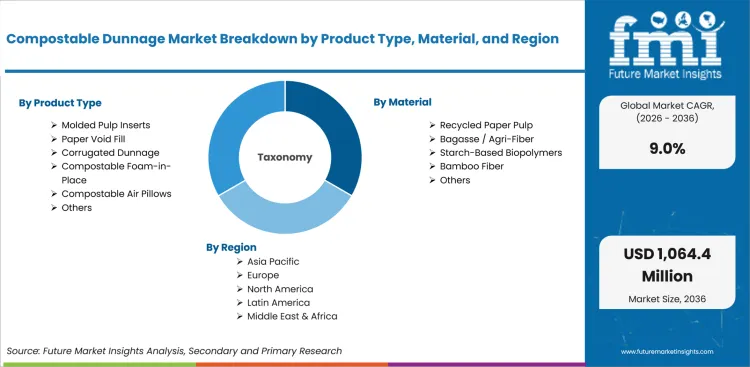
The market is analyzed by Product Type, Material, Form, Application, End Use, Sales Channel, and Region. These categories separate the protective job from the material choice and the buyer's operating conditions. A molded part for a repeat electronics program is specified differently from paper fill for mixed e-commerce orders, even when both carry a similar sustainability claim.
What makes molded pulp Inserts central to the product type category?
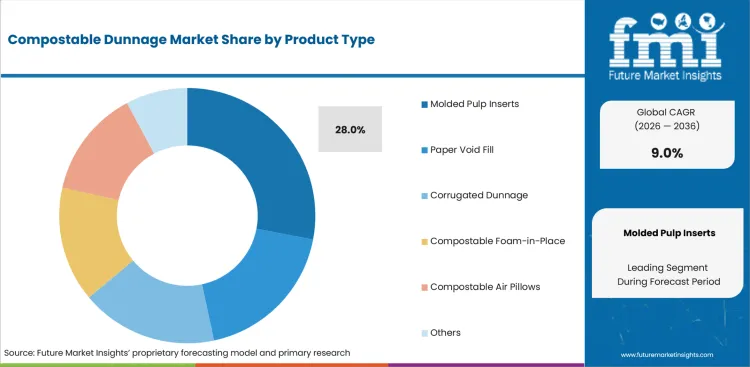
Molded pulp inserts hold a product in a fixed, engineered position rather than simply filling empty carton space, using cavities, ribs, and crush zones to distribute load and absorb impact during transit. Packaging engineers on electronics and appliance programs are the primary specifiers, and the deciding factor is whether tooling investment can be justified across a stable, repeat production volume, since molded tooling only pays off when order volume supports it.
- Molded pulp inserts hold 28.0% share of Product Type in 2026, reflecting the format's advantage in programs where engineered fit and unboxing presentation matter more than raw cost per unit.
- Repeat specification depends on consistent crush-zone performance across production runs, since a batch with inconsistent density undermines the protective fit the tooling was designed around. Converters demonstrating tight dimensional tolerance retain program business through renewal cycles.
Why does recycled paper pulp lead the material category?
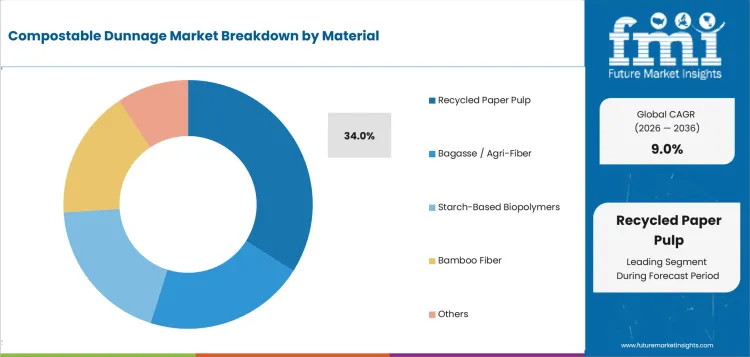
Recycled paper pulp benefits from collection, pulping, forming, and converting infrastructure that's already built out at scale, unlike newer compostable materials still developing regional processing capacity. Converters serving trays, caps, partitions, and inserts are the primary users, and the deciding factor is whether the finished part's disposal instructions hold up against local paper-stream contamination rules, since a coated or contaminated part can be rejected from the intended recycling or composting route.
- Recycled paper pulp accounts for 34.0% share of Material in 2026, supported by established regional processing infrastructure that lets converters produce closer to demand than materials requiring longer supply chains.
- Disposal-instruction clarity shapes buyer confidence, since a material that ends up rejected from its intended paper stream due to coating or contamination undercuts the sustainability claim buyers are paying for. Suppliers providing clear, verified disposal guidance retain accounts through repeat orders.
How do trays & end caps define the form category?
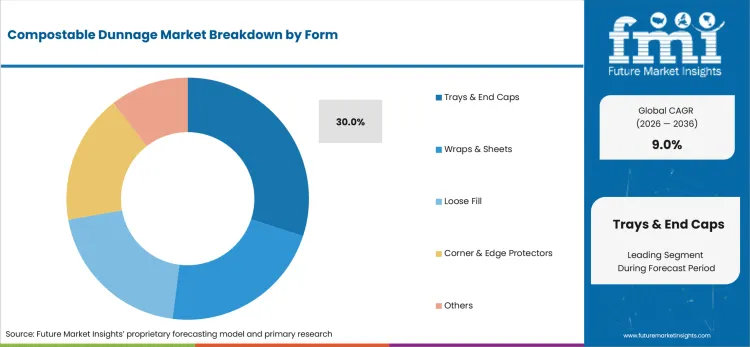
Trays and end caps place protection at the specific contact points where a product is most vulnerable, creating predictable clearances inside the carton rather than relying on loose fill to settle into position. Buyers shipping appliances, glassware, and electronics are the primary users, and the deciding factor is whether the format's compression set and humidity response hold up across the actual shipping route, since a tray that deforms under sustained load or humidity fails at the point it's needed most.
- Trays and end caps hold 30.0% share of Form in 2026, reflecting their fit for products needing protection concentrated at specific vulnerable points rather than uniform cushioning throughout the carton.
- Route-specific performance testing drives repeat specification, since a format that performs well in one climate or transit duration may not hold up on a longer or more humid route. Suppliers validating performance against the buyer's actual shipping conditions retain business over untested alternatives.
What supports consumer goods / E-commerce in the application category?
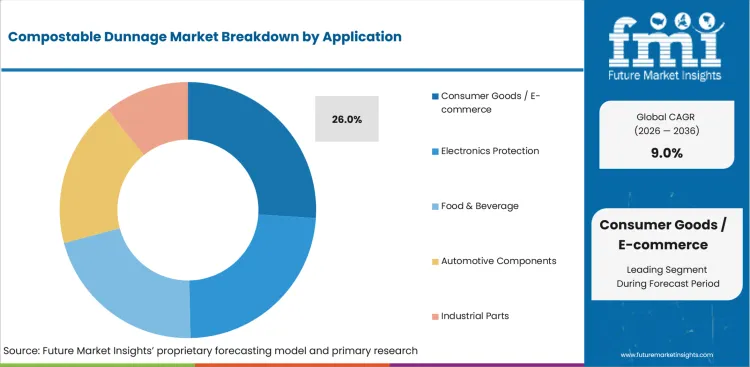
Parcel operations face SKU variety and frequent handling that a single dunnage format rarely solves alone, often requiring wraps for delicate surfaces, void fill for irregular items, and molded parts for repeat SKUs within the same fulfillment center. Fulfillment and packaging operations teams are the primary buyers, and the deciding factor is whether the supplier can show that reduced damage and faster packing time offset the cost premium compostable materials often carry over conventional dunnage.
- Consumer goods and e-commerce represent 26.0% share of Application in 2026, reflecting the segment's exposure to high SKU variety and customer-visible packaging that puts sustainability claims directly in front of the end consumer.
- Packing speed is a practical constraint fulfillment operations weigh heavily, since a compostable format that slows down packer throughput creates a labor cost that can outweigh the material's sustainability benefit. Suppliers demonstrating comparable pack speed to conventional dunnage win broader adoption.
What drives E-commerce & retail in the end use category?
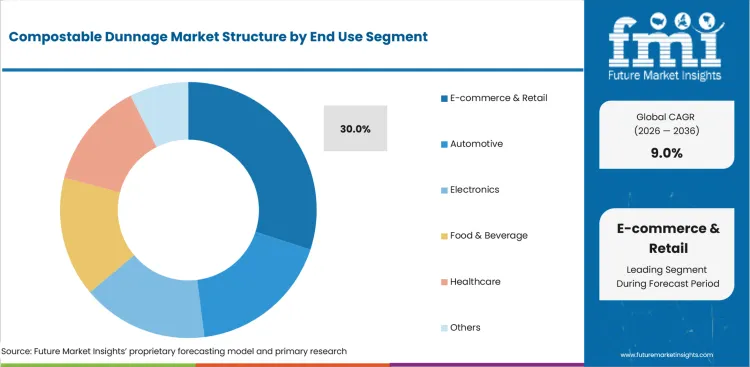
E-commerce and retail consume dunnage with every order shipped, which puts the material and its disposal guidance directly in front of the end customer rather than staying internal to a facility. Retailers and their fulfillment partners are the primary buyers, and the deciding factor is whether converter reliability holds up through seasonal peaks, since a supply gap during a high-volume period disrupts order fulfillment at the worst possible time.
- E-commerce and retail hold 30.0% share of End Use in 2026, reflecting the segment's direct link between order volume and dunnage reorder frequency.
- Seasonal capacity planning shapes long-term supplier relationships, since a converter unable to scale output ahead of a predictable peak season risks losing the account to a competitor with more flexible capacity. Suppliers demonstrating peak-season reliability retain retail accounts through renewal.
Why is direct / OEM supply central to the sales channel category?
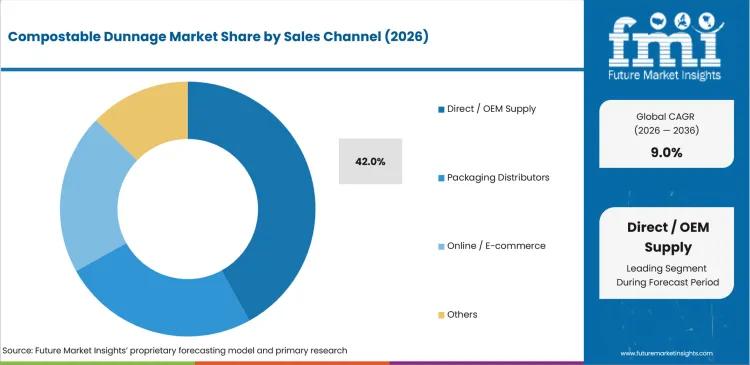
Large dunnage programs get designed directly into a pack specification and validated before routine purchasing even begins, a process that favors a direct technical relationship between converter and buyer over a distributor intermediary. Packaging engineers, quality teams, and procurement are all involved across this validation process, and the deciding factor is whether the direct relationship can support sampling, trials, and ongoing service once the program moves into production.
- Direct and OEM supply leads Sales Channel with 42.0% share in 2026, reflecting how molded parts and automated paper systems require validation steps that a distributor relationship typically can't support as efficiently.
- Distributor relevance persists for standard consumables and smaller accounts, since not every buyer needs the sampling and validation depth a direct relationship provides. Converters maintaining both channels capture programs at different stages of technical complexity.
What are the drivers, restraints, and opportunities in the Compostable Dunnage Market?
- Driver: More parcels and packaging-accountability rules increase demand for proven alternatives to persistent plastic protection.
- Restraint: Material premiums, tooling, humidity sensitivity, route-specific qualification, and unclear collection pathways delay adoption.
- Opportunity: Automated paper systems and locally sourced molded agri-fiber can reduce labor, freight, and material use.
The compostable dunnage market is gaining attention as manufacturers and logistics providers replace persistent plastic protective packaging with fiber-based alternatives that align with packaging accountability requirements. Growing parcel shipments have increased the importance of protective materials that limit product damage while reducing packaging waste. Product selection depends on verified shipping performance instead of sustainability claims alone. Compostable dunnage must maintain cushioning strength during drop impact, vibration, compression, warehouse storage, and changing moisture conditions before it is accepted for routine distribution.
Packaging equipment is influencing supplier selection alongside material performance. Vision-guided paper dispensing systems reduce unnecessary paper use by matching void fill more precisely to package dimensions, while adjustable-speed paper conversion equipment improves packing consistency across high-volume fulfillment lines. Molded agricultural fiber is also receiving greater commercial interest because regional raw material sourcing may reduce freight requirements and lessen reliance on conventional plastic cushioning. These developments place equal importance on packaging efficiency and shipment protection during commercial evaluation.
Higher material costs, tooling investment, humidity sensitivity, and route-specific qualification testing continue to slow wider adoption across distribution networks. Disposal infrastructure creates another practical consideration because certified compostability does not always correspond with available collection systems at the shipment destination. Buyers increasingly examine protective performance, operational compatibility, and realistic end-of-life handling together before replacing existing packaging formats. This broader evaluation process is shaping supplier competition and product development across the compostable dunnage market.
How do country-level CAGRs compare in the Compostable Dunnage Market?
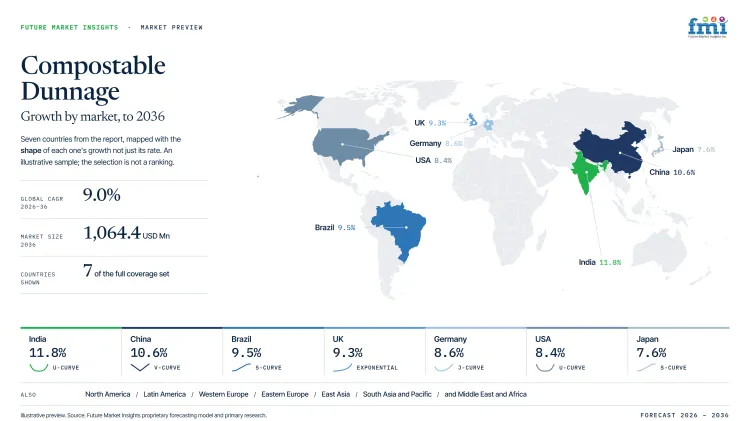
| Country | CAGR, 2026 to 2036 |
|---|---|
| USA | 8.4% |
| China | 10.6% |
| Germany | 8.6% |
| Japan | 7.6% |
| India | 11.8% |
| UK | 9.3% |
| Brazil | 9.5% |
India is 1.2 percentage points ahead of China, while Japan is the slowest profiled market. Growth rates alone do not establish market size or ease of entry. Suppliers should test shipment density, fiber availability, qualification practices, labor economics, regulation, and addressable value per shipment.
Country-wise Analysis
- USA: Demand is poised to rise at 8.4% CAGR. Multi-site fulfillment buyers value converter uptime, transit data, and total-cost evidence. California's 2025 SB 54 classifications improve the case for molded fiber without plastic components, but disposal rules and compost access remain uneven.
- China: Sales are on track to grow at 10.6% CAGR. The country's 199 billion courier parcels in 2025 create a large protection base. Local conversion, high-speed trials, and measurable material savings matter because price pressure and SKU changes are intense.
- Germany: The market is set to expand at 8.6% CAGR. Buyers need clear material composition, LUCID alignment, and defensible recycling instructions. Mono-material designs and stable recovered-fiber quality help shorten approval cycles.
- Japan: Demand is on track to increase at 7.6% CAGR. Compact packs, precise fit, clean surfaces, and low variability matter for electronics and branded goods. Conservative qualification and limited compost collection favor tightly specified recyclable-fiber solutions.
- India: Sales are poised to rise at 11.8% CAGR. Policy pressure on identified single-use plastics supports alternatives, but delivered cost, monsoon humidity, and feedstock consistency remain binding. Local bagasse or recycled-fiber sourcing can improve the case.
- UK: Adoption is poised to advance at 9.3% CAGR. Retailers assess producer-fee exposure, paper-stream compatibility, and disposal clarity. Suppliers should avoid claims that exceed the collection route available to the recipient.
- Brazil: Demand is set to grow at 9.5% CAGR. Long transport distances and variable humidity favor reliable compression performance. Local converter partnerships and reverse-logistics evidence are important under the country's recycling-credit framework.
Who are the notable companies in the Compostable Dunnage Market?
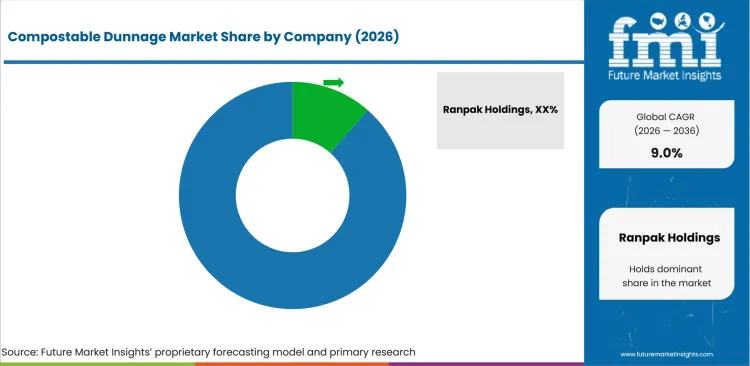
The market includes three competitive groups. Ranpak Holdings, Storopack, Pregis, and Sealed Air compete through on-demand systems, consumables, pack-station integration, and service. UFP Technologies, Huhtamaki, and Brodrene Hartmann bring molded-component and tooling capability, although UFP's present role is narrower after its 2022 divestiture. Sonoco, Cascades, and Smurfit WestRock contribute paper conversion, structural formats, and regional account access. Buyers should compare capability, manufacturing proximity, application support, and service continuity.
Competitive Benchmarking: Compostable Dunnage Market
| Company | On-Demand Systems | Custom Molded Fiber | Paper-Based Structural Protection | Geographic Reach |
|---|---|---|---|---|
| Ranpak Holdings | High | Unscored | Medium | North America, Europe, Asia-Pacific |
| Storopack | High | Medium | Medium | Europe, North America, Asia |
| Pregis | High | Unscored | Medium | North America, Europe |
| UFP Technologies | Unscored | Low | Unscored | North America |
| Sonoco / Cascades / Smurfit WestRock | Medium | Medium | High | Major global regions |
| Huhtamaki / Brodrene Hartmann / Sealed Air | Mixed | High or Unscored | Medium | Major global regions |
Key Developments in the Compostable Dunnage Market
- In January 2025, Ranpak launched PadPak Multi-Station, DecisionTower with FillPak Trident, and Pad'it. Multi-Station can serve up to ten pack stations, while Pad'it can place pads at up to 15 boxes per minute.
- In November 2024, Storopack launched RENATURE Wrap, a TÜV Austria home-compostable starch-based wrapping and cushioning material for sensitive or irregular products.
- In June 2022, Huhtamaki announced an almost USD 100 million expansion of molded-fiber capacity in Hammond, Indiana, using recycled North American raw material.
- In July 2022, UFP Technologies sold its molded-fiber business and related Iowa real estate to CKF for about USD 32 million, narrowing UFP's present exposure to the category.
Key Players in the Compostable Dunnage Market
On-Demand Protective Packaging Systems
- Ranpak Holdings
- Storopack
- Pregis
- Sealed Air
Custom Molded Fiber and Component Specialists
- UFP Technologies
- Huhtamaki
- Brodrene Hartmann
Integrated Paper and Structural Protection Networks
- Sonoco
- Cascades
- Smurfit WestRock
Compostable Dunnage Market - Report Scope
| Coverage field | Report scope |
|---|---|
| Market breakdown | Product Type, Material, Form, Application, End Use, Sales Channel, and Region |
| Quantitative units | Revenue in USD Million, CAGR in %. |
| Market definition | Revenue from compostable dunnage used inside transport packaging for cushioning, void fill, wrapping, blocking, bracing, inserts, trays, end caps, and corner or edge protection. The scope excludes finished-product revenue, non-compostable substitutes, outer cartons without a dunnage function, reusable racks, and stand-alone equipment or service revenue. |
| Regions covered | North America, Latin America, Western Europe, Eastern Europe, East Asia, South Asia and Pacific, and Middle East and Africa |
| Countries covered | USA, China, Germany, Japan, India, UK, Brazil, and more than twenty-five additional countries |
| Forecast period | 2026 to 2036 |
Compostable Dunnage Market - Research Methodology
| Method | Approach |
|---|---|
| Primary Research | FMI engages packaging manufacturers, converters, distributors, OEM engineers, procurement teams, fulfillment operators, and experts on product scope, qualification, pricing, performance, and switching conditions. |
| Desk Research | The review covers official statistics, packaging and waste rules, company records, product documentation, certification information, and standards relevant to the revenue boundary. |
| Market Sizing and Forecasting | Sizing considers supplier revenue, shipment activity, unit values, material substitution, application mix, qualification cycles, fiber availability, labor economics, and country conditions. |
| Data Validation | Results are cross-checked against supplier evidence, end-use indicators, and country operating facts while excluding double counting and categories outside scope. |
Compostable Dunnage Market by Segments
Compostable Dunnage Market segmented by Product Type:
- Molded Pulp Inserts
- Paper Void Fill
- Corrugated Dunnage
- Compostable Foam-in-Place
- Compostable Air Pillows
- Others
Compostable Dunnage Market segmented by Material:
- Recycled Paper Pulp
- Bagasse / Agri-Fiber
- Starch-Based Biopolymers
- Bamboo Fiber
- Others
Compostable Dunnage Market segmented by Form:
- Trays & End Caps
- Wraps & Sheets
- Loose Fill
- Corner & Edge Protectors
- Others
Compostable Dunnage Market segmented by Application:
- Consumer Goods / E-commerce
- Electronics Protection
- Food & Beverage
- Automotive Components
- Industrial Parts
Compostable Dunnage Market segmented by End Use:
- E-commerce & Retail
- Automotive
- Electronics
- Food & Beverage
- Healthcare
- Others
Compostable Dunnage Market segmented by Sales Channel:
- Direct / OEM Supply
- Packaging Distributors
- Online / E-commerce
- Others
Compostable Dunnage Market by Region:
- North America
- United States
- Canada
- Latin America
- Brazil
- Mexico
- Argentina
- Chile
- Western Europe
- Germany
- France
- United Kingdom
- Italy
- Spain
- Benelux
- Nordics
- Eastern Europe
- Poland
- Czech Republic
- Romania
- Hungary
- East Asia
- China
- Japan
- South Korea
- South Asia and Pacific
- India
- ASEAN
- Australia and New Zealand
- Middle East and Africa
- GCC Countries
- South Africa
- Türkiye
- Israel
Research Sources and Bibliography
- USA Census Bureau: Quarterly Retail E-Commerce Sales, May 2026.
- California Department of Resources Recycling and Recovery: SB 54 Covered Material Category List, January 2025.
- Central Agency Packaging Register: Case Report 02/2025, March 2025.
- State Council of the People's Republic of China: Postal Delivery Volume, January 2026.
- Ministry of Economy, Trade and Industry, Japan: FY2024 E-Commerce Market Survey, August 2025.
- Press Information Bureau, Government of India: Compulsory Ban on Polythene Bags, July 2024.
- Department for Environment, Food & Rural Affairs, UK: Simpler Recycling, October 2025.
- Presidency of the Republic of Brazil: Decreto Nº 11.413, February 2023.
- Ranpak, Pregis, Storopack, Huhtamaki, UFP, Hartmann, and Smurfit WestRock publications.
This Report Answers
- What is the 2026 market size and 2036 forecast?
- Which parcel, regulation, labor, and damage pressures support demand?
- Why do molded inserts, recycled paper pulp, and trays lead their segments?
- How do country growth rates differ?
- Which suppliers compete across systems, molded fiber, and paper structures?
- What should packaging and procurement leaders test before switching?
Frequently Asked Questions
How big is the Compostable Dunnage Market in 2026?
The compostable dunnage market is valued at USD 449.6 million in 2026 and is forecast to reach USD 1064.4 million by 2036. Growth reflects increasing demand for protective packaging solutions that reduce plastic use while maintaining shipment protection across e-commerce, consumer goods, and industrial logistics.
What is the CAGR of the Compostable Dunnage Market from 2026 to 2036?
The compostable dunnage market grows at a CAGR of 9.0% between 2026 and 2036, supported by rising parcel shipments, plastic-reduction initiatives, expanding fiber-based packaging adoption, and increasing demand for sustainable transit protection across global supply chains.
Which sales channel leads the Compostable Dunnage Market?
Direct / OEM Supply accounts for 42.0% of the compostable dunnage market by sales channel in 2026, supported by technical qualification requirements, packaging validation, customized protective designs, and long-term supply relationships with large manufacturers and fulfillment operators.
How much will the Compostable Dunnage Market add between 2026 and 2036?
The compostable dunnage market is expected to add USD 614.8 million between 2026 and 2036, increasing from USD 449.6 million to USD 1064.4 million as companies expand the use of molded fiber, recycled paper pulp, and compostable cushioning solutions across transport packaging applications.
Who are the leading companies in the Compostable Dunnage Market?
Leading companies in the compostable dunnage market include Ranpak Holdings, Storopack, Pregis, Sealed Air, Huhtamaki, Brodrene Hartmann, Sonoco, Cascades, Smurfit WestRock, and UFP Technologies, competing through protective packaging systems, molded fiber solutions, paper-based structural packaging, and technical packaging support.
Preview the report firsthand - request a free sample
Get SampleGet the brochure for pricing and purchase details.
Get PDFTable of Content
- Key Takeaways
- Market Size and CAGR
- Top Growth Driver
- Fastest Growing Segment
- Leading Region
- Key Companies
- Emerging Opportunities
- Executive Summary
- Global Market Outlook
- Demand-side Trends
- Supply-side Trends
- Technology Roadmap Analysis
- Analysis and Recommendations
- Analyst Perspective (What is happening? Why now? What should investors know?)
- Key Questions Answered
- How large is the market?
- What is the CAGR?
- What are key trends?
- Which region dominates?
- Who are the leaders?
- Market Overview
- Market Coverage / Taxonomy
- Market Definition / Scope / Limitations
- Research Methodology
- Chapter Orientation
- Analytical Lens and Working Hypotheses
- Market Structure, Signals, and Trend Drivers
- Benchmarking and Cross-market Comparability
- Market Sizing, Forecasting, and Opportunity Mapping
- Research Design and Evidence Framework
- Desk Research Programme (Secondary Evidence)
- Expert Input and Fieldwork (Primary Evidence)
- Tooling, Models, and Reference Databases
- Data Engineering and Model Build
- Quality Assurance and Audit Trail
- Market Background
- Market Dynamics (Drivers, Restraints, Opportunity, Trends)
- Scenario Forecast (Optimistic, Likely, Conservative)
- Impact Analysis
- AI Impact
- Sustainability Impact
- Regulatory Impact
- Technology Impact
- Consumer / Buyer Analysis
- Purchase Drivers
- Adoption Barriers
- Buyer Journey
- Opportunity Map Analysis
- Product Life Cycle Analysis
- Supply Chain Analysis
- Investment Feasibility Matrix
- Value Chain Analysis
- PESTLE and Porter's Analysis
- Regulatory Landscape
- Regional Parent Market Outlook
- Production and Consumption Statistics
- Import and Export Statistics
- Global Market Analysis and Forecast, 2021 to 2036
- Historical Market Size Value (USD Million) Analysis, 2021 to 2025
- Current and Future Market Size Value (USD Million) Projections, 2026 to 2036
- Y-o-Y Growth Trend Analysis
- Absolute $ Opportunity Analysis
- Global Market Pricing Analysis, 2021 to 2036
- Global Market Analysis and Forecast, By Product Type, 2021 to 2036
- Introduction / Key Findings
- Historical Market Size Value (USD Million) Analysis By Product Type, 2021 to 2025
- Current and Future Market Size Value (USD Million) Analysis and Forecast By Product Type, 2026 to 2036
- Molded Pulp Inserts
- Paper Void Fill
- Corrugated Dunnage
- Compostable Foam-in-Place
- Compostable Air Pillows
- Others
- Molded Pulp Inserts
- Y-o-Y Growth Trend Analysis By Product Type, 2021 to 2025
- Absolute $ Opportunity Analysis By Product Type, 2026 to 2036
- Global Market Analysis and Forecast, By Material, 2021 to 2036
- Introduction / Key Findings
- Historical Market Size Value (USD Million) Analysis By Material, 2021 to 2025
- Current and Future Market Size Value (USD Million) Analysis and Forecast By Material, 2026 to 2036
- Recycled Paper Pulp
- Bagasse / Agri-Fiber
- Starch-Based Biopolymers
- Bamboo Fiber
- Others
- Recycled Paper Pulp
- Y-o-Y Growth Trend Analysis By Material, 2021 to 2025
- Absolute $ Opportunity Analysis By Material, 2026 to 2036
- Global Market Analysis and Forecast, By Form, 2021 to 2036
- Introduction / Key Findings
- Historical Market Size Value (USD Million) Analysis By Form, 2021 to 2025
- Current and Future Market Size Value (USD Million) Analysis and Forecast By Form, 2026 to 2036
- Trays & End Caps
- Wraps & Sheets
- Loose Fill
- Corner & Edge Protectors
- Others
- Trays & End Caps
- Y-o-Y Growth Trend Analysis By Form, 2021 to 2025
- Absolute $ Opportunity Analysis By Form, 2026 to 2036
- Global Market Analysis and Forecast, By Application, 2021 to 2036
- Introduction / Key Findings
- Historical Market Size Value (USD Million) Analysis By Application, 2021 to 2025
- Current and Future Market Size Value (USD Million) Analysis and Forecast By Application, 2026 to 2036
- Consumer Goods / E-commerce
- Electronics Protection
- Food & Beverage
- Automotive Components
- Industrial Parts
- Consumer Goods / E-commerce
- Y-o-Y Growth Trend Analysis By Application, 2021 to 2025
- Absolute $ Opportunity Analysis By Application, 2026 to 2036
- Global Market Analysis and Forecast, By End Use, 2021 to 2036
- Introduction / Key Findings
- Historical Market Size Value (USD Million) Analysis By End Use, 2021 to 2025
- Current and Future Market Size Value (USD Million) Analysis and Forecast By End Use, 2026 to 2036
- E-commerce & Retail
- Automotive
- Electronics
- Food & Beverage
- Healthcare
- Others
- E-commerce & Retail
- Y-o-Y Growth Trend Analysis By End Use, 2021 to 2025
- Absolute $ Opportunity Analysis By End Use, 2026 to 2036
- Global Market Analysis and Forecast, By Sales Channel
- Introduction / Key Findings
- Historical Market Size Value (USD Million) Analysis By Sales Channel, 2021 to 2025
- Current and Future Market Size Value (USD Million) Analysis and Forecast By Sales Channel, 2026 to 2036
- Direct / OEM Supply
- Packaging Distributors
- Online / E-commerce
- Others
- Direct / OEM Supply
- Y-o-Y Growth Trend Analysis By Sales Channel, 2021 to 2025
- Absolute $ Opportunity Analysis By Sales Channel, 2026 to 2036
- Global Market Analysis and Forecast, By Region, 2021 to 2036
- Introduction
- Historical Market Size Value (USD Million) Analysis By Region, 2021 to 2025
- Current Market Size Value (USD Million) Analysis and Forecast By Region, 2026 to 2036
- North America
- Latin America
- Western Europe
- Eastern Europe
- East Asia
- South Asia and Pacific
- Middle East & Africa
- Market Attractiveness Analysis By Region
- North America Market Analysis and Forecast, By Country, 2021 to 2036
- Historical Market Size Value (USD Million) Trend Analysis By Market Taxonomy, 2021 to 2025
- Market Size Value (USD Million) Forecast By Market Taxonomy, 2026 to 2036
- By Country
- USA
- Canada
- By Product Type
- By Material
- By Form
- By Application
- By End Use
- By Sales Channel
- By Country
- Market Attractiveness Analysis
- By Country
- By Product Type
- By Material
- By Form
- By Application
- By End Use
- By Sales Channel
- Key Takeaways
- Latin America Market Analysis and Forecast, By Country
- Historical Market Size Value (USD Million) Trend Analysis By Market Taxonomy, 2021 to 2025
- Market Size Value (USD Million) Forecast By Market Taxonomy, 2026 to 2036
- By Country
- Brazil
- Mexico
- Chile
- Rest of Latin America
- By Product Type
- By Material
- By Form
- By Application
- By End Use
- By Sales Channel
- By Country
- Market Attractiveness Analysis
- By Country
- By Product Type
- By Material
- By Form
- By Application
- By End Use
- By Sales Channel
- Key Takeaways
- Western Europe Market Analysis and Forecast, By Country
- Historical Market Size Value (USD Million) Trend Analysis By Market Taxonomy, 2021 to 2025
- Market Size Value (USD Million) Forecast By Market Taxonomy, 2026 to 2036
- By Country
- Germany
- UK
- Italy
- Spain
- France
- Nordic
- BENELUX
- Rest of Western Europe
- By Product Type
- By Material
- By Form
- By Application
- By End Use
- By Sales Channel
- By Country
- Market Attractiveness Analysis
- By Country
- By Product Type
- By Material
- By Form
- By Application
- By End Use
- By Sales Channel
- Key Takeaways
- Eastern Europe Market Analysis and Forecast, By Country
- Historical Market Size Value (USD Million) Trend Analysis By Market Taxonomy, 2021 to 2025
- Market Size Value (USD Million) Forecast By Market Taxonomy, 2026 to 2036
- By Country
- Russia
- Poland
- Hungary
- Balkan & Baltic
- Rest of Eastern Europe
- By Product Type
- By Material
- By Form
- By Application
- By End Use
- By Sales Channel
- By Country
- Market Attractiveness Analysis
- By Country
- By Product Type
- By Material
- By Form
- By Application
- By End Use
- By Sales Channel
- Key Takeaways
- East Asia Market Analysis and Forecast, By Country
- Historical Market Size Value (USD Million) Trend Analysis By Market Taxonomy, 2021 to 2025
- Market Size Value (USD Million) Forecast By Market Taxonomy, 2026 to 2036
- By Country
- China
- Japan
- South Korea
- By Product Type
- By Material
- By Form
- By Application
- By End Use
- By Sales Channel
- By Country
- Market Attractiveness Analysis
- By Country
- By Product Type
- By Material
- By Form
- By Application
- By End Use
- By Sales Channel
- Key Takeaways
- South Asia and Pacific Market Analysis and Forecast, By Country
- Historical Market Size Value (USD Million) Trend Analysis By Market Taxonomy, 2021 to 2025
- Market Size Value (USD Million) Forecast By Market Taxonomy, 2026 to 2036
- By Country
- India
- ASEAN
- Australia & New Zealand
- Rest of South Asia and Pacific
- By Product Type
- By Material
- By Form
- By Application
- By End Use
- By Sales Channel
- By Country
- Market Attractiveness Analysis
- By Country
- By Product Type
- By Material
- By Form
- By Application
- By End Use
- By Sales Channel
- Key Takeaways
- Middle East & Africa Market Analysis and Forecast, By Country
- Historical Market Size Value (USD Million) Trend Analysis By Market Taxonomy, 2021 to 2025
- Market Size Value (USD Million) Forecast By Market Taxonomy, 2026 to 2036
- By Country
- Kingdom of Saudi Arabia
- Other GCC Countries
- Türkiye
- South Africa
- Other African Union
- Rest of Middle East & Africa
- By Product Type
- By Material
- By Form
- By Application
- By End Use
- By Sales Channel
- By Country
- Market Attractiveness Analysis
- By Country
- By Product Type
- By Material
- By Form
- By Application
- By End Use
- By Sales Channel
- Key Takeaways
- Key Countries Market Analysis
- USA
- Pricing Analysis
- Market Share Analysis, 2025
- By Product Type
- By Material
- By Form
- By Application
- By End Use
- By Sales Channel
- Canada
- Pricing Analysis
- Market Share Analysis, 2025
- By Product Type
- By Material
- By Form
- By Application
- By End Use
- By Sales Channel
- Mexico
- Pricing Analysis
- Market Share Analysis, 2025
- By Product Type
- By Material
- By Form
- By Application
- By End Use
- By Sales Channel
- Brazil
- Pricing Analysis
- Market Share Analysis, 2025
- By Product Type
- By Material
- By Form
- By Application
- By End Use
- By Sales Channel
- Chile
- Pricing Analysis
- Market Share Analysis, 2025
- By Product Type
- By Material
- By Form
- By Application
- By End Use
- By Sales Channel
- Germany
- Pricing Analysis
- Market Share Analysis, 2025
- By Product Type
- By Material
- By Form
- By Application
- By End Use
- By Sales Channel
- UK
- Pricing Analysis
- Market Share Analysis, 2025
- By Product Type
- By Material
- By Form
- By Application
- By End Use
- By Sales Channel
- Italy
- Pricing Analysis
- Market Share Analysis, 2025
- By Product Type
- By Material
- By Form
- By Application
- By End Use
- By Sales Channel
- Spain
- Pricing Analysis
- Market Share Analysis, 2025
- By Product Type
- By Material
- By Form
- By Application
- By End Use
- By Sales Channel
- France
- Pricing Analysis
- Market Share Analysis, 2025
- By Product Type
- By Material
- By Form
- By Application
- By End Use
- By Sales Channel
- India
- Pricing Analysis
- Market Share Analysis, 2025
- By Product Type
- By Material
- By Form
- By Application
- By End Use
- By Sales Channel
- ASEAN
- Pricing Analysis
- Market Share Analysis, 2025
- By Product Type
- By Material
- By Form
- By Application
- By End Use
- By Sales Channel
- Australia & New Zealand
- Pricing Analysis
- Market Share Analysis, 2025
- By Product Type
- By Material
- By Form
- By Application
- By End Use
- By Sales Channel
- China
- Pricing Analysis
- Market Share Analysis, 2025
- By Product Type
- By Material
- By Form
- By Application
- By End Use
- By Sales Channel
- Japan
- Pricing Analysis
- Market Share Analysis, 2025
- By Product Type
- By Material
- By Form
- By Application
- By End Use
- By Sales Channel
- South Korea
- Pricing Analysis
- Market Share Analysis, 2025
- By Product Type
- By Material
- By Form
- By Application
- By End Use
- By Sales Channel
- Russia
- Pricing Analysis
- Market Share Analysis, 2025
- By Product Type
- By Material
- By Form
- By Application
- By End Use
- By Sales Channel
- Poland
- Pricing Analysis
- Market Share Analysis, 2025
- By Product Type
- By Material
- By Form
- By Application
- By End Use
- By Sales Channel
- Hungary
- Pricing Analysis
- Market Share Analysis, 2025
- By Product Type
- By Material
- By Form
- By Application
- By End Use
- By Sales Channel
- Kingdom of Saudi Arabia
- Pricing Analysis
- Market Share Analysis, 2025
- By Product Type
- By Material
- By Form
- By Application
- By End Use
- By Sales Channel
- Türkiye
- Pricing Analysis
- Market Share Analysis, 2025
- By Product Type
- By Material
- By Form
- By Application
- By End Use
- By Sales Channel
- South Africa
- Pricing Analysis
- Market Share Analysis, 2025
- By Product Type
- By Material
- By Form
- By Application
- By End Use
- By Sales Channel
- USA
- Market Structure Analysis
- Competition Dashboard
- Competition Benchmarking
- Market Share Analysis of Top Players
- By Regional
- By Product Type
- By Material
- By Form
- By Application
- By End Use
- By Sales Channel
- Emerging Startups
- Innovation Benchmarking
- Competition Analysis
- Competition Deep Dive
- Ranpak Holdings
- Overview
- Product Portfolio
- Profitability by Market Segments
- Sales Footprint
- Strategy Overview
- Marketing Strategy
- Product Strategy
- Channel Strategy
- Storopack
- Pregis
- UFP Technologies
- Sonoco
- Huhtamaki
- Brodrene Hartmann
- Cascades
- Sealed Air
- Smurfit WestRock
- Ranpak Holdings
- Case Studies
- Success Stories
- Recent Developments
- Competition Deep Dive
- Assumptions & Acronyms Used


