

- Market Size (2026)
- USD 223.6 Mn
- Forecast (2036)
- USD 559.2 Mn
- CAGR (2026 to 2036)
- 9.6%
How big is Compostable Produce Liners Market in 2026?
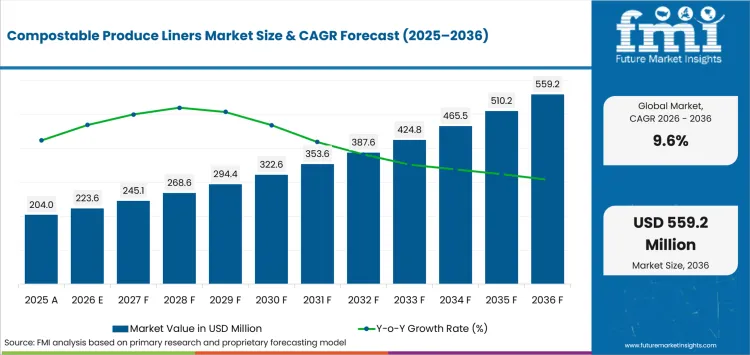
USD 223.6 million in 2026 and USD 559.2 million by 2036 at a 9.6% CAGR.
Demand for compostable produce liners is projected to rise at a 9.6% CAGR between 2026 and 2036. Industry is expected to rise from USD 223.6 million to USD 559.2 million by 2036. Produce respiration and cooling changes leave free water inside packs, so liners must capture liquid without blocking vents or altering the outer tray. European Commission guidance published in June 2026 confirms that Regulation (EU) 2025/40 applies from August 2026. Its packaging and waste rules require documentation across every material class used in commercial programs. Packers therefore need food-contact records and verified disposal claims before approving compostable plastic packaging for recurring produce programs.
National waste systems determine whether a certified liner receives the disposal route printed on its pack. England required workplaces with ten or more employees to separate food waste from March 2025. The same Defra release reported household recycling rates near 44% to 45% during the period since 2015. Germany directs most biodegradable plastic packaging away from biowaste collections despite mature organic treatment infrastructure. Japan reviews material claims within a broader recovery system that favors established collection routes nationally. Fresh food packaging therefore needs country-specific labels aligned with local treatment practice in every sales market.
Key Takeaways of Compostable Produce Liners Market
- Packers replace conventional moisture inserts as compostable formats preserve ventilation and normal filling-line output during seasonal produce programs.
- Certified compostable absorbent pads are projected to hold 30.0% in 2026.
- Airlaid cellulose is estimated to capture 31.0% share in 2026 due to lightweight liquid uptake.
- Industrial compostable certification is anticipated to represent 54.0% as controlled standards support document review during commercial qualification.
- Uneven collection rules weaken disposal claims and extend approval work for packers managing multinational fresh-produce programs.
- Sirane, Cellcomb, McAirlaid's, MAGIC and Elliott compete in absorbent pads for condensation control or soft-fruit protection. Their offers differ by core construction and edge sealing plus custom dimensions across multiple crop programs.
Analyst Perspective
"Packhouses should compare liquid retention and pad movement under the cooling profile used for each crop. Commercial value comes from stable seasonal supply plus disposal instructions that remain accurate in every destination market."
- Nandini Roy Choudhury, Principal Consultant, Future Market Insights
How is the Compostable Produce Liners Market segmented?
The compostable produce liners market is segmented by product type, material, certification, produce type, end use, sales channel and region.
Product type covers absorbent pads, paper and film liners, cellulose nets and other formats, while material includes airlaid cellulose, paper and fiber, PLA, starch biopolymers and other inputs. Certification separates industrial compostable, home compostable and uncertified products, while produce type covers berries, leafy greens, tomatoes, mushrooms and other crops. End use includes growers and packers, grocery retail, wholesale distribution and other users, while sales channel includes direct OEM supply, distributors, online commerce and other routes.
What makes certified compostable absorbent pads central to the product type category?
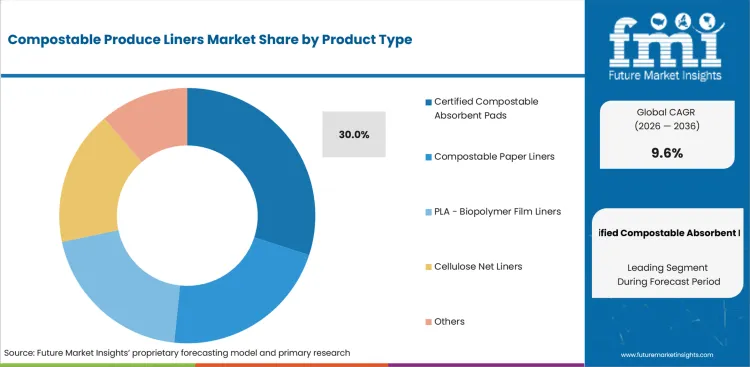
Absorbent pads remove free liquid without changing the outer tray and let packers test surface behavior against one crop. The familiar placement also limits operator retraining as programs extend to other seasonal produce formats.
- Based on product type, certified compostable absorbent pads are projected to account for 30.0% in 2026 due to familiar placement beneath moisture-sensitive produce.
- Custom pad dimensions fit several tray footprints and support inventory planning ahead of peak harvest volumes. Repeat orders depend on liquid retention, ventilation and food-contact records remaining stable under normal line speed and cold-chain handling within produce packaging programs.
Why does airlaid cellulose lead the material category?
Airlaid cellulose combines low component weight with adjustable thickness and liquid uptake while rolls or die-cut pads support automated placement. Converters can adjust density for different crop moisture loads without increasing component weight or changing the outer pack.
- By material, airlaid cellulose is estimated to hold 31.0% in 2026 owing to absorbency across lightweight converted structures.
- Airlaid cellulose supports commercial qualification as web density can be tuned for liquid uptake without increasing pad bulk. Food-grade packaging programs require separate checks for cover layers, edge sealing and direct-contact records to approve a converted construction for seasonal use.
How does industrial compostable certification shape the certification category?
Industrial compostability relies on controlled temperature plus aeration and treatment time, giving packaging teams a defined test route despite local acceptance authority. Multinational programs must compare certificate scope with the collection instructions used by every destination market.
- In 2026, industrial compostable is expected to lead the certification category with 54.0% share because established standards support commercial document review.
- Cellcomb added home and garden compost certification to Cellsorb Circular across Europe during March 2025. The wider route improves qualification options for compostable laminate materials without guaranteeing collection across every destination market. Packers must verify food-contact records and crop-specific moisture performance under intended commercial packing-line conditions.
What supports berries as the leading produce type?
Berries have limited tolerance for free water and pressure points, so liners must capture localized moisture while maintaining airflow around delicate fruit. Pad movement can also damage presentation inside shallow retail punnets before products reach store displays.
- By produce type, berries are forecast to represent 26.0% in 2026 driven by visible quality losses from moisture and bruising.
- MAGIC reported in August 2024 that a company comparison found its compostable G-pad extended strawberry freshness by 50%. The company result supports crop-specific trials within sustainable packaging programs and requires independent packhouse validation for each berry variety instead of proving market-wide adoption.
What are the drivers, restraints and opportunities in the Compostable Produce Liners Market?
Moisture control supports demand while collection rules restrain adoption and crop-specific qualification directs recurring orders.
- Driver: Packhouses need liners that control condensation without adding a difficult material component or reducing filling-line output.
- Restraint: Compostability certificates lose commercial value when local collection systems reject the used liner or require conflicting instructions.
- Opportunity: Crop-specific formats can combine documented absorbency with stable line performance and disposal guidance for each destination market.
Moisture Control Links Quality Protection with Material Change
Fresh-cut processors remove excess moisture before packaging as residual water affects product quality and sanitary handling. USDA Food and Nutrition Service guidance updated in August 2025 describes final washing plus draining or spinning before fresh-cut produce enters approved food-contact materials. Compostable liners enter biodegradable food packaging programs once pack trials confirm added liquid control without blocking vents or slowing placement equipment.
Collection Rules Limit the Value of Certification
Industrial compostability measures breakdown under controlled treatment conditions but commercial acceptance depends on the receiving waste system. Germany's environment ministry introduced a 0.5% plastics limit for biowaste before treatment in May 2025 and advised residents against placing biodegradable plastic products in biobins. Packaging teams therefore need biodegradable packaging instructions that match local collection practice instead of relying on one certificate across every sales territory.
Qualification Services Convert Material Claims into Orders
Manufacturers convert interest into recurring revenue by tuning pad density, dimensions and surface behavior for one crop plus one line. Home-compostable structures suit programs with credible household collection, while cellulose-led formats fit customers prioritizing fiber recovery. Repeat orders require seasonal inventory planning, test records and destination-specific instructions across produce bags and liner systems.
Which country CAGRs are profiled in the Compostable Produce Liners Market?
| Country | CAGR |
|---|---|
| USA | 8.9% |
| Germany | 9.4% |
| Japan | 8.1% |
| UK | 9.7% |
| Brazil | 10.1% |
How do country-level CAGRs compare in the Compostable Produce Liners Market?
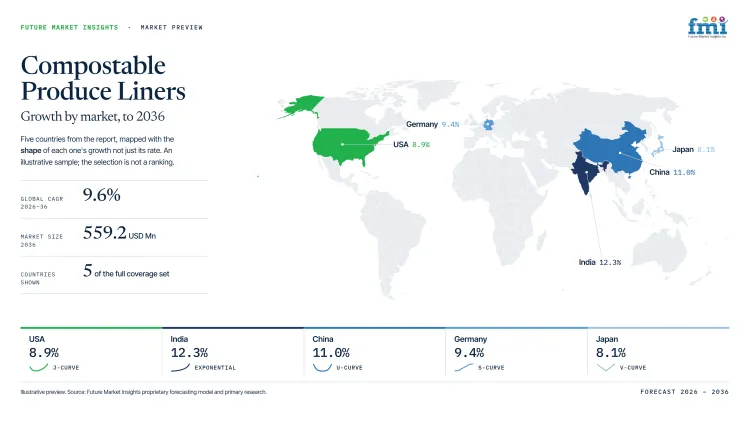
The profiled outlook spans 2.0 percentage points between Brazil at 10.1% and Japan at 8.1%. The narrow range describes forecast pace and does not establish current revenue leadership or absolute installed demand across complete national markets.
- Brazil records 10.1% CAGR as reverse-logistics rules increase packaging accountability across long domestic and export produce routes with uneven treatment access.
- The UK reaches 9.7% CAGR as separate food-waste collection raises scrutiny of disposal instructions used by national grocery programs and contracted packhouses.
- Germany posts 9.4% CAGR as established recovery systems reward precise material claims but restrict compostable plastics entering organic-waste treatment.
- The USA advances at 8.9% CAGR as large retail programs support produce trials although state labels and facility acceptance remain uneven across regions.
- Japan records 8.1% CAGR as broad packaging collection supports disciplined review while conservative food-contact approval extends qualification for new liner structures.
Comparable rates can arise from different certification practices and treatment infrastructure across the five profiled countries. Commercial priority therefore depends on addressable produce programs alongside local qualification costs and available distributor or service support.
The full report provides country-level analysis across North America, Latin America, Europe, East Asia, South Asia and Pacific and the Middle East and Africa.
Country-wise Analysis
- Large supermarket programs and specialist packaging distributors give American packhouses access to crop-specific liner trials across several produce regions, retail formats and peak harvesting periods. Compostable produce liner demand in the USA is forecast to expand at 8.9% CAGR over the forecast period, supported by retail scale despite uneven facility acceptance and state labeling rules. The USA Environmental Protection Agency reported in January 2026 that 66.2 million tons of wasted food entered national management routes during 2019 while composting handled 4.99 percent, leaving packers to provide facility-aware instructions plus documented absorbency and food-contact compliance before approving recurring seasonal produce orders.
- German packers operate within dense produce networks that place strong weight on packaging documentation and contamination control across established organic-waste and material-recovery systems serving national retailers and export-oriented packing programs. Germany's Compostable Produce Liners Market is projected to record 9.4% CAGR during the assessment period, supported by formal packaging review despite restricted disposal routes for biodegradable plastic components. The German Environment Agency reported in January 2026 that dual systems recycled about 5.5 million tonnes of packaging waste during 2024, while producers must distinguish material-recovery claims from compostability claims and prove stable placement plus food-contact compliance under local commercial packhouse conditions.
- Japanese produce programs favor clean presentation and stable material specifications across domestic retail chains, export-oriented packing sites and tightly managed seasonal inventories. Adoption of compostable produce liners in Japan is estimated to expand at 8.1% CAGR through 2036, reinforced by extensive packaging collection but constrained by conservative qualification for new food-contact structures. Japan's Ministry of the Environment reported in March 2026 that municipalities separately collected 2.68 million tonnes of packaging during fiscal 2024, and manufacturers need local records that separate compostable claims from recycling routes while preserving absorbency plus placement and airflow across seasonal programs and extended inventory holding periods.
- British grocery programs can transmit packaging specifications rapidly from national retailers to produce packers serving chilled distribution networks and seasonal sourcing programs across England and adjoining distribution channels. Compostable produce liner sales in the UK are forecast to expand at 9.7% CAGR by 2036, aided by separate food-waste collection despite limited acceptance of compostable packaging in ordinary food-waste streams. Defra stated in March 2026 that English households must separate food and garden waste from dry recyclables and residual waste, leaving packers to provide retailer-approved instructions plus moisture control and stable line output during chilled distribution and seasonal program changes nationwide.
- Brazilian produce packers manage long domestic routes and export programs across regions with uneven refrigeration, distributor coverage and access to waste-treatment infrastructure. Brazil is estimated to post 10.1% CAGR over the forecast period, influenced by national plastic-packaging reverse logistics but constrained by inconsistent access to composting for used liners. Presidential Decree 12,688 issued in October 2025 requires municipalities above 10,000 residents to install one voluntary delivery point per 10,000 residents within four years and makes commercial entry depend on regional inventory plus clear disposal wording and stable absorbency during inland transport and export handling across humid production regions and coastal export corridors.
Who are the notable companies in the Compostable Produce Liners Market?
Coppice Alupack Ltd. (Sirane), Cellcomb AB, McAirlaid's Vliesstoffe GmbH, MAGIC S.p.A., Elliott Absorbent Products Ltd., Futamura Chemical Co., Ltd. and TIPA Corp. are the notable companies serving this market.
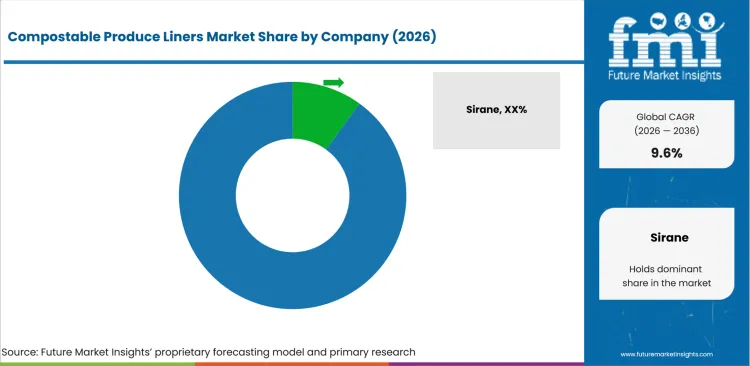
The field remains fragmented across absorbent-pad specialists and compostable-film platforms used in food packaging systems for distinct produce formats and disposal routes. Entry depends on crop-level moisture records, food-contact documents and conversion support during short qualification windows.
- Sirane, Cellcomb, McAirlaid's, MAGIC and Elliott compete in absorbent pads for condensation control or soft-fruit protection. Their offers differ by core construction and edge sealing plus custom dimensions across multiple crop programs.
- Futamura and TIPA provide compostable films for produce-adjacent labeling and flexible packaging uses across international markets. Qualification depends on permeability plus sealing behavior and certificate scope under the intended packing conditions during commercial review.
- Competition centers on moisture performance plus end-of-life documentation and dependable conversion support across seasonal produce programs. Geographic reach matters if one produce program serves retailers operating under different national collection rules.
Competitive Benchmarking: Compostable Produce Liners Market
| Company | Produce Moisture-Control Fit | Documented Compostable Route | Custom Converting Support | Geographic Reach |
|---|---|---|---|---|
| Coppice Alupack Ltd. (Sirane) | High | Medium | High | Europe, North America, Latin America and Australia |
| Cellcomb AB | High | High | Medium | Europe |
| McAirlaid's Vliesstoffe GmbH | High | Medium | High | Europe and North America |
| MAGIC S.p.A. | High | Medium | High | Europe and international sales |
| Elliott Absorbent Products Ltd. | High | Medium | High | United Kingdom and Europe |
| Futamura Chemical Co., Ltd. | Medium | High | Medium | Global |
| TIPA Corp. | Medium | High | Medium | Europe, North America and Asia-Pacific |
Key Developments in the Compostable Produce Liners Market
- In September 2025, TIPA Corp. launched four high-barrier compostable film and laminate products with moisture and oxygen protection. The release covered wider food packaging, so produce converters must complete crop-specific permeability and seal trials for liner applications.
- In June 2025, Cellcomb AB completed its acquisition of Fatex and combined fiber-based manufacturing operations in Sweden and Finland. The transaction broadened converting coverage for food-industry absorbent products without disclosing capacity assigned to produce-liner programs.
- In October 2024, Elliott Absorbent Products Ltd. launched Echo, a recyclable and compostable pad made from crop residues, and later featured it at Fruit Logistica in February 2025. The launch targets berry cushioning plus moisture control within plastic-free fresh-produce packs used for retail distribution.
Key Players in the Compostable Produce Liners Market
Absorbent Pad Specialists
- Coppice Alupack Ltd. (Sirane)
- Cellcomb AB
- McAirlaid's Vliesstoffe GmbH
- MAGIC S.p.A.
- Elliott Absorbent Products Ltd.
Compostable Film Platforms
- Futamura Chemical Co., Ltd.
- TIPA Corp.
Compostable Produce Liners Market - Report Scope
| Coverage field | Report scope |
|---|---|
| Market breakdown | By product type, material, certification, produce type, end use, sales channel and region. |
| Quantitative Units | Revenue in USD million and CAGR in %. |
| Market Definition | Compostable pads, paper liners, film liners and cellulose nets sold as produce-packaging components. |
| Regions Covered | North America, Latin America, Europe, East Asia, South Asia and Pacific and Middle East and Africa. |
| Countries Covered | USA, Germany, Japan, UK, Brazil and 20+ countries included in the full report. |
| Key Companies Profiled | Coppice Alupack Ltd. (Sirane), Cellcomb AB, McAirlaid's Vliesstoffe GmbH, MAGIC S.p.A., Elliott Absorbent Products Ltd., Futamura Chemical Co., Ltd. and TIPA Corp. |
| Forecast Period | 2026 to 2036. |
| Approach | Primary and secondary research with market triangulation. |
Compostable Produce Liners Market - Research Methodology
| Method | Approach |
|---|---|
| Primary Research | FMI analysts gathered input from manufacturers, service providers, technology developers, distributors, end users, procurement teams, and subject-matter experts. Interviews examined purchasing decisions, product or service evaluation, adoption barriers, approval requirements, pricing considerations, and expectations for technical or commercial support. Respondents were also asked what evidence is required before a trial, pilot, or initial order develops into regular purchasing. |
| Desk Research | Desk research covered government statistics, regulatory publications, trade data, industry associations, technical literature, standards, company filings, product information, and official corporate announcements. Sources were reviewed for relevance, publication date, geographic coverage, and consistency with the defined market scope. Claims relating to performance, applications, approvals, capacity, investment, and commercial activity were retained only when supported by credible public evidence. |
| Market Sizing and Forecasting | The market model combined the baseline value with historical performance, segment structure, pricing and volume indicators, adoption levels, company participation, and country-level demand conditions. Forecast assumptions considered economic activity, investment trends, regulatory developments, technology adoption, purchasing cycles, supply availability, and barriers to wider market use. Segment and regional estimates were reconciled before the final market total was calculated. |
| Data Validation | Estimates were checked against multiple independent indicators, including public data, company activity, trade patterns, industry developments, and findings from primary interviews. Validation also tested whether products, services, applications, and company revenues fell within the defined market boundaries. Adjacent categories, unsupported claims, overlapping revenues, and activities without direct market relevance were excluded to reduce double counting and maintain consistency across segments and countries. |
Compostable Produce Liners Market by Segments
Compostable Produce Liners Market segmented by Product Type:
- Certified Compostable Absorbent Pads
- Compostable Paper Liners
- PLA - Biopolymer Film Liners
- Cellulose Net Liners
- Others
Compostable Produce Liners Market segmented by Material:
- Airlaid Cellulose
- Paper - Fiber
- PLA
- Starch Biopolymer
- Others
Compostable Produce Liners Market segmented by Certification:
- Industrial Compostable
- Home Compostable
- Uncertified
Compostable Produce Liners Market segmented by Produce Type:
- Berries
- Leafy Greens
- Tomatoes
- Others
- Mushrooms
Compostable Produce Liners Market segmented by End Use:
- Growers & Packers
- Grocery Retail
- Wholesale & Distribution
- Others
Compostable Produce Liners Market segmented by Sales Channel:
- Direct - OEM Supply
- Packaging Distributors
- Online - E-commerce
- Others
Compostable Produce Liners Market by Region
- North America
- USA
- Canada
- Latin America
- Brazil
- Mexico
- Argentina
- Chile
- Western Europe
- Germany
- France
- UK
- Italy
- Spain
- Benelux
- Nordics
- Eastern Europe
- Poland
- Czech Republic
- Romania
- Hungary
- East Asia
- China
- Japan
- South Korea
- South Asia and Pacific
- India
- ASEAN
- Australia and New Zealand
- Middle East and Africa
- GCC Countries
- South Africa
- Türkiye
- Israel
Research Sources and Bibliography
- European Commission. (2026, June 10). Guidance document for Regulation (EU) 2025/40 on packaging and packaging waste.
- Department for Environment, Food & Rural Affairs. (2025, March 31). New rules simplifying recycling for workplaces in England come into force.
- Cellcomb AB. (2025, March 12). Cellsorb Circular - now certified for your home-and garden compost!
- MAGIC S.p.A. (2024, August 7). Extended freshness for strawberries: G-pad extends shelf life by 50% (our test results).
- USA Department of Agriculture, Food and Nutrition Service. (2025, August 15). Food Safety Practices to Expect from Your Fresh-Cut Produce Processor.
- Federal Ministry for the Environment, Climate Action, Nature Conservation and Nuclear Safety. (2025, April 22). Weniger Kunststoffe im Bioabfall ab Mai 2025.
- USA Environmental Protection Agency. (2026, January 23). Food: Material-Specific Data.
- German Environment Agency. (2026, January 27). Facts against myths: Packaging waste recycling in Germany is working.
- Ministry of the Environment, Government of Japan. (2026, March 31).
- Department for Environment, Food & Rural Affairs. (2026, March 31). Simpler household recycling rules come into force across England.
- Presidency of the Republic of Brazil. (2025, October 21). Decreto Nº 12.688, de 21 de outubro de 2025.
- Coppice Alupack Ltd. (2024, February 12). ABSORBENT PADS: Antimicrobial pads can help keep exported cherries fresh.
- Elliott Absorbent Products Ltd. (2024, October 8). Cutting down on waste with Elliott's new compostable fruit pads.
- Futamura Chemical Co., Ltd. (2026, May). Compostable alternatives for produce labelling.
- TIPA Corp. (2025, September 22). TIPA® Compostable Packaging Launches Breakthrough High-Barrier Solutions for Flexible Packaging.
- Cellcomb AB. (2025, June 4). Cellcomb acquires Fatex.
This Report Answers
- How does moisture accumulation affect liner specification in chilled produce packs?
- Which documentation determines whether compostable liners enter recurring packhouse programs?
- Why do absorbent pads retain the leading Product Type position during 2026?
- How does airlaid cellulose balance liquid uptake with automated placement requirements?
- Why does local collection practice limit the commercial value of compostability certification?
- How do the five profiled countries differ in qualification and disposal conditions?
- Which companies compete in absorbent pads and compostable film platforms?
- What capabilities convert crop-specific liner trials into repeat seasonal orders?
Frequently Asked Questions
How big is the Compostable Produce Liners Market in 2026?
USD 223.6 million is the estimated 2026 value of the Compostable Produce Liners Market. Revenue is projected to reach USD 559.2 million by 2036 as packhouses qualify moisture-control components that preserve ventilation, filling-line output and accurate disposal instructions.
What is the CAGR of the Compostable Produce Liners Market from 2026 to 2036?
9.6% is the projected CAGR for the Compostable Produce Liners Market between 2026 and 2036. Expansion depends on produce-specific trials connecting absorbency with stable placement, food-contact documentation, seasonal supply reliability and a valid end-of-life route in each destination market.
Which certification segment leads the Compostable Produce Liners Market?
54.0% is the estimated 2026 share for industrial compostable certification in the Compostable Produce Liners Market. Controlled standards define a document route, although packaging teams must confirm local collection, food-contact compliance and moisture performance for each exact liner construction.
How much will the Compostable Produce Liners Market add between 2026 and 2036?
USD 335.6 million is the projected incremental opportunity for the Compostable Produce Liners Market between 2026 and 2036. Revenue conversion depends on crop-specific qualification preserving equipment settings, pack appearance, seasonal availability and accurate disposal wording during recurring produce programs.
Which companies are active in the Compostable Produce Liners Market?
Seven profiled companies serve the Compostable Produce Liners Market across absorbent pads and compostable film platforms. They are Coppice Alupack Ltd. (Sirane), Cellcomb AB, McAirlaid's Vliesstoffe GmbH, MAGIC S.p.A., Elliott Absorbent Products Ltd., Futamura Chemical Co., Ltd. and TIPA Corp.
Preview the report firsthand - request a free sample
Get SampleGet the brochure for pricing and purchase details.
Get PDFTable of Content
- Key Takeaways
- Market Size and CAGR
- Top Growth Driver
- Fastest Growing Segment
- Leading Region
- Key Companies
- Emerging Opportunities
- Executive Summary
- Global Market Outlook
- Demand-side Trends
- Supply-side Trends
- Technology Roadmap Analysis
- Analysis and Recommendations
- Analyst Perspective (What is happening? Why now? What should investors know?)
- Key Questions Answered
- How large is the market?
- What is the CAGR?
- What are key trends?
- Which region dominates?
- Who are the leaders?
- Market Overview
- Market Coverage / Taxonomy
- Market Definition / Scope / Limitations
- Research Methodology
- Chapter Orientation
- Analytical Lens and Working Hypotheses
- Market Structure, Signals, and Trend Drivers
- Benchmarking and Cross-market Comparability
- Market Sizing, Forecasting, and Opportunity Mapping
- Research Design and Evidence Framework
- Desk Research Programme (Secondary Evidence)
- Expert Input and Fieldwork (Primary Evidence)
- Tooling, Models, and Reference Databases
- Data Engineering and Model Build
- Quality Assurance and Audit Trail
- Market Background
- Market Dynamics (Drivers, Restraints, Opportunity, Trends)
- Scenario Forecast (Optimistic, Likely, Conservative)
- Impact Analysis
- AI Impact
- Sustainability Impact
- Regulatory Impact
- Technology Impact
- Consumer / Buyer Analysis
- Purchase Drivers
- Adoption Barriers
- Buyer Journey
- Opportunity Map Analysis
- Product Life Cycle Analysis
- Supply Chain Analysis
- Investment Feasibility Matrix
- Value Chain Analysis
- PESTLE and Porter's Analysis
- Regulatory Landscape
- Regional Parent Market Outlook
- Production and Consumption Statistics
- Import and Export Statistics
- Global Market Analysis and Forecast, 2021 to 2036
- Historical Market Size Value (USD Million) Analysis, 2021 to 2025
- Current and Future Market Size Value (USD Million) Projections, 2026 to 2036
- Y-o-Y Growth Trend Analysis
- Absolute $ Opportunity Analysis
- Global Market Pricing Analysis, 2021 to 2036
- Global Market Analysis and Forecast, By Product Type, 2021 to 2036
- Introduction / Key Findings
- Historical Market Size Value (USD Million) Analysis By Product Type, 2021 to 2025
- Current and Future Market Size Value (USD Million) Analysis and Forecast By Product Type, 2026 to 2036
- Certified Compostable Absorbent Pads
- Compostable Paper Liners
- PLA - Biopolymer Film Liners
- Cellulose Net Liners
- Others
- Certified Compostable Absorbent Pads
- Y-o-Y Growth Trend Analysis By Product Type, 2021 to 2025
- Absolute $ Opportunity Analysis By Product Type, 2026 to 2036
- Global Market Analysis and Forecast, By Material, 2021 to 2036
- Introduction / Key Findings
- Historical Market Size Value (USD Million) Analysis By Material, 2021 to 2025
- Current and Future Market Size Value (USD Million) Analysis and Forecast By Material, 2026 to 2036
- Airlaid Cellulose
- Paper - Fiber
- PLA
- Starch Biopolymer
- Others
- Airlaid Cellulose
- Y-o-Y Growth Trend Analysis By Material, 2021 to 2025
- Absolute $ Opportunity Analysis By Material, 2026 to 2036
- Global Market Analysis and Forecast, By Certification, 2021 to 2036
- Introduction / Key Findings
- Historical Market Size Value (USD Million) Analysis By Certification, 2021 to 2025
- Current and Future Market Size Value (USD Million) Analysis and Forecast By Certification, 2026 to 2036
- Industrial Compostable
- Home Compostable
- Uncertified
- Industrial Compostable
- Y-o-Y Growth Trend Analysis By Certification, 2021 to 2025
- Absolute $ Opportunity Analysis By Certification, 2026 to 2036
- Global Market Analysis and Forecast, By Produce Type, 2021 to 2036
- Introduction / Key Findings
- Historical Market Size Value (USD Million) Analysis By Produce Type, 2021 to 2025
- Current and Future Market Size Value (USD Million) Analysis and Forecast By Produce Type, 2026 to 2036
- Berries
- Leafy Greens
- Tomatoes
- Others
- Mushrooms
- Berries
- Y-o-Y Growth Trend Analysis By Produce Type, 2021 to 2025
- Absolute $ Opportunity Analysis By Produce Type, 2026 to 2036
- Global Market Analysis and Forecast, By End Use, 2021 to 2036
- Introduction / Key Findings
- Historical Market Size Value (USD Million) Analysis By End Use, 2021 to 2025
- Current and Future Market Size Value (USD Million) Analysis and Forecast By End Use, 2026 to 2036
- Growers & Packers
- Grocery Retail
- Wholesale & Distribution
- Others
- Growers & Packers
- Y-o-Y Growth Trend Analysis By End Use, 2021 to 2025
- Absolute $ Opportunity Analysis By End Use, 2026 to 2036
- Global Market Analysis and Forecast, By Sales Channel
- Introduction / Key Findings
- Historical Market Size Value (USD Million) Analysis By Sales Channel, 2021 to 2025
- Current and Future Market Size Value (USD Million) Analysis and Forecast By Sales Channel, 2026 to 2036
- Direct - OEM Supply
- Packaging Distributors
- Online - E-commerce
- Others
- Direct - OEM Supply
- Y-o-Y Growth Trend Analysis By Sales Channel, 2021 to 2025
- Absolute $ Opportunity Analysis By Sales Channel, 2026 to 2036
- Global Market Analysis and Forecast, By Region, 2021 to 2036
- Introduction
- Historical Market Size Value (USD Million) Analysis By Region, 2021 to 2025
- Current Market Size Value (USD Million) Analysis and Forecast By Region, 2026 to 2036
- North America
- Latin America
- Western Europe
- Eastern Europe
- East Asia
- South Asia and Pacific
- Middle East & Africa
- Market Attractiveness Analysis By Region
- North America Market Analysis and Forecast, By Country, 2021 to 2036
- Historical Market Size Value (USD Million) Trend Analysis By Market Taxonomy, 2021 to 2025
- Market Size Value (USD Million) Forecast By Market Taxonomy, 2026 to 2036
- By Country
- USA
- Canada
- By Product Type
- By Material
- By Certification
- By Produce Type
- By End Use
- By Sales Channel
- By Country
- Market Attractiveness Analysis
- By Country
- By Product Type
- By Material
- By Certification
- By Produce Type
- By End Use
- By Sales Channel
- Key Takeaways
- Latin America Market Analysis and Forecast, By Country
- Historical Market Size Value (USD Million) Trend Analysis By Market Taxonomy, 2021 to 2025
- Market Size Value (USD Million) Forecast By Market Taxonomy, 2026 to 2036
- By Country
- Brazil
- Mexico
- Chile
- Rest of Latin America
- By Product Type
- By Material
- By Certification
- By Produce Type
- By End Use
- By Sales Channel
- By Country
- Market Attractiveness Analysis
- By Country
- By Product Type
- By Material
- By Certification
- By Produce Type
- By End Use
- By Sales Channel
- Key Takeaways
- Western Europe Market Analysis and Forecast, By Country
- Historical Market Size Value (USD Million) Trend Analysis By Market Taxonomy, 2021 to 2025
- Market Size Value (USD Million) Forecast By Market Taxonomy, 2026 to 2036
- By Country
- Germany
- UK
- Italy
- Spain
- France
- Nordic
- BENELUX
- Rest of Western Europe
- By Product Type
- By Material
- By Certification
- By Produce Type
- By End Use
- By Sales Channel
- By Country
- Market Attractiveness Analysis
- By Country
- By Product Type
- By Material
- By Certification
- By Produce Type
- By End Use
- By Sales Channel
- Key Takeaways
- Eastern Europe Market Analysis and Forecast, By Country
- Historical Market Size Value (USD Million) Trend Analysis By Market Taxonomy, 2021 to 2025
- Market Size Value (USD Million) Forecast By Market Taxonomy, 2026 to 2036
- By Country
- Russia
- Poland
- Hungary
- Balkan & Baltic
- Rest of Eastern Europe
- By Product Type
- By Material
- By Certification
- By Produce Type
- By End Use
- By Sales Channel
- By Country
- Market Attractiveness Analysis
- By Country
- By Product Type
- By Material
- By Certification
- By Produce Type
- By End Use
- By Sales Channel
- Key Takeaways
- East Asia Market Analysis and Forecast, By Country
- Historical Market Size Value (USD Million) Trend Analysis By Market Taxonomy, 2021 to 2025
- Market Size Value (USD Million) Forecast By Market Taxonomy, 2026 to 2036
- By Country
- China
- Japan
- South Korea
- By Product Type
- By Material
- By Certification
- By Produce Type
- By End Use
- By Sales Channel
- By Country
- Market Attractiveness Analysis
- By Country
- By Product Type
- By Material
- By Certification
- By Produce Type
- By End Use
- By Sales Channel
- Key Takeaways
- South Asia and Pacific Market Analysis and Forecast, By Country
- Historical Market Size Value (USD Million) Trend Analysis By Market Taxonomy, 2021 to 2025
- Market Size Value (USD Million) Forecast By Market Taxonomy, 2026 to 2036
- By Country
- India
- ASEAN
- Australia & New Zealand
- Rest of South Asia and Pacific
- By Product Type
- By Material
- By Certification
- By Produce Type
- By End Use
- By Sales Channel
- By Country
- Market Attractiveness Analysis
- By Country
- By Product Type
- By Material
- By Certification
- By Produce Type
- By End Use
- By Sales Channel
- Key Takeaways
- Middle East & Africa Market Analysis and Forecast, By Country
- Historical Market Size Value (USD Million) Trend Analysis By Market Taxonomy, 2021 to 2025
- Market Size Value (USD Million) Forecast By Market Taxonomy, 2026 to 2036
- By Country
- Kingdom of Saudi Arabia
- Other GCC Countries
- Türkiye
- South Africa
- Other African Union
- Rest of Middle East & Africa
- By Product Type
- By Material
- By Certification
- By Produce Type
- By End Use
- By Sales Channel
- By Country
- Market Attractiveness Analysis
- By Country
- By Product Type
- By Material
- By Certification
- By Produce Type
- By End Use
- By Sales Channel
- Key Takeaways
- Key Countries Market Analysis
- USA
- Pricing Analysis
- Market Share Analysis, 2025
- By Product Type
- By Material
- By Certification
- By Produce Type
- By End Use
- By Sales Channel
- Canada
- Pricing Analysis
- Market Share Analysis, 2025
- By Product Type
- By Material
- By Certification
- By Produce Type
- By End Use
- By Sales Channel
- Mexico
- Pricing Analysis
- Market Share Analysis, 2025
- By Product Type
- By Material
- By Certification
- By Produce Type
- By End Use
- By Sales Channel
- Brazil
- Pricing Analysis
- Market Share Analysis, 2025
- By Product Type
- By Material
- By Certification
- By Produce Type
- By End Use
- By Sales Channel
- Chile
- Pricing Analysis
- Market Share Analysis, 2025
- By Product Type
- By Material
- By Certification
- By Produce Type
- By End Use
- By Sales Channel
- Germany
- Pricing Analysis
- Market Share Analysis, 2025
- By Product Type
- By Material
- By Certification
- By Produce Type
- By End Use
- By Sales Channel
- UK
- Pricing Analysis
- Market Share Analysis, 2025
- By Product Type
- By Material
- By Certification
- By Produce Type
- By End Use
- By Sales Channel
- Italy
- Pricing Analysis
- Market Share Analysis, 2025
- By Product Type
- By Material
- By Certification
- By Produce Type
- By End Use
- By Sales Channel
- Spain
- Pricing Analysis
- Market Share Analysis, 2025
- By Product Type
- By Material
- By Certification
- By Produce Type
- By End Use
- By Sales Channel
- France
- Pricing Analysis
- Market Share Analysis, 2025
- By Product Type
- By Material
- By Certification
- By Produce Type
- By End Use
- By Sales Channel
- India
- Pricing Analysis
- Market Share Analysis, 2025
- By Product Type
- By Material
- By Certification
- By Produce Type
- By End Use
- By Sales Channel
- ASEAN
- Pricing Analysis
- Market Share Analysis, 2025
- By Product Type
- By Material
- By Certification
- By Produce Type
- By End Use
- By Sales Channel
- Australia & New Zealand
- Pricing Analysis
- Market Share Analysis, 2025
- By Product Type
- By Material
- By Certification
- By Produce Type
- By End Use
- By Sales Channel
- China
- Pricing Analysis
- Market Share Analysis, 2025
- By Product Type
- By Material
- By Certification
- By Produce Type
- By End Use
- By Sales Channel
- Japan
- Pricing Analysis
- Market Share Analysis, 2025
- By Product Type
- By Material
- By Certification
- By Produce Type
- By End Use
- By Sales Channel
- South Korea
- Pricing Analysis
- Market Share Analysis, 2025
- By Product Type
- By Material
- By Certification
- By Produce Type
- By End Use
- By Sales Channel
- Russia
- Pricing Analysis
- Market Share Analysis, 2025
- By Product Type
- By Material
- By Certification
- By Produce Type
- By End Use
- By Sales Channel
- Poland
- Pricing Analysis
- Market Share Analysis, 2025
- By Product Type
- By Material
- By Certification
- By Produce Type
- By End Use
- By Sales Channel
- Hungary
- Pricing Analysis
- Market Share Analysis, 2025
- By Product Type
- By Material
- By Certification
- By Produce Type
- By End Use
- By Sales Channel
- Kingdom of Saudi Arabia
- Pricing Analysis
- Market Share Analysis, 2025
- By Product Type
- By Material
- By Certification
- By Produce Type
- By End Use
- By Sales Channel
- Türkiye
- Pricing Analysis
- Market Share Analysis, 2025
- By Product Type
- By Material
- By Certification
- By Produce Type
- By End Use
- By Sales Channel
- South Africa
- Pricing Analysis
- Market Share Analysis, 2025
- By Product Type
- By Material
- By Certification
- By Produce Type
- By End Use
- By Sales Channel
- USA
- Market Structure Analysis
- Competition Dashboard
- Competition Benchmarking
- Market Share Analysis of Top Players
- By Regional
- By Product Type
- By Material
- By Certification
- By Produce Type
- By End Use
- By Sales Channel
- Emerging Startups
- Innovation Benchmarking
- Competition Analysis
- Competition Deep Dive
- Sirane
- Overview
- Product Portfolio
- Profitability by Market Segments
- Sales Footprint
- Strategy Overview
- Marketing Strategy
- Product Strategy
- Channel Strategy
- Cellcomb
- McAirlaid's
- Futamura
- TIPA
- Vegware (Novolex)
- Maxwell Chase Technologies
- Novipax
- Huhtamaki
- Cascades
- Sirane
- Case Studies
- Success Stories
- Recent Developments
- Competition Deep Dive
- Assumptions & Acronyms Used


