

- Market Size (2026)
- USD 188.3 Mn
- Forecast (2036)
- USD 466.7 Mn
- CAGR (2026 to 2036)
- 9.5%
How big is Compostable Meat Liners Market in 2026?
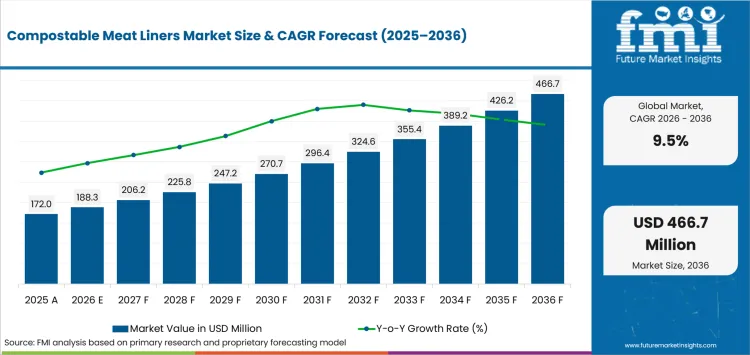
USD 188.3 million in 2026 and USD 466.7 million by 2036 at a 9.5% CAGR.
Demand for compostable meat liners is projected to expand at 9.5% CAGR between 2026 and 2036, lifting value from USD 188.3 million to USD 466.7 million. Protein processors evaluate these liners within the complete tray system because purge control influences shelf appearance and leakage risk. The European Commission confirmed in February 2025 that Regulation (EU) 2025/40 entered into force, increasing documentation pressure across compostable packaging without replacing food-contact validation.
Country conditions determine whether successful pack trials become repeat orders across processor and retail networks. Brazil offers greater protein-line throughput than Japan, which applies more conservative material and disposal reviews during qualification. IBGE reported in March 2026 that Brazilian cattle slaughter reached 42.94 million head during 2025, broadening the installed base available for meat pads and liner trials.
Key Takeaways of Compostable Meat Liners Market
- Protein processors adopt compostable liners that contain purge without changing tray geometry or normal packing speed.
- In 2026, certified compostable absorbent liners are projected to account for 32.0% by product type demand due to familiar pad handling.
- Airlaid cellulose is estimated to capture 30.0% of material demand in 2026 owing to controllable uptake and converting flexibility.
- Industrial compostable certification is anticipated to represent 56.0% in 2026 because controlled standards provide auditable qualification evidence.
- Local organics rejection and failed pack trials slow conversion by exposing disposal, leakage or seal-performance concerns.
- Sirane, Cellcomb, McAirlaid’s, Novipax, POMONA Company, Futamura, TIPA and Novamont are some key companies in the market.
Analyst Perspective
"Compostable meat liners earn approval once absorbency remains stable under the pack’s expected purge load and sealing conditions. Commercial value depends on aligning food-contact evidence with a disposal route accepted by each processor and receiving waste operator."
- Nandini Roy Choudhury, Principal Consultant, Future Market Insights
How is the Compostable Meat Liners Market segmented?
The market is segmented by product type, material, certification, application, end use, sales channel and region.
Product types include certified compostable absorbent liners, compostable paper liners, PLA-biopolymer film liners, compostable interleaves and others. Materials include airlaid cellulose, paper-fiber, PLA, starch biopolymer and others, and certifications cover industrial compostable, home compostable and uncertified. Applications include fresh red meat, poultry, seafood, processed meats and others, end uses cover grocery retail, meat processors, foodservice and others, and sales channels include direct-OEM supply, packaging distributors, online-e-commerce and others.
What makes certified compostable absorbent liners central to the product type category?
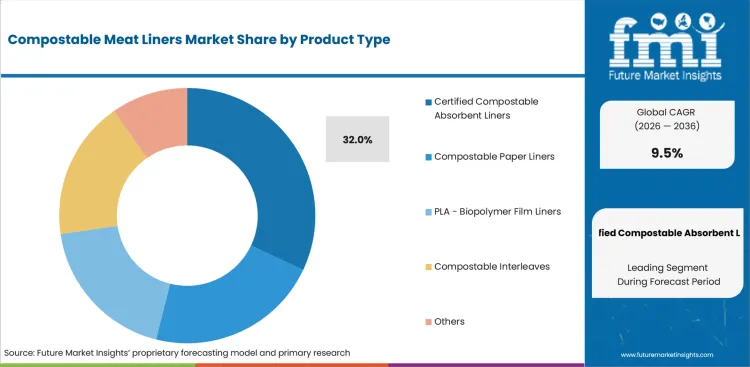
Certified compostable absorbent liners preserve the established pad function in chilled protein packs while changing material composition and disposal claims. Familiar geometry limits redesign across meat packaging lines because processors can test liquid retention within existing trays and sealing sequences.
- Based on product type, certified compostable absorbent liners are projected to account for 32.0% in 2026 due to familiar placement and liquid-control requirements.
- Protein processors compare uptake under pressure with seal stability across chilled distribution and repeated handling. Regular orders begin once the liner manages the specified meat load without changing line speed or tray presentation.
How does airlaid cellulose influence selection within the material category?
Airlaid cellulose forms a dry-laid fiber web with adjustable basis weight for liquid capture. Converters can tune uptake without loose pulp shifting during transport, while airlaid textile knowledge supports pad dimensions and sealed constructions.
- By material, airlaid cellulose is estimated to hold 30.0% in 2026 owing to adjustable absorbency and reliable conversion into sealed liner structures.
- Seafood processors test airlaid structures under extended cold storage and sustained liquid exposure before approving repeat use across chilled packs. McAirlaid’s reported in March 2024 that MAP Enhancer Pads kept white tiger prawns acceptable after fourteen days and supported a minimum shelf-life increase from five to ten days.
What role does industrial compostable certification play within the certification category?
Industrial compostability gives packaging teams a controlled time-and-temperature test regime whose documentation fits approval files more readily than variable home-compost claims across multi-site programs. Related biodegradable food packaging and compostable pouches use comparable evidence, although meat liners require separate liquid-retention trials.
- In 2026, industrial compostable is expected to lead the certification category with 56.0% share because audited standards support repeatable multi-site approval.
- Retailers must align each certificate with collection instructions and contamination rules at the receiving facility. Commercial approval remains incomplete until every participating site has a documented route for the used food-soiled liner.
What drives grocery retail within the end use category?
Grocery retailers set presentation standards across repeated national store volumes and absorb the cost of leaks or markdowns. One approved specification can scale across several packers because fresh food packaging decisions connect shelf appearance with store-level waste handling.
- The grocery retail segment is likely to capture 36.0% share in 2026 attributable to centralized pack specifications and direct exposure to presentation failures.
- Retail teams require processor trials plus disposal instructions that store staff can apply consistently across locations. Repeat orders follow once pack performance and the selected collection route remain stable across the intended network.
What are the drivers, restraints and opportunities in the Compostable Meat Liners Market?
Purge-control requirements and packaging rules support demand, although pack qualification and uneven organics acceptance restrict conversion. Revenue depends on validated fiber-based systems connected to defined collection routes.
- Driver: Protein processors need liquid control that reduces conventional plastic without increasing leaks or visible purge.
- Restraint: Certification loses commercial value if the liner fails plant trials or the receiving facility rejects food-soiled packaging.
- Opportunity: Liner manufacturers can combine custom absorbency with retailer-led collection programs for high-volume protein packs.
Packaging Rules Increase Component-Level Scrutiny
Packaging rules now extend component review beyond trays and lidding across the complete retail pack. Meat processors therefore examine absorbency, material composition and disposal wording within one commercial approval file. Manufacturers that document these conditions can compete across the food packaging sector without weakening the liner’s primary liquid-control function.
Qualification and Disposal Mismatch Extend Sales Cycles
The principal restraint lies between laboratory certification and routine acceptance across operating sites and contracted waste systems. A processor can approve food contact and liquid retention yet find no suitable outlet for the used liner. Additional seal and display trials increase conversion costs across plants using different trays or waste contractors.
Defined Organics Routes Improve Revenue Conversion
The clearest commercial route pairs a custom cellulose liner with documented collection instructions for participating stores. Retailers can concentrate pilots in locations served by one waste contractor and one processor specification. A controlled rollout gives the sustainable packaging sector a measurable path from material approval to recurring liner orders.
Which country CAGRs are profiled in the Compostable Meat Liners Market?
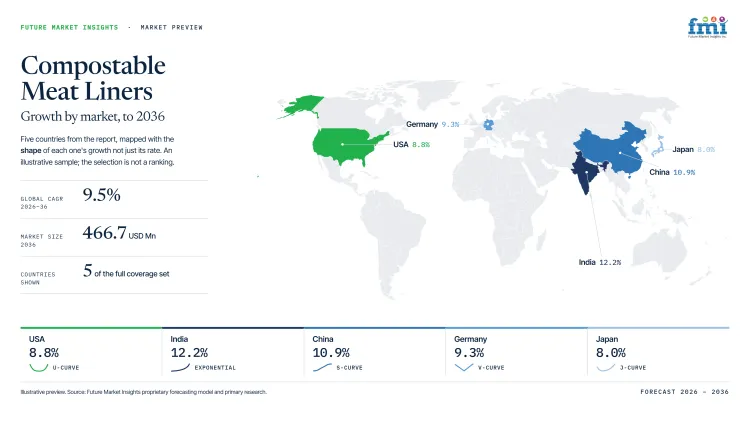
| Country | CAGR |
|---|---|
| Brazil | 10.0% |
| United Kingdom | 9.6% |
| Germany | 9.3% |
| United States | 8.8% |
| Japan | 8.0% |
How do country-level CAGRs compare in the Compostable Meat Liners Market?
The displayed country range spans 2.0 percentage points between Brazil at 10.0% and Japan at 8.0%. The spacing measures forecast pace rather than current revenue scale or installed processing volume across each national packing base and local processor purchasing system.
- Brazil combines high meat-processing throughput with processor networks capable of repeating validated liner specifications across facilities and export programs.
- The United Kingdom rewards retailer-led pilots that connect central packaging rules with one verified commercial waste contractor across store networks.
- Germany favors detailed material records and conservative disposal claims across standardized processor programs and contracted disposal routes.
- The United States combines large protein volumes with fragmented state labeling rules and uneven commercial composting acceptance.
- Japan applies precise pad and tray reviews that lengthen approval for unfamiliar materials across compact retail packaging formats.
Comparable CAGRs can produce different market entry conditions. The full report provides country-level CAGR analysis across North America, Latin America, Europe, East Asia, South Asia and Pacific, and the Middle East and Africa.
Country-wise Analysis
- Brazilian meat processors operate large packing networks that can repeat one validated liner specification across several facilities and retailer programs, reducing separate trial costs for high-volume chilled protein lines. Brazil’s Ministry of Ports and Airports reported in February 2026 that the country shipped 3.45 million tonnes of beef during 2025, increasing liquid-control exposure across longer refrigerated export routes. Compostable meat liner sales in Brazil are forecast to expand at 10.0% CAGR by 2036, supported by processor scale and local converting capacity despite uneven municipal organics acceptance that requires dedicated disposal arrangements near major production and distribution clusters plus chilled export channels.
- United Kingdom grocery groups coordinate packaging specifications across stores and contract packers, allowing one successful liner trial to cover repeated retail formats and national distribution programs. DEFRA reported in March 2025 that English workplaces with at least ten employees must separate food waste, although the rule does not automatically accept food-soiled compostable packaging within that collection stream. Compostable meat liner demand in the United Kingdom is forecast to rise at 9.6% CAGR over the forecast period, aided by retailer-led pilots despite waste contracts that exclude liners and require site-specific disposal instructions for store teams and processing partners across national grocery and processor portfolios.
- German processors use established food-packaging controls and detailed material records across grocery accounts, supporting disciplined absorbent-liner trials on standardized trays plus centralized retailer documentation across national account reviews. Destatis reported in February 2025 that German slaughterhouses produced 6.9 million tonnes of meat during 2024, confirming a sizeable packing base with recurring liquid-management requirements across regional processing centres. Germany is estimated to post 9.3% CAGR over the forecast period, shaped by pack-line expertise despite site-level waste contracts that can reject used liners and require conservative disposal wording across national retail accounts and processor networks across varied processor operating schedules.
- United States protein packers qualify customized liners across large retail and processing networks, producing repeat volume once a format passes the intended tray and chilled-distribution conditions. USDA NASS reported in February 2026 that commercial red meat production totaled 4.58 billion pounds during January, sustaining substantial liquid-management requirements across beef and pork packaging lines. Adoption of compostable meat liners in the United States is estimated to expand at 8.8% CAGR through 2036, reinforced by domestic manufacturing despite state labeling differences and uneven commercial composting acceptance that complicate consistent disposal wording across national retailer and processor programs spanning interstate supply and store networks.
- Japanese meat packers apply tight controls to pad thickness and tray presentation across compact retail formats, making local technical support valuable during purge testing and pad-size engineering across national grocery accounts. Japan’s Ministry of Agriculture reported in January 2026 that dressed-carcass production totaled 46,886 tonnes during December 2025 across the national processing system. The Japanese compostable meat liners sector is projected to record 8.0% CAGR during the assessment period, influenced by precise qualification capacity despite disposal preferences and regional waste contracts that require stronger evidence before compostable liners receive broad national retail approval across multiple chilled protein categories.
Who are the notable companies in the Compostable Meat Liners Market?
Sirane, Cellcomb, McAirlaid’s, Novipax, POMONA Company, Futamura, TIPA and Novamont are the notable companies serving this market.
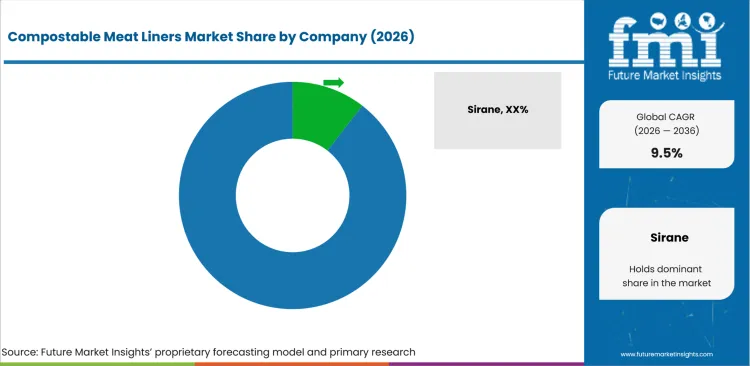
The field remains fragmented between finished absorbent-pad manufacturers and compostable material platforms that depend on converters for final liner formats. Entry requires food-contact documentation, purge-control performance and processor-trial support before material companies gain relevance within cellulose film packaging applications.
- Sirane, Cellcomb, McAirlaid’s, Novipax and POMONA Company provide finished pads with application-specific absorbency for fresh proteins.
- Futamura supplies certified cellulose films for converter-led food-contact structures with documented industrial and home-compostability evidence.
- TIPA and Novamont provide compostable polymer platforms for liner films, interleaves and converter-led food-pack structures.
Competitive Benchmarking: Compostable Meat Liners Market
| Company | Protein Liquid-Management Depth | Compostable Platform Evidence | Pack-Line Customization | Geographic Reach |
|---|---|---|---|---|
| Sirane | High | High | High | Europe, North America and export markets |
| Cellcomb | High | High | High | Europe and export food-pad markets |
| McAirlaid’s | High | Medium | High | Europe and North America |
| Novipax | High | Medium | High | North America |
| POMONA Company | High | Medium | High | Europe and international fresh-food accounts |
| Futamura | Low | High | Medium | Europe, North America and Asia-Pacific |
| TIPA | Low | High | High | Europe, North America and Asia-Pacific |
| Novamont | Low | High | High | Europe with international converter reach |
Key Developments in the Compostable Meat Liners Market
- In April 2026, Futamura expanded its Biopap relationship around NatureFlex-lined compostable food trays for commercial foodservice applications. Certified cellulose films give converters food-contact approval plus industrial or home-compost evidence without sacrificing oxygen, oil and grease barriers.
- In October 2025, TIPA acquired SEALPAP and added recyclable coated paper beside its compostable flexible-film portfolio. Food converters gained one route across paper and certified compostable films that aligns protection requirements with local collection conditions.
- In March 2025, Cellcomb secured European home-and-garden compost certification for Cellsorb CIRCULAR after maintaining its industrial-compostable status. The sealed-edge cellulose food pad gives protein packers a documented household route, although local waste acceptance remains a separate commercial condition.
Key Players in the Compostable Meat Liners Market
Absorbent Liner and Food-Pad Specialists
- Sirane
- Cellcomb
- McAirlaid’s
- Novipax
- POMONA Company
Compostable Film and Biopolymer Platforms
- Futamura
- TIPA
- Novamont
Compostable Meat Liners Market - Report Scope
| Coverage field | Report scope |
|---|---|
| Market breakdown | By product type, material, certification, application, end use, sales channel and region. |
| Quantitative Units | Revenue in USD million and CAGR in %. |
| Market Definition | Commercial compostable absorbent liners, paper liners, biopolymer films and interleaves sold for meat, poultry, seafood and processed-meat packaging. |
| Regions Covered | North America, Latin America, Europe, East Asia, South Asia and Pacific, and Middle East and Africa. |
| Countries Covered | Brazil, United Kingdom, Germany, United States, Japan, and 20+ countries included in the full report. |
| Key Companies Profiled | Sirane, Cellcomb, McAirlaid’s, Novipax, POMONA Company, Futamura, TIPA and Novamont. |
| Forecast Period | 2026 to 2036. |
| Approach | Primary and secondary research with market triangulation. |
Compostable Meat Liners Market - Research Methodology
| Method | Approach |
|---|---|
| Primary Research | FMI analysts gathered input from manufacturers, service providers, technology developers, distributors, end users, procurement teams, and subject-matter experts. Interviews examined purchasing decisions, product or service evaluation, adoption barriers, approval requirements, pricing considerations, and expectations for technical or commercial support. Respondents were also asked what evidence is required before a trial, pilot, or initial order develops into regular purchasing. |
| Desk Research | Desk research covered government statistics, regulatory publications, trade data, industry associations, technical literature, standards, company filings, product information, and official corporate announcements. Sources were reviewed for relevance, publication date, geographic coverage, and consistency with the defined market scope. Claims relating to performance, applications, approvals, capacity, investment, and commercial activity were retained only when supported by credible public evidence. |
| Market Sizing and Forecasting | The market model combined the baseline value with historical performance, segment structure, pricing and volume indicators, adoption levels, company participation, and country-level demand conditions. Forecast assumptions considered economic activity, investment trends, regulatory developments, technology adoption, purchasing cycles, supply availability, and barriers to wider market use. Segment and regional estimates were reconciled before the final market total was calculated. |
| Data Validation | Estimates were checked against multiple independent indicators, including public data, company activity, trade patterns, industry developments, and findings from primary interviews. Validation also tested whether products, services, applications, and company revenues fell within the defined market boundaries. Adjacent categories, unsupported claims, overlapping revenues, and activities without direct market relevance were excluded to reduce double counting and maintain consistency across segments and countries. |
Compostable Meat Liners Market by Segments
Compostable Meat Liners Market segmented by Product Type:
- Certified Compostable Absorbent Liners
- Compostable Paper Liners
- PLA - Biopolymer Film Liners
- Compostable Interleaves
- Others
Compostable Meat Liners Market segmented by Material:
- Airlaid Cellulose
- Paper - Fiber
- PLA
- Starch Biopolymer
- Others
Compostable Meat Liners Market segmented by Certification:
- Industrial Compostable
- Home Compostable
- Uncertified
Compostable Meat Liners Market segmented by Application:
- Fresh Red Meat
- Poultry
- Seafood
- Processed Meats
- Others
Compostable Meat Liners Market segmented by End Use:
- Grocery Retail
- Meat Processors
- Foodservice
- Others
Compostable Meat Liners Market segmented by Sales Channel:
- Direct - OEM Supply
- Packaging Distributors
- Online - E-commerce
- Others
Compostable Meat Liners Market by Region:
- North America
- United States
- Canada
- Latin America
- Brazil
- Mexico
- Chile
- Rest of Latin America
- Western Europe
- Germany
- United Kingdom
- Italy
- Spain
- France
- Nordics
- Benelux
- Rest of Western Europe
- Eastern Europe
- Russia
- Poland
- Hungary
- Balkan and Baltic States
- Rest of Eastern Europe
- East Asia
- China
- Japan
- South Korea
- South Asia and Pacific
- India
- ASEAN
- Australia and New Zealand
- Rest of South Asia and Pacific
- Middle East and Africa
- Kingdom of Saudi Arabia
- Other GCC Countries
- Türkiye
- South Africa
- Other African Union Countries
- Rest of Middle East and Africa
Research Sources and Bibliography
- European Commission. (2025, February 11). New rules enter into force for a more sustainable and competitive packaging economy.
- Brazilian Institute of Geography and Statistics. (2026, March 18). In 2025, Brazil registers the highest production of milk, leather and eggs in history; slaughter of cattle, chickens and pigs also hits record.
- McAirlaid’s. (2024, March 13). Doubling the shelf life.
- Ministry of Ports and Airports, Brazil. (2026, February 6). Infraestrutura portuária responde ao aumento da produção e Brasil lidera mercado global de carne bovina em 2025.
- Department for Environment, Food & Rural Affairs. (2025, March 31). New rules simplifying recycling for workplaces in England come into force.
- Federal Statistical Office of Germany. (2025, February 7). Fleischproduktion im Jahr 2024 um 1,4 % gestiegen.
- USA Department of Agriculture, National Agricultural Statistics Service. (2026, February 19). Livestock Slaughter.
- Ministry of Agriculture, Forestry and Fisheries, Japan. (2026, January 30).
- Sirane. (2024, March 27). ABSORBENT PADS: In-Flex absorbent pad for pre-padding lines still popular after 20 years.
- Novipax. (2026). Absorbent technologies engineered for performance. Retrieved August 7, 2026.
- POMONA Company Sp. z o.o. (2026). Manufacturer of innovative absorbent solutions for fresh food packaging. Retrieved August 7, 2026.
- Futamura Group. (2026, May). Futamura and Biopap Advance Compostable Food Service Solutions.
- TIPA Corp. (2025, October 20). TIPA Acquires SEALPAP: Delivering Full-Service Sustainable Packaging for a Circular Future.
- Cellcomb AB. (2025, March 12). Cellsorb Circular - now certified for your home-and garden compost!
- Novamont S.p.A. (2026, January 15). MATER-BI TAKES ON A NEW LOOK: NOVAMONT UNVEILS ITS REBRANDING AND COMMUNICATION CAMPAIGN.
- Futamura Group. (2025, July 2). £15 million investment announcement at Futamura.
- Cellcomb AB. (2025, June 4). Cellcomb acquires Fatex.
- TIPA Corp. (2025, September 22). TIPA Compostable Packaging Launches Breakthrough High-Barrier Solutions for Flexible Packaging.
This bibliography is provided for reader reference and is not exhaustive. The full report contains the complete reference list and detailed citations
This Report Answers
- How large is the Compostable Meat Liners Market by 2036?
- Which pack conditions convert trials into recurring orders?
- Why do certified absorbent liners lead product demand?
- How does airlaid cellulose manage chilled-pack liquid?
- Why does industrial compostability support multi-site qualification?
- How do the five profiled countries differ commercially?
- Which companies supply liners or compostable materials?
- What limits conversion across commercial meat-packing sites?
Frequently Asked Questions
How big is the Compostable Meat Liners Market in 2026?
The compostable meat liners market is valued at USD 188.3 million in 2026 and is projected to reach USD 466.7 million by 2036. Growth is driven by increasing adoption of compostable packaging solutions that provide liquid absorption while meeting food-contact and disposal requirements.
What is the CAGR of the Compostable Meat Liners Market from 2026 to 2036?
The compostable meat liners market is projected to grow at a CAGR of 9.5% between 2026 and 2036. Expansion is supported by rising demand for sustainable meat packaging and ongoing validation of compostable materials across processing and retail applications.
Which product type is projected to account for 32.0% of the Compostable Meat Liners Market?
Certified compostable absorbent liners are projected to account for 32.0% of the market in 2026. Their leading share is supported by effective liquid retention and compatibility with existing meat packaging formats.
How much will the Compostable Meat Liners Market add between 2026 and 2036?
The compostable meat liners market is expected to add USD 278.4 million in value between 2026 and 2036. Growth reflects increasing replacement of conventional absorbent liners with certified compostable alternatives.
Which companies are active in the compostable Compostable Meat Liners Market?
Key companies operating in the market include Sirane, Cellcomb, McAirlaid’s, Novipax, POMONA Company, Futamura, TIPA, and Novamont. These companies provide compostable absorbent liners, cellulose-based materials, and biopolymer solutions for meat and seafood packaging applications.
Preview the report firsthand - request a free sample
Get SampleGet the brochure for pricing and purchase details.
Get PDFTable of Content
- Key Takeaways
- Market Size and CAGR
- Top Growth Driver
- Fastest Growing Segment
- Leading Region
- Key Companies
- Emerging Opportunities
- Executive Summary
- Global Market Outlook
- Demand-side Trends
- Supply-side Trends
- Technology Roadmap Analysis
- Analysis and Recommendations
- Analyst Perspective (What is happening? Why now? What should investors know?)
- Key Questions Answered
- How large is the market?
- What is the CAGR?
- What are key trends?
- Which region dominates?
- Who are the leaders?
- Market Overview
- Market Coverage / Taxonomy
- Market Definition / Scope / Limitations
- Research Methodology
- Chapter Orientation
- Analytical Lens and Working Hypotheses
- Market Structure, Signals, and Trend Drivers
- Benchmarking and Cross-market Comparability
- Market Sizing, Forecasting, and Opportunity Mapping
- Research Design and Evidence Framework
- Desk Research Programme (Secondary Evidence)
- Expert Input and Fieldwork (Primary Evidence)
- Tooling, Models, and Reference Databases
- Data Engineering and Model Build
- Quality Assurance and Audit Trail
- Market Background
- Market Dynamics (Drivers, Restraints, Opportunity, Trends)
- Scenario Forecast (Optimistic, Likely, Conservative)
- Impact Analysis
- AI Impact
- Sustainability Impact
- Regulatory Impact
- Technology Impact
- Consumer / Buyer Analysis
- Purchase Drivers
- Adoption Barriers
- Buyer Journey
- Opportunity Map Analysis
- Product Life Cycle Analysis
- Supply Chain Analysis
- Investment Feasibility Matrix
- Value Chain Analysis
- PESTLE and Porter's Analysis
- Regulatory Landscape
- Regional Parent Market Outlook
- Production and Consumption Statistics
- Import and Export Statistics
- Global Market Analysis and Forecast, 2021 to 2036
- Historical Market Size Value (USD Million) Analysis, 2021 to 2025
- Current and Future Market Size Value (USD Million) Projections, 2026 to 2036
- Y-o-Y Growth Trend Analysis
- Absolute $ Opportunity Analysis
- Global Market Pricing Analysis, 2021 to 2036
- Global Market Analysis and Forecast, By Product Type, 2021 to 2036
- Introduction / Key Findings
- Historical Market Size Value (USD Million) Analysis By Product Type, 2021 to 2025
- Current and Future Market Size Value (USD Million) Analysis and Forecast By Product Type, 2026 to 2036
- Certified Compostable Absorbent Liners
- Compostable Paper Liners
- PLA - Biopolymer Film Liners
- Compostable Interleaves
- Others
- Certified Compostable Absorbent Liners
- Y-o-Y Growth Trend Analysis By Product Type, 2021 to 2025
- Absolute $ Opportunity Analysis By Product Type, 2026 to 2036
- Global Market Analysis and Forecast, By Material, 2021 to 2036
- Introduction / Key Findings
- Historical Market Size Value (USD Million) Analysis By Material, 2021 to 2025
- Current and Future Market Size Value (USD Million) Analysis and Forecast By Material, 2026 to 2036
- Airlaid Cellulose
- Paper - Fiber
- PLA
- Starch Biopolymer
- Others
- Airlaid Cellulose
- Y-o-Y Growth Trend Analysis By Material, 2021 to 2025
- Absolute $ Opportunity Analysis By Material, 2026 to 2036
- Global Market Analysis and Forecast, By Certification, 2021 to 2036
- Introduction / Key Findings
- Historical Market Size Value (USD Million) Analysis By Certification, 2021 to 2025
- Current and Future Market Size Value (USD Million) Analysis and Forecast By Certification, 2026 to 2036
- Industrial Compostable
- Home Compostable
- Uncertified
- Industrial Compostable
- Y-o-Y Growth Trend Analysis By Certification, 2021 to 2025
- Absolute $ Opportunity Analysis By Certification, 2026 to 2036
- Global Market Analysis and Forecast, By Application, 2021 to 2036
- Introduction / Key Findings
- Historical Market Size Value (USD Million) Analysis By Application, 2021 to 2025
- Current and Future Market Size Value (USD Million) Analysis and Forecast By Application, 2026 to 2036
- Fresh Red Meat
- Poultry
- Seafood
- Processed Meats
- Others
- Fresh Red Meat
- Y-o-Y Growth Trend Analysis By Application, 2021 to 2025
- Absolute $ Opportunity Analysis By Application, 2026 to 2036
- Global Market Analysis and Forecast, By End Use, 2021 to 2036
- Introduction / Key Findings
- Historical Market Size Value (USD Million) Analysis By End Use, 2021 to 2025
- Current and Future Market Size Value (USD Million) Analysis and Forecast By End Use, 2026 to 2036
- Grocery Retail
- Meat Processors
- Foodservice
- Others
- Grocery Retail
- Y-o-Y Growth Trend Analysis By End Use, 2021 to 2025
- Absolute $ Opportunity Analysis By End Use, 2026 to 2036
- Global Market Analysis and Forecast, By Sales Channel
- Introduction / Key Findings
- Historical Market Size Value (USD Million) Analysis By Sales Channel, 2021 to 2025
- Current and Future Market Size Value (USD Million) Analysis and Forecast By Sales Channel, 2026 to 2036
- Direct - OEM Supply
- Packaging Distributors
- Online - E-commerce
- Others
- Direct - OEM Supply
- Y-o-Y Growth Trend Analysis By Sales Channel, 2021 to 2025
- Absolute $ Opportunity Analysis By Sales Channel, 2026 to 2036
- Global Market Analysis and Forecast, By Region, 2021 to 2036
- Introduction
- Historical Market Size Value (USD Million) Analysis By Region, 2021 to 2025
- Current Market Size Value (USD Million) Analysis and Forecast By Region, 2026 to 2036
- North America
- Latin America
- Western Europe
- Eastern Europe
- East Asia
- South Asia and Pacific
- Middle East & Africa
- Market Attractiveness Analysis By Region
- North America Market Analysis and Forecast, By Country, 2021 to 2036
- Historical Market Size Value (USD Million) Trend Analysis By Market Taxonomy, 2021 to 2025
- Market Size Value (USD Million) Forecast By Market Taxonomy, 2026 to 2036
- By Country
- USA
- Canada
- By Product Type
- By Material
- By Certification
- By Application
- By End Use
- By Sales Channel
- By Country
- Market Attractiveness Analysis
- By Country
- By Product Type
- By Material
- By Certification
- By Application
- By End Use
- By Sales Channel
- Key Takeaways
- Latin America Market Analysis and Forecast, By Country
- Historical Market Size Value (USD Million) Trend Analysis By Market Taxonomy, 2021 to 2025
- Market Size Value (USD Million) Forecast By Market Taxonomy, 2026 to 2036
- By Country
- Brazil
- Mexico
- Chile
- Rest of Latin America
- By Product Type
- By Material
- By Certification
- By Application
- By End Use
- By Sales Channel
- By Country
- Market Attractiveness Analysis
- By Country
- By Product Type
- By Material
- By Certification
- By Application
- By End Use
- By Sales Channel
- Key Takeaways
- Western Europe Market Analysis and Forecast, By Country
- Historical Market Size Value (USD Million) Trend Analysis By Market Taxonomy, 2021 to 2025
- Market Size Value (USD Million) Forecast By Market Taxonomy, 2026 to 2036
- By Country
- Germany
- UK
- Italy
- Spain
- France
- Nordic
- BENELUX
- Rest of Western Europe
- By Product Type
- By Material
- By Certification
- By Application
- By End Use
- By Sales Channel
- By Country
- Market Attractiveness Analysis
- By Country
- By Product Type
- By Material
- By Certification
- By Application
- By End Use
- By Sales Channel
- Key Takeaways
- Eastern Europe Market Analysis and Forecast, By Country
- Historical Market Size Value (USD Million) Trend Analysis By Market Taxonomy, 2021 to 2025
- Market Size Value (USD Million) Forecast By Market Taxonomy, 2026 to 2036
- By Country
- Russia
- Poland
- Hungary
- Balkan & Baltic
- Rest of Eastern Europe
- By Product Type
- By Material
- By Certification
- By Application
- By End Use
- By Sales Channel
- By Country
- Market Attractiveness Analysis
- By Country
- By Product Type
- By Material
- By Certification
- By Application
- By End Use
- By Sales Channel
- Key Takeaways
- East Asia Market Analysis and Forecast, By Country
- Historical Market Size Value (USD Million) Trend Analysis By Market Taxonomy, 2021 to 2025
- Market Size Value (USD Million) Forecast By Market Taxonomy, 2026 to 2036
- By Country
- China
- Japan
- South Korea
- By Product Type
- By Material
- By Certification
- By Application
- By End Use
- By Sales Channel
- By Country
- Market Attractiveness Analysis
- By Country
- By Product Type
- By Material
- By Certification
- By Application
- By End Use
- By Sales Channel
- Key Takeaways
- South Asia and Pacific Market Analysis and Forecast, By Country
- Historical Market Size Value (USD Million) Trend Analysis By Market Taxonomy, 2021 to 2025
- Market Size Value (USD Million) Forecast By Market Taxonomy, 2026 to 2036
- By Country
- India
- ASEAN
- Australia & New Zealand
- Rest of South Asia and Pacific
- By Product Type
- By Material
- By Certification
- By Application
- By End Use
- By Sales Channel
- By Country
- Market Attractiveness Analysis
- By Country
- By Product Type
- By Material
- By Certification
- By Application
- By End Use
- By Sales Channel
- Key Takeaways
- Middle East & Africa Market Analysis and Forecast, By Country
- Historical Market Size Value (USD Million) Trend Analysis By Market Taxonomy, 2021 to 2025
- Market Size Value (USD Million) Forecast By Market Taxonomy, 2026 to 2036
- By Country
- Kingdom of Saudi Arabia
- Other GCC Countries
- Türkiye
- South Africa
- Other African Union
- Rest of Middle East & Africa
- By Product Type
- By Material
- By Certification
- By Application
- By End Use
- By Sales Channel
- By Country
- Market Attractiveness Analysis
- By Country
- By Product Type
- By Material
- By Certification
- By Application
- By End Use
- By Sales Channel
- Key Takeaways
- Key Countries Market Analysis
- USA
- Pricing Analysis
- Market Share Analysis, 2025
- By Product Type
- By Material
- By Certification
- By Application
- By End Use
- By Sales Channel
- Canada
- Pricing Analysis
- Market Share Analysis, 2025
- By Product Type
- By Material
- By Certification
- By Application
- By End Use
- By Sales Channel
- Mexico
- Pricing Analysis
- Market Share Analysis, 2025
- By Product Type
- By Material
- By Certification
- By Application
- By End Use
- By Sales Channel
- Brazil
- Pricing Analysis
- Market Share Analysis, 2025
- By Product Type
- By Material
- By Certification
- By Application
- By End Use
- By Sales Channel
- Chile
- Pricing Analysis
- Market Share Analysis, 2025
- By Product Type
- By Material
- By Certification
- By Application
- By End Use
- By Sales Channel
- Germany
- Pricing Analysis
- Market Share Analysis, 2025
- By Product Type
- By Material
- By Certification
- By Application
- By End Use
- By Sales Channel
- UK
- Pricing Analysis
- Market Share Analysis, 2025
- By Product Type
- By Material
- By Certification
- By Application
- By End Use
- By Sales Channel
- Italy
- Pricing Analysis
- Market Share Analysis, 2025
- By Product Type
- By Material
- By Certification
- By Application
- By End Use
- By Sales Channel
- Spain
- Pricing Analysis
- Market Share Analysis, 2025
- By Product Type
- By Material
- By Certification
- By Application
- By End Use
- By Sales Channel
- France
- Pricing Analysis
- Market Share Analysis, 2025
- By Product Type
- By Material
- By Certification
- By Application
- By End Use
- By Sales Channel
- India
- Pricing Analysis
- Market Share Analysis, 2025
- By Product Type
- By Material
- By Certification
- By Application
- By End Use
- By Sales Channel
- ASEAN
- Pricing Analysis
- Market Share Analysis, 2025
- By Product Type
- By Material
- By Certification
- By Application
- By End Use
- By Sales Channel
- Australia & New Zealand
- Pricing Analysis
- Market Share Analysis, 2025
- By Product Type
- By Material
- By Certification
- By Application
- By End Use
- By Sales Channel
- China
- Pricing Analysis
- Market Share Analysis, 2025
- By Product Type
- By Material
- By Certification
- By Application
- By End Use
- By Sales Channel
- Japan
- Pricing Analysis
- Market Share Analysis, 2025
- By Product Type
- By Material
- By Certification
- By Application
- By End Use
- By Sales Channel
- South Korea
- Pricing Analysis
- Market Share Analysis, 2025
- By Product Type
- By Material
- By Certification
- By Application
- By End Use
- By Sales Channel
- Russia
- Pricing Analysis
- Market Share Analysis, 2025
- By Product Type
- By Material
- By Certification
- By Application
- By End Use
- By Sales Channel
- Poland
- Pricing Analysis
- Market Share Analysis, 2025
- By Product Type
- By Material
- By Certification
- By Application
- By End Use
- By Sales Channel
- Hungary
- Pricing Analysis
- Market Share Analysis, 2025
- By Product Type
- By Material
- By Certification
- By Application
- By End Use
- By Sales Channel
- Kingdom of Saudi Arabia
- Pricing Analysis
- Market Share Analysis, 2025
- By Product Type
- By Material
- By Certification
- By Application
- By End Use
- By Sales Channel
- Türkiye
- Pricing Analysis
- Market Share Analysis, 2025
- By Product Type
- By Material
- By Certification
- By Application
- By End Use
- By Sales Channel
- South Africa
- Pricing Analysis
- Market Share Analysis, 2025
- By Product Type
- By Material
- By Certification
- By Application
- By End Use
- By Sales Channel
- USA
- Market Structure Analysis
- Competition Dashboard
- Competition Benchmarking
- Market Share Analysis of Top Players
- By Regional
- By Product Type
- By Material
- By Certification
- By Application
- By End Use
- By Sales Channel
- Emerging Startups
- Innovation Benchmarking
- Competition Analysis
- Competition Deep Dive
- Sirane
- Overview
- Product Portfolio
- Profitability by Market Segments
- Sales Footprint
- Strategy Overview
- Marketing Strategy
- Product Strategy
- Channel Strategy
- Cellcomb
- McAirlaid's
- Futamura
- TIPA
- Novamont
- Vegware (Novolex)
- Maxwell Chase Technologies
- Novipax
- BioBag
- Sirane
- Case Studies
- Success Stories
- Recent Developments
- Competition Deep Dive
- Assumptions & Acronyms Used


