

- Market Size (2026)
- USD 295.3 Mn
- Forecast (2036)
- USD 780.0 Mn
- CAGR (2026 to 2036)
- 10.2%
How big is Compostable Produce Films Market in 2026?
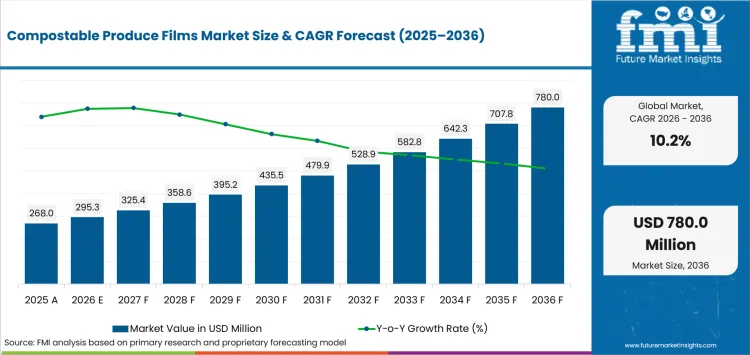
USD 295.3 million in 2026 and USD 780.0 million by 2036 at a 10.2% CAGR.
Demand for compostable produce films is projected to expand at 10.2% CAGR between 2026 and 2036, lifting valuation from USD 295.3 million to USD 780.0 million. Produce packers need films that limit moisture loss and condensation across fresh food packaging lines without leaving persistent food-soiled plastic. UNEP reported in March 2024 that households discarded more than one billion meals each day during 2022. Daily food loss keeps shelf-life performance central to approval, as repeat orders follow verified produce protection instead of a material claim alone.
The United Kingdom has a clearer food-waste collection base than markets that depend mainly on municipal exceptions. Defra reported in March 2026 that England recycled 535,000 tonnes of separately collected food waste during 2024 following a 6.7% increase from 2023. The figure does not guarantee package acceptance, but it gives retailers a broader base for controlled compostable plastic packaging trials. Companies entering fragmented systems must align labels, packers and local waste contractors ahead of volume orders.
Key Takeaways of Compostable Produce Films Market
- Demand grows where produce packers can reduce spoilage and replace food-soiled films that perform poorly in conventional recycling.
- In 2026, cellulose films are projected to account for 30.0% of product type revenue owing to clear presentation and established converting routes.
- Regenerated cellulose is estimated to represent 32.0% of material revenue in 2026 because transparent formats combine printability with controlled moisture transfer.
- Industrial compostable certification is anticipated to hold 56.0% of revenue in 2026 as commercial purchasers rely on defined testing and third-party documentation.
- Line-trial cost, film premiums and uneven acceptance by composting operators can delay conversion from pilot volumes to repeat specifications.
- Futamura, TIPA, Novamont, BioBag, Taghleef Industries, NatureWorks, Coveris and BASF represent the controlled company set for this market.
Analyst Perspective
“Compostable produce films earn repeat orders once packers verify seal stability, gas transfer and produce-specific shelf life on commercial lines. Strong offers connect that technical record with certified claims and local organics routes, as a film without an accepted destination remains an expensive material substitution.”
- Nandini Roy Choudhury, Principal Consultant, Future Market Insights
How is the Compostable Produce Films Market segmented?
The compostable produce films market is segmented by product type, material, certification, produce type, end use, sales channel and region.
Product type includes Cellulose Films, PLA Films, PBAT - Starch Blend Films, PHA Films and other formats. Material includes Regenerated Cellulose, PLA, Starch Blends, PBAT and other substrate families used in the analysis. Certification covers Industrial Compostable, Home Compostable and Uncertified products across the complete defined revenue boundary. Produce type includes Fresh-Cut & Salads, Fruits, Whole Vegetables, Herbs and other produce formats included in demand analysis. End use includes Grocery Retail, Packers & Processors, Foodservice and other commercial purchaser groups within the report. Sales channel includes Direct - OEM Supply, Packaging Distributors, Online - E-commerce and other commercial routes used for market analysis.
Why do cellulose films lead demand within the product type category?
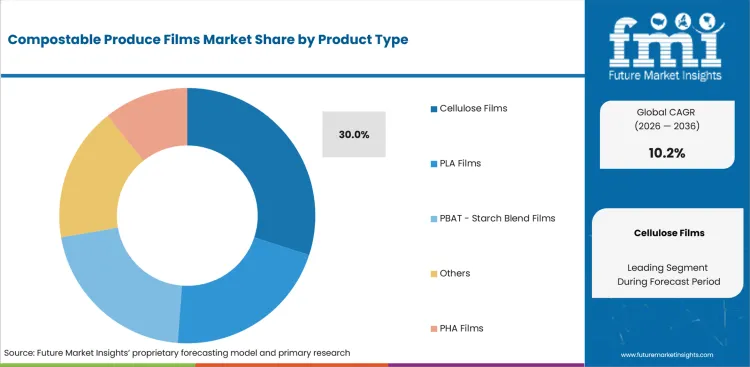
Cellulose films combine high clarity with useful moisture transfer for produce that loses quality under trapped condensation. Their stiffness and print response also support labels, wraps and selected lidding formats within cellulose film packaging programs.
- Based on product type, cellulose films are projected to account for 30.0% in 2026 due to established converting knowledge and strong shelf presentation.
- The European Union adopted Regulation (EU) 2025/40 in December 2024, requiring adhesive labels placed on fruits and vegetables to comply with industrial composting standards by 12 February 2028, with home-composting compatibility where required by Member States. The rule strengthens demand for certified cellulose structures that can withstand printing and application without contaminating organic waste.
Why does regenerated cellulose lead demand within the material category?
Regenerated cellulose provides a familiar transparent substrate for biodegradable packaging designs that need printability and controlled moisture exchange. Packaging engineers can retain existing print workflows, though coatings and adhesives must remain compatible with the final compostability claim during recurring commercial production.
- By material, regenerated cellulose is estimated to hold 32.0% in 2026 owing to conversion familiarity and suitability for clear produce formats.
- Packers qualify the complete structure against seal strength, fogging and gas transfer for each produce family. Commercial use expands once coated films retain certification and prevent moisture conditions that shorten the selling window.
Why does industrial compostable certification lead the certification category?
Industrial compostability uses defined temperature and disintegration conditions that commercial purchasers can document during package approval. Defined documentation supports legal reviews and retailer specifications, though the route remains dependent on facilities that accept the certified format.
- In 2026, industrial compostable is expected to lead certification with 56.0% share because recognized test protocols reduce uncertainty during specification reviews.
- BPI announced its Commercial and Home Compostable Certification program in September 2025 and began accepting applications in December. Expanded certification choices help packaging teams distinguish lower-temperature claims from conventional industrial approvals, though local acceptance remains a separate requirement.
Why do fresh-cut & salads lead demand within the produce type category?
Fresh-cut leaves expose package performance within a short retail window as respiration and surface moisture change rapidly. Packers use modified atmosphere packaging principles to set permeability targets across chilled retail distribution cycles. Each produce packaging trial must also confirm optical clarity and seal stability without accelerating produce dehydration.
- By produce type, fresh-cut & salads are forecast to represent 26.0% in 2026 driven by high packaging intensity and strict gas-control requirements.
- Retailers approve films once chilled trials confirm clarity, seal reliability and a stable internal atmosphere. Successful specifications generate frequent replenishment, but excess condensation or oxygen imbalance can reverse adoption within one selling cycle.
What are the drivers, restraints and opportunities in the Compostable Produce Films Market?
Produce-loss control supports demand, though qualification cost and uneven composting acceptance restrict repeat purchasing, leaving the clearest opening for films that match existing equipment and verified disposal routes.
- Driver: Fresh produce loses value quickly, so packers consider compostable films if permeability and seal performance protect the selling window.
- Restraint: Film premiums and repeated equipment trials delay commercial approval and local composting rules can invalidate an otherwise credible certification.
- Opportunity: Application-specific packs can shorten qualification by combining produce-tested breathability, conventional-line performance and disposal instructions tied to an accepted route.
Shelf-Life Performance Converts Material Interest into Orders
Produce processors fund material changes that reduce measurable shrink across the complete chilled distribution cycle. Compostable films gain budget once seal integrity and controlled respiration match the performance expected from established food packaging formats. The purchase decision therefore starts with product protection and adds the disposal route as a verified operating benefit.
Qualification and Disposal Rules Extend the Sales Cycle
A compostable film must run at acceptable production speed without unstable seals or repeated temperature adjustments. Packaging engineers then test disposal claims against local collection contracts and contamination limits for accepted organic waste. Combined equipment and disposal checks raise trial cost across sustainable plastic packaging projects and postpone volume conversion if the intended composter rejects the package.
Integrated Film Specifications Reduce Conversion Work
Film developers can shorten approval by supplying permeability data, sealing windows and artwork guidance for one produce application. Converter support also helps packers distinguish home and industrial claims within biodegradable food packaging programs. Revenue concentrates in specifications that transfer across related produce lines without repeating every technical trial.
Which country CAGRs are profiled in the Compostable Produce Films Market?
| Country | CAGR |
|---|---|
| United States | 9.5% |
| Germany | 10.0% |
| Japan | 8.7% |
| United Kingdom | 10.3% |
| Brazil | 10.7% |
How do country-level CAGRs compare in the Compostable Produce Films Market?
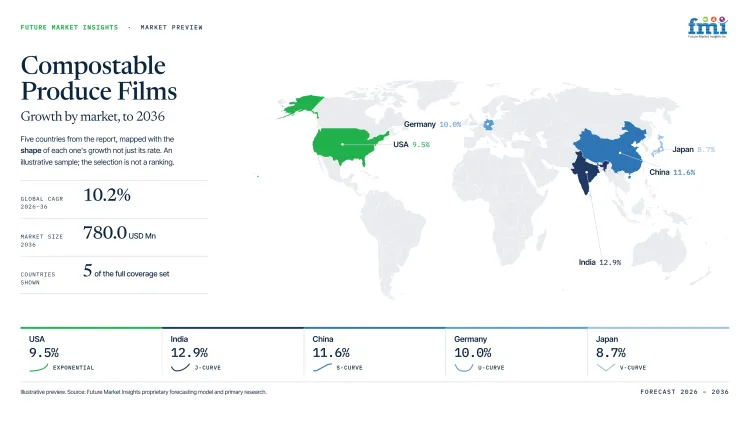
The country forecasts show a relatively compact growth pattern across the compostable produce films market, with a 2.0 percentage point difference between Brazil and Japan. The pattern suggests that adoption is being shaped by compostability standards, food packaging regulations and the availability of collection and processing infrastructure rather than produce consumption alone.
- Brazil exceeds the United Kingdom by 0.4 percentage points as long distribution routes increase the value of produce protection despite uneven organics collection.
- The United Kingdom exceeds Germany by 0.3 percentage points as expanding food-waste collection supports targeted uses with clear disposal instructions.
- Germany exceeds the United States by 0.5 percentage points owing to defined sorting rules and municipal authority over local package acceptance.
- The United States exceeds Japan by 0.8 percentage points attributable to retailer-led trials across a wider but fragmented set of composting outlets.
- The narrow range requires country-specific certification and channel planning because faster growth does not remove approval cost or infrastructure limits.
Comparable national CAGRs can mask differences in approval costs and collection routes across markets with unequal converter capacity and retail concentration. The full report provides country-level CAGR analysis across North America, Latin America, Europe, East Asia, South Asia and Pacific and the Middle East and Africa.
Country-wise Analysis
- United States packaging teams use experienced converters and retailer trials to qualify compostable produce films across grocery programs, but fragmented municipal collection requires each program to confirm an accepted destination before printing disposal instructions. Compostable produce film demand in the United States is forecast to rise at 9.5% CAGR over the forecast period, supported by converting capacity and constrained by different city and state acceptance rules. The Environmental Protection Agency reported in March 2026 that its map covered over 200 source-separated organics communities plus 15,000 potential recipients and gave packaging companies several commercialization routes without a uniform national destination.
- German retailers apply detailed food-contact and sorting requirements to compostable film trials across national and private-label produce programs, favoring companies with complete documentation and stable conversion support during initial validation and recurring production reviews. Germany is estimated to post 10.0% CAGR over the forecast period, shaped by established organics treatment and constrained by local rules that decide which packaging enters municipal collection systems for commercial specifications. The German Environment Agency reported in December 2025 that 55% of household bio-waste entered facilities with a digestion stage during 2023, confirming substantial treatment capacity but leaving local package acceptance under municipal control.
- Japanese produce packers emphasize visual quality and dimensional consistency across compact filling lines, supporting high-specification films that deliver predictable seals and controlled moisture transfer during chilled distribution through demanding national retail programs. Adoption of compostable produce film in Japan is estimated to expand at 8.7% CAGR through 2036, aided by rigorous quality control and limited by established incineration and recycling routes for commercial orders. The Ministry of Agriculture reported in October 2025 that food loss reached 4.64 million tonnes and an estimated JPY 4 trillion, making verified shelf-life improvement necessary for film substitution to earn commercial approval.
- United Kingdom retailers control large private-label specifications and coordinate commercial film trials with converters across several produce categories, giving qualified companies access to aggregated volumes and repeat private-label programs across national store networks. The United Kingdom’s compostable produce films outlook is anticipated to advance at 10.3% CAGR over the assessment period, reinforced by food-waste collections and restricted to applications with credible capture routes across retail programs. WRAP reported in June 2025 that less than 1% of United Kingdom plastic packaging was compostable and recommended targeted use with clear labels and suitable infrastructure, limiting substitution whenever recycling remains preferred locally.
- Brazilian produce supply chains span long transport corridors and varied retail formats, increasing the value of moisture control plus reliable seals across regional packing operations serving several climate zones. Compostable produce film sales in Brazil are forecast to expand at 10.7% CAGR by 2036, supported by distribution needs and limited by uneven collection plus food-contact compliance. Anvisa reported in February 2024 that updated food-contact guidance added questions on biodegradable or compostable packaging, giving manufacturers a compliance reference while leaving disposal routes outside food-safety approval.
Who are the notable companies in the Compostable Produce Films Market?
Futamura, TIPA, Novamont, BioBag, Taghleef Industries, NatureWorks, Coveris and BASF are the notable companies serving this market.
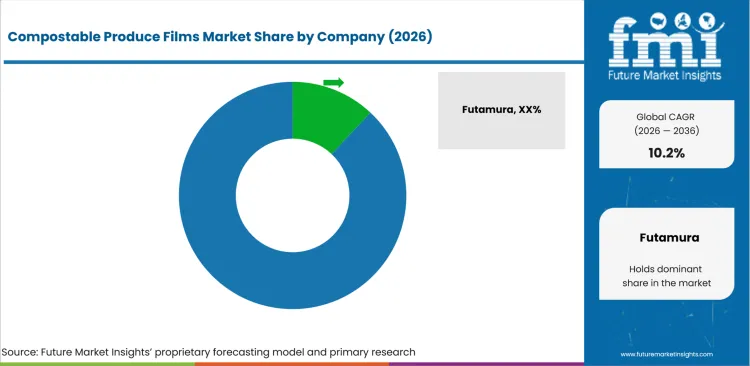
The competitive field combines cellulose-film specialists, compostable material platforms, converted-bag producers and dedicated produce-label converters. Entry barriers arise from certification, produce-specific performance data and conversion support in commercial biodegradable polymers programs. Local disposal fit also affects access, so company size alone does not establish a defensible position.
- Futamura, TIPA, BioBag and Coveris serve converted films, bags or labels with documented fresh-produce applications and commercial qualification support.
- Novamont, NatureWorks and BASF provide compostable material platforms that influence film formulation, process settings and end-of-life certification across produce formats.
- Taghleef Industries supplies oriented biobased and biodegradable film families with barrier options and global relationships across food-packaging conversion markets.
Competitive Benchmarking: Compostable Produce Films Market
| Company | Compostable Film or Material Breadth | Produce Application Evidence | Conversion and Qualification Support | Geographic Reach |
|---|---|---|---|---|
| Futamura | High | High | High | Global |
| TIPA | High | High | High | Europe, North America and Asia-Pacific |
| Novamont | High | High | High | Europe and international distributor markets |
| BioBag | Medium | High | Medium | Europe, North America and international retail markets |
| Taghleef Industries | High | Medium | High | Global |
| NatureWorks | High | High | High | North America, Europe and Asia |
| Coveris | Medium | High | High | Europe and selected international markets |
| BASF | High | Medium | High | Global |
Key Developments in the Compostable Produce Films Market
- In October 2025, Taghleef Industries presented an expanded NATIVIA portfolio covering industrially compostable and home-compostable film families. The updated range adds different barrier and protection levels for converters evaluating certified structures across food and produce packaging applications.
- In September 2025, TIPA launched a home-compostable fresh-produce label designed for conventional printing and application equipment. The label addresses stickers that remain attached to fruit or vegetables and can enter the organic waste stream with produce residues.
- In March 2025, NatureWorks introduced the Ingeo Extend platform and its first grade, Ingeo Extend 4950D, to improve BOPLA film production efficiency and compostability, with the technology identified for applications including salad bags and lidding. The platform combines faster disintegration with improved oriented-film productivity for food-soiled formats that remain difficult to recycle.
Key Players in the Compostable Produce Films Market
Cellulose and Compostable Film Specialists
- Futamura
- TIPA
- Taghleef Industries
Produce Bag and Label Converters
- BioBag
- Coveris
Biopolymer and Material Platforms
- Novamont
- NatureWorks
- BASF
Compostable Produce Films Market - Report Scope
| Coverage field | Report scope |
|---|---|
| Market breakdown | By product type, material, certification, produce type, end use, sales channel and region. |
| Quantitative Units | Revenue in USD million and CAGR in %. |
| Market Definition | Revenue from unconverted film rollstock and converted flexible film-based produce packaging that is certified or designed as compostable. Included formats cover bags, flow-wrap films, lidding films, pouches, liners and relevant produce labels. Excluded categories are standalone resin revenue, conventional film, rigid packs, paper packaging, mulch film and non-produce food packaging. |
| Regions Covered | North America, Latin America, Western Europe, Eastern Europe, East Asia, South Asia and Pacific and Middle East and Africa. |
| Countries Covered | United States, Germany, Japan, United Kingdom, Brazil, and 20+ countries included in the full report. |
| Key Companies Profiled | Futamura, TIPA, Novamont, BioBag, Taghleef Industries, NatureWorks, Coveris and BASF. |
| Forecast Period | 2026 to 2036. |
| Approach | Primary and secondary research with market triangulation. |
Compostable Produce Films Market - Research Methodology
| Method | Approach |
|---|---|
| Primary Research | FMI analysts gathered input from manufacturers, service providers, technology developers, distributors, end users, procurement teams, and subject-matter experts. Interviews examined purchasing decisions, product or service evaluation, adoption barriers, approval requirements, pricing considerations, and expectations for technical or commercial support. Respondents were also asked what evidence is required before a trial, pilot, or initial order develops into regular purchasing. |
| Desk Research | Desk research covered government statistics, regulatory publications, trade data, industry associations, technical literature, standards, company filings, product information, and official corporate announcements. Sources were reviewed for relevance, publication date, geographic coverage, and consistency with the defined market scope. Claims relating to performance, applications, approvals, capacity, investment, and commercial activity were retained only when supported by credible public evidence. |
| Market Sizing and Forecasting | The market model combined the baseline value with historical performance, segment structure, pricing and volume indicators, adoption levels, company participation, and country-level demand conditions. Forecast assumptions considered economic activity, investment trends, regulatory developments, technology adoption, purchasing cycles, supply availability, and barriers to wider market use. Segment and regional estimates were reconciled before the final market total was calculated. |
| Data Validation | Estimates were checked against multiple independent indicators, including public data, company activity, trade patterns, industry developments, and findings from primary interviews. Validation also tested whether products, services, applications, and company revenues fell within the defined market boundaries. Adjacent categories, unsupported claims, overlapping revenues, and activities without direct market relevance were excluded to reduce double counting and maintain consistency across segments and countries. |
Compostable Produce Films Market by Segments
Compostable Produce Films Market segmented by Product Type:
- Cellulose Films
- PLA Films
- PBAT - Starch Blend Films
- Others
- PHA Films
Compostable Produce Films Market segmented by Material:
- Regenerated Cellulose
- PLA
- Starch Blends
- PBAT
- Others
Compostable Produce Films Market segmented by Certification:
- Industrial Compostable
- Home Compostable
- Uncertified
Compostable Produce Films Market segmented by Produce Type:
- Fresh-Cut & Salads
- Fruits
- Whole Vegetables
- Others
- Herbs
Compostable Produce Films Market segmented by End Use:
- Grocery Retail
- Packers & Processors
- Foodservice
- Others
Compostable Produce Films Market segmented by Sales Channel:
- Direct - OEM Supply
- Packaging Distributors
- Online - E-commerce
- Others
Compostable Produce Films Market by Region:
- North America
- United States
- Canada
- Latin America
- Brazil
- Mexico
- Argentina
- Chile
- Western Europe
- Germany
- France
- United Kingdom
- Italy
- Spain
- Benelux
- Nordics
- Eastern Europe
- Poland
- Czech Republic
- Romania
- Hungary
- East Asia
- China
- Japan
- South Korea
- South Asia and Pacific
- India
- ASEAN
- Australia and New Zealand
- Middle East and Africa
- GCC Countries
- South Africa
- Türkiye
- Israel
Research Sources and Bibliography
- United Nations Environment Programme. (2024, March 27). Food Waste Index Report 2024.
- Department for Environment, Food & Rural Affairs. (2026, March 31). Local authority collected waste management - annual results 2024/25.
- European Parliament and Council of the European Union. (2024, December 19). Regulation (EU) 2025/40 on packaging and packaging waste.
- Biodegradable Products Institute. (2025, September 18). BPI Launches Commercial & Home Compostable Certification Program, Bringing Food Waste Diversion to Our Backyards.
- United States Environmental Protection Agency. (2026, March 22). Frequent Questions about the USA EPA Excess Food Opportunities Map.
- Umweltbundesamt. (2025, December 9). Bioabfälle.
- Ministry of Agriculture, Forestry and Fisheries, Japan. (2025, October). 食品ロス削減の現状.
- WRAP. (2025, June 18). Considerations for Compostable Plastic Packaging.
- Agência Nacional de Vigilância Sanitária. (2024, February 29). Anvisa contribui com a sustentabilidade em atualização sobre embalagens de alimentos.
- Futamura Group. (2026). Compostable alternatives for produce labelling. Retrieved August 7, 2026.
- Versalis. (2025). Innovative Polymers for Food Packaging. Retrieved August 7, 2026.
- BioBag. (2026). Retailers. Retrieved August 7, 2026.
- Coveris. (2025, September 17). Coveris and TIPA Enter Exclusive Agreement to Deliver Home Compostable Produce Labels.
- BASF. (2026, April 29). New ecovio® portfolio for flexible packaging: multiple barrier options combined with organic or paper recycling.
- Taghleef Industries. (2025, October 17). At Ecomondo, Taghleef Industries reveals the new era of NATIVIA® for Biobased and Biodegradable Films.
- TIPA. (2025, September 4). TIPA® Compostable Packaging Launches Home Compostable Label for Fresh Produce.
- NatureWorks LLC. (2025, March 18). Ingeo™ Extend: An exceptional solution offering unprecedented manufacturing efficiency and faster biodegradability of BOPLA films.
- Futamura Group. (2026). Sustainability and Accreditations. Retrieved August 7, 2026.
- TIPA. (2026). FAQs. Retrieved August 7, 2026.
This bibliography is provided for reader reference and is not exhaustive. The full report contains the complete reference list and detailed citations
This Report Answers
- What is the value of the Compostable Produce Films Market in 2026 and 2036?
- Which shelf-life and disposal conditions support demand for compostable produce films?
- Why do Cellulose Films hold 30.0% of product type revenue in 2026?
- How does Regenerated Cellulose influence transparent produce-packaging qualification?
- Why does Industrial Compostable certification represent 56.0% of revenue in 2026?
- How do forecast growth rates differ across the five profiled countries?
- Which companies provide certified films, produce formats and compostable material platforms?
- How do line trials and local composting acceptance limit repeat purchasing?
- What should produce packers evaluate before approving a compostable film specification?
Frequently Asked Questions
How big is the Compostable Produce Films Market in 2026?
The compostable produce films market is estimated at USD 295.3 million in 2026. Growth is driven by increasing demand for certified compostable packaging solutions that preserve produce quality while supporting sustainable disposal practices.
What is the CAGR of the Compostable Produce Films Market from 2026 to 2036?
The compostable produce films market is projected to grow at a CAGR of 10.2% between 2026 and 2036. Expansion is supported by rising adoption of compostable packaging and successful performance validation across produce packaging applications.
Which certification segment is projected to account for 56.0% of the Compostable Produce Films Market?
Industrial compostable certification is projected to account for 56.0% of the market in 2026. Its leading share is supported by established certification standards and wider commercial acceptance across packaging supply chains.
How much incremental opportunity will the Compostable Produce Films Market create between 2026 and 2036?
The compostable produce films market is expected to create an incremental opportunity of USD 484.7 million between 2026 and 2036. Growth reflects increasing adoption of compostable films that help reduce packaging waste while maintaining produce protection.
Which companies are active in the Compostable Produce Films Market?
Key companies operating in the market include Futamura, TIPA, Novamont, BioBag, Taghleef Industries, NatureWorks, Coveris, and BASF. These companies provide certified compostable films, biopolymer materials, and sustainable produce packaging solutions.
Preview the report firsthand - request a free sample
Get SampleGet the brochure for pricing and purchase details.
Get PDFTable of Content
- Key Takeaways
- Market Size and CAGR
- Top Growth Driver
- Fastest Growing Segment
- Leading Region
- Key Companies
- Emerging Opportunities
- Executive Summary
- Global Market Outlook
- Demand-side Trends
- Supply-side Trends
- Technology Roadmap Analysis
- Analysis and Recommendations
- Analyst Perspective (What is happening? Why now? What should investors know?)
- Key Questions Answered
- How large is the market?
- What is the CAGR?
- What are key trends?
- Which region dominates?
- Who are the leaders?
- Market Overview
- Market Coverage / Taxonomy
- Market Definition / Scope / Limitations
- Research Methodology
- Chapter Orientation
- Analytical Lens and Working Hypotheses
- Market Structure, Signals, and Trend Drivers
- Benchmarking and Cross-market Comparability
- Market Sizing, Forecasting, and Opportunity Mapping
- Research Design and Evidence Framework
- Desk Research Programme (Secondary Evidence)
- Expert Input and Fieldwork (Primary Evidence)
- Tooling, Models, and Reference Databases
- Data Engineering and Model Build
- Quality Assurance and Audit Trail
- Market Background
- Market Dynamics (Drivers, Restraints, Opportunity, Trends)
- Scenario Forecast (Optimistic, Likely, Conservative)
- Impact Analysis
- AI Impact
- Sustainability Impact
- Regulatory Impact
- Technology Impact
- Consumer / Buyer Analysis
- Purchase Drivers
- Adoption Barriers
- Buyer Journey
- Opportunity Map Analysis
- Product Life Cycle Analysis
- Supply Chain Analysis
- Investment Feasibility Matrix
- Value Chain Analysis
- PESTLE and Porter's Analysis
- Regulatory Landscape
- Regional Parent Market Outlook
- Production and Consumption Statistics
- Import and Export Statistics
- Global Market Analysis and Forecast, 2021 to 2036
- Historical Market Size Value (USD Million) Analysis, 2021 to 2025
- Current and Future Market Size Value (USD Million) Projections, 2026 to 2036
- Y-o-Y Growth Trend Analysis
- Absolute $ Opportunity Analysis
- Global Market Pricing Analysis, 2021 to 2036
- Global Market Analysis and Forecast, By Product Type, 2021 to 2036
- Introduction / Key Findings
- Historical Market Size Value (USD Million) Analysis By Product Type, 2021 to 2025
- Current and Future Market Size Value (USD Million) Analysis and Forecast By Product Type, 2026 to 2036
- Cellulose Films
- PLA Films
- PBAT - Starch Blend Films
- Others
- PHA Films
- Cellulose Films
- Y-o-Y Growth Trend Analysis By Product Type, 2021 to 2025
- Absolute $ Opportunity Analysis By Product Type, 2026 to 2036
- Global Market Analysis and Forecast, By Material, 2021 to 2036
- Introduction / Key Findings
- Historical Market Size Value (USD Million) Analysis By Material, 2021 to 2025
- Current and Future Market Size Value (USD Million) Analysis and Forecast By Material, 2026 to 2036
- Regenerated Cellulose
- PLA
- Starch Blends
- PBAT
- Others
- Regenerated Cellulose
- Y-o-Y Growth Trend Analysis By Material, 2021 to 2025
- Absolute $ Opportunity Analysis By Material, 2026 to 2036
- Global Market Analysis and Forecast, By Certification, 2021 to 2036
- Introduction / Key Findings
- Historical Market Size Value (USD Million) Analysis By Certification, 2021 to 2025
- Current and Future Market Size Value (USD Million) Analysis and Forecast By Certification, 2026 to 2036
- Industrial Compostable
- Home Compostable
- Uncertified
- Industrial Compostable
- Y-o-Y Growth Trend Analysis By Certification, 2021 to 2025
- Absolute $ Opportunity Analysis By Certification, 2026 to 2036
- Global Market Analysis and Forecast, By Produce Type, 2021 to 2036
- Introduction / Key Findings
- Historical Market Size Value (USD Million) Analysis By Produce Type, 2021 to 2025
- Current and Future Market Size Value (USD Million) Analysis and Forecast By Produce Type, 2026 to 2036
- Fresh-Cut & Salads
- Fruits
- Whole Vegetables
- Others
- Herbs
- Fresh-Cut & Salads
- Y-o-Y Growth Trend Analysis By Produce Type, 2021 to 2025
- Absolute $ Opportunity Analysis By Produce Type, 2026 to 2036
- Global Market Analysis and Forecast, By End Use, 2021 to 2036
- Introduction / Key Findings
- Historical Market Size Value (USD Million) Analysis By End Use, 2021 to 2025
- Current and Future Market Size Value (USD Million) Analysis and Forecast By End Use, 2026 to 2036
- Grocery Retail
- Packers & Processors
- Foodservice
- Others
- Grocery Retail
- Y-o-Y Growth Trend Analysis By End Use, 2021 to 2025
- Absolute $ Opportunity Analysis By End Use, 2026 to 2036
- Global Market Analysis and Forecast, By Sales Channel
- Introduction / Key Findings
- Historical Market Size Value (USD Million) Analysis By Sales Channel, 2021 to 2025
- Current and Future Market Size Value (USD Million) Analysis and Forecast By Sales Channel, 2026 to 2036
- Direct - OEM Supply
- Packaging Distributors
- Online - E-commerce
- Others
- Direct - OEM Supply
- Y-o-Y Growth Trend Analysis By Sales Channel, 2021 to 2025
- Absolute $ Opportunity Analysis By Sales Channel, 2026 to 2036
- Global Market Analysis and Forecast, By Region, 2021 to 2036
- Introduction
- Historical Market Size Value (USD Million) Analysis By Region, 2021 to 2025
- Current Market Size Value (USD Million) Analysis and Forecast By Region, 2026 to 2036
- North America
- Latin America
- Western Europe
- Eastern Europe
- East Asia
- South Asia and Pacific
- Middle East & Africa
- Market Attractiveness Analysis By Region
- North America Market Analysis and Forecast, By Country, 2021 to 2036
- Historical Market Size Value (USD Million) Trend Analysis By Market Taxonomy, 2021 to 2025
- Market Size Value (USD Million) Forecast By Market Taxonomy, 2026 to 2036
- By Country
- USA
- Canada
- By Product Type
- By Material
- By Certification
- By Produce Type
- By End Use
- By Sales Channel
- By Country
- Market Attractiveness Analysis
- By Country
- By Product Type
- By Material
- By Certification
- By Produce Type
- By End Use
- By Sales Channel
- Key Takeaways
- Latin America Market Analysis and Forecast, By Country
- Historical Market Size Value (USD Million) Trend Analysis By Market Taxonomy, 2021 to 2025
- Market Size Value (USD Million) Forecast By Market Taxonomy, 2026 to 2036
- By Country
- Brazil
- Mexico
- Chile
- Rest of Latin America
- By Product Type
- By Material
- By Certification
- By Produce Type
- By End Use
- By Sales Channel
- By Country
- Market Attractiveness Analysis
- By Country
- By Product Type
- By Material
- By Certification
- By Produce Type
- By End Use
- By Sales Channel
- Key Takeaways
- Western Europe Market Analysis and Forecast, By Country
- Historical Market Size Value (USD Million) Trend Analysis By Market Taxonomy, 2021 to 2025
- Market Size Value (USD Million) Forecast By Market Taxonomy, 2026 to 2036
- By Country
- Germany
- UK
- Italy
- Spain
- France
- Nordic
- BENELUX
- Rest of Western Europe
- By Product Type
- By Material
- By Certification
- By Produce Type
- By End Use
- By Sales Channel
- By Country
- Market Attractiveness Analysis
- By Country
- By Product Type
- By Material
- By Certification
- By Produce Type
- By End Use
- By Sales Channel
- Key Takeaways
- Eastern Europe Market Analysis and Forecast, By Country
- Historical Market Size Value (USD Million) Trend Analysis By Market Taxonomy, 2021 to 2025
- Market Size Value (USD Million) Forecast By Market Taxonomy, 2026 to 2036
- By Country
- Russia
- Poland
- Hungary
- Balkan & Baltic
- Rest of Eastern Europe
- By Product Type
- By Material
- By Certification
- By Produce Type
- By End Use
- By Sales Channel
- By Country
- Market Attractiveness Analysis
- By Country
- By Product Type
- By Material
- By Certification
- By Produce Type
- By End Use
- By Sales Channel
- Key Takeaways
- East Asia Market Analysis and Forecast, By Country
- Historical Market Size Value (USD Million) Trend Analysis By Market Taxonomy, 2021 to 2025
- Market Size Value (USD Million) Forecast By Market Taxonomy, 2026 to 2036
- By Country
- China
- Japan
- South Korea
- By Product Type
- By Material
- By Certification
- By Produce Type
- By End Use
- By Sales Channel
- By Country
- Market Attractiveness Analysis
- By Country
- By Product Type
- By Material
- By Certification
- By Produce Type
- By End Use
- By Sales Channel
- Key Takeaways
- South Asia and Pacific Market Analysis and Forecast, By Country
- Historical Market Size Value (USD Million) Trend Analysis By Market Taxonomy, 2021 to 2025
- Market Size Value (USD Million) Forecast By Market Taxonomy, 2026 to 2036
- By Country
- India
- ASEAN
- Australia & New Zealand
- Rest of South Asia and Pacific
- By Product Type
- By Material
- By Certification
- By Produce Type
- By End Use
- By Sales Channel
- By Country
- Market Attractiveness Analysis
- By Country
- By Product Type
- By Material
- By Certification
- By Produce Type
- By End Use
- By Sales Channel
- Key Takeaways
- Middle East & Africa Market Analysis and Forecast, By Country
- Historical Market Size Value (USD Million) Trend Analysis By Market Taxonomy, 2021 to 2025
- Market Size Value (USD Million) Forecast By Market Taxonomy, 2026 to 2036
- By Country
- Kingdom of Saudi Arabia
- Other GCC Countries
- Türkiye
- South Africa
- Other African Union
- Rest of Middle East & Africa
- By Product Type
- By Material
- By Certification
- By Produce Type
- By End Use
- By Sales Channel
- By Country
- Market Attractiveness Analysis
- By Country
- By Product Type
- By Material
- By Certification
- By Produce Type
- By End Use
- By Sales Channel
- Key Takeaways
- Key Countries Market Analysis
- USA
- Pricing Analysis
- Market Share Analysis, 2025
- By Product Type
- By Material
- By Certification
- By Produce Type
- By End Use
- By Sales Channel
- Canada
- Pricing Analysis
- Market Share Analysis, 2025
- By Product Type
- By Material
- By Certification
- By Produce Type
- By End Use
- By Sales Channel
- Mexico
- Pricing Analysis
- Market Share Analysis, 2025
- By Product Type
- By Material
- By Certification
- By Produce Type
- By End Use
- By Sales Channel
- Brazil
- Pricing Analysis
- Market Share Analysis, 2025
- By Product Type
- By Material
- By Certification
- By Produce Type
- By End Use
- By Sales Channel
- Chile
- Pricing Analysis
- Market Share Analysis, 2025
- By Product Type
- By Material
- By Certification
- By Produce Type
- By End Use
- By Sales Channel
- Germany
- Pricing Analysis
- Market Share Analysis, 2025
- By Product Type
- By Material
- By Certification
- By Produce Type
- By End Use
- By Sales Channel
- UK
- Pricing Analysis
- Market Share Analysis, 2025
- By Product Type
- By Material
- By Certification
- By Produce Type
- By End Use
- By Sales Channel
- Italy
- Pricing Analysis
- Market Share Analysis, 2025
- By Product Type
- By Material
- By Certification
- By Produce Type
- By End Use
- By Sales Channel
- Spain
- Pricing Analysis
- Market Share Analysis, 2025
- By Product Type
- By Material
- By Certification
- By Produce Type
- By End Use
- By Sales Channel
- France
- Pricing Analysis
- Market Share Analysis, 2025
- By Product Type
- By Material
- By Certification
- By Produce Type
- By End Use
- By Sales Channel
- India
- Pricing Analysis
- Market Share Analysis, 2025
- By Product Type
- By Material
- By Certification
- By Produce Type
- By End Use
- By Sales Channel
- ASEAN
- Pricing Analysis
- Market Share Analysis, 2025
- By Product Type
- By Material
- By Certification
- By Produce Type
- By End Use
- By Sales Channel
- Australia & New Zealand
- Pricing Analysis
- Market Share Analysis, 2025
- By Product Type
- By Material
- By Certification
- By Produce Type
- By End Use
- By Sales Channel
- China
- Pricing Analysis
- Market Share Analysis, 2025
- By Product Type
- By Material
- By Certification
- By Produce Type
- By End Use
- By Sales Channel
- Japan
- Pricing Analysis
- Market Share Analysis, 2025
- By Product Type
- By Material
- By Certification
- By Produce Type
- By End Use
- By Sales Channel
- South Korea
- Pricing Analysis
- Market Share Analysis, 2025
- By Product Type
- By Material
- By Certification
- By Produce Type
- By End Use
- By Sales Channel
- Russia
- Pricing Analysis
- Market Share Analysis, 2025
- By Product Type
- By Material
- By Certification
- By Produce Type
- By End Use
- By Sales Channel
- Poland
- Pricing Analysis
- Market Share Analysis, 2025
- By Product Type
- By Material
- By Certification
- By Produce Type
- By End Use
- By Sales Channel
- Hungary
- Pricing Analysis
- Market Share Analysis, 2025
- By Product Type
- By Material
- By Certification
- By Produce Type
- By End Use
- By Sales Channel
- Kingdom of Saudi Arabia
- Pricing Analysis
- Market Share Analysis, 2025
- By Product Type
- By Material
- By Certification
- By Produce Type
- By End Use
- By Sales Channel
- Türkiye
- Pricing Analysis
- Market Share Analysis, 2025
- By Product Type
- By Material
- By Certification
- By Produce Type
- By End Use
- By Sales Channel
- South Africa
- Pricing Analysis
- Market Share Analysis, 2025
- By Product Type
- By Material
- By Certification
- By Produce Type
- By End Use
- By Sales Channel
- USA
- Market Structure Analysis
- Competition Dashboard
- Competition Benchmarking
- Market Share Analysis of Top Players
- By Regional
- By Product Type
- By Material
- By Certification
- By Produce Type
- By End Use
- By Sales Channel
- Emerging Startups
- Innovation Benchmarking
- Competition Analysis
- Competition Deep Dive
- Futamura
- Overview
- Product Portfolio
- Profitability by Market Segments
- Sales Footprint
- Strategy Overview
- Marketing Strategy
- Product Strategy
- Channel Strategy
- TIPA
- Novamont
- BioBag
- Taghleef Industries
- Innovia Films
- NatureWorks
- Amcor
- Mondi
- StePac
- Futamura
- Case Studies
- Success Stories
- Recent Developments
- Competition Deep Dive
- Assumptions & Acronyms Used


