

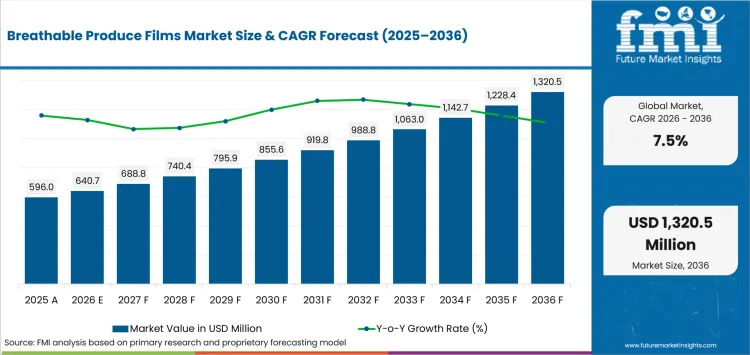
- Market Size (2026)
- USD 640.7 Mn
- Forecast (2036)
- USD 1320.5 Mn
- CAGR (2026 to 2036)
- 7.5%
How big is Breathable Produce Films Market in 2026?
USD 640.7 million in 2026 and USD 1,320.5 million by 2036 at a 7.5% CAGR.
Demand for breathable produce films is projected to expand at a 7.5% CAGR between 2026 and 2036, rising from USD 640.7 million in 2026 to USD 1,320.5 million by 2036. Fresh processors use modified atmosphere packaging as a production control for living products across refrigerated distribution programs. An operating benchmark comes from Taylor Farms’ work across more than 3,000 chopped-salad packaging trials. Taylor Farms reported in April 2025 that those trials extended chopped-salad shelf life from four days to 16 days. The qualification burden directs spending toward tested food packaging films with defined permeability and repeatable seal performance.
Shipment length and packaging recovery rules create specific country-level purchase conditions for breathable produce films. Brazil is forecast at 7.9% CAGR compared with 7.4% for the UK and 6.1% for Japan. Brazil’s National Supply Company reported in July 2026 that fruit exports reached about 1.3 million tonnes during 2025. Extended export routes directly increase the commercial value of moisture control and package-level gas management. Mature fresh food packaging systems place greater weight on recyclability evidence and repeatable line performance during supplier qualification.
Key Takeaways of Breathable Produce Films Market
- Produce packers increase film spending as validated gas exchange protects sellable days across fresh-cut and export programs.
- Micro-Perforated Films are projected to account for 36.0% share in 2026 as controlled apertures match product respiration.
- Polypropylene (BOPP - CPP) is estimated to hold 34.0% share in 2026 owing to clarity, sealing reliability and familiar conversion.
- Bags & Pouches are forecast to represent 38.0% share in 2026 as they establish controllable headspace across varied fill weights.
- Crop variety, cutting method and temperature variation slow switching since each condition can change the acceptable permeability window.
- StePacPPC, PerfoTec, TransFRESH Corporation (Hazel BreatheWay), Amcor plc, Coveris, TIPA Compostable Packaging, Ultraperf Technologies and R.O.P. Ltd. form the verified company set.
Analyst Perspective
“Breathable produce film earns repeat orders once the atmosphere remains safe across the product’s real temperature profile. Suppliers that combine crop testing with dependable conversion support can shorten approval cycles without treating every produce program as interchangeable.”
- Nandini Roy Choudhury, Principal Consultant, Future Market Insights
How is the Breathable Produce Films Market segmented?
Product Type, Material, Format, Produce Type, End Use and Sales Channel define scope.
Product Type includes Micro-Perforated Films, Macro-Perforated Films, Inherently Breathable Polymer Films, Laser-Perforated MAP Films and Others. Material covers Polypropylene (BOPP - CPP), Polyethylene, PLA - Bio-Films, Cellulose and Others while Format includes Bags & Pouches, Flow Wrap, Lidding, Sheets and Others. Produce Type includes Fresh-Cut & Salads, Whole Vegetables, Fruits, Herbs and Others while End Use covers Packers & Processors, Grocery Retail, Foodservice and Others. Sales Channel includes Direct - OEM Supply, Packaging Distributors, Online - E-commerce and Others.
What makes micro-perforated films central to the product type category?
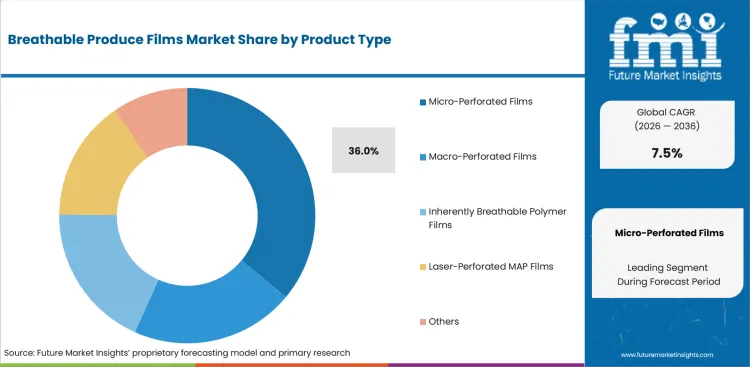
Micro-perforation lets film converters adjust oxygen exchange while retaining an established resin and familiar production setup across recurring produce programs. Converters test aperture diameter and density against produce weight so packaging films become a controlled process input instead of generic vented wrap.
- Based on Product Type, Micro-Perforated Films are projected to account for 36.0% in 2026 due to measurable control over aperture size and count.
- A familiar film platform can use different perforation matrices across crops without changing the underlying resin or conversion equipment. Commercial approval requires sealed-pack trials since line tension and print coverage can change effective gas exchange under different temperatures.
Why does polypropylene (BOPP - CPP) lead the material category?
BOPP provides clarity and stiffness while CPP adds sealability and toughness across converted produce packs. Established extrusion and printing routes support repeat commercial production and make polypropylene packaging films practical for mono-material redesign.
- By Material, Polypropylene (BOPP - CPP) is estimated to hold 34.0% in 2026 owing to familiar conversion settings and dependable retail presentation.
- Material redesign is entering film portfolios that serve fresh produce and other refrigerated food applications. Coveris presented expanded recyclable PE and PP MonoFlex films in February 2024 for markets that included fresh produce. The qualification test remains stable permeability plus anti-fog performance and sealing after structural simplification on repeated production runs.
How do bags & pouches support leadership in the format category?
Bags and pouches establish a defined headspace with less equipment complexity than rigid packaging systems used for fresh produce. Preformed packs suit seasonal packing lines while roll-fed formats support higher throughput across recurring produce programs. The clear surface accommodates antifog packaging films that help retailers inspect product quality during display.
- In 2026, Bags & Pouches are expected to lead the Format category with 38.0% share because dimensions match fill weight and route length.
- The format serves retail packs and carton liners while limiting rigid container sizes across inventory. Packers must validate seal integrity and condensation control since headspace changes equilibration time and moisture behavior.
What supports fresh-cut & salads in the produce type category?
Cutting increases respiration and moisture release which narrows the acceptable atmosphere across refrigerated fresh-cut lines and short retail windows. Active packaging design must reach equilibrium quickly while maintaining enough oxygen for each product’s continuing metabolism.
- By Produce Type, Fresh-Cut & Salads are forecast to represent 28.0% in 2026 driven by high sensitivity to oxygen imbalance and moisture loss.
- Cultivar response makes very low oxygen unsuitable as a universal setting across commercial fresh-cut lettuce programs. USDA Agricultural Research Service reported in April 2025 that cultivars deteriorated differently under very low oxygen, requiring crop-specific trials before commercial approval.
What are the drivers, restraints, and opportunities in the Breathable Produce Films Market?
Shelf-life economics support adoption, product-specific qualification limits switching, and recyclable structures offer the strongest route for differentiated film programs.
- Driver: Processors use controlled permeability to protect selling days across fresh-cut products and longer export routes.
- Restraint: Respiration changes with variety and cut size while temperature and pack weight alter the acceptable permeability window.
- Opportunity: Mono-material and compostable structures can gain orders once they match the gas, moisture and sealing performance of qualified conventional films.
Shelf-Life Economics Support Film Qualification
Processors lose sellable value whenever produce dehydrates or deteriorates before reaching the intended retail window. Controlled permeability slows that loss by matching oxygen exchange with respiration across the expected storage and distribution route. For flexible plastic packaging approval, processors compare demonstrated sellable days and write-off reduction before accepting a higher film price.
Variable Respiration Raises Approval Risk
One film specification rarely transfers safely across different crops or seasonal handling conditions without further testing. Product variety and processing method alter respiration while temperature and fill weight change the required package atmosphere. Film converters need representative trials before routine production since unsuitable permeability can cause dehydration or low-oxygen damage.
Circular Structures Need Equivalent Pack Performance
Packaging regulation is increasing the value of simpler material structures without replacing the need for package qualification. Regulation (EU) 2025/40 entered into force in February 2025 and will generally apply from August 2026. Film companies can offer mono-PE recycle-ready films, mono-PP structures or selected compostable films once each option preserves sealing and transmission performance.
Which country CAGRs are profiled in the Breathable Produce Films Market?
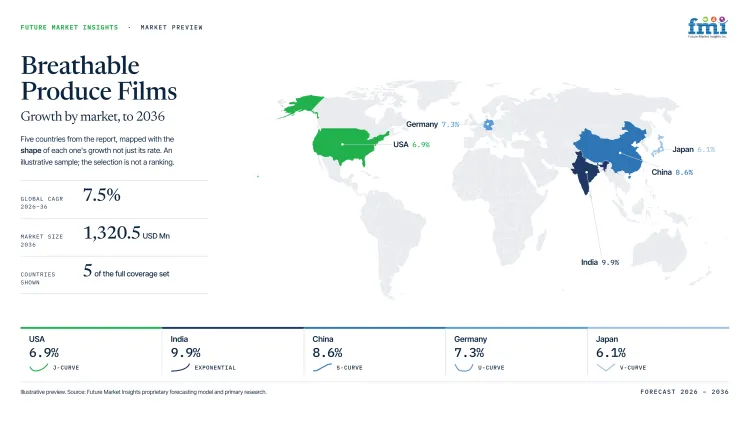
| Country | CAGR |
|---|---|
| Brazil | 7.9% |
| UK | 7.4% |
| Germany | 7.3% |
| USA | 6.9% |
| Japan | 6.1% |
How do country-level CAGRs compare in the Breathable Produce Films Market?
The profiled rates span 1.8 percentage points from Brazil at 7.9% to Japan at 6.1%. Similar forecasts mask distinct qualification routes, packaging rules and service requirements across each national produce chain.
- Brazil forms the upper end of the profile as long export routes increase moisture-control requirements and reward local trials under warm handling conditions during seasonal peaks.
- The UK sits close to Germany because retailer scorecards connect shelf-life performance with packaging recovery evidence across high-volume supermarket programs and frequent assortment changes.
- Germany follows within 0.1 percentage point of the UK as design-for-recycling rules increase documentation needs for recyclable lidding films and mono-material structures across commercial lines.
- The USA remains within the middle group as national fresh-cut programs demand repeatable trials across many recipes, fill weights and distribution temperatures throughout annual schedules.
- Japan closes the profile as narrow specification tolerances and longer approval cycles favor dependable conversion support over rapid first-time adoption.
CAGR alone cannot determine market priority because converter access, produce mix and service distance shape qualification cost across shipment routes and recovery rules.
The full report covers the wider regional set and more than twenty additional national markets within the forecast model.
Country-wise Analysis
- Brazilian mango exporters need packaging that controls moisture during warm handling and long ocean routes while preserving appearance across seasonal packhouse conditions and variable loading practices during peak export periods. Breathable produce film sales in Brazil are forecast to expand at 7.9% CAGR by 2036, supported by exporters seeking longer quality windows for Europe and North America without costly arrival losses across extended delivery schedules. The Ministry of Agriculture and Livestock reported in July 2025 that mango exports reached 73,600 tonnes during January through May and that scale requires local trials reflecting temperature swings plus field packing across refrigerated journeys.
- UK supermarkets review breathable films against shelf-life targets and packaging scorecards across high-volume fruit and vegetable programs with frequent assortment changes plus strict waste-reduction targets throughout national retail networks. The UK breathable produce films sector is projected to record 7.4% CAGR during the assessment period, shaped by producer-responsibility reporting and demand for clear retail presentation across chilled produce categories. The Department for Environment Food & Rural Affairs reported in July 2025 that 51.0% of plastic packaging was recycled under the provisional 2024 methodology, which means simpler films must retain transmission and sealing performance without increasing product write-offs during normal commercial distribution.
- German produce packers balance controlled-atmosphere performance with design-for-recycling thresholds that influence retailer specifications across established fresh-food packaging lines serving regional and imported produce throughout major processing areas nationwide. Adoption of breathable produce films in Germany is estimated to expand at 7.3% CAGR through 2036, reinforced by local conversion capacity and detailed compliance expertise across packaging development programs. The German Environment Agency reported in January 2026 that material recycling for plastic packaging reached 70% in 2024, which raises the qualification burden for mono-material films that must retain permeability and anti-fog performance on commercial sealing and printing systems across repeated retail programs.
- US fresh-cut processors manage many recipes and fill weights across seasonal sources that enter national distribution networks with different temperature profiles plus strict retailer quality windows across recurring chilled programs. Breathable produce film demand in the USA is forecast to rise at 6.9% CAGR over the forecast period, supported by recurring trials on high-volume packing lines serving several regional distribution systems. USDA Agricultural Research Service reported in November 2025 that three aperture sizes produced different atmospheres but limited mango quality improvement, which requires film providers to test representative cultivars before transferring one specification across routes with different storage periods and temperatures.
- Japanese processors favor narrow tolerances and documented performance before approving recurring film orders for smaller produce programs within carefully managed cold chains plus exacting retail standards across major metropolitan markets. Japan is estimated to post 6.1% CAGR over the forecast period, influenced by food-loss reduction efforts and dependable local conversion support for specialized produce packaging programs and distributor relationships. The Ministry of Agriculture Forestry and Fisheries reported in June 2026 that business-related food loss reached 2.37 million tonnes during fiscal 2024, which keeps crop-specific testing and responsive service central to lengthy qualification before each film specification enters routine commercial use.
Who are the notable companies in the Breathable Produce Films Market?
StePacPPC, PerfoTec, TransFRESH Corporation (Hazel BreatheWay), Amcor plc, Coveris, TIPA Compostable Packaging, Ultraperf Technologies and R.O.P. Ltd.
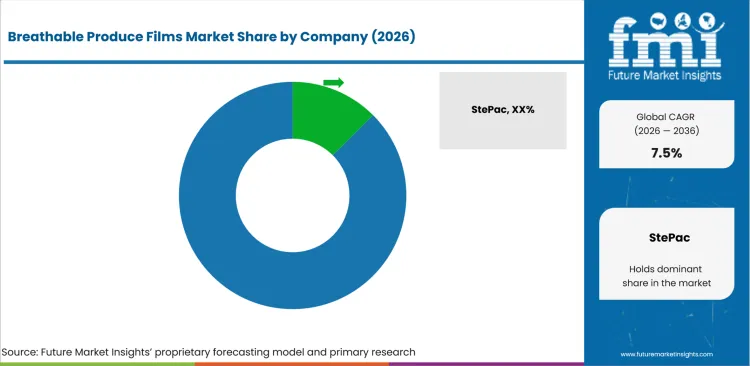
The competitive field remains fragmented between crop-specific atmosphere specialists and broad flexible-film groups serving produce programs. Entry requires respiration data, controlled conversion and application support because one specification rarely transfers across crops. Large converters compete on format availability while specialists differentiate through crop-specific gas exchange and faster qualification.
- Respiration engineering: StePacPPC, PerfoTec, TransFRESH Corporation (Hazel BreatheWay) and Ultraperf Technologies focus on crop-specific gas exchange and trials.
- Conversion breadth: Amcor plc, Coveris and R.O.P. Ltd. provide commercial bags, liners, lidding and roll-stock formats.
- Alternative materials: TIPA Compostable Packaging serves applications requiring compostable films with verified shelf-life and disposal performance.
Competitive Benchmarking: Breathable Produce Films Market
| Company | Respiration-Control Depth | Conversion and Format Coverage | Circular-Material Readiness | Geographic Reach |
|---|---|---|---|---|
| StePacPPC | High | High | Medium | Global produce regions |
| PerfoTec | High | Medium | Medium | Europe and international markets |
| TransFRESH Corporation (Hazel BreatheWay) | High | High | Unscored | North America and export markets |
| Amcor plc | Medium | High | High | Global |
| Coveris | Medium | High | High | Europe and international markets |
| TIPA Compostable Packaging | Medium | Medium | High | Europe, North America and Asia-Pacific |
| Ultraperf Technologies | High | Medium | High | Canada and USA |
| R.O.P. Ltd. | High | High | Medium | Europe and the Americas |
Key Developments in the Breathable Produce Films Market
- In May 2026, TransFRESH Corporation acquired Hazel Technologies and integrated BreatheWay membranes into its Tectrol pallet-bag platform. The transaction combines temperature-responsive atmosphere control with established berry transport formats for long-distance pallet programs.
- In November 2025, StePacPPC began operating a Hermosillo office with local produce-film inventory and technical support across northern Mexico. Regional stock shortens delivery times and supports rapid commercial specification changes during active crop seasons.
- In March 2025, PerfoTec introduced O2Control to regulate oxygen in sealed commercial fresh-cut produce packs. The system pairs atmosphere monitoring with adjustment and helps processors qualify programs with narrow oxygen tolerances.
Key Players in the Breathable Produce Films Market
Produce Respiration-Control Specialists
- StePacPPC
- PerfoTec
- TransFRESH Corporation (Hazel BreatheWay)
- Ultraperf Technologies
Flexible-Film and Format Platforms
- Amcor plc
- Coveris
- R.O.P. Ltd.
Compostable Film Specialist
- TIPA Compostable Packaging
Breathable Produce Films Market - Report Scope
| Coverage field | Report scope |
|---|---|
| Market breakdown | By Product Type, Material, Format, Produce Type, End Use, Sales Channel and Region. |
| Quantitative Units | Revenue in USD Million and CAGR in %. |
| Market Definition | Commercial breathable flexible films and converted film formats sold for fresh fruit, vegetables, herbs and fresh-cut produce. The scope excludes downstream produce revenue, rigid packaging without breathable film, perforation equipment and non-breathable packaging. |
| Regions Covered | North America, Latin America, Western Europe, Eastern Europe, East Asia, South Asia and Pacific and Middle East and Africa. |
| Countries Covered | Brazil, UK, Germany, USA, Japan, and 20+ countries included in the full report. |
| Key Companies Profiled | StePacPPC, PerfoTec, TransFRESH Corporation (Hazel BreatheWay), Amcor plc, Coveris, TIPA Compostable Packaging, Ultraperf Technologies and R.O.P. Ltd. |
| Forecast Period | 2026 to 2036. |
| Approach | Primary and secondary research with market triangulation. |
Breathable Produce Films Market - Research Methodology
| Method | Approach |
|---|---|
| Primary Research | FMI analysts gathered input from manufacturers, service providers, technology developers, distributors, end users, procurement teams, and subject-matter experts. Interviews examined purchasing decisions, product or service evaluation, adoption barriers, approval requirements, pricing considerations, and expectations for technical or commercial support. Respondents were also asked what evidence is required before a trial, pilot, or initial order develops into regular purchasing. |
| Desk Research | Desk research covered government statistics, regulatory publications, trade data, industry associations, technical literature, standards, company filings, product information, and official corporate announcements. Sources were reviewed for relevance, publication date, geographic coverage, and consistency with the defined market scope. Claims relating to performance, applications, approvals, capacity, investment, and commercial activity were retained only when supported by credible public evidence. |
| Market Sizing and Forecasting | The market model combined the baseline value with historical performance, segment structure, pricing and volume indicators, adoption levels, company participation, and country-level demand conditions. Forecast assumptions considered economic activity, investment trends, regulatory developments, technology adoption, purchasing cycles, supply availability, and barriers to wider market use. Segment and regional estimates were reconciled before the final market total was calculated. |
| Data Validation | Estimates were checked against multiple independent indicators, including public data, company activity, trade patterns, industry developments, and findings from primary interviews. Validation also tested whether products, services, applications, and company revenues fell within the defined market boundaries. Adjacent categories, unsupported claims, overlapping revenues, and activities without direct market relevance were excluded to reduce double counting and maintain consistency across segments and countries. |
Breathable Produce Films Market by Segments
Breathable Produce Films Market segmented by Product Type:
- Micro-Perforated Films
- Macro-Perforated Films
- Inherently Breathable Polymer Films
- Laser-Perforated MAP Films
- Others
Breathable Produce Films Market segmented by Material:
- Polypropylene (BOPP - CPP)
- Polyethylene
- PLA - Bio-Films
- Cellulose
- Others
Breathable Produce Films Market segmented by Format:
- Bags & Pouches
- Flow Wrap
- Lidding
- Sheets
- Others
Breathable Produce Films Market segmented by Produce Type:
- Fresh-Cut & Salads
- Whole Vegetables
- Fruits
- Others
- Herbs
Breathable Produce Films Market segmented by End Use:
- Packers & Processors
- Grocery Retail
- Foodservice
- Others
Breathable Produce Films Market segmented by Sales Channel:
- Direct - OEM Supply
- Packaging Distributors
- Online - E-commerce
- Others
Breathable Produce Films Market by Region:
- North America
- United States
- Canada
- Latin America
- Brazil
- Mexico
- Chile
- Rest of Latin America
- Western Europe
- Germany
- United Kingdom
- Italy
- Spain
- France
- Nordics
- Benelux
- Rest of Western Europe
- Eastern Europe
- Russia
- Poland
- Hungary
- Balkan and Baltic States
- Rest of Eastern Europe
- East Asia
- China
- Japan
- South Korea
- South Asia and Pacific
- India
- ASEAN
- Australia and New Zealand
- Rest of South Asia and Pacific
- Middle East and Africa
- Kingdom of Saudi Arabia
- Other GCC Countries
- Türkiye
- South Africa
- Other African Union Countries
- Rest of Middle East and Africa
Research Sources and Bibliography
- Taylor Farms. (2025, April 21). Earth Day 2025.
- Companhia Nacional de Abastecimento. (2026, July 28). Comercialização de frutas e de hortaliças nas Ceasas brasileiras totalizam 16,6 milhões de toneladas em 2025.
- Coveris. (2024, February 9). Coveris unveils fresh, sustainable packaging solutions at Angua FoodTec 2024.
- USA Department of Agriculture, Agricultural Research Service. (2025, April 10). Differential low oxygen response and transcriptomic shifts drive fresh-cut lettuce deterioration in modified atmosphere packaging.
- European Parliament and Council of the European Union. (2025, January 22). Regulation (EU) 2025/40 of the European Parliament and of the Council of 19 December 2024 on packaging and packaging waste, amending Regulation (EU) 2019/1020 and Directive (EU) 2019/904, and repealing Directive 94/62/EC (Text with EEA relevance).
- Ministry of Agriculture and Livestock of Brazil. (2025, July 1). A fruta mais exportada pelo Brasil é a manga.
- Department for Environment, Food & Rural Affairs. (2025, July 23). UK statistics on waste.
- German Environment Agency and Central Agency Packaging Register. (2026, January 27). Facts against myths: Packaging waste recycling in Germany is working.
- USA Department of Agriculture, Agricultural Research Service. (2025, November 30). Modified atmosphere packaging to extend the shelf life of fresh-cut, ripe mango.
- Ministry of Agriculture, Forestry and Fisheries of Japan. (2026, June 30).
- TransFRESH Corporation. (2026, May 27). TransFRESH Corporation Acquires Hazel Technologies to Advance Industry-Leading Freshness Solutions for the Berry Sector.
- StePacPPC. (2026, March 6). StePacPPC opens new regional office in Hermosillo, Mexico.
- PerfoTec. (2025, March 11). PerfoTec O2Control: The smart way to extend shelf life for fresh-cut produce.
- StePacPPC. (2026, May 24). Transition to FSSC 22000 Certification.
- PerfoTec. (2025, December 10). Green Factory & PerfoTec: The Start of a Fresh Partnership.
- StePacPPC. (2025, August 25). StePacPPC’s Pallet -Shrouds Preserve Produce Freshness All the Way to Retail.
This bibliography is provided for reader reference and is not exhaustive. The full report contains the complete reference list and detailed citations.
This Report Answers
- What are the 2026 and 2036 Breathable Produce Films Market values?
- How does respiration control convert shelf-life performance into film demand?
- Why do Micro-Perforated Films hold the leading Product Type share?
- How do Bags & Pouches support both retail and distribution formats?
- What limits transfer of one film specification across different produce programs?
- How do profiled countries differ in commercial entry conditions for breathable produce films?
- Which companies specialize in respiration engineering or broad film conversion?
- What should packers verify before approving recyclable or compostable films?
Frequently Asked Questions
What is the Breathable Produce Films Market size in 2026?
The breathable produce films market is valued at USD 640.7 million in 2026 and is projected to reach USD 1320.5 million by 2036. Growth is driven by increasing demand for packaging solutions that optimize gas and moisture exchange to extend the shelf life of fresh produce.
What CAGR is projected for the Breathable Produce Films Market?
The breathable produce films market is projected to grow at a CAGR of 7.5% between 2026 and 2036. Expansion is supported by growing adoption in fresh produce packaging and the need for improved cold-chain performance.
Which product type leads the Breathable Produce Films Market?
Micro-perforated films are projected to account for 36.0% of the market in 2026. Their leading position is driven by their ability to precisely regulate gas exchange and support a wide range of produce packaging applications.
Which produce type presents the strongest expansion case in the Breathable Produce Films Market?
Fresh-cut & salads account for 28.0% of the market in 2026 and represent the strongest growth opportunity. Rising demand for convenient, ready-to-eat produce is increasing the need for packaging that maintains freshness and controls moisture buildup.
Which companies are profiled in the Breathable Produce Films Market?
Key companies operating in the market include StePacPPC, PerfoTec, TransFRESH Corporation with Hazel BreatheWay, Amcor plc, Coveris, TIPA Compostable Packaging, Ultraperf Technologies, and R.O.P. Ltd. These companies provide packaging solutions focused on respiration control, shelf-life extension, and sustainable film technologies.
Preview the report firsthand - request a free sample
Get SampleGet the brochure for pricing and purchase details.
Get PDFTable of Content
- Key Takeaways
- Market Size and CAGR
- Top Growth Driver
- Fastest Growing Segment
- Leading Region
- Key Companies
- Emerging Opportunities
- Executive Summary
- Global Market Outlook
- Demand-side Trends
- Supply-side Trends
- Technology Roadmap Analysis
- Analysis and Recommendations
- Analyst Perspective (What is happening? Why now? What should investors know?)
- Key Questions Answered
- How large is the market?
- What is the CAGR?
- What are key trends?
- Which region dominates?
- Who are the leaders?
- Market Overview
- Market Coverage / Taxonomy
- Market Definition / Scope / Limitations
- Research Methodology
- Chapter Orientation
- Analytical Lens and Working Hypotheses
- Market Structure, Signals, and Trend Drivers
- Benchmarking and Cross-market Comparability
- Market Sizing, Forecasting, and Opportunity Mapping
- Research Design and Evidence Framework
- Desk Research Programme (Secondary Evidence)
- Expert Input and Fieldwork (Primary Evidence)
- Tooling, Models, and Reference Databases
- Data Engineering and Model Build
- Quality Assurance and Audit Trail
- Market Background
- Market Dynamics (Drivers, Restraints, Opportunity, Trends)
- Scenario Forecast (Optimistic, Likely, Conservative)
- Impact Analysis
- AI Impact
- Sustainability Impact
- Regulatory Impact
- Technology Impact
- Consumer / Buyer Analysis
- Purchase Drivers
- Adoption Barriers
- Buyer Journey
- Opportunity Map Analysis
- Product Life Cycle Analysis
- Supply Chain Analysis
- Investment Feasibility Matrix
- Value Chain Analysis
- PESTLE and Porter's Analysis
- Regulatory Landscape
- Regional Parent Market Outlook
- Production and Consumption Statistics
- Import and Export Statistics
- Global Market Analysis and Forecast, 2021 to 2036
- Historical Market Size Value (USD Million) Analysis, 2021 to 2025
- Current and Future Market Size Value (USD Million) Projections, 2026 to 2036
- Y-o-Y Growth Trend Analysis
- Absolute $ Opportunity Analysis
- Global Market Pricing Analysis, 2021 to 2036
- Global Market Analysis and Forecast, By Product Type, 2021 to 2036
- Introduction / Key Findings
- Historical Market Size Value (USD Million) Analysis By Product Type, 2021 to 2025
- Current and Future Market Size Value (USD Million) Analysis and Forecast By Product Type, 2026 to 2036
- Micro-Perforated Films
- Macro-Perforated Films
- Inherently Breathable Polymer Films
- Laser-Perforated MAP Films
- Others
- Micro-Perforated Films
- Y-o-Y Growth Trend Analysis By Product Type, 2021 to 2025
- Absolute $ Opportunity Analysis By Product Type, 2026 to 2036
- Global Market Analysis and Forecast, By Material, 2021 to 2036
- Introduction / Key Findings
- Historical Market Size Value (USD Million) Analysis By Material, 2021 to 2025
- Current and Future Market Size Value (USD Million) Analysis and Forecast By Material, 2026 to 2036
- Polypropylene (BOPP - CPP)
- Polyethylene
- PLA - Bio-Films
- Cellulose
- Others
- Polypropylene (BOPP - CPP)
- Y-o-Y Growth Trend Analysis By Material, 2021 to 2025
- Absolute $ Opportunity Analysis By Material, 2026 to 2036
- Global Market Analysis and Forecast, By Format, 2021 to 2036
- Introduction / Key Findings
- Historical Market Size Value (USD Million) Analysis By Format, 2021 to 2025
- Current and Future Market Size Value (USD Million) Analysis and Forecast By Format, 2026 to 2036
- Bags & Pouches
- Flow Wrap
- Lidding
- Sheets
- Others
- Bags & Pouches
- Y-o-Y Growth Trend Analysis By Format, 2021 to 2025
- Absolute $ Opportunity Analysis By Format, 2026 to 2036
- Global Market Analysis and Forecast, By Produce Type, 2021 to 2036
- Introduction / Key Findings
- Historical Market Size Value (USD Million) Analysis By Produce Type, 2021 to 2025
- Current and Future Market Size Value (USD Million) Analysis and Forecast By Produce Type, 2026 to 2036
- Fresh-Cut & Salads
- Whole Vegetables
- Fruits
- Others
- Herbs
- Fresh-Cut & Salads
- Y-o-Y Growth Trend Analysis By Produce Type, 2021 to 2025
- Absolute $ Opportunity Analysis By Produce Type, 2026 to 2036
- Global Market Analysis and Forecast, By End Use, 2021 to 2036
- Introduction / Key Findings
- Historical Market Size Value (USD Million) Analysis By End Use, 2021 to 2025
- Current and Future Market Size Value (USD Million) Analysis and Forecast By End Use, 2026 to 2036
- Packers & Processors
- Grocery Retail
- Foodservice
- Others
- Packers & Processors
- Y-o-Y Growth Trend Analysis By End Use, 2021 to 2025
- Absolute $ Opportunity Analysis By End Use, 2026 to 2036
- Global Market Analysis and Forecast, By Sales Channel
- Introduction / Key Findings
- Historical Market Size Value (USD Million) Analysis By Sales Channel, 2021 to 2025
- Current and Future Market Size Value (USD Million) Analysis and Forecast By Sales Channel, 2026 to 2036
- Direct - OEM Supply
- Packaging Distributors
- Online - E-commerce
- Others
- Direct - OEM Supply
- Y-o-Y Growth Trend Analysis By Sales Channel, 2021 to 2025
- Absolute $ Opportunity Analysis By Sales Channel, 2026 to 2036
- Global Market Analysis and Forecast, By Region, 2021 to 2036
- Introduction
- Historical Market Size Value (USD Million) Analysis By Region, 2021 to 2025
- Current Market Size Value (USD Million) Analysis and Forecast By Region, 2026 to 2036
- North America
- Latin America
- Western Europe
- Eastern Europe
- East Asia
- South Asia and Pacific
- Middle East & Africa
- Market Attractiveness Analysis By Region
- North America Market Analysis and Forecast, By Country, 2021 to 2036
- Historical Market Size Value (USD Million) Trend Analysis By Market Taxonomy, 2021 to 2025
- Market Size Value (USD Million) Forecast By Market Taxonomy, 2026 to 2036
- By Country
- USA
- Canada
- By Product Type
- By Material
- By Format
- By Produce Type
- By End Use
- By Sales Channel
- By Country
- Market Attractiveness Analysis
- By Country
- By Product Type
- By Material
- By Format
- By Produce Type
- By End Use
- By Sales Channel
- Key Takeaways
- Latin America Market Analysis and Forecast, By Country
- Historical Market Size Value (USD Million) Trend Analysis By Market Taxonomy, 2021 to 2025
- Market Size Value (USD Million) Forecast By Market Taxonomy, 2026 to 2036
- By Country
- Brazil
- Mexico
- Chile
- Rest of Latin America
- By Product Type
- By Material
- By Format
- By Produce Type
- By End Use
- By Sales Channel
- By Country
- Market Attractiveness Analysis
- By Country
- By Product Type
- By Material
- By Format
- By Produce Type
- By End Use
- By Sales Channel
- Key Takeaways
- Western Europe Market Analysis and Forecast, By Country
- Historical Market Size Value (USD Million) Trend Analysis By Market Taxonomy, 2021 to 2025
- Market Size Value (USD Million) Forecast By Market Taxonomy, 2026 to 2036
- By Country
- Germany
- UK
- Italy
- Spain
- France
- Nordic
- BENELUX
- Rest of Western Europe
- By Product Type
- By Material
- By Format
- By Produce Type
- By End Use
- By Sales Channel
- By Country
- Market Attractiveness Analysis
- By Country
- By Product Type
- By Material
- By Format
- By Produce Type
- By End Use
- By Sales Channel
- Key Takeaways
- Eastern Europe Market Analysis and Forecast, By Country
- Historical Market Size Value (USD Million) Trend Analysis By Market Taxonomy, 2021 to 2025
- Market Size Value (USD Million) Forecast By Market Taxonomy, 2026 to 2036
- By Country
- Russia
- Poland
- Hungary
- Balkan & Baltic
- Rest of Eastern Europe
- By Product Type
- By Material
- By Format
- By Produce Type
- By End Use
- By Sales Channel
- By Country
- Market Attractiveness Analysis
- By Country
- By Product Type
- By Material
- By Format
- By Produce Type
- By End Use
- By Sales Channel
- Key Takeaways
- East Asia Market Analysis and Forecast, By Country
- Historical Market Size Value (USD Million) Trend Analysis By Market Taxonomy, 2021 to 2025
- Market Size Value (USD Million) Forecast By Market Taxonomy, 2026 to 2036
- By Country
- China
- Japan
- South Korea
- By Product Type
- By Material
- By Format
- By Produce Type
- By End Use
- By Sales Channel
- By Country
- Market Attractiveness Analysis
- By Country
- By Product Type
- By Material
- By Format
- By Produce Type
- By End Use
- By Sales Channel
- Key Takeaways
- South Asia and Pacific Market Analysis and Forecast, By Country
- Historical Market Size Value (USD Million) Trend Analysis By Market Taxonomy, 2021 to 2025
- Market Size Value (USD Million) Forecast By Market Taxonomy, 2026 to 2036
- By Country
- India
- ASEAN
- Australia & New Zealand
- Rest of South Asia and Pacific
- By Product Type
- By Material
- By Format
- By Produce Type
- By End Use
- By Sales Channel
- By Country
- Market Attractiveness Analysis
- By Country
- By Product Type
- By Material
- By Format
- By Produce Type
- By End Use
- By Sales Channel
- Key Takeaways
- Middle East & Africa Market Analysis and Forecast, By Country
- Historical Market Size Value (USD Million) Trend Analysis By Market Taxonomy, 2021 to 2025
- Market Size Value (USD Million) Forecast By Market Taxonomy, 2026 to 2036
- By Country
- Kingdom of Saudi Arabia
- Other GCC Countries
- Türkiye
- South Africa
- Other African Union
- Rest of Middle East & Africa
- By Product Type
- By Material
- By Format
- By Produce Type
- By End Use
- By Sales Channel
- By Country
- Market Attractiveness Analysis
- By Country
- By Product Type
- By Material
- By Format
- By Produce Type
- By End Use
- By Sales Channel
- Key Takeaways
- Key Countries Market Analysis
- USA
- Pricing Analysis
- Market Share Analysis, 2025
- By Product Type
- By Material
- By Format
- By Produce Type
- By End Use
- By Sales Channel
- Canada
- Pricing Analysis
- Market Share Analysis, 2025
- By Product Type
- By Material
- By Format
- By Produce Type
- By End Use
- By Sales Channel
- Mexico
- Pricing Analysis
- Market Share Analysis, 2025
- By Product Type
- By Material
- By Format
- By Produce Type
- By End Use
- By Sales Channel
- Brazil
- Pricing Analysis
- Market Share Analysis, 2025
- By Product Type
- By Material
- By Format
- By Produce Type
- By End Use
- By Sales Channel
- Chile
- Pricing Analysis
- Market Share Analysis, 2025
- By Product Type
- By Material
- By Format
- By Produce Type
- By End Use
- By Sales Channel
- Germany
- Pricing Analysis
- Market Share Analysis, 2025
- By Product Type
- By Material
- By Format
- By Produce Type
- By End Use
- By Sales Channel
- UK
- Pricing Analysis
- Market Share Analysis, 2025
- By Product Type
- By Material
- By Format
- By Produce Type
- By End Use
- By Sales Channel
- Italy
- Pricing Analysis
- Market Share Analysis, 2025
- By Product Type
- By Material
- By Format
- By Produce Type
- By End Use
- By Sales Channel
- Spain
- Pricing Analysis
- Market Share Analysis, 2025
- By Product Type
- By Material
- By Format
- By Produce Type
- By End Use
- By Sales Channel
- France
- Pricing Analysis
- Market Share Analysis, 2025
- By Product Type
- By Material
- By Format
- By Produce Type
- By End Use
- By Sales Channel
- India
- Pricing Analysis
- Market Share Analysis, 2025
- By Product Type
- By Material
- By Format
- By Produce Type
- By End Use
- By Sales Channel
- ASEAN
- Pricing Analysis
- Market Share Analysis, 2025
- By Product Type
- By Material
- By Format
- By Produce Type
- By End Use
- By Sales Channel
- Australia & New Zealand
- Pricing Analysis
- Market Share Analysis, 2025
- By Product Type
- By Material
- By Format
- By Produce Type
- By End Use
- By Sales Channel
- China
- Pricing Analysis
- Market Share Analysis, 2025
- By Product Type
- By Material
- By Format
- By Produce Type
- By End Use
- By Sales Channel
- Japan
- Pricing Analysis
- Market Share Analysis, 2025
- By Product Type
- By Material
- By Format
- By Produce Type
- By End Use
- By Sales Channel
- South Korea
- Pricing Analysis
- Market Share Analysis, 2025
- By Product Type
- By Material
- By Format
- By Produce Type
- By End Use
- By Sales Channel
- Russia
- Pricing Analysis
- Market Share Analysis, 2025
- By Product Type
- By Material
- By Format
- By Produce Type
- By End Use
- By Sales Channel
- Poland
- Pricing Analysis
- Market Share Analysis, 2025
- By Product Type
- By Material
- By Format
- By Produce Type
- By End Use
- By Sales Channel
- Hungary
- Pricing Analysis
- Market Share Analysis, 2025
- By Product Type
- By Material
- By Format
- By Produce Type
- By End Use
- By Sales Channel
- Kingdom of Saudi Arabia
- Pricing Analysis
- Market Share Analysis, 2025
- By Product Type
- By Material
- By Format
- By Produce Type
- By End Use
- By Sales Channel
- Türkiye
- Pricing Analysis
- Market Share Analysis, 2025
- By Product Type
- By Material
- By Format
- By Produce Type
- By End Use
- By Sales Channel
- South Africa
- Pricing Analysis
- Market Share Analysis, 2025
- By Product Type
- By Material
- By Format
- By Produce Type
- By End Use
- By Sales Channel
- USA
- Market Structure Analysis
- Competition Dashboard
- Competition Benchmarking
- Market Share Analysis of Top Players
- By Regional
- By Product Type
- By Material
- By Format
- By Produce Type
- By End Use
- By Sales Channel
- Emerging Startups
- Innovation Benchmarking
- Competition Analysis
- Competition Deep Dive
- StePac
- Overview
- Product Portfolio
- Profitability by Market Segments
- Sales Footprint
- Strategy Overview
- Marketing Strategy
- Product Strategy
- Channel Strategy
- Perfotec
- Amcor
- Sumitomo Bakelite
- Sealed Air
- Coveris
- Berry Global
- Futamura
- BreatheWay (Curation Foods)
- Klockner Pentaplast
- StePac
- Case Studies
- Success Stories
- Recent Developments
- Competition Deep Dive
- Assumptions & Acronyms Used


