

- Market Size (2026)
- USD 1.4 Bn
- Forecast (2036)
- USD 3.4 Bn
- CAGR (2026 to 2036)
- 9.4%
How big is Compostable Food Papers Market in 2026?
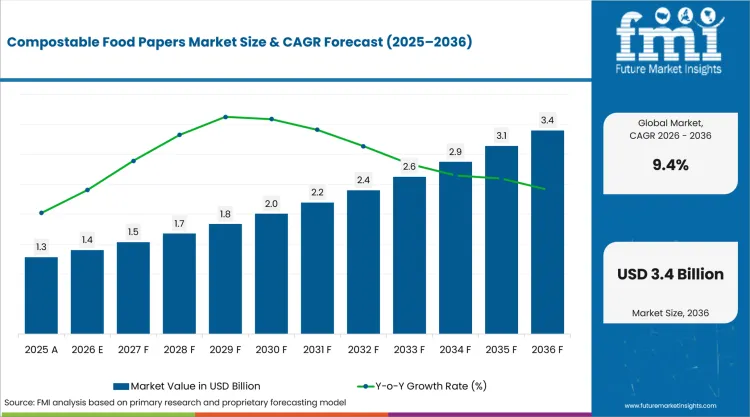
USD 1.4 billion in 2026 and USD 3.4 billion by 2036 at a 9.4% CAGR.
Demand for compostable food papers is projected to increase at 9.4% CAGR between 2026 and 2036, raising value from USD 1.4 billion to USD 3.4 billion. Food brands are replacing grease-resistant flexible packaging paper structures that depend on legacy fluorinated treatments or non-compostable plastic layers. The FDA confirmed in February 2024 that manufacturers ended USA sales of authorized PFAS grease-proofing substances for food-contact paper. The phase-out redirects specification work toward fiber structures that retain oil resistance across foodservice formats. Revenue conversion depends on food-contact approval and repeatable performance during commercial production runs.
Country adoption depends on whether collection systems accept compostable paper after food use. The USA Composting Council reported in May 2025 that 263 responding facilities processed 13,389.9 tons of compostable foodservice ware and packaging during 2023. The limited reported volume makes disposal access a commercial qualification issue instead of a certification assumption. Markets with dedicated organics routes can convert biodegradable food packaging interest into recurring orders more readily. Markets with fragmented collection require account-level contracts and clearer bin instructions before recurring orders begin. These differences shape which applications justify compostable claims and which remain better suited to established paper recycling.
Key Takeaways of Compostable Food Papers Market
- Food-contact chemistry controls and plastic-reduction programs support demand for papers that retain barrier performance on installed converting equipment.
- Certified Compostable Coated Papers are projected to account for 32.0% by product-type in 2026 owing to documented claim support.
- PLA-Coated papers are estimated to capture 28.0% of coating revenue in 2026 due to familiar extrusion and sealing processes.
- Industrial Compostable - EN 13432 - ASTM D6400 is forecast to represent 58.0% share in 2026 supported by recognized test criteria.
- Local collection rules restrain adoption since certification does not guarantee acceptance by a food-waste contractor or municipal treatment facility.
- Ahlstrom, delfort, Koehler Paper, UPM Specialty Papers, Sappi, Mondi, Vegware (Novolex) and Twin Rivers Paper represent the profiled company set.
Analyst Perspective
"Compostable food papers earn repeat orders once the finished structure passes food-contact review and runs without slowing printing or sealing. Certification supports the claim, but disposal guidance must match each customer's collection contract and treatment route."
- Nandini Roy Choudhury, Principal Consultant, Future Market Insights
How is the Compostable Food Papers Market segmented?
The compostable food papers market is segmented by product type, coating, certification, application, end use, sales channel and region.
The Compostable Food Papers Market is segmented by Product Type, Coating, Certification, Application, End Use, Sales Channel and Region. Product types cover certified coated papers, uncoated papers, heat-seal papers, paper-biofilm laminates and others, while coatings include PLA, aqueous bio-dispersions, uncoated structures, PHA and bio-wax. Certification separates industrial, home and in-process claims, while applications cover wraps, pouches, foodservice papers, sachets and formats. End users include foodservice, food processing, retail and grocery, and others, while sales channels cover direct converter supply, distributors, online routes and other channels.
Why do certified compostable coated papers lead the product type category?
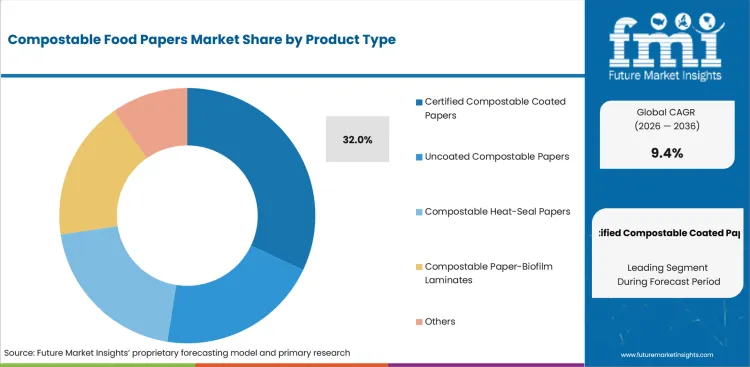
Certified coated papers combine a documented composting route with grease or moisture control for direct food contact. Certification applies to the finished construction and keeps paper composition linked with barrier chemistry throughout the commercial approval process.
- Based on product type, Certified Compostable Coated Papers are projected to account for 32.0% in 2026 due to combined barrier performance and claim documentation.
- Ahlstrom received Australian home-compostability certification for Sulpack parchment in April 2025 following qualification for fresh and greasy food applications. Regional certification broadens market eligibility without removing food-contact review and line-performance trials at commercial production scale.
Why does PLA-coated lead the coating category?
PLA coating gives fiber packaging a continuous moisture barrier and a familiar heat-seal layer for commercial production lines. Extrusion and lamination engineers compare it with conventional polymer coatings using established settings and repeatable trial methods.
- The PLA-Coated segment is likely to capture 28.0% share in 2026 attributable to established extrusion routes and familiar sealing controls.
- Commercial acceptance depends on coating weight and fold integrity plus the seal window required by each food format. Local composting rules determine whether the finished package can carry a defensible disposal claim for the intended specific commercial customer account.
Why does industrial compostable - EN 13432 - ASTM D6400 lead the certification category?
Industrial compostability defines controlled temperature and humidity plus residence-time conditions under recognized standards for validated packaging claims. Packaging teams use the route to assess disintegration and biodegradation for food-soiled formats that resist clean fiber recycling.
- In 2026, Industrial Compostable - EN 13432 - ASTM D6400 is expected to lead certification with 58.0% share because recognized tests provide a common qualification basis.
- Certification establishes technical eligibility but does not compel a local facility to accept the package. Foodservice operators therefore verify collection contracts and labeling rules prior to approving one grade across multiple commercial customer operating locations.
Why do food wraps & liners lead the application category?
Food wraps and liners contact grease and moisture plus handling stress during food service and subsequent distribution. Their commercial test combines stain holdout with fold strength and consistent release from wrapping equipment.
- Food Wraps & Liners are set to lead the application category with 28.0% share in 2026 due to frequent replacement and direct food-contact use.
- delfort and Rieusset Gerosa began a European rollout of thinbarrier 201 paper packs for ice lollies in October 2025. The heat-sealable paper ran on existing equipment and protected frozen food against moisture plus flavor loss during commercial cold-chain distribution.
What are the drivers, restraints and opportunities in the Compostable Food Papers Market?
Food-contact chemistry rules support paper substitution, but collection limits weaken recovery claims and converter-ready barriers offer the clearest commercial route.
- Driver: PFAS limits and plastic-reduction programs require food brands to requalify grease-resistant paper structures across commercial packaging programs.
- Restraint: Compostability certification does not establish acceptance by a municipal facility or contracted food-waste collector.
- Opportunity: Barrier papers that run on installed equipment reduce trial costs for high-volume food and foodservice formats.
The EU Packaging and Packaging Waste Regulation sets PFAS concentration limits for food-contact packaging from August 2026. Packaging engineers must replace grease barriers that fail the new chemistry limits across commercial food programs. Mills can enter packaging materials reformulation programs earlier by documenting barrier chemistry and commercial runnability ahead of final brand specifications.
Collection Rules Limit Recovery Claims
England's workplace recycling rules require compostable packaging to enter residual waste or a dedicated collection instead of ordinary food-waste bins. Foodservice operators must secure a separate collector before using compostability as a credible site-level recovery claim. The extra contract can delay national rollout for biodegradable packaging across venues with different waste arrangements.
Converter-Ready Barriers Reduce Qualification Costs
Koehler Paper packed pasta in NexPlus Seal Pure on standard commercial machines during February 2025 production trials. The trial established a practical converter-ready heat-sealable paper route without requiring new packaging machinery during commercial qualification. Paper packaging producers can shorten qualification by pairing food-contact records with stable seal windows and application-specific barrier data.
Which country CAGRs are profiled in the Compostable Food Papers Market?
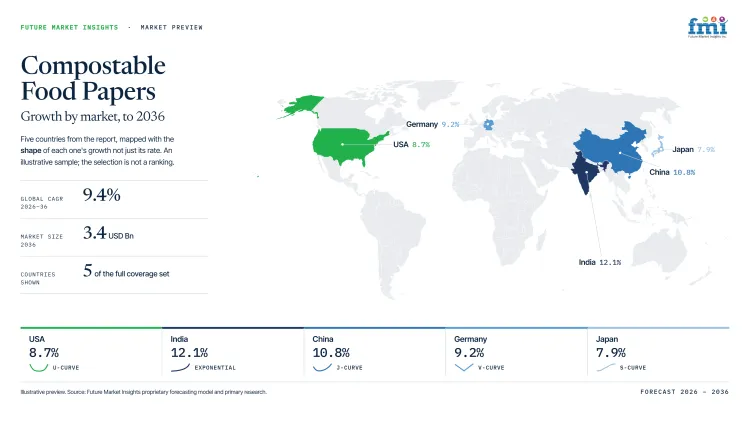
| Country | CAGR |
|---|---|
| United States | 8.7% |
| Japan | 7.9% |
| Germany | 9.2% |
| United Kingdom | 9.5% |
| Brazil | 9.9% |
How do country-level CAGRs compare in the Compostable Food Papers Market?
The five profiled forecasts span 2.0 percentage points between Brazil at 9.9% and Japan at 7.9%. The narrow range reflects policy timing, converter density and collection readiness rather than current market size.
- Brazil benefits from organics diversion initiatives, although outcomes remain closely tied to local collection and processing capacity.
- The UK is influenced by workplace waste segregation requirements that support dedicated compostable packaging streams.
- Germany's outlook is shaped by stricter biowaste quality standards that limit acceptable contamination levels.
- In the United States, adoption is supported by PFAS replacement efforts while recovery conditions continue to vary across states.
- Japan balances compostable paper adoption with established recycling systems and rigorous packaging qualification practices.
Comparable country CAGRs can produce materially different market entry conditions for paper mills and local distributors. The full report provides country-level CAGR analysis across North America and Latin America plus Europe, East Asia, South Asia and Pacific, and the Middle East and Africa.
Country-wise Analysis
- In the United States, large foodservice chains draw on extensive converter networks to qualify PFAS-free grease barriers for takeout and bakery formats within compostable foodservice packaging programs tied to national accounts, recurring volumes and consistent documentation. The United States compostable food papers market is projected to register an 8.7% CAGR during the assessment period, supported by the EPA’s June 2024 report that more than USD 83 million funded 72 projects involving organics recycling and related treatment routes. State labeling differences and uneven collection access continue to create friction, requiring paper mills to pair repeatable production trials with site-specific recovery instructions for approvals across multiple state collection systems.
- Japan’s food manufacturers tend to move through controlled qualification programs that test grease holdout, shelf-life performance and sealing consistency before replacing conventional plastic packs at commercial volume. Compostable food paper sales in Japan are forecast to expand at 7.9% CAGR by 2036, as the agriculture ministry reported in October 2025 that plastic food packaging accounted for more than one-quarter of domestic plastic-product consumption. Established recycling systems remain the main adoption barrier, making narrowly defined food-soiled applications and municipality-specific disposal guidance essential for keeping compostability claims separate from conventional paper recovery.
- In Germany, compostable food papers are assessed against strict sorting expectations and biowaste contamination thresholds within established specialty paper conversion networks that serve large food brands and regional foodservice groups. Adoption is estimated to advance at 9.2% CAGR through 2036 after the Federal Environment Ministry stated in April 2025 that treated biowaste may contain no more than 0.5% plastics. Because biodegradable-labelled plastics should not enter biobins under the guidance, paper mills must focus on food-soiled applications backed by contracted treatment routes and avoid disposal claims that conflict with municipal practice at target customer sites.
- United Kingdom hospitality venues and workplace caterers operate under Simpler Recycling rules that separate dry recyclables, food waste and residual waste across multi-site foodservice estates. Compostable food paper demand in the United Kingdom is forecast to rise at 9.5% CAGR over the forecast period, while DEFRA guidance updated in May 2025 excludes compostable packaging from required household food-waste collections. This exclusion adds operating complexity despite mature paper conversion capacity, so dedicated collection routes must connect caterers with waste contractors before national customers can apply recovery claims reliably across commercial sites.
- Brazilian converters work across municipalities where organics collection and treatment capacity remain uneven, making regional distribution knowledge important when qualifying biodegradable paper and plastic packaging for packaged-food and foodservice programs. Brazil's Compostable Food Papers Market outlook is anticipated to advance at 9.9% CAGR over the assessment period, supported by the Environment Ministry’s April 2026 report that PLANARO targets recovery of 31.6% of urban organic waste by 2030. The target strengthens the long-term infrastructure case but does not guarantee near-term processing access, so paper mills need local distributors and verified treatment partners to present compostability as a workable disposal route for commercial accounts.
Who are the notable companies in the Compostable Food Papers Market?
Ahlstrom, delfort, Koehler Paper, UPM Specialty Papers, Sappi, Mondi, Vegware (Novolex) and Twin Rivers Paper are the notable companies serving this market.
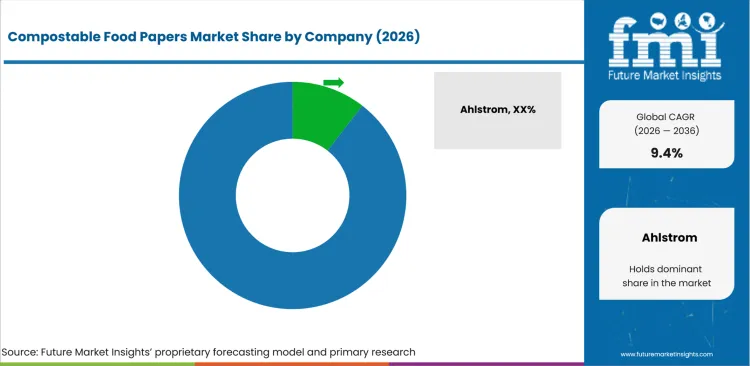
The competitive field remains fragmented across specialty paper mills, integrated packaging groups and one focused foodservice platform. Entry depends on food-contact compliance plus controllable barrier performance and commercial line records for each finished structure. Compostability documentation widens product eligibility but does not replace local collection validation for each finished food-contact format. Mill scale supports broader grade coverage, while application expertise determines whether a paper passes the intended pack and disposal route.
- Ahlstrom, delfort, UPM Specialty Papers and Sappi compete with food-contact papers that combine barrier functions with documented qualification routes.
- Koehler Paper, Mondi and Twin Rivers Paper use integrated paper production with flexible packaging development for grease-resistant or heat-sealable food formats.
- Vegware (Novolex) adds foodservice distribution and application access around compostable cups, containers and packing paper used in multi-format customer programs.
Competitive Benchmarking: Compostable Food Papers Market
| Company | Compostability Qualification Breadth | Food Barrier and Heat-Seal Capability | Converter and Foodservice Access | Geographic Reach |
|---|---|---|---|---|
| Ahlstrom | High | High | High | Global |
| delfort | Medium | High | High | Europe, North America and Asia |
| Koehler Paper | Medium | High | Medium | Europe with international sales |
| UPM Specialty Papers | Medium | High | High | Europe, China and North America |
| Sappi | Medium | High | High | Europe, North America and export markets |
| Mondi | High | High | High | Europe and global packaging customers |
| Vegware (Novolex) | High | Medium | High | United Kingdom, Europe and North America |
| Twin Rivers Paper | Medium | Medium | Medium | North America |
Key Developments in the Compostable Food Papers Market
- In April 2026, Sappi North America introduced LusterFSB OGR for bakery and quick-service packaging that includes takeout formats. The 12-to-20-point board provides medium oil and grease resistance without polyethylene film and arrives barrier-ready for converter qualification. The launch removes an in-house coating step for some formats while giving domestic foodservice accounts a recyclable board designed for home composting.
- In April 2025, Novolex completed its combination with Pactiv Evergreen and made the business a wholly owned subsidiary. The transaction added food, beverage and specialty-packaging manufacturing to the group that includes Vegware's compostable foodservice portfolio. Broader distribution and converting resources can support larger customer programs, although product claims and local collection routes require application-level validation.
- In March 2025, UPM Specialty Papers and Orkla Suomi began a six-month paper-wrapper pilot for Panda Milk chocolate in Finland. UPM Asendo Pro supplied the grease barrier and a cold-seal lacquer allowed the wrapper to run on existing flowpack equipment. The pilot connected shelf-life testing with a practical commercial conversion route for replacing conventional polypropylene wrappers.
Key Players in the Compostable Food Papers Market
Certified Food-Paper Platforms
- Ahlstrom
- delfort
- UPM Specialty Papers
Barrier and Heat-Seal Paper Producers
- Koehler Paper
- Sappi
- Mondi
- Twin Rivers Paper
Foodservice Packaging and Channel Platforms
- Vegware (Novolex)
Compostable Food Papers Market - Report Scope
| Coverage field | Report scope |
|---|---|
| Market breakdown | By product type, coating, certification, application, end use, sales channel and region. |
| Quantitative Units | Revenue in USD billion and CAGR in % |
| Market Definition | Commercial reels, sheets and specialty paper structures sold as compostable food-contact substrates. Finished cups, trays, pouches and other converted-package revenue are excluded. |
| Regions Covered | North America, Latin America, Western Europe, Eastern Europe, East Asia, South Asia and Pacific, and the Middle East and Africa. |
| Countries Covered | United States, Germany, Japan, United Kingdom, Brazil and 25+ countries included in the full report. |
| Key Companies Profiled | Ahlstrom, delfort, Koehler Paper, UPM Specialty Papers, Sappi, Mondi, Vegware (Novolex) and Twin Rivers Paper. |
| Forecast Period | 2026 to 2036. |
| Approach | Primary and secondary research with market triangulation across suppliers, converters, applications and country demand conditions. |
Compostable Food Papers Market - Research Methodology
| Method | Approach |
|---|---|
| Primary Research | FMI analysts gathered input from manufacturers, service providers, technology developers, distributors, end users, procurement teams, and subject-matter experts. Interviews examined purchasing decisions, product or service evaluation, adoption barriers, approval requirements, pricing considerations, and expectations for technical or commercial support. Respondents were also asked what evidence is required before a trial, pilot, or initial order develops into regular purchasing. |
| Desk Research | Desk research covered government statistics, regulatory publications, trade data, industry associations, technical literature, standards, company filings, product information, and official corporate announcements. Sources were reviewed for relevance, publication date, geographic coverage, and consistency with the defined market scope. Claims relating to performance, applications, approvals, capacity, investment, and commercial activity were retained only when supported by credible public evidence. |
| Market Sizing and Forecasting | The market model combined the baseline value with historical performance, segment structure, pricing and volume indicators, adoption levels, company participation, and country-level demand conditions. Forecast assumptions considered economic activity, investment trends, regulatory developments, technology adoption, purchasing cycles, supply availability, and barriers to wider market use. Segment and regional estimates were reconciled before the final market total was calculated. |
| Data Validation | Estimates were checked against multiple independent indicators, including public data, company activity, trade patterns, industry developments, and findings from primary interviews. Validation also tested whether products, services, applications, and company revenues fell within the defined market boundaries. Adjacent categories, unsupported claims, overlapping revenues, and activities without direct market relevance were excluded to reduce double counting and maintain consistency across segments and countries. |
Compostable Food Papers Market by Segments
Compostable Food Papers Market segmented by Product Type:
- Certified Compostable Coated Papers
- Uncoated Compostable Papers
- Compostable Heat-Seal Papers
- Compostable Paper-Biofilm Laminates
- Others
Compostable Food Papers Market segmented by Coating:
- PLA-Coated
- Aqueous Bio-Dispersion
- Uncoated
- PHA-Coated
- Bio-Wax Coated
Compostable Food Papers Market segmented by Certification:
- Industrial Compostable - EN 13432 - ASTM D6400
- Home Compostable
- Uncertified - In-Process
Compostable Food Papers Market segmented by Application:
- Food Wraps & Liners
- Bags & Pouches
- Foodservice Papers
- Sachets
- Others
Compostable Food Papers Market segmented by End Use:
- Foodservice
- Food Processing
- Retail & Grocery
- Others
Compostable Food Papers Market segmented by Sales Channel:
- Direct - Converter Supply
- Packaging Distributors
- Online - E-commerce
- Others
Compostable Food Papers Market by Region:
- North America
- United States
- Canada
- Latin America
- Brazil
- Mexico
- Chile
- Rest of Latin America
- Western Europe
- Germany
- United Kingdom
- Italy
- Spain
- France
- Nordics
- Benelux
- Rest of Western Europe
- Eastern Europe
- Russia
- Poland
- Hungary
- Balkan and Baltic States
- Rest of Eastern Europe
- East Asia
- China
- Japan
- South Korea
- South Asia and Pacific
- India
- ASEAN
- Australia and New Zealand
- Rest of South Asia and Pacific
- Middle East and Africa
- Kingdom of Saudi Arabia
- Other GCC Countries
- Türkiye
- South Africa
- Other African Union Countries
- Rest of Middle East and Africa
Research Sources and Bibliography
- USA Food and Drug Administration. (2024, February 28). FDA Announces PFAS Used in Grease-Proofing Agents for Food Packaging No Longer Being Sold in the USA
- USA Composting Council. (2025, May 19). Compost producers participated in USCC’s second triennial survey.
- Ahlstrom. (2025, April 7). Ahlstrom receives home compostable certification in Australia and New Zealand for Sulpack® Flexible packaging.
- delfort. (2025, October 13). paper packaging for ice lollies: delfort and Rieusset Gerosa Group join forces.
- European Union. (2025, January 22). Regulation (EU) 2025/40 of the European Parliament and of the Council of 19 December 2024 on packaging and packaging waste, amending Regulation (EU) 2019/1020 and Directive (EU) 2019/904, and repealing Directive 94/62/EC.
- Department for Environment, Food & Rural Affairs. (2024, November 29; updated 2025, October 3). Simpler recycling: workplace recycling in England.
- Koehler Paper. (2025, February 11). IRIS Bio and Koehler Paper Offer Recyclable Packaging Alternative.
- USA Environmental Protection Agency. (2024, June 12). Biden-Harris Administration Announces National Strategy to Reduce Food Loss and Waste and Recycle Organics.
- Ministry of Agriculture, Forestry and Fisheries. (2025, October 16). 食品分野におけるプラスチック容器包装資源循環タスクフォース.
- Federal Ministry for the Environment, Climate Action, Nature Conservation and Nuclear Safety. (2025, April 22). Weniger Kunststoffe im Bioabfall ab Mai 2025.
- Department for Environment, Food & Rural Affairs. (2025, March 27; updated 2025, May 13). Simpler recycling: household recycling in England.
- Ministry of the Environment and Climate Change. (2026, April 17). MMA integra programação da Feira Brasil na Mesa.
- Sappi North America. (2026, April 13). Sappi North America Introduces LusterFSB OGR, a Grease Resistant Food Service Board Designed for Compostability.
- Pactiv Evergreen Inc. (2025, April 1). Current Report on Form 8-K.
- UPM Specialty Papers. (2025, March 6). UPM and Orkla Suomi introduce paper packaging for Panda Milk chocolate.
- UPM Specialty Papers. (2024, October 31). UPM Specialty Papers and Eastman introduce paper-based food packaging solution with compostable biobased coating.
- Mondi. (2025, August 14). Mondi ramps up FunctionalBarrier Paper Ultimate to meet growing demand for sustainable high-barrier paper-based packaging.
- Ahlstrom. (2025, May 21). Ahlstrom inaugurates new parchmentizer at the Saint-Séverin plant, strengthening customer partnerships and local commitment.
- delfort. (2025, September 15). see what’s inside: transparent and heat-sealable paper for food and non-food.
- Twin Rivers Paper. (2021, October 28). Twin Rivers Paper EcoBarrier® PFAS-Free Packaging Papers Earn BPI® Compostability Certification.
This bibliography is provided for reader reference and is not exhaustive. The full report contains the complete reference list and detailed citations
This Report Answers
- How large is the Compostable Food Papers Market in 2026 and 2036?
- Which food-contact chemistry controls support demand for compostable food papers?
- Why do Certified Compostable Coated Papers account for 32.0% of product-type revenue in 2026?
- How does PLA coating influence line qualification and moisture-barrier performance?
- Why does industrial compostability provide the principal certification route?
- How do country growth conditions differ across the United States, Japan, Germany, United Kingdom and Brazil?
- Which companies provide certified papers, barrier functions and foodservice market access?
- How do collection rules limit disposal claims for certified compostable food papers?
- What should converters and foodservice operators verify before approving a commercial grade?
Frequently Asked Questions
How big is the Compostable Food Papers Market in 2026?
The Compostable Food Papers Market reaches an estimated valuation of USD 1.4 billion during 2026. Commercial demand centers on food-contact paper that combines grease or moisture resistance with a documented end-of-life claim and stable performance on existing converting equipment.
What is the CAGR of the Compostable Food Papers Market from 2026 to 2036?
The Compostable Food Papers Market is projected to expand at 9.4% CAGR from 2026 to 2036. Growth depends on packaging reformulation following PFAS controls plus the ability of paper mills and converters to qualify barrier structures for repeated commercial orders.
Which product type segment leads the Compostable Food Papers Market?
Certified Compostable Coated Papers are projected to account for 32.0% of the Compostable Food Papers Market product-type revenue in 2026. Their position reflects the need to combine recognized compostability testing with grease or moisture barriers that protect food during distribution and service.
How much will the Compostable Food Papers Market add between 2026 and 2036?
The Compostable Food Papers Market is expected to add USD 2.0billion between 2026 and 2036. The incremental opportunity reflects repeated reformulation programs across foodservice and packaged foods but remains dependent on converter approval and credible collection arrangements.
Which companies are active in the Compostable Food Papers Market?
Ahlstrom, delfort, Koehler Paper, UPM Specialty Papers, Sappi, Mondi, Vegware (Novolex) and Twin Rivers Paper are active in the Compostable Food Papers Market. Their roles span certified parchment and barrier papers plus converter support, regional technical qualification and compostable foodservice distribution.
Preview the report firsthand - request a free sample
Get SampleGet the brochure for pricing and purchase details.
Get PDFTable of Content
- Key Takeaways
- Market Size and CAGR
- Top Growth Driver
- Fastest Growing Segment
- Leading Region
- Key Companies
- Emerging Opportunities
- Executive Summary
- Global Market Outlook
- Demand-side Trends
- Supply-side Trends
- Technology Roadmap Analysis
- Analysis and Recommendations
- Analyst Perspective (What is happening? Why now? What should investors know?)
- Key Questions Answered
- How large is the market?
- What is the CAGR?
- What are key trends?
- Which region dominates?
- Who are the leaders?
- Market Overview
- Market Coverage / Taxonomy
- Market Definition / Scope / Limitations
- Research Methodology
- Chapter Orientation
- Analytical Lens and Working Hypotheses
- Market Structure, Signals, and Trend Drivers
- Benchmarking and Cross-market Comparability
- Market Sizing, Forecasting, and Opportunity Mapping
- Research Design and Evidence Framework
- Desk Research Programme (Secondary Evidence)
- Expert Input and Fieldwork (Primary Evidence)
- Tooling, Models, and Reference Databases
- Data Engineering and Model Build
- Quality Assurance and Audit Trail
- Market Background
- Market Dynamics (Drivers, Restraints, Opportunity, Trends)
- Scenario Forecast (Optimistic, Likely, Conservative)
- Impact Analysis
- AI Impact
- Sustainability Impact
- Regulatory Impact
- Technology Impact
- Consumer / Buyer Analysis
- Purchase Drivers
- Adoption Barriers
- Buyer Journey
- Opportunity Map Analysis
- Product Life Cycle Analysis
- Supply Chain Analysis
- Investment Feasibility Matrix
- Value Chain Analysis
- PESTLE and Porter's Analysis
- Regulatory Landscape
- Regional Parent Market Outlook
- Production and Consumption Statistics
- Import and Export Statistics
- Global Market Analysis and Forecast, 2021 to 2036
- Historical Market Size Value (USD Million) Analysis, 2021 to 2025
- Current and Future Market Size Value (USD Million) Projections, 2026 to 2036
- Y-o-Y Growth Trend Analysis
- Absolute $ Opportunity Analysis
- Global Market Pricing Analysis, 2021 to 2036
- Global Market Analysis and Forecast, By Product Type, 2021 to 2036
- Introduction / Key Findings
- Historical Market Size Value (USD Million) Analysis By Product Type, 2021 to 2025
- Current and Future Market Size Value (USD Million) Analysis and Forecast By Product Type, 2026 to 2036
- Certified Compostable Coated Papers
- Uncoated Compostable Papers
- Compostable Heat-Seal Papers
- Compostable Paper-Biofilm Laminates
- Others
- Certified Compostable Coated Papers
- Y-o-Y Growth Trend Analysis By Product Type, 2021 to 2025
- Absolute $ Opportunity Analysis By Product Type, 2026 to 2036
- Global Market Analysis and Forecast, By Coating, 2021 to 2036
- Introduction / Key Findings
- Historical Market Size Value (USD Million) Analysis By Coating, 2021 to 2025
- Current and Future Market Size Value (USD Million) Analysis and Forecast By Coating, 2026 to 2036
- PLA-Coated
- Aqueous Bio-Dispersion
- Uncoated
- PHA-Coated
- Bio-Wax Coated
- PLA-Coated
- Y-o-Y Growth Trend Analysis By Coating, 2021 to 2025
- Absolute $ Opportunity Analysis By Coating, 2026 to 2036
- Global Market Analysis and Forecast, By Certification, 2021 to 2036
- Introduction / Key Findings
- Historical Market Size Value (USD Million) Analysis By Certification, 2021 to 2025
- Current and Future Market Size Value (USD Million) Analysis and Forecast By Certification, 2026 to 2036
- Industrial Compostable - EN 13432 - ASTM D6400
- Home Compostable
- Uncertified - In-Process
- Industrial Compostable - EN 13432 - ASTM D6400
- Y-o-Y Growth Trend Analysis By Certification, 2021 to 2025
- Absolute $ Opportunity Analysis By Certification, 2026 to 2036
- Global Market Analysis and Forecast, By Application, 2021 to 2036
- Introduction / Key Findings
- Historical Market Size Value (USD Million) Analysis By Application, 2021 to 2025
- Current and Future Market Size Value (USD Million) Analysis and Forecast By Application, 2026 to 2036
- Food Wraps & Liners
- Bags & Pouches
- Foodservice Papers
- Sachets
- Others
- Food Wraps & Liners
- Y-o-Y Growth Trend Analysis By Application, 2021 to 2025
- Absolute $ Opportunity Analysis By Application, 2026 to 2036
- Global Market Analysis and Forecast, By End Use, 2021 to 2036
- Introduction / Key Findings
- Historical Market Size Value (USD Million) Analysis By End Use, 2021 to 2025
- Current and Future Market Size Value (USD Million) Analysis and Forecast By End Use, 2026 to 2036
- Foodservice
- Food Processing
- Retail & Grocery
- Others
- Foodservice
- Y-o-Y Growth Trend Analysis By End Use, 2021 to 2025
- Absolute $ Opportunity Analysis By End Use, 2026 to 2036
- Global Market Analysis and Forecast, By Sales Channel
- Introduction / Key Findings
- Historical Market Size Value (USD Million) Analysis By Sales Channel, 2021 to 2025
- Current and Future Market Size Value (USD Million) Analysis and Forecast By Sales Channel, 2026 to 2036
- Direct - Converter Supply
- Packaging Distributors
- Online - E-commerce
- Others
- Direct - Converter Supply
- Y-o-Y Growth Trend Analysis By Sales Channel, 2021 to 2025
- Absolute $ Opportunity Analysis By Sales Channel, 2026 to 2036
- Global Market Analysis and Forecast, By Region, 2021 to 2036
- Introduction
- Historical Market Size Value (USD Million) Analysis By Region, 2021 to 2025
- Current Market Size Value (USD Million) Analysis and Forecast By Region, 2026 to 2036
- North America
- Latin America
- Western Europe
- Eastern Europe
- East Asia
- South Asia and Pacific
- Middle East & Africa
- Market Attractiveness Analysis By Region
- North America Market Analysis and Forecast, By Country, 2021 to 2036
- Historical Market Size Value (USD Million) Trend Analysis By Market Taxonomy, 2021 to 2025
- Market Size Value (USD Million) Forecast By Market Taxonomy, 2026 to 2036
- By Country
- USA
- Canada
- By Product Type
- By Coating
- By Certification
- By Application
- By End Use
- By Sales Channel
- By Country
- Market Attractiveness Analysis
- By Country
- By Product Type
- By Coating
- By Certification
- By Application
- By End Use
- By Sales Channel
- Key Takeaways
- Latin America Market Analysis and Forecast, By Country
- Historical Market Size Value (USD Million) Trend Analysis By Market Taxonomy, 2021 to 2025
- Market Size Value (USD Million) Forecast By Market Taxonomy, 2026 to 2036
- By Country
- Brazil
- Mexico
- Chile
- Rest of Latin America
- By Product Type
- By Coating
- By Certification
- By Application
- By End Use
- By Sales Channel
- By Country
- Market Attractiveness Analysis
- By Country
- By Product Type
- By Coating
- By Certification
- By Application
- By End Use
- By Sales Channel
- Key Takeaways
- Western Europe Market Analysis and Forecast, By Country
- Historical Market Size Value (USD Million) Trend Analysis By Market Taxonomy, 2021 to 2025
- Market Size Value (USD Million) Forecast By Market Taxonomy, 2026 to 2036
- By Country
- Germany
- UK
- Italy
- Spain
- France
- Nordic
- BENELUX
- Rest of Western Europe
- By Product Type
- By Coating
- By Certification
- By Application
- By End Use
- By Sales Channel
- By Country
- Market Attractiveness Analysis
- By Country
- By Product Type
- By Coating
- By Certification
- By Application
- By End Use
- By Sales Channel
- Key Takeaways
- Eastern Europe Market Analysis and Forecast, By Country
- Historical Market Size Value (USD Million) Trend Analysis By Market Taxonomy, 2021 to 2025
- Market Size Value (USD Million) Forecast By Market Taxonomy, 2026 to 2036
- By Country
- Russia
- Poland
- Hungary
- Balkan & Baltic
- Rest of Eastern Europe
- By Product Type
- By Coating
- By Certification
- By Application
- By End Use
- By Sales Channel
- By Country
- Market Attractiveness Analysis
- By Country
- By Product Type
- By Coating
- By Certification
- By Application
- By End Use
- By Sales Channel
- Key Takeaways
- East Asia Market Analysis and Forecast, By Country
- Historical Market Size Value (USD Million) Trend Analysis By Market Taxonomy, 2021 to 2025
- Market Size Value (USD Million) Forecast By Market Taxonomy, 2026 to 2036
- By Country
- China
- Japan
- South Korea
- By Product Type
- By Coating
- By Certification
- By Application
- By End Use
- By Sales Channel
- By Country
- Market Attractiveness Analysis
- By Country
- By Product Type
- By Coating
- By Certification
- By Application
- By End Use
- By Sales Channel
- Key Takeaways
- South Asia and Pacific Market Analysis and Forecast, By Country
- Historical Market Size Value (USD Million) Trend Analysis By Market Taxonomy, 2021 to 2025
- Market Size Value (USD Million) Forecast By Market Taxonomy, 2026 to 2036
- By Country
- India
- ASEAN
- Australia & New Zealand
- Rest of South Asia and Pacific
- By Product Type
- By Coating
- By Certification
- By Application
- By End Use
- By Sales Channel
- By Country
- Market Attractiveness Analysis
- By Country
- By Product Type
- By Coating
- By Certification
- By Application
- By End Use
- By Sales Channel
- Key Takeaways
- Middle East & Africa Market Analysis and Forecast, By Country
- Historical Market Size Value (USD Million) Trend Analysis By Market Taxonomy, 2021 to 2025
- Market Size Value (USD Million) Forecast By Market Taxonomy, 2026 to 2036
- By Country
- Kingdom of Saudi Arabia
- Other GCC Countries
- Türkiye
- South Africa
- Other African Union
- Rest of Middle East & Africa
- By Product Type
- By Coating
- By Certification
- By Application
- By End Use
- By Sales Channel
- By Country
- Market Attractiveness Analysis
- By Country
- By Product Type
- By Coating
- By Certification
- By Application
- By End Use
- By Sales Channel
- Key Takeaways
- Key Countries Market Analysis
- USA
- Pricing Analysis
- Market Share Analysis, 2025
- By Product Type
- By Coating
- By Certification
- By Application
- By End Use
- By Sales Channel
- Canada
- Pricing Analysis
- Market Share Analysis, 2025
- By Product Type
- By Coating
- By Certification
- By Application
- By End Use
- By Sales Channel
- Mexico
- Pricing Analysis
- Market Share Analysis, 2025
- By Product Type
- By Coating
- By Certification
- By Application
- By End Use
- By Sales Channel
- Brazil
- Pricing Analysis
- Market Share Analysis, 2025
- By Product Type
- By Coating
- By Certification
- By Application
- By End Use
- By Sales Channel
- Chile
- Pricing Analysis
- Market Share Analysis, 2025
- By Product Type
- By Coating
- By Certification
- By Application
- By End Use
- By Sales Channel
- Germany
- Pricing Analysis
- Market Share Analysis, 2025
- By Product Type
- By Coating
- By Certification
- By Application
- By End Use
- By Sales Channel
- UK
- Pricing Analysis
- Market Share Analysis, 2025
- By Product Type
- By Coating
- By Certification
- By Application
- By End Use
- By Sales Channel
- Italy
- Pricing Analysis
- Market Share Analysis, 2025
- By Product Type
- By Coating
- By Certification
- By Application
- By End Use
- By Sales Channel
- Spain
- Pricing Analysis
- Market Share Analysis, 2025
- By Product Type
- By Coating
- By Certification
- By Application
- By End Use
- By Sales Channel
- France
- Pricing Analysis
- Market Share Analysis, 2025
- By Product Type
- By Coating
- By Certification
- By Application
- By End Use
- By Sales Channel
- India
- Pricing Analysis
- Market Share Analysis, 2025
- By Product Type
- By Coating
- By Certification
- By Application
- By End Use
- By Sales Channel
- ASEAN
- Pricing Analysis
- Market Share Analysis, 2025
- By Product Type
- By Coating
- By Certification
- By Application
- By End Use
- By Sales Channel
- Australia & New Zealand
- Pricing Analysis
- Market Share Analysis, 2025
- By Product Type
- By Coating
- By Certification
- By Application
- By End Use
- By Sales Channel
- China
- Pricing Analysis
- Market Share Analysis, 2025
- By Product Type
- By Coating
- By Certification
- By Application
- By End Use
- By Sales Channel
- Japan
- Pricing Analysis
- Market Share Analysis, 2025
- By Product Type
- By Coating
- By Certification
- By Application
- By End Use
- By Sales Channel
- South Korea
- Pricing Analysis
- Market Share Analysis, 2025
- By Product Type
- By Coating
- By Certification
- By Application
- By End Use
- By Sales Channel
- Russia
- Pricing Analysis
- Market Share Analysis, 2025
- By Product Type
- By Coating
- By Certification
- By Application
- By End Use
- By Sales Channel
- Poland
- Pricing Analysis
- Market Share Analysis, 2025
- By Product Type
- By Coating
- By Certification
- By Application
- By End Use
- By Sales Channel
- Hungary
- Pricing Analysis
- Market Share Analysis, 2025
- By Product Type
- By Coating
- By Certification
- By Application
- By End Use
- By Sales Channel
- Kingdom of Saudi Arabia
- Pricing Analysis
- Market Share Analysis, 2025
- By Product Type
- By Coating
- By Certification
- By Application
- By End Use
- By Sales Channel
- Türkiye
- Pricing Analysis
- Market Share Analysis, 2025
- By Product Type
- By Coating
- By Certification
- By Application
- By End Use
- By Sales Channel
- South Africa
- Pricing Analysis
- Market Share Analysis, 2025
- By Product Type
- By Coating
- By Certification
- By Application
- By End Use
- By Sales Channel
- USA
- Market Structure Analysis
- Competition Dashboard
- Competition Benchmarking
- Market Share Analysis of Top Players
- By Regional
- By Product Type
- By Coating
- By Certification
- By Application
- By End Use
- By Sales Channel
- Emerging Startups
- Innovation Benchmarking
- Competition Analysis
- Competition Deep Dive
- Ahlstrom
- Overview
- Product Portfolio
- Profitability by Market Segments
- Sales Footprint
- Strategy Overview
- Marketing Strategy
- Product Strategy
- Channel Strategy
- Delfort
- Koehler Paper
- UPM Specialty Papers
- Sappi
- Mondi
- Vegware (Novolex)
- Seaman Paper
- Twin Rivers Paper
- Pudumjee Paper Products
- Ahlstrom
- Case Studies
- Success Stories
- Recent Developments
- Competition Deep Dive
- Assumptions & Acronyms Used


