

- Market Size (2026)
- USD 2.5 Bn
- Forecast (2036)
- USD 4.9 Bn
- CAGR (2026 to 2036)
- 6.8%
How big is Recyclable Food Papers Market in 2026?
USD 2.5 billion in 2026 and USD 4.9 billion by 2036 at a 6.8% CAGR.
Recyclable food paper demand is projected to expand at a 6.8% CAGR between 2026 and 2036, pushing the valuation from USD 2.5 billion in 2026 to USD 4.9 billion by 2036. Food brands increasingly specify paper packaging that protects shelf life and enters established fiber-recovery systems. The European Paper Recycling Council reported in July 2025 that paper packaging reached an 83.1% recycling rate during 2024. That recovery base gives qualified coated papers a practical route into conventional mills serving recovered fiber markets.
Country adoption follows local proof requirements that determine whether technical interest becomes recurring commercial volume. From January 2025, UK producers began reporting household packaging under the Recyclability Assessment Methodology framework. The method assigns red, amber or green ratings that directly influence producer disposal fees for household packaging. The fee connection turns recyclable packaging from a design claim into a documented commercial condition. Paper producers must provide component data for printed and sealed structures, then demonstrate reliable barrier and sealing performance on each food processor’s established equipment during full production trials.
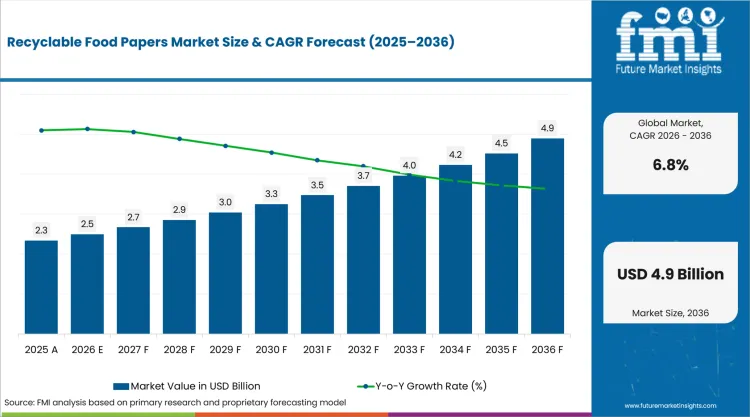
Key Takeaways of Recyclable Food Papers Market
- Food processors are revising material specifications toward paper structures that combine shelf protection with an accepted fiber-recycling route.
- Barrier-coated recyclable papers are projected to account for 30.0% of product type demand in 2026 due to adjustable food-protection functions.
- Virgin fiber is estimated to hold 44.0% by material in 2026 owing to controlled purity and dependable converting strength.
- Grease & oil barrier is forecast to represent 32.0% share in 2026 driven by high-volume fatty food applications.
- Qualification remains the main restraint owing to separate repulping, migration and production-line requirements for the final converted pack.
- Mondi, Sappi, UPM Specialty Papers, Ahlstrom, Billerud, Koehler Paper, Delfort and Oji Holdings form the reconciled company group.
Analyst Perspective
"Recyclable food papers earn repeat orders once the converted pack protects food and passes the applicable recovery assessment. Coating design and line support determine commercial value owing to the inability of a strong base sheet to correct an unstable seal window or incompatible final construction."
- Nandini Roy Choudhury, Principal Consultant, Future Market Insights
How is the Recyclable Food Papers Market segmented?
The Recyclable Food Papers Market is segmented by product type, material, barrier function, application, end use, sales channel and region.
Product type includes barrier-coated recyclable papers, uncoated functional papers, heat-sealable recyclable papers, grease-resistant recyclable papers, and others. Material covers virgin fiber, recycled fiber, bagasse - agri-fiber, and others, and barrier function covers grease & oil, moisture, oxygen - aroma, heat-seal, and others. Application includes flexible food wrapping, bags & sachets, liners & interleaves, trays & formable papers, and others. End use covers food processing, foodservice, retail & grocery, and others. Sales channel includes direct - converter supply, packaging distributors, online - e-commerce, and others, with region completing the taxonomy.
What makes Barrier-Coated Recyclable Papers central to the Product Type category?
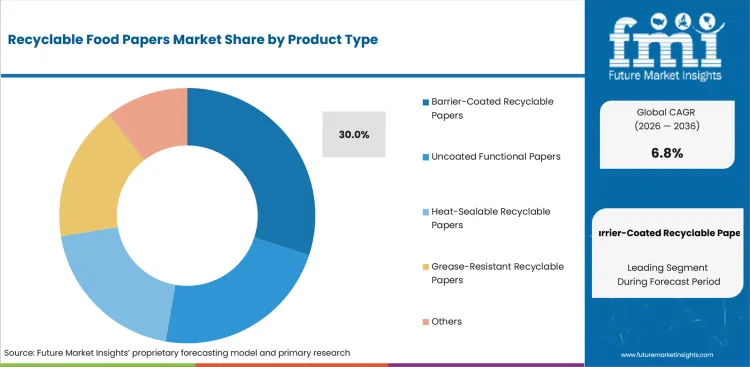
Barrier coated papers let producers add grease, moisture or oxygen protection without replacing fiber base. Commercial flexible packaging paper must retain those functions during printing and sealing across production runs. Delfort reported in June 2025 that thinbarrier 303 performed from -18°C to +38°C across food-packaging storage conditions.
- Based on product type, barrier-coated recyclable papers are projected to account for 30.0% in 2026 due to adjustable protection across food formats.
- Converters match coating weight to the intended food and machine settings so the pack preserves barrier performance during printing, folding and sealing at commercial scale.
Why does Virgin Fiber lead the Material category?
Virgin fiber gives food-packaging producers a controlled furnish for migration review and dependable coating performance. India’s September 2024 Ecomark Rules require paper used for food packaging to contain virgin pulp and remain free from dioxins. The rule reinforces demand among food grade packaging producers that need consistent surface quality and mechanical strength across high-speed lines used for direct or indirect food-contact formats.
- By material, virgin fiber is estimated to hold 44.0% in 2026 owing to purity controls and stable mechanical performance during qualification.
- Recycled fiber remains suitable for permitted indirect-contact formats, although commercial use depends on contamination control and surface consistency across production batches.
How does Grease & Oil Barrier shape the Barrier Function category?
Grease resistance must now protect fatty foods without relying on several legacy fluorinated coating chemistries. The FDA withdrew 35 PFAS food-contact notifications in January 2025 for grease-proofing coatings used on paper and paperboard packaging. Producers are reformulating barrier coatings for packaging around alternative chemistries that resist staining without weakening fiber recovery during commercial collection and processing.
- In 2026, grease & oil barrier is expected to lead barrier function with 32.0% share due to broad use across fatty and oily foods.
- Food processors test resistance against intended products and storage temperatures so folding and heat exposure preserve protection during commercial filling and distribution.
What drives Direct - Converter Supply in the Sales Channel category?
Direct agreements let paper producers and converters adjust coating, printing and sealing during a shared qualification program. Functional paper coating materials vary by equipment and substrate, changing drying and sealing behavior during qualification. Technical changes require shared trial records for each food format to establish recurring commercial orders reliably.
- The sales channel category is forecast to be led by direct - converter supply at 48.0% in 2026 due to coordinated technical qualification.
- Commercial trials increasingly connect paper design with the complete food pack and its intended production route. Koehler Paper reported in February 2025 that it developed NexPlus Advanced packaging with pack&satt for ready-to-eat meals.
What are the drivers, restraints and opportunities in the Recyclable Food Papers Market?
Recyclability rules are tightening food-packaging specifications, although multi-stage qualification slows conversion and low-coat-weight barriers widen the addressable format range.
- Driver: Packaging rules require food brands to document how the completed paper structure enters an established recycling process.
- Restraint: Barrier chemistry must pass recycling, food-contact and production-line tests to secure recurring food-packaging approval at commercial scale.
- Opportunity: Thin aqueous and mineral-based barriers can extend paper into sachets, pouches and wraps that previously required heavier laminates.
Recyclability Rules Reset Material Specifications
Food brands require a measurable recovery route to replace established laminate structures within recurring packaging programs. Regulation (EU) 2025/40 establishes recyclability requirements for packaging placed on the European market during the coming compliance cycle. The rule favors papers that pair product protection with established paper recycling routes across the completed printed and sealed construction.
Qualification Work Extends Purchase Timelines
Laboratory repulping results do not guarantee stable performance across commercial printing, forming and heat-sealing equipment during extended production runs. Coatings can crack at folds or narrow the usable heat-seal window during continuous production, which increases trial time and material waste. Cepi published Version 3 of its recyclability test method in March 2025, yet food-contact review and line trials remain separate approval requirements.
Low-Coat-Weight Barriers Widen Flexible Formats
Low-coat-weight systems reduce the functional material added to each paper structure without removing the protection required for commercial handling. The route fits flexible packaging that needs grease, moisture or oxygen control at low basis weight. Sappi introduced Guard Pro OHS and Guard Pro OMH in September 2025 for flow-wraps, sachets and pouches. The release gives converters additional structures for application-specific trials across heat-seal and cold-seal production routes.
Which country CAGRs are profiled in the Recyclable Food Papers Market?
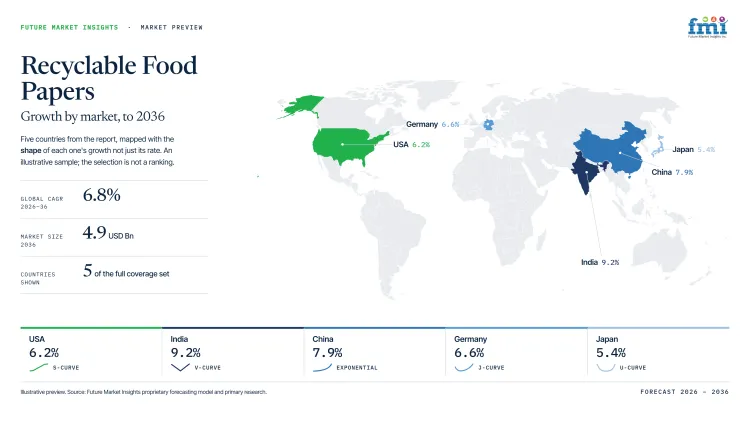
| Country | CAGR |
|---|---|
| Brazil | 7.2% |
| United Kingdom | 6.7% |
| Germany | 6.6% |
| United States | 6.2% |
| Japan | 5.4% |
How do country-level CAGRs compare in the Recyclable Food Papers Market?
The profiled forecasts span 1.8 percentage points between Brazil at 7.2% CAGR and Japan at 5.4% CAGR. Similar growth rates conceal different recovery systems, qualification practices and routes from food-brand trials into recurring national orders.
- Brazil contends with uneven collection quality across dispersed food-packaging networks, increasing the need for localized recovery support.
- Recyclability fee mechanisms in the UK are driving greater demand for verified packaging composition and component-level documentation.
- Germany places greater emphasis on documented recovery outcomes, making recyclability performance a key factor during packaging approvals.
- Across the United States, barrier-coating reformulation efforts must be managed alongside varying paper recovery practices between municipalities.
- Japan's adoption cycle is extended by thorough production validation procedures and selective municipal acceptance of paper packaging formats.
Comparable CAGRs can produce different market entry conditions owing to distinct qualification costs and route-to-market requirements. The full report provides country-level CAGR analysis across North America, Latin America, Europe, East Asia, South Asia and Pacific, and the Middle East and Africa.
Country-wise Analysis
- Brazilian food-packaging programs depend on regional paper converters and domestic recovery networks that serve foodservice, grocery and branded-food accounts across long transport corridors requiring reliable stock placement and machine support during national supply planning. Brazil is estimated to post 7.2% CAGR over the forecast period, influenced by the May 2025 federal measure expected to reduce selected waste imports by more than 90%. The policy favors domestic recovered fiber including cardboard, but uneven collection quality and coating control outside major industrial centers require regional inventory plus practical line support for recyclable paper designs to generate dependable recurring orders during launch and repeat volume planning.
- UK food brands compare recyclability data with disposal fees as packaging engineers test completed paper structures on established printing and sealing equipment across several product lines and national retail programs. The United Kingdom outlook for Recyclable Food Papers is anticipated to advance at 6.7% CAGR over the assessment period, aided by PackUK’s June 2025 publication of material-specific base fees and planned recyclability modulation. Fee visibility strengthens documented recyclable designs, yet national supply agreements require component evidence and production trials that confirm shelf protection across printed and sealed food formats at intended commercial speeds before recurring orders begin at scale.
- German food-packaging programs place early emphasis on design-for-recycling evidence and complete coating documentation across household packs used by national brands and foodservice categories on established converting lines during national supply reviews. The German Recyclable Food Papers sector is projected to record 6.6% CAGR during the assessment period, shaped by the August 2025 minimum standard developed with the Federal Environment Agency. Recognized laboratory results can shorten technical review, but recurring approval requires coatings that preserve sorting and fiber recovery across the final printed construction under intended production speeds and established household collection routes during national portfolio reviews for recurring commercial orders.
- US food processors require current chemistry declarations and completed line trials for grease-resistant wraps serving regional plants, foodservice programs and packaged-food formats across different municipal recovery routes used at national account scale. Recyclable Food Papers demand in the United States is forecast to rise at 6.2% CAGR through 2036, supported by the FDA’s February 2024 confirmation that PFAS grease-proofing agents were no longer sold. Municipal acceptance remains uneven for coated paper structures, so national supply agreements require current final-pack recovery evidence and consistent sealing data across production sites so trial volumes can become reliable recurring food-program orders during annual account reviews.
- Japanese food manufacturers favor stable basis weight and careful line qualification during material changes across production schedules serving convenience stores, supermarkets and national packaged-food brands across multiple prefectures with strict quality controls. Adoption of Recyclable Food Papers in Japan is estimated to expand at 5.4% CAGR through 2036 owing to the environment ministry’s March 2026 report covering 81,757 tonnes across 664 municipalities. Municipal implementation reached 38.1% for paper containers and packaging, so paper producers need local conversion partners and pack-specific recovery claims that remain credible beyond the strongest collection areas during national account reviews and recurring production planning.
Who are the notable companies in the Recyclable Food Papers Market?
Mondi, Sappi, UPM Specialty Papers, Ahlstrom, Billerud, Koehler Paper, Delfort and Oji Holdings are the notable companies serving this market.
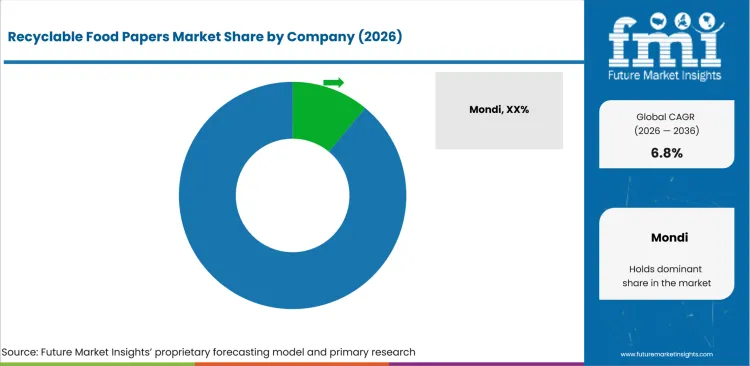
Integrated paper groups use broader paperboard packaging operations, whereas specialists focus on barrier performance and heat sealing for defined food applications. Entry barriers arise from coating control, food-contact records and access to qualified commercial trials at line speed.
- Mondi and Oji Holdings combine paper production with packaging operations that support customer programs across markets.
- Sappi, UPM Specialty Papers and Ahlstrom compete with functional-paper portfolios across several documented barrier requirements.
- Billerud, Koehler Paper and Delfort focus on barrier performance and converting fit across food formats.
Competitive Benchmarking: Recyclable Food Papers Market
| Company | Barrier Breadth | Recyclability Evidence | Application Support | Geographic Reach |
|---|---|---|---|---|
| Mondi | High | High | High | Global |
| Sappi | High | High | High | Europe, North America, Africa and international sales |
| UPM Specialty Papers | High | High | High | China, Finland, Germany and global service |
| Ahlstrom | Medium | High | High | Global specialty-material network |
| Billerud | Low | Low | Medium | Europe and North America |
| Koehler Paper | High | High | Medium | European manufacturing and international sales |
| Delfort | High | Medium | High | Europe, Americas and Asia |
| Oji Holdings | Medium | Low | Medium | Asia, Europe and Oceania |
Key Developments in the Recyclable Food Papers Market
- In August 2025, Mondi ramped FunctionalBarrier Paper Ultimate production following a EUR 16 million investment at Solec in Poland. The paper reports oxygen and water-vapor transmission below 0.5 in the stated units, supporting demanding dry-food trials on horizontal and vertical form-fill-seal lines.
- In March 2025, UPM Specialty Papers reported that named barrier papers and base papers passed the Cepi recyclability test. Selected papers also received WMU SBS-E certification, giving European and US programs separate evidence for unconverted paper during final-pack qualification.
- In March 2025, Ahlstrom launched LamiBak Flex for further coating or metallization across pouches and sachets plus flow packs. The base paper carries EN 13430 and Cepi certification and uses a natural grease barrier that reduces primer and coating loads during conversion.
Key Players in the Recyclable Food Papers Market
Integrated Paper and Packaging Groups
- Mondi
- Oji Holdings
Global Specialty Paper Platforms
- Sappi
- UPM Specialty Papers
- Ahlstrom
Focused Flexible-Barrier Developers
- Billerud
- Koehler Paper
- Delfort
Recyclable Food Papers Market - Report Scope
| Coverage field | Report scope |
|---|---|
| Market breakdown | By product type, material, barrier function, application, end use, sales channel and region. |
| Quantitative Units | Revenue in USD billion and CAGR in %. |
| Market Definition | Paper-based food-packaging materials that enter fiber-recycling routes and provide barrier or sealing functions. |
| Regions Covered | North America, Latin America, Western Europe, Eastern Europe, East Asia, South Asia and Pacific and Middle East and Africa. |
| Countries Covered | Brazil, United Kingdom, Germany, United States, Japan, and 20+ countries included in the full report. |
| Key Companies Profiled | Mondi, Sappi, UPM Specialty Papers, Ahlstrom, Billerud, Koehler Paper, Delfort and Oji Holdings. |
| Forecast Period | 2026 to 2036. |
| Approach | Primary and secondary research with market triangulation. |
Recyclable Food Papers Market - Research Methodology
| Method | Approach |
|---|---|
| Primary Research | FMI analysts gathered input from manufacturers, service providers, technology developers, distributors, end users, procurement teams, and subject-matter experts. Interviews examined purchasing decisions, product or service evaluation, adoption barriers, approval requirements, pricing considerations, and expectations for technical or commercial support. Respondents were also asked what evidence is required before a trial, pilot, or initial order develops into regular purchasing. |
| Desk Research | Desk research covered government statistics, regulatory publications, trade data, industry associations, technical literature, standards, company filings, product information, and official corporate announcements. Sources were reviewed for relevance, publication date, geographic coverage, and consistency with the defined market scope. Claims relating to performance, applications, approvals, capacity, investment, and commercial activity were retained only when supported by credible public evidence. |
| Market Sizing and Forecasting | The market model combined the baseline value with historical performance, segment structure, pricing and volume indicators, adoption levels, company participation, and country-level demand conditions. Forecast assumptions considered economic activity, investment trends, regulatory developments, technology adoption, purchasing cycles, supply availability, and barriers to wider market use. Segment and regional estimates were reconciled before the final market total was calculated. |
| Data Validation | Estimates were checked against multiple independent indicators, including public data, company activity, trade patterns, industry developments, and findings from primary interviews. Validation also tested whether products, services, applications, and company revenues fell within the defined market boundaries. Adjacent categories, unsupported claims, overlapping revenues, and activities without direct market relevance were excluded to reduce double counting and maintain consistency across segments and countries. |
Recyclable Food Papers Market by Segments
Recyclable Food Papers Market segmented by Product Type:
- Barrier-Coated Recyclable Papers
- Uncoated Functional Papers
- Heat-Sealable Recyclable Papers
- Grease-Resistant Recyclable Papers
- Others
Recyclable Food Papers Market segmented by Material:
- Virgin Fiber
- Recycled Fiber
- Bagasse - Agri-Fiber
- Others
Recyclable Food Papers Market segmented by Barrier Function:
- Grease & Oil Barrier
- Moisture Barrier
- Oxygen - Aroma Barrier
- Heat-Seal Function
- Others
Recyclable Food Papers Market segmented by Application:
- Flexible Food Wrapping
- Bags & Sachets
- Liners & Interleaves
- Trays & Formable Papers
- Others
Recyclable Food Papers Market segmented by End Use:
- Food Processing
- Foodservice
- Retail & Grocery
- Others
Recyclable Food Papers Market segmented by Sales Channel:
- Direct - Converter Supply
- Packaging Distributors
- Online - E-commerce
- Others
Recyclable Food Papers Market by Region:
- North America
- United States
- Canada
- Latin America
- Brazil
- Mexico
- Chile
- Rest of Latin America
- Western Europe
- Germany
- United Kingdom
- Italy
- Spain
- France
- Nordics
- Benelux
- Rest of Western Europe
- Eastern Europe
- Russia
- Poland
- Hungary
- Balkan and Baltic States
- Rest of Eastern Europe
- East Asia
- China
- Japan
- South Korea
- South Asia and Pacific
- India
- ASEAN
- Australia and New Zealand
- Rest of South Asia and Pacific
- Middle East and Africa
- Saudi Arabia
- Other GCC Countries
- Türkiye
- South Africa
- Other African Union Countries
- Rest of Middle East and Africa
Research Sources and Bibliography
- European Paper Recycling Council. (2025, July 11). Press release: European Paper Recycling Council Reports Strong Recycling Rates for 2024
- Department for Environment, Food & Rural Affairs, Environment Agency, & Natural Resources Wales. (2024, December 23). Recyclability assessment methodology: how to assess your packaging waste
- Delfortgroup AG. (2025, June 17). new barrier paper for varying temperatures: thinbarrier 303 protects food from frozen to tropical
- Ministry of Environment, Forest and Climate Change. (2024, September 26). Ecomark Rules, 2024
- USA Food and Drug Administration. (2025, January 3). FDA Determines Authorization for 35 Food Contact Notifications Related to PFAS Are No Longer Effective
- Koehler Paper. (2025, February 20). pack&satt Organic Ready-to-Eat Meals Packed in Koehler Paper Material
- European Union. (2025, January 22). Regulation (EU) 2025/40 of the European Parliament and of the Council of 19 December 2024 on packaging and packaging waste, amending Regulation (EU) 2019/1020 and Directive (EU) 2019/904, and repealing Directive 94/62/EC
- Confederation of European Paper Industries. (2025, March 13). Cepi Recyclability Test Method Version 3
- Sappi Europe. (2025, September 3). Sappi expands recyclable, high-barrier paper portfolio for primary packaging
- Ministry of the Environment and Climate Change, Brazil. (2025, May 7). Publicado novo decreto que regulamenta a lei de importações de resíduos sólidos
- Department for Environment, Food & Rural Affairs. (2025, June 30). Extended Producer Responsibility for Packaging: 2025 base fees
- Zentrale Stelle Verpackungsregister. (2025, August 29). 2025 minimum standard published - initial touchstone for companies preparing for the EU Packaging and Packaging Waste Regulation (PPWR)
- USA Food and Drug Administration. (2024, February 28). FDA Announces PFAS Used in Grease-Proofing Agents for Food Packaging No Longer Being Sold in the USA
- Ministry of the Environment, Government of Japan. (2026, March 31). 令和6年度容器包装リサイクル法に基づく市町村の分別収集等の実績について
- Mondi. (2025, August 14). Mondi ramps up FunctionalBarrier Paper Ultimate to meet growing demand for sustainable high-barrier paper-based packaging
- Sappi. (2024, April 17). Sappi establishes inhouse capacity to test recyclability of its products
- UPM Specialty Papers. (2024, October 24). UPM Specialty Papers and Michelman introduce a new generation of structures for high performance, recyclable paper packaging
- UPM Specialty Papers. (2025, March 18). UPM packaging papers achieve recyclability certifications in Europe and the USA
- Ahlstrom. (2025, March 17). Ahlstrom expands LamiBak™ portfolio with a new base paper for flexible food packaging
- Billerud. (2025, September 8). Billerud launches recyclable cartonboards built for strength and moisture resistance
- Oji Holdings Corporation. (2024, October 22). 欧州 包装材に関する環境規制対応事例(仏ブランド菓子製品):リサイクル可能な紙パッケージソリューション
- Oji Holdings Corporation. (2025, October 15). Paper-Based Liquid Sachets Using Oji Group’s Paper Material Adopted for Kewpie Dressing on JAL International In-flight Meal
- Mondi. (2026, February 18). How Prymat improved spice preservation with Mondi’s recyclable ultra-high barrier paper solution
- Koehler Paper. (2025, October 22). NORMA Uses Koehler Paper Packaging Paper for Cream of Wheat and Rice Pudding
- Oji Holdings Corporation. (2024, April 16). Oji Completes Acquisition of Walki, a European Advanced Materials Conversion Company
This bibliography is provided for reader reference and is not exhaustive. The full report contains the complete reference list and detailed citations
This Report Answers
- How large is the Recyclable Food Papers Market through 2036?
- Which operating conditions support the 6.8% forecast?
- Why do barrier-coated papers lead product type demand?
- How do fiber purity and grease barriers affect qualification?
- Which testing requirements delay recurring commercial orders?
- Why do profiled country CAGRs create different entry conditions?
- Which companies combine barrier breadth with recyclability evidence?
- Which developments are changing food-paper qualification?
Frequently Asked Questions
How big is the recyclable food papers market in 2026?
The recyclable food papers market is estimated at USD 2.5 billion in 2026. Growth is driven by increasing demand for paper-based food packaging solutions that support recyclability while maintaining product protection and shelf life.
What is the CAGR of the recyclable food papers market from 2026 to 2036?
The recyclable food papers market is projected to grow at a CAGR of 6.8% between 2026 and 2036. Expansion is supported by wider adoption of recyclable barrier papers and increasing sustainability requirements in food packaging.
Which product type is projected to account for 30.0% of the recyclable food papers market?
Barrier-coated recyclable papers are projected to account for 30.0% of the market in 2026. Their leading share is supported by their ability to provide grease, moisture, and oxygen resistance while remaining compatible with recycling systems.
How much incremental opportunity is projected for the recyclable food papers market through 2036?
The recyclable food papers market is expected to create an incremental opportunity of USD 2.4 billion between 2026 and 2036. Growth reflects increasing commercial adoption of recyclable packaging materials across various food applications.
Which companies are active in the recyclable food papers market?
Key companies operating in the market include Mondi, Sappi, UPM Specialty Papers, Ahlstrom, Billerud, Koehler Paper, Delfort, and Oji Holdings. These companies compete through recyclable barrier technologies, product innovation, and food packaging application expertise.
Preview the report firsthand - request a free sample
Get SampleGet the brochure for pricing and purchase details.
Get PDFTable of Content
- Key Takeaways
- Market Size and CAGR
- Top Growth Driver
- Fastest Growing Segment
- Leading Region
- Key Companies
- Emerging Opportunities
- Executive Summary
- Global Market Outlook
- Demand-side Trends
- Supply-side Trends
- Technology Roadmap Analysis
- Analysis and Recommendations
- Analyst Perspective (What is happening? Why now? What should investors know?)
- Key Questions Answered
- How large is the market?
- What is the CAGR?
- What are key trends?
- Which region dominates?
- Who are the leaders?
- Market Overview
- Market Coverage / Taxonomy
- Market Definition / Scope / Limitations
- Research Methodology
- Chapter Orientation
- Analytical Lens and Working Hypotheses
- Market Structure, Signals, and Trend Drivers
- Benchmarking and Cross-market Comparability
- Market Sizing, Forecasting, and Opportunity Mapping
- Research Design and Evidence Framework
- Desk Research Programme (Secondary Evidence)
- Expert Input and Fieldwork (Primary Evidence)
- Tooling, Models, and Reference Databases
- Data Engineering and Model Build
- Quality Assurance and Audit Trail
- Market Background
- Market Dynamics (Drivers, Restraints, Opportunity, Trends)
- Scenario Forecast (Optimistic, Likely, Conservative)
- Impact Analysis
- AI Impact
- Sustainability Impact
- Regulatory Impact
- Technology Impact
- Consumer / Buyer Analysis
- Purchase Drivers
- Adoption Barriers
- Buyer Journey
- Opportunity Map Analysis
- Product Life Cycle Analysis
- Supply Chain Analysis
- Investment Feasibility Matrix
- Value Chain Analysis
- PESTLE and Porter's Analysis
- Regulatory Landscape
- Regional Parent Market Outlook
- Production and Consumption Statistics
- Import and Export Statistics
- Global Market Analysis and Forecast, 2021 to 2036
- Historical Market Size Value (USD Million) Analysis, 2021 to 2025
- Current and Future Market Size Value (USD Million) Projections, 2026 to 2036
- Y-o-Y Growth Trend Analysis
- Absolute $ Opportunity Analysis
- Global Market Pricing Analysis, 2021 to 2036
- Global Market Analysis and Forecast, By Product Type, 2021 to 2036
- Introduction / Key Findings
- Historical Market Size Value (USD Million) Analysis By Product Type, 2021 to 2025
- Current and Future Market Size Value (USD Million) Analysis and Forecast By Product Type, 2026 to 2036
- Barrier-Coated Recyclable Papers
- Uncoated Functional Papers
- Heat-Sealable Recyclable Papers
- Grease-Resistant Recyclable Papers
- Others
- Barrier-Coated Recyclable Papers
- Y-o-Y Growth Trend Analysis By Product Type, 2021 to 2025
- Absolute $ Opportunity Analysis By Product Type, 2026 to 2036
- Global Market Analysis and Forecast, By Material, 2021 to 2036
- Introduction / Key Findings
- Historical Market Size Value (USD Million) Analysis By Material, 2021 to 2025
- Current and Future Market Size Value (USD Million) Analysis and Forecast By Material, 2026 to 2036
- Virgin Fiber
- Recycled Fiber
- Bagasse - Agri-Fiber
- Others
- Virgin Fiber
- Y-o-Y Growth Trend Analysis By Material, 2021 to 2025
- Absolute $ Opportunity Analysis By Material, 2026 to 2036
- Global Market Analysis and Forecast, By Barrier Function, 2021 to 2036
- Introduction / Key Findings
- Historical Market Size Value (USD Million) Analysis By Barrier Function, 2021 to 2025
- Current and Future Market Size Value (USD Million) Analysis and Forecast By Barrier Function, 2026 to 2036
- Grease & Oil Barrier
- Moisture Barrier
- Oxygen - Aroma Barrier
- Heat-Seal Function
- Others
- Grease & Oil Barrier
- Y-o-Y Growth Trend Analysis By Barrier Function, 2021 to 2025
- Absolute $ Opportunity Analysis By Barrier Function, 2026 to 2036
- Global Market Analysis and Forecast, By Application, 2021 to 2036
- Introduction / Key Findings
- Historical Market Size Value (USD Million) Analysis By Application, 2021 to 2025
- Current and Future Market Size Value (USD Million) Analysis and Forecast By Application, 2026 to 2036
- Flexible Food Wrapping
- Bags & Sachets
- Liners & Interleaves
- Trays & Formable Papers
- Others
- Flexible Food Wrapping
- Y-o-Y Growth Trend Analysis By Application, 2021 to 2025
- Absolute $ Opportunity Analysis By Application, 2026 to 2036
- Global Market Analysis and Forecast, By End Use, 2021 to 2036
- Introduction / Key Findings
- Historical Market Size Value (USD Million) Analysis By End Use, 2021 to 2025
- Current and Future Market Size Value (USD Million) Analysis and Forecast By End Use, 2026 to 2036
- Food Processing
- Foodservice
- Retail & Grocery
- Others
- Food Processing
- Y-o-Y Growth Trend Analysis By End Use, 2021 to 2025
- Absolute $ Opportunity Analysis By End Use, 2026 to 2036
- Global Market Analysis and Forecast, By Sales Channel
- Introduction / Key Findings
- Historical Market Size Value (USD Million) Analysis By Sales Channel, 2021 to 2025
- Current and Future Market Size Value (USD Million) Analysis and Forecast By Sales Channel, 2026 to 2036
- Direct - Converter Supply
- Packaging Distributors
- Online - E-commerce
- Others
- Direct - Converter Supply
- Y-o-Y Growth Trend Analysis By Sales Channel, 2021 to 2025
- Absolute $ Opportunity Analysis By Sales Channel, 2026 to 2036
- Global Market Analysis and Forecast, By Region, 2021 to 2036
- Introduction
- Historical Market Size Value (USD Million) Analysis By Region, 2021 to 2025
- Current Market Size Value (USD Million) Analysis and Forecast By Region, 2026 to 2036
- North America
- Latin America
- Western Europe
- Eastern Europe
- East Asia
- South Asia and Pacific
- Middle East & Africa
- Market Attractiveness Analysis By Region
- North America Market Analysis and Forecast, By Country, 2021 to 2036
- Historical Market Size Value (USD Million) Trend Analysis By Market Taxonomy, 2021 to 2025
- Market Size Value (USD Million) Forecast By Market Taxonomy, 2026 to 2036
- By Country
- USA
- Canada
- By Product Type
- By Material
- By Barrier Function
- By Application
- By End Use
- By Sales Channel
- By Country
- Market Attractiveness Analysis
- By Country
- By Product Type
- By Material
- By Barrier Function
- By Application
- By End Use
- By Sales Channel
- Key Takeaways
- Latin America Market Analysis and Forecast, By Country
- Historical Market Size Value (USD Million) Trend Analysis By Market Taxonomy, 2021 to 2025
- Market Size Value (USD Million) Forecast By Market Taxonomy, 2026 to 2036
- By Country
- Brazil
- Mexico
- Chile
- Rest of Latin America
- By Product Type
- By Material
- By Barrier Function
- By Application
- By End Use
- By Sales Channel
- By Country
- Market Attractiveness Analysis
- By Country
- By Product Type
- By Material
- By Barrier Function
- By Application
- By End Use
- By Sales Channel
- Key Takeaways
- Western Europe Market Analysis and Forecast, By Country
- Historical Market Size Value (USD Million) Trend Analysis By Market Taxonomy, 2021 to 2025
- Market Size Value (USD Million) Forecast By Market Taxonomy, 2026 to 2036
- By Country
- Germany
- UK
- Italy
- Spain
- France
- Nordic
- BENELUX
- Rest of Western Europe
- By Product Type
- By Material
- By Barrier Function
- By Application
- By End Use
- By Sales Channel
- By Country
- Market Attractiveness Analysis
- By Country
- By Product Type
- By Material
- By Barrier Function
- By Application
- By End Use
- By Sales Channel
- Key Takeaways
- Eastern Europe Market Analysis and Forecast, By Country
- Historical Market Size Value (USD Million) Trend Analysis By Market Taxonomy, 2021 to 2025
- Market Size Value (USD Million) Forecast By Market Taxonomy, 2026 to 2036
- By Country
- Russia
- Poland
- Hungary
- Balkan & Baltic
- Rest of Eastern Europe
- By Product Type
- By Material
- By Barrier Function
- By Application
- By End Use
- By Sales Channel
- By Country
- Market Attractiveness Analysis
- By Country
- By Product Type
- By Material
- By Barrier Function
- By Application
- By End Use
- By Sales Channel
- Key Takeaways
- East Asia Market Analysis and Forecast, By Country
- Historical Market Size Value (USD Million) Trend Analysis By Market Taxonomy, 2021 to 2025
- Market Size Value (USD Million) Forecast By Market Taxonomy, 2026 to 2036
- By Country
- China
- Japan
- South Korea
- By Product Type
- By Material
- By Barrier Function
- By Application
- By End Use
- By Sales Channel
- By Country
- Market Attractiveness Analysis
- By Country
- By Product Type
- By Material
- By Barrier Function
- By Application
- By End Use
- By Sales Channel
- Key Takeaways
- South Asia and Pacific Market Analysis and Forecast, By Country
- Historical Market Size Value (USD Million) Trend Analysis By Market Taxonomy, 2021 to 2025
- Market Size Value (USD Million) Forecast By Market Taxonomy, 2026 to 2036
- By Country
- India
- ASEAN
- Australia & New Zealand
- Rest of South Asia and Pacific
- By Product Type
- By Material
- By Barrier Function
- By Application
- By End Use
- By Sales Channel
- By Country
- Market Attractiveness Analysis
- By Country
- By Product Type
- By Material
- By Barrier Function
- By Application
- By End Use
- By Sales Channel
- Key Takeaways
- Middle East & Africa Market Analysis and Forecast, By Country
- Historical Market Size Value (USD Million) Trend Analysis By Market Taxonomy, 2021 to 2025
- Market Size Value (USD Million) Forecast By Market Taxonomy, 2026 to 2036
- By Country
- Kingdom of Saudi Arabia
- Other GCC Countries
- Türkiye
- South Africa
- Other African Union
- Rest of Middle East & Africa
- By Product Type
- By Material
- By Barrier Function
- By Application
- By End Use
- By Sales Channel
- By Country
- Market Attractiveness Analysis
- By Country
- By Product Type
- By Material
- By Barrier Function
- By Application
- By End Use
- By Sales Channel
- Key Takeaways
- Key Countries Market Analysis
- USA
- Pricing Analysis
- Market Share Analysis, 2025
- By Product Type
- By Material
- By Barrier Function
- By Application
- By End Use
- By Sales Channel
- Canada
- Pricing Analysis
- Market Share Analysis, 2025
- By Product Type
- By Material
- By Barrier Function
- By Application
- By End Use
- By Sales Channel
- Mexico
- Pricing Analysis
- Market Share Analysis, 2025
- By Product Type
- By Material
- By Barrier Function
- By Application
- By End Use
- By Sales Channel
- Brazil
- Pricing Analysis
- Market Share Analysis, 2025
- By Product Type
- By Material
- By Barrier Function
- By Application
- By End Use
- By Sales Channel
- Chile
- Pricing Analysis
- Market Share Analysis, 2025
- By Product Type
- By Material
- By Barrier Function
- By Application
- By End Use
- By Sales Channel
- Germany
- Pricing Analysis
- Market Share Analysis, 2025
- By Product Type
- By Material
- By Barrier Function
- By Application
- By End Use
- By Sales Channel
- UK
- Pricing Analysis
- Market Share Analysis, 2025
- By Product Type
- By Material
- By Barrier Function
- By Application
- By End Use
- By Sales Channel
- Italy
- Pricing Analysis
- Market Share Analysis, 2025
- By Product Type
- By Material
- By Barrier Function
- By Application
- By End Use
- By Sales Channel
- Spain
- Pricing Analysis
- Market Share Analysis, 2025
- By Product Type
- By Material
- By Barrier Function
- By Application
- By End Use
- By Sales Channel
- France
- Pricing Analysis
- Market Share Analysis, 2025
- By Product Type
- By Material
- By Barrier Function
- By Application
- By End Use
- By Sales Channel
- India
- Pricing Analysis
- Market Share Analysis, 2025
- By Product Type
- By Material
- By Barrier Function
- By Application
- By End Use
- By Sales Channel
- ASEAN
- Pricing Analysis
- Market Share Analysis, 2025
- By Product Type
- By Material
- By Barrier Function
- By Application
- By End Use
- By Sales Channel
- Australia & New Zealand
- Pricing Analysis
- Market Share Analysis, 2025
- By Product Type
- By Material
- By Barrier Function
- By Application
- By End Use
- By Sales Channel
- China
- Pricing Analysis
- Market Share Analysis, 2025
- By Product Type
- By Material
- By Barrier Function
- By Application
- By End Use
- By Sales Channel
- Japan
- Pricing Analysis
- Market Share Analysis, 2025
- By Product Type
- By Material
- By Barrier Function
- By Application
- By End Use
- By Sales Channel
- South Korea
- Pricing Analysis
- Market Share Analysis, 2025
- By Product Type
- By Material
- By Barrier Function
- By Application
- By End Use
- By Sales Channel
- Russia
- Pricing Analysis
- Market Share Analysis, 2025
- By Product Type
- By Material
- By Barrier Function
- By Application
- By End Use
- By Sales Channel
- Poland
- Pricing Analysis
- Market Share Analysis, 2025
- By Product Type
- By Material
- By Barrier Function
- By Application
- By End Use
- By Sales Channel
- Hungary
- Pricing Analysis
- Market Share Analysis, 2025
- By Product Type
- By Material
- By Barrier Function
- By Application
- By End Use
- By Sales Channel
- Kingdom of Saudi Arabia
- Pricing Analysis
- Market Share Analysis, 2025
- By Product Type
- By Material
- By Barrier Function
- By Application
- By End Use
- By Sales Channel
- Türkiye
- Pricing Analysis
- Market Share Analysis, 2025
- By Product Type
- By Material
- By Barrier Function
- By Application
- By End Use
- By Sales Channel
- South Africa
- Pricing Analysis
- Market Share Analysis, 2025
- By Product Type
- By Material
- By Barrier Function
- By Application
- By End Use
- By Sales Channel
- USA
- Market Structure Analysis
- Competition Dashboard
- Competition Benchmarking
- Market Share Analysis of Top Players
- By Regional
- By Product Type
- By Material
- By Barrier Function
- By Application
- By End Use
- By Sales Channel
- Emerging Startups
- Innovation Benchmarking
- Competition Analysis
- Competition Deep Dive
- Mondi
- Overview
- Product Portfolio
- Profitability by Market Segments
- Sales Footprint
- Strategy Overview
- Marketing Strategy
- Product Strategy
- Channel Strategy
- Sappi
- UPM Specialty Papers
- Ahlstrom
- Billerud
- Koehler Paper
- Delfort
- Smurfit Westrock
- Oji Holdings
- Nippon Paper
- Mondi
- Case Studies
- Success Stories
- Recent Developments
- Competition Deep Dive
- Assumptions & Acronyms Used


