

- Market Size (2026)
- USD 166.3 Mn
- Forecast (2036)
- USD 315.1 Mn
- CAGR (2026 to 2036)
- 6.6%
How big is the Recyclable High Barrier Mono-Material Pouches Market in 2026?
USD 166.3 million in 2026 and USD 315.1 million by 2036 at a 6.6% CAGR.
Sales of recyclable high-barrier mono-material pouches are estimated to rise at 6.6% CAGR through 2036, increasing valuation from USD 166.3 million in 2026 to USD 315.1 million by 2036. Regulatory requirements for packaging recyclability are accelerating the shift toward mono-material formats that can deliver both product protection and end-of-life recovery. Regulation (EU) 2025/40 requires packaging placed on the European Union market to meet recyclability conditions and introduces performance grades beginning in 2030. The rule strengthens the commercial case for mono-material packaging that protects products without creating complex sorting streams. Early food and household-product conversions rely on high barrier films to preserve shelf life across established filling lines. Packaging developers need structures that balance moisture and oxygen protection with recognized collection and recycling routes across each intended sales geography.
United States packaging programs face state-specific requirements that differ from European plans for harmonized recyclability grades and national reporting systems. RecyClass revised flexible polyethylene and polypropylene guidance in March 2026 following more than twenty testing campaigns during 2025. The update gives recyclable packaging developers clearer recommendations for inks and transparent-film printing across commercial structures. Separate qualification records may remain necessary for flexible plastic packaging programs as collection and reprocessing routes vary among destination markets. European guidance improves technical comparability without replacing local evidence about sorting access and recovered-polymer quality. Commercial adoption therefore depends on validating the complete pouch since incompatible coatings or closures can disqualify a film structure built around one polymer family.
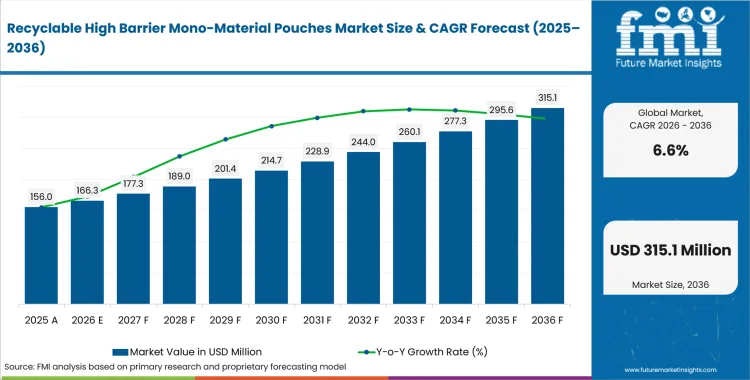
Key Takeaways of Recyclable High Barrier Mono-Material Pouches Market
- Packaging rules increase demand for pouches that preserve shelf life while passing documented recyclability assessments across the complete package.
- Mono-material PE is expected to hold 54.0% share in 2026, supported by familiar film conversion and heat-sealing infrastructure.
- Pouches are projected to represent 27.0% of format demand in 2026, reflecting low material use and broad filling-line compatibility.
- Grease-resistant structures are anticipated to capture 18.0% in 2026, attributable to measurable performance needs across food applications.
- Coatings and adhesives with fitments or inks can weaken recyclability even though the primary film uses one polymer family.
- Amcor and Mondi use multinational converting networks as Coveris and ProAmpac develop specialized pouch platforms; UFlex and Constantia Flexibles expand regional choices while Huhtamaki and Dow contribute flexible-packaging and resin expertise.
Analyst Perspective
"A recyclable high-barrier pouch succeeds if the complete pack protects its contents and passes the recycling test used in each sales market. Film choice sets the foundation, but closures and coatings often determine the final recycling rating for the finished package. Packaging teams should qualify barrier performance and line speed together so a material change does not create shelf-life losses or repeated plant trials."
- Nandini Roy Choudhury, Principal Analyst, Future Market Insights
How is the Recyclable High Barrier Mono-Material Pouches Market segmented?
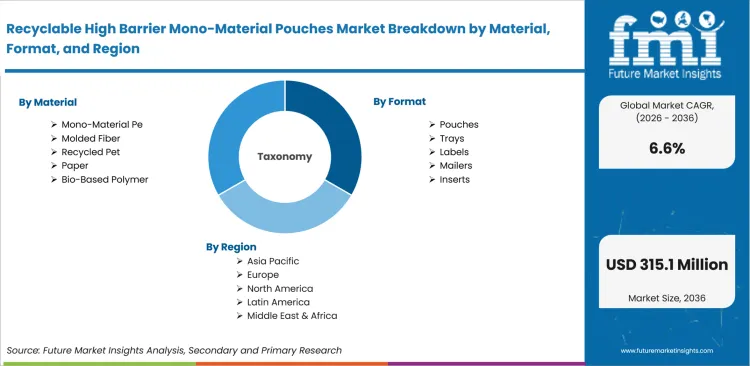
The recyclable high barrier mono-material pouches industry is segmented by material, format, barrier or feature, end use, and region.
The segmentation separates material composition from package format and the functional protection built into each structure. Material identifies the principal polymer or fiber route used throughout the complete pouch during commercial conversion and qualification. Format distinguishes pouches from trays and labels as well as mailers or inserts according to filling and presentation requirements. Barrier or feature classifies grease resistance and high-barrier performance alongside tamper evidence and freshness indicators. End use groups food and pharmaceutical applications with e-commerce and personal care as well as cold-chain requirements. Regional analysis compares commercial availability across national collection systems and recycling infrastructure that determine practical recovery and resin quality.
What supports mono-material PE demand within the material category?
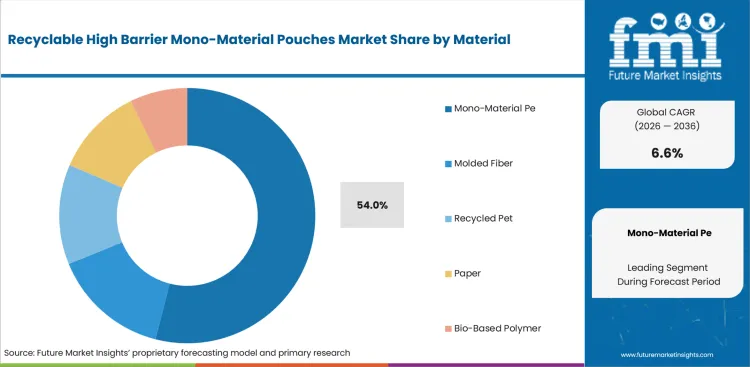
Polyethylene structures combine sealability with broad production familiarity across pouch lines used for dry products and liquid applications. Dow launched INNATE TF 220 resin in June 2025 for biaxially oriented polyethylene films intended for recyclable mono-material flexible packaging. The development expands material options for oriented films that need stiffness and heat resistance beside seal performance. The broader barrier packaging market helps pouch manufacturers compare moisture protection with oxygen and aroma control across the same pouch design.
- By material, mono-material PE is estimated to hold 54.0% in 2026 owing to established film conversion and heat-sealing infrastructure. Film producers can combine support and sealant layers within one polyethylene family and retain familiar pouch equipment. The approach reduces redesign work for packaged-food and home-care lines that replace complex laminates across existing sizes and filling programs.
- Food and personal-care plants increasingly select polyethylene structures for lines that already handle zipper and spout formats. The material supports controlled commercial trials without replacing complete filling systems or established operator routines. Adoption remains limited for oxygen-sensitive products if coatings or tie layers fail the recycling protocol used in the destination market.
How do pouches shape demand within the format category?
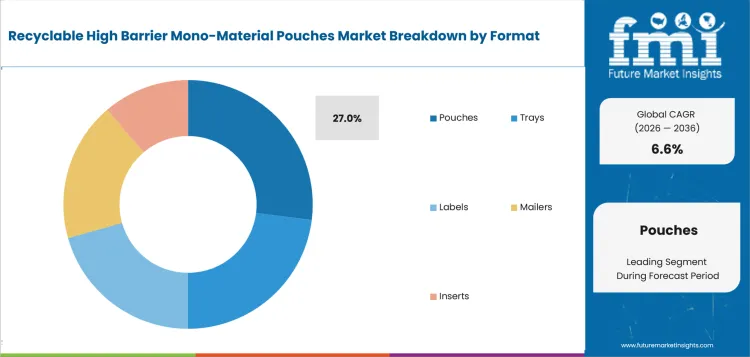
ProAmpac announced several United States patents in March 2025 covering mono-material premade pouches and an ultra-high-barrier retort structure. The disclosures show how pouch design integrates film construction with seals and closures across demanding applications. Pouches reduce package weight and shipping volume and support zippers or spouts across varied product sizes. The spout pouches market provides a useful comparison for fitment design and filling compatibility within recyclable structures.
- Based on format, pouches are projected to account for 27.0% in 2026 due to low material use and broad filling-line compatibility. Empty packs require limited inbound space and support several closure options across refill and food programs. Finished packs reduce distribution weight once seals and fitments pass line-speed and leak tests under commercial operating conditions.
- Household-product and pet-food brands use pouches for refills and concentrated products across several pack sizes. Flexible sizing allows one platform to serve trial packs and larger refill formats without equivalent rigid-container weight. Commercial expansion depends on fitments and zipper systems that preserve mono-material classification across the complete package during commercial use.
What supports demand for grease-resistant structures within the barrier or feature category?
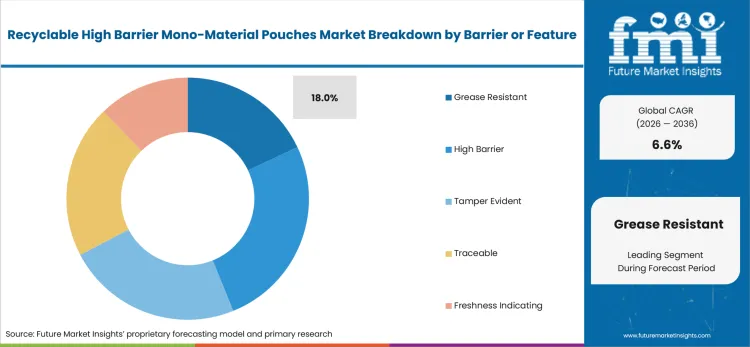
Grease resistance converts a broad material claim into a measurable requirement for oils and sauces alongside bakery products and pet foods. The retort pouches market illustrates how heat treatment increases demands for seal integrity and barrier stability. RecyClass updated its flexible packaging protocols in January 2025 to address adhesive and PVOH compatibility during recyclability assessments. Packaging engineers must confirm that surface treatments survive distribution without contaminating recycling wash streams or recovered polymer.
- Grease-resistant structures are set to lead the barrier or feature category with 18.0% share in 2026 due to frequent contact with oils across food applications. Oil migration can damage labels and secondary packs during transport and weaken retail presentation across long distribution routes. Qualification therefore links the coating choice with package integrity and recycling compatibility across storage and distribution conditions.
- Flexible-packaging engineers add grease resistance through coatings or functional layers that remain compatible with the selected recycling stream. Food manufacturers value treatments that protect printed surfaces and secondary packaging during storage or transport. Treatment choices become less attractive if they disrupt optical sorting or leave residues during industrial washing and reprocessing.
Why does food account for the dominant share within the end-use category?
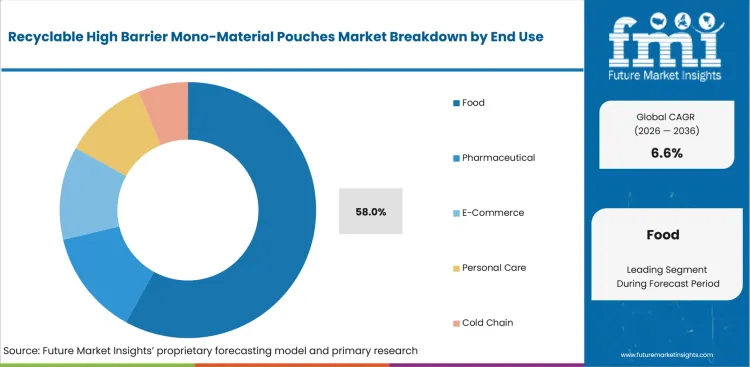
Food pouches must preserve shelf life and seal integrity and must also meet migration and recycling requirements across the complete structure. Coveris reported in June 2025 that several major United Kingdom retailers were using its PE-based MonoFlexBE packaging for grated cheese. The company documented high-barrier performance and shelf life of up to 120 days across retail distribution. The commercial programs show why food applications require validated protection on established packing lines rather than a material claim alone.
- Food is projected to hold 58.0% share in 2026 owing to the wide range of products already sold in flexible pouches. High recurring volumes can justify longer qualification programs across established filling lines and several product families. Recyclable structures gain approval once shelf-life trials match the multi-material package they replace under normal distribution conditions.
- Food manufacturers evaluate seal strength and migration compliance alongside aroma retention and filling-line speed before approving commercial conversion. Product development teams need evidence from complete production runs rather than isolated laboratory material tests. Adoption remains slower for retorted or highly oxygen-sensitive foods because recyclable barrier systems require extended validation across distribution and storage conditions.
What are the drivers, restraints, and opportunities in the Recyclable High Barrier Mono-Material Pouches Market?
Regulatory assessments support demand for verified recyclable pouches; material incompatibility slows conversion across demanding barrier applications; region-specific validation creates a commercial route for packaging manufacturers serving regulated consumer markets.
- Driver: Regulatory assessment systems reward pouch structures that pass recognized recyclability tests and support producer-responsibility reporting.
- Restraint: Barrier coatings and adhesives with closures or inks can prevent a nominally mono-material pouch from meeting practical recycling requirements.
- Opportunity: Packaging manufacturers can expand adoption through validation packages that connect barrier performance with local collection and reprocessing routes.
Recyclability reporting now affects package approval for companies that sell household goods in the United Kingdom. PackUK’s April 2025 methodology requires liable producers to assess complete packaging units and report the result to regulators. The process connects film choice with closures and labels instead of judging the primary layer alone. Pouch programs gain a clearer commercial route if their design records match the classification used for producer-responsibility fees and retailer review.
High-barrier performance often depends on coatings and adhesives that can reduce practical recyclability across established collection systems. Germany’s 2025 minimum standard measures the recyclable share through actual sorting and recovery routes rather than material labels alone. Packaging engineers must test inks and closures beside the primary film before replacing a proven laminate. Conversion slows if one component lowers the package rating or reduces the quality of recovered polymer during qualification.
Food-contact applications offer a defined route for recyclable pouches that use verified recycled polyethylene in established packaging lines. The route can support recycled-content targets across packaged food and household products without requiring a new rigid container. Resin traceability and migration compliance remain necessary alongside stable barrier performance throughout storage and commercial distribution. UFlex reported in March 2025 that the USFDA approved its recycling process for recycled polyethylene in food packaging. Commercial use depends on complete-package testing across filling and distribution conditions for every intended food application.
Which country CAGRs are profiled in the Recyclable High Barrier Mono-Material Pouches Market?
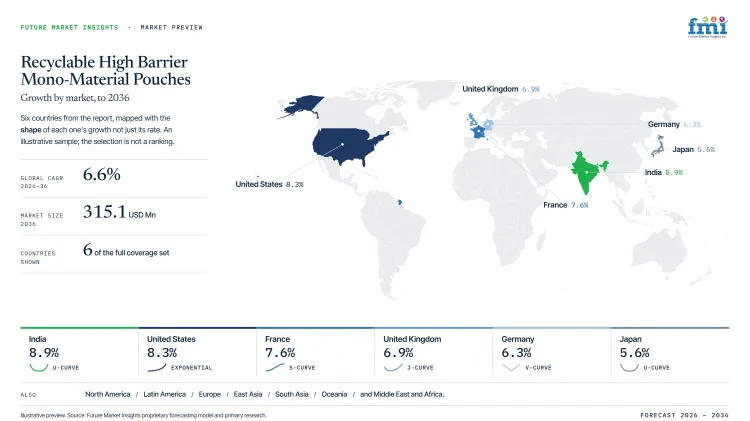
| Country | CAGR |
|---|---|
| India | 8.9% |
| United States | 8.3% |
| France | 7.6% |
| United Kingdom | 6.9% |
| Germany | 6.3% |
| Japan | 5.6% |
How do country-level CAGRs compare in the Recyclable High Barrier Mono-Material Pouches Market?
The forecasts form a gradual progression across a 3.3-point range rather than a sharp break between regulatory systems. India and the United States can spread approved pouch designs across large consumer-product volumes through established packaging networks. France and the United Kingdom remain closely aligned as national recycling classifications shape documentation and design review more directly than package demand alone. Germany and Japan require detailed component compatibility across mature recovery systems that apply disciplined sorting and material-quality controls. The spacing therefore reflects different qualification speeds for films and closures rather than a simple difference in brand interest.
- India’s expanding recycler registrations and diverse packaged-food base support rapid commercialization, although flexible-film recovery and food-contact validation remain uneven across states.
- United States programs benefit from national brand scale and large converting networks, yet state packaging rules can fragment documentation and labeling requirements.
- France combines European recyclability targets with national policy pressure on plastic packaging, which favors designs backed by clear sorting and reprocessing evidence.
- United Kingdom producer reporting creates an early reason to classify complete pouch structures, including fitments and adhesives that can change the final rating.
- Germany’s mature recovery infrastructure supports disciplined material substitution, although detailed technical standards can lengthen qualification for high-barrier structures.
- Japan’s established recycling system supports reliable material routes, yet premium food-quality expectations can extend shelf-life and component testing before conversion.
Similar country CAGRs do not create identical market entry conditions because collection routes and recyclability classifications differ across national packaging systems. The full report provides country-level CAGR analysis across North America, Latin America, Europe, East Asia, South Asia, Oceania and the Middle East and Africa.
Country-wise Analysis
- India’s plastic packaging system combines extended producer responsibility with a growing network of registered recyclers across several states. India’s environment ministry reported in March 2026 that 2,986 registered plastic recyclers had processed 19.697 million metric tons. The registered base gives packaging manufacturers a clearer route for collection evidence across high-volume food and household-product programs. Recyclable high-barrier mono-material pouch demand in India is forecast to rise at 8.9% CAGR over the forecast period, reinforced by formal recycling capacity and expanding film-production participation. Food-contact testing and flexible-film recovery remain uneven across municipal systems and create material friction outside established urban collection networks. National launch plans should sequence regions by verified collection access and food-contact validation instead of assuming uniform recovery conditions.
- United States packaging programs operate through state rules that can alter national pouch specifications and documentation requirements. The recyclable high-barrier mono-material pouch sector in the United States is projected to record 8.3% CAGR during the assessment period, shaped by large consumer portfolios and established film-conversion networks. National brands can spread a validated film platform across several product lines without rebuilding every filling operation. CalRecycle confirmed in May 2026 that permanent SB 54 regulations had taken effect with phased source-reduction and recycling targets. California provides a major commercialization route although food-contact rules and uneven flexible-film collection complicate national rollout. Packaging teams should separate state compliance records from technical film specifications so regulatory changes do not force unnecessary material fragmentation.
- France is tightening plastic packaging policy as it develops national routes for collection and higher-quality recycling across consumer applications. Packaging developers need pouch structures that fit European recyclability criteria and French sorting practices without weakening shelf-life performance. The Ministry for Ecological Transition launched a national plastic consultation in May 2026 to improve packaging recycling and align with European targets. France’s recyclable high-barrier mono-material pouch market outlook is anticipated to advance at 7.6% CAGR over the assessment period, aided by policy pressure on unrecycled plastic packaging and national recycling reform. National coordination supports clearer design evidence although flexible-film collection and barrier-laminate replacement remain material local frictions. French retail programs need one evidence package that aligns shelf-life testing with local sorting criteria and national policy documentation.
- United Kingdom producers must classify household packaging through a formal recyclability assessment linked to extended producer responsibility reporting. PackUK published its 2025 recyclability assessment requirements in June 2025 and clarified the temporary reporting route for second-half data. Recyclable high-barrier mono-material pouch sales in the United Kingdom are forecast to expand at 6.9% CAGR by 2036, supported by formal reporting duties and retailer packaging specifications. The guidance gives packaging teams a defined compliance route and connects recyclability results with future disposal-fee modulation. Fitments and adhesives create material friction if they lower the final rating despite a recyclable primary film. Artwork and launch schedules should remain provisional until the complete pouch receives a defensible RAM classification.
- Germany combines established packaging recovery systems with detailed technical standards for assessing commercial recyclability across complete package structures. In Germany, recyclable high-barrier mono-material pouch demand is predicted to advance at 6.3% CAGR through 2036 and is influenced by rigorous design validation and mature film-processing capabilities. Experienced flexible-packaging plants can compare new mono-material designs with proven barrier laminates through disciplined substitution programs. The German Environment Agency reported in January 2026 that plastic packaging material recycling reached 70% during 2024. The established recovery route supports compatible polyethylene and polypropylene pouches although demanding food applications require extended shelf-life trials. German projects should treat component-level recycling evidence as a gate for high-barrier food applications and closure-dependent formats.
- Japan operates a mature packaging recycling system with disciplined bidding processes and material-specific recovery routes for plastic packaging. The Japan Containers and Packaging Recycling Association published preliminary FY2026 bidding results in March 2026 that allocated 71.5% of awarded plastic packaging volume to material recycling. The provisional allocation gives domestic packaging plants a current reference for recovery routes across convenience-food and household-product formats. Adoption of recyclable high-barrier mono-material pouches in Japan is estimated to expand at 5.6% CAGR through 2036, linked to material efficiency goals and exacting food-quality standards. Premium barrier requirements create material friction through shelf-life and seal testing that extends qualification beyond standard film trials. Packaging developers should prioritize consistent components and production evidence for brands that sell oxygen-sensitive products through premium channels.
Who are the notable companies in the Recyclable High Barrier Mono-Material Pouches Market?
Amcor, Mondi, Coveris, ProAmpac, UFlex, Constantia Flexibles, Huhtamaki, and Dow are the notable companies shaping this market.
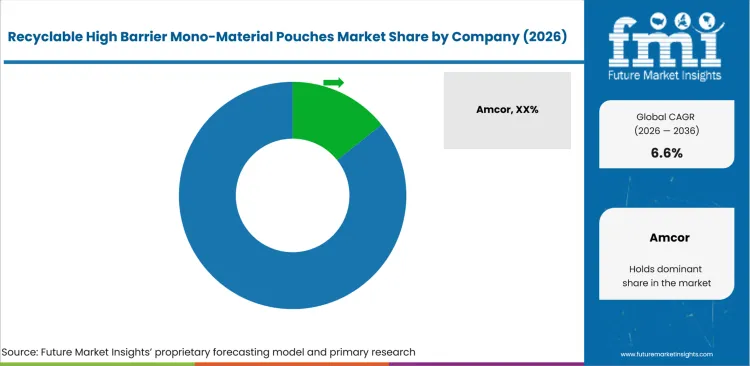
Key players in the competitive outlook such as Amcor and Mondi are focusing on multinational manufacturing networks whereas Coveris and ProAmpac focus on specialized pouch development across food and pet care packaging programs. UFlex and Constantia Flexibles broaden film and pouch-development options across regions; Huhtamaki adds international flexible-packaging reach. Dow contributes resin and film technology that supports oriented structures and recycled-content development rather than finished-pouch conversion. Brand owners therefore compare plant-level qualification support with resin expertise and geographic execution across each intended sales program.
- Amcor and Mondi provide multinational manufacturing networks that can support coordinated pouch programs across several regions. Huhtamaki adds established flexible-packaging access for brands seeking another global development route across food and household applications. Selection depends on whether each packaging group can reproduce barrier performance and recycling evidence across multiple plants without extending qualification schedules.
- Coveris and ProAmpac compete through specialized pouch platforms that combine documented high-barrier performance with closure-development capability. UFlex and Constantia Flexibles broaden the available application and geographic routes for food and household products. Packaging teams should compare pilot-line support and fitment compatibility beside the ability to document recyclability across the final commercial structure.
- Dow supports film development through polyethylene resins and technical collaboration across oriented-film and recycled-content structures. Resin performance must transfer through film conversion and package testing, so Dow’s commercial role differs from finished-pouch manufacturers. Selection therefore depends on material data and technical development support rather than direct finished-package supply.
Competitive Benchmarking: Recyclable High Barrier Mono-Material Pouches Market
| Company | Technical Depth and Evidence | Delivery and Integration Support | Account and Channel Reach | Geographic Reach |
|---|---|---|---|---|
| Amcor | High | High | High | Global |
| Mondi | High | High | High | Global |
| Coveris | High | Medium | Medium | Europe |
| ProAmpac | High | High | High | Global |
| UFlex | Medium | Medium | High | Global |
| Constantia Flexibles | High | High | High | Global |
| Huhtamaki | High | Medium | Medium | Global |
| Dow | Medium | Medium | High | Global |
Key Developments in the Recyclable High Barrier Mono-Material Pouches Market
- In July 2025, Amcor and Mediacor launched a two-liter spouted refill pouch for Nana laundry and cleaning products. The mono-material high-barrier structure was described as recycle-ready in Italy and Germany as well as Austria. The format supports concentrated household products that need reliable dispensing and controlled pouring across repeated consumer use. The development demonstrates how large refill packs can combine product protection with region-specific recyclability requirements across European sales programs.
- In February 2025, Mondi and Sherwin-Williams introduced a pre-made polyethylene mono-material spouted pouch for paint in the United Kingdom. Mondi reported that the one-liter format replaced rigid plastic tubs and reduced plastic use by 90%. The pack extends recyclable pouch adoption into viscous products that need dependable dispensing and transport protection. Commercial qualification must also confirm seal reliability across paint filling and distribution conditions during commercial programs.
- In May 2025, Constantia Flexibles and Delica launched EcoVerHighPlus for ground coffee and coffee beans. The mono-polypropylene laminate combines high aroma protection with a matching valve in the same polymer family. Constantia reported stable vertical form-fill-seal performance on established coffee lines without equipment modifications after initial fine-tuning. The commercial launch shows how high-barrier pouch conversion can preserve freshness while reducing material complexity across established coffee packaging lines.
- In September 2025, Dow and Zermatt launched a mono-material polyethylene pet-food pouch for Nature’s Variety with 10% advanced recycled content under a mass-balance approach. The pack replaced a PET and polyethylene laminate and reached shelves in Spain and France as well as Portugal. The commercial release links design-for-recycling work with food-contact recycled content across European pet-food packaging programs. Brand programs must verify barrier stability and component compatibility against forthcoming European regulatory requirements for packaging.
Key Players in the Recyclable High Barrier Mono-Material Pouches Market
Global Flexible Packaging Manufacturers
- Amcor
- Mondi
- Huhtamaki
Specialized Flexible Packaging Producers
- Coveris
- ProAmpac
- UFlex
- Constantia Flexibles
Materials and Resin Technology Providers
- Dow
Recyclable High Barrier Mono-Material Pouches Market - Report Scope
| Coverage field | Report scope |
|---|---|
| Market breakdown | Material, format, barrier or feature, end use, and region. |
| Quantitative Units | Revenue in USD Million, CAGR in %. |
| Market Definition | Commercially tracked demand for recyclable high-barrier mono-material pouches that use one principal polymer family while providing functional protection across identified formats and end uses. |
| Regions Covered | North America, Latin America, Europe, East Asia, South Asia, Oceania, and Middle East and Africa. |
| Countries Covered | India, United States, France, United Kingdom, Germany, Japan, and 30+ countries. |
| Key Companies Profiled | Amcor, Mondi, Coveris, ProAmpac, UFlex, Constantia Flexibles, Huhtamaki, and Dow. |
| Forecast Period | 2026 to 2036. |
| Approach | Hybrid bottom-up and top-down market sizing supported by primary interviews and official desk research. |
Recyclable High Barrier Mono-Material Pouches Market - Research Methodology
| Method | Approach |
|---|---|
| Primary Research | FMI analysts gathered input from manufacturers, service providers, technology developers, distributors, end users, procurement teams, and subject-matter experts. Interviews examined purchasing decisions, product or service evaluation, adoption barriers, approval requirements, pricing considerations, and expectations for technical or commercial support. Respondents were also asked what evidence is required before a trial, pilot, or initial order develops into regular purchasing. |
| Desk Research | Desk research covered government statistics, regulatory publications, trade data, industry associations, technical literature, standards, company filings, product information, and official corporate announcements. Sources were reviewed for relevance, publication date, geographic coverage, and consistency with the defined market scope. Claims relating to performance, applications, approvals, capacity, investment, and commercial activity were retained only when supported by credible public evidence. |
| Market Sizing and Forecasting | The market model combined the baseline value with historical performance, segment structure, pricing and volume indicators, adoption levels, company participation, and country-level demand conditions. Forecast assumptions considered economic activity, investment trends, regulatory developments, technology adoption, purchasing cycles, supply availability, and barriers to wider market use. Segment and regional estimates were reconciled before the final market total was calculated. |
| Data Validation | Estimates were checked against multiple independent indicators, including public data, company activity, trade patterns, industry developments, and findings from primary interviews. Validation also tested whether products, services, applications, and company revenues fell within the defined market boundaries. Adjacent categories, unsupported claims, overlapping revenues, and activities without direct market relevance were excluded to reduce double counting and maintain consistency across segments and countries. |
Recyclable High Barrier Mono-Material Pouches Market by Segments
Recyclable High Barrier Mono-Material Pouches Market segmented by Material:
- Paper
- Molded Fiber
- Recycled PET
- Mono-material PE
- Bio-based Polymer
Recyclable High Barrier Mono-Material Pouches Market segmented by Format:
- Pouches
- Trays
- Labels
- Mailers
- Inserts
Recyclable High Barrier Mono-Material Pouches Market segmented by Barrier or Feature:
- Grease Resistant
- High Barrier
- Tamper Evident
- Traceable
- Freshness Indicating
Recyclable High Barrier Mono-Material Pouches Market segmented by End Use:
- Food
- Pharmaceutical
- E-commerce
- Personal Care
- Cold Chain
Recyclable High Barrier Mono-Material Pouches Market by Region:
- North America
- United States
- Canada
- Mexico
- Latin America
- Brazil
- Chile
- Rest of Latin America
- Western Europe
- Germany
- UK
- Italy
- Spain
- France
- Nordic
- BENELUX
- Rest of Western Europe
- Eastern Europe
- Russia
- Poland
- Hungary
- Balkan and Baltic
- Rest of Eastern Europe
- East Asia
- China
- Japan
- South Korea
- South Asia and Pacific
- India
- ASEAN
- Australia and New Zealand
- Rest of South Asia and Pacific
- Middle East and Africa
- Kingdom of Saudi Arabia
- Other GCC Countries
- Turkiye
- South Africa
- Other African Union
- Rest of Middle East and Africa
Research Sources and Bibliography
- European Parliament & Council of the European Union. (2025, January 22). Regulation (EU) 2025/40 of the European Parliament and of the Council of 19 December 2024 on packaging and packaging waste, amending Regulation (EU) 2019/1020 and Directive (EU) 2019/904, and repealing Directive 94/62/EC (Text with EEA relevance).
- RecyClass. (2026, March 11). RecyClass Updates Packaging Recyclability Recommendations Following Extensive Testing in 2025.
- Dow. (2025, June 30). Dow Announces INNATE™ TF 220 Precision Packaging Resin and Advances Collaborations to Redefine Packaging Circularity.
- ProAmpac. (2025, March 4). Bolstering Sustainable Packaging Leadership, ProAmpac Expands Intellectual Property Portfolio.
- RecyClass. (2025, January 28). RecyClass updates Recyclability Evaluation Protocols and Design for Recycling Guidelines with latest scientific findings.
- Constantia Flexibles. (2025, May 20). EcoVerHighPlus: A recyclable-ready innovation for coffee packaging in partnership with Delica, part of Migros Industrie.
- Department for Environment, Food & Rural Affairs. (2025, September 4). Recyclability assessment methodology: stages of recyclability and definitions.
- PackUK. (2025, June 27). PackUK: 2025 recyclability assessment requirements.
- German Environment Agency. (2025, August 29). Recyclingfähigkeit von Verpackungen: Mindeststandard 2025.
- UFlex. (2025, March 12). UFlex Secures USFDA Approval for Recycled PE in Food Packaging.
- Ministry of Environment, Forest and Climate Change. (2026, March 23). PARLIAMENT QUESTION: Circular Economy Framework and Extended Producer Responsibility.
- California Department of Resources Recycling and Recovery. (2026, May 1). Plastic Pollution Prevention and Packaging Producer Responsibility Act.
- Ministry for Ecological Transition. (2026, May 28). Plan plastique : la concertation est lancée pour atteindre les objectifs européens en matière de recyclage plastique à horizon 2030.
- German Environment Agency. (2026, January 27). Facts against myths: Packaging waste recycling in Germany is working.
- Japan Containers and Packaging Recycling Association. (2026, March 2).
- Amcor. (2025, April 30). Amcor completes combination with Berry Global; positioned to significantly enhance value for customers and shareholders.
- Amcor. (2025, July 11). Amcor & Mediacor launch a refill pouch for Nana laundry and cleaning products.
- Mondi. (2025, February 26). Mondi’s re/cycle SpoutedPouch replaces plastic tubs for paint.
- Coveris. (2025, June 13). Visit Coveris at the International Cheese & Dairy Awards.
- Dow. (2025, September 29). Dow, Zermatt, and Nature’s Variety launch pet food pouch with food-contact compliant advanced recycled content.
- Coveris. (2025, September 4). Coveris Showcases Sustainable Pet Food Packaging at PATS UK 2025.
- Huhtamaki. (2026, January 12). Huhtamaki Solutions Recognised at the WorldStar Awards 2026.
This bibliography is provided for reader reference and is not exhaustive. The full report contains the complete reference list and detailed citations
This Report Answers
- How large is the recyclable high barrier mono-material pouches market in 2026 and 2036?
- Why does mono-material PE account for the largest material share in 2026?
- How do pouch formats affect filling compatibility and recycling assessment?
- Which barrier features create the clearest commercial reason for adoption?
- Why do food applications account for the largest end-use share?
- How do country growth rates differ between India and the United States and across Europe and Japan?
- Which companies provide converted pouch platforms or supporting material technology?
- What limits recyclability across closures and adhesives together with coatings and functional barriers?
- How should brand owners compare technical evidence with delivery support and geographic reach?
Frequently Asked Questions
How big is the Recyclable High Barrier Mono-Material Pouches Market in 2026?
The recyclable high barrier mono-material pouches market is valued at USD 166.3 million in 2026 and is forecast to reach USD 315.1 million by 2036.
What is the CAGR of the Recyclable High Barrier Mono-Material Pouches Market from 2026 to 2036?
The recyclable high barrier mono-material pouches market is projected to grow at a CAGR of 6.6% between 2026 and 2036, supported by regulatory assessment systems rewarding pouch structures that pass recognized recyclability tests and support producer-responsibility reporting across major consumer markets.
Which end use leads the Recyclable High Barrier Mono-Material Pouches Market?
Food accounts for 58.0% of the recyclable high barrier mono-material pouches market by end use in 2026, driven by the wide range of products already sold in flexible pouches where high recurring volumes justify longer qualification programs across established filling lines and product families.
Which country is growing fastest in the Recyclable High Barrier Mono-Material Pouches Market?
India is the fastest-growing country in the recyclable high barrier mono-material pouches market, expanding at an 8.9% CAGR through 2036, ahead of the market average of 6.6%, reinforced by formal recycling capacity with 2,986 registered plastic recyclers and expanding film-production participation across high-volume food and household programs.
Who are the leading companies in the Recyclable High Barrier Mono-Material Pouches Market?
Leading companies in the recyclable high barrier mono-material pouches market include Amcor, Mondi, Coveris, ProAmpac, UFlex, Constantia Flexibles, Huhtamaki, and Dow, competing across global flexible packaging manufacturing, specialized high-barrier pouch development, and materials and resin technology platforms.
Preview the report firsthand - request a free sample
Get SampleGet the brochure for pricing and purchase details.
Get PDFTable of Content
- Key Takeaways
- Market Size and CAGR
- Top Growth Driver
- Fastest Growing Segment
- Leading Region
- Key Companies
- Emerging Opportunities
- Executive Summary
- Global Market Outlook
- Demand-side Trends
- Supply-side Trends
- Technology Roadmap Analysis
- Analysis and Recommendations
- Analyst Perspective (What is happening? Why now? What should investors know?)
- Key Questions Answered
- How large is the market?
- What is the CAGR?
- What are key trends?
- Which region dominates?
- Who are the leaders?
- Market Overview
- Market Coverage / Taxonomy
- Market Definition / Scope / Limitations
- Research Methodology
- Chapter Orientation
- Analytical Lens and Working Hypotheses
- Market Structure, Signals, and Trend Drivers
- Benchmarking and Cross-market Comparability
- Market Sizing, Forecasting, and Opportunity Mapping
- Research Design and Evidence Framework
- Desk Research Programme (Secondary Evidence)
- Expert Input and Fieldwork (Primary Evidence)
- Tooling, Models, and Reference Databases
- Data Engineering and Model Build
- Quality Assurance and Audit Trail
- Market Background
- Market Dynamics (Drivers, Restraints, Opportunity, Trends)
- Scenario Forecast (Optimistic, Likely, Conservative)
- Impact Analysis
- AI Impact
- Sustainability Impact
- Regulatory Impact
- Technology Impact
- Consumer / Buyer Analysis
- Purchase Drivers
- Adoption Barriers
- Buyer Journey
- Opportunity Map Analysis
- Product Life Cycle Analysis
- Supply Chain Analysis
- Investment Feasibility Matrix
- Value Chain Analysis
- PESTLE and Porter's Analysis
- Regulatory Landscape
- Regional Parent Market Outlook
- Production and Consumption Statistics
- Import and Export Statistics
- Global Market Analysis and Forecast, 2021 to 2036
- Historical Market Size Value (USD Million) Analysis, 2021 to 2025
- Current and Future Market Size Value (USD Million) Projections, 2026 to 2036
- Y-o-Y Growth Trend Analysis
- Absolute $ Opportunity Analysis
- Global Market Pricing Analysis, 2021 to 2036
- Global Market Analysis and Forecast, By Material, 2021 to 2036
- Introduction / Key Findings
- Historical Market Size Value (USD Million) Analysis By Material, 2021 to 2025
- Current and Future Market Size Value (USD Million) Analysis and Forecast By Material, 2026 to 2036
- Mono-Material Pe
- Molded Fiber
- Recycled Pet
- Paper
- Bio-Based Polymer
- Mono-Material Pe
- Y-o-Y Growth Trend Analysis By Material, 2021 to 2025
- Absolute $ Opportunity Analysis By Material, 2026 to 2036
- Global Market Analysis and Forecast, By Format, 2021 to 2036
- Introduction / Key Findings
- Historical Market Size Value (USD Million) Analysis By Format, 2021 to 2025
- Current and Future Market Size Value (USD Million) Analysis and Forecast By Format, 2026 to 2036
- Pouches
- Trays
- Labels
- Mailers
- Inserts
- Pouches
- Y-o-Y Growth Trend Analysis By Format, 2021 to 2025
- Absolute $ Opportunity Analysis By Format, 2026 to 2036
- Global Market Analysis and Forecast, By Barrier or Feature, 2021 to 2036
- Introduction / Key Findings
- Historical Market Size Value (USD Million) Analysis By Barrier or Feature, 2021 to 2025
- Current and Future Market Size Value (USD Million) Analysis and Forecast By Barrier or Feature, 2026 to 2036
- Grease Resistant
- High Barrier
- Tamper Evident
- Traceable
- Freshness Indicating
- Grease Resistant
- Y-o-Y Growth Trend Analysis By Barrier or Feature, 2021 to 2025
- Absolute $ Opportunity Analysis By Barrier or Feature, 2026 to 2036
- Global Market Analysis and Forecast, By End Use, 2021 to 2036
- Introduction / Key Findings
- Historical Market Size Value (USD Million) Analysis By End Use, 2021 to 2025
- Current and Future Market Size Value (USD Million) Analysis and Forecast By End Use, 2026 to 2036
- Food
- Pharmaceutical
- E-Commerce
- Personal Care
- Cold Chain
- Food
- Y-o-Y Growth Trend Analysis By End Use, 2021 to 2025
- Absolute $ Opportunity Analysis By End Use, 2026 to 2036
- Global Market Analysis and Forecast, By Region, 2021 to 2036
- Introduction
- Historical Market Size Value (USD Million) Analysis By Region, 2021 to 2025
- Current Market Size Value (USD Million) Analysis and Forecast By Region, 2026 to 2036
- North America
- Latin America
- Western Europe
- Eastern Europe
- East Asia
- South Asia and Pacific
- Middle East & Africa
- Market Attractiveness Analysis By Region
- North America Market Analysis and Forecast, By Country, 2021 to 2036
- Historical Market Size Value (USD Million) Trend Analysis By Market Taxonomy, 2021 to 2025
- Market Size Value (USD Million) Forecast By Market Taxonomy, 2026 to 2036
- By Country
- USA
- Canada
- By Material
- By Format
- By Barrier or Feature
- By End Use
- By Country
- Market Attractiveness Analysis
- By Country
- By Material
- By Format
- By Barrier or Feature
- By End Use
- Key Takeaways
- Latin America Market Analysis and Forecast, By Country
- Historical Market Size Value (USD Million) Trend Analysis By Market Taxonomy, 2021 to 2025
- Market Size Value (USD Million) Forecast By Market Taxonomy, 2026 to 2036
- By Country
- Brazil
- Mexico
- Chile
- Rest of Latin America
- By Material
- By Format
- By Barrier or Feature
- By End Use
- By Country
- Market Attractiveness Analysis
- By Country
- By Material
- By Format
- By Barrier or Feature
- By End Use
- Key Takeaways
- Western Europe Market Analysis and Forecast, By Country
- Historical Market Size Value (USD Million) Trend Analysis By Market Taxonomy, 2021 to 2025
- Market Size Value (USD Million) Forecast By Market Taxonomy, 2026 to 2036
- By Country
- Germany
- UK
- Italy
- Spain
- France
- Nordic
- BENELUX
- Rest of Western Europe
- By Material
- By Format
- By Barrier or Feature
- By End Use
- By Country
- Market Attractiveness Analysis
- By Country
- By Material
- By Format
- By Barrier or Feature
- By End Use
- Key Takeaways
- Eastern Europe Market Analysis and Forecast, By Country
- Historical Market Size Value (USD Million) Trend Analysis By Market Taxonomy, 2021 to 2025
- Market Size Value (USD Million) Forecast By Market Taxonomy, 2026 to 2036
- By Country
- Russia
- Poland
- Hungary
- Balkan & Baltic
- Rest of Eastern Europe
- By Material
- By Format
- By Barrier or Feature
- By End Use
- By Country
- Market Attractiveness Analysis
- By Country
- By Material
- By Format
- By Barrier or Feature
- By End Use
- Key Takeaways
- East Asia Market Analysis and Forecast, By Country
- Historical Market Size Value (USD Million) Trend Analysis By Market Taxonomy, 2021 to 2025
- Market Size Value (USD Million) Forecast By Market Taxonomy, 2026 to 2036
- By Country
- China
- Japan
- South Korea
- By Material
- By Format
- By Barrier or Feature
- By End Use
- By Country
- Market Attractiveness Analysis
- By Country
- By Material
- By Format
- By Barrier or Feature
- By End Use
- Key Takeaways
- South Asia and Pacific Market Analysis and Forecast, By Country
- Historical Market Size Value (USD Million) Trend Analysis By Market Taxonomy, 2021 to 2025
- Market Size Value (USD Million) Forecast By Market Taxonomy, 2026 to 2036
- By Country
- India
- ASEAN
- Australia & New Zealand
- Rest of South Asia and Pacific
- By Material
- By Format
- By Barrier or Feature
- By End Use
- By Country
- Market Attractiveness Analysis
- By Country
- By Material
- By Format
- By Barrier or Feature
- By End Use
- Key Takeaways
- Middle East & Africa Market Analysis and Forecast, By Country
- Historical Market Size Value (USD Million) Trend Analysis By Market Taxonomy, 2021 to 2025
- Market Size Value (USD Million) Forecast By Market Taxonomy, 2026 to 2036
- By Country
- Kingdom of Saudi Arabia
- Other GCC Countries
- Türkiye
- South Africa
- Other African Union
- Rest of Middle East & Africa
- By Material
- By Format
- By Barrier or Feature
- By End Use
- By Country
- Market Attractiveness Analysis
- By Country
- By Material
- By Format
- By Barrier or Feature
- By End Use
- Key Takeaways
- Key Countries Market Analysis
- USA
- Pricing Analysis
- Market Share Analysis, 2025
- By Material
- By Format
- By Barrier or Feature
- By End Use
- Canada
- Pricing Analysis
- Market Share Analysis, 2025
- By Material
- By Format
- By Barrier or Feature
- By End Use
- Mexico
- Pricing Analysis
- Market Share Analysis, 2025
- By Material
- By Format
- By Barrier or Feature
- By End Use
- Brazil
- Pricing Analysis
- Market Share Analysis, 2025
- By Material
- By Format
- By Barrier or Feature
- By End Use
- Chile
- Pricing Analysis
- Market Share Analysis, 2025
- By Material
- By Format
- By Barrier or Feature
- By End Use
- Germany
- Pricing Analysis
- Market Share Analysis, 2025
- By Material
- By Format
- By Barrier or Feature
- By End Use
- UK
- Pricing Analysis
- Market Share Analysis, 2025
- By Material
- By Format
- By Barrier or Feature
- By End Use
- Italy
- Pricing Analysis
- Market Share Analysis, 2025
- By Material
- By Format
- By Barrier or Feature
- By End Use
- Spain
- Pricing Analysis
- Market Share Analysis, 2025
- By Material
- By Format
- By Barrier or Feature
- By End Use
- France
- Pricing Analysis
- Market Share Analysis, 2025
- By Material
- By Format
- By Barrier or Feature
- By End Use
- India
- Pricing Analysis
- Market Share Analysis, 2025
- By Material
- By Format
- By Barrier or Feature
- By End Use
- ASEAN
- Pricing Analysis
- Market Share Analysis, 2025
- By Material
- By Format
- By Barrier or Feature
- By End Use
- Australia & New Zealand
- Pricing Analysis
- Market Share Analysis, 2025
- By Material
- By Format
- By Barrier or Feature
- By End Use
- China
- Pricing Analysis
- Market Share Analysis, 2025
- By Material
- By Format
- By Barrier or Feature
- By End Use
- Japan
- Pricing Analysis
- Market Share Analysis, 2025
- By Material
- By Format
- By Barrier or Feature
- By End Use
- South Korea
- Pricing Analysis
- Market Share Analysis, 2025
- By Material
- By Format
- By Barrier or Feature
- By End Use
- Russia
- Pricing Analysis
- Market Share Analysis, 2025
- By Material
- By Format
- By Barrier or Feature
- By End Use
- Poland
- Pricing Analysis
- Market Share Analysis, 2025
- By Material
- By Format
- By Barrier or Feature
- By End Use
- Hungary
- Pricing Analysis
- Market Share Analysis, 2025
- By Material
- By Format
- By Barrier or Feature
- By End Use
- Kingdom of Saudi Arabia
- Pricing Analysis
- Market Share Analysis, 2025
- By Material
- By Format
- By Barrier or Feature
- By End Use
- Türkiye
- Pricing Analysis
- Market Share Analysis, 2025
- By Material
- By Format
- By Barrier or Feature
- By End Use
- South Africa
- Pricing Analysis
- Market Share Analysis, 2025
- By Material
- By Format
- By Barrier or Feature
- By End Use
- USA
- Market Structure Analysis
- Competition Dashboard
- Competition Benchmarking
- Market Share Analysis of Top Players
- By Regional
- By Material
- By Format
- By Barrier or Feature
- By End Use
- Emerging Startups
- Innovation Benchmarking
- Competition Analysis
- Competition Deep Dive
- Amcor
- Overview
- Product Portfolio
- Profitability by Market Segments
- Sales Footprint
- Strategy Overview
- Marketing Strategy
- Product Strategy
- Channel Strategy
- Mondi
- Berry Global
- ProAmpac
- UFlex
- Constantia Flexibles
- Huhtamaki
- Dow
- Amcor
- Case Studies
- Success Stories
- Recent Developments
- Competition Deep Dive
- Assumptions & Acronyms Used


