

- Market Size (2026)
- USD 50.0 Mn
- Forecast (2036)
- USD 120.0 Mn
- CAGR (2026 to 2036)
- 9.1%
How big is Recyclable Barrier Packaging Peelable Lidding Films Market in 2026?
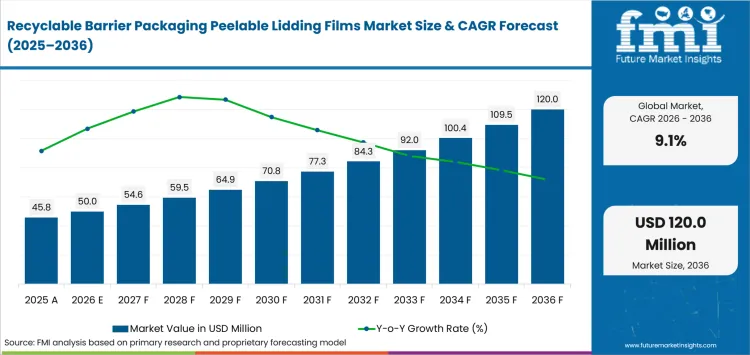
USD 50.0 million in 2026 and USD 120.0 million by 2036 at a 9.1% CAGR.
Sales of recyclable barrier packaging peelable lidding films are estimated to rise at 9.1% CAGR through 2036, increasing valuation from USD 50.0 million in 2026 to USD 120.0 million by 2036. Film manufacturers therefore need mono-material packaging structures that retain barrier performance across clearly defined recovery routes. Plant engineers must also confirm that each barrier film maintains seal strength and peel consistency on the intended equipment.
Tray material and flange geometry determine the temperature and pressure needed for a clean seal during commercial production, so comparable food packaging films must prove both recycling compatibility and stable operation across the selected sealing process. Packaging engineers therefore compare mono-PE laminates through a single evidence package covering material recovery, peel performance and line reliability, especially as the European Union’s Regulation (EU) 2025/40, published in January 2025, applies from 12 August 2026.
Key Takeaways of Recyclable Barrier Packaging Peelable Lidding Films Market
- Recyclability rules are increasing design accountability without reducing the need for stable barrier protection and dependable tray-sealing performance.
- Mono-material PE is projected to represent 34.0% share in 2026 owing to familiar processing routes and clearer polymer-family assessment.
- Pouches are estimated to account for 44.0% share in 2026 due to flexible dimensions and efficient material use across several fill volumes.
- Grease-resistant films are forecast to capture 38.0% share in 2026 driven by stable sealing across oily foods and prepared meals.
- Functional coatings and sealants remain a material restraint as incompatible layers can lower recycling performance within simplified film structures.
- Amcor, Coveris, SÜDPACK, Winpak, TekniPlex, Constantia Flexibles, Klöckner Pentaplast and ProAmpac are focusing on barrier control and application support.
Analyst Perspective
"Commercial success depends on a verified tray-film pair instead of an isolated recyclable lidding claim. Packaging teams that combine seal trials with recovery assessment can avoid late specification reversals."
- Nandini Roy Choudhury, Principal Consultant, Future Market Insights
How is the Recyclable Barrier Packaging Peelable Lidding Films Market segmented?
The recyclable barrier packaging peelable lidding films industry is segmented by material, format, barrier or feature, end use and region.
The recyclable barrier packaging peelable lidding films market is organized around material, format, barrier or feature, end use and region because each category changes product selection and validation. For material, the taxonomy covers paper, molded fiber, recycled PET, mono-material PE and bio-based polymer. Across format, the analysis includes pouches, trays, labels, mailers and inserts. Under barrier or feature, the report recognizes grease resistant, high barrier, tamper evident, traceable and freshness indicating. By end use, the assessment includes Food, pharmaceutical, e-commerce, personal care and cold chain.
Why does mono-material PE lead demand within the material category?
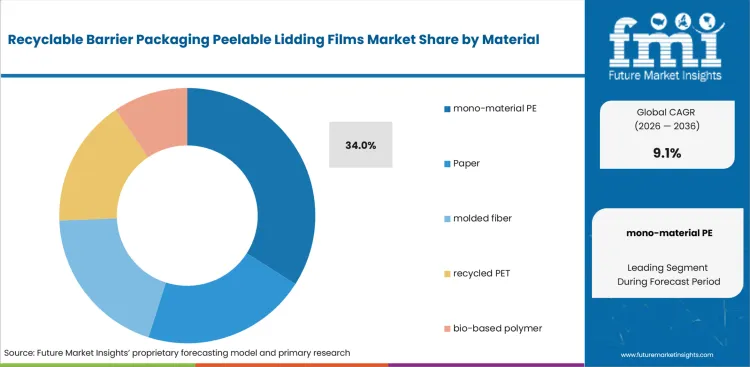
Mono-material PE simplifies material identification across recyclable lidding structures built around established polyethylene recovery routes.
- Mono-material PE is set to lead the material category with 34.0% share in 2026 due to familiar PE processing and lower material-change work during lidding qualification.
- Food processors usually begin with plant trials that measure peel force and line speed under expected product contamination. Repeatable results from MDO-PE films or comparable structures give plant engineers a practical basis for volume commitments across approved production sites, and Coveris’ June 2025 MonoFlexBE disclosure supports this shift by showing high-barrier performance within a recyclable mono-material lidding structure.
Why do pouches lead demand within the format category?
Pouches accommodate changing fill volumes across seasonal products without the fixed geometry of trays or cups. Their role within barrier packaging depends on durable seals and stable printing across existing form-fill-seal equipment.
- Pouches are projected to hold 44.0% share in 2026 owing to flexible dimensions and efficient use of existing form-fill-seal equipment.
- Contract packers can introduce pouches through short runs covering several dimensions and closure options across existing filling equipment.
How are grease-resistant films positioned within the barrier or feature category?
Oil or marinade on a tray flange can reduce seal contact during high-speed food production. Performance varies with product temperature and flange condition across daily fresh food packaging production lines.
- Grease-resistant films are likely to capture 38.0% share in 2026 attributable to stable sealing needs across oily products and contaminated tray flanges.
- Seafood and prepared-meal plants need repeatable sealing on flanges exposed to oil or marinade during normal filling, making grease resistance a production requirement rather than a secondary feature. ProAmpac’s September 2025 listing of its R-2300 recyclable film series among new filling-line packaging launches reinforces this positioning.
What makes food central to the end use category?
Food applications combine product protection and opening behavior inside one high-volume packaging decision for processors. This is why supplier activity is concentrated around complete food-pack systems; for example, Amcor announced in May 2025 that its collaboration with Metsä Group paired high-barrier lidding with molded-fiber pulp packaging for perishable foods.
- By end use, food applications are estimated to hold 63.0% in 2026 owing to high-volume shelf-life protection and controlled opening requirements for chilled products.
- Protein and ready-meal plants prefer qualified food-grade packaging film families that cover several tray depths without repeated material changes.
What are the drivers, restraints and opportunities in the Recyclable Barrier Packaging Peelable Lidding Films Market?
Driver: Recyclability assessment rules are making complete-pack design part of commercial approval. Restraint: Barrier coatings and sealants can lower recycling compatibility within otherwise mono-material films. Opportunity: Joint tray and lidding trials can shorten qualification across machinery and material changes.
- Driver: Recyclability scoring now affects material selection and future producer-fee exposure across household packaging programs.
- Restraint: Functional layers can lower recyclate quality even though the main film uses one polymer family.
- Opportunity: Joint tray and lidding development can identify sealing problems earlier during commercial qualification programs.
Recyclability assessment now influences film selection and future producer-fee exposure throughout national household packaging programs. Design-for-recycling packaging programs therefore need documented results for barrier layers and labels alongside the main film. Retail pack reviews increasingly test material recovery alongside seal reliability across every final tray-film combination.
Barrier layers and sealants can reduce recyclate quality even though the main web uses one polymer family. Converters must verify inks, sealants and barrier layers rather than relying on the base polymer alone. The work must cover actual tray contact, product residue and collection conditions before brand approval at scale.
Joint development of trays and lidding films aligns pack geometry with sealing conditions during one machinery qualification program. Shared trials let machinery teams identify flange and peel constraints before full materials qualification begins. The result can reduce late changes across factory trials, retailer acceptance reviews and final materials approval.
Which country CAGRs are profiled in the Recyclable Barrier Packaging Peelable Lidding Films Market?
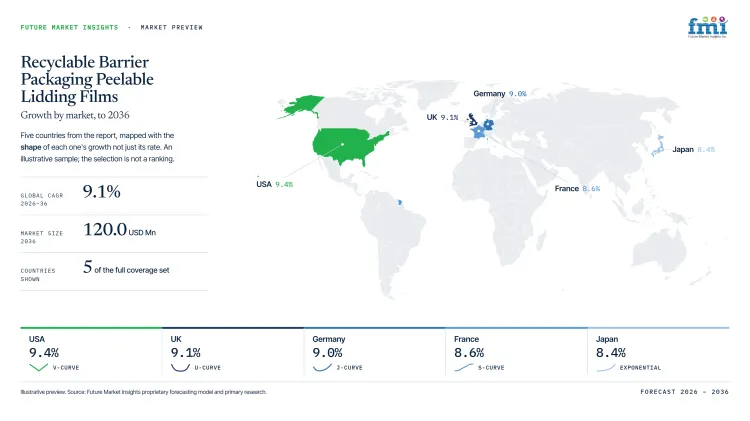
| Country | CAGR |
|---|---|
| United States | 9.4% |
| United Kingdom | 9.1% |
| Germany | 9.0% |
| France | 8.6% |
| Japan | 8.4% |
How do country-level CAGRs compare in the Recyclable Barrier Packaging Peelable Lidding Films Market?
The country comparison spans 1.8 percentage points and forms three practical growth bands across the forecast period.
- The United States remains 0.3 percentage point above the United Kingdom in the comparison.
- The United Kingdom remains 0.1 percentage point above Germany through a separate producer-assessment route.
- Germany remains 0.4 percentage point above France within the concentrated European forecast band for recyclable lidding films.
- France remains 0.2 percentage point above Japan and applies strict environmental claim substantiation across consumer packaging programs.
- Japan closes the displayed range through detailed domestic qualification and material-traceability practices across packaging production networks.
Comparable CAGRs can produce different market entry conditions due to differences in recycling rules and technical support networks. Full report coverage includes North America, Latin America, Europe, East Asia, South Asia and Pacific, Middle East and Africa.
Country-wise Analysis
- California requires recyclability labels to reflect materials that state recovery systems regularly collect and process through established routes, making claim approval a territory-specific requirement for lidding suppliers. CalRecycle confirmed in June 2026 that SB 343 restrictions apply to products and packaging manufactured after October 4, 2026. Recyclable peelable lidding film sales in the United States are forecast to expand at 9.4% CAGR by 2036, aided by large chilled-food operations and accessible packaging laboratories. State recovery differences remain a material friction, so contracts should assign claim approval and technical responsibility by sales territory.
- United Kingdom packaging producers assess household formats through PackUK methodology and report outcomes against the applicable annual version, so recyclable lidding approvals must stay aligned with the reporting year. PackUK reported in July 2026 that RAM 2027 applies to packaging supplied during 2027 and version 1.1 remains required for 2026 reporting. Adoption of recyclable peelable lidding films in the United Kingdom is estimated to expand at 9.1% CAGR through 2036, shaped by annual recyclability scoring and established chilled-food production. Annual methodology changes remain a friction, which means supply agreements should link approved specifications with the applicable reporting period.
- Germany assesses household packaging through a national minimum standard that classifies the major component by its predominant material, giving film developers a defined documentation route ahead of wider PPWR implementation. Zentrale Stelle Verpackungsregister published the 2025 minimum standard in August 2025 with revised category-based guidance for packaging design. Germany's recyclable peelable lidding film market outlook is anticipated to advance at 9.0% CAGR over the assessment period, underpinned by defined national design rules and advanced film-converting capacity.
- France requires environmental claims to remain clear and supported by evidence that consumers can understand across the complete package, increasing the importance of launch files that connect film design with disposal guidance. DGCCRF stated in September 2025 that environmental claims must be verifiable and justified through scientific evidence. The French recyclable peelable lidding films sector is projected to record 8.6% CAGR during the assessment period, influenced by structured retail review and strict claim substantiation. Retailers and food brands can use established printing and sealing support during national launches across chilled-food channels.
- Japanese packaging programs place strong emphasis on material traceability and consistent film quality across regulated product formats, which supports controlled trials across domestic production networks. TOPPAN reported in March 2025 that three Japanese packaging plants gained ISCC PLUS certification covering polypropylene and polyethylene films. Recyclable peelable lidding film demand in Japan is forecast to rise at 8.4% CAGR over the forecast period, linked to dependable domestic film production and detailed qualification practices. Domestic coordination supports controlled trials, yet each production line requires separate validation for sealing speed and peel behavior.
Who are the notable companies in the Recyclable Barrier Packaging Peelable Lidding Films Market?
Amcor, Coveris, SÜDPACK, Winpak, TekniPlex, Constantia Flexibles, Klöckner Pentaplast and ProAmpac are the notable companies shaping this market.
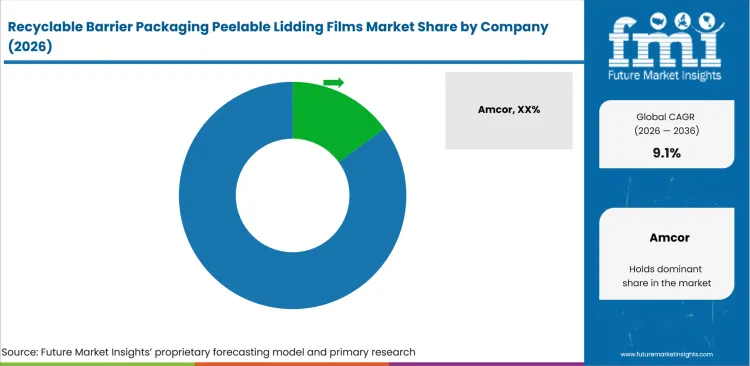
The competitive field is split between integrated film groups and specialists with proven film production and application-testing capacity.
- Amcor, Coveris and SÜDPACK combine recyclable lidding films with tray or bottom-web expertise across chilled-food applications.
- Winpak, TekniPlex and Constantia Flexibles address food or healthcare applications that require controlled peel and documented barrier performance.
- Klöckner Pentaplast and ProAmpac connect lidding films with wider rigid and flexible packaging systems for food applications.
Competitive Benchmarking: Recyclable Barrier Packaging Peelable Lidding Films Market
| Company | Mono-Material Lidding | Barrier and Peel Performance | Food and Healthcare Coverage | Geographic Reach |
|---|---|---|---|---|
| Amcor | High | High | High | Global |
| Coveris | High | High | Medium | Europe |
| SÜDPACK | High | High | High | Global |
| Winpak | Medium | High | High | North America and Europe |
| TekniPlex | High | High | Medium | Global |
| Constantia Flexibles | Medium | High | High | Global |
| Klöckner Pentaplast | Medium | High | Medium | Global |
| ProAmpac | Medium | High | Medium | Global |
Key Developments in the Recyclable Barrier Packaging Peelable Lidding Films Market
- In April 2026, Amcor expanded its collaboration with Metsä Group and G. Mondini around a molded-fiber tray with barrier liner and top web.
- In September 2025, Coveris introduced MonoFlexBP for refrigerated foods through a recyclable mono-material tray and resealable lidding system.
- In October 2025, Constantia Flexibles and watttron developed a coordinated sealing approach for polypropylene and aluminum lids on polypropylene cups.
- In September 2025, Winpak introduced Medform DT as a recycle-ready polyethylene forming film for healthcare packaging.
Recyclable Barrier Packaging Peelable Lidding Films Market - Report Scope
| Coverage field | Report scope |
|---|---|
| Market breakdown | By material, format, barrier or feature, end use and region. |
| Market Definition | The market covers recyclable barrier packaging peelable lidding films market across commercial applications, technologies and regional supply routes. |
| Regions Covered | North America, Latin America, Europe, East Asia, South Asia and Pacific and Middle East and Africa. |
| Countries Covered | India, United States, United Kingdom, Germany, France, Japan |
| Key Companies Profiled | Amcor, Coveris, SÜDPACK, Winpak, TekniPlex, Constantia Flexibles, Klöckner Pentaplast, ProAmpac |
| Forecast Period | 2026–2036. |
| Approach | Primary and secondary research with market triangulation. |
Recyclable Barrier Packaging Peelable Lidding Films Market - Research Methodology
| Method | Approach |
|---|---|
| Primary Research | Analysts examined manufacturer, distributor, end-user and specialist views on buying criteria, approvals, technical support and adoption barriers. |
| Desk Research | The team reviewed official releases, filings, standards, trade sources, technical papers and relevant market disclosures. |
| Market Sizing and Forecasting | Models combined demand drivers, supply capacity, pricing signals, regulations and historical market behavior across assessed regions. |
| Data Validation | Findings were checked through data triangulation and expert review across regional operating conditions. |
Recyclable Barrier Packaging Peelable Lidding Films Market by Segments
Recyclable Barrier Packaging Peelable Lidding Films Market segmented by Material:
- Paper
- Molded fiber
- Recycled PET
- Mono-material PE
- Bio-based polymer
Recyclable Barrier Packaging Peelable Lidding Films Market segmented by Format:
- Pouches
- Trays
- Labels
- Mailers
- Inserts
Recyclable Barrier Packaging Peelable Lidding Films Market segmented by Barrier or Feature:
- Grease resistant
- High barrier
- Tamper evident
- Traceable
- Freshness indicating
Recyclable Barrier Packaging Peelable Lidding Films Market segmented by End Use:
- Food
- Pharmaceutical
- E-commerce
- Personal care
- Cold chain
Recyclable Barrier Packaging Peelable Lidding Films Market by Region:
- North America
- United States
- Canada
- Latin America
- Brazil
- Chile
- Mexico
- Rest of Latin America
- Western Europe
- Germany
- United Kingdom
- Italy
- Spain
- France
- Nordics
- Benelux
- Rest of Western Europe
- Eastern Europe
- Russia
- Poland
- Hungary
- Balkan and Baltic States
- Rest of Eastern Europe
- East Asia
- China
- Japan
- South Korea
- South Asia and Pacific
- India
- ASEAN
- Australia and New Zealand
- Rest of South Asia and Pacific
- Middle East and Africa
- Kingdom of Saudi Arabia
- Other GCC Countries
- Türkiye
- South Africa
- Other African Union Countries
- Rest of Middle East and Africa
Research Sources and Bibliography
- Amcor. (2025, May 12). Amcor and Metsä Group partner to develop molded fiber-based food packaging solutions.
- Amcor. (2026, April 21). Amcor Accelerates All-in-One Fiber Packaging Innovation Through Strategic Collaboration with Metsä Group and G. Mondini.
- Coveris. (2025, September 10). Coveris combines freshness and sustainability with new monomaterial pack for refrigerated goods.
- Constantia Flexibles. (2025, October 8). Constantia Flexibles and watttron collaborate on a streamlined sealing solution for PP and aluminum lids.
- Winpak. (2025, September 10). Introducing Medform™ DT.
- Press Information Bureau. (2026, March 23). PARLIAMENT QUESTION: Circular Economy Framework and Extended Producer Responsibility.
- California Department of Resources Recycling and Recovery. (2026, June 24). Accurate Recycling Labels.
- PackUK. (2026, July 1). PackUK Publishes Recyclability Assessment Methodology (RAM) 2027.
- Zentrale Stelle Verpackungsregister. (2025, August 29). 2025 minimum standard published – initial touchstone for companies preparing for the EU Packaging and Packaging Waste Regulation (PPWR).
- TOPPAN Holdings Inc. (2025, March 28). TOPPAN Acquires ISCC PLUS Certification for Three Packaging Plants.
- European Parliament and Council of the European Union. (2025, January 22). Regulation (EU) 2025/40 of the European Parliament and of the Council of 19 December 2024 on packaging and packaging waste, amending Regulation (EU) 2019/1020 and Directive (EU) 2019/904 and repealing Directive 94/62/EC (Text with EEA relevance).
- Coveris. (2025, June 13). Visit Coveris at the International Cheese & Dairy Awards.
- ProAmpac. (2025, September 22). One Partner, Endless Packaging Possibilities: ProAmpac at PACK EXPO 2025.
This Report Answers
- How large is the recyclable barrier packaging peelable lidding films market in 2026 and 2036?
- Which operating conditions support demand for recyclable barrier packaging peelable lidding films market?
- Which material segment holds the significant share in 2026?
- How does the format mix shape commercial demand?
- Which operating condition shapes recyclable barrier packaging peelable lidding films market adoption?
- How do country growth rates differ for recyclable barrier packaging peelable lidding films market?
- Which companies serve the recyclable barrier packaging peelable lidding films market?
- What currently limits recyclable barrier packaging peelable lidding films market adoption?
- How should teams compare material and format options?
Frequently Asked Questions
How big is the Recyclable Barrier Packaging Peelable Lidding Films Market in 2026?
The recyclable barrier packaging peelable lidding films market is valued at USD 50.0 million in 2026 and is forecast to reach USD 120.0 million by 2036. Growth is supported by recyclability rules that require mono-material packaging structures to retain barrier performance across clearly defined recovery routes.
What is the CAGR of the Recyclable Barrier Packaging Peelable Lidding Films Market from 2026 to 2036?
The recyclable barrier packaging peelable lidding films market grows at a CAGR of 9.1% between 2026 and 2036, supported by recyclability scoring rules that now affect material selection and producer-fee exposure across household packaging programs, pushing brands toward verified mono-material film structures.
Which format leads the Recyclable Barrier Packaging Peelable Lidding Films Market?
Pouches account for 44.0% of the recyclable barrier packaging peelable lidding films market by format in 2026, driven by flexible dimensions and efficient material use across several fill volumes that let contract packers run short batches on existing form-fill-seal equipment.
How much will the Recyclable Barrier Packaging Peelable Lidding Films Market add between 2026 and 2036?
The recyclable barrier packaging peelable lidding films market is set to add USD 70.0 million between 2026 and 2036, growing from USD 50.0 million to USD 120.0 million as recyclability regulations expand demand for verified mono-material barrier films across chilled-food packaging programs worldwide.
Who are the leading companies in the Recyclable Barrier Packaging Peelable Lidding Films Market?
Eight companies lead the recyclable barrier packaging peelable lidding films market, including Amcor, Coveris, SÜDPACK, Winpak, TekniPlex, Constantia Flexibles, Klöckner Pentaplast, and ProAmpac, competing through mono-material lidding, barrier and peel performance, and food and healthcare coverage across global networks.
Preview the report firsthand - request a free sample
Get SampleGet the brochure for pricing and purchase details.
Get PDFTable of Content
- Key Takeaways
- Market Size and CAGR
- Top Growth Driver
- Fastest Growing Segment
- Leading Region
- Key Companies
- Emerging Opportunities
- Executive Summary
- Global Market Outlook
- Demand-side Trends
- Supply-side Trends
- Technology Roadmap Analysis
- Analysis and Recommendations
- Analyst Perspective (What is happening? Why now? What should investors know?)
- Key Questions Answered
- How large is the market?
- What is the CAGR?
- What are key trends?
- Which region dominates?
- Who are the leaders?
- Market Overview
- Market Coverage / Taxonomy
- Market Definition / Scope / Limitations
- Research Methodology
- Chapter Orientation
- Analytical Lens and Working Hypotheses
- Market Structure, Signals, and Trend Drivers
- Benchmarking and Cross-market Comparability
- Market Sizing, Forecasting, and Opportunity Mapping
- Research Design and Evidence Framework
- Desk Research Programme (Secondary Evidence)
- Expert Input and Fieldwork (Primary Evidence)
- Tooling, Models, and Reference Databases
- Data Engineering and Model Build
- Quality Assurance and Audit Trail
- Market Background
- Market Dynamics (Drivers, Restraints, Opportunity, Trends)
- Scenario Forecast (Optimistic, Likely, Conservative)
- Impact Analysis
- AI Impact
- Sustainability Impact
- Regulatory Impact
- Technology Impact
- Consumer / Buyer Analysis
- Purchase Drivers
- Adoption Barriers
- Buyer Journey
- Opportunity Map Analysis
- Product Life Cycle Analysis
- Supply Chain Analysis
- Investment Feasibility Matrix
- Value Chain Analysis
- PESTLE and Porter's Analysis
- Regulatory Landscape
- Regional Parent Market Outlook
- Production and Consumption Statistics
- Import and Export Statistics
- Global Market Analysis and Forecast, 2021 to 2036
- Historical Market Size Value (USD Million) Analysis, 2021 to 2025
- Current and Future Market Size Value (USD Million) Projections, 2026 to 2036
- Y-o-Y Growth Trend Analysis
- Absolute $ Opportunity Analysis
- Global Market Pricing Analysis, 2021 to 2036
- Global Market Analysis and Forecast, By Material, 2021 to 2036
- Introduction / Key Findings
- Historical Market Size Value (USD Million) Analysis By Material, 2021 to 2025
- Current and Future Market Size Value (USD Million) Analysis and Forecast By Material, 2026 to 2036
- mono-material PE
- Paper
- molded fiber
- recycled PET
- bio-based polymer
- mono-material PE
- Y-o-Y Growth Trend Analysis By Material, 2021 to 2025
- Absolute $ Opportunity Analysis By Material, 2026 to 2036
- Global Market Analysis and Forecast, By Format, 2021 to 2036
- Introduction / Key Findings
- Historical Market Size Value (USD Million) Analysis By Format, 2021 to 2025
- Current and Future Market Size Value (USD Million) Analysis and Forecast By Format, 2026 to 2036
- Pouches
- trays
- labels
- mailers
- inserts
- Pouches
- Y-o-Y Growth Trend Analysis By Format, 2021 to 2025
- Absolute $ Opportunity Analysis By Format, 2026 to 2036
- Global Market Analysis and Forecast, By Barrier or Feature, 2021 to 2036
- Introduction / Key Findings
- Historical Market Size Value (USD Million) Analysis By Barrier or Feature, 2021 to 2025
- Current and Future Market Size Value (USD Million) Analysis and Forecast By Barrier or Feature, 2026 to 2036
- Grease resistant
- high barrier
- tamper evident
- traceable
- freshness indicating
- Grease resistant
- Y-o-Y Growth Trend Analysis By Barrier or Feature, 2021 to 2025
- Absolute $ Opportunity Analysis By Barrier or Feature, 2026 to 2036
- Global Market Analysis and Forecast, By End Use, 2021 to 2036
- Introduction / Key Findings
- Historical Market Size Value (USD Million) Analysis By End Use, 2021 to 2025
- Current and Future Market Size Value (USD Million) Analysis and Forecast By End Use, 2026 to 2036
- Food
- pharmaceutical
- e-commerce
- personal care
- cold chain
- Food
- Y-o-Y Growth Trend Analysis By End Use, 2021 to 2025
- Absolute $ Opportunity Analysis By End Use, 2026 to 2036
- Global Market Analysis and Forecast, By Region, 2021 to 2036
- Introduction
- Historical Market Size Value (USD Million) Analysis By Region, 2021 to 2025
- Current Market Size Value (USD Million) Analysis and Forecast By Region, 2026 to 2036
- North America
- Latin America
- Western Europe
- Eastern Europe
- East Asia
- South Asia and Pacific
- Middle East & Africa
- Market Attractiveness Analysis By Region
- North America Market Analysis and Forecast, By Country, 2021 to 2036
- Historical Market Size Value (USD Million) Trend Analysis By Market Taxonomy, 2021 to 2025
- Market Size Value (USD Million) Forecast By Market Taxonomy, 2026 to 2036
- By Country
- USA
- Canada
- By Material
- By Format
- By Barrier or Feature
- By End Use
- By Country
- Market Attractiveness Analysis
- By Country
- By Material
- By Format
- By Barrier or Feature
- By End Use
- Key Takeaways
- Latin America Market Analysis and Forecast, By Country
- Historical Market Size Value (USD Million) Trend Analysis By Market Taxonomy, 2021 to 2025
- Market Size Value (USD Million) Forecast By Market Taxonomy, 2026 to 2036
- By Country
- Brazil
- Mexico
- Chile
- Rest of Latin America
- By Material
- By Format
- By Barrier or Feature
- By End Use
- By Country
- Market Attractiveness Analysis
- By Country
- By Material
- By Format
- By Barrier or Feature
- By End Use
- Key Takeaways
- Western Europe Market Analysis and Forecast, By Country
- Historical Market Size Value (USD Million) Trend Analysis By Market Taxonomy, 2021 to 2025
- Market Size Value (USD Million) Forecast By Market Taxonomy, 2026 to 2036
- By Country
- Germany
- UK
- Italy
- Spain
- France
- Nordic
- BENELUX
- Rest of Western Europe
- By Material
- By Format
- By Barrier or Feature
- By End Use
- By Country
- Market Attractiveness Analysis
- By Country
- By Material
- By Format
- By Barrier or Feature
- By End Use
- Key Takeaways
- Eastern Europe Market Analysis and Forecast, By Country
- Historical Market Size Value (USD Million) Trend Analysis By Market Taxonomy, 2021 to 2025
- Market Size Value (USD Million) Forecast By Market Taxonomy, 2026 to 2036
- By Country
- Russia
- Poland
- Hungary
- Balkan & Baltic
- Rest of Eastern Europe
- By Material
- By Format
- By Barrier or Feature
- By End Use
- By Country
- Market Attractiveness Analysis
- By Country
- By Material
- By Format
- By Barrier or Feature
- By End Use
- Key Takeaways
- East Asia Market Analysis and Forecast, By Country
- Historical Market Size Value (USD Million) Trend Analysis By Market Taxonomy, 2021 to 2025
- Market Size Value (USD Million) Forecast By Market Taxonomy, 2026 to 2036
- By Country
- China
- Japan
- South Korea
- By Material
- By Format
- By Barrier or Feature
- By End Use
- By Country
- Market Attractiveness Analysis
- By Country
- By Material
- By Format
- By Barrier or Feature
- By End Use
- Key Takeaways
- South Asia and Pacific Market Analysis and Forecast, By Country
- Historical Market Size Value (USD Million) Trend Analysis By Market Taxonomy, 2021 to 2025
- Market Size Value (USD Million) Forecast By Market Taxonomy, 2026 to 2036
- By Country
- India
- ASEAN
- Australia & New Zealand
- Rest of South Asia and Pacific
- By Material
- By Format
- By Barrier or Feature
- By End Use
- By Country
- Market Attractiveness Analysis
- By Country
- By Material
- By Format
- By Barrier or Feature
- By End Use
- Key Takeaways
- Middle East & Africa Market Analysis and Forecast, By Country
- Historical Market Size Value (USD Million) Trend Analysis By Market Taxonomy, 2021 to 2025
- Market Size Value (USD Million) Forecast By Market Taxonomy, 2026 to 2036
- By Country
- Kingdom of Saudi Arabia
- Other GCC Countries
- Türkiye
- South Africa
- Other African Union
- Rest of Middle East & Africa
- By Material
- By Format
- By Barrier or Feature
- By End Use
- By Country
- Market Attractiveness Analysis
- By Country
- By Material
- By Format
- By Barrier or Feature
- By End Use
- Key Takeaways
- Key Countries Market Analysis
- USA
- Pricing Analysis
- Market Share Analysis, 2025
- By Material
- By Format
- By Barrier or Feature
- By End Use
- Canada
- Pricing Analysis
- Market Share Analysis, 2025
- By Material
- By Format
- By Barrier or Feature
- By End Use
- Mexico
- Pricing Analysis
- Market Share Analysis, 2025
- By Material
- By Format
- By Barrier or Feature
- By End Use
- Brazil
- Pricing Analysis
- Market Share Analysis, 2025
- By Material
- By Format
- By Barrier or Feature
- By End Use
- Chile
- Pricing Analysis
- Market Share Analysis, 2025
- By Material
- By Format
- By Barrier or Feature
- By End Use
- Germany
- Pricing Analysis
- Market Share Analysis, 2025
- By Material
- By Format
- By Barrier or Feature
- By End Use
- UK
- Pricing Analysis
- Market Share Analysis, 2025
- By Material
- By Format
- By Barrier or Feature
- By End Use
- Italy
- Pricing Analysis
- Market Share Analysis, 2025
- By Material
- By Format
- By Barrier or Feature
- By End Use
- Spain
- Pricing Analysis
- Market Share Analysis, 2025
- By Material
- By Format
- By Barrier or Feature
- By End Use
- France
- Pricing Analysis
- Market Share Analysis, 2025
- By Material
- By Format
- By Barrier or Feature
- By End Use
- India
- Pricing Analysis
- Market Share Analysis, 2025
- By Material
- By Format
- By Barrier or Feature
- By End Use
- ASEAN
- Pricing Analysis
- Market Share Analysis, 2025
- By Material
- By Format
- By Barrier or Feature
- By End Use
- Australia & New Zealand
- Pricing Analysis
- Market Share Analysis, 2025
- By Material
- By Format
- By Barrier or Feature
- By End Use
- China
- Pricing Analysis
- Market Share Analysis, 2025
- By Material
- By Format
- By Barrier or Feature
- By End Use
- Japan
- Pricing Analysis
- Market Share Analysis, 2025
- By Material
- By Format
- By Barrier or Feature
- By End Use
- South Korea
- Pricing Analysis
- Market Share Analysis, 2025
- By Material
- By Format
- By Barrier or Feature
- By End Use
- Russia
- Pricing Analysis
- Market Share Analysis, 2025
- By Material
- By Format
- By Barrier or Feature
- By End Use
- Poland
- Pricing Analysis
- Market Share Analysis, 2025
- By Material
- By Format
- By Barrier or Feature
- By End Use
- Hungary
- Pricing Analysis
- Market Share Analysis, 2025
- By Material
- By Format
- By Barrier or Feature
- By End Use
- Kingdom of Saudi Arabia
- Pricing Analysis
- Market Share Analysis, 2025
- By Material
- By Format
- By Barrier or Feature
- By End Use
- Türkiye
- Pricing Analysis
- Market Share Analysis, 2025
- By Material
- By Format
- By Barrier or Feature
- By End Use
- South Africa
- Pricing Analysis
- Market Share Analysis, 2025
- By Material
- By Format
- By Barrier or Feature
- By End Use
- USA
- Market Structure Analysis
- Competition Dashboard
- Competition Benchmarking
- Market Share Analysis of Top Players
- By Regional
- By Material
- By Format
- By Barrier or Feature
- By End Use
- Emerging Startups
- Innovation Benchmarking
- Competition Analysis
- Competition Deep Dive
- Amcor
- Overview
- Product Portfolio
- Profitability by Market Segments
- Sales Footprint
- Strategy Overview
- Marketing Strategy
- Product Strategy
- Channel Strategy
- Berry Global
- Coveris
- Winpak
- UPM Raflatac
- Avery Dennison
- TekniPlex
- Constantia Flexibles
- Amcor
- Case Studies
- Success Stories
- Recent Developments
- Competition Deep Dive
- Assumptions & Acronyms Used


