

- Market Size (2026)
- USD 196.6 Mn
- Forecast (2036)
- USD 465.4 Mn
- CAGR (2026 to 2036)
- 9.0%
How big is the pie & tart forming machines market in 2026?
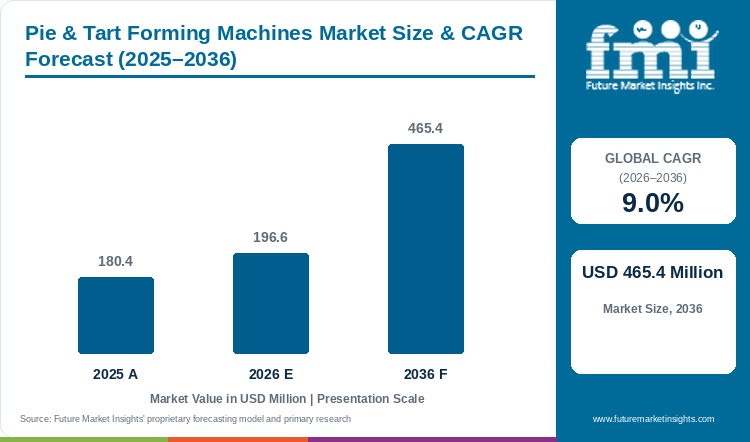
The market was valued at USD 180.4 million in 2025 and is expected to reach USD 196.6 million in 2026. It is projected to reach USD 465.4 million by 2036 at a CAGR of 9.0% from 2026 to 2036.
The global pie & tart forming machines market was valued at USD 180.4 million in 2025 and is expected to reach USD 196.6 million in 2026, then USD 465.4 million by 2036 at a 9.0% CAGR over 2026 to 2036. In 2026, Mid-capacity lines account for 40.0% of Equipment Type, 500-2,000 kg/hr represents 43.0% of Capacity, and Fully automatic / robotic systems lead Automation Level with 43.0%. Purchases depend on consistent shell geometry and weight control as much as headline throughput, particularly where bakeries change recipes or pan formats frequently. Demand arises when industrial bakeries need repeatable pastry thickness and deposit weights while reducing manual placement and rework. Gorreri documents heated pressing and dosing modules for short-pastry shells.[6] Rademaker offers dedicated pressing equipment for pie and quiche production.[7] These examples establish available production architectures rather than validating forecast sales. Procurement consequently centers on line fit and measurable yield gains, not simply machinery replacement.
Key Market Trends & Insights
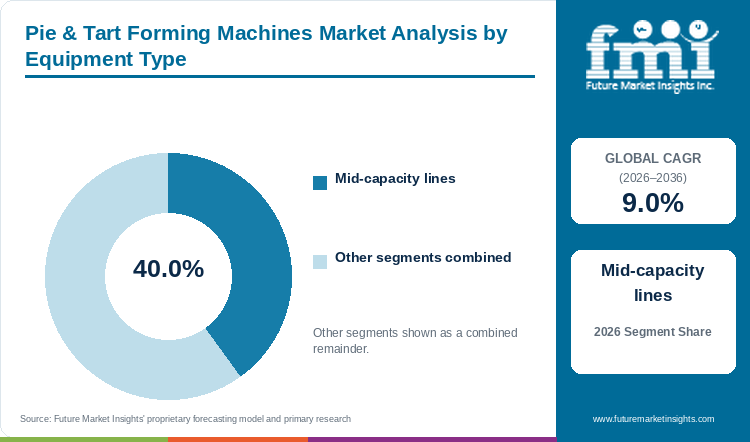
- By Equipment Type: Mid-capacity lines represent 40.0% in 2026. They accommodate multi-SKU bakers without the investment burden of the largest industrial lines.
- By Capacity: 500-2,000 kg/hr accounts for 43.0% in 2026. This range can match regional bakery throughput while preserving recipe flexibility.
- By Automation Level: Fully automatic / robotic systems hold 43.0% in 2026. Integrated pressing and deposition reduce repetitive handling at higher output.
Regional Highlights
- The UAE heads the pie and tart forming machine country outlook at 10.3% CAGR through 2036, with consistent shell geometry important across different pan sizes and pastry recipes.
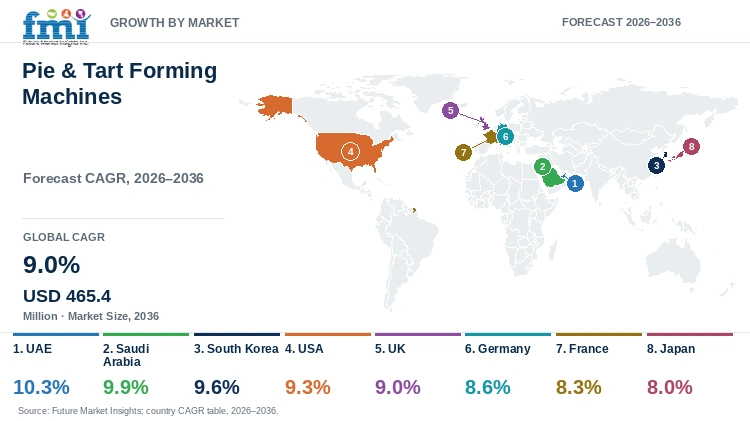
- Saudi Arabia is projected at 9.9% and South Korea at 9.6%; Japan's 8.0% forecast is the lowest of the eight profiled country rates.
Market Size & Forecast
Table 1: Pie & Tart Forming Machines Market Size and Forecast (USD million), 2025 to 2036
| Market size and forecast | Value |
|---|---|
| 2025 Value (actual) | USD 180.4 million |
| Estimated market size in 2026 | USD 196.6 million |
| Projected market size by 2036 | USD 465.4 million |
| CAGR (2026-2036) | 9.0% |
Purchasing conditions vary across bakery networks. Germany’s baker trade association recorded 8,659 craft bakery businesses in 2025 and identified labor and energy-cost pressure in June 2026.[25] Saudi Arabia’s SFDA reported 624 licensed food factories in January 2026, signaling a regulated processing base without identifying pie producers.[1][22] In the UAE, a May 2025 manufacturing initiative announced AED 11.0 billion of proposed industrial projects across sectors.[23] None of these totals measures equipment spending directly. A firm order still requires a production trial that establishes product quality, sanitation performance and acceptable payback.
This market is assessed by Equipment Type, Capacity, Automation Level, End User, Sales Channel and Region for the 2026 to 2036 forecast period. It covers machinery and integrated forming solutions used to prepare pie and tart shells or assembled pastry formats at commercial and industrial scale.
Profiled companies are AMF Bakery Systems, Buhler Group, Baker Perkins, Rademaker, FRITSCH Group, Rheon Automatic Machinery, Mecatherm, Middleby, Reading Bakery Systems, Kaak Group.
Table 2: Supporting Industry Indicators for the Pie & Tart Forming Machines Market
| Indicator | Data point | Why it matters | Source |
|---|---|---|---|
| Pie-and-tart equipment | In November 2024, Middleby acquired Gorreri Food Processing Technology, whose portfolio explicitly includes pies and tarts.[5] | The transaction added documented specialized dosing and shell-forming machinery to a broader food-processing group. It widened supplier configuration options without establishing how much pie-forming revenue or installed capacity changed. | [5] |
| Pastry-line flexibility | In May 2025, FRITSCH Group presented the PROGRESSA pastry line with emphasis on hygienic access and quicker format changes.[10] | The system serves mixed pastry production for retail bakeries. It illustrates a route to efficient dough make-up but is not evidence of a dedicated pie-shell press launch. | [10] |
| Forming capabilities | In May 2025, Rademaker reported the acquisition of Form & Frys as part of a wider extension of its bakery-forming capabilities.[9] | The acquired technology is relevant to pastry handling and shaping. Application-specific trials remain necessary to establish suitability for a particular pie or tart format. | [9] |
Demand Intensity Analysis
Buyer demand centers on standardized shell shaping and filling-ready transfer; vendors must demonstrate reduced trimming waste and predictable changeovers.
Investment is constrained by changeover complexity, food-contact sanitation, service access and proof that new tooling works with existing ovens and pans.
The increase from USD 196.6 million in 2026 to USD 465.4 million in 2036 represents USD 268.8 million in additional market revenue over the forecast period.
Table 3: Demand Intensity Metrics for the Pie & Tart Forming Machines Market, 2026 to 2036
| Demand intensity metric | Value | Basis |
|---|---|---|
| Pie & Tart Forming Machines Market value CAGR | 9.0% | Global market value growth, 2026 to 2036 |
| Mid-capacity lines share in 2026 | 40.0% | Equipment Type classification |
| 500-2,000 kg/hr share in 2026 | 43.0% | Capacity classification |
| Fully automatic / robotic share in 2026 | 43.0% | Automation Level classification |
| Added revenue through 2036 | USD 268.8 million | Increase in market revenue from 2026 to 2036 |
Analyst Perspective
The difference between a promising equipment specification and recognized market demand is the buyer’s validated cost per acceptable pie or tart. Tooling flexibility, hygienic access and local service determine whether projected labor savings survive normal production variability.
- Nandini Roy Choudhury, Principal Consultant, FMI
How is the pie & tart forming machines market segmented?
The market is segmented by Equipment Type, Capacity, Automation Level, End User and Sales Channel.
Equipment Type includes Mid-capacity lines, Compact / entry systems and High-capacity industrial lines. Capacity comprises 500-2,000 kg/hr, Below 500 kg/hr and Above 2,000 kg/hr. Automation Level covers Fully automatic / robotic, Semi-automatic and Manual. End User distinguishes Industrial bakeries, In-store & retail bakeries, Artisan bakeries and Foodservice / QSR central kitchens. Sales Channel comprises Direct OEM sales, Dealers & distributors and Aftermarket & refurbished.
Why do Mid-capacity lines lead Equipment Type?
Regional suppliers of chilled and frozen pastries often need repeated short runs rather than one dedicated output format. Mid-capacity lines balance deposit control with practical recipe changes and factory footprints. Modular components allow shell pressing and dough make-up to be scaled without immediately specifying the longest conveyor system. Larger factories favor high-capacity industrial lines for stable volumes, while compact installations better suit store-linked production. Equipment selection therefore depends on the mix of pan sizes and products as well as annual units.
- Mid-capacity lines lead Equipment Type with 40.0% in 2026 because their operating range fits bakeries managing several pastry formats.
- In May 2025, FRITSCH presented PROGRESSA pastry with cleaning and quick-change features for retail bakers; this illustrates the value of adaptable medium-scale pastry machinery, not the segment-share calculation.[10]
How does 500-2,000 kg/hr retain the largest Capacity position?
Kilograms per hour capture mass throughput rather than pies per minute. This distinction matters when pastry weight changes across a mini tart and a filled family pie. The 500-2,000 kg/hr band provides a workable balance between line utilization and batch variety for manufacturers serving several channels. Buyers must confirm whether an OEM specification measures dough only or the assembled product. A capacity claim becomes commercially meaningful after testing yield at the required dough thickness and actual filling viscosity.
- 500-2,000 kg/hr leads Capacity with 43.0% in 2026, reflecting the appeal of controlled throughput between small bakery equipment and very large lines.
- Rademaker’s published pastry make-up configurations include differing throughput envelopes and application-specific equipment; these technical offers illustrate capacity matching rather than proving the stated share.
What supports Fully automatic / robotic systems within Automation Level?
Pressing dough into trays and transferring shells to depositors require repeatability when production runs for multiple shifts. Automated indexing can synchronize die movement and filling deposition. It also helps maintain product geometry when skilled operators are scarce. The commercial test remains whether operators can clean assemblies and restore machine settings quickly after a format change. Semi-automatic and manual formats retain value when pastry design varies heavily or capital budgets cannot support integrated control systems.
- Fully automatic / robotic systems hold 43.0% of Automation Level in 2026, with geometry consistency and labor substitution supporting purchase consideration.
- Middleby’s November 2024 acquisition of Gorreri added access to documented automatic and semi-automatic pie and tart lines. The transaction indicates equipment availability, not market-wide automation penetration.
Why do Industrial bakeries anchor End User demand?
Industrial bakeries can spread dedicated pressing tools and upstream dough conditioning over longer production schedules. Retail stores may need simpler lines because daily staff deployment and available floor area vary. Artisan makers place more weight on product variation and hand-finished appearance. Foodservice / QSR central kitchens may prioritize freezer-ready products and standardized portioning. Each model creates a different approval process; industrial buyers typically require formal acceptance testing before integrating shell-forming machinery into an existing production line.
- Industrial bakeries lead End User with 40.0% in 2026 because repeated large batches support investment in specialized shell tooling.
- In April 2026, Mecatherm described prepared-food applications including pies and tarts as a line-engineering consideration. This demonstrates industrial use cases without quantifying the end-user split.
Why is Direct OEM sales the primary Sales Channel?
A shell-forming purchase frequently involves custom dies and pans as well as conveyor timing and factory layout. These requirements favor direct manufacturer engineering discussions. Distributors remain valuable for localized demonstrations and small equipment procurement. Refurbished systems and aftermarket units serve buyers with tight budgets but can carry legacy controls or unavailable tooling. A direct sale does not remove the need for local parts delivery and commissioning. Service agreements should be evaluated against expected downtime exposure rather than negotiated machine price alone.
- Direct OEM sales account for 59.0% of Sales Channel in 2026 because tooling specifications and commissioning depend on close supplier–bakery coordination.
- Reading Bakery Systems announced an EMEA customer-care and sales support expansion in April 2026. Although its publicly documented pie relevance is primarily upstream mixing, the action illustrates how direct technical coverage can support equipment lifecycle decisions.
What are the drivers, restraints and opportunities in the pie & tart forming machines market?
Demand for uniform pastry products favors repeatable forming and dosing, while integration and sanitation raise qualification costs and modular lines open access to diversified bakery production.
- Driver: Bakery operators seeking consistent crust weight and finished appearance favor automated pressing and controlled deposition.
- Restraint: Capital approval and plant integration are delayed by sanitation validation, tooling expense and uncertain throughput under mixed recipes.
- Opportunity: Reconfigurable shell tooling and service-backed installations can reach regional producers that cannot justify single-product high-capacity lines.
Driver. Commercial pie production depends on repeatable wall thickness and clean release from tins or paper cups. A 2024 Middleby announcement specifically identified Gorreri equipment for pies and tarts. Gorreri also documents pneumatic pressing heads and interchangeable deposition systems. The practical demand mechanism is lower dough giveaway and fewer malformed shells during longer runs. Equipment purchases should therefore be triggered by line-level rejects and staffing costs measured over several shifts. Broader bakery output alone is not proof that all producers will replace existing machines.
Restraint. Food-contact equipment must be designed and operated for effective cleaning. The FDA describes current good manufacturing practices for food processing, while EU Regulation (EC) No 852/2004 specifies hygiene obligations.[1][2] A pressing line adds tooling cavities and conveyor interfaces that operators must sanitize between products or allergen profiles. Installation can also require upstream dough-temperature control and a compatible baking tunnel. These tests extend commissioning and may make the lifetime cost of an automated unit less attractive for bakeries running infrequent products. A failed trial delays procurement rather than eliminating underlying product demand.
Opportunity. Smaller industrial sites can gain from platforms that support multiple pastry shapes using changeable dies and recipe-controlled settings. FRITSCH’s May 2025 PROGRESSA pastry presentation emphasized access for cleaning and fast format changes. Rheon’s HM Pastry Line describes optional make-up attachments and pie production among several bakery applications. These examples suggest a route to more productive mixed-format operations, although neither establishes a new market-wide installed base. Vendors must combine credible product trials with replacement-part coverage and operator training before adaptable equipment becomes a repeatable sales proposition.
Which country CAGRs are profiled in the pie & tart forming machines market?
The following country growth rates cover 2026 to 2036. They refer to forecast percentage changes in the defined equipment market, not to the countries’ starting market values.
Table 4: Country growth outlook for the Pie & Tart Forming Machines Market
| Country | CAGR |
|---|---|
| UAE | 10.3% |
| Saudi Arabia | 9.9% |
| South Korea | 9.6% |
| USA | 9.3% |
| UK | 9.0% |
| Germany | 8.6% |
| France | 8.3% |
| Japan | 8.0% |
How do country-level CAGRs compare in the pie & tart forming machines market?
The eight profiled CAGRs range from 8.0% for Japan to 10.3% for the UAE, a spread of 2.3 percentage points. UAE and Saudi Arabia form the highest-growth group. South Korea and USA follow, while UK is in line with the global forecast pace. Germany, France and Japan show lower percentage growth within this selected comparison. Faster growth should not be interpreted as a larger installed equipment market.
- UAE: Industrial-development programs improve the environment for factory capital projects, subject to actual bakery-line investment.
- Saudi Arabia: The licensed food-processing base supports supplier prospecting but does not identify pie-equipment orders.
- South Korea: Dense bakery franchise networks can support standardized formats through central production, where adopted.
- USA: Large-batch frozen and chilled baked goods favor repeatable forming, provided sanitation and service requirements are met.
- UK: Domestic bakery manufacturing provides a substantial operating context, with recipe range influencing line flexibility.
- Germany: Rising costs and craft-bakery consolidation increase scrutiny of utilization and payback.
- France: The distinction between wholesale industrial pastry and direct retail baking shapes equipment procurement.
- Japan: Established food-machinery engineering and precise recipe specifications can favor incremental line upgrades.
These eight country profiles are selected rate comparisons and do not exhaust the global regional coverage listed later in the report. No ranking of national market values follows from the growth-rate order.
Country-wise Analysis
UAE
A 10.3% CAGR from 2026 to 2036 places the UAE first among the profiled country growth rates. In May 2025, the Ministry of Industry and Advanced Technology reported more than AED 11.0 billion in newly announced projects across a range of industries. Food and beverage activity was included in the broader initiative, but no pie-forming order can be inferred. For bakery investors, factory location and imported machinery support are central to equipment choices. Suppliers with experience commissioning multi-format pastry lines may find demand where regional production is substituted for imported finished goods. Approval still depends on landed cost, spare-parts access and demonstrated output at local plant conditions.
Saudi Arabia
The country’s projected 9.9% CAGR for 2026 to 2036 reflects an expanding procurement opportunity within a regulated food-processing environment. The Saudi Food and Drug Authority reported 624 licensed food factories and 5,344 food warehouses in January 2026. Those totals cover food processing and storage broadly, not pie or tart specialists. Industrial buyers considering pastry lines must account for formal food-safety practices and delivery capacity across a geographically dispersed retail system. OEMs can improve purchasing confidence through process trials and documented commissioning support. The degree to which central bakeries internalize frozen or chilled pastry production will determine conversion from broad factory investment to category-specific equipment sales.
South Korea
South Korea is profiled at a 9.6% CAGR from 2026 to 2036. A December 2025 national statistics release counted 9,476 franchised bakery outlets in 2024, illustrating the scale of one potential distribution channel. Franchise store counts are not machinery installations. Central kitchens serving repeatable pastry lines may prioritize automated portioning and shell consistency when recipes are standardized. Conversely, frequent seasonal bakery launches can require shorter changeover times and versatile make-up equipment. Buyers must balance a tightly specified product appearance against cost per unit and labor coverage. Suppliers that can document tooling for small formats and dependable local technical response may be better qualified for procurement tenders.
USA
At 9.3% CAGR over 2026 to 2036, the USA sits above the overall market growth rate. Manufacturers of frozen and refrigerated pies have incentives to standardize dough shells across large production batches, although factory outputs cannot be derived from the forecast CAGR. AMF’s sweet and savory pie systems and Middleby’s Gorreri portfolio illustrate equipment architectures available to buyers serving these channels. U.S. food manufacturers also operate under FDA current good manufacturing practice expectations.[1] A bakery evaluating automated press tooling must demonstrate hygienic access and machine availability across longer shifts. The strongest purchase cases will connect labor deployment and measurable scrap reduction to the full installed cost.
UK
The UK’s 9.0% CAGR from 2026 to 2036 matches the overall forecast. Office for National Statistics turnover series for manufacture of bakery and farinaceous products show a continuing domestic manufacturing base; the category is much wider than pies and tarts. Producers serving supermarkets or foodservice contracts can benefit from stable pastry thickness and predictable sealing of filled products. Baker Perkins supplies general bakery systems, although publicly reviewed materials do not establish a dedicated pie-and-tart forming line under that brand. This distinction matters during vendor shortlisting. Procurement teams should seek samples from relevant production recipes and clarify responsibility for shell forming versus upstream mixing or downstream baking.
Germany
German demand is projected to increase at 8.6% CAGR from 2026 to 2036. In June 2026, the national bakers’ association reported 8,659 craft bakery businesses for 2025 and highlighted cost pressure from energy and staffing. Many of those firms are not plausible industrial forming-line customers. Equipment demand is more likely to arise where regional or factory bakeries consolidate higher-volume pastry production. FRITSCH’s configurable pastry solutions demonstrate an approach suited to product variation, although pie-specific tooling must be verified for each application. Buyers will scrutinize cleaning time, local maintenance and replacement-part terms. A machine that increases theoretical output without simplifying operations may struggle to clear capital approval.
France
France carries an 8.3% CAGR for the 2026 to 2036 period. INSEE’s September 2026 manufacturing classification explicitly includes fresh tarts within industrial bakery and pastry production for professional customers. It distinguishes that activity from retail sales to consumers. The distinction is useful when separating industrial forming-line purchases from artisan equipment demand. Mecatherm documents line-engineering capabilities in pastry and prepared foods, including pie-and-tart applications, but project specifications determine the relevant machinery content. Industrial buyers typically need product changeovers without excessive cleaning or downtime. Manufacturers seeking to address French bakeries must demonstrate compatibility with product dimensions and traceable food-contact controls rather than relying on broad bakery-system descriptions.
Japan
Japan’s 8.0% CAGR from 2026 to 2036 is the lowest among the listed forecasts but still indicates growth in the defined equipment category. The Japan Food Machinery Manufacturers Association maintains sector statistics that describe a domestic machinery ecosystem, not pie-and-tart sales in isolation. Rheon’s Japan-linked HM Pastry Line documents production of pies and other baked goods through configurable sheeting and make-up stages. This approach can suit factories balancing presentation standards with diverse pastry recipes. Large buyers must still validate dough handling, dimensional tolerances and service availability. The country’s comparatively lower rate should not be read as proof of weak absolute bakery production or limited technical sophistication.
Who are the notable companies in the pie & tart forming machines market?
AMF Bakery Systems, Buhler Group, Baker Perkins, Rademaker, FRITSCH Group, Rheon Automatic Machinery, Mecatherm, Middleby, Reading Bakery Systems, Kaak Group are the notable companies profiled in this market.
Companies compete through different points in the pie-and-tart production workflow. AMF Bakery Systems documents complete pie-system design. Rademaker supplies pressing and pastry make-up lines, while Middleby participates through Gorreri’s dedicated pie and tart equipment. Rheon Automatic Machinery offers versatile pastry forming machinery. Mecatherm supports industrial pastry and prepared-food line engineering. FRITSCH Group concentrates on configurable sheeting and pastry make-up, with pie-specific integration dependent on project scope. Baker Perkins and Kaak Group document broader dough-processing capabilities whose direct pie-shell applicability requires qualification. Buhler Group is better evidenced for biscuit processing and baking systems than dedicated pie forming. Reading Bakery Systems documents crust-relevant mixing and adjacent forming systems. These differences limit the usefulness of treating every company as a directly substitutable equipment vendor.
- Pie/tart-specific and multi-application forming lines: AMF Bakery Systems, Rademaker, Rheon Automatic Machinery, Mecatherm and Middleby. Published products or project material document relevant pastry-forming tasks.
- Adaptable pastry and dough-processing systems: FRITSCH Group, Baker Perkins and Kaak Group. FRITSCH’s pastry applicability is documented; direct pie/tart forming scope is less clear for the other two.
- Adjacent process and line integration: Buhler Group and Reading Bakery Systems. The reviewed public evidence is strongest for baking or mixing systems rather than direct pie-shell forming.
Competitive Benchmarking: Pie & Tart Forming Machines Market
Ratings describe documented capability against the defined production workflow. An Unscored result indicates that the reviewed public information does not establish the requested application.
Table 5: Company capabilities for the Pie & Tart Forming Machines Market
| Company | Pie/Tart Forming | Pastry/Dough Flexibility | Line Integration | Geographic Reach |
|---|---|---|---|---|
| AMF Bakery Systems | High | Medium | High | United States; European equipment operations and international supply |
| Buhler Group | Unscored | Unscored | Medium | Europe and Asia through industrial bakery and biscuit systems |
| Baker Perkins | Unscored | Medium | Medium | United Kingdom and United States bakery-system activities |
| Rademaker | High | High | High | Europe, North America and Asia through bakery lines |
| FRITSCH Group | Unscored | High | Medium | Germany and international pastry equipment customers |
| Rheon Automatic Machinery | Medium | High | Medium | Japan, Asia-Pacific, North America and Europe |
| Mecatherm | Medium | High | High | France with international industrial-bakery projects |
| Middleby | High | High | High | United States and Europe through Middleby and Gorreri |
| Reading Bakery Systems | Unscored | Medium | Medium | United States; European and international technical support |
| Kaak Group | Unscored | Medium | Medium | Netherlands and other industrial-bakery markets |
Scoring basis: Pie/Tart Forming measures documented pressing or other shell-forming suitability; High requires a directly specified product line, while Medium indicates verified multiproduct pie applicability. Pastry/Dough Flexibility evaluates evidenced sheeting, tooling or changeover breadth. Line Integration reflects supported upstream or downstream interfaces and service capability, with High reserved for substantial documented line-level coverage. Medium denotes narrower or less direct application support. Low denotes a documented limitation; unavailable public information is left Unscored.
Key Developments in the Pie & Tart Forming Machines Market
In November 2024, Middleby acquired Gorreri Food Processing Technology, whose portfolio explicitly includes pies and tarts.[5] The transaction added documented specialized dosing and shell-forming machinery to a broader food-processing group. It widened supplier configuration options without establishing how much pie-forming revenue or installed capacity changed.
In May 2025, FRITSCH Group presented the PROGRESSA pastry line with emphasis on hygienic access and quicker format changes.[10] The system serves mixed pastry production for retail bakeries. It illustrates a route to efficient dough make-up but is not evidence of a dedicated pie-shell press launch.
In May 2025, Rademaker reported the acquisition of Form & Frys as part of a wider extension of its bakery-forming capabilities.[9] The acquired technology is relevant to pastry handling and shaping. Application-specific trials remain necessary to establish suitability for a particular pie or tart format.
Key Players in the Pie & Tart Forming Machines Market
Pie/tart-specific and multi-application forming lines
- AMF Bakery Systems
- Rademaker
- Rheon Automatic Machinery
- Mecatherm
- Middleby
Adaptable pastry and dough-processing systems
- FRITSCH Group
- Baker Perkins
- Kaak Group
Adjacent process and line integration
- Buhler Group
- Reading Bakery Systems
Pie & Tart Forming Machines Market - Report Scope
Table 6: Report scope for the Pie & Tart Forming Machines Market
| Coverage field | Report scope |
|---|---|
| Market breakdown | Equipment Type; Capacity; Automation Level; End User; Sales Channel |
| Quantitative Units | USD million |
| Market Definition | Includes revenue from new pie and tart forming machines, qualifying refurbished forming machines sold through the aftermarket channel, and attributable forming modules within integrated pastry lines. Excludes finished pies or tarts, stand-alone upstream mixers or downstream ovens, general-purpose bakery machines without qualifying pie or tart forming use, and repair-only services or parts sold separately. Bundled system sales are counted only for the directly qualifying forming-equipment value to avoid double counting. |
| Regions Covered | North America; Latin America; Western Europe; Eastern Europe; East Asia; South Asia and Pacific; Middle East and Africa |
| Countries Covered | USA, Germany, France, UK, Saudi Arabia, UAE, Japan, South Korea |
| Key Companies Profiled | AMF Bakery Systems, Buhler Group, Baker Perkins, Rademaker, FRITSCH Group, Rheon Automatic Machinery, Mecatherm, Middleby, Reading Bakery Systems, Kaak Group |
| Forecast Period | 2026 to 2036 |
| Approach | Primary and secondary research with market triangulation. |
Pie & Tart Forming Machines Market - Research Methodology
Table 7: Research approach for the Pie & Tart Forming Machines Market
| Method | Approach |
|---|---|
| Primary Research | FMI analysts gathered input from manufacturers, service providers, technology developers, distributors, end users, procurement teams and subject-matter experts. Interviews examined purchasing decisions, product or service evaluation, adoption barriers, approval requirements, pricing considerations and expectations for technical or commercial support. Respondents were also asked what evidence is required before a trial, pilot, or initial order develops into regular purchasing. |
| Desk Research | Desk research covered government statistics, regulatory publications, trade data, industry associations, technical literature, standards, company filings, product information and official corporate announcements. Sources were reviewed for relevance, publication date, geographic coverage and consistency with the defined market scope. Claims relating to performance, applications, approvals, capacity, investment and commercial activity were retained only when supported by credible public evidence. |
| Market Sizing and Forecasting | The market model combined the baseline value with historical performance, segment structure, pricing and volume indicators, adoption levels, company participation and country-level demand conditions. Forecast assumptions considered economic activity, investment trends, regulatory developments, technology adoption, purchasing cycles, supply availability and barriers to wider market use. Segment and regional estimates were reconciled before the final market total was calculated. |
| Data Validation | Estimates were checked against multiple independent indicators, including public data, company activity, trade patterns, industry developments and findings from primary interviews. Validation also tested whether products, services, applications and company revenues fell within the defined market boundaries. Adjacent categories, unsupported claims, overlapping revenues and activities without direct market relevance were excluded to reduce double counting and maintain consistency across segments and countries. |
Pie & Tart Forming Machines Market by Segments
Equipment Type
- Mid-capacity lines
- Compact / entry systems
- High-capacity industrial lines
Capacity
- 500-2,000 kg/hr
- Below 500 kg/hr
- Above 2,000 kg/hr
Automation Level
- Fully automatic / robotic
- Semi-automatic
- Manual
End User
- Industrial bakeries
- In-store & retail bakeries
- Artisan bakeries
- Foodservice / QSR central kitchens
Sales Channel
- Direct OEM sales
- Dealers & distributors
- Aftermarket & refurbished
Pie & Tart Forming Machines Market by Region
- North America
- United States
- Canada
- Latin America
- Brazil
- Mexico
- Argentina
- Chile
- Western Europe
- Germany
- France
- United Kingdom
- Italy
- Spain
- Benelux
- Nordics
- Eastern Europe
- Poland
- Czech Republic
- Romania
- Hungary
- East Asia
- China
- Japan
- South Korea
- South Asia and Pacific
- India
- ASEAN
- Australia and New Zealand
- Middle East and Africa
- GCC Countries
- South Africa
- Türkiye
- Israel
Research Sources and Bibliography
- [1] U.S. Food and Drug Administration (n.d.). Current Good Manufacturing Practices (CGMPs) for Food and Dietary Supplements.
- [2] European Parliament and Council (2004, April 29). Regulation (EC) No 852/2004 on the Hygiene of Foodstuffs.
- [3] AMF Bakery Systems (n.d.). Sweet & Savory Pie System.
- [4] AMF Bakery Systems (2019, February 4). AMF and Tromp Group Integrate to Unify Global Strategy.
- [5] Middleby (2024, November 26). Middleby Acquires Gorreri Food Processing Technology.
- [6] Gorreri (n.d.). Pie, Tart & Cheesecake Lines.
- [7] Rademaker (n.d.). Pressing Line.
- [8] Rademaker (n.d.). Pastry Make-Up Line.
- [9] iba (2025, May 16). Rademaker Expands Innovation Expertise Through Strategic Acquisitions and Partnerships.
- [10] FRITSCH Group (2025, May 13). PROGRESSA Pastry: The New Pastry Line for Retail Bakers.
- [11] FRITSCH Group (n.d.). PROGRESSA: Pastry Line Systems.
- [12] Rheon Automatic Machinery (n.d.). HM Pastry Line.
- [13] Mecatherm (2025, May 18). MECATHERM Facilitates Production Line Operations with MyMecatherm Digital Platform.
- [14] Mecatherm (2026, April 10). Industrial Performance and Sustainability: Key Challenges for Prepared Foods and Snacking Products.
- [15] Baker Perkins (n.d.). General Bakery Equipment.
- [16] Buhler Group (2024, May 22). Future-ready Setup for Bühler’s Biscuit Business and Nordic Organization.
- [17] Reading Bakery Systems (n.d.). Industrial Mixer.
- [18] Reading Bakery Systems (2026, April 9). Reading Bakery Systems Expands Customer Care and Sales Leadership in EMEA.
- [19] Reading Bakery Systems (2025, August 1). RBS Expands Customer Care Team to Strengthen Global Support.
- [20] Kaak Group (n.d.). Equipment: Industrial Bakery Processing.
- [21] Kaak Group (2026, June 8). Royal Kaak Introduces New Innovations for DrieM Sheeting Lines.
- [22] Saudi Food and Drug Authority (2026, January 26). SFDA Reports 18% Growth in Licensed Factories and Warehouses During 2025.
- [23] UAE Ministry of Industry and Advanced Technology (2025, May 22). Make it in the Emirates Concludes with New Industrial Projects Valued Over AED 11 Billion.
- [24] Ministry of Data and Statistics, Republic of Korea (2025, December 23). Preliminary Results of the 2024 Franchise Survey.
- [25] Zentralverband des Deutschen Bäckerhandwerks (2026, June 9). Bäckerhandwerk zeigt Stabilität, doch Betriebe zunehmend unter Druck.
- [26] Institut national de la statistique et des études économiques (INSEE) (2026, September 4). NAF 2025, Sous-classe 10.71G: Fabrication industrielle de pain et de pâtisserie fraîche.
- [27] Office for National Statistics (n.d.). UKProdTO: Manufacture of Bakery and Farinaceous Products, Home Turnover.
- [28] Japan Food Machinery Manufacturers Association (n.d.). Food Machinery Statistics.
This Report Answers
- How large is the global pie & tart forming machines market in 2026, and what value is forecast for 2036?
- Which operating pressures encourage bakeries to invest in repeatable pie-shell and tart-forming processes?
- Why do Mid-capacity lines hold the largest Equipment Type position?
- What supports the 500-2,000 kg/hr Capacity segment?
- How do the profiled country growth rates differ between 2026 and 2036?
- Which profiled companies provide dedicated forming equipment or relevant bakery-process systems?
- Which integration and sanitation requirements can delay equipment procurement?
- What should buyers test before investing in a pie or tart forming installation?
Frequently Asked Questions
How big is the pie & tart forming machines market in 2026, and what is forecast for 2036?
The market is projected at USD 196.6 million in 2026 and USD 465.4 million by 2036. The figures refer to the defined equipment-revenue boundary rather than sales of finished bakery products.
What is the pie & tart forming machines market CAGR from 2026 to 2036?
The projected CAGR is 9.0% from 2026 to 2036. Actual machine orders depend on how quickly bakeries qualify automated or reconfigurable shell-forming production.
Which Equipment Type segment leads the pie & tart forming machines market?
Mid-capacity lines lead Equipment Type with 40.0% in 2026. Their attraction lies in balancing production scale with manageable format and recipe changes.
Which Capacity segment has the largest share of the market?
500-2,000 kg/hr leads Capacity with 43.0% in 2026. Buyers still need to test whether a quoted throughput refers to pastry dough mass or complete filled output.
Which profiled countries have the highest growth rates?
The UAE is highest at 10.3% CAGR, followed by Saudi Arabia at 9.9% and South Korea at 9.6% for 2026 to 2036. These are growth rates and do not rank the countries by equipment market size.
Which companies participate in the pie & tart forming machines market?
The profiled companies are AMF Bakery Systems, Buhler Group, Baker Perkins, Rademaker, FRITSCH Group, Rheon Automatic Machinery, Mecatherm, Middleby, Reading Bakery Systems, Kaak Group. Published product evidence supports different roles, ranging from dedicated pie presses to adjacent mixing and baking systems.
Preview the report firsthand - request a free sample
Get SampleGet the brochure for pricing and purchase details.
Get PDFTable of Content
- Key Takeaways
- Market Size and CAGR
- Top Growth Driver
- Fastest Growing Segment
- Leading Region
- Key Companies
- Emerging Opportunities
- Executive Summary
- Global Market Outlook
- Demand-side Trends
- Supply-side Trends
- Technology Roadmap Analysis
- Analysis and Recommendations
- Analyst Perspective (What is happening? Why now? What should investors know?)
- Key Questions Answered
- How large is the market?
- What is the CAGR?
- What are key trends?
- Which region dominates?
- Who are the leaders?
- Market Overview
- Market Coverage / Taxonomy
- Market Definition / Scope / Limitations
- Research Methodology
- Chapter Orientation
- Analytical Lens and Working Hypotheses
- Market Structure, Signals, and Trend Drivers
- Benchmarking and Cross-market Comparability
- Market Sizing, Forecasting, and Opportunity Mapping
- Research Design and Evidence Framework
- Desk Research Programme (Secondary Evidence)
- Expert Input and Fieldwork (Primary Evidence)
- Tooling, Models, and Reference Databases
- Data Engineering and Model Build
- Quality Assurance and Audit Trail
- Market Background
- Market Dynamics (Drivers, Restraints, Opportunity, Trends)
- Scenario Forecast (Optimistic, Likely, Conservative)
- Impact Analysis
- AI Impact
- Sustainability Impact
- Regulatory Impact
- Technology Impact
- Consumer / Buyer Analysis
- Purchase Drivers
- Adoption Barriers
- Buyer Journey
- Opportunity Map Analysis
- Product Life Cycle Analysis
- Supply Chain Analysis
- Investment Feasibility Matrix
- Value Chain Analysis
- PESTLE and Porter's Analysis
- Regulatory Landscape
- Regional Parent Market Outlook
- Production and Consumption Statistics
- Import and Export Statistics
- Global Market Analysis and Forecast, 2021 to 2036
- Historical Market Size Value (USD Million) Analysis, 2021 to 2025
- Current and Future Market Size Value (USD Million) Projections, 2026 to 2036
- Y-o-Y Growth Trend Analysis
- Absolute $ Opportunity Analysis
- Global Market Pricing Analysis, 2021 to 2036
- Global Market Analysis and Forecast, By Equipment Type, 2021 to 2036
- Introduction / Key Findings
- Historical Market Size Value (USD Million) Analysis By Equipment Type, 2021 to 2025
- Current and Future Market Size Value (USD Million) Analysis and Forecast By Equipment Type, 2026 to 2036
- Mid-capacity lines
- Compact / entry systems
- High-capacity industrial lines
- Y-o-Y Growth Trend Analysis By Equipment Type, 2021 to 2025
- Absolute $ Opportunity Analysis By Equipment Type, 2026 to 2036
- Global Market Analysis and Forecast, By Capacity, 2021 to 2036
- Introduction / Key Findings
- Historical Market Size Value (USD Million) Analysis By Capacity, 2021 to 2025
- Current and Future Market Size Value (USD Million) Analysis and Forecast By Capacity, 2026 to 2036
- 500-2,000 kg/hr
- Below 500 kg/hr
- Above 2,000 kg/hr
- Y-o-Y Growth Trend Analysis By Capacity, 2021 to 2025
- Absolute $ Opportunity Analysis By Capacity, 2026 to 2036
- Global Market Analysis and Forecast, By Automation Level, 2021 to 2036
- Introduction / Key Findings
- Historical Market Size Value (USD Million) Analysis By Automation Level, 2021 to 2025
- Current and Future Market Size Value (USD Million) Analysis and Forecast By Automation Level, 2026 to 2036
- Fully automatic / robotic
- Semi-automatic
- Manual
- Y-o-Y Growth Trend Analysis By Automation Level, 2021 to 2025
- Absolute $ Opportunity Analysis By Automation Level, 2026 to 2036
- Global Market Analysis and Forecast, By End User, 2021 to 2036
- Introduction / Key Findings
- Historical Market Size Value (USD Million) Analysis By End User, 2021 to 2025
- Current and Future Market Size Value (USD Million) Analysis and Forecast By End User, 2026 to 2036
- Industrial bakeries
- In-store & retail bakeries
- Artisan bakeries
- Foodservice / QSR central kitchens
- Y-o-Y Growth Trend Analysis By End User, 2021 to 2025
- Absolute $ Opportunity Analysis By End User, 2026 to 2036
- Global Market Analysis and Forecast, By Sales Channel, 2021 to 2036
- Introduction / Key Findings
- Historical Market Size Value (USD Million) Analysis By Sales Channel, 2021 to 2025
- Current and Future Market Size Value (USD Million) Analysis and Forecast By Sales Channel, 2026 to 2036
- Direct OEM sales
- Dealers & distributors
- Aftermarket & refurbished
- Y-o-Y Growth Trend Analysis By Sales Channel, 2021 to 2025
- Absolute $ Opportunity Analysis By Sales Channel, 2026 to 2036
- Global Market Analysis and Forecast, By Region, 2021 to 2036
- Introduction
- Historical Market Size Value (USD Million) Analysis By Region, 2021 to 2025
- Current Market Size Value (USD Million) Analysis and Forecast By Region, 2026 to 2036
- North America
- Latin America
- Western Europe
- Eastern Europe
- East Asia
- South Asia and Pacific
- Middle East and Africa
- Market Attractiveness Analysis By Region
- North America Market Analysis and Forecast, By Country, 2021 to 2036
- Historical Market Size Value (USD Million) Trend Analysis By Market Taxonomy, 2021 to 2025
- Market Size Value (USD Million) Forecast By Market Taxonomy, 2026 to 2036
- By Country
- United States
- Canada
- By Equipment Type
- By Capacity
- By Automation Level
- By End User
- By Sales Channel
- By Country
- Market Attractiveness Analysis
- By Country
- By Equipment Type
- By Capacity
- By Automation Level
- By End User
- By Sales Channel
- Key Takeaways
- Latin America Market Analysis and Forecast, By Country
- Historical Market Size Value (USD Million) Trend Analysis By Market Taxonomy, 2021 to 2025
- Market Size Value (USD Million) Forecast By Market Taxonomy, 2026 to 2036
- By Country
- Brazil
- Mexico
- Argentina
- Chile
- By Equipment Type
- By Capacity
- By Automation Level
- By End User
- By Sales Channel
- By Country
- Market Attractiveness Analysis
- By Country
- By Equipment Type
- By Capacity
- By Automation Level
- By End User
- By Sales Channel
- Key Takeaways
- Western Europe Market Analysis and Forecast, By Country
- Historical Market Size Value (USD Million) Trend Analysis By Market Taxonomy, 2021 to 2025
- Market Size Value (USD Million) Forecast By Market Taxonomy, 2026 to 2036
- By Country
- Germany
- France
- United Kingdom
- Italy
- Spain
- Benelux
- Nordics
- By Equipment Type
- By Capacity
- By Automation Level
- By End User
- By Sales Channel
- By Country
- Market Attractiveness Analysis
- By Country
- By Equipment Type
- By Capacity
- By Automation Level
- By End User
- By Sales Channel
- Key Takeaways
- Eastern Europe Market Analysis and Forecast, By Country
- Historical Market Size Value (USD Million) Trend Analysis By Market Taxonomy, 2021 to 2025
- Market Size Value (USD Million) Forecast By Market Taxonomy, 2026 to 2036
- By Country
- Poland
- Czech Republic
- Romania
- Hungary
- By Equipment Type
- By Capacity
- By Automation Level
- By End User
- By Sales Channel
- By Country
- Market Attractiveness Analysis
- By Country
- By Equipment Type
- By Capacity
- By Automation Level
- By End User
- By Sales Channel
- Key Takeaways
- East Asia Market Analysis and Forecast, By Country
- Historical Market Size Value (USD Million) Trend Analysis By Market Taxonomy, 2021 to 2025
- Market Size Value (USD Million) Forecast By Market Taxonomy, 2026 to 2036
- By Country
- China
- Japan
- South Korea
- By Equipment Type
- By Capacity
- By Automation Level
- By End User
- By Sales Channel
- By Country
- Market Attractiveness Analysis
- By Country
- By Equipment Type
- By Capacity
- By Automation Level
- By End User
- By Sales Channel
- Key Takeaways
- South Asia and Pacific Market Analysis and Forecast, By Country
- Historical Market Size Value (USD Million) Trend Analysis By Market Taxonomy, 2021 to 2025
- Market Size Value (USD Million) Forecast By Market Taxonomy, 2026 to 2036
- By Country
- India
- ASEAN
- Australia and New Zealand
- By Equipment Type
- By Capacity
- By Automation Level
- By End User
- By Sales Channel
- By Country
- Market Attractiveness Analysis
- By Country
- By Equipment Type
- By Capacity
- By Automation Level
- By End User
- By Sales Channel
- Key Takeaways
- Middle East and Africa Market Analysis and Forecast, By Country
- Historical Market Size Value (USD Million) Trend Analysis By Market Taxonomy, 2021 to 2025
- Market Size Value (USD Million) Forecast By Market Taxonomy, 2026 to 2036
- By Country
- GCC Countries
- South Africa
- Türkiye
- Israel
- By Equipment Type
- By Capacity
- By Automation Level
- By End User
- By Sales Channel
- By Country
- Market Attractiveness Analysis
- By Country
- By Equipment Type
- By Capacity
- By Automation Level
- By End User
- By Sales Channel
- Key Takeaways
- Key Countries Market Analysis
- United States
- Pricing Analysis
- Market Share Analysis, 2025
- By Equipment Type
- By Capacity
- By Automation Level
- By End User
- By Sales Channel
- Canada
- Pricing Analysis
- Market Share Analysis, 2025
- By Equipment Type
- By Capacity
- By Automation Level
- By End User
- By Sales Channel
- Mexico
- Pricing Analysis
- Market Share Analysis, 2025
- By Equipment Type
- By Capacity
- By Automation Level
- By End User
- By Sales Channel
- Brazil
- Pricing Analysis
- Market Share Analysis, 2025
- By Equipment Type
- By Capacity
- By Automation Level
- By End User
- By Sales Channel
- Chile
- Pricing Analysis
- Market Share Analysis, 2025
- By Equipment Type
- By Capacity
- By Automation Level
- By End User
- By Sales Channel
- Germany
- Pricing Analysis
- Market Share Analysis, 2025
- By Equipment Type
- By Capacity
- By Automation Level
- By End User
- By Sales Channel
- United Kingdom
- Pricing Analysis
- Market Share Analysis, 2025
- By Equipment Type
- By Capacity
- By Automation Level
- By End User
- By Sales Channel
- Italy
- Pricing Analysis
- Market Share Analysis, 2025
- By Equipment Type
- By Capacity
- By Automation Level
- By End User
- By Sales Channel
- Spain
- Pricing Analysis
- Market Share Analysis, 2025
- By Equipment Type
- By Capacity
- By Automation Level
- By End User
- By Sales Channel
- France
- Pricing Analysis
- Market Share Analysis, 2025
- By Equipment Type
- By Capacity
- By Automation Level
- By End User
- By Sales Channel
- India
- Pricing Analysis
- Market Share Analysis, 2025
- By Equipment Type
- By Capacity
- By Automation Level
- By End User
- By Sales Channel
- ASEAN
- Pricing Analysis
- Market Share Analysis, 2025
- By Equipment Type
- By Capacity
- By Automation Level
- By End User
- By Sales Channel
- Australia and New Zealand
- Pricing Analysis
- Market Share Analysis, 2025
- By Equipment Type
- By Capacity
- By Automation Level
- By End User
- By Sales Channel
- China
- Pricing Analysis
- Market Share Analysis, 2025
- By Equipment Type
- By Capacity
- By Automation Level
- By End User
- By Sales Channel
- Japan
- Pricing Analysis
- Market Share Analysis, 2025
- By Equipment Type
- By Capacity
- By Automation Level
- By End User
- By Sales Channel
- South Korea
- Pricing Analysis
- Market Share Analysis, 2025
- By Equipment Type
- By Capacity
- By Automation Level
- By End User
- By Sales Channel
- Poland
- Pricing Analysis
- Market Share Analysis, 2025
- By Equipment Type
- By Capacity
- By Automation Level
- By End User
- By Sales Channel
- Hungary
- Pricing Analysis
- Market Share Analysis, 2025
- By Equipment Type
- By Capacity
- By Automation Level
- By End User
- By Sales Channel
- Türkiye
- Pricing Analysis
- Market Share Analysis, 2025
- By Equipment Type
- By Capacity
- By Automation Level
- By End User
- By Sales Channel
- South Africa
- Pricing Analysis
- Market Share Analysis, 2025
- By Equipment Type
- By Capacity
- By Automation Level
- By End User
- By Sales Channel
- UAE
- Pricing Analysis
- Market Share Analysis, 2025
- By Equipment Type
- By Capacity
- By Automation Level
- By End User
- By Sales Channel
- Saudi Arabia
- Pricing Analysis
- Market Share Analysis, 2025
- By Equipment Type
- By Capacity
- By Automation Level
- By End User
- By Sales Channel
- United States
- Market Structure Analysis
- Competition Dashboard
- Competition Benchmarking
- Market Share Analysis of Top Players
- By Regional
- By Equipment Type
- By Capacity
- By Automation Level
- By End User
- By Sales Channel
- Emerging Startups
- Innovation Benchmarking
- Competition Analysis
- Competition Deep Dive
- AMF Bakery Systems
- Overview
- Product Portfolio
- Profitability by Market Segments
- Sales Footprint
- Strategy Overview
- Marketing Strategy
- Product Strategy
- Channel Strategy
- Buhler Group
- Baker Perkins
- Rademaker
- FRITSCH Group
- Rheon Automatic Machinery
- Mecatherm
- Middleby
- Reading Bakery Systems
- Kaak Group
- AMF Bakery Systems
- Case Studies
- Success Stories
- Recent Developments
- Competition Deep Dive
- Assumptions & Acronyms Used


