

- Industry Size (2026)
- USD 118.1 Mn
- Forecast (2036)
- USD 222.2 Mn
- CAGR (2026 to 2036)
- 6.5%
Demand for Film Forming Starches in United Kingdom Forecast and Outlook 2026 to 2036
The film forming starches market in the United Kingdom is projected to grow from USD 118.1 million in 2026 to USD 222.2 million by 2036, at a CAGR of 6.5%. Demand in this market is characterized by a strong emphasis on repeat usage, as these starches are integral to industries like food processing, pharmaceuticals, and personal care. The quality of demand is stable, driven by regulatory standards and ongoing consumer preference for natural, sustainable ingredients in product formulations.
Buyers are typically committed to long-term sourcing agreements, as film-forming starches are essential to consistent product performance and quality. Growth will not be uniform across all sectors, with some industries experiencing stronger adoption based on specific formulations and applications. Companies that can offer reliable, high-quality solutions will retain buyer loyalty, whereas those unable to meet evolving regulatory or performance demands may see volatility in their customer base.
Quick Stats for the Demand for Film Forming Starches in United Kingdom:
- Film Forming Starches in United Kingdom Value (2026): USD 118.1 million
- Film Forming Starches in United Kingdom Forecast Value (2036): USD 222.2 million
- Film Forming Starches in United Kingdom Global Forecast CAGR (2026 to 2036): 6.5%
- Film Forming Starches in United Kingdom Leading Segment: Dry (70% share)
- Key Growth Regions of Film Forming Starches in United Kingdom: England
- Top Players of Film Forming Starches in United Kingdom: Cargill, Inc., Associated British Foods plc, Ingredion Incorporated, Tate and Lyle PLC, International Flavors & Fragrances Inc. (IFF)
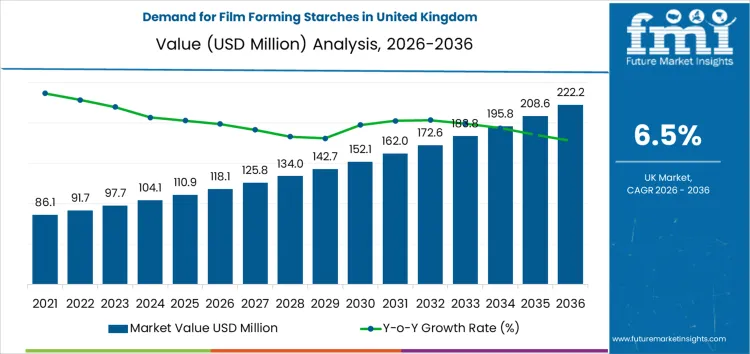
What is the Growth Forecast for Film Forming Starches in United Kingdom through 2036?
The demand for film-forming starches in the United Kingdom is projected to rise from USD 118.1 million in 2026 to USD 222.2 million by 2036, reflecting a compound annual growth rate (CAGR) of 6.5%. Between 2026 and 2031, the market will experience steady growth, increasing from USD 118.1 million to USD 162.0 million. From 2031 to 2036, the growth will continue, reaching USD 222.2 million by the end of the forecast period.
The compound absolute growth analysis shows that the market will see a consistent increase in value over the forecast period, with a significant contribution from applications in the food and pharmaceutical sectors. The market will experience a moderate acceleration in growth as demand for natural and functional ingredients expands, while innovation in starch technology will continue to drive market expansion. This gradual yet steady increase will reflect the increasing adoption of film-forming starches in various product formulations across industries.
Key Takeaways for Demand for Film Forming Starches in United Kingdom
| Metric | Value |
|---|---|
| Industry Sales Value (2026) | USD 118.1 million |
| Industry Forecast Value (2036) | USD 222.2 million |
| Industry Forecast CAGR (2026 to 2036) | 6.5% |
Why is Demand for Film Forming Starches in United Kingdom Growing?
Demand for film forming starches in the United Kingdom has increased from historical levels as food manufacturers sought functional ingredients that improve product quality and processing performance. Historically, film forming starches were used primarily in confectionery and bakery products to provide surface coatings that enhance appearance and shelf life. Over time their use broadened into applications such as snack coatings, encapsulation of flavours, and edible films for moisture control. Food processors in the UK adopted these starches to replace traditional film formers that offered less control over texture or required additional processing steps. Growing emphasis on ingredient functionality in product formulations supported uptake of film forming starches that deliver barrier properties and structural performance. In addition, operational drivers such as process efficiency and consistent product output encouraged integration of starch based films in manufacturing lines. Suppliers responded with a range of modified starch options tailored to specific application needs, which reinforced demand across food processing segments.
The demand for film forming starches in the United Kingdom is expected to continue rising as end users pursue formulations that balance performance with consumer preferences. Adoption will be supported by ongoing trends in convenience foods where starch derived films contribute to product stability and extended shelf life without reliance on synthetic polymers. Manufacturers seeking to meet regulatory expectations for ingredient transparency and cleaner labelling may favour starch based solutions that are perceived as familiar and food derived. Expansion of applications into areas such as pharmaceutical coatings, agricultural seed treatments, and biodegradable packaging films could further support demand growth. Changes in formulation practices driven by nutritional goals and supply chain considerations will sustain interest in film forming starches across diverse sectors in the UK.
What Are the Key Segments in the Demand for Film Forming Starches in the United Kingdom?
Demand for film forming starches in the United Kingdom is driven by form and product type. Dry starch leads the form segment with 70% of the market share, while native starch dominates the product type segment with 50%. Modified starch and starch derivatives & sweeteners also contribute to the market. These segments reflect the versatile applications of starches across industries such as food, pharmaceuticals, and textiles, where film-forming properties are essential.
What Is the Form Segment of Demand for Film Forming Starches in the United Kingdom?
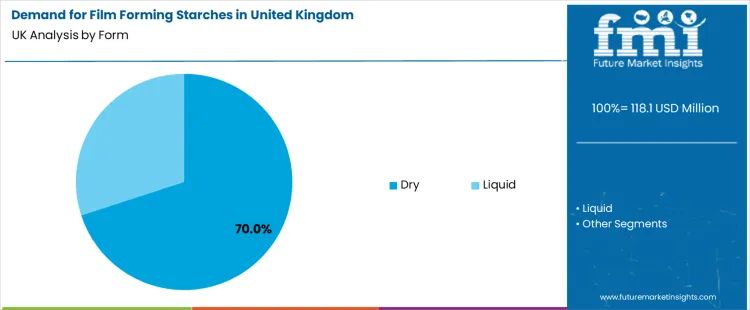
The form segment for film forming starches in the United Kingdom is predominantly led by dry starch, which holds a 70% share of the market. Dry starch is favored for its ease of handling, long shelf life, and ease of incorporation into various applications. It is widely used in industries such as food, pharmaceuticals, and cosmetics, where it serves as a thickening agent, binder, and stabilizer. Dry starches are particularly valued for their ability to form films that provide protection, coating, and structure in food products like confectionery, snack coatings, and tablets in pharmaceuticals.
The ability of dry starch to form thin, flexible films makes it ideal for use in controlled-release applications and coatings that require high durability. Liquid starch, although representing a smaller share of the market, is also used in applications where ease of application or processing at lower temperatures is beneficial. Liquid starches are commonly employed in industries that require smooth, easily spreadable coatings or film-forming solutions, such as in paper manufacturing or certain food processing applications. Despite its smaller market share, liquid starch’s ability to dissolve easily and be directly applied in liquid form contributes to its continued demand in specific, niche applications. However, dry starch remains dominant due to its broad applicability and versatility across various industries.
What Is the Product Type Segment of Demand for Film Forming Starches in the United Kingdom?
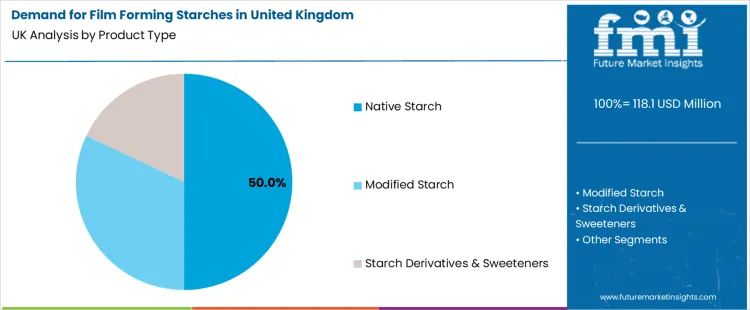
The product type segment for film forming starches in the United Kingdom is primarily led by native starch, which accounts for 50% of the market share. Native starch is the most basic form of starch, extracted directly from natural sources such as corn, potato, or wheat. It is widely used in food production, particularly in the confectionery and bakery sectors, where it functions as a stabilizer, thickener, and binder. Native starch is valued for its natural origin, purity, and ability to form films that enhance texture, mouthfeel, and shelf-life.
Its use is prevalent in pharmaceutical applications as well, where it helps in tablet formation and controlled-release mechanisms. Modified starch follows as another key segment, offering enhanced properties through chemical or physical treatments that modify its structure. Modified starches are designed to improve film-forming characteristics, stability, and functionality in a range of applications. They are particularly important in applications that require higher viscosity, improved water resistance, or better performance under varying temperatures, such as in adhesives, coatings, and food packaging. Starch derivatives and sweeteners represent a smaller portion of the market but serve important roles in industries where specific functional properties, such as sweetness or controlled solubility, are required. These derivatives are often used in the food and beverage industry, as well as in personal care products. The growing demand for starch derivatives and modified starches reflects the increasing need for tailored solutions in industrial and consumer applications, with native starch continuing to hold the largest share due to its natural qualities and versatility.
What is the Demand for Film Forming Starches in the United Kingdom?
Demand for film forming starches in the United Kingdom is anchored in their use as functional biopolymers across food processing, coatings, pharmaceuticals, and packaging applications. These starch derivatives act as edible films, binders, and encapsulation matrices that improve texture, stability, and moisture control. The food and beverage sector, where they appear in confectionery, bakery, and ready to eat products, represents a significant volume source. Broader procurement patterns reflect formulation requirements for biodegradable and performance additives that align with manufacturing quality standards and consumer expectations for ingredient functionality.
What are the Key Drivers for Film Forming Starch Demand in the United Kingdom?
Several factors drive demand for film forming starches in the United Kingdom. Food manufacturers utilise these ingredients for edible coatings that extend shelf life and enhance product appearance, supporting requirements for moisture retention and barrier properties. Growth in processed food segments reinforces uptake where starch films replace or augment synthetic alternatives. Regulatory emphasis on clean label and food safety standards motivates formulators to select ingredients perceived as natural and digestible. Pharmaceutical and nutraceutical producers also depend on film forming starches for capsule coatings and controlled release matrices. Investment in sustainable packaging research further underpins interest in bio based film solutions.
What are the Restraints on Film Forming Starch Demand in the United Kingdom?
Despite ongoing utilisation, the film forming starch market in the United Kingdom faces restraints. Cost considerations, including premium pricing relative to conventional polymeric materials, can limit adoption among cost sensitive manufacturers. Technical challenges arise in achieving consistent film performance, particularly where mechanical strength and barrier properties must meet rigorous specifications. Competition from synthetic polymers with higher strength or moisture resistance can displace starch films in certain applications. Supply chain variability for specific starch grades and derivatised starches may affect formulation planning. Additionally, stringent regulatory compliance for food contact and pharmaceutical excipient use adds formulation and testing complexity.
What are the Key Trends in Film Forming Starch Demand in the United Kingdom?
Key trends influencing film forming starch demand in the United Kingdom include heightened interest in biodegradable and compostable coating systems that reduce reliance on petroleum based polymers. Manufacturers are prioritising modified starch derivatives that deliver tailored viscosity, adhesion, and clarity to meet application specific performance criteria. Innovation in dual function additives that combine film formation with emulsification or controlled release is gaining traction in food and pharmaceutical formulations. Cross industry emphasis on natural and plant based ingredients supports procurement decisions where ingredient origin and sustainability credentials matter. Research into hybrid film systems that integrate starch with other biopolymers reflects ongoing efforts to enhance functional performance.
What is the Country-Wise Demand for Film Forming Starches in the United Kingdom?
The country-wise demand for film forming starches in the United Kingdom shows regional variations, with England leading the market. The demand in England is driven by the food, pharmaceutical, and personal care industries, where film forming starches are used in products ranging from food coatings and packaging to pharmaceuticals and cosmetics. Scotland, Wales, and Northern Ireland also exhibit steady demand growth, supported by similar applications in food processing, pharmaceuticals, and cosmetics. As industries continue to seek sustainable and natural alternatives to synthetic materials, the demand for film forming starches is expected to rise across all regions. While England remains the dominant market, other regions also show promising growth driven by increasing awareness of sustainable ingredients and the expanding food and personal care sectors.
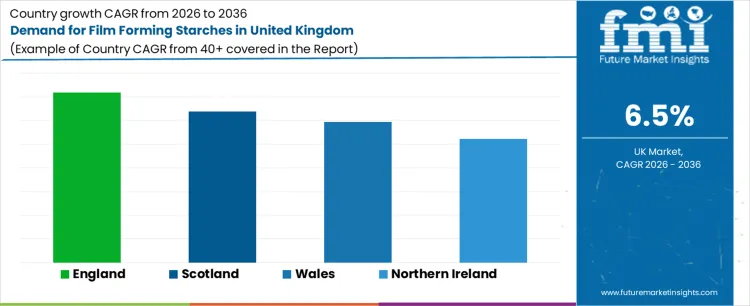
CAGR for Film Forming Starches Demand in the United Kingdom
| Country | CAGR (2026 to 2036) |
|---|---|
| England | 7.2% |
| Scotland | 6.4% |
| Wales | 5.9% |
| Northern Ireland | 5.2% |
What is Driving the Demand for Film Forming Starches in England?
The demand for film forming starches in England is projected to grow at a CAGR of 7.2% from 2026 to 2036. England’s large food processing, pharmaceutical, and personal care industries are the main drivers of this demand. Film forming starches are increasingly used as natural and sustainable alternatives to synthetic ingredients in various products. In the food industry, they are used in coatings and edible films, while in the pharmaceutical and personal care sectors, they serve as excipients in tablets and as thickening agents in cosmetics. The growing demand for plant-based and eco-friendly ingredients is further driving the adoption of film forming starches. Additionally, the food industry’s focus on healthier, more natural products is pushing manufacturers to turn to film forming starches as a versatile, safe, and biodegradable option. England’s continued focus on sustainability and natural ingredients ensures that demand for film forming starches will remain strong.
How is the Demand for Film Forming Starches Performing in Scotland?
In Scotland, the demand for film forming starches is expected to grow at a CAGR of 6.4% from 2026 to 2036. The growth is primarily driven by the food processing and personal care industries, where film forming starches are increasingly being used for their natural properties. In the food industry, film forming starches are used to create edible coatings and films, offering enhanced functionality without compromising on product quality. Scotland’s growing pharmaceutical sector also contributes to demand, as these starches are used as excipients in tablets and capsules. Additionally, the personal care industry is adopting film forming starches in cosmetics and skincare products for their texturizing and binding properties. With increasing consumer demand for natural and sustainable products, Scotland is expected to see continued growth in the adoption of film forming starches, particularly in the food and personal care sectors.
What Are the Growth Drivers for Film Forming Starches in Wales?
The demand for film forming starches in Wales is projected to grow at a CAGR of 5.9% through 2036. The primary growth drivers are the food processing, pharmaceutical, and personal care industries, where the need for sustainable and natural alternatives to synthetic ingredients is growing. In the food industry, film forming starches are used in coatings, edible films, and as binders in processed foods. In the pharmaceutical sector, they are used in tablets and capsules, while in personal care, they are valued for their role in cosmetics and skin care products. As consumer preferences in Wales shift towards more natural, plant-based ingredients, the demand for film forming starches is expected to rise. Wales’ focus on sustainable and healthier product formulations further supports this trend, making film forming starches a critical ingredient for industries across the region.
What is the Outlook for Film Forming Starches Demand in Northern Ireland?
Northern Ireland’s demand for film forming starches is expected to grow at a CAGR of 5.2% from 2026 to 2036. Although Northern Ireland represents a smaller market compared to other regions, the demand for these starches is steadily increasing, driven by their applications in the food, pharmaceutical, and personal care industries. As in other regions, the demand for sustainable, natural ingredients is pushing Northern Ireland’s food processors, pharmaceutical companies, and cosmetics manufacturers to adopt film forming starches. These starches are used in food coatings, as well as in tablets and personal care formulations. The rising consumer demand for healthier, more natural products and the growing focus on sustainability in Northern Ireland are expected to drive continued growth in the demand for film forming starches, despite the smaller market size compared to England and Scotland.
What is the Competitive Landscape for Demand for Film Forming Starches in the United Kingdom?
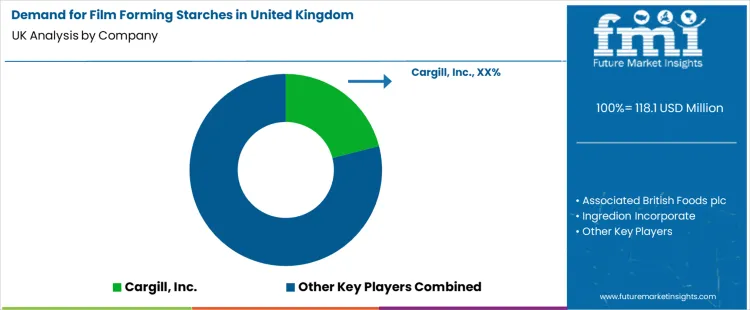
Demand for film forming starches in the United Kingdom is driven by food and beverage applications, edible coatings, and functional ingredient formulations where texture, stability, and appearance are critical. Bakery products, confectionery, snack foods, and coating applications specify film forming starches for moisture control and surface finish. Buyers reference product brochures to compare documented attributes such as clarity, tensile strength of films, and hydration profiles under defined processing conditions.
Cargill, Incorporated supplies a range of food grade film forming starches with documentation that lists viscosity profiles, film clarity values, and recommended concentrations for target applications. Associated British Foods plc (ABF Ingredients) competes with branded starch solutions, and its technical literature details performance metrics used by formulation teams to align ingredient selection with processing parameters.
Ingredion Incorporated’s documentation presents a suite of film forming starch grades with measured mechanical properties, processing notes, and handling guides that aid manufacturers when specifying material for coatings and encapsulation. Tate and Lyle PLC contributes film forming starches described in product sheets that list documented gelation points, film strength values, and application notes for food systems requiring structured surface layers. International Flavors & Fragrances Inc. (IFF) offers functional starch systems integrated with sensory solutions, with specification guides that outline rheology behavior and stability under thermal processing.
Procurement decisions in the United Kingdom incorporate documented performance data and supply considerations from these key suppliers. Demand patterns reflect scheduled production runs in bakery and snack segments where formulation stability and film characteristics are prioritized. Technical teams review product brochures to ensure compatibility with existing process equipment and finished product criteria, anchoring choices in measurable attributes. Lead times, distribution capabilities, and quality certificates are referenced during tender evaluations and procurement cycles. Buyers assess regulatory compliance as part of specification alignment, particularly where film forming starches interact with labeling and nutritional requirements. Competitive activity is informed by functional performance and supply terms supplied by each company, forming the basis for selection decisions in diverse food and beverage applications across the United Kingdom.
Key Players of the Demand for Film Forming Starches in the United Kingdom
- Cargill, Incorporated
- Associated British Foods plc (ABF Ingredients)
- Ingredion Incorporate
- Tate and Lyle PLC
- International Flavors & Fragrances Inc. (IFF)
Scope of the Report
| Items | Values |
|---|---|
| Quantitative Units (2026) | USD Million |
| Source | Potato, Wheat, Corn, Cassava, Tapioca, Maize, Rice |
| Product Type | Native Starch, Modified Starch, Starch Derivatives & Sweeteners |
| End Use | Pharmaceuticals, Food and Beverages, Industrial Applications, Others |
| Form | Dry, Liquid |
| Companies | Cargill, Incorporated, Associated British Foods plc (ABF Ingredients), Ingredion Incorporated, Tate & Lyle PLC, International Flavors & Fragrances Inc. (IFF) |
| Regions Covered | United Kingdom |
| Countries Covered | England, Scotland, Wales, Northern Ireland |
| Additional Attributes | Dollar by sales by source, product type, end use, and form. Includes market trends towards sustainability, regulatory compliance, and the role of film-forming starches in various applications across industries. |
Demand for Film Forming Starches in United Kingdom
Source:
- Potato
- Wheat
- Corn
- Cassava
- Tapioca
- Maize
- Rice
Product Type:
- Native Starch
- Modified Starch
- Starch Derivatives & Sweeteners
End Use:
- Pharmaceuticals
- Food and Beverages
- Industrial Applications
- Others
Form:
- Dry
- Liquid
Countries:
- England
- Scotland
- Wales
- Northern Ireland
Bibliography
- Office for National Statistics. (2024). UK manufacturers’ sales by product: 2023.
- Food Standards Agency. (2023). Guidance on food additives, starches, and processing aids used in food manufacture.
- European Food Safety Authority. (2023). Safety evaluation of modified starches used as food additives. EFSA Journal, 21(5).
- International Organization for Standardization. (2023). ISO 22000: Food safety management systems - Requirements for any organization in the food chain.
- European Commission. (2024). Regulation (EC) No 1935/2004 on materials and articles intended to come into contact with food: Consolidated application guidance.
Frequently Asked Questions
How big is the demand for film forming starches in United Kingdom in 2026?
The demand for film forming starches in United Kingdom is estimated to be valued at USD 118.1 million in 2026.
What will be the size of film forming starches in United Kingdom in 2036?
The market size for the film forming starches in United Kingdom is projected to reach USD 222.2 million by 2036.
How much will be the demand for film forming starches in United Kingdom growth between 2026 and 2036?
The demand for film forming starches in United Kingdom is expected to grow at a 6.5% CAGR between 2026 and 2036.
What are the key product types in the film forming starches in United Kingdom?
The key product types in film forming starches in United Kingdom are corn, potato, wheat, cassava, tapioca, maize and rice.
Which product type segment is expected to contribute significant share in the film forming starches in United Kingdom in 2026?
In terms of product type, native starch segment is expected to command 50.0% share in the film forming starches in United Kingdom in 2026.
Preview the report firsthand - request a free sample
Get SampleGet the brochure for pricing and purchase details.
Get PDFTable of Content
- Executive Summary
- UK Market Outlook
- Demand-side Trends
- Supply-side Trends
- Technology Roadmap Analysis
- Analysis and Recommendations
- Market Overview
- Market Coverage / Taxonomy
- Market Definition / Scope / Limitations
- Market Background
- Market Dynamics
- Drivers
- Restraints
- Opportunity
- Trends
- Scenario Forecast
- Demand in Optimistic Scenario
- Demand in Likely Scenario
- Demand in Conservative Scenario
- Opportunity Map Analysis
- Product Life Cycle Analysis
- Supply Chain Analysis
- Investment Feasibility Matrix
- Value Chain Analysis
- PESTLE and Porter’s Analysis
- Regulatory Landscape
- Regional Parent Market Outlook
- Production and Consumption Statistics
- Import and Export Statistics
- Market Dynamics
- UK Market Analysis 2021 to 2025 and Forecast, 2026 to 2036
- Historical Market Size Value (USD Million) Analysis, 2021 to 2025
- Current and Future Market Size Value (USD Million) Projections, 2026 to 2036
- Y-o-Y Growth Trend Analysis
- Absolute $ Opportunity Analysis
- UK Market Pricing Analysis 2021 to 2025 and Forecast 2026 to 2036
- UK Market Analysis 2021 to 2025 and Forecast 2026 to 2036, By Source
- Introduction / Key Findings
- Historical Market Size Value (USD Million) Analysis By Source , 2021 to 2025
- Current and Future Market Size Value (USD Million) Analysis and Forecast By Source , 2026 to 2036
- Corn
- Potato
- Wheat
- Cassava
- Tapioca
- Maize
- Rice
- Corn
- Y-o-Y Growth Trend Analysis By Source , 2021 to 2025
- Absolute $ Opportunity Analysis By Source , 2026 to 2036
- UK Market Analysis 2021 to 2025 and Forecast 2026 to 2036, By Product Type
- Introduction / Key Findings
- Historical Market Size Value (USD Million) Analysis By Product Type, 2021 to 2025
- Current and Future Market Size Value (USD Million) Analysis and Forecast By Product Type, 2026 to 2036
- Native Starch
- Modified Starch
- Starch Derivatives & Sweeteners
- Native Starch
- Y-o-Y Growth Trend Analysis By Product Type, 2021 to 2025
- Absolute $ Opportunity Analysis By Product Type, 2026 to 2036
- UK Market Analysis 2021 to 2025 and Forecast 2026 to 2036, By End Use
- Introduction / Key Findings
- Historical Market Size Value (USD Million) Analysis By End Use, 2021 to 2025
- Current and Future Market Size Value (USD Million) Analysis and Forecast By End Use, 2026 to 2036
- Food and Beverages
- Pharmaceuticals
- Industrial Applications
- Others
- Food and Beverages
- Y-o-Y Growth Trend Analysis By End Use, 2021 to 2025
- Absolute $ Opportunity Analysis By End Use, 2026 to 2036
- UK Market Analysis 2021 to 2025 and Forecast 2026 to 2036, By Form
- Introduction / Key Findings
- Historical Market Size Value (USD Million) Analysis By Form, 2021 to 2025
- Current and Future Market Size Value (USD Million) Analysis and Forecast By Form, 2026 to 2036
- Dry
- Liquid
- Dry
- Y-o-Y Growth Trend Analysis By Form, 2021 to 2025
- Absolute $ Opportunity Analysis By Form, 2026 to 2036
- Market Structure Analysis
- Competition Dashboard
- Competition Benchmarking
- Market Share Analysis of Top Players
- By Regional
- By Source
- By Product Type
- By End Use
- By Form
- Competition Analysis
- Competition Deep Dive
- Cargill, Inc.
- Overview
- Product Portfolio
- Profitability by Market Segments (Product/Age /Sales Channel/Region)
- Sales Footprint
- Strategy Overview
- Marketing Strategy
- Product Strategy
- Channel Strategy
- Associated British Foods plc
- Ingredion Incorporate
- Tate and Lyle PLC
- NSC National Starch & Chemical Ltd
- Cargill, Inc.
- Competition Deep Dive
- Assumptions & Acronyms Used
- Research Methodology


