

- Industry Size (2026)
- USD 630.0 Mn
- Forecast (2036)
- USD 987.8 Mn
- CAGR (2026 to 2036)
- 4.6%
Pomace Olive Oil Market Size, Market Forecast and Outlook By FMI
The pomace olive oil market was valued at USD 602.3 million in 2025. Sector is poised to cross USD 630.0 million in 2026, and reach USD 987.8 million by 2036, at a 4.6% CAGR over the forecast period. Market is propelled by import-dependent regions substituting premium virgin grades with refined pomace blends for high-heat commercial applications.
Summary of Pomace Olive Oil Market
- The market is estimated at USD 630.0 million in 2026.
- The market is projected to reach USD 987.8 million by 2036.
- The market is expected to grow at a CAGR of 4.6% from 2026 to 2036.
- The forecast period represents an incremental opportunity of USD 357.8 million.
- Olive pomace oil blend leads the product type segment with a 58.0% share.
- Household cooking dominates the end use segment with a 46.0% share.
- 1L bottles lead the packaging segment with a 34.0% share.
- Supermarkets dominate the distribution channel segment with a 49.0% share.
- Foodservice and industrial frying remain key demand applications.
- India (6.8%), Brazil (5.9%), and the United States (4.9%) are among the fastest-growing markets.
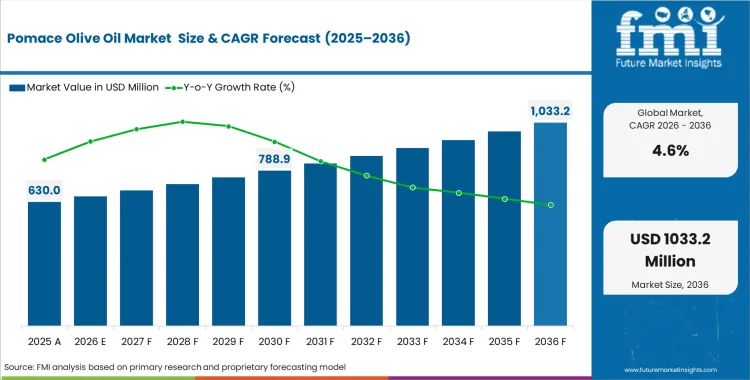
Pomace Olive Oil Market Key Takeaways
| Metric | Details |
|---|---|
| Industry Size (2026) | USD 630.0 Million |
| Industry Value (2036) | USD 987.8 Million |
| CAGR (2026-2036) | 4.6% |
Source: Future Market Insights (FMI) analysis, based on proprietary forecasting model and primary research
Foodservice procurement executives encounter severe financial strain stemming directly from consecutive diminished regional olive crop yields during the recent season. Such intense margin compression compels sourcing professionals to approve alternative frying mediums retaining the geographic label claim without bearing the steep extra-virgin price premium. Purchasing teams operating within large catering organizations actively evaluate refined blends specifically for superior thermal stability, relying fundamentally on the elevated smoke point to effectively prolong commercial fryer lifespan during the substitution of pomace olive oil for frying applications. Securing highly consistent volume from established regional refineries remains the primary strategic defense against severe margin erosion for India olive oil importers managing highly price-sensitive retail channels.
International distributors operating across eastern and Latin geographies trigger the necessary adoption threshold by educating household buyers regarding high-heat functional utility, thereby driving substantially broader pomace olive oil demand amidst global olive oil production. Routine household adoption effectively transitions the refined product from a niche specialty import category directly into an indispensable everyday cooking staple utilized across diverse global consumer demographics.
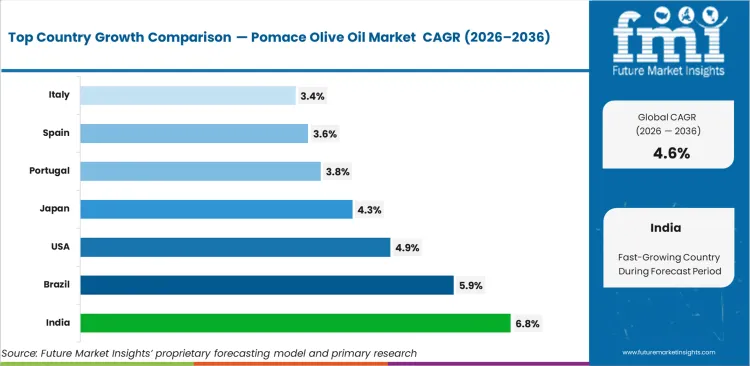
India is expected to register a 6.8% CAGR during the forecast period due to urban households actively seeking cost-effective Mediterranean cooking fats. Brazil is estimated to expand at a 5.9% CAGR during the forecast as its domestic packaging operations rely structurally on imported bulk oils in Europe. Growth in the United States is poised to expand at a 4.9% CAGR, Japan at 4.3% CAGR, Portugal at 3.8% CAGR, Spain and Italy at a 3.6% and 3.4% CAGR respectively.
Segmental Analysis
Pomace Olive Oil Market Analysis by Product Type
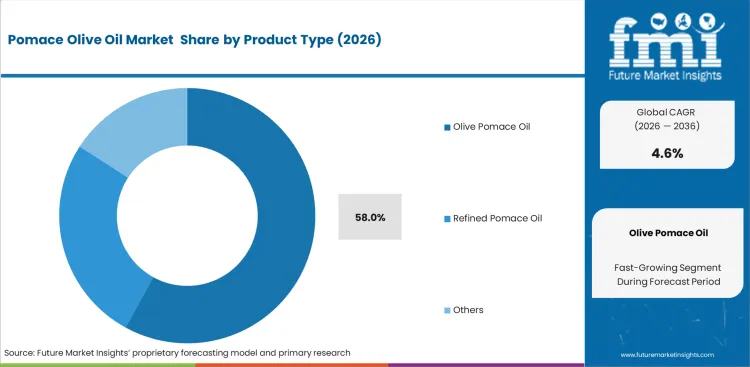
Virgin oil integration strictly establishes the fundamental legal commercialization pathway across various edible fat categories. The olive pomace oil blend segment is expected to hold 58.0% revenue share in 2026, owing to strict regulatory mandates requiring virgin inclusion for retail sale, significant cost advantages over pure extra virgin grades, superior thermal endurance necessary for high-heat cooking, and established consumer acceptance in mainstream grocery channels. Integrating natural upcycled olive pomace byproducts directly into adjacent supply networks further alters producer economics, allowing facilities to extract maximum commercial value from agricultural waste streams, thereby preventing sudden production halts during severe regional harvest shortfalls.
- Blend ratio optimization: Facility personnel precisely calibrate the exact percentage of virgin oil introduced into the refined base, constantly monitoring fluctuations in commodity prices for optimal input costs.
- Oxidative profile testing: Quality assurance specialists measure peroxide values following the blending process in specialized laboratory environments to accurately forecast product shelf life and thermal resilience characteristics.
- Tariff classification management: Logistics management continually optimizes the geographic location of the blending step to mitigate the impact of punitive agricultural import duties levied by various governments.
Pomace Olive Oil Market Analysis by End Use
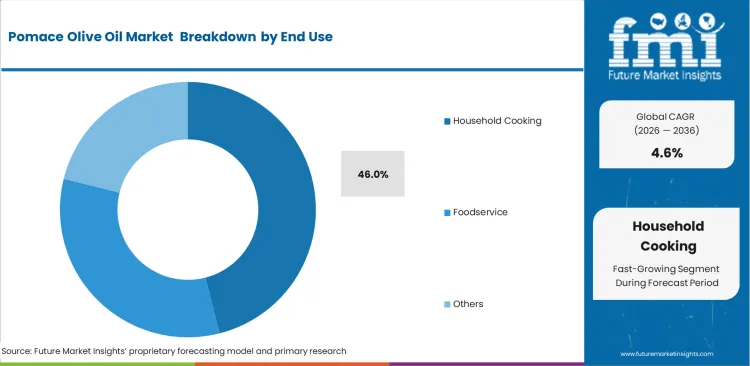
Intense cost pressures sweeping across the consumer grocery sector continually force a systemic reevaluation of premium cooking fats. Inflation-weary shoppers actively trade down from extra-virgin grades for high-volume frying tasks to seek immediate financial relief without abandoning the broader Mediterranean category entirely. The household cooking segment is estimated to account for 46.0% revenue share in 2026, driven by inflationary pressures shifting consumer buying patterns, robust retail promotion highlighting smoke point benefits, rising culinary media endorsement for high-temperature roasting, and the bulk affordability required for daily sautéing. Formulators testing high oleocanthal olive extracts often overlook the massive volume of basic, affordable cooking fat continuously required by ordinary households globally.
- Price-tier substitution: Consumers purposefully select refined blends over mechanical extracts for routine sautéing to manage constrained grocery budgets.
- Thermal performance marketing: Brand managers strategically emphasize smoke point metrics on front-of-pack labeling to completely substantiate the product's functional utility in high-heat cooking.
- Placement adjacency tactics: Store merchandisers physically position these products directly between premium seed oils and true virgin varieties, systematically intercepting shoppers who remain undecided about their purchase.
Pomace Olive Oil Market Analysis by Packaging
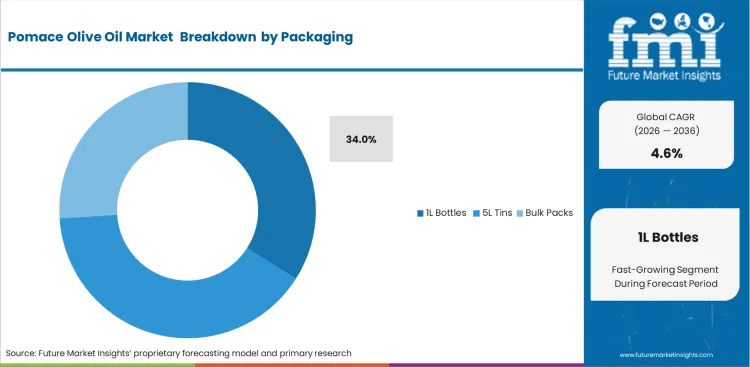
While evaluating pomace olive oil distribution, volume velocity at the retail level dictates physical container formats prioritized by global supply networks. Tracking early harvest olive packaging formats operates with entirely different unforgiving logistics parameters compared to the severe pressure changes experienced during extended maritime transit routes for mass-market cooking oils. The 1L bottles segment is expected to hold 34.0% revenue share in 2026, because of the format's exceptional ability to provide optimal grocery shelf dimensions maximizing retail display space alongside consumer convenience for daily kitchen handling.
- Pallet density optimization: Packaging professionals meticulously engineer proprietary bottle configurations specifically eliminating unused volume within established export shipping containers, ensuring critical freight cost reductions absolutely vital for low-margin liquid transport across vast oceanic expanses, consequently preserving supplier margins.
- Seal integrity validation: Quality inspection personnel rigorously stress-test closure mechanisms against extreme atmospheric pressure fluctuations within simulated transit environments, allowing importers to completely avoid catastrophic entire-container rejections and massive product losses.
- Visual tinting application: Marketing teams purposefully specify dark green or brown plastics to successfully mask the inherently pale color of highly refined oil blends, actively preventing sudden consumer rejection triggered by unfavorable visual comparisons with mechanically pressed, vibrantly green virgin oils available on identical retail shelving.
Pomace Olive Oil Market Analysis by Distribution Channel
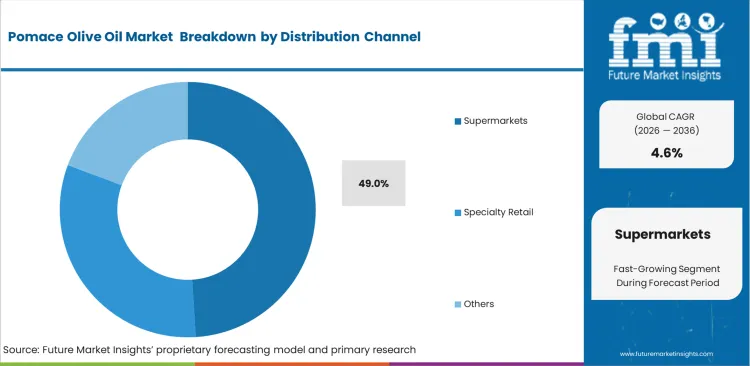
Mainstream grocery foot traffic provides the essential scale completely necessary for low-margin liquid commodities achieving sustainable long-term commercial profitability across modern retail networks. The supermarkets segment is predicted to hold 49.0% revenue share in 2026, primarily driven by unparalleled consumer foot traffic, direct physical shelf adjacency immediately surrounding competing premium seed oils, strategic promotional pricing capabilities during intense seasonal peaks, and established bulk supply contracts guaranteeing predictable margins.
According to FMI's estimates, specialized polyphenol concentrate online transactions occur rapidly alongside digital platforms, but heavy bulk cooking fats fundamentally demand immediate physical retail presence for circumventing prohibitively expensive direct-to-consumer shipping expenses, ensuring physical supermarkets continue defining future distribution standards.
- Annual volume contracting: Corporate grocery buyers aggressively negotiate comprehensive twelve-month supply agreements to shield regional retail pricing from unpredictable harvest volatility. Supplier executives secure the highly predictable, massive revenue streams strictly necessary to fund capital-intensive, year-round continuous operations at large-scale solvent extraction plants.
- End-cap promotional scheduling: Retail managers build massive, aggressive display features during peak culinary seasons to rapidly accelerate product movement. Distribution firms heavily utilize these retail promotions to clear excess imported inventory efficiently before the brand-new Mediterranean harvest processing cycle officially begins in late autumn.
- Slotting fee negotiations: Key account managers heavily finance prime shelf positioning to successfully break deeply entrenched consumer seed-oil purchasing habits. Brand owners risk absolute total market invisibility and rapid retailer delisting if they refuse to aggressively fund these mandatory physical placement initiatives inside major national supermarket chains.
Pomace Olive Oil Market Drivers, Restraints, and Opportunities
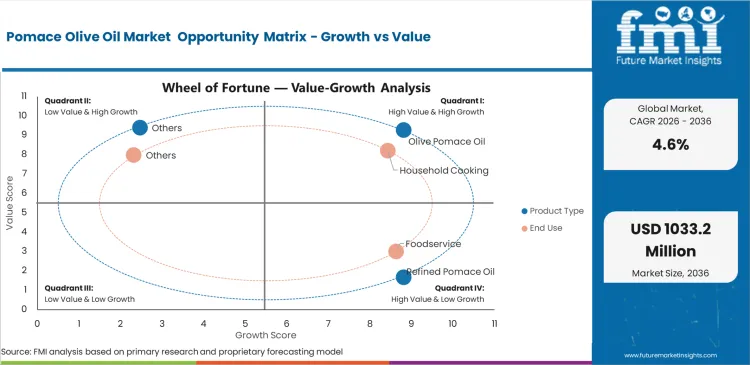
Unprecedented extra-virgin pricing volatility resulting from severe Europe droughts is escalating global premium oil costs, compelling foodservice purchasing heads to authorize functional pomace blends for continuous back-of-house frying operations. Severe margin compression leaves major catering operators completely unable to absorb consecutive years of poor Mediterranean harvests without escalating consumer menu prices toward absolutely unsustainable retail levels. Securing consistent bulk container shipments directly from established Iberian refineries remains the absolute primary strategic defense against catastrophic margin erosion sweeping across commercial restaurant kitchens globally.
Negative consumer perception surrounding the industrial solvent extraction process creates a persistent friction significantly slowing mainstream retail adoption within the global pomace olive oil market. Health-conscious retail shoppers frequently express deep skepticism toward chemically refined agricultural products, heavily influenced by overarching clean-label food trends and intensely competitive premium extra-virgin marketing campaigns. International food safety regulators continuously mandate extremely stringent maximum residue limits for commercial extraction solvents to ensure absolute consumer safety. Meeting these rigid chemical safety thresholds vastly complicates global export compliance and substantially increases routine laboratory testing costs for all major Mediterranean bulk oil producers.
Opportunities in the Pomace Olive Oil Market
- Emerging market retail penetration: Grocery buyers in Asia Pacific introduce affordable Mediterranean oil options directly to rapidly expanding middle-class households. Importers secure vital early brand loyalty before multinational FMCG competitors establish local, vertically integrated bottling infrastructure.
- Commercial bakery formulation: Food scientists actively swap expensive, highly volatile dairy fats for stable olive phenolic complexes in complex laminated dough applications. Industrial bakeries achieve significant raw material cost reductions while measurably improving finished product shelf life.
- Foodservice bulk packaging: Restaurant supply personnel transition commercial kitchens rapidly to 5L tin formats specifically engineered for high-volume, continuous frying. Catering operators drastically reduce per-ounce lipid costs while strictly maintaining required flavor profiles and operational safety.
Regional Analysis
Based on regional analysis, the pomace olive oil market is segmented into North America, Latin America, Europe, Asia Pacific, and Middle East & Africa across 40 plus countries.
.webp "Top Country Growth Comparison Pomace Olive Oil Market Cagr (2026 2036)")
| Country | CAGR (2026 to 2036) |
|---|---|
| India | 6.8% |
| Brazil | 5.9% |
| United States | 4.9% |
| Japan | 4.3% |
| Portugal | 3.8% |
| Spain | 3.6% |
| Italy | 3.4% |
Source: Future Market Insights (FMI) analysis, based on proprietary forecasting model and primary research
Asia Pacific Pomace Olive Oil Market Analysis
Proactive retail distribution substituting local premium oils with Mediterranean imports clearly defines the commercial landscape in Asia. According to FMI's extensive estimates, regional food distributors expertly utilize the established prestige of Europe-based agricultural products to instantly elevate the perceived consumer value of these highly affordable blends. Importers skillfully navigate complex, localized blending regulations to ensure absolute product compliance while aggressively maximizing profit margins. Market penetration across the region relies heavily on systematically educating commercial kitchen staff regarding thermal stability limits rather than promoting subtle flavor nuances.
- India: Urban grocery buyers in India actively seek out cost-effective Mediterranean cooking fats to completely replace traditional seed oils inside modern, health-conscious kitchens. Importers within the country secure massive volume advantages over local, fragmented competitors by establishing immediate, unmediated Iberian supply lines. Demand in India is expected to expand at a 6.8% CAGR during the forecast period, owing to ongoing urbanization profoundly shifting dietary habits toward healthier imported lipid alternatives. Other factors are extensive expansion of modern retail distribution networks successfully substituting domestic premium seed oils, alongside rising middle-class purchasing power actively seeking Mediterranean health halos.
- Japan: Distributors operating locally demand exceptional, documented purity certifications to consistently satisfy the rigorous domestic food safety inspections required across the territory. Japan is projected to rise at a 4.3% CAGR during the forecast period, owing to continuous corporate procurement patterns establishing a firm consumption floor. Other factors are deep product integration into bulk commercial frying operations, strict adherence to stringent domestic food safety regulations, and constant supply reliability stemming from established international importers.
FMI's report includes South Korea and China, where high reliance on imported specialty ingredients creates isolated pockets of demand for highly functional frying applications in the expanding fast-casual dining sector.
Latin America Pomace Olive Oil Market Analysis
Reliance on imported Europe-based bulk oils to sustain domestic packaging operations dictates the fundamental supply reality across Latin America. FMI's detailed analysis indicates that large local bottling firms import vast quantities of crude or refined base oils directly from Spain and execute the final virgin blending locally to intelligently circumvent finished-goods import tariffs. Supermarket chains entirely dominate the distribution network, treating the category strictly as a high-velocity, everyday cooking staple rather than a luxury culinary import.
- Brazil: Large domestic bottling infrastructure is presenting major commercial opportunities. This internal capability expansion directly positions local consumer brands to dominate regional retail supply across the broader edible oil sector. Brazil is estimated to expand at a 5.9% CAGR during the forecast period, owing to the existence of highly sophisticated domestic bottling infrastructure providing an unparalleled baseline for regional packaging operations. Other factor is plant operators constantly securing uninterrupted Mediterranean bulk shipments to capture domestic value rather than importing finished commodities.
FMI's report includes Mexico and Argentina, where pulse-based and domestic seed oils face emerging, albeit price-sensitive, competition from bulk Mediterranean cooking fat imports in urban supermarket channels.
North America Pomace Olive Oil Market Analysis
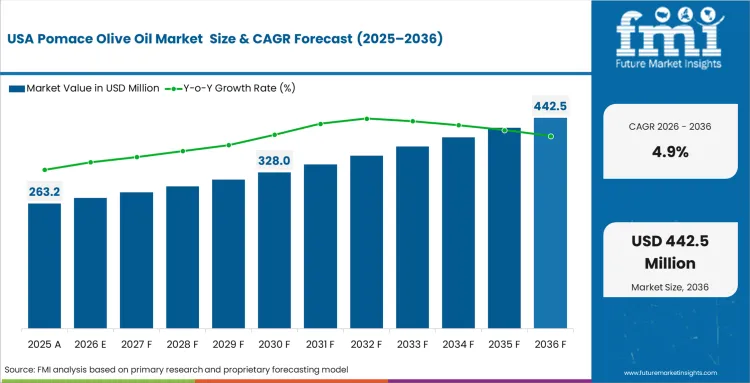
Commercial kitchens blending refined pomace into high-volume dressings and complex baking applications heavily shape the volume metric in North America distribution channels. Based on FMI's commercial assessment, major national restaurant chains specify this exact fat to strictly control food costs while maintaining the lucrative ability to list olive oil prominently on ingredient declarations. Retail shelf space remains highly competitive and heavily consolidated, requiring extremely significant upfront slotting investments from ambitious Europe-based brand owners looking to enter the market.
- United States: While evaluating regional pomace olive oil consumption, extreme food-cost inflation define ingredient substitution across massive kitchen operations. Restaurant supply networks consume the highest regional volume but demand minimal specialized refinement, often settling for standard bulk packaging, while commercial bakers drive the major volume requirements for highly stable lipid alternatives inside processed goods. Industry in the United States is predicted to incline at a 4.9% CAGR during the forecast period, owing to commercial kitchens managing severe food-cost inflation, and massive industrial bakeries systematically transitioning to highly stable lipid alternatives. Other factors are steadily growing foodservice demand for Mediterranean-branded frying mediums, and sustained promotional investments initiated by overseas brand owners.
FMI's report includes Canada, where localized processing bottlenecks for specialty oils force reliance on robust import pipelines to satisfy growing commercial bakery formulation requirements.
Europe Pomace Olive Oil Market Analysis
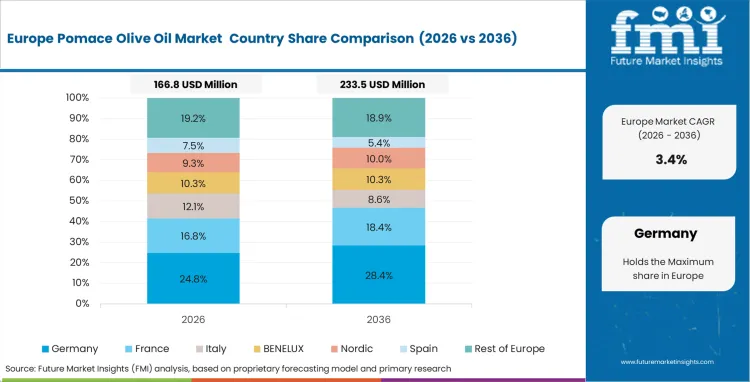
Mature Mediterranean producers processing massive crude inputs primarily for lucrative export and industrial extraction completely dominate the operational baseline in the region. In FMI's analytical view, domestic consumption remains relatively flat and uninspired as local populations fiercely and culturally prefer mechanical virgin extracts for all household use. Refinery operators balance their immense output entirely toward securing highly lucrative export contracts directed to expanding Asia Pacific- and America-based distribution networks.
- Portugal: Export executives at highly specialized refineries based in Portugal obsessively optimize complex extraction yields to reliably supply rapidly expanding international demand. Demand in Portugal is expected to expand at a 3.8% CAGR during the forecast period. This steady growth is sustained by factors such as specialized refinery optimization for maximum extraction yields, deep historical trade routes heavily penetrating Latin America, an incredibly integrated Iberian supply chain position, and consistent export volume far outweighing flat domestic consumption.
- Spain: Massive industrial solvent extraction facilities situated entirely within Jaén completely dictate global international pricing strictly based on annual crude availability and fluctuating harvest yields. The resulting modest commercial expansion strictly reflects total domestic market saturation alongside steadily declining local household usage surrounding these refined products. Spain is expected to register a 3.6% CAGR during the forecast period, supported by cooperative pricing power, massive industrial extraction infrastructure heavily clustered in Jaén, absolute control over the primary global raw material supply, and highly lucrative long-term export contracts.
- Italy: Regional bottlers import vast amounts of crude material originating from Spain to execute local refinement reaching exact specifications and leverage premium regional branding to successfully command massive export premiums. Export managers based in Italy face incredibly intense and ongoing regulatory scrutiny from international customs agencies regarding the absolute exactness covering origin declarations and specific blending ratios. Sales of pomace olive oil in Italy is estimated to expand at a 3.4% CAGR during the forecast period, propelled by strong international brand equity commanding significant export premiums and sustained demand from premium Europe-based distribution networks.
FMI's report includes the United Kingdom and Germany, where highly strict clean-label mandates from dominant supermarkets force buyers into long-term supplier contracts to guarantee consistent European tonnage.
Competitive Aligners for Market Players
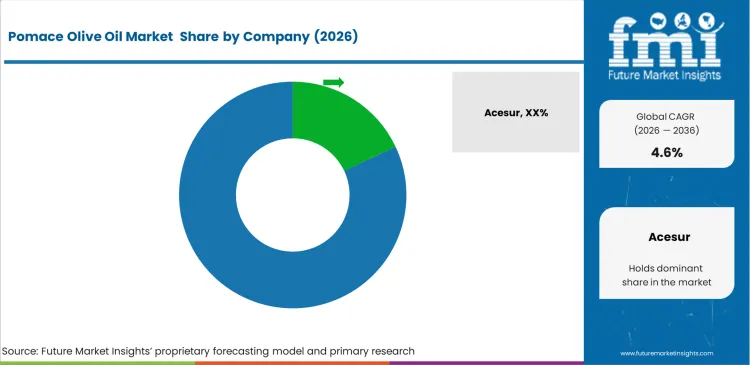
Acesur, Sovena, and Deoleo control the global supply architecture of the pomace olive oil market not through premium brand equity, but through massive, undeniable physical extraction and refining capacity heavily clustered in the Iberian Peninsula. Independent bottlers scattered across the globe cannot realistically replicate the highly capital-intensive solvent extraction facilities absolutely required to process raw olive milling waste at any meaningful commercial scale. Sourcing personnel at massive multinational food brands bypass minor regional players entirely, locking into rigid annual contracts with these Spanish giants to guarantee steady, uninterrupted volume.
Incumbents securely possess deep, multi-generational relationships with local olive mills, securing the highly exclusive right to collect wet pomace immediately after the primary mechanical pressing concludes. Challengers aggressively attempting to enter the space struggle immensely to secure sufficient raw biomass before it rapidly degrades, lacking the highly localized trucking fleets and rapid-drying infrastructure strictly necessary to stabilize the volatile waste product. FMI observes that olive leaf extract producers sometimes cleverly share this exact, highly efficient logistics network to lower overhead. Established refiners expertly utilize immense, sprawling storage tank farms to systematically blend away highly seasonal quality variations, absolutely ensuring a perfectly uniform product lands in foreign ports year-round.
Key Players in the Pomace Olive Oil Market
- Acesur
- Sovena
- Deoleo
- Borges International Group
- Ybarra Group
- Oleev (Modi Naturals)
- Basso Fedele & Figli
Scope of the Report
| Metric | Value |
|---|---|
| Quantitative Units | USD 630.0 Million in 2026 to USD 987.8 Million by 2036, at a CAGR of 4.6% |
| Market Definition | The pomace olive oil market represents the edible fat category extracted from the solid residue remaining after primary mechanical pressing of olive fruit. Refining treatments remove impurities before facilities blend it with virgin olive varieties to restore baseline flavor. |
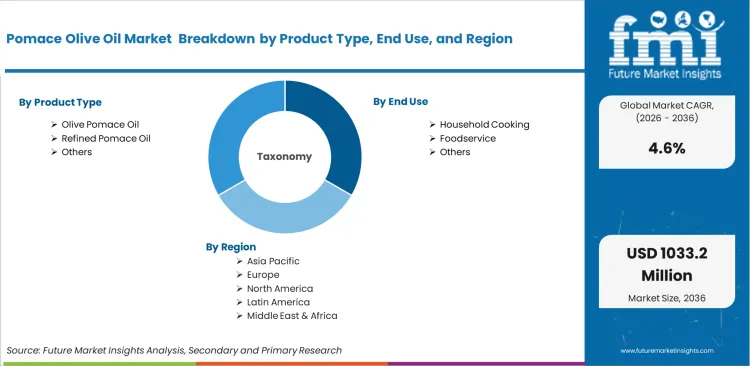
| Segmentation | Product Type, End Use, Packaging, Distribution Channel, and Region |
| Regions Covered | North America, Latin America, Europe, Asia Pacific, Middle East & Africa |
| Countries Covered | India, Brazil, United States, Japan, Portugal, Spain, Italy |
| Key Companies Profiled | Acesur, Sovena, Deoleo, Borges International Group, Ybarra Group, Oleev (Modi Naturals), Basso Fedele & Figli |
| Forecast Period | 2026 to 2036 |
| Approach | Global crude extraction volumes paired with IOC category share reporting anchor the baseline consumption models for the pomace olive oil market. |
Source: Future Market Insights (FMI) analysis, based on proprietary forecasting model and primary research
Pomace Olive Oil Market Analysis by Segments
Product Type
- Olive pomace oil blend
- Refined pomace oil
- Crude pomace oil
End Use
- Household cooking
- Foodservice
- Food processing
Packaging
- 1L bottles
- 5L tins
- Bulk packs
Distribution Channel
- Supermarkets
- Specialty retail
- Online retail
- Foodservice distributors
Region
- North America
- United States
- Canada
- Latin America
- Brazil
- Mexico
- Rest of Latin America
- Europe
- Germany
- United Kingdom
- France
- Italy
- Spain
- Portugal
- Rest of Europe
- Asia Pacific
- China
- Japan
- India
- Australia
- Rest of Asia Pacific
- Middle East & Africa
- GCC Countries
- South Africa
- Rest of Middle East & Africa
Bibliography
- International Olive Council. (2025). Trade standard applying to olive oils and olive-pomace oils (COI/T.15/NC No 3/Rev.21/2025).
- Codex Committee on Fats and Oils. (2025, December). Matters referred to the Codex Committee on Fats and Oils by the Codex Alimentarius Commission and/or other subsidiary bodies (CX/FO 26/29/2). FAO/WHO Codex Alimentarius.
- California Department of Food and Agriculture. (2025). 2025-2026 grade and labeling standards for olive oil, refined-olive oil, olive-pomace oil, and refined olive-pomace oil.
- European Court of Auditors. (2026, January). Special report 01/2026: Control systems for olive oil in the EU.
- Menegoz Ursol, L., Conchione, C., Peroni, D., & Moret, S. (2025, February). A study on the impact of industrial-scale refining on olive oil and olive pomace oil contamination with mineral oils. Food Chemistry, 466, 142207.)
This bibliography is provided for reader reference. The full FMI report on the pomace olive oil market contains the complete reference list with primary source documentation.
This Report Addresses
- Extra-virgin pricing volatility forcing foodservice procurement heads to evaluate refined olive-derived fats in the pomace olive oil market.
- Tariff classification management executed by logistics personnel during international bulk transit operations.
- Smoke point marketing tactics deployed by retail brand managers to drive household cooking substitution.
- Oxidative profile testing conducted by quality technicians to ensure thermal stability in commercial fryers.
- Pallet density optimization pursued by packaging designers engineering standard 1L bottle dimensions.
- Annual volume contracting utilized by corporate grocery buyers to shield retail pricing from harvest shocks.
- Integration of refined pomace into high-volume bakery formulations to replace costly dairy lipids.
- Iberian refinery concentration dictating raw material access and global pricing structures across the pomace olive oil market.
Frequently Asked Questions
What is the current pomace olive oil market size?
The industry size sits at USD 630.0 million in 2026. This figure signals a stable reliance on Mediterranean extraction output by international food networks demanding affordable olive-derived cooking fats.
How fast is the pomace olive oil forecast 2036 expected to grow?
Demand expands at a steady 4.6% CAGR across the forecast period. This trajectory is secured primarily by aggressive foodservice adoption and continuous commercial baking substitution requiring stable frying mediums.
Which countries consume pomace olive oil most?
High-growth import economies like India and Brazil record the fastest expansion, while the United States maintains steady volume. Mature Mediterranean nations like Spain and Italy remain significant consumption hubs despite widespread domestic preference for mechanical extracts.
Is pomace olive oil cheaper than olive oil?
Yes, commercial buyers rely on this cost differential to manage tight operational budgets. Solvent extraction and high-yield processing allow refiners to offer a Mediterranean-branded cooking fat at a fraction of the cost of premium extra-virgin varieties.
What is refined olive pomace oil used for?
Commercial kitchens and food manufacturers utilize the refined base specifically for high-heat frying and baking applications. The chemical refining process strips out impurities, significantly elevating the smoke point compared to unrefined mechanical extracts.
Is pomace olive oil good for frying?
Yes, professional chefs recommend the product specifically to prevent bitter flavor development during deep frying applications. The higher smoke point of the refined base prevents the rapid degradation typical of unrefined virgin grades under intense heat.
How does evaluating olive pomace oil vs extra virgin olive oil impact buyers?
Procurement personnel weigh thermal performance against sensory perception. Extra-virgin offers superior flavor but burns rapidly in commercial fryers, whereas pomace provides exceptional heat stability while satisfying the marketing requirement of an olive-derived ingredient.
Why compare pomace olive oil vs sunflower oil for commercial kitchens?
Catering operators evaluate these two options when seeking cost-effective frying solutions. While sunflower oil provides a neutral flavor baseline, pomace allows restaurant menus to retain the premium association of a Mediterranean cooking fat.
Who are the key companies in the pomace olive oil industry?
The global supply architecture is heavily concentrated among massive Iberian refiners including Acesur, Sovena, and Deoleo. These entities dominate the category by controlling the physical drying infrastructure required to stabilize raw milling waste.
How do analysts compare the pomace olive oil market with the olive oil market structurally?
The parent olive oil sector operates on premium sensory positioning and agricultural terroir, while the pomace derivative sector functions strictly as a high-volume, low-margin industrial commodity driven by raw material logistics and bulk processing capacity.
What drives crude olive pomace oil trade globally?
International bottlers import the crude base from Spain to execute virgin blending within their destination countries. This logistics strategy minimizes agricultural import duties and avoids the steep tariffs placed on fully finished retail bottles.
Why is an edible olive pomace oil blend required by regulators?
International food standards prohibit the retail sale of unblended refined pomace. Regulatory agencies mandate the integration of virgin olive oil to restore baseline flavor profiles and ensure the product meets edible consumption criteria.
How does the wholesale price affect pomace olive oil suppliers?
Facility operators face immediate pressure to secure long-term bottling contracts to prevent bulk commodity price erosion. Stable wholesale pricing ensures the predictable revenue streams necessary to fund the continuous operation of capital-intensive solvent extraction plants.
What defines pomace olive oil private label strategy?
Supermarket category managers utilize blind bidding events to pit Mediterranean refiners against one another. Procurement teams strip away branded margins by tying massive annual private-label volumes directly to regional commodity pricing indexes.
Why select pomace olive oil for food processing?
Industrial formulators demand consistent lipid profiles that match the specific oxidative stability required for laminated doughs. Replacing dairy fats with olive-derived options lowers per-unit manufacturing costs while extending product shelf life.
How do pomace olive oil manufacturers secure raw materials?
Incumbent refiners possess deep, generational relationships with local olive mills, securing the exclusive right to collect wet pomace immediately after primary pressing. Challengers struggle to replicate the localized trucking fleets necessary to transport the degrading biomass.
What are the main pomace olive oil distribution channels?
Supermarkets dominate retail volume, as impulse substitution away from expensive mechanical extracts occurs at the physical grocery shelf edge. Key account managers finance prime end-cap positions during major holiday cooking seasons to capture this traffic.
What dictates the pomace olive oil market share by product type?
Legal frameworks dictate category structure, ensuring the blended format commands the highest share. Refineries cannot legally distribute retail-ready cooking fats without executing the mandated virgin blending process prior to bottling.
Why do distributors specify pomace olive oil for baking?
Food scientists rely on the refined product to provide neutral flavor while improving the moisture retention of baked goods. Industrial bakeries achieve significant cost reductions by eliminating expensive animal fats from their large-scale production runs.
How do pomace olive oil packaging trends impact logistics?
Packaging personnel optimize container shapes to eliminate dead space within export shipping units. Critical freight cost reductions remain vital for maintaining profitability during long maritime transit routes for low-margin liquid commodities.
What shapes the pomace olive oil market in India?
Urban grocery buyers actively seek cost-effective Mediterranean cooking fats to replace traditional seed oils in modern kitchens. Indian importers secure massive volume advantages over local competitors by establishing direct Iberian supply lines.
How does the pomace olive oil market in the United States operate?
Restaurant supply personnel transition commercial kitchens to affordable olive-derived options to combat severe food-cost inflation. Steady foodservice demand sustains regional volume entirely separate from fluctuating household retail purchases.
Why does the pomace olive oil market in Spain control global pricing?
Massive industrial extraction facilities in Jaén dictate international availability based on annual crude yields. Spanish cooperative personnel hold unparalleled pricing power because they control the primary raw material supply for the entire global sector.
What drives the refined olive pomace oil demand for household cooking?
Inflation-weary shoppers actively trade down from extra-virgin grades for high-volume tasks. Brand managers successfully highlight smoke point metrics to pivot the product from a perceived downgrade into a practical, heat-stable culinary tool.
Preview the report firsthand - request a free sample
Get SampleGet the brochure for pricing and purchase details.
Get PDFTable of Content
- Executive Summary
- Global Market Outlook
- Demand-side Trends
- Supply-side Trends
- Technology Roadmap Analysis
- Analysis and Recommendations
- Market Overview
- Market Coverage / Taxonomy
- Market Definition / Scope / Limitations
- Research Methodology
- Chapter Orientation
- Analytical Lens and Working Hypotheses
- Market Sizing, Forecasting, and Opportunity Mapping
- Research Design and Evidence Framework
- Desk Research Programme (Secondary Evidence)
- Company Annual and Sustainability Reports
- Peer-reviewed Journals and Academic Literature
- Corporate Websites, Product Literature, and Technical Notes
- Earnings Decks and Investor Briefings
- Statutory Filings and Regulatory Disclosures
- Technical White Papers and Standards Notes
- Trade Journals, Industry Magazines, and Analyst Briefs
- Conference Proceedings, Webinars, and Seminar Materials
- Government Statistics Portals and Public Data Releases
- Press Releases and Reputable Media Coverage
- Specialist Newsletters and Curated Briefings
- Sector Databases and Reference Repositories
- FMI Internal Proprietary Databases and Historical Market Datasets
- Subscription Datasets and Paid Sources
- Social Channels, Communities, and Digital Listening Inputs
- Additional Desk Sources
- Expert Input and Fieldwork (Primary Evidence)
- Primary Modes
- Qualitative Interviews and Expert Elicitation
- Quantitative Surveys and Structured Data Capture
- Blended Approach
- Why Primary Evidence is Used
- Observational and In-context Research
- Social and Community Interactions
- Primary Modes
- Stakeholder Universe Engaged
- C-suite Leaders
- Board Members
- Presidents and Vice Presidents
- R&D and Innovation Heads
- Technical Specialists
- Domain Subject-matter Experts
- Scientists
- Physicians and Other Healthcare Professionals
- Governance, Ethics, and Data Stewardship
- Research Ethics
- Data Integrity and Handling
- Desk Research Programme (Secondary Evidence)
- Tooling, Models, and Reference Databases
- Data Engineering and Model Build
- Data Acquisition and Ingestion
- Cleaning, Normalisation, and Verification
- Synthesis, Triangulation, and Analysis
- Quality Assurance and Audit Trail
- Market Background
- Market Dynamics
- Drivers
- Restraints
- Opportunity
- Trends
- Scenario Forecast
- Demand in Optimistic Scenario
- Demand in Likely Scenario
- Demand in Conservative Scenario
- Opportunity Map Analysis
- Product Life Cycle Analysis
- Supply Chain Analysis
- Investment Feasibility Matrix
- Value Chain Analysis
- PESTLE and Porter’s Analysis
- Regulatory Landscape
- Regional Parent Market Outlook
- Production and Consumption Statistics
- Import and Export Statistics
- Market Dynamics
- Global Market Analysis 2021 to 2025 and Forecast, 2026 to 2036
- Historical Market Size Value (USD Million) Analysis, 2021 to 2025
- Current and Future Market Size Value (USD Million) Projections, 2026 to 2036
- Y-o-Y Growth Trend Analysis
- Absolute $ Opportunity Analysis
- Global Market Pricing Analysis 2021 to 2025 and Forecast 2026 to 2036
- Global Market Analysis 2021 to 2025 and Forecast 2026 to 2036, By Product Type
- Introduction / Key Findings
- Historical Market Size Value (USD Million) Analysis By Product Type , 2021 to 2025
- Current and Future Market Size Value (USD Million) Analysis and Forecast By Product Type , 2026 to 2036
- Olive Pomace Oil
- Refined Pomace Oil
- Others
- Olive Pomace Oil
- Y-o-Y Growth Trend Analysis By Product Type , 2021 to 2025
- Absolute $ Opportunity Analysis By Product Type , 2026 to 2036
- Global Market Analysis 2021 to 2025 and Forecast 2026 to 2036, By End Use
- Introduction / Key Findings
- Historical Market Size Value (USD Million) Analysis By End Use, 2021 to 2025
- Current and Future Market Size Value (USD Million) Analysis and Forecast By End Use, 2026 to 2036
- Household Cooking
- Foodservice
- Others
- Household Cooking
- Y-o-Y Growth Trend Analysis By End Use, 2021 to 2025
- Absolute $ Opportunity Analysis By End Use, 2026 to 2036
- Global Market Analysis 2021 to 2025 and Forecast 2026 to 2036, By Packaging
- Introduction / Key Findings
- Historical Market Size Value (USD Million) Analysis By Packaging, 2021 to 2025
- Current and Future Market Size Value (USD Million) Analysis and Forecast By Packaging, 2026 to 2036
- 1L Bottles
- 5L Tins
- Bulk Packs
- 1L Bottles
- Y-o-Y Growth Trend Analysis By Packaging, 2021 to 2025
- Absolute $ Opportunity Analysis By Packaging, 2026 to 2036
- Global Market Analysis 2021 to 2025 and Forecast 2026 to 2036, By Distribution Channel
- Introduction / Key Findings
- Historical Market Size Value (USD Million) Analysis By Distribution Channel, 2021 to 2025
- Current and Future Market Size Value (USD Million) Analysis and Forecast By Distribution Channel, 2026 to 2036
- Supermarkets
- Specialty Retail
- Others
- Supermarkets
- Y-o-Y Growth Trend Analysis By Distribution Channel, 2021 to 2025
- Absolute $ Opportunity Analysis By Distribution Channel, 2026 to 2036
- Global Market Analysis 2021 to 2025 and Forecast 2026 to 2036, By Region
- Introduction
- Historical Market Size Value (USD Million) Analysis By Region, 2021 to 2025
- Current Market Size Value (USD Million) Analysis and Forecast By Region, 2026 to 2036
- North America
- Latin America
- Western Europe
- Eastern Europe
- East Asia
- South Asia and Pacific
- Middle East & Africa
- Market Attractiveness Analysis By Region
- North America Market Analysis 2021 to 2025 and Forecast 2026 to 2036, By Country
- Historical Market Size Value (USD Million) Trend Analysis By Market Taxonomy, 2021 to 2025
- Market Size Value (USD Million) Forecast By Market Taxonomy, 2026 to 2036
- By Country
- USA
- Canada
- Mexico
- By Product Type
- By End Use
- By Packaging
- By Distribution Channel
- By Country
- Market Attractiveness Analysis
- By Country
- By Product Type
- By End Use
- By Packaging
- By Distribution Channel
- Key Takeaways
- Latin America Market Analysis 2021 to 2025 and Forecast 2026 to 2036, By Country
- Historical Market Size Value (USD Million) Trend Analysis By Market Taxonomy, 2021 to 2025
- Market Size Value (USD Million) Forecast By Market Taxonomy, 2026 to 2036
- By Country
- Brazil
- Chile
- Rest of Latin America
- By Product Type
- By End Use
- By Packaging
- By Distribution Channel
- By Country
- Market Attractiveness Analysis
- By Country
- By Product Type
- By End Use
- By Packaging
- By Distribution Channel
- Key Takeaways
- Western Europe Market Analysis 2021 to 2025 and Forecast 2026 to 2036, By Country
- Historical Market Size Value (USD Million) Trend Analysis By Market Taxonomy, 2021 to 2025
- Market Size Value (USD Million) Forecast By Market Taxonomy, 2026 to 2036
- By Country
- Germany
- UK
- Italy
- Spain
- France
- Nordic
- BENELUX
- Rest of Western Europe
- By Product Type
- By End Use
- By Packaging
- By Distribution Channel
- By Country
- Market Attractiveness Analysis
- By Country
- By Product Type
- By End Use
- By Packaging
- By Distribution Channel
- Key Takeaways
- Eastern Europe Market Analysis 2021 to 2025 and Forecast 2026 to 2036, By Country
- Historical Market Size Value (USD Million) Trend Analysis By Market Taxonomy, 2021 to 2025
- Market Size Value (USD Million) Forecast By Market Taxonomy, 2026 to 2036
- By Country
- Russia
- Poland
- Hungary
- Balkan & Baltic
- Rest of Eastern Europe
- By Product Type
- By End Use
- By Packaging
- By Distribution Channel
- By Country
- Market Attractiveness Analysis
- By Country
- By Product Type
- By End Use
- By Packaging
- By Distribution Channel
- Key Takeaways
- East Asia Market Analysis 2021 to 2025 and Forecast 2026 to 2036, By Country
- Historical Market Size Value (USD Million) Trend Analysis By Market Taxonomy, 2021 to 2025
- Market Size Value (USD Million) Forecast By Market Taxonomy, 2026 to 2036
- By Country
- China
- Japan
- South Korea
- By Product Type
- By End Use
- By Packaging
- By Distribution Channel
- By Country
- Market Attractiveness Analysis
- By Country
- By Product Type
- By End Use
- By Packaging
- By Distribution Channel
- Key Takeaways
- South Asia and Pacific Market Analysis 2021 to 2025 and Forecast 2026 to 2036, By Country
- Historical Market Size Value (USD Million) Trend Analysis By Market Taxonomy, 2021 to 2025
- Market Size Value (USD Million) Forecast By Market Taxonomy, 2026 to 2036
- By Country
- India
- ASEAN
- Australia & New Zealand
- Rest of South Asia and Pacific
- By Product Type
- By End Use
- By Packaging
- By Distribution Channel
- By Country
- Market Attractiveness Analysis
- By Country
- By Product Type
- By End Use
- By Packaging
- By Distribution Channel
- Key Takeaways
- Middle East & Africa Market Analysis 2021 to 2025 and Forecast 2026 to 2036, By Country
- Historical Market Size Value (USD Million) Trend Analysis By Market Taxonomy, 2021 to 2025
- Market Size Value (USD Million) Forecast By Market Taxonomy, 2026 to 2036
- By Country
- Kingdom of Saudi Arabia
- Other GCC Countries
- Turkiye
- South Africa
- Other African Union
- Rest of Middle East & Africa
- By Product Type
- By End Use
- By Packaging
- By Distribution Channel
- By Country
- Market Attractiveness Analysis
- By Country
- By Product Type
- By End Use
- By Packaging
- By Distribution Channel
- Key Takeaways
- Key Countries Market Analysis
- USA
- Pricing Analysis
- Market Share Analysis, 2025
- By Product Type
- By End Use
- By Packaging
- By Distribution Channel
- Canada
- Pricing Analysis
- Market Share Analysis, 2025
- By Product Type
- By End Use
- By Packaging
- By Distribution Channel
- Mexico
- Pricing Analysis
- Market Share Analysis, 2025
- By Product Type
- By End Use
- By Packaging
- By Distribution Channel
- Brazil
- Pricing Analysis
- Market Share Analysis, 2025
- By Product Type
- By End Use
- By Packaging
- By Distribution Channel
- Chile
- Pricing Analysis
- Market Share Analysis, 2025
- By Product Type
- By End Use
- By Packaging
- By Distribution Channel
- Germany
- Pricing Analysis
- Market Share Analysis, 2025
- By Product Type
- By End Use
- By Packaging
- By Distribution Channel
- UK
- Pricing Analysis
- Market Share Analysis, 2025
- By Product Type
- By End Use
- By Packaging
- By Distribution Channel
- Italy
- Pricing Analysis
- Market Share Analysis, 2025
- By Product Type
- By End Use
- By Packaging
- By Distribution Channel
- Spain
- Pricing Analysis
- Market Share Analysis, 2025
- By Product Type
- By End Use
- By Packaging
- By Distribution Channel
- France
- Pricing Analysis
- Market Share Analysis, 2025
- By Product Type
- By End Use
- By Packaging
- By Distribution Channel
- India
- Pricing Analysis
- Market Share Analysis, 2025
- By Product Type
- By End Use
- By Packaging
- By Distribution Channel
- ASEAN
- Pricing Analysis
- Market Share Analysis, 2025
- By Product Type
- By End Use
- By Packaging
- By Distribution Channel
- Australia & New Zealand
- Pricing Analysis
- Market Share Analysis, 2025
- By Product Type
- By End Use
- By Packaging
- By Distribution Channel
- China
- Pricing Analysis
- Market Share Analysis, 2025
- By Product Type
- By End Use
- By Packaging
- By Distribution Channel
- Japan
- Pricing Analysis
- Market Share Analysis, 2025
- By Product Type
- By End Use
- By Packaging
- By Distribution Channel
- South Korea
- Pricing Analysis
- Market Share Analysis, 2025
- By Product Type
- By End Use
- By Packaging
- By Distribution Channel
- Russia
- Pricing Analysis
- Market Share Analysis, 2025
- By Product Type
- By End Use
- By Packaging
- By Distribution Channel
- Poland
- Pricing Analysis
- Market Share Analysis, 2025
- By Product Type
- By End Use
- By Packaging
- By Distribution Channel
- Hungary
- Pricing Analysis
- Market Share Analysis, 2025
- By Product Type
- By End Use
- By Packaging
- By Distribution Channel
- Kingdom of Saudi Arabia
- Pricing Analysis
- Market Share Analysis, 2025
- By Product Type
- By End Use
- By Packaging
- By Distribution Channel
- Turkiye
- Pricing Analysis
- Market Share Analysis, 2025
- By Product Type
- By End Use
- By Packaging
- By Distribution Channel
- South Africa
- Pricing Analysis
- Market Share Analysis, 2025
- By Product Type
- By End Use
- By Packaging
- By Distribution Channel
- USA
- Market Structure Analysis
- Competition Dashboard
- Competition Benchmarking
- Market Share Analysis of Top Players
- By Regional
- By Product Type
- By End Use
- By Packaging
- By Distribution Channel
- Competition Analysis
- Competition Deep Dive
- Acesur
- Overview
- Product Portfolio
- Profitability by Market Segments (Product/Age /Sales Channel/Region)
- Sales Footprint
- Strategy Overview
- Marketing Strategy
- Product Strategy
- Channel Strategy
- Sovena
- Deoleo
- Borges International Group
- Ybarra Group
- Acesur
- Competition Deep Dive
- Assumptions & Acronyms Used


