

- Industry Size (2026)
- USD 910.1 Mn
- Forecast (2036)
- : USD 1516.1 Mn
- CAGR (2026 to 2036)
- 5.2%
Plant-Protein Sachets Market Forecast and Outlook 2026 to 2036
In 2026, the plant-protein sachets market is valued at USD 910.1 million and is projected to reach USD 1,516.1 million by 2036, growing at a CAGR of 5.2%. From 2026 to 2031, the market shows moderate acceleration as annual additions increase gradually from about USD 47 million to nearly USD 62 million. This phase reflects steady expansion in nutraceuticals, functional foods, and single-serve nutrition formats. Growth is supported by rising inclusion of plant-protein sachets in established product lines rather than rapid portfolio shifts, resulting in a controlled acceleration pattern anchored in predictable demand cycles.
Beyond 2031, the market enters a phase of relative deceleration in growth momentum, though absolute value gains remain consistent. Between 2031 and 2036, the market advances from approximately USD 1,172.5 million to USD 1,516.1 million, with yearly increments stabilizing rather than widening sharply. This pattern indicates maturing adoption across core end-use segments, where sachets become standardized packaging formats. Expansion continues through volume scaling and repeat procurement, but acceleration softens as penetration levels increase, reflecting a transition from growth intensification to sustained, steady-state expansion across global plant-based nutrition supply chains.
Quick Stats of the Plant Protein Sachets Market:
- Plant Protein Sachets Market Value (2026): USD 910.1 million
- Plant Protein Sachets Market Forecast Value (2036): USD 1,516.1 million
- Plant Protein Sachets Market Forecast CAGR (2026 to 2036): 5.2%
- Leading End Use: Supplements & Nutraceuticals (40%)
- Key Growth Regions: India, China, USA, Brazil, Germany, Japan
- Top Players: Sealed Air / flexible packagers, Mondi, YUTO Packaging, UFlex, Toppan
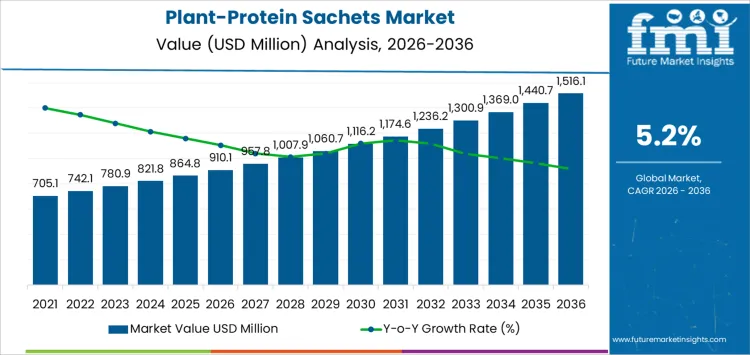
What is the Growth Forecast for the Plant-Protein Sachets Market through 2036?
From 2026 to 2031, the plant-protein sachets market increases from USD 910.1 million to about USD 1,114.7 million, reflecting steady compounding growth rather than abrupt volume shifts. Absolute yearly additions rise gradually during this phase as sachets gain wider placement in sports nutrition, meal replacements, and functional beverage mixes. Growth is supported by portion-controlled consumption, portability needs, and expanding trial by mainstream nutrition brands. The market trajectory in this period shows incremental strengthening, with each successive year contributing more value than the last as distribution widens and repeat ordering improves.
Between 2031 and 2036, the market expands from approximately USD 1,114.7 million to USD 1,516.1 million, indicating a stronger compounding effect in absolute value creation. Annual additions accelerate as sachets move from complementary formats to core packaging across mass-market nutrition portfolios. Growth is reinforced by higher SKU penetration, increased usage frequency, and broader adoption in clinical nutrition, workplace wellness, and e-commerce channels. While early growth reflected gradual build-up, the later phase demonstrates compounding momentum driven by scale deployment, standardized sourcing, and consistent demand across global protein supplementation applications.
Plant Protein Sachets Market Key Takeaways
| Metric | Value |
|---|---|
| Market Value (2026) | USD 910.1 million |
| Forecast Value (2036) | USD 1,516.1 million |
| Forecast CAGR (2026–2036) | 5.2% |
How Are Portion Precision and Distribution Flexibility Driving the Plant-Protein Sachets Market from 2026 to 2036?
Plant-protein sachets gained use as manufacturers packaged exact serving sizes for controlled daily intake. Nutritional brands, hospitals, and foodservice operators used sachets to standardize dosing of protein powders across varied settings. Historical demand reflected need for lightweight formats that reduced product waste and simplified storage. Sachets supported institutional catering, travel retail, and sample distribution where bulk containers were impractical. Packaging teams prioritized moisture barriers, seal integrity, and consistent fill weights to preserve protein quality. Adoption aligned with growth of powdered supplements used alongside meals rather than as standalone products.
From 2026 to 2036 demand is expected to expand as protein fortification spreads into routine diets and clinical nutrition. Sachets support integration of plant proteins into beverages, porridges, and ready meals prepared on site. Growth aligns with ageing populations, controlled nutrition programs, and broader use in hospitals and care facilities. Manufacturers refine sachet materials to improve flow release and reduce static cling. Buyers assess shelf stability, packing efficiency, and compatibility with automated filling equipment. Demand reflects increased focus on measured intake, portability, and simplified supply across nutrition focused channels.
What Is the Demand for the Plant-Protein Sachets Market by End Use and Packaging Format from 2026 to 2036?
Between 2026 and 2036, the plant-protein sachets market expands as protein consumption increasingly shifts toward portion-controlled and portable formats. Demand is shaped by supplements, functional drink mixes, and sports nutrition, where dosage accuracy and shelf stability remain critical. Sachets support controlled intake, reduced exposure to moisture, and efficient distribution across retail and online channels. Market growth reflects habitual consumption patterns rather than discretionary purchases, with packaging formats selected to ensure consistent quality, regulatory compliance, and operational efficiency across high-volume nutrition categories.
Why do supplements and nutraceuticals account for 40% of demand in the plant-protein sachets market from 2026 to 2036?
Supplements and nutraceuticals account for 40% of demand because plant proteins are increasingly positioned as daily dietary additions. Consumption intensity remains high among consumers following structured wellness routines that require precise serving sizes. Sachets preserve powder quality by limiting air and moisture exposure after opening. Procurement decisions emphasize oxygen barriers, moisture resistance, and sufficient space for regulatory labeling. Buyers favor sachets for travel packs, trial formats, and subscription refills. Price sensitivity remains moderate since sachets reduce dosing errors and product waste. Demand remains stable through 2036 as nutraceutical brands continue prioritizing consistency, hygiene, and predictable intake across plant-based protein offerings.
Sachet usage remains favored over bulk containers because bulk packs introduce variability after repeated opening. Sachets isolate each serving, maintaining flow properties and sensory consistency. Procurement favors formats that reduce customer complaints linked to clumping or degradation. Manufacturers prioritize compatibility with fine protein powders and accurate fill weights. Specification focus includes seal strength and powder release behavior. Demand stays resilient through 2036 as supplements continue integrating plant proteins into routine nutrition supported by controlled packaging.
Why do single-serve sachets represent 60% of demand in the plant-protein sachets market by packaging format from 2026 to 2036?
Single-serve sachets represent 60% of demand because they deliver exact portions without additional measuring tools. Consumption remains strong across supplements, functional drink mixes, and sports nutrition where intake consistency influences user adherence. Sachets protect plant proteins from humidity, oxygen, and contamination during storage and transport. Procurement decisions emphasize compatibility with high-speed form-fill-seal equipment and consistent seal performance. Buyers prioritize puncture resistance and handling durability. Price sensitivity stays moderate since single-serve formats reduce waste and simplify logistics. Demand persists through 2036 as brands scale standardized sachet formats across multiple protein formulations.
Operational efficiency reinforces the dominance of single-serve sachets across supply chains. Packaging lines benefit from uniform dimensions and predictable throughput. Warehousing and fulfillment gain from compact storage and consistent case packing. Procurement favors sachets that integrate smoothly with automated packing and labeling systems. Specification control centers on barrier consistency and seal integrity under transit stress. Demand remains firm through 2036 as single-serve sachets balance manufacturing efficiency with consumer convenience across plant-protein nutrition markets.
How Are Plant Protein Sachets Being Positioned Within Single Serve Nutrition and Food Service Systems?
Adoption appears in settings where measured protein intake and ease of handling guide format choice. Functional food brands distribute sachets alongside beverages and breakfast items that require precise protein addition. Airline caterers use sachets to support controlled meal composition without bulk containers. Workplace canteens rely on single serve packs to manage dietary variation among users. Disaster relief and aid programs include sachets for lightweight nutrition delivery. These applications reflect practical deployment needs centered on portion accuracy, portability, and controlled distribution rather than routine household consumption.
What Usage Contexts Encourage Selection of Plant Protein Sachets?
Use aligns with environments that manage nutrition through standardized servings. Clinical nutrition programs favor sachets to support patient specific intake without cross handling. Food manufacturers include them in multipacks for recipe based preparation. Fitness studios offer sachets for post workout consumption where storage space is limited. Online retailers rely on sachets to simplify fulfillment and reduce damage during shipping. These contexts prioritize dosing reliability, hygiene, and logistical simplicity within structured consumption or distribution settings.
Which Factors Influence Constraints on Wider Use of Plant Protein Sachets?
Packaging cost remains higher per serving compared with bulk formats. Fine protein powders can present sealing and dust control challenges during filling. Tear performance must balance ease of opening with barrier integrity. Waste generation concerns affect institutional buyers with disposal limits. Branding space is limited on small packs. Equipment setup for small fills adds operational complexity. These factors lead to selective adoption where controlled intake and portability outweigh cost and processing considerations.
What is the Demand for Plant Protein Sachets by Country?
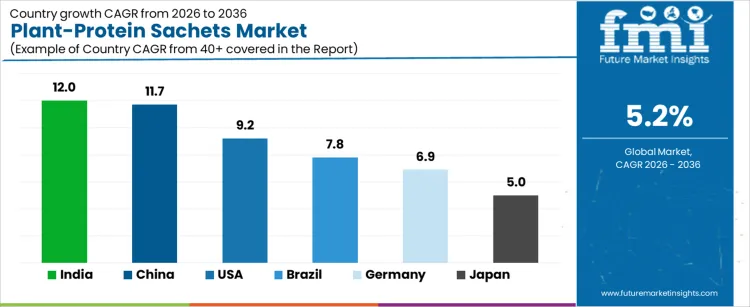
| Country | CAGR (%) |
|---|---|
| USA | 9.2% |
| Germany | 6.9% |
| China | 11.7% |
| India | 12.0% |
| Brazil | 7.8% |
| Japan | 5.0% |
The demand for plant protein sachets shows varied growth across countries, shaped by dietary trends, packaged nutrition consumption, and single serve format adoption. India leads with a 12.0% CAGR, supported by rising consumption of plant based nutrition products and growth in affordable single serve packaging. China follows at 11.7%, driven by expanding functional food and supplement manufacturing. The USA grows at 9.2%, reflecting demand for portion controlled nutrition products. Brazil records 7.8%, supported by expanding health food distribution. Germany posts 6.9%, shaped by mature health food markets, while Japan grows at 5.0%, reflecting stable consumption patterns and steady demand.
How Is Functional Food Packaging Adoption Supporting Growth in the United States?
In the United States, revenue from the Plant Protein Sachets Market is expanding at a CAGR of 9.2% through 2035, driven by growing consumption of plant based nutrition products and single serve formats. Food and nutraceutical brands are using plant protein sachets for portion control, portability, and extended shelf stability. Demand is concentrated in sports nutrition, dietary supplements, and functional beverage mixes distributed through retail and direct channels. Domestic contract packers are supporting high speed sachet filling compatible with protein powders. Stable consumer demand, established distribution networks, and recurring replenishment cycles are sustaining consistent procurement across product manufacturers nationwide.
- Sports nutrition and supplement brands are increasing use of single serve protein sachets for portion control and convenience
- Compatibility with existing sachet filling equipment supports adoption without changes to packaging lines
- Domestic contract packers provide scalable capacity for high volume sachet production
- Recurring consumer replenishment patterns sustain predictable packaging demand
How Do Quality and Labeling Standards Shape Demand in Germany?
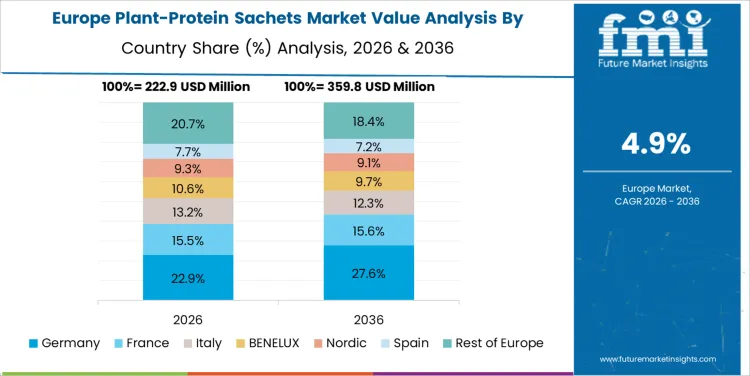
Germany continues to record steady growth in the Plant Protein Sachets Market at a CAGR of 6.9% through 2035, supported by strong quality standards and regulated food labeling practices. Producers are adopting sachet formats to deliver measured protein doses with controlled ingredient disclosure. Demand remains focused on dietary supplements, clinical nutrition, and functional food additives. Technical expertise in portion packaging supports consistent fill accuracy and sealing integrity. Stable health food consumption and compliance driven procurement practices are sustaining measured adoption across domestic packaging operations nationwide.
- Regulated nutrition labeling supports use of precise single serve sachet formats
- Dietary supplements and clinical nutrition products anchor demand
- Portion packaging expertise ensures consistent fill weight and seal quality
- Compliance focused procurement sustains steady adoption levels
How Is Plant Based Nutrition Expansion Accelerating Adoption in China?
In China, revenue from the Plant Protein Sachets Market is growing at a CAGR of 11.7% through 2035, driven by rapid expansion of plant based nutrition consumption and functional food manufacturing. Brands are using sachets to distribute protein powders and blends through e commerce and modern retail channels. Demand is strong across sports nutrition, meal replacements, and wellness products. Domestic manufacturers are scaling sachet production capacity using integrated packaging supply chains. High online sales volumes and structured procurement practices are sustaining rapid adoption across major nutrition product hubs nationwide.
- Growth in plant based nutrition consumption is increasing demand for sachet packaging
- E commerce distribution favors lightweight and portioned packaging formats
- Domestic production scaling improves availability at commercial volumes
- High turnover product categories sustain consistent packaging usage
How Is Organized Nutrition Manufacturing Supporting Growth in India?
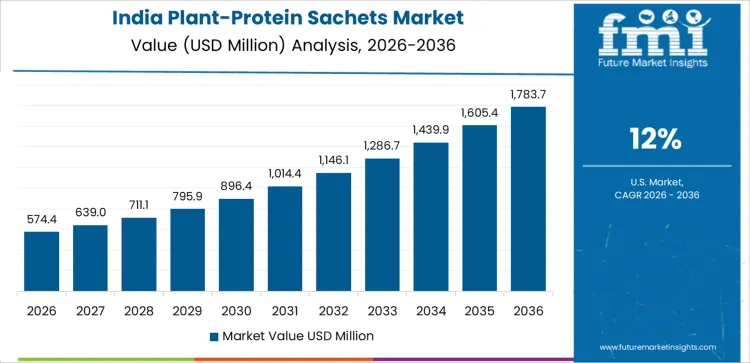
India is witnessing strong expansion in the Plant Protein Sachets Market at a CAGR of 12% through 2035, supported by growth in organized nutrition manufacturing and rising intake of protein supplements. Producers are adopting sachet formats to improve affordability and widen consumer reach. Demand is rising across sports nutrition, fortified foods, and institutional supply channels. Domestic packaging suppliers are offering cost aligned sachet solutions suited to high volume production. Expanding retail penetration and increasing health awareness are sustaining robust procurement across nutrition product manufacturers nationwide.
- Organized nutrition manufacturing is increasing demand for sachet based protein formats
- Affordable single serve packaging supports wider consumer adoption
- Domestic suppliers improve cost alignment for high volume sachet production
- Retail expansion and health awareness sustain demand growth
How Are Functional Beverage Mixes Supporting Adoption in Brazil?
Brazil is seeing steady growth in the Plant Protein Sachets Market at a CAGR of 7.8% through 2035, supported by rising consumption of functional beverage mixes and nutrition supplements. Manufacturers are using sachets to distribute protein powders and drink mixes with controlled dosing. Demand is concentrated in fitness focused products and wellness nutrition. Imports supply some specialized protein blends, while local packers expand sachet filling capacity. Growth in organized retail and nutrition product availability is sustaining recurring procurement across packaging operations nationwide.
- Functional beverage mixes drive demand for portioned protein sachets
- Controlled dosing supports product consistency and consumer use
- Local packers expand sachet filling capabilities to meet demand
- Retail nutrition growth sustains recurring packaging consumption
How Does Mature Nutrition Consumption Influence Stability in Japan?
Japan is maintaining measured growth in the Plant Protein Sachets Market at a CAGR of 5% through 2035, supported by mature nutrition consumption and preference for precise portion control. Brands apply sachet packaging selectively for protein supplements and functional foods. Demand remains focused on quality consistency, clean labeling, and ease of use. Domestic packaging suppliers emphasize precision filling and sealing reliability. Stable consumption patterns and replacement driven purchasing are sustaining predictable procurement across established nutrition product operations nationwide.
- Mature nutrition markets favor selective adoption of portion controlled sachet formats
- Precision dosing supports quality consistency and consumer trust
- Domestic suppliers ensure reliable filling and sealing performance
- Replacement driven purchasing sustains procurement continuity
What Is Shaping the Demand for Plant Protein Sachets and Which Packaging Firms Enable Commercial Scale Use?
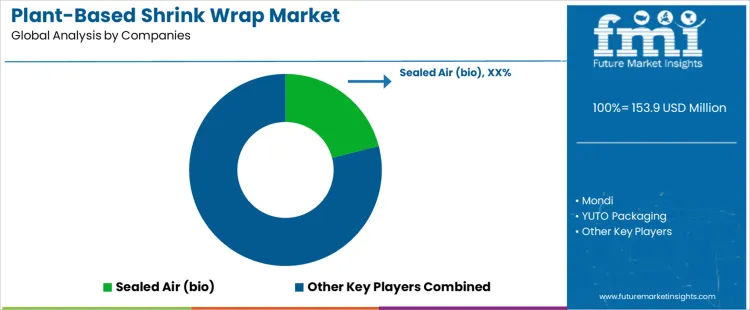
Plant protein sachets are gaining traction as brands expand single serve formats for powdered nutrition, meal enhancers, and functional food additives. Sports nutrition, elderly nutrition, and convenience focused dietary supplements rely on sachets to deliver controlled portions with long shelf stability. Sealed Air and other flexible packagers support this demand through barrier film sachets designed to protect protein powders from moisture and oxidation. Mondi contributes paper based and hybrid sachet structures used where renewable materials and recyclability messaging matter. YUTO Packaging supports premium and customized sachet formats for branded nutrition products and gift assortments. These solutions are tailored to high speed filling lines and diverse protein textures.
Material selection is driven by moisture barrier performance, seal integrity, powder release behavior, and resistance to pinholing during transport. UFlex supports high volume applications through cost efficient multilayer films used in mass market protein supplements. Toppan contributes advanced printing and sachet forming capabilities that support branding, dosage clarity, and regulatory information. Food manufacturers emphasize clean opening, minimal residue retention, and compatibility with dry blending systems. Usage spans plant protein drinks, instant soups, fortified foods, and meal replacement mixes. Demand visibility tracks growth in plant based nutrition, expansion of single serve packaging in Asia, and continued focus on portability and portion control in functional food consumption.
Key Players in the Plant Protein Sachets Market
- Sealed Air / flexible packagers
- Mondi
- YUTO Packaging
- UFlex
- Toppan
Scope of the Report
| Items | Values |
|---|---|
| Quantitative Units (2026) | USD million |
| End Use Application | Supplements and Nutraceuticals; Functional Drink Mixes; OEM Food Ingredients; Retail Protein Snacks; Sports Nutrition; Other Applications |
| Packaging Format Type | Single-serve Sachets; Powder Sachets; Flow-wrap Sachets; Heat-seal Sachets; Other Formats |
| Material | Multi-layer Barrier Pouches; Paper-plastic Laminates; PET Laminates; Recyclable Mono-PE; Other Materials |
| Technology | Sachet Filling and Sealing; Quad-seal Technology; High-speed Sachet Lines; Sachet Barrier Coating; Other Technologies |
| Regions Covered | Asia Pacific; Europe; North America; Latin America; Middle East & Africa |
| Countries Covered | China; Japan; South Korea; India; Australia & New Zealand; ASEAN; Germany; United Kingdom; France; Italy; Spain; Nordic; BENELUX; United States; Canada; Mexico; Brazil; Chile; Kingdom of Saudi Arabia; Turkey; South Africa; plus additional countries across Asia Pacific, Europe, Latin America, and Middle East & Africa |
| Key Companies Profiled | Sealed Air; Mondi; YUTO Packaging; UFlex; Toppan |
| Additional Attributes | Dollar by sales across end use applications and sachet formats; role of single serve sachets in portion controlled plant protein consumption; adoption of sachet packaging for sports nutrition, functional foods, and nutraceuticals; importance of moisture barrier performance, seal integrity, and powder flow release in sachet design; integration of sachet packaging with high speed filling and sealing lines; use of sachets in clinical nutrition, foodservice, and e commerce distribution; influence of packaging cost, waste considerations, and filling efficiency on adoption decisions |
Plant Protein Sachets Market Segmentation
End-use / Application
- Supplements & Nutraceuticals
- Functional Drink Mixes
- OEM Food Ingredients
- Retail Protein Snacks
- Sports Nutrition
- Others
Packaging Format / Type
- Single-serve Sachets
- Powder Sachets
- Flow-wrap Sachets
- Heat-seal Sachets
- Others
Material
- Multi-layer Pouches (barrier)
- Paper-plastic Laminates
- PET Laminate
- Recyclable Mono-PE
- Others
Technology
- Sachet Filling & Sealing
- Quad-seal Technology
- High-speed Sachet Lines
- Sachet Barrier Coating
- Others
Region
- Asia Pacific
- China
- Japan
- South Korea
- India
- Australia & New Zealand
- ASEAN
- Rest of Asia Pacific
- Europe
- Germany
- United Kingdom
- France
- Italy
- Spain
- Nordic
- BENELUX
- Rest of Europe
- North America
- United States
- Canada
- Mexico
- Latin America
- Brazil
- Chile
- Rest of Latin America
- Middle East & Africa
- Kingdom of Saudi Arabia
- Other GCC Countries
- Turkey
- South Africa
- Other African Union
- Rest of Middle East & Africa
Bibliography
- Food and Agriculture Organization of the United Nations. (2023). Plant protein materials and their use in food contact and packaging formats. FAO Food Systems Publications.
- International Organization for Standardization. (2023). Packaging materials and sachet performance testing standards. ISO Standards Publications.
- European Food Safety Authority. (2023). Plant derived materials used in food contact applications and safety considerations. EFSA Scientific Reports.
- Institute of Packaging Professionals. (2023). Flexible packaging formats including sachets and small portion packs. IoPP Technical Publications.
Frequently Asked Questions
How big is the plant-protein sachets market in 2026?
The global plant-protein sachets market is estimated to be valued at USD 910.1 million in 2026.
What will be the size of plant-protein sachets market in 2036?
The market size for the plant-protein sachets market is projected to reach USD 1,516.1 million by 2036.
How much will be the plant-protein sachets market growth between 2026 and 2036?
The plant-protein sachets market is expected to grow at a 5.2% CAGR between 2026 and 2036.
What are the key product types in the plant-protein sachets market?
The key product types in plant-protein sachets market are supplements & nutraceuticals, functional drink mixes, oem food ingredients, retail protein snacks, sports nutrition and others.
Which packaging format / type segment to contribute significant share in the plant-protein sachets market in 2026?
In terms of packaging format / type, single-serve sachets segment to command 60.0% share in the plant-protein sachets market in 2026.
Preview the report firsthand - request a free sample
Get SampleGet the brochure for pricing and purchase details.
Get PDFTable of Content
- Executive Summary
- Global Market Outlook
- Demand-side Trends
- Supply-side Trends
- Technology Roadmap Analysis
- Analysis and Recommendations
- Market Overview
- Market Coverage / Taxonomy
- Market Definition / Scope / Limitations
- Market Background
- Market Dynamics
- Drivers
- Restraints
- Opportunity
- Trends
- Scenario Forecast
- Demand in Optimistic Scenario
- Demand in Likely Scenario
- Demand in Conservative Scenario
- Opportunity Map Analysis
- Product Life Cycle Analysis
- Supply Chain Analysis
- Investment Feasibility Matrix
- Value Chain Analysis
- PESTLE and Porter’s Analysis
- Regulatory Landscape
- Regional Parent Market Outlook
- Production and Consumption Statistics
- Import and Export Statistics
- Market Dynamics
- Global Market Analysis 2021 to 2025 and Forecast, 2026 to 2036
- Historical Market Size Value (USD Million) Analysis, 2021 to 2025
- Current and Future Market Size Value (USD Million) Projections, 2026 to 2036
- Y-o-Y Growth Trend Analysis
- Absolute $ Opportunity Analysis
- Global Market Pricing Analysis 2021 to 2025 and Forecast 2026 to 2036
- Global Market Analysis 2021 to 2025 and Forecast 2026 to 2036, By End-use / Application
- Introduction / Key Findings
- Historical Market Size Value (USD Million) Analysis By End-use / Application , 2021 to 2025
- Current and Future Market Size Value (USD Million) Analysis and Forecast By End-use / Application , 2026 to 2036
- Supplements & Nutraceuticals
- Functional Drink Mixes
- OEM Food Ingredients
- Retail Protein Snacks
- Sports Nutrition
- Others
- Y-o-Y Growth Trend Analysis By End-use / Application , 2021 to 2025
- Absolute $ Opportunity Analysis By End-use / Application , 2026 to 2036
- Global Market Analysis 2021 to 2025 and Forecast 2026 to 2036, By Packaging Format / Type
- Introduction / Key Findings
- Historical Market Size Value (USD Million) Analysis By Packaging Format / Type, 2021 to 2025
- Current and Future Market Size Value (USD Million) Analysis and Forecast By Packaging Format / Type, 2026 to 2036
- Single-serve Sachets
- Powder Sachets
- Flow-wrap Sachets
- Heat-seal Sachets
- Others
- Y-o-Y Growth Trend Analysis By Packaging Format / Type, 2021 to 2025
- Absolute $ Opportunity Analysis By Packaging Format / Type, 2026 to 2036
- Global Market Analysis 2021 to 2025 and Forecast 2026 to 2036, By Material
- Introduction / Key Findings
- Historical Market Size Value (USD Million) Analysis By Material, 2021 to 2025
- Current and Future Market Size Value (USD Million) Analysis and Forecast By Material, 2026 to 2036
- Multi-layer Pouches (barrier)
- Paper-plastic laminates
- PET Laminate
- Recyclable Mono-PE
- Others
- Y-o-Y Growth Trend Analysis By Material, 2021 to 2025
- Absolute $ Opportunity Analysis By Material, 2026 to 2036
- Global Market Analysis 2021 to 2025 and Forecast 2026 to 2036, By Technology
- Introduction / Key Findings
- Historical Market Size Value (USD Million) Analysis By Technology, 2021 to 2025
- Current and Future Market Size Value (USD Million) Analysis and Forecast By Technology, 2026 to 2036
- Sachet Filling & Sealing
- Quad-seal Tech
- High-speed Sachet Lines
- Sachet Barrier Coating
- Others
- Y-o-Y Growth Trend Analysis By Technology, 2021 to 2025
- Absolute $ Opportunity Analysis By Technology, 2026 to 2036
- Global Market Analysis 2021 to 2025 and Forecast 2026 to 2036, By Region
- Introduction
- Historical Market Size Value (USD Million) Analysis By Region, 2021 to 2025
- Current Market Size Value (USD Million) Analysis and Forecast By Region, 2026 to 2036
- North America
- Latin America
- Western Europe
- Eastern Europe
- East Asia
- South Asia and Pacific
- Middle East & Africa
- Market Attractiveness Analysis By Region
- North America Market Analysis 2021 to 2025 and Forecast 2026 to 2036, By Country
- Historical Market Size Value (USD Million) Trend Analysis By Market Taxonomy, 2021 to 2025
- Market Size Value (USD Million) Forecast By Market Taxonomy, 2026 to 2036
- By Country
- USA
- Canada
- Mexico
- By End-use / Application
- By Packaging Format / Type
- By Material
- By Technology
- By Country
- Market Attractiveness Analysis
- By Country
- By End-use / Application
- By Packaging Format / Type
- By Material
- By Technology
- Key Takeaways
- Latin America Market Analysis 2021 to 2025 and Forecast 2026 to 2036, By Country
- Historical Market Size Value (USD Million) Trend Analysis By Market Taxonomy, 2021 to 2025
- Market Size Value (USD Million) Forecast By Market Taxonomy, 2026 to 2036
- By Country
- Brazil
- Chile
- Rest of Latin America
- By End-use / Application
- By Packaging Format / Type
- By Material
- By Technology
- By Country
- Market Attractiveness Analysis
- By Country
- By End-use / Application
- By Packaging Format / Type
- By Material
- By Technology
- Key Takeaways
- Western Europe Market Analysis 2021 to 2025 and Forecast 2026 to 2036, By Country
- Historical Market Size Value (USD Million) Trend Analysis By Market Taxonomy, 2021 to 2025
- Market Size Value (USD Million) Forecast By Market Taxonomy, 2026 to 2036
- By Country
- Germany
- UK
- Italy
- Spain
- France
- Nordic
- BENELUX
- Rest of Western Europe
- By End-use / Application
- By Packaging Format / Type
- By Material
- By Technology
- By Country
- Market Attractiveness Analysis
- By Country
- By End-use / Application
- By Packaging Format / Type
- By Material
- By Technology
- Key Takeaways
- Eastern Europe Market Analysis 2021 to 2025 and Forecast 2026 to 2036, By Country
- Historical Market Size Value (USD Million) Trend Analysis By Market Taxonomy, 2021 to 2025
- Market Size Value (USD Million) Forecast By Market Taxonomy, 2026 to 2036
- By Country
- Russia
- Poland
- Hungary
- Balkan & Baltic
- Rest of Eastern Europe
- By End-use / Application
- By Packaging Format / Type
- By Material
- By Technology
- By Country
- Market Attractiveness Analysis
- By Country
- By End-use / Application
- By Packaging Format / Type
- By Material
- By Technology
- Key Takeaways
- East Asia Market Analysis 2021 to 2025 and Forecast 2026 to 2036, By Country
- Historical Market Size Value (USD Million) Trend Analysis By Market Taxonomy, 2021 to 2025
- Market Size Value (USD Million) Forecast By Market Taxonomy, 2026 to 2036
- By Country
- China
- Japan
- South Korea
- By End-use / Application
- By Packaging Format / Type
- By Material
- By Technology
- By Country
- Market Attractiveness Analysis
- By Country
- By End-use / Application
- By Packaging Format / Type
- By Material
- By Technology
- Key Takeaways
- South Asia and Pacific Market Analysis 2021 to 2025 and Forecast 2026 to 2036, By Country
- Historical Market Size Value (USD Million) Trend Analysis By Market Taxonomy, 2021 to 2025
- Market Size Value (USD Million) Forecast By Market Taxonomy, 2026 to 2036
- By Country
- India
- ASEAN
- Australia & New Zealand
- Rest of South Asia and Pacific
- By End-use / Application
- By Packaging Format / Type
- By Material
- By Technology
- By Country
- Market Attractiveness Analysis
- By Country
- By End-use / Application
- By Packaging Format / Type
- By Material
- By Technology
- Key Takeaways
- Middle East & Africa Market Analysis 2021 to 2025 and Forecast 2026 to 2036, By Country
- Historical Market Size Value (USD Million) Trend Analysis By Market Taxonomy, 2021 to 2025
- Market Size Value (USD Million) Forecast By Market Taxonomy, 2026 to 2036
- By Country
- Kingdom of Saudi Arabia
- Other GCC Countries
- Turkiye
- South Africa
- Other African Union
- Rest of Middle East & Africa
- By End-use / Application
- By Packaging Format / Type
- By Material
- By Technology
- By Country
- Market Attractiveness Analysis
- By Country
- By End-use / Application
- By Packaging Format / Type
- By Material
- By Technology
- Key Takeaways
- Key Countries Market Analysis
- USA
- Pricing Analysis
- Market Share Analysis, 2025
- By End-use / Application
- By Packaging Format / Type
- By Material
- By Technology
- Canada
- Pricing Analysis
- Market Share Analysis, 2025
- By End-use / Application
- By Packaging Format / Type
- By Material
- By Technology
- Mexico
- Pricing Analysis
- Market Share Analysis, 2025
- By End-use / Application
- By Packaging Format / Type
- By Material
- By Technology
- Brazil
- Pricing Analysis
- Market Share Analysis, 2025
- By End-use / Application
- By Packaging Format / Type
- By Material
- By Technology
- Chile
- Pricing Analysis
- Market Share Analysis, 2025
- By End-use / Application
- By Packaging Format / Type
- By Material
- By Technology
- Germany
- Pricing Analysis
- Market Share Analysis, 2025
- By End-use / Application
- By Packaging Format / Type
- By Material
- By Technology
- UK
- Pricing Analysis
- Market Share Analysis, 2025
- By End-use / Application
- By Packaging Format / Type
- By Material
- By Technology
- Italy
- Pricing Analysis
- Market Share Analysis, 2025
- By End-use / Application
- By Packaging Format / Type
- By Material
- By Technology
- Spain
- Pricing Analysis
- Market Share Analysis, 2025
- By End-use / Application
- By Packaging Format / Type
- By Material
- By Technology
- France
- Pricing Analysis
- Market Share Analysis, 2025
- By End-use / Application
- By Packaging Format / Type
- By Material
- By Technology
- India
- Pricing Analysis
- Market Share Analysis, 2025
- By End-use / Application
- By Packaging Format / Type
- By Material
- By Technology
- ASEAN
- Pricing Analysis
- Market Share Analysis, 2025
- By End-use / Application
- By Packaging Format / Type
- By Material
- By Technology
- Australia & New Zealand
- Pricing Analysis
- Market Share Analysis, 2025
- By End-use / Application
- By Packaging Format / Type
- By Material
- By Technology
- China
- Pricing Analysis
- Market Share Analysis, 2025
- By End-use / Application
- By Packaging Format / Type
- By Material
- By Technology
- Japan
- Pricing Analysis
- Market Share Analysis, 2025
- By End-use / Application
- By Packaging Format / Type
- By Material
- By Technology
- South Korea
- Pricing Analysis
- Market Share Analysis, 2025
- By End-use / Application
- By Packaging Format / Type
- By Material
- By Technology
- Russia
- Pricing Analysis
- Market Share Analysis, 2025
- By End-use / Application
- By Packaging Format / Type
- By Material
- By Technology
- Poland
- Pricing Analysis
- Market Share Analysis, 2025
- By End-use / Application
- By Packaging Format / Type
- By Material
- By Technology
- Hungary
- Pricing Analysis
- Market Share Analysis, 2025
- By End-use / Application
- By Packaging Format / Type
- By Material
- By Technology
- Kingdom of Saudi Arabia
- Pricing Analysis
- Market Share Analysis, 2025
- By End-use / Application
- By Packaging Format / Type
- By Material
- By Technology
- Turkiye
- Pricing Analysis
- Market Share Analysis, 2025
- By End-use / Application
- By Packaging Format / Type
- By Material
- By Technology
- South Africa
- Pricing Analysis
- Market Share Analysis, 2025
- By End-use / Application
- By Packaging Format / Type
- By Material
- By Technology
- USA
- Market Structure Analysis
- Competition Dashboard
- Competition Benchmarking
- Market Share Analysis of Top Players
- By Regional
- By End-use / Application
- By Packaging Format / Type
- By Material
- By Technology
- Competition Analysis
- Competition Deep Dive
- Sealed Air / flexible packagers
- Overview
- Product Portfolio
- Profitability by Market Segments (Product/Age /Sales Channel/Region)
- Sales Footprint
- Strategy Overview
- Marketing Strategy
- Product Strategy
- Channel Strategy
- Mondi
- YUTO Packaging
- UFlex
- Toppan
- Sealed Air / flexible packagers
- Competition Deep Dive
- Assumptions & Acronyms Used
- Research Methodology


