

- Market Size (2026)
- USD 480.0 Mn
- Forecast (2036)
- USD 1085.3 Mn
- CAGR (2026 to 2036)
- 8.5%
How big is the Poultry Resilience Additives Market in 2026?
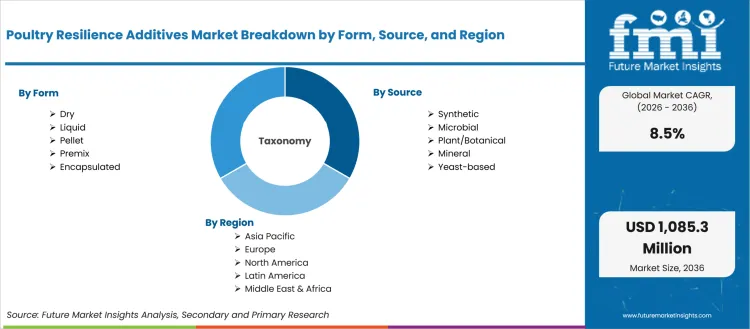
USD 480.0 million in 2026 and USD 1,085.3 million by 2036 at a 8.5% CAGR.
Demand in the poultry resilience additives market is tied to the economics of animal production. Producers consider these additives when they can connect use to more stable broiler and layer performance under commercial production pressure.
The source base keeps the market discussion grounded in livestock and feed-input pressure. FAOSTAT and FAO Livestock Systems frame the production base, while USDA ERS Feed Grains Database helps explain why feed-cost movement affects additive evaluation.
The operating issue for buyers is validation. A product may appear useful in controlled tests, but procurement teams need evidence for flock-level response, stage-of-life fit, and integrator economics before it becomes part of routine formulation. This keeps supplier selection focused on proof, service quality, and formulation support.
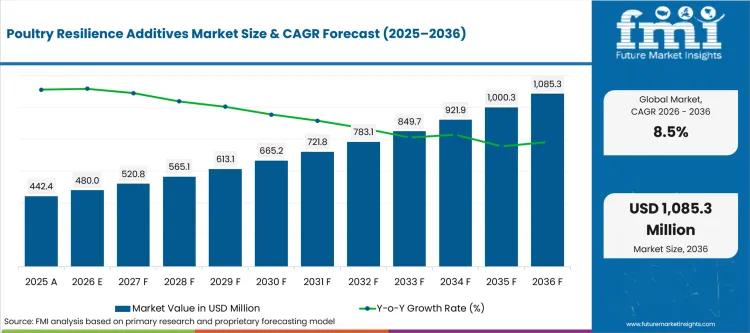
Key Takeaways of Poultry Resilience Additives Market
-
Demand for poultry resilience additives is driven by the need to improve poultry resilience, maintain flock performance, and optimize feed efficiency while supporting commercial production profitability.
- By livestock, poultry is expected to lead with 43.8% share in 2026 (USD 210.2 million), supported by continuous monitoring of feed conversion, flock uniformity, and production performance.
- Dry formulations are the dominant form segment, projected to hold 38.7% share in 2026 (USD 185.8 million), owing to easier storage, handling, blending, and transportation.
- Synthetic sources are estimated to lead the source category with 21.8% share in 2026 (USD 104.6 million), reflecting demand for consistent quality, predictable supply, and tighter specification control.
- Budget constraints, validation costs, dosage economics, and processing stability remain key barriers to broader market adoption, keeping procurement focused on trial validation and cost discipline.
- India and China are expected to form the higher-growth country tier, advancing at 10.74% and 9.74% CAGR respectively through 2036, supported by expanding poultry production and large-scale feed manufacturing.
- Competition centers on dsm-firmenich, Cargill, ADM, Kemin Industries, Alltech, and Novonesis, with vendors differentiating through poultry nutrition solutions, technical documentation, and application support tailored to regional production systems.
Analyst Perspective
"Success in the poultry resilience additives market is closely tied to how well products perform across different stages of poultry production under commercial farming conditions. Feed producers and integrators are selecting suppliers that can translate research into practical feeding strategies, deliver consistent flock outcomes, and support customers with timely technical expertise. Suppliers that help improve bird resilience while maintaining efficient production systems are expected to establish stronger, long-term commercial relationships."
- Nandini Roy Choudhury, Principal Analyst, Food and Beverage
How is the Poultry Resilience Additives Market segmented?
The poultry resilience additives industry is segmented by Form, Source, Livestock, Function, and Region.
By form, the market covers Dry, Liquid, Pellet, Premix, and Encapsulated. By source, the market covers Synthetic, Microbial, Plant/Botanical, Mineral, and Yeast-based. By livestock, the market covers Poultry, Broilers, Layers, Turkey, and Other poultry. By function, the market covers Gut health, Growth performance, Immunity, Nutrient use, and Stress management. By region, the market covers North America, Europe, East Asia, South Asia, and Latin America.
Why does Poultry carry weight within Livestock?
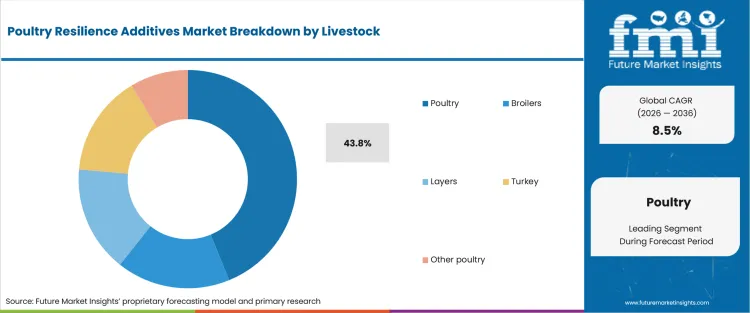
Commercial poultry diets rely heavily on plant ingredients that contain substantial phosphorus bound in phytate. Phytase breaks this structure and improves phosphorus access, so integrators assess feed conversion and mineral release across short production cycles. In May 2026, Novonesis received full European Union label registration for HiPhorius across all monogastric species. The company reported improved heat stability during pelleting and broader regulated use across poultry categories. The expanded label gives feed producers one regulated formulation route across broiler and layer programs.
- Poultry is expected to lead the livestock category with 43.8% share in 2026 due to the scale and repetition of commercial feed programs. Large commercial flocks consume standardized rations every day across tightly scheduled production cycles and integrated farms. Small improvements in phosphorus release or feed conversion therefore affect ingredient costs across many production cycles and support regular phytase use.
- Poultry nutrition teams adopt phytate-reduction additives to release phosphorus from plant ingredients and reduce dependence on inorganic phosphate. Broiler and layer programs also require species-specific dosing across life stages with different calcium needs and production goals. Commercial uptake therefore depends on clear matrix values that formulation software can apply without weakening mineral balance or flock performance.
What keeps Dry relevant in the Form category?
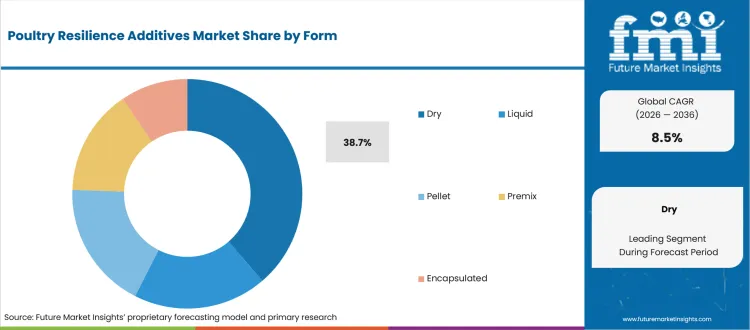
Dry phytate-reduction additives fit feed mills that dose enzymes through premixes or directly into compound feed before pelleting. Storage stability and even distribution determine whether enzyme activity remains consistent across large commercial feed batches. In January 2026, the European Commission renewed authorization for a 6-phytase preparation in solid and liquid forms and required instructions covering storage conditions and heat-treatment stability. The decision reflects the operational checks that determine whether dry products remain usable through feed processing.
- By form, dry is estimated to hold 38.7% share in 2026 owing to its compatibility with premix handling and pre-pellet dosing. Feed manufacturers can meter powders or granulates through established batching systems that already handle vitamins and other micro-ingredients. Established handling infrastructure reduces the need for separate post-pellet liquid equipment and supports consistent inclusion across commercial production runs.
- Commercial feed mills favor dry formulations for programs that require long storage periods and frequent recipe changes. Granulated or coated products can be staged with other micro-ingredients and transferred through standard storage systems. Commercial adoption depends on verified enzyme recovery during pelleting, since heat exposure can reduce active phytase below the formulated dose.
How do buyers evaluate Synthetic within Source?
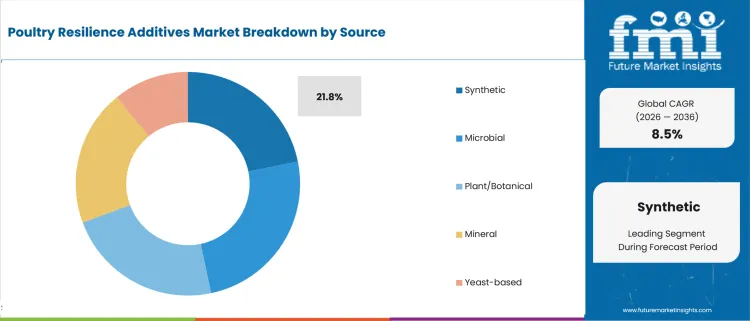
The synthetic source segment competes through controlled activity and consistent specification rather than natural variability in untreated ingredients. Feed formulators need a declared activity level that remains comparable across premixes and finished diets. In February 2026, the European Commission authorized a 6-phytase preparation with defined minimum activity for solid and liquid forms. The regulation also specified EN ISO 30024 for activity measurement, giving commercial users a clearer basis for dose verification and source comparison.
- By source, synthetic is forecast to represent 21.8% share in 2026 driven by demand for controlled concentration and documented activity. Feed manufacturers can compare declared enzyme units across batches and production sites using the same quality framework. Controlled specifications support tighter formulation tolerances and simplify quality review for programs that require predictable nutrient-release values. The same documentation supports contracted specifications across facilities that use different grain blends and processing conditions.
- Compound-feed producers choose controlled formulations when they need the same matrix contribution across changing grain lots and manufacturing locations. Adoption depends on accurate dosing and independent activity testing rather than a broad source claim. Repeat purchasing requires quality teams to confirm enzyme recovery in premixes and finished feed through recognized analytical methods.
Where does Gut health fit within Function demand?
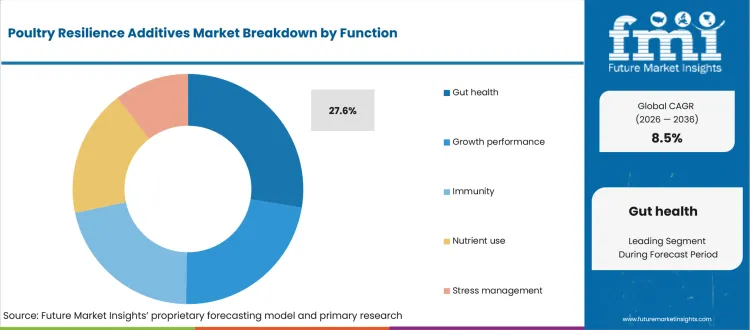
Gut health demand is linked to phytate’s antinutritional effects, which can reduce mineral availability and alter digestive conditions around plant-based diets. In January 2025, AB Vista announced field research that used specific biomarkers to monitor gastrointestinal health in broilers and assess flock resilience. Feed programs therefore need measurable intestinal outcomes that separate digestive response from broad wellness positioning. The development strengthens the commercial case for linking phytase programs with measurable digestive responses under normal farm conditions.
- The gut health segment is likely to capture 27.6 % share in 2026 attributable to the need for stable digestive performance in grain-based feeding programs. Phytate degradation can support nutrient release beyond phosphorus, giving nutrition teams a reason to assess intestinal response alongside feed conversion and mineral utilization during commercial trials.
- Poultry and swine nutrition teams expand gut-health applications as trials demonstrate repeatable responses under normal diet changes and production stress. The adoption decision depends on biomarkers and performance records that separate phytase effects from other enzymes or additives. Clear evidence helps formulators set an inclusion rate without turning a targeted digestive function into an
What explains the North America position within Region?
North America demand within Region is shaped by how easily the additive can be handled in commercial feeding programs. North America reflects integrated production systems, formal nutrition programs, and established technical-service expectations from suppliers.
- North America accounts for 24.9% share within Region in 2026. The segment is valued at USD 110.2 million in 2025, USD 119.5 million in 2026, and USD 270.2 million by 2036. Cargill feed additives provides the source context used for this demand view.
- For suppliers, the issue is service coverage. Regional demand becomes easier to capture when technical support, distributor reach, and local trial evidence are already in place.
What are the drivers, restraints, and opportunities in the Poultry Resilience Additives Market?
Near-term purchases are being shaped by the operating requirement, implementation constraint, and expansion route outlined below.
- The main driver is that feed efficiency, animal performance, protein demand, and input-cost discipline support demand. Buyers need a practical reason to approve spend, so demand improves where evidence can be linked to flock-level response, stage-of-life fit, and integrator economics.
- The main restraint is that budget pressure, uncertain farm economics, validation cost, and uneven technical support restrain adoption. Adoption slows when buyer teams cannot see the payback, safety boundary, service owner, or documentation path clearly enough for approval.
- The opportunity lies in precision nutrition, antibiotic-reduction programs, and species-specific additive support. Suppliers can use this route only when they bring practical evidence, local support, and a realistic implementation plan.
Demand is more defensible when the additive addresses a defined feed-program problem. FAOSTAT anchors the livestock and agricultural context, so adoption should be tied to farm economics and measurable response.
The profiled country rows reconcile to USD 480.0 million in 2026 and USD 1,085.3 million by 2036 at a 8.5% CAGR. This matters because a strong forecast still depends on whether producers can justify additive spend against feed cost and field performance.
Implementation friction comes from trial cost, formulation changes, processing stability, and responsibility for technical service after purchase. Suppliers with clear usage guidance and reliable local support are better positioned than suppliers that offer only product availability.
Which country CAGRs are profiled in the Poultry Resilience Additives Market?
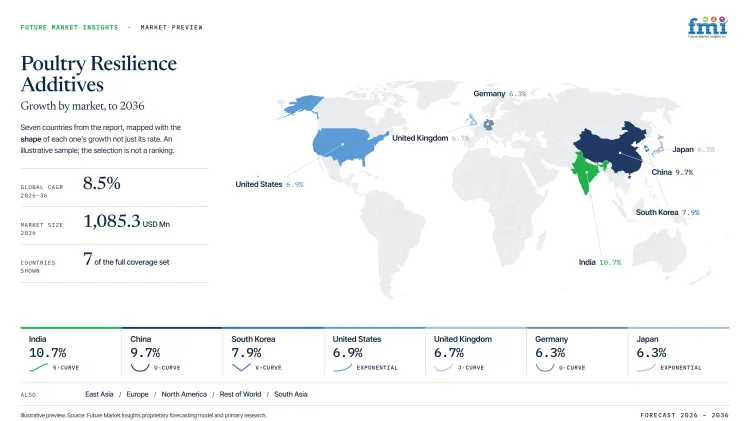
| Country | CAGR |
|---|---|
| United States | 6.94% |
| China | 9.74% |
| India | 10.74% |
| Germany | 6.34% |
| United Kingdom | 6.74% |
| Japan | 6.34% |
| South Korea | 7.94% |
| Rest of World | 9.14% |
How do country-level CAGRs compare in the Poultry Resilience Additives Market?
The country comparison spans 4.4 percentage points and reveals four distinct growth tiers across the Poultry Resilience Additives Market. India, China and the Rest of World occupy the highest growth band with 1.6 percentage points separating the three markets. South Korea forms a transition between the upper and lower tiers, sitting 1.2 percentage points below the Rest of World. The United States and the United Kingdom remain closely aligned with only a 0.2-point difference, while Germany and Japan record identical CAGRs. Markets with expanding commercial poultry production and increasing focus on flock resilience, disease management and production efficiency generally exhibit stronger growth.
-
India tops the comparison at 10.74% CAGR as poultry producers increasingly adopt resilience-focused feed additives to strengthen bird health, improve tolerance to environmental stress and maintain consistent production performance.
-
China comes next, trailing India by 1.0 percentage point. The country's large commercial poultry industry continues to expand the use of nutritional solutions that help improve flock robustness and support efficient production under intensive farming conditions.
-
The Rest of World records a CAGR of 9.14%, placing it 0.6 percentage points below China. Growth is supported by the modernization of poultry production across emerging markets and increasing adoption of feed additives that enhance bird resilience and overall productivity.
-
South Korea sits 1.2 percentage points behind the Rest of World, reflecting growing interest in precision poultry nutrition and feed programs designed to improve health status and reduce production losses.
-
The United States follows with a CAGR of 6.94%, remaining 1.0 percentage point below South Korea. Demand is driven by greater emphasis on maintaining flock performance, optimizing feed efficiency and supporting bird health throughout the production cycle.
-
The United Kingdom remains just 0.2 percentage points below the United States as producers continue incorporating nutritional technologies that help birds cope with production stress while sustaining growth and feed utilization.
-
Germany and Japan each register a CAGR of 6.34%, placing them at the same level in the comparison. Established poultry industries in both markets continue adopting resilience additives as part of balanced nutrition programs aimed at supporting flock health, productivity and efficient feed use.
Comparable CAGRs can still produce different market entry conditions. Differences in poultry production systems, feed formulation practices, disease management priorities and adoption of advanced nutritional technologies influence market expansion and long-term commercial opportunities. The full report provides country-level CAGR analysis across North America, Latin America, Europe, East Asia, South Asia, Oceania and the Middle East and Africa.
Country-wise Analysis
- India records USD 48.00 million in 2026, reaching USD 133.1 million by 2036 at a 10.74% CAGR, the fastest pace in this set. Poultry, dairy, and mixed livestock operations all contribute to demand, but adoption speed hinges on price sensitivity and how much field support suppliers provide. Affordable pricing paired with straightforward inclusion guidance determines whether products move quickly from trial stage into routine use.
- United States: Valued at USD 96.00 million in 2026, the market is projected to reach USD 187.9 million by 2036, growing at a 6.94% CAGR. Integrator economics and tight feed-cost margins keep buyers focused on measurable outcomes rather than promotional claims. Formal nutrition programs at the integrator level mean sourcing teams expect trial data, clear dosage economics, and support structured around integrator decision timelines before any product moves past evaluation.
- China: From a base of USD 86.40 million in 2026, revenue is set to climb to USD 218.9 million by 2036, a 9.74% CAGR. Large-scale feed compounders and high-throughput operations push demand toward additives proven to hold up through processing. Suppliers competing here need documented processing-stability data and technical support built to scale across sizable feed operations, since inconsistent performance at volume quickly erodes buyer confidence.
- Germany's market stands at USD 38.40 million in 2026 and is expected to reach USD 71.04 million by 2036, expanding at a 6.34% CAGR. Feed buyers here weigh documentation quality, additive performance, and regulatory compliance carefully before switching formulation programs. Supplier evaluations tend to center on how well documentation and regulatory fit hold up, alongside evidence that feed response stays consistent across batches.
- The United Kingdom starts 2026 at USD 24.00 million and is on track to hit USD 46.10 million by 2036, a 6.74% CAGR. Farm economics and retail-driven pressure around animal production practices are shaping demand here. Buyers need technical guidance that clearly links additive use to both farm-level economics and the expectations retail chains are placing on producers.
- Japan's market size of USD 28.80 million in 2026 is forecast to grow to USD 53.28 million by 2036, reflecting a 6.34% CAGR. Production systems here are compact and quality-focused, which puts a premium on consistent feed response and well-documented supplier support. Confidence in a supplier tends to rest on stable product quality, detailed usage instructions, and dependable distributor service.
- South Korea, valued at USD 19.20 million in 2026, is projected to more than double to USD 41.23 million by 2036 at a 7.94% CAGR. Dense livestock operations combined with feed-cost sensitivity push buyers to look for fast, local evidence of results. When performance gaps show up, buyers expect quick technical response backed by data from local diet conditions rather than generic trial results.
- Rest of World enters 2026 at USD 139.2 million and is expected to more than double to USD 333.8 million by 2036, growing at a 9.14% CAGR. Adoption across this group leans heavily on distributor networks, and mixed livestock systems make local technical service just as important as simple product availability. Because livestock systems and feed practices vary so widely across these markets, strong distributor reach and hands-on local support remain essential to gaining traction.
Who are the notable companies in the Poultry Resilience Additives Market?
dsm-firmenich, Cargill, ADM, Kemin Industries, Alltech, Novonesis, Lallemand Animal Nutrition, Phileo by Lesaffre, Trouw Nutrition / Selko, Evonik Industries, and EW Nutrition are the notable companies shaping this market.
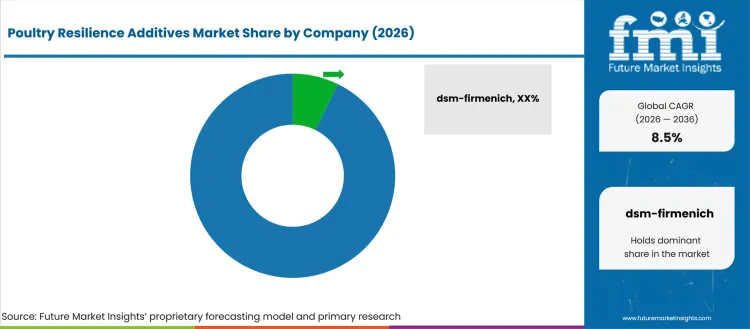
Competition is shaped by the ability to support broiler and layer performance through heat stress, gut challenge, feed hygiene, raw-material variation, and antibiotic-reduction programs. Poultry integrators need suppliers that can support product use at flock scale, with enough technical service to explain the response when conditions change.
- dsm-firmenich, Cargill, ADM, Evonik Industries, and Kemin Industries are relevant because they combine poultry nutrition portfolios with field and technical support. Their buyer relevance is strongest where integrators want additive use to fit ration cost, production targets, and supplier accountability.
- Novonesis, Lallemand Animal Nutrition, Phileo by Lesaffre, Alltech, and EW Nutrition matter where resilience programs involve probiotics, yeast, microbial products, gut-health support, and toxin-risk mitigation. Buyers need evidence by bird type, diet, and local management condition before widening use.
- Trouw Nutrition / Selko is relevant where poultry resilience is tied to feed safety, Salmonella control, trace mineral optimization, and flock-performance support. It is useful for buyers that want feed-to-farm service rather than a narrow additive purchase.
Competitive Benchmarking: Poultry Resilience Additives Market
| Company | Poultry Portfolio Fit | Gut or Stress Support | Technical Service Capability | Geographic Footprint |
|---|---|---|---|---|
| dsm-firmenich | High | High | High | Global |
| Cargill | High | Strong | High | Global |
| ADM | Strong | Medium | High | Global |
| Kemin Industries | High | High | Strong | Global |
| Alltech | Strong | Strong | Strong | Global |
| Novonesis | Strong | High | Strong | Global |
| Lallemand Animal Nutrition | Strong | Strong | Strong | Global |
| Phileo by Lesaffre | Strong | Strong | Strong | Global |
| Trouw Nutrition / Selko | Strong | Strong | Strong | Global |
| Evonik Industries | Strong | Medium | High | Global |
| EW Nutrition | Strong | Strong | Strong | Global |
Source: Future Market Insights competitive analysis, 2026. Ratings reflect relative portfolio relevance, workflow or project fit, service capability, and geographic reach.
Key Players in the Poultry Resilience Additives Market
Integrated Poultry Nutrition Suppliers
- dsm-firmenich
- Cargill
- ADM
- Evonik Industries
- Kemin Industries
Gut-Health, Microbial, and Yeast Solution Suppliers
- Novonesis
- Lallemand Animal Nutrition
- Phileo by Lesaffre
- Alltech
- EW Nutrition
Feed Safety and Flock-Support Suppliers
- Trouw Nutrition / Selko
Poultry Resilience Additives Market - Report Scope
| Coverage field | Report scope |
|---|---|
| Market breakdown | Poultry Resilience Additives Market Breakdown Form, Source, Livestock, Function, Region |
| Market Definition | Commercial demand covered under Poultry Resilience Additives Market, including country demand, segment demand, and supplier-selection context |
| Regions Covered | East Asia, Europe, North America, Rest of World, South Asia |
| Countries Covered | United States, China, India, Germany, United Kingdom, Japan, South Korea, Rest of World |
| Key Companies Profiled | dsm-firmenich, Cargill, ADM, Kemin Industries, Alltech, Novonesis, Lallemand Animal Nutrition, Phileo by Lesaffre, Trouw Nutrition / Selko, Evonik Industries, and EW Nutrition |
| Forecast Period | 2026 to 2036 |
| Approach | Global, country, and segment assessment using public source evidence and market context |
Poultry Resilience Additives Market - Research Methodology
| Method | Approach |
|---|---|
| Primary Research | The assessment covers buyer needs, supplier roles, country demand, and segment-level adoption patterns. |
| Desk Research | FAOSTAT; FAO Livestock Systems; USDA ERS Feed Grains Database. Official company portfolio, product, label, and press-release pages were reviewed where company names were used. |
| Market Sizing and Forecasting | Global, country, and segment values were assessed across demand pools, country adoption, segment share, and forecast-period growth. |
| Data Validation | Country totals, segment shares, and forecast values are presented on one reconciled base. |
Poultry Resilience Additives Market by Segments
Poultry Resilience Additives Market segmented by Form:
- Dry
- Liquid
- Pellet
- Premix
- Encapsulated
Poultry Resilience Additives Market segmented by Source:
- Synthetic
- Microbial
- Plant/Botanical
- Mineral
- Yeast-based
Poultry Resilience Additives Market segmented by Livestock:
- Poultry
- Broilers
- Layers
- Turkey
- Other poultry
Poultry Resilience Additives Market segmented by Function:
- Gut health
- Growth performance
- Immunity
- Nutrient use
- Stress management
Poultry Resilience Additives Market segmented by Region:
- North America
- Europe
- East Asia
- South Asia
- Latin America
Research Sources and Bibliography
- 1. FAOSTAT. Livestock, crop, food-balance, and agricultural production baseline.
- 2. FAO Livestock Systems. Livestock distribution and animal-production demand context.
- 3. USDA ERS Feed Grains Database. Feed grain supply, use, and price context for feed inputs.
- 4. dsm-firmenich Animal Nutrition & Health.
- 5. Cargill feed additives.
- 6. Evonik Animal Nutrition & Health.
- 7. ADM Animal Nutrition.
- 8. Adisseo animal nutrition.
- 9. IFF Danisco Animal Nutrition & Health.
- 10. Kemin Animal Nutrition & Health.
- 11. Alltech Mycosorb.
- 12. Novus International.
- 13. Novonesis poultry digestive health.
- 14. Lallemand Animal Nutrition.
- 15. Phileo by Lesaffre.
- 16. Trouw Nutrition Selko feed additives.
- 17. EW Nutrition products.
- 18. European Commission. (2026, January 14). Commission Implementing Regulation (EU) 2026/91 of 14 January 2026 concerning the renewal of the authorisation of a preparation of 6-phytase produced with Trichoderma reesei CBS 126897 as a feed additive for poultry, weaned piglets, pigs for fattening and sows, the authorisation of a preparation of 6-phytase produced with Trichoderma reesei CBS 126897 as a feed additive for ornamental birds, suckling piglets and minor porcine species (holder of authorisation: AB Enzymes Finland Oy) and repealing Implementing Regulation (EU) No 292/2014. Official Journal of the European Union.
- 19. Novonesis. (2026, May 26). Full label registration of Novonesis’ HiPhorius™ phytase enables wider use for feed producers in the EU.
- 20.European Commission. (2026, February 24). Commission Implementing Regulation (EU) 2026/404 of 24 February 2026 concerning the authorisation of a preparation of 6-phytase produced with Komagataella phaffii CGMCC 7.370 as a feed additive for porcine species, poultry and ornamental birds (holder of authorisation: Victory Enzymes GmbH). Official Journal of the European Union.
- 21.AB Vista. (2025, January 23). AB Vista to present latest findings on gut health and phytase at IPPE 2025.
This Report Answers
- What is the expected global value of the Poultry Resilience Additives Market in 2026 and 2036?
- What CAGR is forecast for the Poultry Resilience Additives Market during the 2026 to 2036 period?
- Which country value and CAGR rows are included for Poultry Resilience Additives Market?
- Which segment groups and subsegments carry the higher 2026 shares?
- How do country values reconcile with the global 2026 and 2036 totals?
- Which public sources support the market, country, and segment context?
- Which named companies shape competition in the Poultry Resilience Additives Market?
- What adoption risk, procurement risk, or supplier-selection issue should executives watch?
- How does FMI size and forecast Poultry Resilience Additives Market across countries and segments?
- Which supplier or development signals affect executive decisions?
Frequently Asked Questions
Why should executives track the Poultry Resilience Additives Market?
Executives should track this market because additive use affects feed cost, animal performance, supplier dependence, and formulation risk. The value case is easier to defend when procurement can connect product use to field response and avoid broad nutrition claims.
What business problem does the Poultry Resilience Additives Market address?
The market addresses the need to improve more stable broiler and layer performance under commercial production pressure while keeping additive spend under control. Buyers need proof that the product works in commercial diets, as well as in controlled demonstrations.
What should procurement leaders evaluate before selecting suppliers?
Procurement leaders should compare formulation fit, dosage economics, processing stability, species-specific evidence, distributor service, and documentation quality. Supplier selection should also check who supports trial work after the first purchase.
What can limit return on investment for buyers?
Return on investment can be limited by weak field evidence, high validation cost, inconsistent raw materials, and poor local technical support. Buyers can reduce this risk by using phased trials and measuring outcomes against feed-cost and performance targets.
How can suppliers build executive confidence?
Suppliers build confidence through field data, clear inclusion guidance, stable supply, and practical nutrition support. The buyer needs to see how the product performs in routine feeding programs before it becomes part of repeat procurement.
Preview the report firsthand - request a free sample
Get SampleGet the brochure for pricing and purchase details.
Get PDFTable of Content
- Key Takeaways
- Market Size and CAGR
- Top Growth Driver
- Fastest Growing Segment
- Leading Region
- Key Companies
- Emerging Opportunities
- Executive Summary
- Global Market Outlook
- Demand-side Trends
- Supply-side Trends
- Technology Roadmap Analysis
- Analysis and Recommendations
- Analyst Perspective (What is happening? Why now? What should investors know?)
- Key Questions Answered
- How large is the market?
- What is the CAGR?
- What are key trends?
- Which region dominates?
- Who are the leaders?
- Market Overview
- Market Coverage / Taxonomy
- Market Definition / Scope / Limitations
- Research Methodology
- Chapter Orientation
- Analytical Lens and Working Hypotheses
- Market Structure, Signals, and Trend Drivers
- Benchmarking and Cross-market Comparability
- Market Sizing, Forecasting, and Opportunity Mapping
- Research Design and Evidence Framework
- Desk Research Programme (Secondary Evidence)
- Expert Input and Fieldwork (Primary Evidence)
- Tooling, Models, and Reference Databases
- Data Engineering and Model Build
- Quality Assurance and Audit Trail
- Market Background
- Market Dynamics (Drivers, Restraints, Opportunity, Trends)
- Scenario Forecast (Optimistic, Likely, Conservative)
- Impact Analysis
- AI Impact
- Sustainability Impact
- Regulatory Impact
- Technology Impact
- Consumer / Buyer Analysis
- Purchase Drivers
- Adoption Barriers
- Buyer Journey
- Opportunity Map Analysis
- Product Life Cycle Analysis
- Supply Chain Analysis
- Investment Feasibility Matrix
- Value Chain Analysis
- PESTLE and Porter's Analysis
- Regulatory Landscape
- Regional Parent Market Outlook
- Production and Consumption Statistics
- Import and Export Statistics
- Global Market Analysis and Forecast, 2021 to 2036
- Historical Market Size Value (USD Million) Analysis, 2021 to 2025
- Current and Future Market Size Value (USD Million) Projections, 2026 to 2036
- Y-o-Y Growth Trend Analysis
- Absolute $ Opportunity Analysis
- Global Market Pricing Analysis, 2021 to 2036
- Global Market Analysis and Forecast, By Form, 2021 to 2036
- Introduction / Key Findings
- Historical Market Size Value (USD Million) Analysis By Form, 2021 to 2025
- Current and Future Market Size Value (USD Million) Analysis and Forecast By Form, 2026 to 2036
- Dry
- Liquid
- Pellet
- Premix
- Encapsulated
- Dry
- Y-o-Y Growth Trend Analysis By Form, 2021 to 2025
- Absolute $ Opportunity Analysis By Form, 2026 to 2036
- Global Market Analysis and Forecast, By Source, 2021 to 2036
- Introduction / Key Findings
- Historical Market Size Value (USD Million) Analysis By Source, 2021 to 2025
- Current and Future Market Size Value (USD Million) Analysis and Forecast By Source, 2026 to 2036
- Synthetic
- Microbial
- Plant/Botanical
- Mineral
- Yeast-based
- Synthetic
- Y-o-Y Growth Trend Analysis By Source, 2021 to 2025
- Absolute $ Opportunity Analysis By Source, 2026 to 2036
- Global Market Analysis and Forecast, By Livestock, 2021 to 2036
- Introduction / Key Findings
- Historical Market Size Value (USD Million) Analysis By Livestock, 2021 to 2025
- Current and Future Market Size Value (USD Million) Analysis and Forecast By Livestock, 2026 to 2036
- Poultry
- Broilers
- Layers
- Turkey
- Other poultry
- Poultry
- Y-o-Y Growth Trend Analysis By Livestock, 2021 to 2025
- Absolute $ Opportunity Analysis By Livestock, 2026 to 2036
- Global Market Analysis and Forecast, By Function, 2021 to 2036
- Introduction / Key Findings
- Historical Market Size Value (USD Million) Analysis By Function, 2021 to 2025
- Current and Future Market Size Value (USD Million) Analysis and Forecast By Function, 2026 to 2036
- Gut health
- Growth performance
- Immunity
- Nutrient use
- Stress management
- Gut health
- Y-o-Y Growth Trend Analysis By Function, 2021 to 2025
- Absolute $ Opportunity Analysis By Function, 2026 to 2036
- Global Market Analysis and Forecast, By Region, 2021 to 2036
- Introduction
- Historical Market Size Value (USD Million) Analysis By Region, 2021 to 2025
- Current Market Size Value (USD Million) Analysis and Forecast By Region, 2026 to 2036
- North America
- Latin America
- Western Europe
- Eastern Europe
- East Asia
- South Asia and Pacific
- Middle East & Africa
- Market Attractiveness Analysis By Region
- North America Market Analysis and Forecast, By Country, 2021 to 2036
- Historical Market Size Value (USD Million) Trend Analysis By Market Taxonomy, 2021 to 2025
- Market Size Value (USD Million) Forecast By Market Taxonomy, 2026 to 2036
- By Country
- USA
- Canada
- By Form
- By Source
- By Livestock
- By Function
- By Country
- Market Attractiveness Analysis
- By Country
- By Form
- By Source
- By Livestock
- By Function
- Key Takeaways
- Latin America Market Analysis and Forecast, By Country
- Historical Market Size Value (USD Million) Trend Analysis By Market Taxonomy, 2021 to 2025
- Market Size Value (USD Million) Forecast By Market Taxonomy, 2026 to 2036
- By Country
- Brazil
- Mexico
- Chile
- Rest of Latin America
- By Form
- By Source
- By Livestock
- By Function
- By Country
- Market Attractiveness Analysis
- By Country
- By Form
- By Source
- By Livestock
- By Function
- Key Takeaways
- Western Europe Market Analysis and Forecast, By Country
- Historical Market Size Value (USD Million) Trend Analysis By Market Taxonomy, 2021 to 2025
- Market Size Value (USD Million) Forecast By Market Taxonomy, 2026 to 2036
- By Country
- Germany
- UK
- Italy
- Spain
- France
- Nordic
- BENELUX
- Rest of Western Europe
- By Form
- By Source
- By Livestock
- By Function
- By Country
- Market Attractiveness Analysis
- By Country
- By Form
- By Source
- By Livestock
- By Function
- Key Takeaways
- Eastern Europe Market Analysis and Forecast, By Country
- Historical Market Size Value (USD Million) Trend Analysis By Market Taxonomy, 2021 to 2025
- Market Size Value (USD Million) Forecast By Market Taxonomy, 2026 to 2036
- By Country
- Russia
- Poland
- Hungary
- Balkan & Baltic
- Rest of Eastern Europe
- By Form
- By Source
- By Livestock
- By Function
- By Country
- Market Attractiveness Analysis
- By Country
- By Form
- By Source
- By Livestock
- By Function
- Key Takeaways
- East Asia Market Analysis and Forecast, By Country
- Historical Market Size Value (USD Million) Trend Analysis By Market Taxonomy, 2021 to 2025
- Market Size Value (USD Million) Forecast By Market Taxonomy, 2026 to 2036
- By Country
- China
- Japan
- South Korea
- By Form
- By Source
- By Livestock
- By Function
- By Country
- Market Attractiveness Analysis
- By Country
- By Form
- By Source
- By Livestock
- By Function
- Key Takeaways
- South Asia and Pacific Market Analysis and Forecast, By Country
- Historical Market Size Value (USD Million) Trend Analysis By Market Taxonomy, 2021 to 2025
- Market Size Value (USD Million) Forecast By Market Taxonomy, 2026 to 2036
- By Country
- India
- ASEAN
- Australia & New Zealand
- Rest of South Asia and Pacific
- By Form
- By Source
- By Livestock
- By Function
- By Country
- Market Attractiveness Analysis
- By Country
- By Form
- By Source
- By Livestock
- By Function
- Key Takeaways
- Middle East & Africa Market Analysis and Forecast, By Country
- Historical Market Size Value (USD Million) Trend Analysis By Market Taxonomy, 2021 to 2025
- Market Size Value (USD Million) Forecast By Market Taxonomy, 2026 to 2036
- By Country
- Kingdom of Saudi Arabia
- Other GCC Countries
- Türkiye
- South Africa
- Other African Union
- Rest of Middle East & Africa
- By Form
- By Source
- By Livestock
- By Function
- By Country
- Market Attractiveness Analysis
- By Country
- By Form
- By Source
- By Livestock
- By Function
- Key Takeaways
- Key Countries Market Analysis
- USA
- Pricing Analysis
- Market Share Analysis, 2025
- By Form
- By Source
- By Livestock
- By Function
- Canada
- Pricing Analysis
- Market Share Analysis, 2025
- By Form
- By Source
- By Livestock
- By Function
- Mexico
- Pricing Analysis
- Market Share Analysis, 2025
- By Form
- By Source
- By Livestock
- By Function
- Brazil
- Pricing Analysis
- Market Share Analysis, 2025
- By Form
- By Source
- By Livestock
- By Function
- Chile
- Pricing Analysis
- Market Share Analysis, 2025
- By Form
- By Source
- By Livestock
- By Function
- Germany
- Pricing Analysis
- Market Share Analysis, 2025
- By Form
- By Source
- By Livestock
- By Function
- UK
- Pricing Analysis
- Market Share Analysis, 2025
- By Form
- By Source
- By Livestock
- By Function
- Italy
- Pricing Analysis
- Market Share Analysis, 2025
- By Form
- By Source
- By Livestock
- By Function
- Spain
- Pricing Analysis
- Market Share Analysis, 2025
- By Form
- By Source
- By Livestock
- By Function
- France
- Pricing Analysis
- Market Share Analysis, 2025
- By Form
- By Source
- By Livestock
- By Function
- India
- Pricing Analysis
- Market Share Analysis, 2025
- By Form
- By Source
- By Livestock
- By Function
- ASEAN
- Pricing Analysis
- Market Share Analysis, 2025
- By Form
- By Source
- By Livestock
- By Function
- Australia & New Zealand
- Pricing Analysis
- Market Share Analysis, 2025
- By Form
- By Source
- By Livestock
- By Function
- China
- Pricing Analysis
- Market Share Analysis, 2025
- By Form
- By Source
- By Livestock
- By Function
- Japan
- Pricing Analysis
- Market Share Analysis, 2025
- By Form
- By Source
- By Livestock
- By Function
- South Korea
- Pricing Analysis
- Market Share Analysis, 2025
- By Form
- By Source
- By Livestock
- By Function
- Russia
- Pricing Analysis
- Market Share Analysis, 2025
- By Form
- By Source
- By Livestock
- By Function
- Poland
- Pricing Analysis
- Market Share Analysis, 2025
- By Form
- By Source
- By Livestock
- By Function
- Hungary
- Pricing Analysis
- Market Share Analysis, 2025
- By Form
- By Source
- By Livestock
- By Function
- Kingdom of Saudi Arabia
- Pricing Analysis
- Market Share Analysis, 2025
- By Form
- By Source
- By Livestock
- By Function
- Türkiye
- Pricing Analysis
- Market Share Analysis, 2025
- By Form
- By Source
- By Livestock
- By Function
- South Africa
- Pricing Analysis
- Market Share Analysis, 2025
- By Form
- By Source
- By Livestock
- By Function
- USA
- Market Structure Analysis
- Competition Dashboard
- Competition Benchmarking
- Market Share Analysis of Top Players
- By Regional
- By Form
- By Source
- By Livestock
- By Function
- Emerging Startups
- Innovation Benchmarking
- Competition Analysis
- Competition Deep Dive
- dsm-firmenich
- Overview
- Product Portfolio
- Profitability by Market Segments
- Sales Footprint
- Strategy Overview
- Marketing Strategy
- Product Strategy
- Channel Strategy
- Cargill
- ADM
- Kemin Industries
- Alltech
- Novonesis
- Lallemand Animal Nutrition
- Phileo by Lesaffre
- Trouw Nutrition / Selko
- Evonik Industries
- EW Nutrition
- dsm-firmenich
- Case Studies
- Success Stories
- Recent Developments
- Competition Deep Dive
- Assumptions & Acronyms Used


