

- Industry Size (2026)
- USD 1650.0 Mn
- Forecast (2036)
- USD 3185.6 Mn
- CAGR (2026 to 2036)
- 6.80%
Raingun Sprinklers Market Forecast and Outlook 2026 to 2036
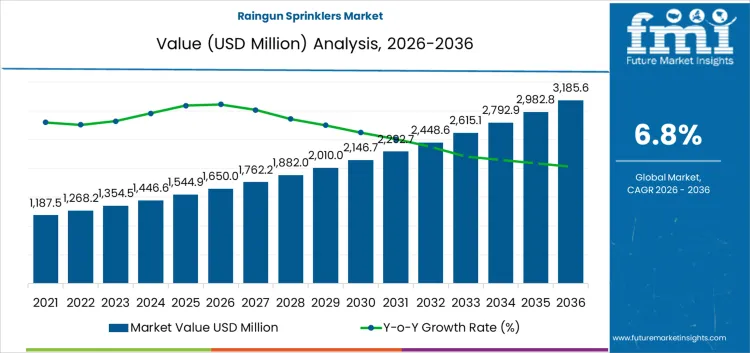
The raingun sprinklers market is likely to be valued at USD 1,650.0 million in 2026 and is projected to reach USD 3,185.6 million by 2036, expanding at a CAGR of 6.8% over the forecast period. Value capture is concentrated among manufacturers that control nozzle engineering, drive-mechanism durability, and pressure-performance validation, because these attributes directly determine throw consistency, clog tolerance, and lifecycle replacement rates. Margins tend to pool in higher-spec impact and gear-drive models built for abrasive water and long duty cycles, while low-end commoditized sprinklers compete mainly on price and erode profitability.
Pricing power is typically exercised through bundled kits (raingun + riser + hose + fittings) and distributor networks that influence what farmers can source quickly during irrigation windows. Between 2026 and 2036, aftermarket parts nozzles, seals, bearings, and repair kits often deliver steadier contribution than new unit sales, especially in regions where water quality accelerates wear. Contractors and dealer-led service models further shift earnings toward suppliers with fast spares availability and field support, not simply the highest shipment volumes.
Quick Stats for Raingun Sprinklers Market
- Raingun Sprinklers Market Value (2026): USD 1,650.0 Million
- Raingun Sprinklers Market Forecast Value (2036): USD 3,185.6 Million
- Raingun Sprinklers Market Forecast CAGR 2026 to 2036: 6.80%
- Leading Product Type in Raingun Sprinklers Market: Impact Drive Rainguns
- Leading Application in Raingun Sprinklers Market: Field Crops
- Key Growth Regions in Raingun Sprinklers Market: Asia Pacific, Latin America, Middle East & Africa
- Top Key Players in Raingun Sprinklers Market: Nelson Irrigation, Komet Irrigation, Sime S.p.A., Rain Bird, Irrifrance, Lindsay Corporation, Valmont, Jain Irrigation, Netafim, Regional Suppliers
Raingun Sprinklers Market Key Takeaways
| Metric | Value |
|---|---|
| Industry Value (2026) | USD 1,650.0 Million |
| Forecast Value (2036) | USD 3,185.6 Million |
| Forecast CAGR 2026 to 2036 | 6.80% |
How Is the Global Raingun Sprinklers Market Advancing?
The global raingun sprinklers market is advancing steadily, driven by increasing demand for efficient irrigation solutions in agriculture, landscaping, and large-area turf management. Raingun sprinklers are widely used to irrigate large fields due to their long throw range, high water discharge capacity, and ability to cover extensive areas with minimal equipment.
A key driver supporting market growth is the growing emphasis on improving irrigation efficiency and crop productivity in water-stressed regions. Farmers are increasingly adopting raingun sprinklers to achieve uniform water distribution across large plots while reducing manual labor and irrigation time. These systems are particularly suitable for crops such as sugarcane, maize, cereals, and fodder, as well as for irrigation of sports grounds and open landscapes.
Technological advancements are further strengthening market adoption. Improvements in nozzle design, pressure regulation, and material durability are enhancing water distribution accuracy and system lifespan. In addition, the integration of raingun sprinklers with automated irrigation controls and mobile pumping units is improving operational efficiency. As agricultural modernization and demand for scalable irrigation solutions continue to grow, the raingun sprinklers market is expected to experience consistent growth over the forecast period.
What Is the Segment-Wise Overview of the Raingun Sprinklers Market?
The raingun sprinklers market is driven by demand for high-coverage irrigation solutions in large-scale agriculture. Impact drive rainguns lead with a 46% share, reflecting their durability, long throw range, and reliable performance under varying pressure and field conditions. These systems are widely preferred for open-field irrigation due to low maintenance needs and consistent water distribution. On the end-use side, field crops account for 44% of demand, as cereals, pulses, and oilseeds are cultivated across extensive land areas that require efficient, wide-radius irrigation. Together, these segments highlight a market focused on robust irrigation technologies and large-area crop applications that prioritize reliability and operational efficiency.
Why Do Impact Drive Rainguns Lead the Raingun Sprinklers Market?
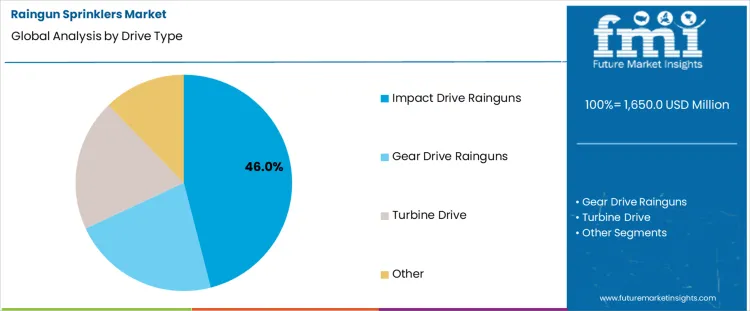
Impact drive rainguns account for 46% of the raingun sprinklers market due to their robust design, long throw distance, and suitability for large agricultural fields. These systems operate using a mechanical impact mechanism that delivers reliable rotation and uniform water distribution, even under variable pressure conditions. Farmers prefer impact drive rainguns for their durability, low maintenance requirements, and ability to handle water with higher sediment levels. They are particularly effective in open-field irrigation where wide coverage and consistent application are critical. Impact rainguns also perform well in windy conditions compared to lighter sprinkler systems. As large-scale agriculture continues to prioritize dependable and cost-effective irrigation solutions, impact drive rainguns remain the most widely adopted drive type in the market.
Why Do Field Crops Dominate End-Use Demand in the Raingun Sprinklers Market?
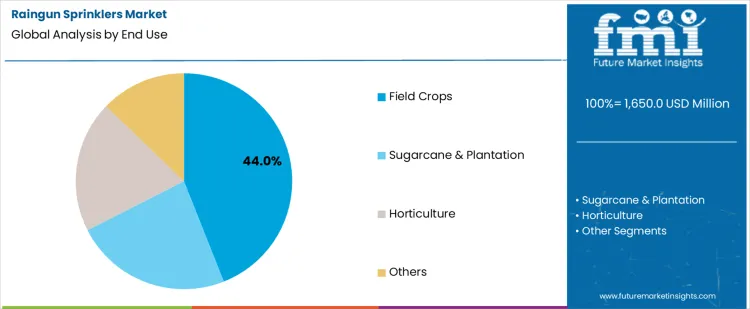
Field crops represent 44% of total end-use demand, making them the largest application segment in the raingun sprinklers market. Crops such as wheat, maize, pulses, and oilseeds are typically cultivated over large land areas that require efficient, wide-radius irrigation systems. Raingun sprinklers provide uniform water distribution across expansive fields, reducing irrigation time and labor requirements. Farmers rely on these systems to support crop growth during critical stages, particularly in regions with irregular rainfall. The ability to operate with flexible layouts and varying water sources further enhances suitability for field crop irrigation. As food production demand increases and mechanized irrigation adoption expands, field crops continue to drive strong demand for raingun sprinkler systems.
What Are the Key Dynamics for the Raingun Sprinklers Market?
Raingun sprinklers are designed to distribute water over extensive areas with adjustable throw distances and variable spray patterns, making them suitable for row crops, fodder fields, and pasture irrigation. Key market dynamics include increasing global food demand that boosts irrigated agriculture, the expansion of commercial farming operations, and rising adoption of mechanized irrigation systems to improve water use efficiency. Technological enhancements such as adjustable nozzles, corrosion-resistant materials, and durable drive mechanisms improve reliability and adaptability across diverse crop and soil conditions. Government initiatives promoting modern irrigation infrastructure and sustainable water use further encourage adoption of raingun systems over traditional and manual irrigation methods.
Why Is the Raingun Sprinklers Market Growing?
The raingun sprinklers market is growing as farmers and agricultural enterprises seek irrigation solutions that deliver broad, uniform water distribution while minimizing labor intensity and water losses. Climate variability and increasing drought frequency in some regions have underscored the importance of controlled irrigation systems capable of matching crop water requirements. Raingun sprinklers provide flexibility in coverage area and deployment, allowing for irrigation of irregular fields and adjustment to seasonal cropping patterns. Advances in materials, including lightweight alloys and UV-resistant plastics, enhance product longevity in harsh outdoor environments. Expansion of farm consolidation and commercial farming practices in major producing regions drives investment in irrigation infrastructure that supports consistent crop yields.
How Are the Key Drivers Shaping the Raingun Sprinklers Market?
Key drivers shaping the raingun sprinklers market include the need for scalable irrigation systems that optimize water application across large acreages, aligning with broader efforts to improve agricultural productivity and reduce water wastage. Integration of automation and smart controls allows remote scheduling and regulation of water application, enhancing water management practices and lowering operational costs. Partnerships between equipment manufacturers, agritech firms, and agricultural cooperatives are expanding awareness and distribution networks, particularly in emerging economies. Environmental regulations and watershed protection goals are incentivizing efficient irrigation technologies that reduce runoff and soil erosion.
What Is the Growth Outlook for the Raingun Sprinklers Market by Country?
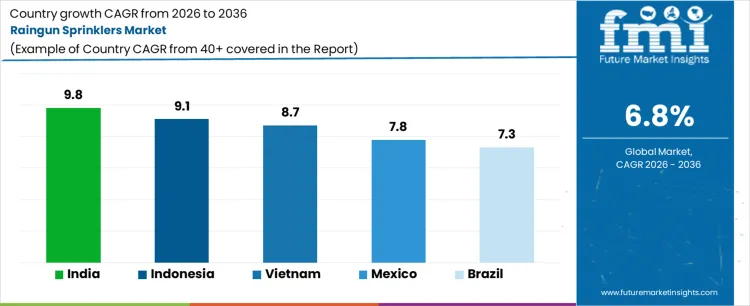
| Country | CAGR (%) |
|---|---|
| India | 9.8% |
| Indonesia | 9.1% |
| Vietnam | 8.7% |
| Mexico | 7.8% |
| Brazil | 7.3% |
The raingun sprinklers market is expanding steadily as farmers seek efficient and adaptable irrigation solutions. India leads with a 9.8% CAGR, driven by water scarcity concerns and government support for irrigation modernization. Indonesia (9.1%) and Vietnam (8.7%) follow, supported by agricultural mechanization and climate variability. Mexico (7.8%) shows moderate growth due to irrigation needs in arid regions, while Brazil (7.3%) benefits from large-scale farming and pasture irrigation demand. As water management becomes increasingly critical, adoption of raingun sprinklers is expected to rise across these regions.
What Is Driving the Growth of the Raingun Sprinklers Market in India?
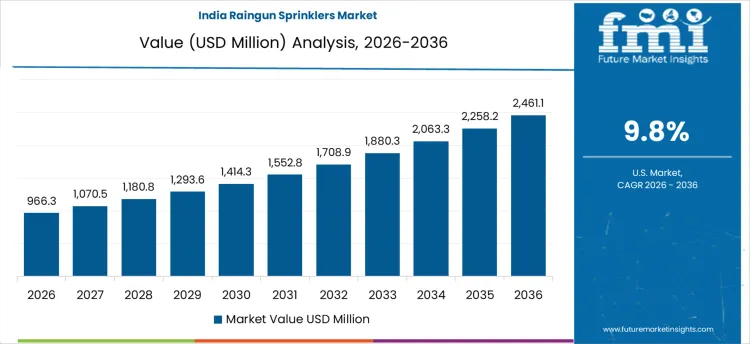
The raingun sprinklers market in India is growing at a CAGR of 9.8%, driven by increasing demand for efficient irrigation solutions in water-stressed agricultural regions. Raingun sprinklers are widely adopted for crops such as sugarcane, wheat, cotton, vegetables, and fodder due to their ability to cover large areas with relatively low installation costs. Rising groundwater depletion and irregular monsoon patterns are encouraging farmers to shift toward controlled irrigation methods. Government subsidy programs promoting micro-irrigation and water-use efficiency are further supporting adoption. In addition, growth in contract farming and commercial agriculture is increasing demand for high-capacity irrigation systems. Ease of installation, portability, and compatibility with existing pump infrastructure make raingun sprinklers attractive for small and mid-sized farms. As India continues to modernize irrigation practices, demand for raingun sprinklers is expected to grow steadily.
How Is the Raingun Sprinklers Market Expanding in Indonesia?
The raingun sprinklers market in Indonesia is expanding at a CAGR of 9.1%, supported by increasing focus on improving agricultural productivity and water management. Indonesia’s diverse crop base, including plantations, rice fields, and horticulture, is driving demand for flexible irrigation solutions. Raingun sprinklers are preferred for their ability to irrigate uneven terrain and large plots efficiently. Seasonal rainfall variability and dry periods are encouraging farmers to invest in supplementary irrigation systems. Government initiatives aimed at improving irrigation coverage and agricultural resilience are further supporting market growth. In addition, expansion of commercial farming and plantation agriculture is increasing adoption of mechanized irrigation equipment. As Indonesia continues to strengthen its agricultural infrastructure, demand for raingun sprinklers is expected to rise consistently.
What Is Supporting Growth of the Raingun Sprinklers Market in Vietnam?
The raingun sprinklers market in Vietnam is growing at a CAGR of 8.7%, driven by increasing adoption of modern irrigation techniques across horticulture and field crops. Climate variability and uneven rainfall distribution are pushing farmers to adopt irrigation systems that provide uniform water coverage. Raingun sprinklers are particularly suited for vegetables, coffee, and industrial crops grown in open fields. Expansion of export-oriented agriculture and emphasis on yield improvement are further supporting demand. Government programs promoting efficient water use and agricultural mechanization are also contributing to market growth. In addition, rising labor costs are encouraging adoption of automated and semi-automated irrigation solutions. As Vietnam continues to modernize its agricultural sector, demand for raingun sprinklers is expected to grow steadily.
How Is the Raingun Sprinklers Market Developing in Mexico?
The raingun sprinklers market in Mexico is expanding at a CAGR of 7.8%, supported by the need for efficient irrigation in arid and semi-arid agricultural regions. Farmers growing crops such as maize, alfalfa, vegetables, and fodder are adopting raingun sprinklers to improve water distribution and reduce labor intensity. Water scarcity and declining groundwater levels are increasing focus on controlled irrigation practices. Government support for irrigation modernization and agricultural productivity improvement is further strengthening demand. In addition, growth of commercial farming operations and export-oriented agriculture is driving investment in large-area irrigation systems. While cost considerations influence adoption rates, the versatility and durability of raingun sprinklers support steady market growth. As Mexico continues to address water management challenges, demand for raingun sprinklers is expected to increase gradually.
How Is the Raingun Sprinklers Market Expanding in Brazil?
The raingun sprinklers market in Brazil is growing at a CAGR of 7.3%, driven by large-scale agricultural operations and expanding use of mechanized irrigation systems. Raingun sprinklers are widely used in pasture irrigation, sugarcane, and fodder crops due to their suitability for large landholdings. Seasonal rainfall variability and periodic drought conditions are encouraging farmers to invest in supplemental irrigation. Expansion of commercial agriculture and livestock farming further supports demand. In addition, increasing awareness of water-use efficiency and crop yield optimization is influencing irrigation equipment choices. While center pivot systems dominate large-scale farms, raingun sprinklers remain attractive for flexible and lower-capital irrigation needs. As Brazil continues to strengthen its agricultural productivity, demand for raingun sprinklers is expected to grow at a stable pace.
How Are Companies Competing in the Raingun Sprinklers Market?
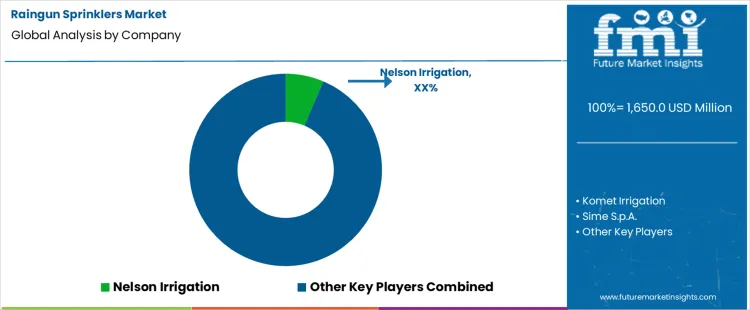
Competition in the raingun sprinklers market is driven by throw distance, water distribution uniformity, durability under high pressure, and adaptability across diverse crop and field conditions. Raingun sprinklers are widely used in large-area irrigation for agriculture, plantations, and pastureland, where consistent coverage and operational reliability directly influence crop yield and water efficiency. Companies compete on nozzle engineering, rotation control, pressure tolerance, and resistance to wear from sand-laden or hard water. Differentiation increasingly centers on precision water application, ease of adjustment, and compatibility with mobile, traveler, and pivot-based irrigation systems.
Nelson Irrigation, Komet Irrigation, Sime S.p.A., Rain Bird, Irrifrance, Lindsay Corporation, Valmont, Netafim, and Jain Irrigation lead competition through strong engineering capabilities, global distribution, and application-specific product portfolios. Nelson and Komet differentiate with high-performance rainguns known for long throw distances and consistent rotation under varying pressures. Sime and Rain Bird compete through durable designs and broad nozzle options suitable for multiple crop types. Irrifrance integrates rainguns into traveler irrigation systems, while Lindsay and Valmont leverage large-scale irrigation expertise to position rainguns within integrated farm infrastructure solutions. Netafim and Jain apply precision irrigation knowledge to enhance water control and system compatibility.
Regional suppliers compete through cost competitiveness, local adaptation, and service responsiveness. These players often tailor raingun designs to regional crops, water quality, and farming practices, offering simpler maintenance and faster availability. Across the market, competitive advantage is defined by coverage consistency, mechanical reliability, long service life, and the ability to deliver efficient irrigation across large and variable agricultural landscapes.
Key Plyers in Raingun Sprinklers Market
- Nelson Irrigation
- Komet Irrigation
- Sime S.p.A.
- Rain Bird
- Irrifrance
- Lindsay Corporation
- Valmont
- Jain Irrigation
- Netafim
- Regional Suppliers
Scope of Report
| Attributes | Description |
|---|---|
| Quantitative Unit (2026) | USD Million |
| Drive Type | Impact Drive Rainguns, Gear Drive Rainguns, Turbine Drive, Other |
| End Use | Field Crops, Sugarcane & Plantation, Horticulture, Others |
| Regions Covered | Asia Pacific, Europe, North America, Latin America, Middle East & Africa |
| Countries Covered | China, Japan, South Korea, India, Australia & New Zealand, ASEAN, Rest of Asia Pacific, Germany, United Kingdom, France, Italy, Spain, Nordic, BENELUX, Rest of Europe, United States, Canada, Mexico, Brazil, Chile, Rest of Latin America, Kingdom of Saudi Arabia, Other GCC Countries, Turkey, South Africa, Other African Union, Rest of Middle East & Africa |
| Key Companies Profiled | Nelson Irrigation, Komet Irrigation, Sime S.p.A., Rain Bird, Irrifrance, Lindsay Corporation, Valmont, Jain Irrigation, Netafim, Regional Suppliers |
| Additional Attributes | Dollar sales by drive type and end use; regional market size and forecast analysis; growth outlook across major regions; adoption trends for raingun sprinkler systems; assessment of water throw efficiency, durability requirements, and demand patterns across large-field agriculture, plantation crops, and horticultural irrigation applications. |
Raingun Sprinklers Market by Key Segments
Drive Type
- Impact Drive Rainguns
- Gear Drive Rainguns
- Turbine Drive
- Other
End Use
- Field Crops
- Sugarcane & Plantation
- Horticulture
- Others
Region:
- Asia Pacific
- China
- Japan
- South Korea
- India
- Australia & New Zealand
- ASEAN
- Rest of Asia Pacific
- Europe
- Germany
- United Kingdom
- France
- Italy
- Spain
- Nordic
- BENELUX
- Rest of Europe
- North America
- United States
- Canada
- Mexico
- Latin America
- Brazil
- Chile
- Rest of Latin America
- Middle East & Africa
- Kingdom of Saudi Arabia
- Other GCC Countries
- Turkey
- South Africa
- Other African Union
- Rest of Middle East & Africa
Bibliography
- Food and Agriculture Organization of the United Nations. (2024). Efficient irrigation technologies for sustainable agriculture: Guidelines for sprinkler and raingun irrigation systems. FAO.
- International Commission on Irrigation and Drainage. (2023). Best practices in pressurized irrigation systems: Design, performance, and management of raingun sprinklers. ICID.
- United Nations Environment Programme. (2023). Water-efficient agricultural technologies for climate-resilient farming systems. UNEP.
- European Committee for Standardization. (2024). EN 12201: Irrigation systems-Design and installation requirements for pressurized water distribution and sprinkler systems. CEN.
- World Bank. (2023). Sustainable water resource management and modernization of irrigation infrastructure in developing economies. World Bank Publications.
Frequently Asked Questions
How big is the raingun sprinklers market in 2026?
The global raingun sprinklers market is estimated to be valued at USD 1,650.0 million in 2026.
What will be the size of raingun sprinklers market in 2036?
The market size for the raingun sprinklers market is projected to reach USD 3,185.6 million by 2036.
How much will be the raingun sprinklers market growth between 2026 and 2036?
The raingun sprinklers market is expected to grow at a 6.8% CAGR between 2026 and 2036.
What are the key product types in the raingun sprinklers market?
The key product types in raingun sprinklers market are impact drive rainguns, gear drive rainguns, turbine drive and other.
Which end use segment to contribute significant share in the raingun sprinklers market in 2026?
In terms of end use, field crops segment to command 44.0% share in the raingun sprinklers market in 2026.
Preview the report firsthand - request a free sample
Get SampleGet the brochure for pricing and purchase details.
Get PDFTable of Content
- Executive Summary
- Global Market Outlook
- Demand-side Trends
- Supply-side Trends
- Technology Roadmap Analysis
- Analysis and Recommendations
- Market Overview
- Market Coverage / Taxonomy
- Market Definition / Scope / Limitations
- Market Background
- Market Dynamics
- Drivers
- Restraints
- Opportunity
- Trends
- Scenario Forecast
- Demand in Optimistic Scenario
- Demand in Likely Scenario
- Demand in Conservative Scenario
- Opportunity Map Analysis
- Product Life Cycle Analysis
- Supply Chain Analysis
- Investment Feasibility Matrix
- Value Chain Analysis
- PESTLE and Porter’s Analysis
- Regulatory Landscape
- Regional Parent Market Outlook
- Production and Consumption Statistics
- Import and Export Statistics
- Market Dynamics
- Global Market Analysis 2021 to 2025 and Forecast, 2026 to 2036
- Historical Market Size Value (USD Million) Analysis, 2021 to 2025
- Current and Future Market Size Value (USD Million) Projections, 2026 to 2036
- Y-o-Y Growth Trend Analysis
- Absolute $ Opportunity Analysis
- Global Market Pricing Analysis 2021 to 2025 and Forecast 2026 to 2036
- Global Market Analysis 2021 to 2025 and Forecast 2026 to 2036, By Drive Type
- Introduction / Key Findings
- Historical Market Size Value (USD Million) Analysis By Drive Type , 2021 to 2025
- Current and Future Market Size Value (USD Million) Analysis and Forecast By Drive Type , 2026 to 2036
- Impact Drive Rainguns
- Gear Drive Rainguns
- Turbine Drive
- Other
- Impact Drive Rainguns
- Y-o-Y Growth Trend Analysis By Drive Type , 2021 to 2025
- Absolute $ Opportunity Analysis By Drive Type , 2026 to 2036
- Global Market Analysis 2021 to 2025 and Forecast 2026 to 2036, By End Use
- Introduction / Key Findings
- Historical Market Size Value (USD Million) Analysis By End Use, 2021 to 2025
- Current and Future Market Size Value (USD Million) Analysis and Forecast By End Use, 2026 to 2036
- Field Crops
- Sugarcane & Plantation
- Horticulture
- Others
- Field Crops
- Y-o-Y Growth Trend Analysis By End Use, 2021 to 2025
- Absolute $ Opportunity Analysis By End Use, 2026 to 2036
- Global Market Analysis 2021 to 2025 and Forecast 2026 to 2036, By Region
- Introduction
- Historical Market Size Value (USD Million) Analysis By Region, 2021 to 2025
- Current Market Size Value (USD Million) Analysis and Forecast By Region, 2026 to 2036
- North America
- Latin America
- Western Europe
- Eastern Europe
- East Asia
- South Asia and Pacific
- Middle East & Africa
- Market Attractiveness Analysis By Region
- North America Market Analysis 2021 to 2025 and Forecast 2026 to 2036, By Country
- Historical Market Size Value (USD Million) Trend Analysis By Market Taxonomy, 2021 to 2025
- Market Size Value (USD Million) Forecast By Market Taxonomy, 2026 to 2036
- By Country
- USA
- Canada
- Mexico
- By Drive Type
- By End Use
- By Country
- Market Attractiveness Analysis
- By Country
- By Drive Type
- By End Use
- Key Takeaways
- Latin America Market Analysis 2021 to 2025 and Forecast 2026 to 2036, By Country
- Historical Market Size Value (USD Million) Trend Analysis By Market Taxonomy, 2021 to 2025
- Market Size Value (USD Million) Forecast By Market Taxonomy, 2026 to 2036
- By Country
- Brazil
- Chile
- Rest of Latin America
- By Drive Type
- By End Use
- By Country
- Market Attractiveness Analysis
- By Country
- By Drive Type
- By End Use
- Key Takeaways
- Western Europe Market Analysis 2021 to 2025 and Forecast 2026 to 2036, By Country
- Historical Market Size Value (USD Million) Trend Analysis By Market Taxonomy, 2021 to 2025
- Market Size Value (USD Million) Forecast By Market Taxonomy, 2026 to 2036
- By Country
- Germany
- UK
- Italy
- Spain
- France
- Nordic
- BENELUX
- Rest of Western Europe
- By Drive Type
- By End Use
- By Country
- Market Attractiveness Analysis
- By Country
- By Drive Type
- By End Use
- Key Takeaways
- Eastern Europe Market Analysis 2021 to 2025 and Forecast 2026 to 2036, By Country
- Historical Market Size Value (USD Million) Trend Analysis By Market Taxonomy, 2021 to 2025
- Market Size Value (USD Million) Forecast By Market Taxonomy, 2026 to 2036
- By Country
- Russia
- Poland
- Hungary
- Balkan & Baltic
- Rest of Eastern Europe
- By Drive Type
- By End Use
- By Country
- Market Attractiveness Analysis
- By Country
- By Drive Type
- By End Use
- Key Takeaways
- East Asia Market Analysis 2021 to 2025 and Forecast 2026 to 2036, By Country
- Historical Market Size Value (USD Million) Trend Analysis By Market Taxonomy, 2021 to 2025
- Market Size Value (USD Million) Forecast By Market Taxonomy, 2026 to 2036
- By Country
- China
- Japan
- South Korea
- By Drive Type
- By End Use
- By Country
- Market Attractiveness Analysis
- By Country
- By Drive Type
- By End Use
- Key Takeaways
- South Asia and Pacific Market Analysis 2021 to 2025 and Forecast 2026 to 2036, By Country
- Historical Market Size Value (USD Million) Trend Analysis By Market Taxonomy, 2021 to 2025
- Market Size Value (USD Million) Forecast By Market Taxonomy, 2026 to 2036
- By Country
- India
- ASEAN
- Australia & New Zealand
- Rest of South Asia and Pacific
- By Drive Type
- By End Use
- By Country
- Market Attractiveness Analysis
- By Country
- By Drive Type
- By End Use
- Key Takeaways
- Middle East & Africa Market Analysis 2021 to 2025 and Forecast 2026 to 2036, By Country
- Historical Market Size Value (USD Million) Trend Analysis By Market Taxonomy, 2021 to 2025
- Market Size Value (USD Million) Forecast By Market Taxonomy, 2026 to 2036
- By Country
- Kingdom of Saudi Arabia
- Other GCC Countries
- Turkiye
- South Africa
- Other African Union
- Rest of Middle East & Africa
- By Drive Type
- By End Use
- By Country
- Market Attractiveness Analysis
- By Country
- By Drive Type
- By End Use
- Key Takeaways
- Key Countries Market Analysis
- USA
- Pricing Analysis
- Market Share Analysis, 2025
- By Drive Type
- By End Use
- Canada
- Pricing Analysis
- Market Share Analysis, 2025
- By Drive Type
- By End Use
- Mexico
- Pricing Analysis
- Market Share Analysis, 2025
- By Drive Type
- By End Use
- Brazil
- Pricing Analysis
- Market Share Analysis, 2025
- By Drive Type
- By End Use
- Chile
- Pricing Analysis
- Market Share Analysis, 2025
- By Drive Type
- By End Use
- Germany
- Pricing Analysis
- Market Share Analysis, 2025
- By Drive Type
- By End Use
- UK
- Pricing Analysis
- Market Share Analysis, 2025
- By Drive Type
- By End Use
- Italy
- Pricing Analysis
- Market Share Analysis, 2025
- By Drive Type
- By End Use
- Spain
- Pricing Analysis
- Market Share Analysis, 2025
- By Drive Type
- By End Use
- France
- Pricing Analysis
- Market Share Analysis, 2025
- By Drive Type
- By End Use
- India
- Pricing Analysis
- Market Share Analysis, 2025
- By Drive Type
- By End Use
- ASEAN
- Pricing Analysis
- Market Share Analysis, 2025
- By Drive Type
- By End Use
- Australia & New Zealand
- Pricing Analysis
- Market Share Analysis, 2025
- By Drive Type
- By End Use
- China
- Pricing Analysis
- Market Share Analysis, 2025
- By Drive Type
- By End Use
- Japan
- Pricing Analysis
- Market Share Analysis, 2025
- By Drive Type
- By End Use
- South Korea
- Pricing Analysis
- Market Share Analysis, 2025
- By Drive Type
- By End Use
- Russia
- Pricing Analysis
- Market Share Analysis, 2025
- By Drive Type
- By End Use
- Poland
- Pricing Analysis
- Market Share Analysis, 2025
- By Drive Type
- By End Use
- Hungary
- Pricing Analysis
- Market Share Analysis, 2025
- By Drive Type
- By End Use
- Kingdom of Saudi Arabia
- Pricing Analysis
- Market Share Analysis, 2025
- By Drive Type
- By End Use
- Turkiye
- Pricing Analysis
- Market Share Analysis, 2025
- By Drive Type
- By End Use
- South Africa
- Pricing Analysis
- Market Share Analysis, 2025
- By Drive Type
- By End Use
- USA
- Market Structure Analysis
- Competition Dashboard
- Competition Benchmarking
- Market Share Analysis of Top Players
- By Regional
- By Drive Type
- By End Use
- Competition Analysis
- Competition Deep Dive
- Nelson Irrigation
- Overview
- Product Portfolio
- Profitability by Market Segments (Product/Age /Sales Channel/Region)
- Sales Footprint
- Strategy Overview
- Marketing Strategy
- Product Strategy
- Channel Strategy
- Komet Irrigation
- Sime S.p.A.
- Rain Bird
- Irrifrance
- Lindsay Corporation
- Valmont
- Jain Irrigation
- Netafim
- Regional Suppliers
- Nelson Irrigation
- Competition Deep Dive
- Assumptions & Acronyms Used
- Research Methodology


