

- Industry Size (2026)
- USD 308.3 Mn
- Forecast (2036)
- USD 480.7 Mn
- CAGR (2026 to 2036)
- 4.5%
RFID-Enabled Gift Boxes Market Forecast and Outlook 2026 to 2036
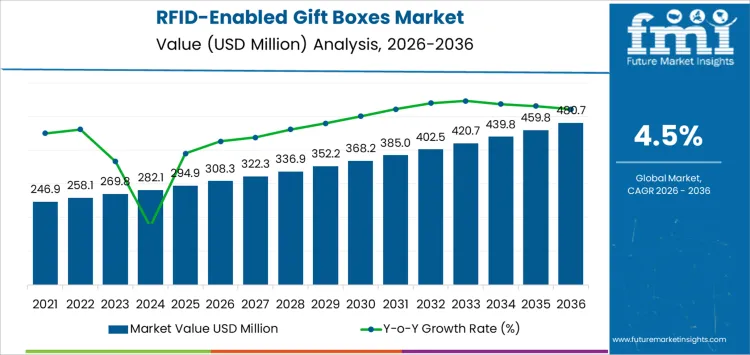
In 2026, the RFID-enabled gift boxes market is valued at USD 308.3 million and is projected to reach USD 480.7 million by 2036, registering a CAGR of 4.5%. During the first five-year block from 2026 to 2031, market value rises to around USD 384.3 million. This phase reflects structured uptake in luxury retail and electronics gifting, where NFC tagging and premium rigid boxes support authentication, inventory tracking, and brand engagement. Growth remains incremental, driven by selective deployment in high-value gifting formats rather than broad replacement of conventional packaging.
From 2031 to 2036, the market expands from approximately USD 384.3 million to USD 480.7 million, forming the second growth block with higher absolute additions. Corporate gifting, event merchandise, and special edition packaging contribute steady volume as RFID integration becomes standardized within premium packaging lines. UHF RFID and embedded smart labels gain wider use alongside NFC. This block reflects scale-up in production and repeat ordering from established clients, with growth shaped by packaging upgrades and value-added features rather than expansion in overall gifting volumes.
Quick Stats of the RFID-Enabled Gift Boxes Market
- RFID-Enabled Gift Boxes Market Value (2026): USD 308.3 million
- RFID-Enabled Gift Boxes Market Forecast Value (2036): USD 480.7 million
- RFID-Enabled Gift Boxes Market Forecast CAGR (2026-2036): 4.5%
- Leading Application: Luxury Retail (40%)
- Key Growth Regions: China, India, USA, Germany, Brazil, Japan
- Top Players: Avery Dennison, YUTO Packaging, DS Smith, ITC Packaging, Toppan
What is the Growth Forecast for the RFID-Enabled Gift Boxes Market through 2036?
From 2026 to 2031, the RFID-enabled gift boxes market grows from USD 308.3 million to about USD 367.7 million, reflecting adoption driven by brand protection and inventory visibility rather than gifting volume alone. Early growth is concentrated among premium confectionery, cosmetics, and corporate gifting programs where authentication and traceability add measurable value. During this phase, RFID is often deployed selectively for limited editions and seasonal campaigns. YeAR-on-year gains widen gradually as packaging converters refine integration methods, improve read reliability through decorative materials, and align unit costs with mid-range product pricing.
Between 2031 and 2036, the market expands from approximately USD 367.7 million to USD 480.7 million, marking a clearer shift toward scaled use. Growth accelerates as RFID-enabled boxes become standard for omnichannel fulfillment, returns management, and post-purchase engagement. Brands increasingly leverage embedded tags for anti-diversion controls, lifecycle tracking, and personalized content activation. Annual value additions increase as adoption spreads beyond luxury into broader retail gifting, supported by higher tag volumes, improved interoperability with retail systems, and repeat deployment across multi-market packaging programs.
RFID Enabled Gift Boxes Market Key Takeaways
| Metric | Value |
|---|---|
| Market Value (2026) | USD 308.3 million |
| Forecast Value (2036) | USD 480.7 million |
| Forecast CAGR (2026-2036) | 4.5% |
How Are Smart Packaging Strategies Driving the RFID-Enabled Gift Boxes Market from 2026 to 2036?
RFID-enabled gift boxes gained traction as premium brands looked beyond decorative packaging toward functional value in gifting formats. High-end food, beverages, cosmetics, and promotional merchandise used RFID tags to support controlled distribution and stock visibility during seasonal peaks. Historical demand reflected needs around inventory accuracy, shrinkage reduction, and authentication in gift-heavy retail cycles. Packaging designers integrated RFID discreetly to preserve visual appeal while enabling backend tracking. Adoption remained concentrated in limited editions, corporate gifting, and duty-free retail where handling visibility and provenance mattered.
From 2026 to 2036 demand is expected to broaden as smart packaging becomes part of brand operations rather than novelty use. RFID-enabled gift boxes support logistics automation, returns verification, and event-based gifting campaigns. Growth aligns with omnichannel fulfillment and data-driven retail planning. Manufacturers refine recyclable materials and thinner inlays to reduce cost and improve compatibility. Buyers evaluate system integration, data ownership, and lifecycle management when selecting RFID packaging solutions.
What Is the Demand for the RFID-Enabled Gift Boxes Market by Application and Product Type for 2026 to 2036?
From 2026 to 2036, the RFID-enabled gift boxes market expands as brands adopt smart packaging to support authentication, inventory visibility, and premium customer engagement. Luxury retail accounts for 40% of application demand as high-value gifting places emphasis on provenance tracking, anti-tamper assurance, and post-purchase interaction. Premium rigid boxes lead product type adoption with a 45% share because they provide structural integrity, presentation quality, and sufficient space for concealed RFID inlays. Demand reflects integration of packaging with digital retail systems, controlled distribution, and enhanced brand storytelling.
Why does luxury retail account for 40% of demand in the RFID-enabled gift boxes market by application from 2026 to 2036?
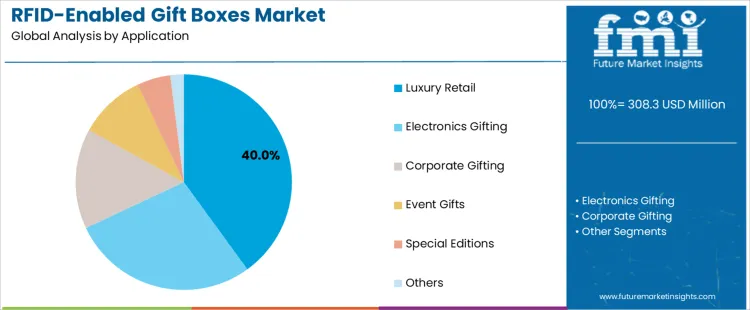
Luxury retail accounts for 40% of demand because premium brands require packaging that supports authentication and controlled circulation across omnichannel environments. Consumption intensity is high for watches, jewelry, fragrances, and designer accessories where gifting aligns with seasonal launches and limited editions. Usage remains steady as RFID enables item-level tracking from fulfillment to point of sale and post-sale services. Procurement decisions prioritize discreet tag placement, signal reliability, and compatibility with existing retail infrastructure. Buyers favor solutions that enable inventory accuracy and theft deterrence without compromising aesthetics. Price sensitivity stays moderate since packaging represents a small fraction of product value while delivering operational benefits. Specification control focuses on tag readability through dense materials, durability during handling, and data security standards. Demand continues from 2026 to 2036 as luxury retailers scale connected packaging initiatives to improve stock control and customer experience. Repeat utilization remains predictable due to recurring gifting cycles and premium product refresh schedules.
Why do premium rigid boxes represent 45% of demand in the RFID-enabled gift boxes market by product type from 2026 to 2036?
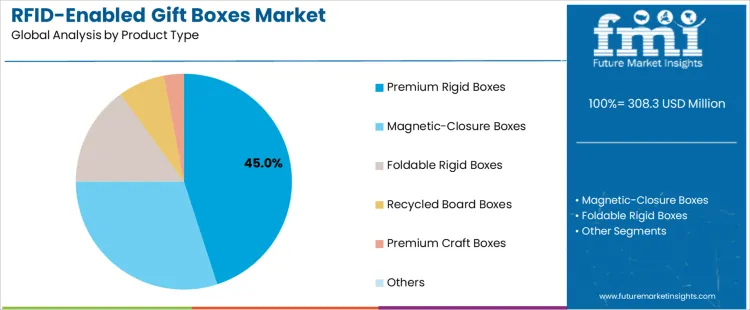
Premium rigid boxes represent 45% of demand because they offer the structural stability required to protect high-value items while housing RFID components securely. Consumption is strong in applications where presentation quality and unboxing experience influence brand perception. Usage remains steady as rigid formats withstand transport stress and repeated handling without degrading tag performance. Procurement favors box constructions that allow RFID integration between board layers or within closures, ensuring concealment and signal consistency. Buyers prioritize materials that support precise finishing, embossing, and lining without interfering with radio frequency transmission. Price sensitivity stays moderate as rigid boxes deliver longevity and reuse potential. Specification control emphasizes board density, adhesive compatibility, and tolerance to shielding effects. Demand persists from 2026 to 2036 as brands align premium packaging with digital traceability and elevated gifting standards across luxury and corporate segments.
How Are RFID Enabled Gift Boxes Being Incorporated Into Retail and Brand Fulfillment Workflows?
Use appears in premium retail, corporate gifting, and event merchandising where tracking and authentication matter. Luxury retailers embed RFID tags in gift boxes to manage inventory across flagship stores and pop up locations. Corporate gifting firms use them to confirm delivery status for high volume campaigns. Event organizers apply RFID enabled packaging to monitor distribution during sponsored promotions. Subscription box services integrate tags to improve warehouse picking accuracy. These uses reflect operational needs tied to traceability, loss reduction, and controlled distribution rather than decorative packaging alone.
What Commercial Conditions Support Adoption of RFID Enabled Gift Boxes?
Selection aligns with environments that require visibility beyond the point of sale. Retail chains adopt RFID boxes to link packaging with stock management systems. Brand owners use them to verify authenticity in limited edition releases. Logistics teams handling high value gifts rely on RFID to reduce manual scanning during transit. Marketing teams apply tagged boxes to measure engagement at events through controlled handouts. These conditions favor solutions that connect physical packaging with digital records, supporting coordination across sales, logistics, and brand operations.
Which Considerations Limit Wider Use of RFID Enabled Gift Boxes?
Cost remains a key consideration for mass market gifting formats. Integration requires alignment with existing inventory and point of sale systems. Smaller retailers lack technical staff to manage tag data effectively. Recycling concerns arise where RFID components complicate disposal. Privacy expectations also influence use in consumer facing campaigns. Tag damage during handling can reduce reliability. These factors result in selective deployment where tracking value, brand positioning, and system readiness justify added complexity and expense.
What is the Demand for RFID Enabled Gift Boxes by Country?
| Country | CAGR (%) |
|---|---|
| USA | 9.5% |
| China | 12.0% |
| Germany | 7.8% |
| India | 11.1% |
| Japan | 6.0% |
| Brazil | 7.2% |
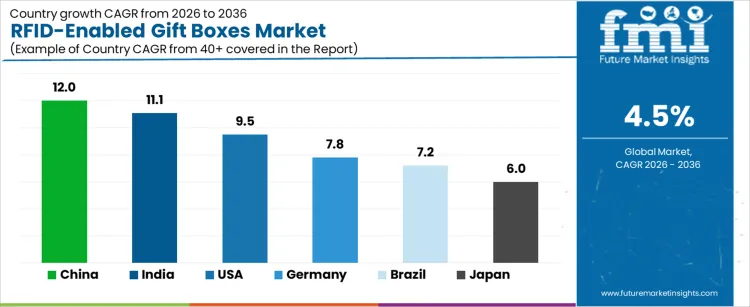
The demand for RFID enabled gift boxes varies by country, shaped by retail digitization, premium gifting trends, and logistics tracking needs. China leads with a 12.0% CAGR, supported by large scale e commerce gifting, luxury brand adoption, and widespread use of smart packaging in retail distribution. India follows at 11.1%, driven by organized retail expansion, festival based gifting, and rising use of traceable packaging formats. The USA grows at 9.5%, reflecting adoption among premium brands seeking inventory visibility and anti-theft functions. Germany records 7.8%, supported by structured retail supply chains. Brazil posts 7.2%, influenced by growing organized retail, while Japan grows at 6.0%, reflecting mature packaging and retail technology adoption.
How Is Smart Packaging Adoption Enhancing Gift Packaging Demand in the United States?
In the United States, revenue from the RFID Enabled Gift Boxes Market is expanding at a CAGR of 9.5% through 2035, driven by rising adoption of smart packaging across premium gifting and branded merchandise segments. Retailers and brand owners are integrating RFID enabled boxes to improve inventory tracking, authentication, and consumer engagement. Demand is concentrated in luxury goods, corporate gifting, and high value retail packaging where traceability supports loss prevention. Domestic packaging converters collaborate with RFID solution providers to deliver integrated box formats. Growth in omnichannel retail fulfillment and experiential packaging programs is sustaining consistent procurement activity across large retailers and brand owners nationwide.
- Luxury and corporate gifting segments support adoption.
- Inventory tracking requirements drive RFID integration.
- Domestic converters enable scalable production.
- Omnichannel retail supports recurring demand.
How Is Digital Retail Infrastructure Accelerating Growth in China?
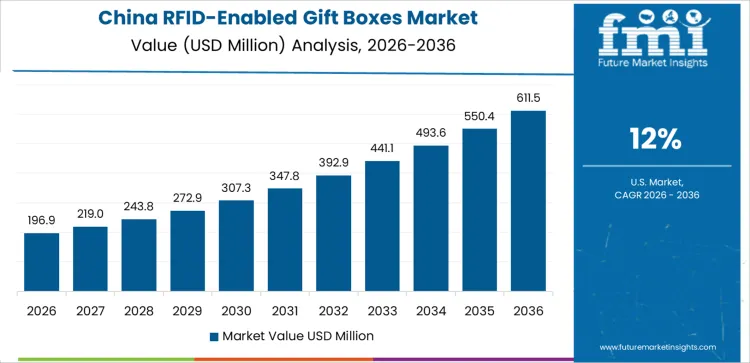
In China, revenue from the RFID Enabled Gift Boxes Market is growing at a CAGR of 12% through 2035, supported by rapid expansion of digital retail infrastructure and premium product packaging demand. Brands are adopting RFID enabled boxes to improve supply chain visibility and product authentication across online and offline channels. Demand is strong in cosmetics, electronics gifting, and seasonal promotional packaging. Domestic manufacturers scale production through integrated electronics and packaging capabilities. High e commerce volumes and brand protection priorities are sustaining rapid adoption across large scale retail and gifting programs nationwide.
- Digital retail growth supports smart packaging adoption.
- Product authentication remains a key driver.
- Integrated manufacturing improves supply efficiency.
- Seasonal promotions sustain volume demand.
How Does Structured Packaging Innovation Support Demand in Germany?
Germany continues to record expansion in the RFID Enabled Gift Boxes Market at a CAGR of 7.8% through 2035, supported by structured packaging innovation and strong emphasis on logistics efficiency. Manufacturers integrate RFID enabled boxes to improve traceability and handling accuracy within retail distribution networks. Demand is centered on premium consumer goods, electronics, and branded gift assortments. Technical expertise in packaging engineering supports reliable RFID integration. Stable demand from established brands and organized retail systems sustains predictable procurement patterns across domestic packaging suppliers.
- Logistics efficiency requirements support adoption.
- Premium goods packaging anchors demand.
- Engineering expertise enables reliable integration.
- Established brands sustain procurement stability.
Why Is Premium Gifting Culture Driving Growth in India?
India is witnessing growth in the RFID Enabled Gift Boxes Market at a CAGR of 11.1% through 2035, driven by expanding premium gifting culture and rising branded merchandise consumption. Companies adopt RFID enabled boxes to enhance presentation and manage inventory across corporate gifting and festive sales. Demand is emerging across apparel, electronics, and personal care gift packaging. Domestic converters collaborate with technology providers to offer cost aligned solutions. Expanding organized retail and increasing gift oriented consumption are sustaining steady adoption across urban markets nationwide.
- Corporate and festive gifting drive demand.
- Inventory management needs support RFID usage.
- Domestic converters improve accessibility.
- Organized retail expansion sustains growth.
How Does Controlled Adoption Shape Market Stability in Japan?
Japan is maintaining steady growth in the RFID Enabled Gift Boxes Market at a CAGR of 6% through 2035, supported by controlled adoption of smart packaging within premium retail formats. Brands apply RFID enabled boxes selectively to improve handling accuracy and product verification. Demand remains concentrated in luxury goods, electronics, and seasonal gift packaging. Domestic suppliers emphasize precision integration and quality consistency. Stable retail volumes and replacement driven usage sustain predictable procurement across established gifting programs nationwide.
- Precision focused packaging supports selective adoption.
- Luxury and electronics gifting anchor demand.
- Domestic suppliers ensure quality consistency.
- Replacement cycles sustain procurement stability.
How Are Brand Differentiation Strategies Supporting Growth in Brazil?
Brazil is seeing steady expansion in the RFID Enabled Gift Boxes Market at a CAGR of 7.2% through 2035, supported by growing focus on brand differentiation and premium packaging formats. Companies use RFID enabled boxes to enhance product presentation and manage distribution across retail channels. Demand is rising in cosmetics, apparel gifting, and promotional packaging. Imports supply some RFID components, while local converters expand box production capabilities. Expanding consumer goods distribution and promotional activity sustain consistent demand across branded gifting applications nationwide.
- Brand differentiation supports RFID box adoption.
- Promotional packaging drives incremental demand.
- Imports supply specialized components.
- Consumer goods expansion sustains procurement activity.
How Is Demand for RFID Enabled Gift Boxes Developing and Which Packaging Firms Influence Brand Adoption?
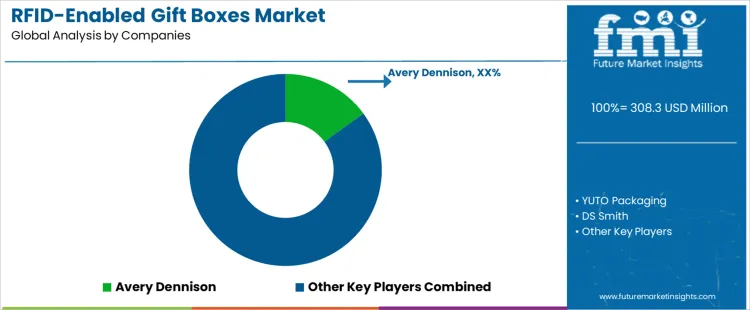
RFID enabled gift boxes are emerging as brands seek better inventory visibility, anti-theft control, and post-sale engagement for premium products. Luxury goods, electronics, cosmetics, and seasonal gifting segments use embedded RFID to track movement from warehouse to retail shelf while preserving presentation quality. Avery Dennison plays a key role through RFID inlays and labels integrated discreetly into box structures. Toppan supports adoption through printed electronics and smart packaging formats used by high value brands in Japan and overseas markets. YUTO Packaging contributes through rigid and folding gift boxes designed to accommodate RFID components without altering aesthetics. DS Smith participates where smart packaging aligns with omnichannel retail logistics and traceability needs. ITC Packaging supports adoption through premium board based boxes used in gifting and promotional campaigns.
Design and procurement decisions are shaped by read accuracy, tag concealment, recyclability, and compatibility with automated packing lines. Brand owners prioritize boxes that enable store level inventory checks without opening packaging. Retailers value faster stock reconciliation and improved loss prevention during peak gifting seasons. Packaging teams focus on maintaining tactile quality while embedding smart features. Applications include festive gift sets, limited edition launches, corporate gifting, and high value subscription boxes. Demand visibility tracks growth in connected retail, expansion of RFID use beyond apparel, and increased emphasis on supply chain transparency for premium packaged goods.
Key Players in the RFID-Enabled Gift Boxes Market
- Avery Dennison
- YUTO Packaging
- DS Smith
- ITC Packaging
- Toppan
Scope of the Report
| Items | Values |
|---|---|
| Quantitative Units (2026) | USD million |
| Application | Luxury Retail; Electronics Gifting; Corporate Gifting; Event Gifts; Special Editions; Other Applications |
| Product Type | Premium Rigid Boxes; Magnetic-Closure Boxes; Foldable Rigid Boxes; Recycled Board Boxes; Premium Craft Boxes; Other Box Types |
| Technology | NFC Tagging; UHF RFID; Embedded Smart Labels; QR-RFID Hybrid; Passive RFID |
| Regions Covered | Asia Pacific; Europe; North America; Latin America; Middle East and Africa |
| Countries Covered | China; Japan; South Korea; India; Australia and New Zealand; ASEAN; Germany; United Kingdom; France; Italy; Spain; Nordic; BENELUX; United States; Canada; Mexico; Brazil; Chile; Kingdom of Saudi Arabia; Turkey; South Africa; plus additional countries across Asia Pacific, Europe, Latin America, and Middle East and Africa |
| Key Companies Profiled | Avery Dennison; YUTO Packaging; DS Smith; ITC Packaging; Toppan |
| Additional Attributes | Dollar by sales across applications and product types; adoption of RFID-enabled gift boxes for authentication, inventory visibility, and brand engagement in premium gifting; use of NFC, UHF RFID, and embedded smart labels to support omnichannel fulfillment and returns management; role of premium rigid and foldable box structures in concealing RFID inlays while preserving aesthetics; integration of smart packaging into luxury retail, corporate gifting, and event merchandise workflows; influence of system integration, recyclability considerations, and tag readability on procurement decisions; deployment of RFID gift boxes for anti-diversion control, lifecycle tracking, and post-purchase digital interaction across branded gifting programs |
RFID-Enabled Gift Boxes Market Segmentation
By Application
- Luxury Retail
- Electronics Gifting
- Corporate Gifting
- Event Gifts
- Special Editions
- Others
By Product Type
- Premium Rigid Boxes
- Magnetic-Closure Boxes
- Foldable Rigid Boxes
- Recycled Board Boxes
- Premium Craft Boxes
- Others
By Technology
- NFC Tagging
- UHF RFID
- Embedded Smart Labels
- QR–RFID Hybrid
- Passive RFID
Region
- Asia Pacific
- China
- Japan
- South Korea
- India
- Australia & New Zealand
- ASEAN
- Rest of Asia Pacific
- Europe
- Germany
- United Kingdom
- France
- Italy
- Spain
- Nordic
- BENELUX
- Rest of Europe
- North America
- United States
- Canada
- Mexico
- Latin America
- Brazil
- Chile
- Rest of Latin America
- Middle East & Africa
- Kingdom of Saudi Arabia
- Other GCC Countries
- Turkey
- South Africa
- Other African Union
- Rest of Middle East & Africa
Frequently Asked Questions
How big is the RFID-enabled gift boxes market in 2026?
The global RFID-enabled gift boxes market is estimated to be valued at USD 308.3 million in 2026.
What will be the size of RFID-enabled gift boxes market in 2036?
The market size for the RFID-enabled gift boxes market is projected to reach USD 480.7 million by 2036.
How much will be the RFID-enabled gift boxes market growth between 2026 and 2036?
The RFID-enabled gift boxes market is expected to grow at a 4.5% CAGR between 2026 and 2036.
What are the key product types in the RFID-enabled gift boxes market?
The key product types in RFID-enabled gift boxes market are luxury retail, electronics gifting, corporate gifting, event gifts, special editions and others.
Which product type segment to contribute significant share in the RFID-enabled gift boxes market in 2026?
In terms of product type, premium rigid boxes segment to command 45.0% share in the RFID-enabled gift boxes market in 2026.
Preview the report firsthand - request a free sample
Get SampleGet the brochure for pricing and purchase details.
Get PDFTable of Content
- Executive Summary
- Global Market Outlook
- Demand-side Trends
- Supply-side Trends
- Technology Roadmap Analysis
- Analysis and Recommendations
- Market Overview
- Market Coverage / Taxonomy
- Market Definition / Scope / Limitations
- Market Background
- Market Dynamics
- Drivers
- Restraints
- Opportunity
- Trends
- Scenario Forecast
- Demand in Optimistic Scenario
- Demand in Likely Scenario
- Demand in Conservative Scenario
- Opportunity Map Analysis
- Product Life Cycle Analysis
- Supply Chain Analysis
- Investment Feasibility Matrix
- Value Chain Analysis
- PESTLE and Porter’s Analysis
- Regulatory Landscape
- Regional Parent Market Outlook
- Production and Consumption Statistics
- Import and Export Statistics
- Market Dynamics
- Global Market Analysis 2021 to 2025 and Forecast, 2026 to 2036
- Historical Market Size Value (USD Million) Analysis, 2021 to 2025
- Current and Future Market Size Value (USD Million) Projections, 2026 to 2036
- Y-o-Y Growth Trend Analysis
- Absolute $ Opportunity Analysis
- Global Market Pricing Analysis 2021 to 2025 and Forecast 2026 to 2036
- Global Market Analysis 2021 to 2025 and Forecast 2026 to 2036, By Application
- Introduction / Key Findings
- Historical Market Size Value (USD Million) Analysis By Application , 2021 to 2025
- Current and Future Market Size Value (USD Million) Analysis and Forecast By Application , 2026 to 2036
- Luxury Retail
- Electronics Gifting
- Corporate Gifting
- Event Gifts
- Special Editions
- Others
- Y-o-Y Growth Trend Analysis By Application , 2021 to 2025
- Absolute $ Opportunity Analysis By Application , 2026 to 2036
- Global Market Analysis 2021 to 2025 and Forecast 2026 to 2036, By Product Type
- Introduction / Key Findings
- Historical Market Size Value (USD Million) Analysis By Product Type, 2021 to 2025
- Current and Future Market Size Value (USD Million) Analysis and Forecast By Product Type, 2026 to 2036
- Premium Rigid Boxes
- Magnetic-Closure Boxes
- Foldable Rigid Boxes
- Recycled Board Boxes
- Premium Craft Boxes
- Others
- Y-o-Y Growth Trend Analysis By Product Type, 2021 to 2025
- Absolute $ Opportunity Analysis By Product Type, 2026 to 2036
- Global Market Analysis 2021 to 2025 and Forecast 2026 to 2036, By Technology
- Introduction / Key Findings
- Historical Market Size Value (USD Million) Analysis By Technology, 2021 to 2025
- Current and Future Market Size Value (USD Million) Analysis and Forecast By Technology, 2026 to 2036
- NFC Tagging
- UHF RFID
- Embedded Smart Labels
- QRRFID Hybrid
- Passive RFID
- Y-o-Y Growth Trend Analysis By Technology, 2021 to 2025
- Absolute $ Opportunity Analysis By Technology, 2026 to 2036
- Global Market Analysis 2021 to 2025 and Forecast 2026 to 2036, By Region
- Introduction
- Historical Market Size Value (USD Million) Analysis By Region, 2021 to 2025
- Current Market Size Value (USD Million) Analysis and Forecast By Region, 2026 to 2036
- North America
- Latin America
- Western Europe
- Eastern Europe
- East Asia
- South Asia and Pacific
- Middle East & Africa
- Market Attractiveness Analysis By Region
- North America Market Analysis 2021 to 2025 and Forecast 2026 to 2036, By Country
- Historical Market Size Value (USD Million) Trend Analysis By Market Taxonomy, 2021 to 2025
- Market Size Value (USD Million) Forecast By Market Taxonomy, 2026 to 2036
- By Country
- USA
- Canada
- Mexico
- By Application
- By Product Type
- By Technology
- By Country
- Market Attractiveness Analysis
- By Country
- By Application
- By Product Type
- By Technology
- Key Takeaways
- Latin America Market Analysis 2021 to 2025 and Forecast 2026 to 2036, By Country
- Historical Market Size Value (USD Million) Trend Analysis By Market Taxonomy, 2021 to 2025
- Market Size Value (USD Million) Forecast By Market Taxonomy, 2026 to 2036
- By Country
- Brazil
- Chile
- Rest of Latin America
- By Application
- By Product Type
- By Technology
- By Country
- Market Attractiveness Analysis
- By Country
- By Application
- By Product Type
- By Technology
- Key Takeaways
- Western Europe Market Analysis 2021 to 2025 and Forecast 2026 to 2036, By Country
- Historical Market Size Value (USD Million) Trend Analysis By Market Taxonomy, 2021 to 2025
- Market Size Value (USD Million) Forecast By Market Taxonomy, 2026 to 2036
- By Country
- Germany
- UK
- Italy
- Spain
- France
- Nordic
- BENELUX
- Rest of Western Europe
- By Application
- By Product Type
- By Technology
- By Country
- Market Attractiveness Analysis
- By Country
- By Application
- By Product Type
- By Technology
- Key Takeaways
- Eastern Europe Market Analysis 2021 to 2025 and Forecast 2026 to 2036, By Country
- Historical Market Size Value (USD Million) Trend Analysis By Market Taxonomy, 2021 to 2025
- Market Size Value (USD Million) Forecast By Market Taxonomy, 2026 to 2036
- By Country
- Russia
- Poland
- Hungary
- Balkan & Baltic
- Rest of Eastern Europe
- By Application
- By Product Type
- By Technology
- By Country
- Market Attractiveness Analysis
- By Country
- By Application
- By Product Type
- By Technology
- Key Takeaways
- East Asia Market Analysis 2021 to 2025 and Forecast 2026 to 2036, By Country
- Historical Market Size Value (USD Million) Trend Analysis By Market Taxonomy, 2021 to 2025
- Market Size Value (USD Million) Forecast By Market Taxonomy, 2026 to 2036
- By Country
- China
- Japan
- South Korea
- By Application
- By Product Type
- By Technology
- By Country
- Market Attractiveness Analysis
- By Country
- By Application
- By Product Type
- By Technology
- Key Takeaways
- South Asia and Pacific Market Analysis 2021 to 2025 and Forecast 2026 to 2036, By Country
- Historical Market Size Value (USD Million) Trend Analysis By Market Taxonomy, 2021 to 2025
- Market Size Value (USD Million) Forecast By Market Taxonomy, 2026 to 2036
- By Country
- India
- ASEAN
- Australia & New Zealand
- Rest of South Asia and Pacific
- By Application
- By Product Type
- By Technology
- By Country
- Market Attractiveness Analysis
- By Country
- By Application
- By Product Type
- By Technology
- Key Takeaways
- Middle East & Africa Market Analysis 2021 to 2025 and Forecast 2026 to 2036, By Country
- Historical Market Size Value (USD Million) Trend Analysis By Market Taxonomy, 2021 to 2025
- Market Size Value (USD Million) Forecast By Market Taxonomy, 2026 to 2036
- By Country
- Kingdom of Saudi Arabia
- Other GCC Countries
- Turkiye
- South Africa
- Other African Union
- Rest of Middle East & Africa
- By Application
- By Product Type
- By Technology
- By Country
- Market Attractiveness Analysis
- By Country
- By Application
- By Product Type
- By Technology
- Key Takeaways
- Key Countries Market Analysis
- USA
- Pricing Analysis
- Market Share Analysis, 2025
- By Application
- By Product Type
- By Technology
- Canada
- Pricing Analysis
- Market Share Analysis, 2025
- By Application
- By Product Type
- By Technology
- Mexico
- Pricing Analysis
- Market Share Analysis, 2025
- By Application
- By Product Type
- By Technology
- Brazil
- Pricing Analysis
- Market Share Analysis, 2025
- By Application
- By Product Type
- By Technology
- Chile
- Pricing Analysis
- Market Share Analysis, 2025
- By Application
- By Product Type
- By Technology
- Germany
- Pricing Analysis
- Market Share Analysis, 2025
- By Application
- By Product Type
- By Technology
- UK
- Pricing Analysis
- Market Share Analysis, 2025
- By Application
- By Product Type
- By Technology
- Italy
- Pricing Analysis
- Market Share Analysis, 2025
- By Application
- By Product Type
- By Technology
- Spain
- Pricing Analysis
- Market Share Analysis, 2025
- By Application
- By Product Type
- By Technology
- France
- Pricing Analysis
- Market Share Analysis, 2025
- By Application
- By Product Type
- By Technology
- India
- Pricing Analysis
- Market Share Analysis, 2025
- By Application
- By Product Type
- By Technology
- ASEAN
- Pricing Analysis
- Market Share Analysis, 2025
- By Application
- By Product Type
- By Technology
- Australia & New Zealand
- Pricing Analysis
- Market Share Analysis, 2025
- By Application
- By Product Type
- By Technology
- China
- Pricing Analysis
- Market Share Analysis, 2025
- By Application
- By Product Type
- By Technology
- Japan
- Pricing Analysis
- Market Share Analysis, 2025
- By Application
- By Product Type
- By Technology
- South Korea
- Pricing Analysis
- Market Share Analysis, 2025
- By Application
- By Product Type
- By Technology
- Russia
- Pricing Analysis
- Market Share Analysis, 2025
- By Application
- By Product Type
- By Technology
- Poland
- Pricing Analysis
- Market Share Analysis, 2025
- By Application
- By Product Type
- By Technology
- Hungary
- Pricing Analysis
- Market Share Analysis, 2025
- By Application
- By Product Type
- By Technology
- Kingdom of Saudi Arabia
- Pricing Analysis
- Market Share Analysis, 2025
- By Application
- By Product Type
- By Technology
- Turkiye
- Pricing Analysis
- Market Share Analysis, 2025
- By Application
- By Product Type
- By Technology
- South Africa
- Pricing Analysis
- Market Share Analysis, 2025
- By Application
- By Product Type
- By Technology
- USA
- Market Structure Analysis
- Competition Dashboard
- Competition Benchmarking
- Market Share Analysis of Top Players
- By Regional
- By Application
- By Product Type
- By Technology
- Competition Analysis
- Competition Deep Dive
- Avery Dennison
- Overview
- Product Portfolio
- Profitability by Market Segments (Product/Age /Sales Channel/Region)
- Sales Footprint
- Strategy Overview
- Marketing Strategy
- Product Strategy
- Channel Strategy
- YUTO Packaging
- DS Smith
- ITC Packaging
- Toppan
- Avery Dennison
- Competition Deep Dive
- Assumptions & Acronyms Used
- Research Methodology


