

- Industry Size (2026)
- USD 352.6 Mn
- Forecast (2036)
- USD 507.1 Mn
- CAGR (2026 to 2036)
- 3.7%
Ripening Cultures Market Size, Market Forecast and Outlook By FMI
In 2025, the ripening cultures market was valued at USD 340.0 million. Based on Future Market Insights' analysis, demand for ripening cultures is estimated to grow to USD 352.6 million in 2026 and USD 507.1 million by 2036. FMI projects a CAGR of 3.7% during the forecast period.
Absolute dollar growth of USD 154.5 million over the decade reflects steady, structurally anchored expansion within dairy processing, a category where culture strain performance directly governs product quality, shelf life, and regulatory compliance. The market's growth engine is not volume expansion in commodity cheese production but the premiumization of culture formulations, specifically the shift toward all-in-one ripening and protective culture systems that perform multiple functions within a single inoculation step.
In September 2025, dsm-firmenich launched the next generation of its Dairy Safe cultures, combining ripening strains with nisin-producing protective bacteria in a single freeze-dried format that prevents late blowing defects in hard cheese while naturally inhibiting spoilage organisms, directly replacing traditional nitrate additives that face increasing regulatory restriction across EU dairy categories. [1]
Summary of Ripening Cultures Market
- Ripening Cultures Market Definition
- The market covers defined mesophilic and thermophilic microbial culture preparations used in dairy processing to direct the enzymatic transformation of milk proteins and fats during cheese ripening, cultured butter production, and specialty fermented dairy applications.
- Demand Drivers in the Market
- Regulatory restriction on nitrate and chemical preservative use in EU and North American cheese production is compelling dairy manufacturers to adopt nisin-producing and bioprotective ripening cultures as compliant natural alternatives.
- Premiumization of artisanal and specialty cheese categories in North America, Europe, and Asia-Pacific is driving procurement of adjunct culture strains that deliver distinctive and regionally authentic flavor profiles not achievable with standard commodity starters.
- The integration of AI-assisted microbial screening into culture development is shortening the R&D cycle for new strain identification by an estimated 40%, enabling culture manufacturers to respond to dairy processor flavor innovation requirements with commercially viable strain solutions faster than previously possible.
- Key Segments Analyzed in the FMI Report
- Type: Mesophilic Cultures hold approximately 60% share, reflecting their foundational role in the production of major cheese categories including Gouda, Cheddar, Edam, and cultured butter, where medium-temperature fermentation parameters are standard across both industrial and artisanal dairy operations.
- Form: Freeze-dried Powder accounts for approximately 55% of form share, with its logistical stability advantage over liquid cultures enabling standardized dosing, extended shelf life, and reliable performance across dairy production facilities operating in diverse climate and storage conditions.
- Application: Dairy Industry constitutes approximately 70% of total application demand, anchored by industrial cheese producers and large-scale cultured dairy manufacturers procuring cultures on volume contracts, while Household and HoReCa segments represent growing adoption in home cheesemaking and premium foodservice dairy applications.
- Analyst Opinion at FMI
- Nandini Roy Choudhury, Principal Consultant for Food and Beverage Industry at Future Market Insights, opines, 'In the updated version of the Ripening Cultures Market Report for 2026 to 2036, CXOs will find that the critical commercial inflection point in this market is the convergence of two previously separate procurement decisions: the selection of primary ripening cultures and the selection of bioprotective cultures. My findings indicate that the leading culture suppliers are now positioning all-in-one systems as the dominant commercial offer, which will restructure supplier relationships by consolidating what was historically a two-vendor procurement into a single-supplier contract, materially disadvantaging smaller culture producers who supply only starter or only protective strains but not both in validated combination.'
- Strategic Implications / Executive Takeaways
- Develop validated all-in-one ripening and bioprotective culture combinations as integrated product offerings to capture procurement consolidation driven by dairy manufacturers seeking to simplify supplier relationships and meet nitrate-free labeling requirements in a single culture dose.
- Invest in regional culture strain libraries calibrated to local milk composition, climatic conditions, and traditional cheese flavor profiles to serve the fastest-growing regional specialty dairy markets, where generic international strains do not deliver authentic product outcomes.
- Integrate AI-assisted microbial screening into culture development pipelines to reduce time-to-market for new adjunct strain commercialization, establishing a R&D speed advantage over competitors still relying on conventional empirical screening programs.
- Methodology
- Validated through primary interviews with dairy culture manufacturers and industrial cheese producers across Europe, North America, and South Asia.
- Zero reliance on speculative third-party market research reports; benchmarks sourced from IDF statistical bulletins and verified company investor disclosures.
- Based on verified dairy processing volume data, culture dose metrics, and published manufacturer capacity announcements from major ripening culture producers.
USA (6.4% CAGR) leads country growth through premiumization of specialty cheese categories and clean-label dairy product launches by major retailers. China (6.0% CAGR) follows as domestic dairy consumption expands beyond fluid milk into cheese and cultured dairy formats. UK (5.7% CAGR) and Japan (5.7% CAGR) generate consistent demand through artisanal dairy product development and strict food safety compliance requirements. India (5.8% CAGR) reflects accelerating adoption of industrial dairy fermentation technology. Mesophilic Cultures hold approximately 60% market share by type; Freeze-dried Powder accounts for approximately 55% by form; the Dairy Industry constitutes approximately 70% of total application demand, with Direct distribution representing 50% of channel volume.
Ripening Cultures Market Definition
The ripening cultures market comprises the global production and supply of defined microbial strain preparations, including mesophilic and thermophilic bacterial cultures, used in dairy processing to govern the biochemical transformation of milk proteins and fats during cheese aging, cultured butter production, and specialty fermented dairy applications. These cultures control flavor development, texture, aroma, and the safety profile of ripened dairy products by directing enzymatic activity over defined maturation periods. The market includes both primary starter and adjunct culture formulations supplied in freeze-dried and liquid formats for industrial, artisanal, and foodservice dairy operations.
Ripening Cultures Market Inclusions
The report includes Global and Regional Market Sizes (Volume and Value) and a 10-year Forecast (2026 to 2036). Coverage spans segmental breakdowns by type (Mesophilic Cultures and Thermophilic Cultures), form (Freeze-dried Powder and Liquid), application (Dairy Industry, Household, and HoReCa), distribution channel (Direct, Hypermarkets and Supermarkets, Convenience Stores, Specialty Stores, and Online Retail), and geography across 40-plus countries.
Ripening Cultures Market Exclusions
The scope excludes undefined starter cultures in traditional farmhouse dairy production where no commercial culture preparation is purchased or applied. Probiotic culture preparations marketed for direct human health supplementation rather than dairy processing function are outside the reportable market boundary. Enzyme preparations such as rennet, lipases, and proteases sold separately from microbial culture products are excluded. Non-dairy fermentation culture applications in vegetable fermentation, brewing, and baking are not covered within this market scope.
Ripening Cultures Market Research Methodology
- Primary Research: Interviews were conducted with dairy culture manufacturers, cheese producers, industrial dairy processors, artisanal creameries, dairy technology suppliers, and food safety and regulatory compliance specialists across Europe, North America, South Asia, and East Asia.
- Desk Research: Production data from national dairy industry associations, IDF (International Dairy Federation) statistical bulletins, company annual reports and investor disclosures, and peer-reviewed dairy science publications supported volume and value benchmarking.
- Market-Sizing and Forecasting: A hybrid top-down and bottom-up model was developed. Demand was reconstructed from dairy processing volume data, culture dose-per-batch metrics, and product type penetration rates, then validated against culture manufacturer production capacity announcements and trade data.
- Data Validation and Update Cycle: Outputs undergo cross-validation against dairy trade flow statistics, regulatory approval records for new culture strains, and structured peer review prior to release.
Comparison of Ripening Cultures Market Trends (2021 to 2025 vs. 2026 to 2036)
| 2021 to 2025 Trends | 2026 to 2036 Trends |
|---|---|
| Moderate growth due to growing demand for the traditional cheese and fermented products | Increased consumer demand for traditional, aged, and plant-based cheeses |
| Focus mainly on conventional ripening cultures | Clean-label, organic, and non-dairy fermentation solutions |
| Primarily in cheese, dry-cured meat, and dairy fermentation | Plant-based cheese; new meat products, and new fermentation technologies |
| Good food safety and quality | Tighter regulations emphasizing natural, non-GMO, and sustainable fermentation |
| Improvement of the microbial strains through flavor and texture | New Bioengineering innovation to embed personalization of cultures and increased efficiency in fermentations |
| Increasing attention to sustainable procurement of ingredients. | Growing interest in the greening of food manufacturing and decreasing environmental footprint in the processing of foods. |
Consumer Trends
An Increased Demand for Artisanal and Specialty Cheeses
Advanced fermentation techniques are increasingly being demanded for high-quality, artisanal cheeses by consumers. Cheese manufacturers apply specific microbial strains to enhance flavor, texture, and aroma. Gourmet and traditional dairy products have become in greater demand because of the interest in premium and locally crafted cheeses. Manufacturers keep innovating unique aging methods in response to evolving consumer tastes.
Increasing Focus on Clean-Label and Natural Fermentation
The increasing demand for clean-label and naturally fermented foods increases the adoption of microbial cultures for cheese and other dairy products. Consumers are looking for products with fewer additives, which is forcing manufacturers to include natural fermentation to control aging and flavor development. This trend favors the demand for organic, preservative-free, and traditionally fermented dairy products globally.
Segment-Wise Analysis
By Type
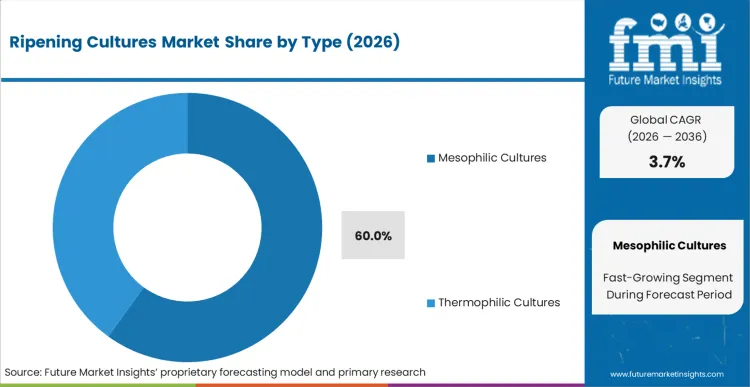
The majority of types of cheeses ripened at intermediate temperatures require the manufacture of most cheeses to rely on mesophilic cultures. These cultures generally work best within the temperature range of 20°C to 45°C, but they strongly influence texture formation, aroma compounds, and flavour in cheddar, gouda, cottage cheese, etc. Rising demand from consumers interested in these sorts of cheese varieties as well as the growing trends for artisan and specialty dairy is a reason why good-quality mesophilic cultures are in demand.
Mesophilic cultures are generally preferred by dairy manufacturers due to their ability to continuously matetrize cheese and ensure product uniformity. The quality and sensory appeal of dairy products will depend on the functionality of mesophilic cultures due to the stringent standards for manufacturers as well as consumers. Therefore, with innovation in dairy processing processes expected to continue, mesophilic cultures will remain integral to cheese-making and fermented dairy applications.
By Form
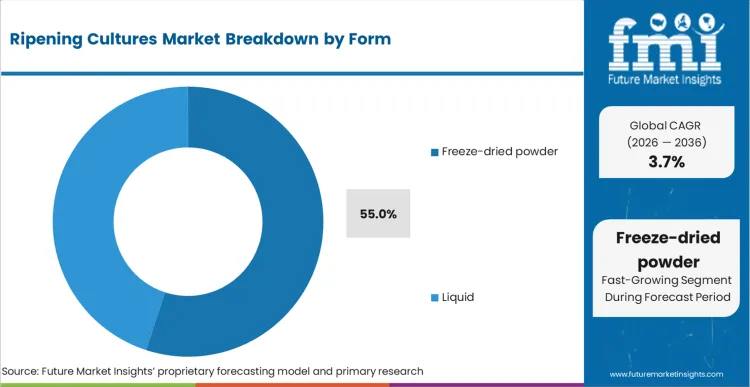
Liquid fermentation cultures are widely preferred in the dairy industry since they ensure easy handling, and also ensure uniform dispersion within the milk while fermenting. Freeze-dried variants have slower activation time, resulting in less maturity time and flavor formation. Therefore, they are very suitable for high-scale dairy industries where there is a need to provide efficiency and accuracy for the application of culture in the production.
Liquid cultures owe some considerable benefits in terms of improvement in the quality and texture of dairy products. The high metabolic activity of cultures is crucial for efficiency in fermentation, which produces some properties unique to cheese and other dairy culture products. With dairy producers aiming for optimization of their process, a creeping demand for liquid cultures will drive them to great importance in the industry.
By Application
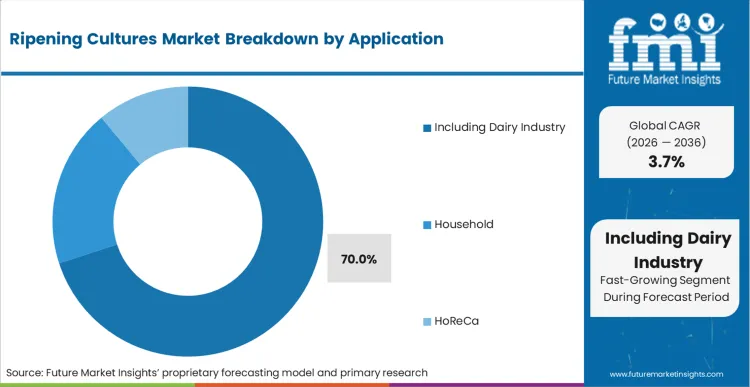
The dairy industry particularly depends on the fermentation culture. It offers it with excellent means of obtaining excellent fermented products: cheese, and yogurt, are examples of very important quality fermentation products in themselves. In view of consumer taste, texture and aroma play major roles as decisive factors. Presently, for specialty and functionally more relevant dairy products the demand is further increasing and stimulating the advanced microbes to cater more to such emergent requirements as per consumers.
Moreover, increased consumption of dairy products worldwide has led to the adoption of innovative processing techniques that improve efficiency and differentiate products. Fermentation cultures give dairy manufacturers the possibility of achieving constant results while ensuring quality and safety standards in dairy products. With this ever-growing demand for premium and health-oriented dairy products, the microbial strains will be pivotal to shaping the future of innovation in the dairy industry.
By Distribution Channel
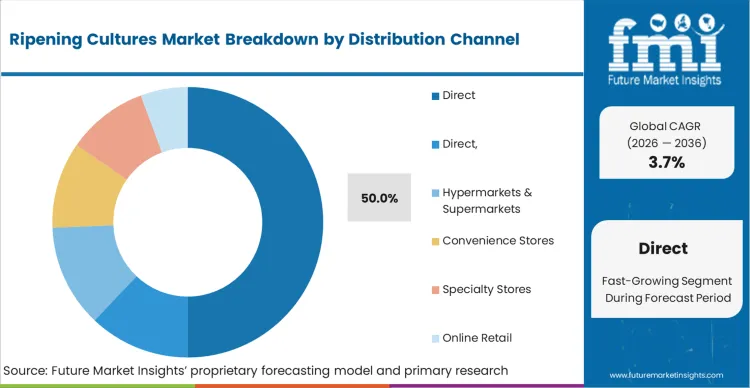
It should be preferred to make the direct distribution channels available to supply ripening cultures to dairy producers, with customized solutions and technical support. Dairy companies can obtain the finest quality cultures by directly communicating with manufacturers. This channel allows for more effective communication and thus better support, ensuring proper troubleshooting and process optimization.
In addition, direct distribution will see that the dairy producer will have continuity of their products in view of a stable supply of cultures. In this regard, large-scale dairy operations benefit more from direct culture suppliers in view of their ability to formulate proprietary products and make the process of production much easier. In view of the increasing complexity of dairy processing, the direct distribution model will be the primary driver for efficiency and quality in the industry.
Country-Wise Insights
.webp "Top Country Growth Comparison Ripening Cultures Market Cagr (2026 2036)")
| Countries | CAGR (2025 to 2035) |
|---|---|
| UK | 5.7% |
| Japan | 5.7% |
| USA | 6.4% |
| India | 5.8% |
| China | 6.0% |
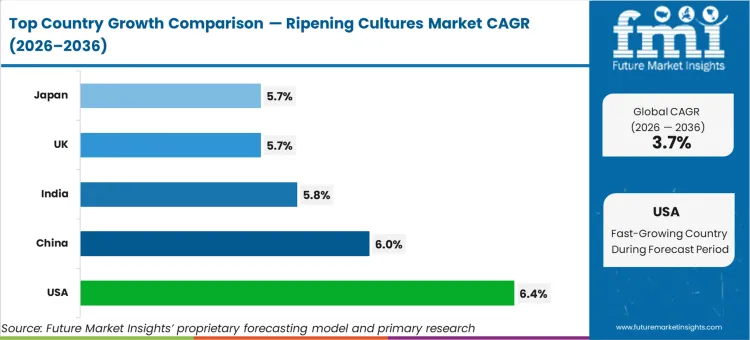
Increasing Demand for Handcrafted Dairy is Propelling the Market in the UK
The United Kingdom market is expected to grow steadily due to the consumers' preference for premium and artisanal dairy products. The specialty cheese market is growing, while the improvement in fermentation technology contributes to the acceptance of cultures for food production purposes. Manufacturers have been investing in high-quality cultures to enhance flavor and texture.
Further impetus to market growth comes from increasingly clean-label and naturally aged dairy products. As consumers become more aware of probiotic-enriched foods and sustainable production methods, food companies launch sophisticated cultures that meet new expectations, thus guaranteeing steady growth in the sector from 2035 onwards.
Technological Advancements in Dairy Processing Are Driving the Market in Japan
Due to dairy processing and fermentation technique innovations, Japan's market is expected to grow. Advances in technology in the country have led manufacturers to high-quality, naturally aged dairy products. Growing acceptance of fermented food intake in the Japanese diet serves to fuel demand for cultures.
Increasing functional dairy, like probiotic-rich and gut-friendly products, is driving food manufacturers to invest in advanced cultures. Support from regulations on traditional and naturally fermented foods is also changing the market growth, which is going to provide steady demand for cultures in the food industry of Japan over the next decade.
Rising Demand for Specialty Cheese Will Propel the USA Market
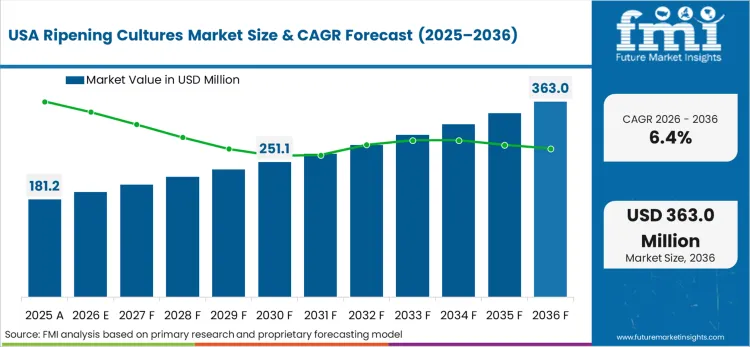
The United States is witnessing a high demand for cultures due to higher consumer interest in specialty and gourmet cheese. Artisanal cheese production, in tandem with steadily increasing investments in fermented dairy processing, adds to this growth. A large number of consumers seek premium-quality naturally aged cheese products with enhanced flavors.
Biotechnology in food aging for the manufacturers of such food is helpful in the consistency of their products while having longer shelf lives. Cultures growth also supports a clean-label movement and chemical-free dairy preference. Dairy fermentation's continuous innovation propels USA markets forward toward long-term growth.
Expanding Dairy Industry Strengthening Market in India
Due to its fast-developing dairy industry, India's market is currently in growth. With the increased acceptance of fermented dairy products, a high demand for superior quality advanced cultures gets created for consumers who consume traditional Indian cheeses and yogurts. Growing consciousness of the population about better quality and naturally processed dairy products is fuelling the market.
Local dairy manufacturers are investing in culture development in order to improve the texture, taste, and shelf life of the product. As the demand for functional and probiotic-rich dairy increases, the integration of innovative cultures is expected to grow. Government support for dairy processing advancements is further bolstering the growth of the industry in India.
Increasing Demand for Fermented Dairy is Driving the Market in China
China's market grows because of more demand for the fermented dairy, especially among healthier consumers. Cultures have chances to increase growth because of influence from Western diets and the introduction of specialty cheese, which can be consumed worldwide. Local companies use advanced techniques in fermentation according to changing demand from consumers.
The growing dairy industry, along with regulatory programs that promote high-quality food production, will further enhance the growth of the market. Increasing demand from customers toward traditionally fermented, probiotic-rich dairy products is driving manufacturers to improve fermentation procedures. With continuous innovation in dairy production, China's market is expected to grow with a positive trend.
Market Concentration
A few firms are dominating the fermentation industry due to their control over microbial technologies. They emphasize developing some specific strains that help speed up the ripening process in dairy and meat products. Their expertise is superior in terms of controlling the texture, aroma, and flavor formation, thus enhancing their dominance in this specialized area.
Consumer demand for artisanal and specialty cheeses has prompted manufacturers to perfect fermentation techniques for a number of applications. Producers work to develop proprietary bacterial and fungal strains to satisfy specific aging profiles. This allows cheesemakers to create a range of products tailored to regional and gourmet tastes, which will help open markets.
The development of very effective fermentation technologies that reduce production timelines is an outcome of advances in research on microbes. Developments in enzyme activity and metabolic pathways allow companies to shorten maturation times while retaining the traditional flavor. This enables large-scale manufacturers to maintain the balance between efficiency and authenticity.
Sustainability trends are impacting the industry, as firms focus on natural and clean-label cultures. Manufacturers perfect the fermentation process to minimize synthetic additives. Consumers have demanded minimally processed foods. To this end, leading companies adopt eco-friendly practices that make them stand out and align with international regulatory shifts favoring greater transparency in food processing.
Cheese and cured meat making has been practiced for centuries and it remains the most significant region till the present day. French, Italian, and German companies carry on the traditional practices with knowledge fashioned through trials over several centuries and blended it with the most modern biotechnological know-how. This age has increased interest in aged dairy and plant-based fermentation applications, causing quickening expansion into North America and Asia-Pacific.
Competitive Landscape
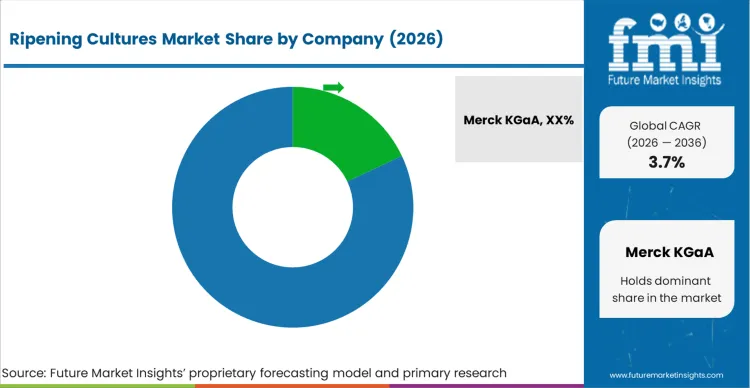
The major players in the market of fermentation include Chr. Hansen, DSM, DuPont (IFF), Sacco System, and Bioprox. Such companies have the policies of research, innovation, and partnership for strengthening their position. The purchase of DSM's surface and fermentation business had a significant impact on Lallemand and enhanced its presence globally in the dairy and meat processing business.
Europe is the largest fermenter market mainly due to its strength in dairy consumption and a strong cheese-making tradition in France, Germany, and Italy. Premium cheeses and artisanal dairy products are still growing in demand, leading companies to improve the flavors, textures, and quality of these products with the help of advanced microbial solutions.
North America has noted a high demand for fermented dairy products with particular interests in foods with probiotics. The USA being the most prominent consumer for cheese marks its growing interests in specialty cheese and artisanal cheese. Manufacturers are now looking forward to investing in premium fermentation so as to differentiate their product and meet changing consumer demands.
Asia Pacific will top the growth regions, principally owing to greater consumption of dairy and increased health awareness. Rapid urbanization coupled with changing dietary patterns- especially in China and India- will also spur the demand for premium quality dairy products. This is driving dairy producers to emulsify advanced microbial solutions into their processes to boost product consistency and taste.
The dairy and fermented food market is continuously developing because producers search for better quality products. The science of microbial cultures and other techniques of processing is contributing to industry innovation. With high demand from consumers of specialty cheeses and functional dairy products, fermentation technology will lead in the reshaping of future market trends.
Recent Developments
The report includes full coverage of key trends from competitive benchmarking. Some of the recent developments covered in the reports:
- In February 2026, the industry accelerated the adoption of agentic AI in microbial strain selection, with leading culture manufacturers deploying autonomous AI agents capable of screening millions of bacterial strains to identify those delivering the most consistent ripening profiles under varying climatic and processing conditions, reducing the R&D cycle for new culture commercialization by an estimated 40%. [2]
- In February 2026, dsm-firmenich announced 'Frosted Star Anise' as its 2026 Flavor of the Year, reflecting the broader market trend toward multisensory sensation profiles incorporating cooling and warming dimensions that are being integrated into new adjunct culture formulations for specialty cheeses targeting emotion-driven eating experiences. [3]
- In December 2025, Sacco System accelerated its South American expansion by acquiring its Brazilian subsidiary and a Uruguayan biotechnology firm, targeting the USD 45 to 55 billion Latin American dairy market with localized ripening culture formulations specifically designed for regional taste preferences and high-temperature storage challenges encountered across the region. [4]
- In September 2025, dsm-firmenich launched the next generation of its Dairy Safe cultures, an all-in-one ripening and protective culture system using specific nisin-producing strains to prevent late blowing defects in hard cheeses while naturally inhibiting spoilage organisms, designed as a direct replacement for traditional nitrate additives facing regulatory restriction across multiple European dairy markets. [1]
Key Market Players
- Merck KGaA
- DuPont de Nemours, Inc.
- DSM Food Specialties
- Sacco System
- Biochem SRL
- CSK Food Enrichment
- Lactalis Ingredients
- Connell Bros. Co. LLC
- Bioprox
- Chr. Hansen Holding A/S
Scope of the Report
| Metric | Value |
|---|---|
| Quantitative Units | USD 352.6 million (2026) to USD 507.1 million (2036), at a CAGR of 3.7% |
| Market Definition | The ripening cultures market covers defined mesophilic and thermophilic microbial culture preparations used in dairy processing to govern enzymatic transformat ion of milk proteins and fats during cheese ripening, cultured butter production, and specialty fermented dairy applications. |
| Type Segmentation | Mesophilic Cultures, Thermophilic Cultures |
| Form Segmentation | Freeze-dried Powder, Liquid |
| Application Segmentation | Dairy Industry, Household, HoReCa |
| Distribution Channel | Direct, Hypermarkets and Supermarkets, Convenience Stores, Specialty Stores, Online Retail |
| Regions Covered | North America, Latin America, Europe, East Asia, South Asia, Oceania, Middle East and Africa |
| Countries Covered | United Kingdom, Japan, United States, India, China and 40 plus countries |
| Key Companies Profiled | Merck KGaA, DuPont de Nemours Inc., DSM Food Specialties, Sacco System, Biochem SRL, CSK Food Enrichment, Lactalis Ingredients, Connell Bros. Co. LLC, Bioprox, Chr. Hansen Holding A/S |
| Forecast Period | 2026 to 2036 |
| Approach | Hybrid top-down and bottom-up market modeling validated through primary interviews with dairy culture manufacturers and cheese producers, supported by IDF statistical benchmarks and verified manufacturer capacity disclosures |
Ripening Cultures Market Segmentation
By Type:
The market is segmented by type into mesophilic cultures and thermophilic cultures.
By Form:
Based on the form, the market is segmented into liquid and freeze-dried powder.
By Application:
The market are categories based on application, including dairy industry, household, and HoReCa.
By Distribution Channel:
The market is segmented by distribution channel into direct, indirect, hypermarkets & supermarkets, convenience stores, specialty stores, and online retail.
By Region:
The market is segmented by region into North America, Latin America, Western Europe, South Asia & Pacific, East Asia, Middle East, and Africa.
Bibliography
- [1] dsm-firmenich. (2025). dsm-firmenich launches next generation Dairy Safe cultures combining ripening and bioprotective strains for nitrate-free hard cheese production. Corporate Product Release, September 2025.
- [2] Future Market Insights Inc. (2026). Ripening Cultures Market: agentic AI in microbial selection reduces R&D cycle by 40% as leading manufacturers deploy autonomous strain screening systems. Market Intelligence Update, February 2026.
- [3] dsm-firmenich. (2026). dsm-firmenich announces Frosted Star Anise as 2026 Flavor of the Year, reflecting multisensory sensation trends in specialty dairy culture development. Corporate Announcement, February 2026.
- [4] Sacco System. (2025). Sacco System expands in Latin America through acquisition of Brazilian subsidiary and Uruguayan biotech firm to serve localized ripening culture demand. Corporate Press Release, December 2025.
- [5] International Dairy Federation. (2025). World dairy situation 2025: production, consumption and trade statistics. IDF Bulletin. Brussels: IDF.
- [6] Merck KGaA. (2026). Merck KGaA annual report 2025: Life Science segment culture media and fermentation performance. Investor Disclosure, February 2026.
This Report Addresses
- Market intelligence to enable structured procurement and new product development strategy for dairy processors, cheese manufacturers, and cultured dairy producers requiring ripening and bioprotective culture solutions
- Market size estimation and 10-year revenue forecasts from 2026 to 2036, supported by validated dairy processing volume benchmarks and culture manufacturer capacity data
- Growth opportunity mapping across culture types and application segments with emphasis on all-in-one ripening and bioprotective combination culture transitions replacing nitrate-based preservation systems
- Segment and regional revenue forecasts covering dairy industry, household, and HoReCa application channels across key consuming geographies in Europe, North America, and Asia-Pacific
- Competition strategy assessment including AI-assisted strain development capability, all-in-one culture system portfolio strength, and regional strain customization service benchmarking
- Product and regulatory compliance tracking including EU nitrate restriction timelines, clean-label culture certification requirements, and new strain EFSA and FDA safety approval pathways
- Regulatory impact analysis covering EU dairy additive restrictions, nitrate phase-out schedules, and their procurement implications for bioprotective and ripening culture suppliers
- Market report delivery in PDF, Excel, PPT, and interactive dashboard formats for executive and operational use
Frequently Asked Questions
How large is the demand for ripening cultures in the global market in 2026?
Demand for ripening cultures in the global market is estimated to be valued at USD 352.6 million in 2026.
What will be the market size of ripening cultures by 2036?
Market size for ripening cultures is projected to reach USD 507.1 million by 2036.
What is the expected CAGR for the ripening cultures market between 2026 and 2036?
Demand for ripening cultures is expected to grow at a CAGR of 3.7% between 2026 and 2036.
Which type segment holds the largest share in the ripening cultures market?
Mesophilic Cultures hold approximately 60% market share, reflecting their foundational role in major cheese categories including Gouda, Cheddar, and Edam, and in cultured butter production across both industrial and artisanal dairy operations.
Which form of ripening culture is most widely used?
Freeze-dried Powder accounts for approximately 55% of the market by form, with its logistical stability, standardized dosing capability, and extended shelf life making it the preferred format for industrial dairy manufacturers operating across diverse climate conditions.
Which countries show the fastest growth in ripening cultures demand?
USA leads at 6.4% CAGR through 2036, followed by China at 6.0% and India at 5.8%, with growth in all three markets driven by specialty cheese premiumization and expansion of cultured dairy product categories beyond traditional fluid milk consumption.
What is the United Kingdom's role in the ripening cultures market?
The United Kingdom is projected to grow at 5.7% CAGR through 2036, driven by artisanal dairy product development, strict food safety compliance requirements, and growing retail demand for protected designation of origin cheeses requiring specific culture strain performance.
How is AI technology changing ripening culture development?
Leading culture manufacturers are deploying AI agents to screen millions of bacterial strains, identifying candidates with the most consistent ripening profiles under varying climatic and processing conditions. This has reduced the R&D cycle for new culture commercialization by an estimated 40% compared to conventional empirical screening programs.
Is Japan covered in this report?
Yes, Japan is covered within the East Asia regional scope at 5.7% CAGR through 2036, driven by consistent demand from artisanal dairy growth and the adoption of specialty western-style cheese categories within premium Japanese food retail channels.
How does FMI validate the ripening cultures market forecast?
The forecast uses a hybrid model validated through primary interviews with dairy culture manufacturers and cheese processors, cross-referenced against IDF statistical bulletins, regulatory approval records for new culture strains, and verified company investor disclosures from major culture producers.
Preview the report firsthand - request a free sample
Get SampleGet the brochure for pricing and purchase details.
Get PDFTable of Content
- Executive Summary
- Global Market Outlook
- Demand-side Trends
- Supply-side Trends
- Technology Roadmap Analysis
- Analysis and Recommendations
- Market Overview
- Market Coverage / Taxonomy
- Market Definition / Scope / Limitations
- Research Methodology
- Chapter Orientation
- Analytical Lens and Working Hypotheses
- Market Structure, Signals, and Trend Drivers
- Benchmarking and Cross-market Comparability
- Market Sizing, Forecasting, and Opportunity Mapping
- Research Design and Evidence Framework
- Desk Research Programme (Secondary Evidence)
- Company Annual and Sustainability Reports
- Peer-reviewed Journals and Academic Literature
- Corporate Websites, Product Literature, and Technical Notes
- Earnings Decks and Investor Briefings
- Statutory Filings and Regulatory Disclosures
- Technical White Papers and Standards Notes
- Trade Journals, Industry Magazines, and Analyst Briefs
- Conference Proceedings, Webinars, and Seminar Materials
- Government Statistics Portals and Public Data Releases
- Press Releases and Reputable Media Coverage
- Specialist Newsletters and Curated Briefings
- Sector Databases and Reference Repositories
- FMI Internal Proprietary Databases and Historical Market Datasets
- Subscription Datasets and Paid Sources
- Social Channels, Communities, and Digital Listening Inputs
- Additional Desk Sources
- Expert Input and Fieldwork (Primary Evidence)
- Primary Modes
- Qualitative Interviews and Expert Elicitation
- Quantitative Surveys and Structured Data Capture
- Blended Approach
- Why Primary Evidence is Used
- Field Techniques
- Interviews
- Surveys
- Focus Groups
- Observational and In-context Research
- Social and Community Interactions
- Stakeholder Universe Engaged
- C-suite Leaders
- Board Members
- Presidents and Vice Presidents
- R&D and Innovation Heads
- Technical Specialists
- Domain Subject-matter Experts
- Scientists
- Physicians and Other Healthcare Professionals
- Governance, Ethics, and Data Stewardship
- Research Ethics
- Data Integrity and Handling
- Primary Modes
- Tooling, Models, and Reference Databases
- Desk Research Programme (Secondary Evidence)
- Data Engineering and Model Build
- Data Acquisition and Ingestion
- Cleaning, Normalisation, and Verification
- Synthesis, Triangulation, and Analysis
- Quality Assurance and Audit Trail
- Market Background
- Market Dynamics
- Drivers
- Restraints
- Opportunity
- Trends
- Scenario Forecast
- Demand in Optimistic Scenario
- Demand in Likely Scenario
- Demand in Conservative Scenario
- Opportunity Map Analysis
- Product Life Cycle Analysis
- Supply Chain Analysis
- Investment Feasibility Matrix
- Value Chain Analysis
- PESTLE and Porter’s Analysis
- Regulatory Landscape
- Regional Parent Market Outlook
- Production and Consumption Statistics
- Import and Export Statistics
- Market Dynamics
- Global Market Analysis 2021 to 2025 and Forecast, 2026 to 2036
- Historical Market Size Value (USD Million) Analysis, 2021 to 2025
- Current and Future Market Size Value (USD Million) Projections, 2026 to 2036
- Y-o-Y Growth Trend Analysis
- Absolute $ Opportunity Analysis
- Global Market Pricing Analysis 2021 to 2025 and Forecast 2026 to 2036
- Global Market Analysis 2021 to 2025 and Forecast 2026 to 2036, By Type
- Introduction / Key Findings
- Historical Market Size Value (USD Million) Analysis By Type , 2021 to 2025
- Current and Future Market Size Value (USD Million) Analysis and Forecast By Type , 2026 to 2036
- Mesophilic Cultures
- Thermophilic Cultures
- Mesophilic Cultures
- Y-o-Y Growth Trend Analysis By Type , 2021 to 2025
- Absolute $ Opportunity Analysis By Type , 2026 to 2036
- Global Market Analysis 2021 to 2025 and Forecast 2026 to 2036, By Form
- Introduction / Key Findings
- Historical Market Size Value (USD Million) Analysis By Form, 2021 to 2025
- Current and Future Market Size Value (USD Million) Analysis and Forecast By Form, 2026 to 2036
- Freeze-dried powder
- Liquid
- Freeze-dried powder
- Y-o-Y Growth Trend Analysis By Form, 2021 to 2025
- Absolute $ Opportunity Analysis By Form, 2026 to 2036
- Global Market Analysis 2021 to 2025 and Forecast 2026 to 2036, By Application
- Introduction / Key Findings
- Historical Market Size Value (USD Million) Analysis By Application, 2021 to 2025
- Current and Future Market Size Value (USD Million) Analysis and Forecast By Application, 2026 to 2036
- Including Dairy Industry
- Household
- HoReCa
- Including Dairy Industry
- Y-o-Y Growth Trend Analysis By Application, 2021 to 2025
- Absolute $ Opportunity Analysis By Application, 2026 to 2036
- Global Market Analysis 2021 to 2025 and Forecast 2026 to 2036, By Distribution Channel
- Introduction / Key Findings
- Historical Market Size Value (USD Million) Analysis By Distribution Channel, 2021 to 2025
- Current and Future Market Size Value (USD Million) Analysis and Forecast By Distribution Channel, 2026 to 2036
- Direct
- Direct,
- Hypermarkets & Supermarkets
- Convenience Stores
- Specialty Stores
- Online Retail
- Direct
- Y-o-Y Growth Trend Analysis By Distribution Channel, 2021 to 2025
- Absolute $ Opportunity Analysis By Distribution Channel, 2026 to 2036
- Global Market Analysis 2021 to 2025 and Forecast 2026 to 2036, By Region
- Introduction
- Historical Market Size Value (USD Million) Analysis By Region, 2021 to 2025
- Current Market Size Value (USD Million) Analysis and Forecast By Region, 2026 to 2036
- North America
- Latin America
- Western Europe
- Eastern Europe
- East Asia
- South Asia and Pacific
- Middle East & Africa
- Market Attractiveness Analysis By Region
- North America Market Analysis 2021 to 2025 and Forecast 2026 to 2036, By Country
- Historical Market Size Value (USD Million) Trend Analysis By Market Taxonomy, 2021 to 2025
- Market Size Value (USD Million) Forecast By Market Taxonomy, 2026 to 2036
- By Country
- USA
- Canada
- Mexico
- By Type
- By Form
- By Application
- By Distribution Channel
- By Country
- Market Attractiveness Analysis
- By Country
- By Type
- By Form
- By Application
- By Distribution Channel
- Key Takeaways
- Latin America Market Analysis 2021 to 2025 and Forecast 2026 to 2036, By Country
- Historical Market Size Value (USD Million) Trend Analysis By Market Taxonomy, 2021 to 2025
- Market Size Value (USD Million) Forecast By Market Taxonomy, 2026 to 2036
- By Country
- Brazil
- Chile
- Rest of Latin America
- By Type
- By Form
- By Application
- By Distribution Channel
- By Country
- Market Attractiveness Analysis
- By Country
- By Type
- By Form
- By Application
- By Distribution Channel
- Key Takeaways
- Western Europe Market Analysis 2021 to 2025 and Forecast 2026 to 2036, By Country
- Historical Market Size Value (USD Million) Trend Analysis By Market Taxonomy, 2021 to 2025
- Market Size Value (USD Million) Forecast By Market Taxonomy, 2026 to 2036
- By Country
- Germany
- UK
- Italy
- Spain
- France
- Nordic
- BENELUX
- Rest of Western Europe
- By Type
- By Form
- By Application
- By Distribution Channel
- By Country
- Market Attractiveness Analysis
- By Country
- By Type
- By Form
- By Application
- By Distribution Channel
- Key Takeaways
- Eastern Europe Market Analysis 2021 to 2025 and Forecast 2026 to 2036, By Country
- Historical Market Size Value (USD Million) Trend Analysis By Market Taxonomy, 2021 to 2025
- Market Size Value (USD Million) Forecast By Market Taxonomy, 2026 to 2036
- By Country
- Russia
- Poland
- Hungary
- Balkan & Baltic
- Rest of Eastern Europe
- By Type
- By Form
- By Application
- By Distribution Channel
- By Country
- Market Attractiveness Analysis
- By Country
- By Type
- By Form
- By Application
- By Distribution Channel
- Key Takeaways
- East Asia Market Analysis 2021 to 2025 and Forecast 2026 to 2036, By Country
- Historical Market Size Value (USD Million) Trend Analysis By Market Taxonomy, 2021 to 2025
- Market Size Value (USD Million) Forecast By Market Taxonomy, 2026 to 2036
- By Country
- China
- Japan
- South Korea
- By Type
- By Form
- By Application
- By Distribution Channel
- By Country
- Market Attractiveness Analysis
- By Country
- By Type
- By Form
- By Application
- By Distribution Channel
- Key Takeaways
- South Asia and Pacific Market Analysis 2021 to 2025 and Forecast 2026 to 2036, By Country
- Historical Market Size Value (USD Million) Trend Analysis By Market Taxonomy, 2021 to 2025
- Market Size Value (USD Million) Forecast By Market Taxonomy, 2026 to 2036
- By Country
- India
- ASEAN
- Australia & New Zealand
- Rest of South Asia and Pacific
- By Type
- By Form
- By Application
- By Distribution Channel
- By Country
- Market Attractiveness Analysis
- By Country
- By Type
- By Form
- By Application
- By Distribution Channel
- Key Takeaways
- Middle East & Africa Market Analysis 2021 to 2025 and Forecast 2026 to 2036, By Country
- Historical Market Size Value (USD Million) Trend Analysis By Market Taxonomy, 2021 to 2025
- Market Size Value (USD Million) Forecast By Market Taxonomy, 2026 to 2036
- By Country
- Kingdom of Saudi Arabia
- Other GCC Countries
- Turkiye
- South Africa
- Other African Union
- Rest of Middle East & Africa
- By Type
- By Form
- By Application
- By Distribution Channel
- By Country
- Market Attractiveness Analysis
- By Country
- By Type
- By Form
- By Application
- By Distribution Channel
- Key Takeaways
- Key Countries Market Analysis
- USA
- Pricing Analysis
- Market Share Analysis, 2025
- By Type
- By Form
- By Application
- By Distribution Channel
- Canada
- Pricing Analysis
- Market Share Analysis, 2025
- By Type
- By Form
- By Application
- By Distribution Channel
- Mexico
- Pricing Analysis
- Market Share Analysis, 2025
- By Type
- By Form
- By Application
- By Distribution Channel
- Brazil
- Pricing Analysis
- Market Share Analysis, 2025
- By Type
- By Form
- By Application
- By Distribution Channel
- Chile
- Pricing Analysis
- Market Share Analysis, 2025
- By Type
- By Form
- By Application
- By Distribution Channel
- Germany
- Pricing Analysis
- Market Share Analysis, 2025
- By Type
- By Form
- By Application
- By Distribution Channel
- UK
- Pricing Analysis
- Market Share Analysis, 2025
- By Type
- By Form
- By Application
- By Distribution Channel
- Italy
- Pricing Analysis
- Market Share Analysis, 2025
- By Type
- By Form
- By Application
- By Distribution Channel
- Spain
- Pricing Analysis
- Market Share Analysis, 2025
- By Type
- By Form
- By Application
- By Distribution Channel
- France
- Pricing Analysis
- Market Share Analysis, 2025
- By Type
- By Form
- By Application
- By Distribution Channel
- India
- Pricing Analysis
- Market Share Analysis, 2025
- By Type
- By Form
- By Application
- By Distribution Channel
- ASEAN
- Pricing Analysis
- Market Share Analysis, 2025
- By Type
- By Form
- By Application
- By Distribution Channel
- Australia & New Zealand
- Pricing Analysis
- Market Share Analysis, 2025
- By Type
- By Form
- By Application
- By Distribution Channel
- China
- Pricing Analysis
- Market Share Analysis, 2025
- By Type
- By Form
- By Application
- By Distribution Channel
- Japan
- Pricing Analysis
- Market Share Analysis, 2025
- By Type
- By Form
- By Application
- By Distribution Channel
- South Korea
- Pricing Analysis
- Market Share Analysis, 2025
- By Type
- By Form
- By Application
- By Distribution Channel
- Russia
- Pricing Analysis
- Market Share Analysis, 2025
- By Type
- By Form
- By Application
- By Distribution Channel
- Poland
- Pricing Analysis
- Market Share Analysis, 2025
- By Type
- By Form
- By Application
- By Distribution Channel
- Hungary
- Pricing Analysis
- Market Share Analysis, 2025
- By Type
- By Form
- By Application
- By Distribution Channel
- Kingdom of Saudi Arabia
- Pricing Analysis
- Market Share Analysis, 2025
- By Type
- By Form
- By Application
- By Distribution Channel
- Turkiye
- Pricing Analysis
- Market Share Analysis, 2025
- By Type
- By Form
- By Application
- By Distribution Channel
- South Africa
- Pricing Analysis
- Market Share Analysis, 2025
- By Type
- By Form
- By Application
- By Distribution Channel
- USA
- Market Structure Analysis
- Competition Dashboard
- Competition Benchmarking
- Market Share Analysis of Top Players
- By Regional
- By Type
- By Form
- By Application
- By Distribution Channel
- Competition Analysis
- Competition Deep Dive
- Merck KGaA
- Overview
- Product Portfolio
- Profitability by Market Segments (Product/Age /Sales Channel/Region)
- Sales Footprint
- Strategy Overview
- Marketing Strategy
- Product Strategy
- Channel Strategy
- DuPont de Nemours, Inc.
- DSM Food Specialties
- Sacco System
- Biochem SRL
- CSK Food Enrichment
- Lactalis Ingredients
- Connell Bros. Co. LLC
- Bioprox
- Chr. Hansen Holding A/S
- Merck KGaA
- Competition Deep Dive
- Assumptions & Acronyms Used


