

- Market Size (2026)
- USD 96.54 Mn
- Forecast (2036)
- USD 107.64 Mn
- CAGR (2026 to 2036)
- 1.09%
How big is the Rivaroxaban Market?
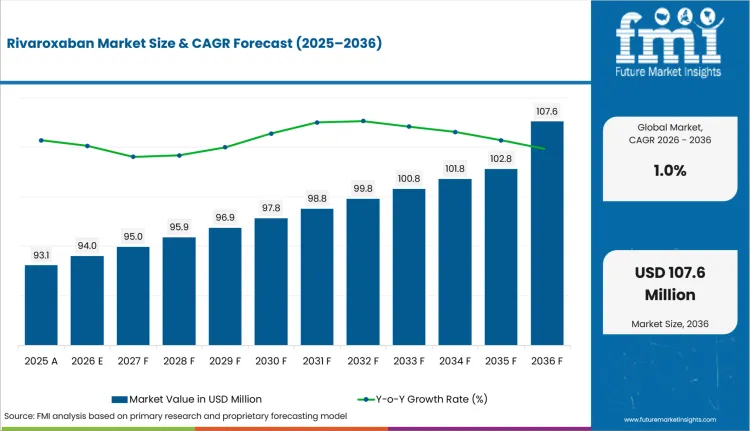
The Rivaroxaban Market is projected to grow from USD 96.54 million in 2026 to USD 107.64 million by 2036, at a CAGR of 1.09%.
The Rivaroxaban Market was valued at USD 93.08 million in 2025 and is estimated at USD 96.54 million in 2026. The market is forecast to reach USD 107.64 million by 2036 at a CAGR of 1.09%. Micronized API is projected to account for a 61.2% share in 2026 as finished-dose makers keep tighter control over dissolution behavior. The ≥99.5% purity grade is projected to hold a 67.4% share in 2026 as regulated buyers prioritize impurity control and filing continuity.
| Metric | Value |
|---|---|
| 2025 Market Size | USD 93.08 million |
| 2026 Market Size | USD 96.54 million |
| 2036 Market Size | USD 107.64 million |
| Forecast CAGR (2026-2036) | 1.09% |
| Leading Form | Micronized API |
| Micronized API Share (2026) | 61.2% |
| Leading Purity Grade | ≥99.5% |
| ≥99.5% Share (2026) | 67.4% |
| Fastest-growing Country | India |
| India CAGR by 2036 | 1.8% |
Summary of the Rivaroxaban Market
| Market Signal | Commercial Impact |
|---|---|
| Demand and Growth Drivers | Demand for rivaroxaban API is increasing as generic drug approvals, chronic anticoagulant therapy, and regulatory quality requirements continue to expand validated API sourcing needs.
|
| Product and Segment View | Micronized API, high-purity grades, and stroke prevention applications continue to represent the leading commercial opportunities in the market.
|
| Geography and Growth Outlook | Europe remains the leading regional market while North America and India continue to strengthen their positions through generic drug expansion and API manufacturing capabilities.
|
| Competitive Landscape | Competition increasingly focuses on regulatory compliance, API quality, and integrated finished-dose manufacturing capabilities.
|
| Analyst Perspective | Rivaroxaban API is evolving into a quality-driven market where regulatory compliance, documentation strength, and manufacturing consistency outweigh price competition alone.
- Anurag Sharma, Principal Consultant at Future Market Insights |
In March 2025, the USA FDA approved the first generics of Xarelto 2.5 mg tablets for cardiovascular and peripheral artery disease risk reduction. This widened the USA generic supply pool. In April 2025, Aurobindo Pharma received final USA FDA approval for Rivaroxaban Tablets USP 2.5 mg. This added another approved finished-dose route in the United States.
FDA approval of first generics for the 2.5 mg strength in March 2025 widened the United States supply pool, which raises price pressure while keeping API quality expectations high.
Why is the Rivaroxaban Market growing?
Generic tablet approvals create new API qualification work as each finished-dose supplier needs a validated source. Atrial fibrillation use supports repeat demand since rivaroxaban is used to reduce stroke and systemic embolism risk.
- Generic tablet approvals create new API qualification work as each finished-dose supplier needs a validated source.
- Atrial fibrillation use supports repeat demand since rivaroxaban is used to reduce stroke and systemic embolism risk.
- VTE treatment needs keep a second application pool as hospitals and outpatient prescribers use oral anticoagulants.
Rivaroxaban behaves like a mature chronic-use API where growth comes from supplier substitution and generic competition. DailyMed labels identify rivaroxaban for reducing stroke and systemic embolism risk in non-valvular atrial fibrillation. That indication keeps demand tied to long-term prescription use rather than short treatment bursts. Buyers therefore focus on continuity of supply and bioequivalence support. This shifts commercial advantage toward API makers with stable particle-size distribution and strong regulatory files. It also supports adjacent demand across direct oral anticoagulants where oral dosing and predictable anticoagulant effect shape buyer selection. VTE use adds resilience because rivaroxaban is used across treatment and prevention settings.
How is the Rivaroxaban Market segmented?
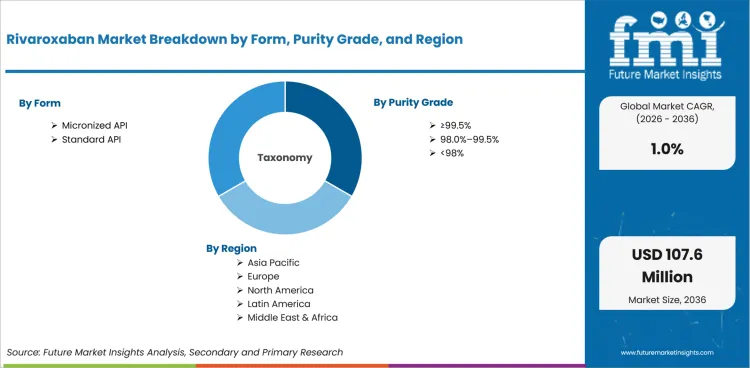
The Rivaroxaban Market is segmented by form, purity grade, application, sales channel, and region.
- Micronized API is projected to lead the form category with a 61.2% share in 2026 as particle-size control supports tablet dissolution targets.
- With an estimated 67.4% share in 2026, ≥99.5% is expected to lead the purity-grade category as regulated buyers screen impurity risk early.
- Stroke Prevention (Atrial Fibrillation) is projected to account for 58.6% of Application demand in 2026 with chronic use supporting repeat orders.
How does Micronized API contribute to the form category?
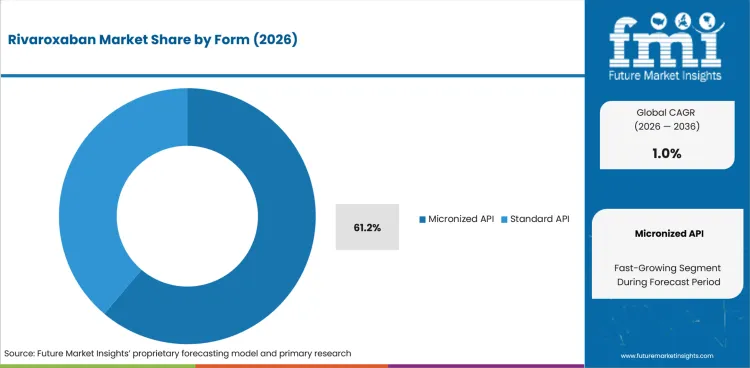
- Micronized API is projected to account for a 61.2% share in 2026 as tablet makers need controlled particle size to support dissolution and bioequivalence testing.
- Standard API suits buyers with formulation processes that can manage dissolution through excipient choice or milling, but it carries higher qualification work in strict markets.
What supports demand for ≥99.5%?
- The ≥99.5% grade is estimated to account for a 67.4% share in 2026 as regulated buyers place impurity thresholds ahead of spot-price savings.
- Lower-purity grades mainly serve development, early validation, or less regulated procurement routes where buyers accept more testing effort before scale-up.
How do buyers evaluate Stroke Prevention (Atrial Fibrillation) within the application category?
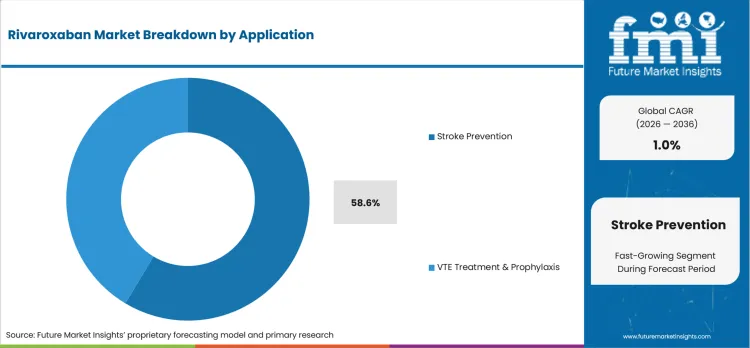
- Stroke Prevention (Atrial Fibrillation) is anticipated to hold a 58.6% share in 2026 as chronic prescription use creates stable repeat API demand.
- Atrial fibrillation use differs from VTE use because supply planning must support longer therapy duration and more predictable refill-linked finished-dose output.
What market factors influence demand for Direct?
- Direct sales are expected to represent a 72.8% share in 2026 as regulated formulators prefer audited supply relationships and documented change-control history.
- Distributor demand remains relevant for development batches and backup sourcing, but large buyers usually shift to direct contracts after supplier qualification.
How does Europe affect the regional outlook?
- Europe is projected to account for 31.6% regional share in 2026 as EMA references and national reimbursement systems support regulated generic entry.
- European demand favors suppliers with DMF and CEP depth, since buyers must manage national price pressure without raising regulatory risk.
What drives and restrains the market?
Driver: Generic approvals drive API qualification work as new finished-dose suppliers need validated Rivaroxaban API sources; restraint: Price erosion restrains value growth as generic competition lowers finished-dose pricing and compresses API margins; opportunity: specialty sourcing opportunities exist where suppliers combine specialty active pharmaceutical ingredients experience with oral-solid regulatory support.
The market reflects a balance between the identified demand driver, adoption constraints, and the supplier opportunity outlined below.
- Driver: Generic approvals drive API qualification work as new finished-dose suppliers need validated Rivaroxaban API sources.
- Restraint: Price erosion restrains value growth as generic competition lowers finished-dose pricing and compresses API margins.
- Opportunity: specialty sourcing opportunities exist where suppliers combine specialty active pharmaceutical ingredients experience with oral-solid regulatory support.
Generic Filing Pull: Generic filing activity is the clearest growth mechanism in the Rivaroxaban Market. The USA FDA approved the first generics of Xarelto 2.5 mg tablets in March 2025, and that approval expanded the supply pool for a strength used in cardiovascular risk reduction. New finished-dose competitors need API sources that match the dossier and support scale-up. This means API makers are selling regulatory confidence as much as chemical output. Buyers screen supplier records before price talks become decisive.
Micronized Dissolution Control: Micronization is a core purchase factor because rivaroxaban is an oral small-molecule drug where dissolution behavior affects finished-dose performance. Rivaroxaban 2.5 mg and 10 mg tablets show high bioavailability, while larger doses are taken with food to support absorption. This makes particle-size control more important for finished-dose makers trying to keep release behavior within approved ranges. Suppliers with proven milling control reduce reformulation work and lower buyer risk during validation. The effect is notable in regulated markets where a supplier change can trigger documentation, testing, and delay. API Price Compression: The main restraint is value pressure after generic entry.
Which factors support expansion?
Commercial expansion is reinforced by the value, workflow, and recurring-demand factors below.
- The market value is rising from USD 96.54 million in 2026 to USD 107.64 million by 2036 as generic supply broadens.
- The 1.09% CAGR shows limited price-led expansion as mature anticoagulant use offsets buyer pressure on API pricing.
- Micronized API remains the value anchor because finished-dose makers need particle-size consistency for bioequivalence work.
Which country markets are included in the CAGR comparison?
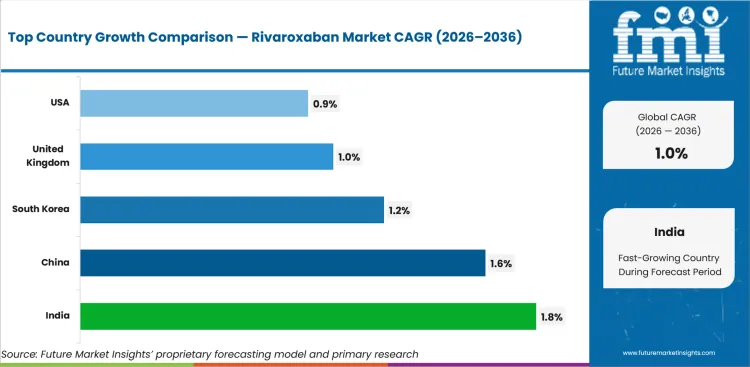
The selected CAGR comparison covers India (1.8%), China (1.6%), South Korea (1.2%), United Kingdom (1.0%), and United States (0.9%) through 2036.
| Country | CAGR |
|---|---|
| India | 1.8% |
| China | 1.6% |
| South Korea | 1.2% |
| United Kingdom | 1.0% |
| United States | 0.9% |
Source: Future Market Insights analysis.
How do country-level CAGRs compare?
- India (CAGR: 1.8%): India is expected to record a CAGR of 1.8% through 2036 as API manufacturing depth supports regulated-market supply.
- China (CAGR: 1.6%): China is forecast to grow at a CAGR of 1.6% through 2036 as local generic activity and scale demand support faster growth than mature Western markets.
- South Korea (CAGR: 1.2%): South Korea is expected to record a CAGR of 1.2% through 2036 as clinical confidence supports careful oral anticoagulant use.
- United Kingdom (CAGR: 1.0%): The United Kingdom is expected to grow at a CAGR of 1.0% through 2036 as NHS reimbursement creates clear channel discipline.
- United States (CAGR: 0.9%): The United States has a large atrial fibrillation pool, with the CDC estimating 12.1 million affected people by 2050.
The global Rivaroxaban Market is forecast to record a CAGR of 1.09% from 2026 to 2036. The study covers 30+ countries across the report regions.
How is the Rivaroxaban Market developing in India?
India is projected to record a CAGR of 1.8% through 2036. The country outlook identifies this demand signal: Export documentation supports regulated-market API demand.
Country Market Snapshot
| Country | India |
|---|---|
| Forecast CAGR | 1.8% |
| Growth role | India is projected to record a CAGR of 1.8% through 2036. |
| API supply signal | CDSCO written-confirmation records include rivaroxaban for export-oriented API supply. |
| Regulatory activity | CDSCO’s cardiovascular committee accepted Bayer’s Phase IV study results for rivaroxaban 2.5 mg in November 2025. |
| Company context | Companies active in or serving this market include Dr. Reddy’s Laboratories, Aurobindo Pharma, Lupin, Biocon Pharma, and MSN Laboratories. |
| Buyer behavior | Export buyers screen Indian suppliers by documentation and audit history. |
| Restraint | Competitive pricing among Indian API producers limits margin expansion. |
| Executive implication | Executive teams should compare qualification requirements, local service depth, and total implementation economics before selecting suppliers. |
Market Outlook
India is expected to record a CAGR of 1.8% through 2036 as API manufacturing depth supports regulated-market supply. The country’s role is more supply-side than consumption-side. CDSCO written-confirmation records and company API listings show how Indian producers support export markets. This makes India central to the global Rivaroxaban Market analysis. Indian suppliers compete on route chemistry, documentation, micronization control, and cost. Export buyers often start with audit history before negotiating price.
Key Growth Drivers
- Export documentation supports regulated-market API demand.
- Indian API firms offer cost and filing support in one supplier route.
- Multiple Indian companies have public rivaroxaban API or finished-dose evidence.
- India is an important supply-side growth country because its API producers serve regulated and semi-regulated buyers from the same manufacturing base.
Key Restraints
- Intense domestic supplier competition limits pricing power.
- Buyers may require long audit cycles before approving supplier change.
- Competitive pricing among Indian API producers limits margin expansion.
Country Market FAQs
What should C-suite teams prioritize in India?
C-suite teams should prioritize qualification requirements, procurement routes, local service coverage, and implementation economics before committing capital or supplier volume.
How should suppliers approach the India market?
Suppliers should align technical evidence, local channel support, and account-specific commercial terms with the buying process used by major customers in India.
What can weaken the business case in India?
Competitive pricing among Indian API producers limits margin expansion. Executives should test this exposure during supplier, investment, and rollout reviews.
How is the Rivaroxaban Market developing in China?
China is projected to record a CAGR of 1.6% through 2036. The country outlook identifies this demand signal: Local generic tablet activity creates API qualification demand.
Country Market Snapshot
| Country | China |
|---|---|
| Forecast CAGR | 1.6% |
| Regulatory activity | NMPA notice records in 2024 and 2025 include rivaroxaban tablets linked to Bayer Healthcare. |
| Domestic signal | NMPA records include rivaroxaban tablet approvals for Jilin Boda Pharmaceutical and Jilin Sihuan Pharmaceutical. |
| Buyer behavior | Domestic generic makers compare API price with approval-document readiness. |
| Application mix | AF and VTE demand supports oral anticoagulant manufacturing. |
| Supply structure | Local tablet approval activity creates API qualification demand. |
| Restraint | Volume-based price pressure can compress API margins. |
| Company context | Companies active in or serving this market include Bayer, Zhejiang Huahai Pharmaceutical, Jiangsu Hengrui Pharmaceuticals, Jilin Boda Pharmaceutical, and Jilin Sihuan Pharmaceutical. |
Market Outlook
China is forecast to grow at a CAGR of 1.6% through 2036 as local generic activity and scale demand support faster growth than mature Western markets. NMPA delivery records in 2024 and 2025 include multiple rivaroxaban tablet notices, including entries tied to Bayer Healthcare and local manufacturers. This points to a market where regulatory approvals and domestic substitution shape API buying. Chinese buyers often balance price with the need for approval-ready documentation.
Key Growth Drivers
- Local generic tablet activity creates API qualification demand.
- NMPA approval records support wider finished-dose participation.
- Domestic scale can lift batch demand once suppliers pass qualification.
- AF and VTE demand supports oral anticoagulant manufacturing.
Key Restraints
- Price pressure can limit API value growth.
- Approval-linked sourcing slows rapid supplier replacement.
- Volume-based price pressure can compress API margins.
Country Market FAQs
What should C-suite teams prioritize in China?
C-suite teams should prioritize qualification requirements, procurement routes, local service coverage, and implementation economics before committing capital or supplier volume.
How should suppliers approach the China market?
Suppliers should align technical evidence, local channel support, and account-specific commercial terms with the buying process used by major customers in China.
What can weaken the business case in China?
Volume-based price pressure can compress API margins. Executives should test this exposure during supplier, investment, and rollout reviews.
How is the Rivaroxaban Market developing in South Korea?
South Korea is projected to record a CAGR of 1.2% through 2036. The country outlook identifies this demand signal: Local clinical evidence supports confidence in AF-related rivaroxaban use.
Country Market Snapshot
| Country | South Korea |
|---|---|
| Forecast CAGR | 1.2% |
| Clinical signal | Korean studies have examined rivaroxaban use in non-valvular atrial fibrillation with renal impairment. |
| Patient profile | Elderly East Asian dosing work shapes anticoagulant use discussions. |
| Regulatory context | MFDS publishes annual drug approval trend reporting for local market oversight. |
| Buyer behavior | Safety and dose confidence affect hospital and specialist use. |
| Application mix | AF-related stroke prevention remains the main demand anchor. |
| Restraint | Local finished-dose demand is concentrated among approved suppliers and hospital channels. |
| Company context | Companies active in or serving this market include Bayer Korea, Hanmi Pharmaceutical, Chong Kun Dang, Yuhan Corporation, and Daewoong Pharmaceutical. |
Market Outlook
South Korea is expected to record a CAGR of 1.2% through 2036 as clinical confidence supports careful oral anticoagulant use. The market is not defined by visible API expansion in public sources. It is shaped by hospital prescribing behavior, patient safety concerns, and local evidence on renal impairment and elderly use. Korean real-world work on rivaroxaban in non-valvular atrial fibrillation adds context for buyer confidence. Finished-dose demand depends on prescriber acceptance and regulated channel access.
Key Growth Drivers
- Local clinical evidence supports confidence in AF-related rivaroxaban use.
- Aging-patient needs sustain oral anticoagulant demand.
- Hospital specialist use keeps quality expectations high.
- AF-related stroke prevention remains the main demand anchor.
Key Restraints
- Limited public API supplier evidence reduces company-level visibility.
- Safety-focused prescribing can slow rapid shifts between alternatives.
- Local finished-dose demand is concentrated among approved suppliers and hospital channels.
Country Market FAQs
What should C-suite teams prioritize in South Korea?
C-suite teams should prioritize qualification requirements, procurement routes, local service coverage, and implementation economics before committing capital or supplier volume.
How should suppliers approach the South Korea market?
Suppliers should align technical evidence, local channel support, and account-specific commercial terms with the buying process used by major customers in South Korea.
What can weaken the business case in South Korea?
Local finished-dose demand is concentrated among approved suppliers and hospital channels. Executives should test this exposure during supplier, investment, and rollout reviews.
How is the Rivaroxaban Market developing in the United Kingdom?
The United Kingdom is projected to record a CAGR of 1.0% through 2036. The country outlook identifies this demand signal: NHS prescribing pathways keep rivaroxaban relevant in anticoagulant treatment.
Country Market Snapshot
| Country | United Kingdom |
|---|---|
| Forecast CAGR | 1.0% |
| Reimbursement signal | Rivaroxaban strengths were added to NHS Drug Tariff categories from September 2024. |
| Clinical pathway | NICE lists rivaroxaban among options for atrial fibrillation and VTE treatment. |
| API evidence | The UK API registry lists MSN Laboratories and Hetero Labs against rivaroxaban. |
| Channel route | Pharmacy reimbursement shapes finished-dose price expectations. |
| Buyer behavior | Buyers favor suppliers with audit-ready files and stable batch history. |
| Restraint | Drug Tariff visibility keeps strong pressure on finished-dose and API margins. |
| Company context | Companies active in or serving this market include Bayer, Accord Healthcare, Teva UK, Viatris, and MSN Laboratories. |
Market Outlook
The United Kingdom is expected to grow at a CAGR of 1.0% through 2036 as NHS reimbursement creates clear channel discipline. Demand is steady because rivaroxaban sits inside established oral anticoagulant use, but the commercial route is price-sensitive. NHSBSA tariff category treatment makes finished-dose pricing more transparent, which affects how generic makers negotiate API costs. UK buyers use a pragmatic sourcing model. They need dependable API documentation, but they also watch tariff movements and pharmacy reimbursement closely.
Key Growth Drivers
- NHS prescribing pathways keep rivaroxaban relevant in anticoagulant treatment.
- Drug Tariff listing supports predictable pharmacy channel access.
- API registry evidence helps buyers screen supplier suitability.
- The United Kingdom turns reimbursement transparency into a sourcing discipline that links API price with pharmacy channel economics.
Key Restraints
- Tariff-based pricing limits supplier margin expansion.
- Generic makers face tight switching controls after supplier qualification.
- Drug Tariff visibility keeps strong pressure on finished-dose and API margins.
Country Market FAQs
What should C-suite teams prioritize in the United Kingdom?
C-suite teams should prioritize qualification requirements, procurement routes, local service coverage, and implementation economics before committing capital or supplier volume.
How should suppliers approach the United Kingdom market?
Suppliers should align technical evidence, local channel support, and account-specific commercial terms with the buying process used by major customers in the United Kingdom.
What can weaken the business case in the United Kingdom?
Drug Tariff visibility keeps strong pressure on finished-dose and API margins. Executives should test this exposure during supplier, investment, and rollout reviews.
How is the Rivaroxaban Market developing in the United States?
The United States is projected to record a CAGR of 0.9% through 2036. The country outlook identifies this demand signal: The United States has a large atrial fibrillation pool, with the CDC estimating 12.1 million affected people by 2050.
Country Market Snapshot
| Country | United States |
|---|---|
| Forecast CAGR | 0.9% |
| Demand anchor | The United States has a large atrial fibrillation pool, with the CDC estimating 12.1 million affected people by 2050. |
| Regulatory signal | The USA FDA approved the first generics of Xarelto 2.5 mg tablets in March 2025. |
| Application mix | Stroke prevention and vascular risk reduction both support finished-dose demand. |
| Channel signal | Large generic buyers use direct API contracts after audit and dossier review. |
| Restraint | Medicare price pressure and generic substitution limit API value expansion. |
| Company context | Companies active in or serving this market include Bayer, Johnson & Johnson Innovative Medicine, Lupin, Taro Pharmaceuticals (Sun Pharma), and Aurobindo Pharma USA. |
| Executive implication | Executive teams should compare qualification requirements, local service depth, and total implementation economics before selecting suppliers. |
Market Outlook
The United States is projected to record a CAGR of 0.9% through 2036 as mature anticoagulant use balances generic price pressure. Demand is not volume-starved, but value growth is restrained by substitution and reimbursement pressure. FDA’s 2025 generic action widened finished-dose competition for 2.5 mg tablets, which increases API qualification needs while lowering price tolerance. Buyers in the United States compare API suppliers by FDA-facing documentation, impurity controls, and ability to support multiple tablet strengths.
Key Growth Drivers
- Generic approvals create new API qualification work for suppliers serving ANDA holders.
- Atrial fibrillation treatment keeps repeat demand tied to chronic oral therapy.
- Vascular risk-reduction use supports additional finished-dose strength demand.
- The United States has a large atrial fibrillation pool, with the CDC estimating 12.1 million affected people by 2050.
Key Restraints
- Generic competition reduces price room for API suppliers.
- Medicare and payer pressure can push finished-dose makers toward lower-cost sourcing.
- Medicare price pressure and generic substitution limit API value expansion.
Country Market FAQs
What should C-suite teams prioritize in the United States?
C-suite teams should prioritize qualification requirements, procurement routes, local service coverage, and implementation economics before committing capital or supplier volume.
How should suppliers approach the United States market?
Suppliers should align technical evidence, local channel support, and account-specific commercial terms with the buying process used by major customers in the United States.
What can weaken the business case in the United States?
Medicare price pressure and generic substitution limit API value expansion. Executives should test this exposure during supplier, investment, and rollout reviews.
Which companies are discussed in the Rivaroxaban Market?
The preview discusses Dr. Reddy’s Laboratories, Aurobindo Pharma, Lupin, Biocon Pharma, and MSN Laboratories among the companies active in this market.
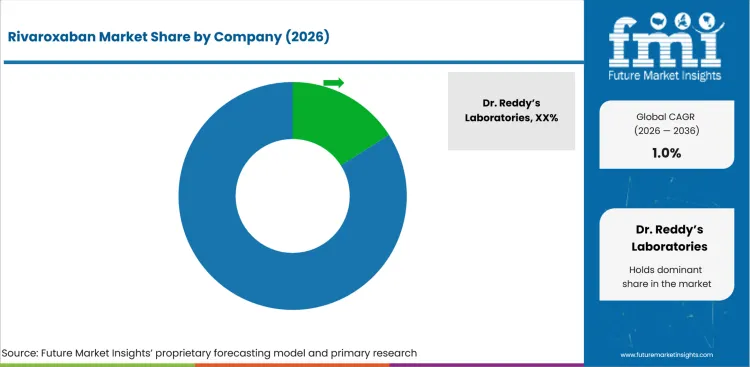
The market is moderately concentrated because regulated buyers favor suppliers with proven API files and repeat batch history. established companies gain advantage through micronization control, impurity management, and access to finished-dose customers. Smaller API firms compete on price and speed, but they lose ground where buyers need strong filing support.
Entry barriers include route chemistry validation, particle-size consistency, audit history, and regulated-market documentation. Competition in the Rivaroxaban Market centers on evidence rather than broad capacity claims. Buyers ask whether the supplier can support regulated filings, manage particle-size range, and hold impurity levels across commercial batches.
How is competition structured?
Competition reflects differences in specialization, portfolio scope, geographic reach, evidence, and customer access.
The market includes API specialists and integrated generic companies serving regulated oral anticoagulant supply.
- Integrated Regulated Suppliers: Dr. Reddy’s Laboratories, Aurobindo Pharma, Lupin, and Biocon Pharma combine finished-dose or regulated-market evidence with sourcing and documentation capabilities. Their advantage is the ability to connect API quality expectations with tablet approval needs.
- API-Focused Indian Suppliers: MSN Laboratories, Hetero Labs, Optimus Drugs, and MetroChem API compete through Rivaroxaban API evidence, written-confirmation routes, and regulated buyer outreach. Their strengths sit in route chemistry, batch supply, and price competitiveness.
- Originator and Local Market Anchors: Bayer and country-level finished-dose holders influence quality expectations even where they are not API merchant suppliers. Bayer’s Xarelto reference role shapes regulatory comparison in Europe and Japan.
How do selected companies compare?
The selected companies differ in portfolio focus, geographic reach, evidence depth, and channel strength.
| Company | Competitive position |
|---|---|
| Dr. Reddy’s Laboratories | Dr. Reddy’s Laboratories is assessed for API or finished-dose relevance, regulated-market documentation, supply reliability, and access to pharmaceutical buyers. |
| Aurobindo Pharma | Aurobindo Pharma is assessed for API or finished-dose relevance, regulated-market documentation, supply reliability, and access to pharmaceutical buyers. |
| Lupin | Lupin is assessed for API or finished-dose relevance, regulated-market documentation, supply reliability, and access to pharmaceutical buyers. |
| Biocon Pharma | Biocon Pharma is assessed for API or finished-dose relevance, regulated-market documentation, supply reliability, and access to pharmaceutical buyers. |
| MSN Laboratories | MSN Laboratories is assessed for API or finished-dose relevance, regulated-market documentation, supply reliability, and access to pharmaceutical buyers. |
What are the key developments in the Rivaroxaban Market?
- In March 2025, the USA FDA approved the first generics of Xarelto 2.5 mg tablets for cardiovascular and peripheral artery disease risk reduction. This widened the USA generic supply pool.
- In April 2025, Aurobindo Pharma received final USA FDA approval for Rivaroxaban Tablets USP 2.5 mg. This added another approved finished-dose route in the United States.
- In May 2025, Lupin received USA FDA approval for Rivaroxaban Tablets USP 10 mg, 15 mg, and 20 mg. The product is manufactured at Aurangabad in India.
Selected Companies in the Rivaroxaban Market
Companies referenced in this preview
- Dr. Reddy’s Laboratories.
- Aurobindo Pharma.
- Lupin.
- Biocon Pharma.
- MSN Laboratories.
- Hetero.
- Taro Pharmaceuticals (Sun Pharma).
- Bayer.
Market Scope & Definition
| Metric | Value |
|---|---|
| Market definition | The Rivaroxaban Market covers the active pharmaceutical ingredient used to make rivaroxaban finished-dose medicines. The scope includes micronized and standard API grades supplied for oral tablets and related regulated formulations. |
| Functions covered | Micronized API, Standard API |
| Applications covered | Stroke Prevention (Atrial Fibrillation), VTE Treatment & Prophylaxis |
| End-use industries | Stroke Prevention (Atrial Fibrillation), VTE Treatment & Prophylaxis |
| Inclusions | Market scope covers commercially traded Rivaroxaban API by form, including Micronized API and Standard API; purity grades, including ≥99.5%, 98.0%-99.5%, and <98%; applications, including Stroke Prevention (Atrial Fibrillation) and VTE Treatment & Prophylaxis; sales channels, including Direct, Distributors, and Online/API Marketplaces; and regions, including Europe, Latin America, South Asia & Pacific, Middle East & Africa, East Asia, and North America. |
| Exclusions | The market excludes finished Xarelto and generic tablet revenue, anticoagulant finished-dose retail sales, heparin API, warfarin API, injectable antithrombotic products, antiplatelet drugs, diagnostic tests, packaging revenue, and contract manufacturing revenue that is not tied to Rivaroxaban API supply. |
Research Methodology
| Metric | Value |
|---|---|
| Primary Research | Future Market Insights analysts reviewed inputs from API manufacturers, finished-dose formulators, regulatory affairs teams, sourcing heads, and pharmaceutical distributors. The interviews focused on batch qualification, impurity expectations, micronization control, and buyer switching behavior. |
| Desk Research | The desk review used regulator product references, medicine labels, national drug tariff information, and company product disclosures. Sources included FDA, DailyMed, EMA, PMDA, CDSCO, NHSBSA, NMPA, and official company announcements. |
| Market Sizing and Forecasting | The model combined API demand from finished-dose use, average API pricing, regulated-market approval activity, and country-level sourcing patterns. Segment shares were estimated from API specification needs and buyer channel behavior. |
| Data Validation | Forecasts were checked against anticoagulant indication scope, generic approval signals, API supplier evidence, and public regulatory records. Country assumptions were cross-checked against local medicine references and documented approval activity. |
What does the report cover?
The report covers form, purity grade, application, sales channel, and region across the 2026-2036 forecast period in 30+ countries.
| Metric | Value |
|---|---|
| Periods | Base year 2025; estimated year 2026; forecast period 2026-2036 |
| Quantitative units | USD 96.54 million in 2026 to USD 107.64 million in 2036, at a CAGR of 1.09% |
| Segment axes | form, purity grade, application, sales channel, and region |
| Regions | Europe, Latin America, South Asia & Pacific, Middle East & Africa, East Asia, North America |
| Countries | United States, United Kingdom, Germany, France, Japan, China, South Korea, India and 30+ countries |
| Companies | Dr. Reddy’s Laboratories, Aurobindo Pharma, Lupin, Biocon Pharma, MSN Laboratories, Hetero, Taro Pharmaceuticals (Sun Pharma), Bayer, and others |
| Approach | Hybrid bottom-up and top-down methodology using regulated product references, approval signals, supplier evidence, pricing behavior, and segment use rates. |
Market Segmentation Analysis
Segmented by Form
- Micronized API.
- Standard API.
Segmented by Purity Grade
- ≥99.5%.
- 98.0%-99.5%.
- <98%.
Segmented by Application
- Stroke Prevention (Atrial Fibrillation).
- VTE Treatment & Prophylaxis.
Segmented by Sales Channel
- Direct.
- Distributors.
- Online/API Marketplaces.
By Region
- North America.
- United States.
- Latin America.
- East Asia.
- China.
- Japan.
- South Korea.
- Middle East & Africa.
- Western Europe.
- United Kingdom.
- Germany.
- France.
- South Asia and Pacific.
- India.
Research Sources and Bibliography
- 1. USA Food and Drug Administration. (2025, March 4). FDA Roundup: March 4, 2025. USA Food and Drug Administration.
- 2. USA National Library of Medicine. (2026, April). DailyMed: Rivaroxaban tablet, film coated. DailyMed.
- 3. European Medicines Agency. (2024, September 12). Xarelto. European Medicines Agency.
- 4. European Medicines Agency. (2025, September 19). Rivaroxaban Koanaa. European Medicines Agency.
- 5. Centers for Disease Control and Prevention. (2024, May 14). About atrial fibrillation. Centers for Disease Control and Prevention.
- 6. NHS Business Services Authority. (2026). Drug Tariff Part VIII. NHS Business Services Authority.
- 7. Medicines and Healthcare products Regulatory Agency. (2026). API registrations: Rivaroxaban. Medicines and Healthcare products Regulatory Agency.
- 8. Pharmaceuticals and Medical Devices Agency. (2024, June 2). Pharmaceuticals and Medical Devices Safety Information No. 410. Pharmaceuticals and Medical Devices Agency.
- 9. National Medical Products Administration. (2024, July 2). 2024. National Medical Products Administration.
- 10. Central Drugs Standard Control Organisation. (2025, November 6). Recommendations of the SEC Cardiovascular held on 06.11.2025. Central Drugs Standard Control Organisation.
- 11. Dr. Reddy’s Laboratories. (2026). Rivaroxaban API manufacturer and supplier. Dr. Reddy’s Laboratories.
- 12. Aurobindo Pharma. (2025, April 12). Aurobindo Pharma receives final ANDA approval for Rivaroxaban Tablets USP. Aurobindo Pharma.
- 13. Lupin Limited. (2025, May 15). Lupin receives approval from USA FDA for Rivaroxaban Tablets USP, 10 mg, 15 mg, and 20 mg. Lupin Limited.
- 14. Biocon Limited. (2025, May 15). Biocon Pharma Limited receives USA FDA approval for Rivaroxaban Tablets. Biocon Limited.
- 15. Korean Circulation Journal. (2025). XARENAL: Rivaroxaban in non-valvular atrial fibrillation patients with renal impairment. Korean Circulation Journal.
- 16. Journal of Korean Medical Science. (2024). Low-dose rivaroxaban regimens in elderly East Asians. Journal of Korean Medical Science.
The bibliography is provided for reader reference and uses primary non-commercial government, regulatory, academic, or official company publications.
This Report Answers
- What is the projected value of the Rivaroxaban Market in 2026?
- What value is forecast for the Rivaroxaban Market by 2036?
- What CAGR is forecast for the Rivaroxaban Market from 2026 to 2036?
- What 2026 share is projected for Micronized API within the form category?
- What 2026 share is projected for ≥99.5% within the purity grade category?
- Which demand factors support the Rivaroxaban Market outlook?
- Which restraints and opportunities affect adoption in the Rivaroxaban Market?
- How are country CAGR outlooks, including India at 1.8%, compared?
- Which companies and product developments are covered in the competitive analysis?
- What is included in the market scope, and how is the forecast validated?
Frequently Asked Questions
Why should executives track the Rivaroxaban Market?
Executives should track this market because it can affect capital allocation, supplier strategy, operating risk, and competitive positioning across commercial planning cycles.
What business problem does the Rivaroxaban Market address?
It helps executive teams judge where customer pain, supplier capability, compliance exposure, and implementation economics justify investment, procurement, or portfolio action.
What should procurement leaders evaluate before selecting suppliers?
Procurement leaders should assess evidence quality, integration fit, service coverage, compliance readiness, total cost of ownership, and supplier execution capability.
What can limit return on investment for buyers?
Return on investment can be limited by low utilization, integration delays, training gaps, unclear ownership, pricing pressure, or weak fit with existing workflows.
How can suppliers build executive confidence?
Suppliers can build confidence by proving implementation speed, risk reduction, support depth, reference use cases, and measurable outcomes for budget owners.
Preview the report firsthand - request a free sample
Get SampleGet the brochure for pricing and purchase details.
Get PDFTable of Content
- Key Takeaways
- Market Size and CAGR
- Top Growth Driver
- Fastest Growing Segment
- Leading Region
- Key Companies
- Emerging Opportunities
- Executive Summary
- Global Market Outlook
- Demand-side Trends
- Supply-side Trends
- Technology Roadmap Analysis
- Analysis and Recommendations
- Analyst Perspective (What is happening? Why now? What should investors know?)
- Key Questions Answered
- How large is the market?
- What is the CAGR?
- What are key trends?
- Which region dominates?
- Who are the leaders?
- Market Overview
- Market Coverage / Taxonomy
- Market Definition / Scope / Limitations
- Research Methodology
- Chapter Orientation
- Analytical Lens and Working Hypotheses
- Market Structure, Signals, and Trend Drivers
- Benchmarking and Cross-market Comparability
- Market Sizing, Forecasting, and Opportunity Mapping
- Research Design and Evidence Framework
- Desk Research Programme (Secondary Evidence)
- Expert Input and Fieldwork (Primary Evidence)
- Tooling, Models, and Reference Databases
- Data Engineering and Model Build
- Quality Assurance and Audit Trail
- Market Background
- Market Dynamics (Drivers, Restraints, Opportunity, Trends)
- Scenario Forecast (Optimistic, Likely, Conservative)
- Impact Analysis
- AI Impact
- Sustainability Impact
- Regulatory Impact
- Technology Impact
- Consumer / Buyer Analysis
- Purchase Drivers
- Adoption Barriers
- Buyer Journey
- Opportunity Map Analysis
- Product Life Cycle Analysis
- Supply Chain Analysis
- Investment Feasibility Matrix
- Value Chain Analysis
- PESTLE and Porter's Analysis
- Regulatory Landscape
- Regional Parent Market Outlook
- Production and Consumption Statistics
- Import and Export Statistics
- Global Market Analysis and Forecast, 2021 to 2036
- Historical Market Size Value (USD Million) & Volume (Unit) Analysis, 2021 to 2025
- Current and Future Market Size Value (USD Million) & Volume (Unit) Projections, 2026 to 2036
- Y-o-Y Growth Trend Analysis
- Absolute $ Opportunity Analysis
- Global Market Pricing Analysis, 2021 to 2036
- Global Market Analysis and Forecast, By Form, 2021 to 2036
- Introduction / Key Findings
- Historical Market Size Value (USD Million) & Volume (Unit) Analysis By Form, 2021 to 2025
- Current and Future Market Size Value (USD Million) & Volume (Unit) Analysis and Forecast By Form, 2026 to 2036
- Micronized API
- Standard API
- Micronized API
- Y-o-Y Growth Trend Analysis By Form, 2021 to 2025
- Absolute $ Opportunity Analysis By Form, 2026 to 2036
- Global Market Analysis and Forecast, By Purity Grade, 2021 to 2036
- Introduction / Key Findings
- Historical Market Size Value (USD Million) & Volume (Unit) Analysis By Purity Grade, 2021 to 2025
- Current and Future Market Size Value (USD Million) & Volume (Unit) Analysis and Forecast By Purity Grade, 2026 to 2036
- ≥99.5%
- 98.0%-99.5%
- <98%
- ≥99.5%
- Y-o-Y Growth Trend Analysis By Purity Grade, 2021 to 2025
- Absolute $ Opportunity Analysis By Purity Grade, 2026 to 2036
- Global Market Analysis and Forecast, By Application, 2021 to 2036
- Introduction / Key Findings
- Historical Market Size Value (USD Million) & Volume (Unit) Analysis By Application, 2021 to 2025
- Current and Future Market Size Value (USD Million) & Volume (Unit) Analysis and Forecast By Application, 2026 to 2036
- Stroke Prevention
- VTE Treatment & Prophylaxis
- Stroke Prevention
- Y-o-Y Growth Trend Analysis By Application, 2021 to 2025
- Absolute $ Opportunity Analysis By Application, 2026 to 2036
- Global Market Analysis and Forecast, By Region, 2021 to 2036
- Introduction
- Historical Market Size Value (USD Million) & Volume (Unit) Analysis By Region, 2021 to 2025
- Current Market Size Value (USD Million) & Volume (Unit) Analysis and Forecast By Region, 2026 to 2036
- North America
- Latin America
- Western Europe
- Eastern Europe
- East Asia
- South Asia and Pacific
- Middle East & Africa
- Market Attractiveness Analysis By Region
- North America Market Analysis and Forecast, By Country, 2021 to 2036
- Historical Market Size Value (USD Million) & Volume (Unit) Trend Analysis By Market Taxonomy, 2021 to 2025
- Market Size Value (USD Million) & Volume (Unit) Forecast By Market Taxonomy, 2026 to 2036
- By Country
- USA
- Canada
- Mexico
- By Form
- By Purity Grade
- By Application
- By Country
- Market Attractiveness Analysis
- By Country
- By Form
- By Purity Grade
- By Application
- Key Takeaways
- Latin America Market Analysis and Forecast, By Country
- Historical Market Size Value (USD Million) & Volume (Unit) Trend Analysis By Market Taxonomy, 2021 to 2025
- Market Size Value (USD Million) & Volume (Unit) Forecast By Market Taxonomy, 2026 to 2036
- By Country
- Brazil
- Chile
- Rest of Latin America
- By Form
- By Purity Grade
- By Application
- By Country
- Market Attractiveness Analysis
- By Country
- By Form
- By Purity Grade
- By Application
- Key Takeaways
- Western Europe Market Analysis and Forecast, By Country
- Historical Market Size Value (USD Million) & Volume (Unit) Trend Analysis By Market Taxonomy, 2021 to 2025
- Market Size Value (USD Million) & Volume (Unit) Forecast By Market Taxonomy, 2026 to 2036
- By Country
- Germany
- UK
- Italy
- Spain
- France
- Nordic
- BENELUX
- Rest of Western Europe
- By Form
- By Purity Grade
- By Application
- By Country
- Market Attractiveness Analysis
- By Country
- By Form
- By Purity Grade
- By Application
- Key Takeaways
- Eastern Europe Market Analysis and Forecast, By Country
- Historical Market Size Value (USD Million) & Volume (Unit) Trend Analysis By Market Taxonomy, 2021 to 2025
- Market Size Value (USD Million) & Volume (Unit) Forecast By Market Taxonomy, 2026 to 2036
- By Country
- Russia
- Poland
- Hungary
- Balkan & Baltic
- Rest of Eastern Europe
- By Form
- By Purity Grade
- By Application
- By Country
- Market Attractiveness Analysis
- By Country
- By Form
- By Purity Grade
- By Application
- Key Takeaways
- East Asia Market Analysis and Forecast, By Country
- Historical Market Size Value (USD Million) & Volume (Unit) Trend Analysis By Market Taxonomy, 2021 to 2025
- Market Size Value (USD Million) & Volume (Unit) Forecast By Market Taxonomy, 2026 to 2036
- By Country
- China
- Japan
- South Korea
- By Form
- By Purity Grade
- By Application
- By Country
- Market Attractiveness Analysis
- By Country
- By Form
- By Purity Grade
- By Application
- Key Takeaways
- South Asia and Pacific Market Analysis and Forecast, By Country
- Historical Market Size Value (USD Million) & Volume (Unit) Trend Analysis By Market Taxonomy, 2021 to 2025
- Market Size Value (USD Million) & Volume (Unit) Forecast By Market Taxonomy, 2026 to 2036
- By Country
- India
- ASEAN
- Australia & New Zealand
- Rest of South Asia and Pacific
- By Form
- By Purity Grade
- By Application
- By Country
- Market Attractiveness Analysis
- By Country
- By Form
- By Purity Grade
- By Application
- Key Takeaways
- Middle East & Africa Market Analysis and Forecast, By Country
- Historical Market Size Value (USD Million) & Volume (Unit) Trend Analysis By Market Taxonomy, 2021 to 2025
- Market Size Value (USD Million) & Volume (Unit) Forecast By Market Taxonomy, 2026 to 2036
- By Country
- Kingdom of Saudi Arabia
- Other GCC Countries
- Türkiye
- South Africa
- Other African Union
- Rest of Middle East & Africa
- By Form
- By Purity Grade
- By Application
- By Country
- Market Attractiveness Analysis
- By Country
- By Form
- By Purity Grade
- By Application
- Key Takeaways
- Key Countries Market Analysis
- USA
- Pricing Analysis
- Market Share Analysis, 2025
- By Form
- By Purity Grade
- By Application
- Canada
- Pricing Analysis
- Market Share Analysis, 2025
- By Form
- By Purity Grade
- By Application
- Mexico
- Pricing Analysis
- Market Share Analysis, 2025
- By Form
- By Purity Grade
- By Application
- Brazil
- Pricing Analysis
- Market Share Analysis, 2025
- By Form
- By Purity Grade
- By Application
- Chile
- Pricing Analysis
- Market Share Analysis, 2025
- By Form
- By Purity Grade
- By Application
- Germany
- Pricing Analysis
- Market Share Analysis, 2025
- By Form
- By Purity Grade
- By Application
- UK
- Pricing Analysis
- Market Share Analysis, 2025
- By Form
- By Purity Grade
- By Application
- Italy
- Pricing Analysis
- Market Share Analysis, 2025
- By Form
- By Purity Grade
- By Application
- Spain
- Pricing Analysis
- Market Share Analysis, 2025
- By Form
- By Purity Grade
- By Application
- France
- Pricing Analysis
- Market Share Analysis, 2025
- By Form
- By Purity Grade
- By Application
- India
- Pricing Analysis
- Market Share Analysis, 2025
- By Form
- By Purity Grade
- By Application
- ASEAN
- Pricing Analysis
- Market Share Analysis, 2025
- By Form
- By Purity Grade
- By Application
- Australia & New Zealand
- Pricing Analysis
- Market Share Analysis, 2025
- By Form
- By Purity Grade
- By Application
- China
- Pricing Analysis
- Market Share Analysis, 2025
- By Form
- By Purity Grade
- By Application
- Japan
- Pricing Analysis
- Market Share Analysis, 2025
- By Form
- By Purity Grade
- By Application
- South Korea
- Pricing Analysis
- Market Share Analysis, 2025
- By Form
- By Purity Grade
- By Application
- Russia
- Pricing Analysis
- Market Share Analysis, 2025
- By Form
- By Purity Grade
- By Application
- Poland
- Pricing Analysis
- Market Share Analysis, 2025
- By Form
- By Purity Grade
- By Application
- Hungary
- Pricing Analysis
- Market Share Analysis, 2025
- By Form
- By Purity Grade
- By Application
- Kingdom of Saudi Arabia
- Pricing Analysis
- Market Share Analysis, 2025
- By Form
- By Purity Grade
- By Application
- Türkiye
- Pricing Analysis
- Market Share Analysis, 2025
- By Form
- By Purity Grade
- By Application
- South Africa
- Pricing Analysis
- Market Share Analysis, 2025
- By Form
- By Purity Grade
- By Application
- USA
- Market Structure Analysis
- Competition Dashboard
- Competition Benchmarking
- Market Share Analysis of Top Players
- By Regional
- By Form
- By Purity Grade
- By Application
- Emerging Startups
- Innovation Benchmarking
- Competition Analysis
- Competition Deep Dive
- Dr. Reddy’s Laboratories
- Overview
- Product Portfolio
- Profitability by Market Segments (Product/Region/Sales Channel)
- Sales Footprint
- Strategy Overview
- Marketing Strategy
- Product Strategy
- Channel Strategy
- Aurobindo Pharma
- Lupin
- Biocon Pharma
- MSN Laboratories
- Hetero
- Dr. Reddy’s Laboratories
- Case Studies
- Success Stories
- Recent Developments
- Competition Deep Dive
- Assumptions & Acronyms Used


