

- Industry Size (2025)
- USD 290.0 Mn
- Forecast (2035)
- USD 481.5 Mn
- CAGR (2025 to 2035)
- 5.2%
Serological Pipettes Market Size and Share Forecast Outlook 2025 to 2035
The Serological Pipettes Market is estimated to be valued at USD 290.0 million in 2025 and is projected to reach USD 481.5 million by 2035, registering a compound annual growth rate (CAGR) of 5.2% over the forecast period.
Quick Stats for Serological Pipettes Market
- Serological Pipettes Market Value (2025): USD 290.0 million
- Serological Pipettes Market Forecast Value (2035): USD 481.5 million
- Serological Pipettes Market Forecast CAGR: 5.2%
- Leading Segment in Serological Pipettes Market in 2025: Open-End Pipettes (40.0%)
- Key Growth Regions in Serological Pipettes Market: North America, Asia-Pacific, Europe
- Top Key Players in Serological Pipettes Market: Thermo Fisher Scientific, Corning Incorporated, Eppendorf AG, Merck KGaA, Sartorius AG, Greiner Bio-One International, Bio-Rad Laboratories, Inc., BRAND GMBH + CO KG
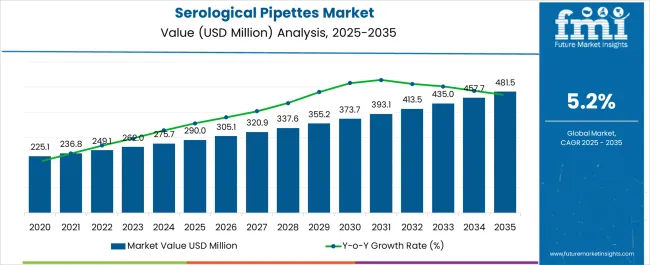
Serological Pipettes Market Key Takeaways
| Metric | Value |
|---|---|
| Serological Pipettes Market Estimated Value in (2025 E) | USD 290.0 million |
| Serological Pipettes Market Forecast Value in (2035 F) | USD 481.5 million |
| Forecast CAGR (2025 to 2035) | 5.2% |
Why is the Serological Pipettes Market Growing?
The Serological Pipettes market is experiencing steady growth as laboratories, research institutions, and biopharmaceutical companies increasingly adopt precise liquid handling solutions to support their workflows. The current landscape is shaped by the rising demand for accurate and reproducible results across clinical diagnostics, drug discovery, and academic research. Growth is being supported by the expansion of life sciences research, coupled with ongoing investments in laboratory infrastructure in both developed and emerging regions.
The market is further benefiting from the increased application of cell culture and molecular biology techniques, where pipetting accuracy is critical to maintaining reliability of outcomes. Automation trends are also driving demand, as serological pipettes remain essential tools in processes where manual accuracy complements advanced technologies.
The future outlook is favorable, with further opportunities emerging from the development of sterile, contamination-resistant products and innovations in pipette design As global healthcare and research investments expand, the Serological Pipettes market is expected to sustain consistent growth, reinforcing its role as a core component of laboratory consumables.
Segmental Analysis
The serological pipettes market is segmented by product type, applications, material, end user, and geographic regions. By product type, serological pipettes market is divided into Open-End Pipettes, Bacteriological Pipettes, and Aspirating Pipettes. In terms of applications, serological pipettes market is classified into Bacterial Culture, Testing Labs, Tissue Culture, Cell Culture, and Others.
Based on material, serological pipettes market is segmented into Glass Pipettes, Plastic Pipettes, Polystyrene Pipettes, and Others. By end user, serological pipettes market is segmented into Hospitals, Diagnostic Laboratories, Research Institutes, Educational Institutes, Biotechnology Industry, and Others.
Regionally, the serological pipettes industry is classified into North America, Latin America, Western Europe, Eastern Europe, Balkan & Baltic Countries, Russia & Belarus, Central Asia, East Asia, South Asia & Pacific, and the Middle East & Africa.
Insights into the Open-End Pipettes Segment
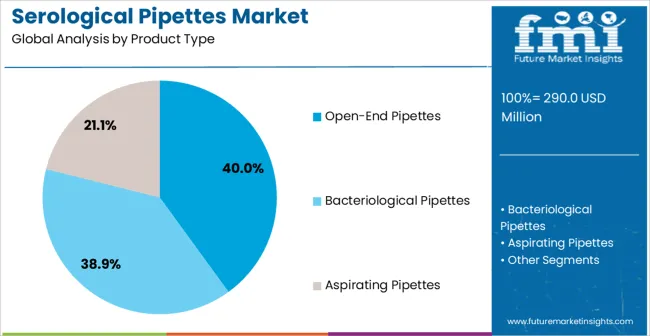
The Open-End Pipettes product type is anticipated to account for 40.00% of the Serological Pipettes market revenue in 2025, making it the leading product category. This dominance is being attributed to its ability to facilitate rapid transfer of viscous or high-volume liquids, which makes it highly effective in research and industrial laboratory environments. Open-End Pipettes have gained preference due to their adaptability in applications requiring quick fluid handling without clogging, ensuring efficiency in repetitive laboratory tasks.
Growth in this segment has been supported by rising laboratory workloads, where ease of use and consistent performance are vital to maintaining throughput. The demand is also being driven by laboratories engaged in large-volume cell culture work and bioprocessing, where traditional narrow-end pipettes are less efficient.
The enhanced precision, reduced risk of contamination, and compatibility with sterile environments have further reinforced their adoption With the growing scale of laboratory research and biopharmaceutical production, the Open-End Pipettes segment is expected to retain its leading position, supported by its proven functionality in handling complex liquid transfer needs.
Insights into the Bacterial Culture Segment
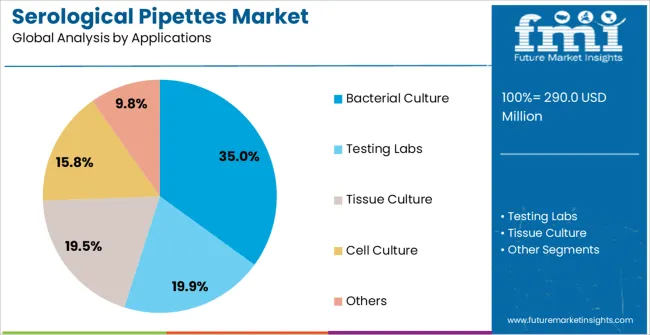
The Bacterial Culture application segment is projected to hold 35.00% of the Serological Pipettes market revenue in 2025, emerging as the largest application area. This leadership position is being shaped by the widespread use of bacterial cultures in diagnostics, pharmaceutical research, and vaccine development, where pipetting precision plays a critical role in ensuring reproducibility.
The increased prevalence of infectious diseases and the growing focus on antimicrobial resistance research have amplified demand for reliable bacterial culture techniques. Serological Pipettes are being used extensively in these workflows due to their sterility, accuracy, and ease of handling, which minimize contamination risks and support controlled experimental conditions.
Expansion in biotechnology and pharmaceutical R&D pipelines has further strengthened this segment, as bacterial cultures remain fundamental in testing, screening, and therapeutic development processes As global investments in microbiology research and vaccine manufacturing continue to rise, the Bacterial Culture segment is expected to maintain its dominance, with growth reinforced by the vital role pipettes play in producing consistent, high-quality laboratory results.
Insights into the Glass Pipettes Segment
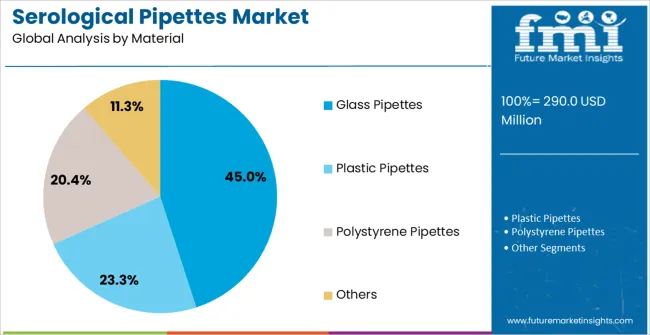
The Glass Pipettes material segment is expected to represent 45.00% of the Serological Pipettes market revenue in 2025, making it the leading material category. This position is being supported by the durability, reusability, and chemical resistance that glass pipettes provide, which make them highly suitable for laboratory settings requiring precision and reliability. Unlike disposable plastic pipettes, glass variants are valued for their ability to withstand repeated sterilization without compromising accuracy, making them cost-efficient over long-term use.
Their adoption has been reinforced in applications where sterility and accuracy are prioritized, such as clinical diagnostics, microbiology, and high-end pharmaceutical research. The increased focus on reducing plastic waste in laboratories has also contributed to the demand for glass pipettes, as institutions aim to align with sustainability initiatives.
Additionally, the robust calibration of glass pipettes ensures consistency in volume measurement, further solidifying their role in regulated laboratory environments As laboratories balance cost-effectiveness, sustainability, and precision, the Glass Pipettes segment is projected to maintain leadership, supported by its established reputation for reliability and accuracy in diverse research applications.
Market Overview
Serological Pipettes: Market Insights
Serological pipettes are used to calculate the definitive volume of liquids. Serological pipettes measure the volume of liquid in a milliliter, from less than 1 ml to up to 50 ml. Serological pipettes have a high adoption rate in the clinical market and find major applications in research & development and educational institutes.
The increasing adoption rate for serological pipettes will act as the driving factor for the growth of serological pipettes market. Serological pipettes are used for a variety of experimental assays and are very useful for mixing cell suspensions and chemical solutions and for transferring liquids between containers and for layering reagents of different densities.
The advantage of transferring accurate ml volumes of solutions in the lab will grow the market of serological pipettes over the forecast period. However, new market players find it difficult to enter due to the presence of a large number of manufacturer and compete based on quality, and reliability in the serological pipettes market.
This factor will hamper the growth of serological pipettes market. Moreover, lack of expertise in the measurement of the volume of liquid will increase the probability of false result and will act as the restraint factor for the growth of the serological market.
Analysis of Serological Pipettes Market By Key Countries
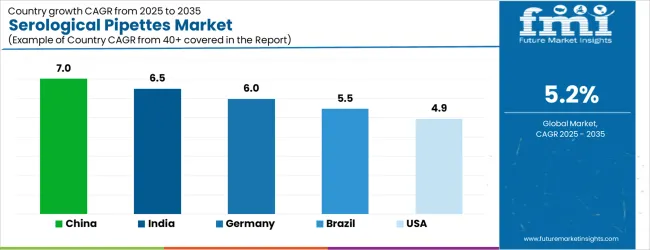
| Country | CAGR |
|---|---|
| China | 7.0% |
| India | 6.5% |
| Germany | 6.0% |
| Brazil | 5.5% |
| USA | 4.9% |
| UK | 4.4% |
| Japan | 3.9% |
Country-wise Analysis
The Serological Pipettes Market is expected to register a CAGR of 5.2% during the forecast period, exhibiting varied country level momentum. China leads with the highest CAGR of 7.0%, followed by India at 6.5%. Developed markets such as Germany, France, and the UK continue to expand steadily, while the USA is likely to grow at consistent rates.
Japan posts the lowest CAGR at 3.9%, yet still underscores a broadly positive trajectory for the global Serological Pipettes Market. In 2024, Germany held a dominant revenue in the Western Europe market and is expected to grow with a CAGR of 6.0%.
The USA Serological Pipettes Market is estimated to be valued at USD 107.5 million in 2025 and is anticipated to reach a valuation of USD 107.5 million by 2035. Sales are projected to rise at a CAGR of 0.0% over the forecast period between 2025 and 2035. While Japan and South Korea markets are estimated to be valued at USD 13.6 million and USD 8.3 million respectively in 2025.
Key Players in the Serological Pipettes Market
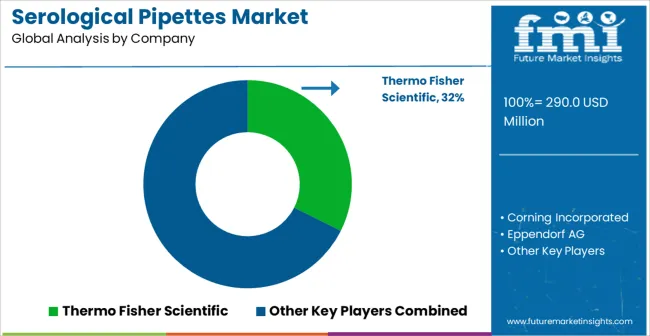
- Thermo Fisher Scientific
- Corning Incorporated
- Eppendorf AG
- Merck KGaA
- Sartorius AG
- Greiner Bio-One International
- Bio-Rad Laboratories, Inc.
- BRAND GMBH + CO KG
Scope of the Report
| Item | Value |
|---|---|
| Quantitative Units | USD 290.0 Million |
| Product Type | Open-End Pipettes, Bacteriological Pipettes, and Aspirating Pipettes |
| Applications | Bacterial Culture, Testing Labs, Tissue Culture, Cell Culture, and Others |
| Material | Glass Pipettes, Plastic Pipettes, Polystyrene Pipettes, and Others |
| End User | Hospitals, Diagnostic Laboratories, Research Institutes, Educational Institutes, Biotechnology Industry, and Others |
| Regions Covered | North America, Europe, Asia-Pacific, Latin America, Middle East & Africa |
| Country Covered | United States, Canada, Germany, France, United Kingdom, China, Japan, India, Brazil, South Africa |
| Key Companies Profiled | Thermo Fisher Scientific, Corning Incorporated, Eppendorf AG, Merck KGaA, Sartorius AG, Greiner Bio-One International, Bio-Rad Laboratories, Inc., and BRAND GMBH + CO KG |
Serological Pipettes Market by Segments
Product Type:
- Open-End Pipettes
- Bacteriological Pipettes
- Aspirating Pipettes
Applications:
- Bacterial Culture
- Testing Labs
- Tissue Culture
- Cell Culture
- Others
Material:
- Glass Pipettes
- Plastic Pipettes
- Polystyrene Pipettes
- Others
End User:
- Hospitals
- Diagnostic Laboratories
- Research Institutes
- Educational Institutes
- Biotechnology Industry
- Others
Region:
- North America
- USA
- Canada
- Mexico
- Latin America
- Brazil
- Chile
- Rest of Latin America
- Western Europe
- Germany
- UK
- Italy
- Spain
- France
- Nordic
- BENELUX
- Rest of Western Europe
- Eastern Europe
- Russia
- Poland
- Hungary
- Balkan & Baltic
- Rest of Eastern Europe
- East Asia
- China
- Japan
- South Korea
- South Asia and Pacific
- India
- ASEAN
- Australia & New Zealand
- Rest of South Asia and Pacific
- Middle East & Africa
- Kingdom of Saudi Arabia
- Other GCC Countries
- Turkiye
- South Africa
- Other African Union
- Rest of Middle East & Africa
Frequently Asked Questions
How big is the serological pipettes market in 2025?
The global serological pipettes market is estimated to be valued at USD 290.0 million in 2025.
What will be the size of serological pipettes market in 2035?
The market size for the serological pipettes market is projected to reach USD 481.5 million by 2035.
How much will be the serological pipettes market growth between 2025 and 2035?
The serological pipettes market is expected to grow at a 5.2% CAGR between 2025 and 2035.
What are the key product types in the serological pipettes market?
The key product types in serological pipettes market are open-end pipettes, bacteriological pipettes and aspirating pipettes.
Which applications segment to contribute significant share in the serological pipettes market in 2025?
In terms of applications, bacterial culture segment to command 35.0% share in the serological pipettes market in 2025.
Preview the report firsthand - request a free sample
Get SampleGet the brochure for pricing and purchase details.
Get PDFTable of Content
- Executive Summary
- Global Market Outlook
- Demand-side Trends
- Supply-side Trends
- Technology Roadmap Analysis
- Analysis and Recommendations
- Market Overview
- Market Coverage / Taxonomy
- Market Definition / Scope / Limitations
- Market Background
- Market Dynamics
- Drivers
- Restraints
- Opportunity
- Trends
- Scenario Forecast
- Demand in Optimistic Scenario
- Demand in Likely Scenario
- Demand in Conservative Scenario
- Opportunity Map Analysis
- Product Life Cycle Analysis
- Supply Chain Analysis
- Investment Feasibility Matrix
- Value Chain Analysis
- PESTLE and Porter’s Analysis
- Regulatory Landscape
- Regional Parent Market Outlook
- Production and Consumption Statistics
- Import and Export Statistics
- Market Dynamics
- Global Market Analysis 2020 to 2024 and Forecast, 2025 to 2035
- Historical Market Size Value (USD Million) Analysis, 2020 to 2024
- Current and Future Market Size Value (USD Million) Projections, 2025 to 2035
- Y-o-Y Growth Trend Analysis
- Absolute $ Opportunity Analysis
- Global Market Pricing Analysis 2020 to 2024 and Forecast 2025 to 2035
- Global Market Analysis 2020 to 2024 and Forecast 2025 to 2035, By Product Type
- Introduction / Key Findings
- Historical Market Size Value (USD Million) Analysis By Product Type, 2020 to 2024
- Current and Future Market Size Value (USD Million) Analysis and Forecast By Product Type, 2025 to 2035
- Open-End Pipettes
- Bacteriological Pipettes
- Aspirating Pipettes
- Y-o-Y Growth Trend Analysis By Product Type, 2020 to 2024
- Absolute $ Opportunity Analysis By Product Type, 2025 to 2035
- Global Market Analysis 2020 to 2024 and Forecast 2025 to 2035, By Applications
- Introduction / Key Findings
- Historical Market Size Value (USD Million) Analysis By Applications, 2020 to 2024
- Current and Future Market Size Value (USD Million) Analysis and Forecast By Applications, 2025 to 2035
- Bacterial Culture
- Testing Labs
- Tissue Culture
- Cell Culture
- Others
- Y-o-Y Growth Trend Analysis By Applications, 2020 to 2024
- Absolute $ Opportunity Analysis By Applications, 2025 to 2035
- Global Market Analysis 2020 to 2024 and Forecast 2025 to 2035, By Material
- Introduction / Key Findings
- Historical Market Size Value (USD Million) Analysis By Material, 2020 to 2024
- Current and Future Market Size Value (USD Million) Analysis and Forecast By Material, 2025 to 2035
- Glass Pipettes
- Plastic Pipettes
- Polystyrene Pipettes
- Others
- Y-o-Y Growth Trend Analysis By Material, 2020 to 2024
- Absolute $ Opportunity Analysis By Material, 2025 to 2035
- Global Market Analysis 2020 to 2024 and Forecast 2025 to 2035, By End User
- Introduction / Key Findings
- Historical Market Size Value (USD Million) Analysis By End User, 2020 to 2024
- Current and Future Market Size Value (USD Million) Analysis and Forecast By End User, 2025 to 2035
- Hospitals
- Diagnostic Laboratories
- Research Institutes
- Educational Institutes
- Biotechnology Industry
- Others
- Y-o-Y Growth Trend Analysis By End User, 2020 to 2024
- Absolute $ Opportunity Analysis By End User, 2025 to 2035
- Global Market Analysis 2020 to 2024 and Forecast 2025 to 2035, By Region
- Introduction
- Historical Market Size Value (USD Million) Analysis By Region, 2020 to 2024
- Current Market Size Value (USD Million) Analysis and Forecast By Region, 2025 to 2035
- North America
- Latin America
- Western Europe
- Eastern Europe
- East Asia
- South Asia and Pacific
- Middle East & Africa
- Market Attractiveness Analysis By Region
- North America Market Analysis 2020 to 2024 and Forecast 2025 to 2035, By Country
- Historical Market Size Value (USD Million) Trend Analysis By Market Taxonomy, 2020 to 2024
- Market Size Value (USD Million) Forecast By Market Taxonomy, 2025 to 2035
- By Country
- USA
- Canada
- Mexico
- By Product Type
- By Applications
- By Material
- By End User
- By Country
- Market Attractiveness Analysis
- By Country
- By Product Type
- By Applications
- By Material
- By End User
- Key Takeaways
- Latin America Market Analysis 2020 to 2024 and Forecast 2025 to 2035, By Country
- Historical Market Size Value (USD Million) Trend Analysis By Market Taxonomy, 2020 to 2024
- Market Size Value (USD Million) Forecast By Market Taxonomy, 2025 to 2035
- By Country
- Brazil
- Chile
- Rest of Latin America
- By Product Type
- By Applications
- By Material
- By End User
- By Country
- Market Attractiveness Analysis
- By Country
- By Product Type
- By Applications
- By Material
- By End User
- Key Takeaways
- Western Europe Market Analysis 2020 to 2024 and Forecast 2025 to 2035, By Country
- Historical Market Size Value (USD Million) Trend Analysis By Market Taxonomy, 2020 to 2024
- Market Size Value (USD Million) Forecast By Market Taxonomy, 2025 to 2035
- By Country
- Germany
- UK
- Italy
- Spain
- France
- Nordic
- BENELUX
- Rest of Western Europe
- By Product Type
- By Applications
- By Material
- By End User
- By Country
- Market Attractiveness Analysis
- By Country
- By Product Type
- By Applications
- By Material
- By End User
- Key Takeaways
- Eastern Europe Market Analysis 2020 to 2024 and Forecast 2025 to 2035, By Country
- Historical Market Size Value (USD Million) Trend Analysis By Market Taxonomy, 2020 to 2024
- Market Size Value (USD Million) Forecast By Market Taxonomy, 2025 to 2035
- By Country
- Russia
- Poland
- Hungary
- Balkan & Baltic
- Rest of Eastern Europe
- By Product Type
- By Applications
- By Material
- By End User
- By Country
- Market Attractiveness Analysis
- By Country
- By Product Type
- By Applications
- By Material
- By End User
- Key Takeaways
- East Asia Market Analysis 2020 to 2024 and Forecast 2025 to 2035, By Country
- Historical Market Size Value (USD Million) Trend Analysis By Market Taxonomy, 2020 to 2024
- Market Size Value (USD Million) Forecast By Market Taxonomy, 2025 to 2035
- By Country
- China
- Japan
- South Korea
- By Product Type
- By Applications
- By Material
- By End User
- By Country
- Market Attractiveness Analysis
- By Country
- By Product Type
- By Applications
- By Material
- By End User
- Key Takeaways
- South Asia and Pacific Market Analysis 2020 to 2024 and Forecast 2025 to 2035, By Country
- Historical Market Size Value (USD Million) Trend Analysis By Market Taxonomy, 2020 to 2024
- Market Size Value (USD Million) Forecast By Market Taxonomy, 2025 to 2035
- By Country
- India
- ASEAN
- Australia & New Zealand
- Rest of South Asia and Pacific
- By Product Type
- By Applications
- By Material
- By End User
- By Country
- Market Attractiveness Analysis
- By Country
- By Product Type
- By Applications
- By Material
- By End User
- Key Takeaways
- Middle East & Africa Market Analysis 2020 to 2024 and Forecast 2025 to 2035, By Country
- Historical Market Size Value (USD Million) Trend Analysis By Market Taxonomy, 2020 to 2024
- Market Size Value (USD Million) Forecast By Market Taxonomy, 2025 to 2035
- By Country
- Kingdom of Saudi Arabia
- Other GCC Countries
- Turkiye
- South Africa
- Other African Union
- Rest of Middle East & Africa
- By Product Type
- By Applications
- By Material
- By End User
- By Country
- Market Attractiveness Analysis
- By Country
- By Product Type
- By Applications
- By Material
- By End User
- Key Takeaways
- Key Countries Market Analysis
- USA
- Pricing Analysis
- Market Share Analysis, 2024
- By Product Type
- By Applications
- By Material
- By End User
- Canada
- Pricing Analysis
- Market Share Analysis, 2024
- By Product Type
- By Applications
- By Material
- By End User
- Mexico
- Pricing Analysis
- Market Share Analysis, 2024
- By Product Type
- By Applications
- By Material
- By End User
- Brazil
- Pricing Analysis
- Market Share Analysis, 2024
- By Product Type
- By Applications
- By Material
- By End User
- Chile
- Pricing Analysis
- Market Share Analysis, 2024
- By Product Type
- By Applications
- By Material
- By End User
- Germany
- Pricing Analysis
- Market Share Analysis, 2024
- By Product Type
- By Applications
- By Material
- By End User
- UK
- Pricing Analysis
- Market Share Analysis, 2024
- By Product Type
- By Applications
- By Material
- By End User
- Italy
- Pricing Analysis
- Market Share Analysis, 2024
- By Product Type
- By Applications
- By Material
- By End User
- Spain
- Pricing Analysis
- Market Share Analysis, 2024
- By Product Type
- By Applications
- By Material
- By End User
- France
- Pricing Analysis
- Market Share Analysis, 2024
- By Product Type
- By Applications
- By Material
- By End User
- India
- Pricing Analysis
- Market Share Analysis, 2024
- By Product Type
- By Applications
- By Material
- By End User
- ASEAN
- Pricing Analysis
- Market Share Analysis, 2024
- By Product Type
- By Applications
- By Material
- By End User
- Australia & New Zealand
- Pricing Analysis
- Market Share Analysis, 2024
- By Product Type
- By Applications
- By Material
- By End User
- China
- Pricing Analysis
- Market Share Analysis, 2024
- By Product Type
- By Applications
- By Material
- By End User
- Japan
- Pricing Analysis
- Market Share Analysis, 2024
- By Product Type
- By Applications
- By Material
- By End User
- South Korea
- Pricing Analysis
- Market Share Analysis, 2024
- By Product Type
- By Applications
- By Material
- By End User
- Russia
- Pricing Analysis
- Market Share Analysis, 2024
- By Product Type
- By Applications
- By Material
- By End User
- Poland
- Pricing Analysis
- Market Share Analysis, 2024
- By Product Type
- By Applications
- By Material
- By End User
- Hungary
- Pricing Analysis
- Market Share Analysis, 2024
- By Product Type
- By Applications
- By Material
- By End User
- Kingdom of Saudi Arabia
- Pricing Analysis
- Market Share Analysis, 2024
- By Product Type
- By Applications
- By Material
- By End User
- Turkiye
- Pricing Analysis
- Market Share Analysis, 2024
- By Product Type
- By Applications
- By Material
- By End User
- South Africa
- Pricing Analysis
- Market Share Analysis, 2024
- By Product Type
- By Applications
- By Material
- By End User
- USA
- Market Structure Analysis
- Competition Dashboard
- Competition Benchmarking
- Market Share Analysis of Top Players
- By Regional
- By Product Type
- By Applications
- By Material
- By End User
- Competition Analysis
- Competition Deep Dive
- Thermo Fisher Scientific
- Overview
- Product Portfolio
- Profitability by Market Segments (Product/Age /Sales Channel/Region)
- Sales Footprint
- Strategy Overview
- Marketing Strategy
- Product Strategy
- Channel Strategy
- Corning Incorporated
- Eppendorf AG
- Merck KGaA
- Sartorius AG
- Greiner Bio-One International
- Bio-Rad Laboratories, Inc.
- BRAND GMBH + CO KG
- Thermo Fisher Scientific
- Competition Deep Dive
- Assumptions & Acronyms Used
- Research Methodology


