

- Market Size (2026)
- USD 4.9 Bn
- Forecast (2036)
- USD 8.3 Bn
- CAGR (2026 to 2036)
- 5.3%
Enzyme Substrates Market Size, Market Forecast and Outlook By FMI
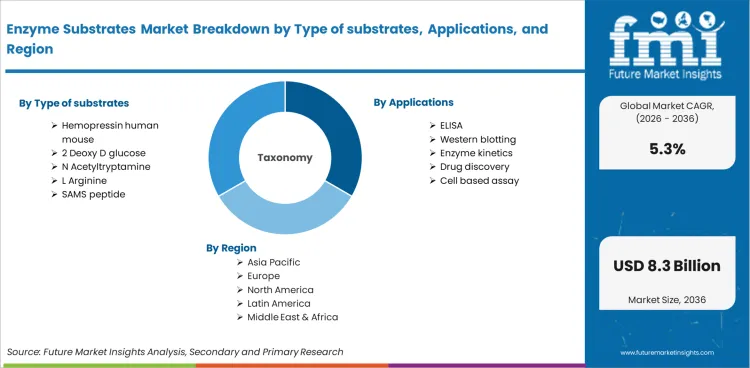
The enzyme substrates market was valued at USD 4.7 billion in 2025. the market is set to reach USD 4.9 billion by 2026-end and grow at a CAGR of 5.3% between 2026-2036 to reach USD 8.3 billion by 2036.
Summary of the Enzyme Substrates Market
- Demand and Growth Drivers
- The increasing number of diagnostic tests in clinical laboratories worldwide continues to support the need for standardized enzyme substrate formulations.
- Procurement volume for high-purity enzyme substrates in assay development and validation is being driven by the growth in biopharmaceutical drug discovery.
- Responding to regulatory pressure to reduce chemical additives and the popularity of clean labels, Enzymes are used in food and beverage manufacturing.
- Product and Segment View
- The largest end users segment in the food and beverages industry is 34.0% because of the use of enzyme substrates in processing, quality testing, and regulatory compliance.
- The applications segment is LED by ELISA with wide applications in clinical diagnostics, food safety testing, and pharmaceutical quality control.
- The source segment is dominated by natural enzyme substrates, Suggesting a preference for bio-derived formulations in regulated applications.
- Geography and Competitive Outlook
- Robust life sciences funding, Increased diagnostic laboratory infrastructure, and the USA driving global growth at 5.6% CAGR.
- The demand remains high at 5.3% CAGR backed by Japan’s advanced manufacturing capabilities and adoption of precision medicine.
- The companies are in a good position to gain traction over the forecast period owing to multi-vertical regulatory documentation and validated product portfolios.
- Analyst Opinion
- “Companies that are able to sustain validated purity standards while expanding their product portfolios in sectors such as diagnostic, pharmaceutical and food testing are likely to enhance their competitive position.
- The industry is evolving from the traditional laboratory setting to point-of-care diagnostics and decentralized testing applications.
- Supply concentration among specialty chemical manufacturers is a source of procurement risk and consolidation opportunity.
- Global health priorities continue to support diagnostic testing volumes and pharmaceutical R&D investment.
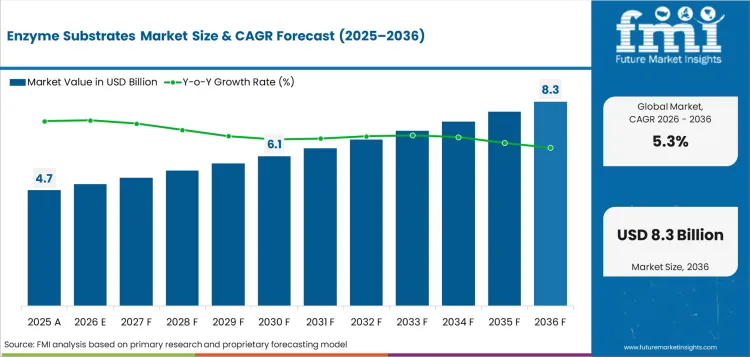
Key Takeaways, Market Size, And Forecast
| Metric | Value |
|---|---|
| Market Size (2025) | USD 4.70 Billion |
| Market Size (2036) | USD 8.29 Billion |
| Highlight | The market is projected to grow at a rate of 5.3% between 2026 and 2036 |
| Incremental Opportunity | USD 3.35 Billion |
| Leading End Users (2026) | The End Users Segment |
| The End Users Segment Share (2026) | 34% |
| Fastest-Growing Country | USA |
| USA CAGR | 5.6% |
| 2nd Fastest-Growing Country | Japan |
| Japan CAGR | 5.3% |
Enzyme Substrates Market Definition
Enzyme Substrates Market The enzyme substrates market comprises biochemical compounds that interact with enzymes to trigger catalytic reactions. These are of critical importance in diagnostics, Pharmaceuticals, Biotechnology, food processing, and research applications. Market covered applications are clinical diagnostics, Drug discovery, Forensic analysis and enzymatic processes in industries.
Enzyme Substrates Market Inclusions
Market scope includes all enzyme substrates commercially traded and categorized by type of substrates (hemopressin, 2-deoxy-D-glucose, N-acetyltryptamine, L-arginine, SAMS peptide), Applications (ELISA, Western blotting, Enzyme kinetics, Drug discovery, Cell-based assay), end users (food and beverages, Cosmetics and skincare, Biofuels, R&D), source, product and enzyme type compatibility. Revenue sizing is provided for the forecast period 2026-2036.
Enzyme Substrates Market Exclusions
Bulk industrial enzymes not paired with substrate, Raw biochemical reagents not formulated for enzyme assays, or enzyme inhibitors are not included.
Enzyme Substrates Market Research Methodology
- Primary Research: FMI analysts interviewed manufacturers, Distributors, Procurement specialists and end-use application experts in key markets.
- Desk Research: Industry association data, regulatory filings, sustainability certification bodies, Manufacturer disclosures.
- Market Size and Forecast: Bottom-up aggregation by type of substrates, Applications, end users, source, product, Enzyme type compatibility, with regional adoption curves and cross referencing with publicly available industry data.
- Data Validation: Quarterly cross-checked against global production data, Trade statistics and manufacturer reported figures.
Why is the Enzyme Substrates Market Growing?
- Clinical diagnostic testing volumes are expanding globally, Creating consistent procurement demand for enzyme substrates in ELISA, Immunoassay, and point-of-care platforms.
- Biopharmaceutical R&D investment is increasing consumption of high-purity enzyme substrates in drug discovery and biomarker validation workflows.
- The USA leads growth at 5.6% CAGR, reflecting strong life sciences funding and diagnostic laboratory infrastructure.
The increasing consumption of standardized enzyme substrate formulations in diagnostic testing, pharmaceutical research and food processing applications is propelling the enzyme substrates market growth. Clinical laboratory demand is the major growth channel and enzyme substrates are key components in ELISA kits, Immunoassay platforms and glucose monitoring systems. the rise of point of care diagnostics and decentralized testing is driving additional procurement volume outside of traditional laboratory settings.
34.0% of the end-use demand is from food and beverage industries, Indicating the use of enzyme substrates in processing, quality testing and regulatory compliance. with more regulatory scrutiny on processing aids, Natural-source enzyme substrates are preferred over synthetic alternatives. the market is ripe for established reagent suppliers with validated product catalogs and regulatory documentation for various end-use verticals.
Market Segmentation Analysis
- Hemopressin human mouse leads the type of substrates segment, reflecting established supply and end-use preference.
- ELISA holds the leading position in the applications category.
- Food and beverages industries accounts for the largest share in the end users segment with 34% of demand.
The enzyme substrates market is segmented by type of substrates, Applications, end users, source, product, Enzyme type compatibility. Each segment reflects distinct procurement criteria, end-use requirements, and pricing structures that shape competitive dynamics across the value chain.
Insights into the Type of substrates Segment
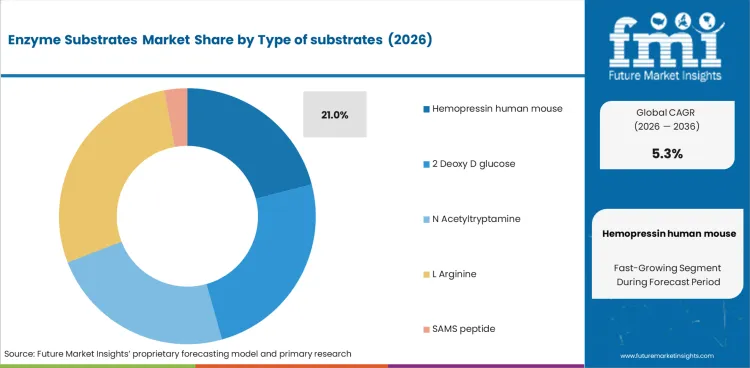
Hemopressin human mouse is dominating the type of substrates segment. Demand is being driven by the existing compatibility with end uses, the availability of the supply chain, and the cost competitiveness with alternative options. Procurement specifications are still in favor of hemopressin human mouse formulations for primary end-use applications.
Other type of substrates categories are 2 Deoxy D glucose, N Acetyltryptamine, L Arginine which serve specific application requirements. Diversification across sub-segments indicates the range of technical specifications required by different end-use industries.
Insights into the Applications Segment
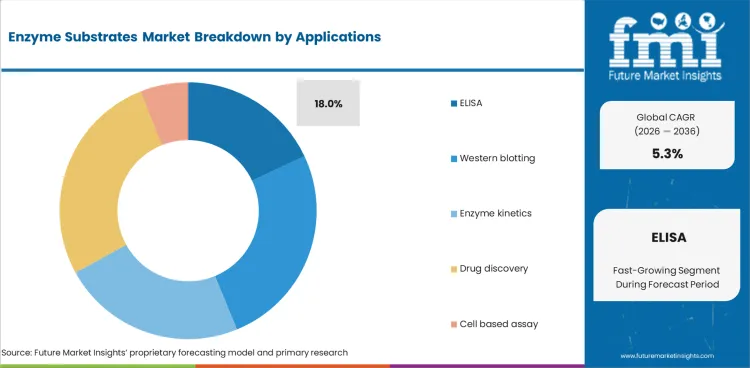
ELISA has the dominant position in the applications segment. Demand is driven by proven end-use compatibility, Supply chain availability and cost competitiveness versus alternatives. in procurement specifications, Elisa formulations are still the preferred choice in primary end use applications.
Other application categories include Western blotting, Enzyme kinetics, Drug discovery, Meeting specific application requirements. the diversity across sub-segments demonstrates the broad spectrum of technical specifications required by different end-use industries.
Enzyme Substrates Market Drivers, Restraints, and Opportunities
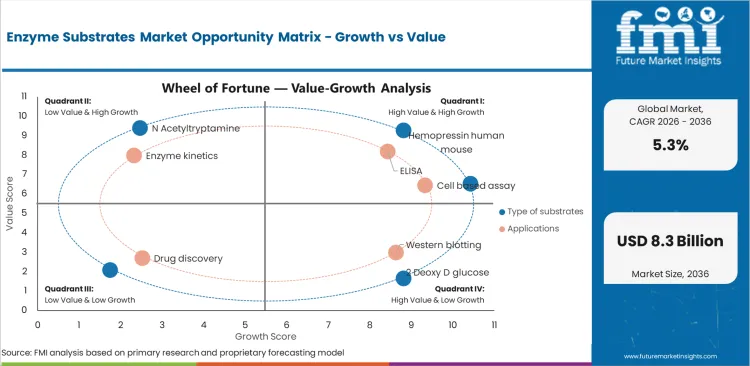
- The increasing volume of clinical diagnostic testing worldwide is creating a need for standardized, Validated enzyme substrate formulations.
- The concentration in supply among a few specialty chemical manufacturers does pose a procurement risk for companies involved in diagnostics and pharmaceuticals downstream.
- The expansion of point-of-care diagnostics and decentralized testing is increasing the addressable market for enzyme substrate products beyond the traditional laboratory environment.
Regulatory drivers, Cost structure constraints and emerging application opportunities are fueling the growth of the enzyme substrates market. Long term expansion is underpinned by structural demand factors but pace of adoption varies by segment, Geography and price sensitivity of end-use applications.
Diagnostic Testing Volume Expansion
Clinical laboratory testing volumes continue to grow globally, driven by chronic disease screening, Infectious disease surveillance and preventive health programs. Enzyme substrates are main consumables for these diagnostic workflows, Resulting in a steady demand for procurement that correlates with healthcare utilization trends.
Supply Concentration Risk
The supply of high-purity enzyme substrates is in the hands of a handful of specialty chemical manufacturers. this concentration creates a procurement risk for diagnostic kit manufacturers and pharmaceutical research operations. Second-source qualification and supply chain diversification are rising higher on the procurement agenda.
Point-of-Care Market Expansion
Decentralized diagnostics and point-of-care testing are increasing the addressable market for enzyme substrates beyond centralized laboratories, Driving demand for products optimized for rapid-test and portable-platform formats. this channel requires substrates with long term stability and easier handling properties.
Analysis of Enzyme Substrates Market By Key Countries
.webp "Top Country Growth Comparison Enzyme Substrates Market Cagr (2026 2036)")
| Country | CAGR |
|---|---|
| USA | 5.6% |
| Japan | 5.3% |
| South Korea | 5.2% |
| UK | 5.1% |
| EU | 5% |
Source: FMI analysis based on primary research and proprietary forecasting model
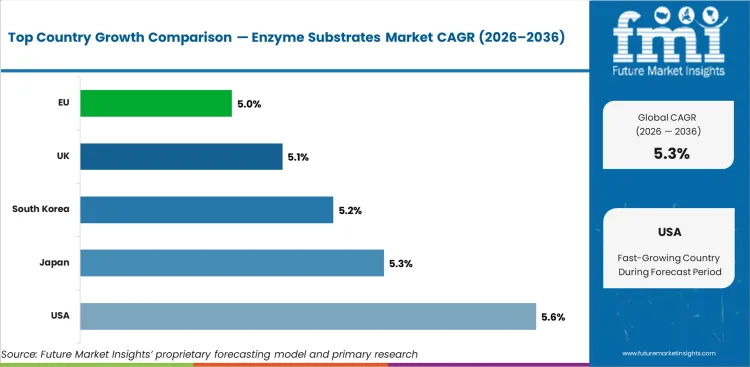
- USA leads with a 5.6% CAGR, reflecting established procurement networks.
- Japan at 5.3% shows strong demand due to advanced manufacturing capabilities.
- South Korea (5.2%) and UK (5.1%) continue growing, Supported by end-use industry expansion.
The global enzyme substrates market is expected to grow at a rate of 5.3% per year from 2026 to 2036. the study covers more than 30 countries, and the main markets are listed below.
Demand Outlook for Enzyme Substrates Market in USA
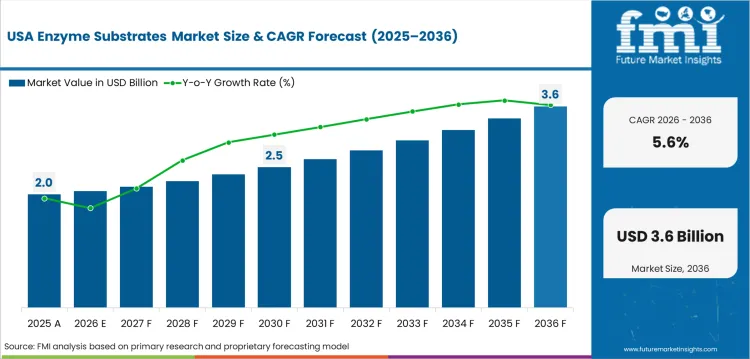
USA is projected to grow at a rate of 5.6% through 2036, reflecting established procurement networks, regulatory compliance investment, and strong end-use demand. Demand is supported by compliance-driven procurement, established distribution networks, and premium product demand.
- Compliance-LED procurement is sustaining demand for products meeting regulatory specifications.
- Established distribution networks support efficient supply chain coverage across end-use sectors.
- Premium product demand is creating value-added procurement channels alongside volume purchasing.
Future Outlook for Enzyme Substrates Market in Japan
Japan is projected to grow at a rate of 5.3% through 2036, reflecting advanced manufacturing capabilities, quality standards, and technology adoption. Demand is supported by quality-driven procurement standards, advanced manufacturing, and technology adoption.
- Quality-driven procurement standards sustain demand for high-specification products.
- Advanced manufacturing capabilities support domestic production and technology adoption.
- Established industry infrastructure enables efficient distribution across end-use sectors.
Opportunity Analysis of Enzyme Substrates Market in South Korea
South Korea is projected to grow at a rate of 5.2% through 2036, reflecting technology-LED adoption and manufacturing sector modernization. Demand is supported by manufacturing sector investment, technology adoption, and export-oriented capabilities.
- Technology-LED adoption is driving procurement modernization across industrial applications.
- Manufacturing sector investment supports domestic demand and export competitiveness.
- Regulatory development is raising product specification requirements across categories.
In-depth Analysis of Enzyme Substrates Market in UK
UK is projected to grow at a rate of 5.1% through 2036, reflecting regulatory alignment with sustainability standards and established distribution infrastructure. Demand is supported by regulatory alignment with sustainability standards, established distribution channels, and premium market demand.
- Regulatory standards alignment is shaping product specifications and procurement criteria.
- Established distribution infrastructure supports efficient market coverage across the region.
- Premium segment demand is creating opportunities for value-added product positioning.
Sales Analysis of Enzyme Substrates Market in Europe
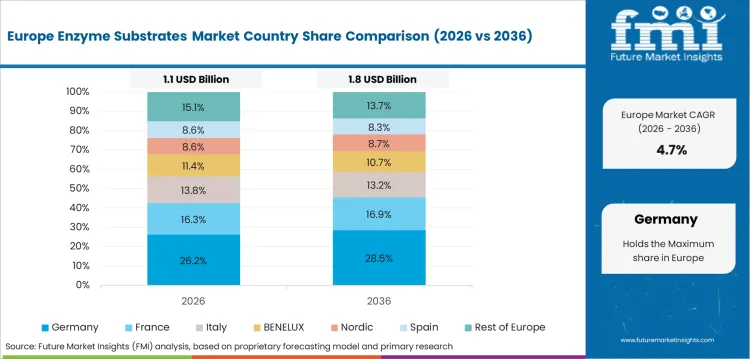
Europe is projected to grow at a rate of 5% through 2036, reflecting EU regulatory frameworks, sustainability mandates, and advanced manufacturing infrastructure. Demand is supported by EU-wide regulatory harmonization, sustainability mandates, and advanced manufacturing infrastructure.
- EU regulatory frameworks are creating compliance-LED demand across member states.
- Sustainability mandates are accelerating adoption of compliant product specifications.
- Advanced manufacturing infrastructure supports efficient production and distribution.
Competitive Landscape and Strategic Positioning
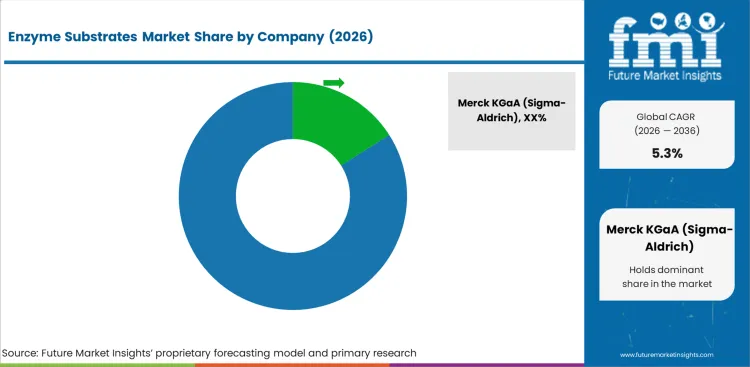
- Merck KGaA (Sigma-Aldrich) is in a leading position due to its established manufacturing infrastructure, Broad product portfolio and strong relationships with end-use customers.
- Thermo Fisher Scientific and Bio-Rad Laboratories, Inc. have a competitive advantage due to product breadth and regional distribution capabilities.
- Smaller and emerging players are targeting specialized applications and niche segments to develop market position.
Merck KGaA (Sigma-Aldrich) is a key player with extensive manufacturing capacity and established relationships with end-use customers across multiple geographies. Thermo Fisher Scientific competes based on the breadth of its product portfolio and distribution reach.
Bio-Rad Laboratories, Inc. and Roche Diagnostics are competitive in certain product categories and regions. Barriers to entry include the need to produce at scale, the lead times to obtain regulatory certification, the need to validate product performance and existing customer procurement relationships.
The competitive landscape strategies include cost optimization, Geographic expansion, product specification upgrades and alignment with regulatory compliance timelines.
Key Companies in the Enzyme Substrates Market
Key global companies leading the enzyme substrates market include:
- Merck KGaA (Sigma-Aldrich), Thermo Fisher Scientific, Bio-Rad Laboratories, Inc. hold leading positions through established manufacturing infrastructure, Broad product portfolios, and strong end-use customer relationships.
- Roche Diagnostics and Danaher Corporation (Beckman Coulter) maintain competitive positions through regional expertise and focused product specialization.
Competitive Benchmarking: Enzyme Substrates Market
| Company | Catalog Breadth | Purity Standards | Regulatory Documentation | Geographic Reach |
|---|---|---|---|---|
| Merck KGaA (Sigma-Aldrich) | High | Strong | Strong | Global |
| Thermo Fisher Scientific | High | Strong | Strong | Global |
| Bio-Rad Laboratories, Inc. | High | Strong | Strong | Global |
| Roche Diagnostics | Medium | Moderate | Moderate | Regional |
| Danaher Corporation (Beckman Coulter) | Medium | Moderate | Moderate | Regional |
Source: Future Market Insights competitive analysis, 2026.
Key Players in the Enzyme Substrates Market
Major Global Players
- Merck KGaA (Sigma-Aldrich)
- Thermo Fisher Scientific
- Bio-Rad Laboratories, Inc.
- Roche Diagnostics
- Danaher Corporation (Beckman Coulter)
Emerging Players/Startups
- Roche Diagnostics
- Danaher Corporation (Beckman Coulter)
Report Scope and Coverage
| Metric | Value |
|---|---|
| Quantitative Units | USD 4.95 billion to USD 8.29 billion, at a CAGR of 5.3% |
| Market Definition | The enzyme substrates market encompasses products categorized by type of substrates, Applications, end users, source, product, Enzyme type compatibility across all major end-use applications. |
| Regions Covered | North America, Latin America, Europe, East Asia, South Asia and Pacific, Middle East and Africa |
| Countries Covered | USA, Japan, South Korea, UK, EU, 30 plus countries |
| Key Companies Profiled | Merck KGaA (Sigma-Aldrich), Thermo Fisher Scientific, Bio-Rad Laboratories, Inc., Roche Diagnostics, Danaher Corporation (Beckman Coulter) |
| Forecast Period | 2026 to 2036 |
| Approach | Hybrid bottom-up and top-down methodology starting with verified transaction data, Projecting adoption velocity across segments and regions. |
Market Segmentation Analysis
Enzyme Substrates Market Segmented by Type of substrates:
- Hemopressin human mouse
- 2 Deoxy D glucose
- N Acetyltryptamine
- L Arginine
- SAMS peptide
Enzyme Substrates Market Segmented by Applications:
- ELISA
- Western blotting
- Enzyme kinetics
- Drug discovery
- Cell based assay
Enzyme Substrates Market Segmented by End users:
- Food and beverages industries
- Cosmetics and skincare industries
- Biofuels
- Research and development activities
Enzyme Substrates Market Segmented by Source:
- Natural
- Synthetic
- Recombinant
Enzyme Substrates Market Segmented by Product:
- Natural Enzyme Substrates
- Carbohydrate Substrates
- Glucose Based Substrates
- Starch Derived Substrates
- Carbohydrate Substrates
- Protein Substrates
-
- Peptide Substrates
- Amino Acid Substrates
-
- Lipid Substrates
-
- Triglycerides
- Fatty Acid Esters
-
- Synthetic Enzyme Substrates
- Chromogenic Substrates
- Colorimetric Substrates
- High Sensitivity Substrates
- Chromogenic Substrates
- Fluorogenic Substrates
-
- Fluorescent Probes
- High Throughput Screening Substrates
-
- Labeled Substrates
-
- Radioactive Labeled
- Isotope Labeled
-
Enzyme Substrates Market Segmented by Enzyme Type Compatibility:
- Protease Substrates
- Peptide Based
- Short Chain Peptides
- Long Chain Peptides
- Peptide Based
- Carbohydrase Substrates
- Sugar Based
- Monosaccharides
- Polysaccharides
- Sugar Based
- Lipase Substrates
- Lipid Based
- Ester Based Substrates
- Triglyceride Substrates
- Lipid Based
- Polymerase And Nuclease Substrates
- Nucleic Acid Based
- DNA Substrates
- RNA Substrates
- Nucleic Acid Based
Enzyme Substrates Market by Region:
- North America
- USA
- Canada
- Mexico
- Latin America
- Brazil
- Chile
- Rest of Latin America
- Western Europe
- Germany
- UK
- Italy
- Spain
- France
- Nordic
- BENELUX
- Rest of Western Europe
- Eastern Europe
- Russia
- Poland
- Hungary
- Balkan & Baltic
- Rest of Eastern Europe
- East Asia
- China
- Japan
- South Korea
- South Asia and Pacific
- India
- ASEAN
- Australia & New Zealand
- Rest of South Asia and Pacific
- Middle East & Africa
- Kingdom of Saudi Arabia
- Other GCC Countries
- Turkiye
- South Africa
- Other African Union
- Rest of Middle East & Africa
Research Sources and Bibliography
- World Health Organization. (2025). Global Diagnostics Market Report. WHO.
- United States Food and Drug Administration. (2024). In Vitro Diagnostic Products Regulatory Framework. FDA.
- European Commission. (2024). In Vitro Diagnostic Regulation Implementation Update. EC.
- International Union of Biochemistry and Molecular Biology. (2025). Enzyme Nomenclature and Classification Standards. IUBMB.
- Organisation for Economic Co-operation and Development. (2025). Biotechnology and Life Sciences Outlook. OECD.
This bibliography is provided for reader reference.
This Report Answers
- Estimating the size of the enzyme substrates market and revenue projections from 2026 to 2036.
- Segmentation by type of substrates, Applications, end users, source, product, Enzyme type compatibility.
- Insights across more than 30 country and regional markets.
- Analysis of key growth drivers, Restraints, and emerging opportunities.
- Assessment of the competitive landscape and strategic positioning.
- Identification of investment opportunities across primary application segments.
- Supply chain structure and distribution channel analysis.
- Delivery of data in PDF and Excel formats.
Frequently Asked Questions
What is the global market demand for Enzyme Substrates Market in 2026?
In 2026, the global enzyme substrates market is expected to be worth USD 4.95 billion.
How big will the Enzyme Substrates Market be in 2036?
By 2036, the enzyme substrates market is expected to be worth USD 8.29 billion.
How much is demand for Enzyme Substrates Market expected to grow between 2026 and 2036?
Between 2026 and 2036, the enzyme substrates market is expected to grow at a CAGR of 5.3%.
Which segment is likely to lead the Enzyme Substrates Market in 2026?
In the Enzyme Substrates Market, food and beverages industries is expected to account for 34% of the end users segment in 2026, reflecting strong downstream demand and established procurement patterns.
What is causing demand to rise in USA for the Enzyme Substrates Market?
In the Enzyme Substrates Market, USA is projected to grow at 5.6% through 2036, reflecting established procurement networks, regulatory compliance investment, and strong end-use demand.
What is causing demand to rise in Japan for the Enzyme Substrates Market?
In the Enzyme Substrates Market, Japan is projected to grow at 5.3% through 2036, reflecting advanced manufacturing capabilities, quality standards, and technology adoption.
What is the definition of the Enzyme Substrates Market?
The enzyme substrates market encompasses products categorized by type of substrates, Applications, end users, source, product, Enzyme type compatibility across all major end-use applications.
How does FMI forecast and validate the Enzyme Substrates Market?
Forecasting models use a hybrid bottom-up and top-down approach, starting with verified transaction data and cross-referencing against global production statistics and manufacturer disclosures.
Preview the report firsthand - request a free sample
Get SampleGet the brochure for pricing and purchase details.
Get PDFTable of Content
- Executive Summary
- Global Market Outlook
- Demand-side Trends
- Supply-side Trends
- Technology Roadmap Analysis
- Analysis and Recommendations
- Market Overview
- Market Coverage / Taxonomy
- Market Definition / Scope / Limitations
- Research Methodology
- Chapter Orientation
- Analytical Lens and Working Hypotheses
- Market Structure, Signals, and Trend Drivers
- Benchmarking and Cross-market Comparability
- Market Sizing, Forecasting, and Opportunity Mapping
- Research Design and Evidence Framework
- Desk Research Programme (Secondary Evidence)
- Company Annual and Sustainability Reports
- Peer-reviewed Journals and Academic Literature
- Corporate Websites, product Literature, and Technical Notes
- Earnings Decks and Investor Briefings
- Statutory Filings and Regulatory Disclosures
- Technical White Papers and Standards Notes
- Trade Journals, Industry Magazines, and Analyst Briefs
- Conference Proceedings, Webinars, and Seminar Materials
- Government Statistics Portals and Public Data Releases
- Press Releases and Reputable Media Coverage
- Specialist Newsletters and Curated Briefings
- Sector Databases and Reference Repositories
- FMI Internal Proprietary Databases and Historical Market Datasets
- Subscription Datasets and Paid Sources
- Social Channels, Communities, and Digital Listening Inputs
- Additional Desk Sources
- Expert Input and Fieldwork (Primary Evidence)
- Primary Modes
- Qualitative Interviews and Expert Elicitation
- Quantitative Surveys and Structured Data Capture
- Blended Approach
- Why Primary Evidence is Used
- Field Techniques
- Interviews
- Surveys
- Focus Groups
- Observational and In-context Research
- Social and Community Interactions
- Stakeholder Universe Engaged
- C-suite Leaders
- Board Members
- Presidents and Vice Presidents
- R&D and Innovation Heads
- Technical Specialists
- Domain Subject-matter Experts
- Scientists
- Physicians and Other Healthcare Professionals
- Governance, Ethics, and Data Stewardship
- Research Ethics
- Data Integrity and Handling
- Primary Modes
- Tooling, Models, and Reference Databases
- Desk Research Programme (Secondary Evidence)
- Data Engineering and Model Build
- Data Acquisition and Ingestion
- Cleaning, Normalisation, and Verification
- Synthesis, Triangulation, and Analysis
- Quality Assurance and Audit Trail
- Market Background
- Market Dynamics
- Drivers
- Restraints
- Opportunity
- Trends
- Scenario Forecast
- Demand in Optimistic Scenario
- Demand in Likely Scenario
- Demand in Conservative Scenario
- Opportunity Map Analysis
- Product Life Cycle Analysis
- Supply Chain Analysis
- Investment Feasibility Matrix
- Value Chain Analysis
- PESTLE and Porter’s Analysis
- Regulatory Landscape
- Regional Parent Market Outlook
- Production and Consumption Statistics
- Import and Export Statistics
- Market Dynamics
- Global Market Analysis 2021 to 2025 and Forecast, 2026 to 2036
- Historical Market Size Value (USD Million) Analysis, 2021 to 2025
- Current and Future Market Size Value (USD Million) Projections, 2026 to 2036
- Y-o-Y Growth Trend Analysis
- Absolute $ Opportunity Analysis
- Global Market Pricing Analysis 2021 to 2025 and Forecast 2026 to 2036
- Global Market Analysis 2021 to 2025 and Forecast 2026 to 2036, by Type of substrates
- Introduction / Key Findings
- Historical Market Size Value (USD Million) Analysis By Type of substrates , 2021 to 2025
- Current and Future Market Size Value (USD Million) Analysis and Forecast By Type of substrates , 2026 to 2036
- Hemopressin human mouse
- 2 Deoxy D glucose
- N Acetyltryptamine
- L Arginine
- SAMS peptide
- Hemopressin human mouse
- Y-o-Y Growth Trend Analysis By Type of substrates , 2021 to 2025
- Absolute $ Opportunity Analysis By Type of substrates , 2026 to 2036
- Global Market Analysis 2021 to 2025 and Forecast 2026 to 2036, by Applications
- Introduction / Key Findings
- Historical Market Size Value (USD Million) Analysis By Applications, 2021 to 2025
- Current and Future Market Size Value (USD Million) Analysis and Forecast By Applications, 2026 to 2036
- ELISA
- Western blotting
- Enzyme kinetics
- Drug discovery
- Cell based assay
- ELISA
- Y-o-Y Growth Trend Analysis By Applications, 2021 to 2025
- Absolute $ Opportunity Analysis By Applications, 2026 to 2036
- Global Market Analysis 2021 to 2025 and Forecast 2026 to 2036, by End users
- Introduction / Key Findings
- Historical Market Size Value (USD Million) Analysis By End users, 2021 to 2025
- Current and Future Market Size Value (USD Million) Analysis and Forecast By End users, 2026 to 2036
- Food and beverages industries
- Cosmetics and skincare industries
- Biofuels
- Research and development activities
- Food and beverages industries
- Y-o-Y Growth Trend Analysis By End users, 2021 to 2025
- Absolute $ Opportunity Analysis By End users, 2026 to 2036
- Global Market Analysis 2021 to 2025 and Forecast 2026 to 2036, by Source
- Introduction / Key Findings
- Historical Market Size Value (USD Million) Analysis By Source, 2021 to 2025
- Current and Future Market Size Value (USD Million) Analysis and Forecast By Source, 2026 to 2036
- Natural
- Synthetic
- Recombinant
- Natural
- Y-o-Y Growth Trend Analysis By Source, 2021 to 2025
- Absolute $ Opportunity Analysis By Source, 2026 to 2036
- Global Market Analysis 2021 to 2025 and Forecast 2026 to 2036, by Product
- Introduction / Key Findings
- Historical Market Size Value (USD Million) Analysis By Product, 2021 to 2025
- Current and Future Market Size Value (USD Million) Analysis and Forecast By Product, 2026 to 2036
- Natural Enzyme Substrates
- Carbohydrate Substrates
- Glucose Based Substrates
- Starch Derived Substrates
- Protein Substrates
- Peptide Substrates
- Amino Acid Substrates
- Lipid Substrates
- Triglycerides
- Fatty Acid Esters
- Synthetic Enzyme Substrates
- Chromogenic Substrates
- Colorimetric Substrates
- High Sensitivity Substrates
- Fluorogenic Substrates
- Fluorescent Probes
- High Throughput Screening Substrates
- Labeled Substrates
- Radioactive Labeled
- Isotope Labeled
- Natural Enzyme Substrates
- Y-o-Y Growth Trend Analysis By Product, 2021 to 2025
- Absolute $ Opportunity Analysis By Product, 2026 to 2036
- Global Market Analysis 2021 to 2025 and Forecast 2026 to 2036, by Enzyme Type Compatibility
- Introduction / Key Findings
- Historical Market Size Value (USD Million) Analysis By Enzyme Type Compatibility, 2021 to 2025
- Current and Future Market Size Value (USD Million) Analysis and Forecast By Enzyme Type Compatibility, 2026 to 2036
- Protease Substrates
- Peptide Based
- Short Chain Peptides
- Long Chain Peptides
- Carbohydrase Substrates
- Sugar Based
- Monosaccharides
- Polysaccharides
- Lipase Substrates
- Lipid Based
- Ester Based Substrates
- Triglyceride Substrates
- Polymerase And Nuclease Substrates
- Nucleic Acid Based
- DNA Substrates
- RNA Substrates
- Protease Substrates
- Y-o-Y Growth Trend Analysis By Enzyme Type Compatibility, 2021 to 2025
- Absolute $ Opportunity Analysis By Enzyme Type Compatibility, 2026 to 2036
- Global Market Analysis 2021 to 2025 and Forecast 2026 to 2036, by Region
- Introduction
- Historical Market Size Value (USD Million) Analysis By Region, 2021 to 2025
- Current Market Size Value (USD Million) Analysis and Forecast By Region, 2026 to 2036
- North America
- Latin America
- Western Europe
- Eastern Europe
- East Asia
- South Asia and Pacific
- Middle East & Africa
- Market Attractiveness Analysis By Region
- North America Market Analysis 2021 to 2025 and Forecast 2026 to 2036, by Country
- Historical Market Size Value (USD Million) Trend Analysis By Market Taxonomy, 2021 to 2025
- Market Size Value (USD Million) Forecast By Market Taxonomy, 2026 to 2036
- By Country
- USA
- Canada
- Mexico
- By Type of substrates
- By Applications
- By End users
- By Source
- By Product
- By Enzyme Type Compatibility
- By Country
- Market Attractiveness Analysis
- By Country
- By Type of substrates
- By Applications
- By End users
- By Source
- By Product
- By Enzyme Type Compatibility
- Key Takeaways
- Latin America Market Analysis 2021 to 2025 and Forecast 2026 to 2036, by Country
- Historical Market Size Value (USD Million) Trend Analysis By Market Taxonomy, 2021 to 2025
- Market Size Value (USD Million) Forecast By Market Taxonomy, 2026 to 2036
- By Country
- Brazil
- Chile
- Rest of Latin America
- By Type of substrates
- By Applications
- By End users
- By Source
- By Product
- By Enzyme Type Compatibility
- By Country
- Market Attractiveness Analysis
- By Country
- By Type of substrates
- By Applications
- By End users
- By Source
- By Product
- By Enzyme Type Compatibility
- Key Takeaways
- Western Europe Market Analysis 2021 to 2025 and Forecast 2026 to 2036, by Country
- Historical Market Size Value (USD Million) Trend Analysis By Market Taxonomy, 2021 to 2025
- Market Size Value (USD Million) Forecast By Market Taxonomy, 2026 to 2036
- By Country
- Germany
- UK
- Italy
- Spain
- France
- Nordic
- BENELUX
- Rest of Western Europe
- By Type of substrates
- By Applications
- By End users
- By Source
- By Product
- By Enzyme Type Compatibility
- By Country
- Market Attractiveness Analysis
- By Country
- By Type of substrates
- By Applications
- By End users
- By Source
- By Product
- By Enzyme Type Compatibility
- Key Takeaways
- Eastern Europe Market Analysis 2021 to 2025 and Forecast 2026 to 2036, by Country
- Historical Market Size Value (USD Million) Trend Analysis By Market Taxonomy, 2021 to 2025
- Market Size Value (USD Million) Forecast By Market Taxonomy, 2026 to 2036
- By Country
- Russia
- Poland
- Hungary
- Balkan & Baltic
- Rest of Eastern Europe
- By Type of substrates
- By Applications
- By End users
- By Source
- By Product
- By Enzyme Type Compatibility
- By Country
- Market Attractiveness Analysis
- By Country
- By Type of substrates
- By Applications
- By End users
- By Source
- By Product
- By Enzyme Type Compatibility
- Key Takeaways
- East Asia Market Analysis 2021 to 2025 and Forecast 2026 to 2036, by Country
- Historical Market Size Value (USD Million) Trend Analysis By Market Taxonomy, 2021 to 2025
- Market Size Value (USD Million) Forecast By Market Taxonomy, 2026 to 2036
- By Country
- China
- Japan
- South Korea
- By Type of substrates
- By Applications
- By End users
- By Source
- By Product
- By Enzyme Type Compatibility
- By Country
- Market Attractiveness Analysis
- By Country
- By Type of substrates
- By Applications
- By End users
- By Source
- By Product
- By Enzyme Type Compatibility
- Key Takeaways
- South Asia and Pacific Market Analysis 2021 to 2025 and Forecast 2026 to 2036, by Country
- Historical Market Size Value (USD Million) Trend Analysis By Market Taxonomy, 2021 to 2025
- Market Size Value (USD Million) Forecast By Market Taxonomy, 2026 to 2036
- By Country
- India
- ASEAN
- Australia & New Zealand
- Rest of South Asia and Pacific
- By Type of substrates
- By Applications
- By End users
- By Source
- By Product
- By Enzyme Type Compatibility
- By Country
- Market Attractiveness Analysis
- By Country
- By Type of substrates
- By Applications
- By End users
- By Source
- By Product
- By Enzyme Type Compatibility
- Key Takeaways
- Middle East & Africa Market Analysis 2021 to 2025 and Forecast 2026 to 2036, by Country
- Historical Market Size Value (USD Million) Trend Analysis By Market Taxonomy, 2021 to 2025
- Market Size Value (USD Million) Forecast By Market Taxonomy, 2026 to 2036
- By Country
- Kingdom of Saudi Arabia
- Other GCC Countries
- Turkiye
- South Africa
- Other African Union
- Rest of Middle East & Africa
- By Type of substrates
- By Applications
- By End users
- By Source
- By Product
- By Enzyme Type Compatibility
- By Country
- Market Attractiveness Analysis
- By Country
- By Type of substrates
- By Applications
- By End users
- By Source
- By Product
- By Enzyme Type Compatibility
- Key Takeaways
- Key Countries Market Analysis
- USA
- Pricing Analysis
- Market Share Analysis, 2025
- By Type of substrates
- By Applications
- By End users
- By Source
- By Product
- By Enzyme Type Compatibility
- Canada
- Pricing Analysis
- Market Share Analysis, 2025
- By Type of substrates
- By Applications
- By End users
- By Source
- By Product
- By Enzyme Type Compatibility
- Mexico
- Pricing Analysis
- Market Share Analysis, 2025
- By Type of substrates
- By Applications
- By End users
- By Source
- By Product
- By Enzyme Type Compatibility
- Brazil
- Pricing Analysis
- Market Share Analysis, 2025
- By Type of substrates
- By Applications
- By End users
- By Source
- By Product
- By Enzyme Type Compatibility
- Chile
- Pricing Analysis
- Market Share Analysis, 2025
- By Type of substrates
- By Applications
- By End users
- By Source
- By Product
- By Enzyme Type Compatibility
- Germany
- Pricing Analysis
- Market Share Analysis, 2025
- By Type of substrates
- By Applications
- By End users
- By Source
- By Product
- By Enzyme Type Compatibility
- UK
- Pricing Analysis
- Market Share Analysis, 2025
- By Type of substrates
- By Applications
- By End users
- By Source
- By Product
- By Enzyme Type Compatibility
- Italy
- Pricing Analysis
- Market Share Analysis, 2025
- By Type of substrates
- By Applications
- By End users
- By Source
- By Product
- By Enzyme Type Compatibility
- Spain
- Pricing Analysis
- Market Share Analysis, 2025
- By Type of substrates
- By Applications
- By End users
- By Source
- By Product
- By Enzyme Type Compatibility
- France
- Pricing Analysis
- Market Share Analysis, 2025
- By Type of substrates
- By Applications
- By End users
- By Source
- By Product
- By Enzyme Type Compatibility
- India
- Pricing Analysis
- Market Share Analysis, 2025
- By Type of substrates
- By Applications
- By End users
- By Source
- By Product
- By Enzyme Type Compatibility
- ASEAN
- Pricing Analysis
- Market Share Analysis, 2025
- By Type of substrates
- By Applications
- By End users
- By Source
- By Product
- By Enzyme Type Compatibility
- Australia & New Zealand
- Pricing Analysis
- Market Share Analysis, 2025
- By Type of substrates
- By Applications
- By End users
- By Source
- By Product
- By Enzyme Type Compatibility
- China
- Pricing Analysis
- Market Share Analysis, 2025
- By Type of substrates
- By Applications
- By End users
- By Source
- By Product
- By Enzyme Type Compatibility
- Japan
- Pricing Analysis
- Market Share Analysis, 2025
- By Type of substrates
- By Applications
- By End users
- By Source
- By Product
- By Enzyme Type Compatibility
- South Korea
- Pricing Analysis
- Market Share Analysis, 2025
- By Type of substrates
- By Applications
- By End users
- By Source
- By Product
- By Enzyme Type Compatibility
- Russia
- Pricing Analysis
- Market Share Analysis, 2025
- By Type of substrates
- By Applications
- By End users
- By Source
- By Product
- By Enzyme Type Compatibility
- Poland
- Pricing Analysis
- Market Share Analysis, 2025
- By Type of substrates
- By Applications
- By End users
- By Source
- By Product
- By Enzyme Type Compatibility
- Hungary
- Pricing Analysis
- Market Share Analysis, 2025
- By Type of substrates
- By Applications
- By End users
- By Source
- By Product
- By Enzyme Type Compatibility
- Kingdom of Saudi Arabia
- Pricing Analysis
- Market Share Analysis, 2025
- By Type of substrates
- By Applications
- By End users
- By Source
- By Product
- By Enzyme Type Compatibility
- Turkiye
- Pricing Analysis
- Market Share Analysis, 2025
- By Type of substrates
- By Applications
- By End users
- By Source
- By Product
- By Enzyme Type Compatibility
- South Africa
- Pricing Analysis
- Market Share Analysis, 2025
- By Type of substrates
- By Applications
- By End users
- By Source
- By Product
- By Enzyme Type Compatibility
- USA
- Market Structure Analysis
- Competition Dashboard
- Competition Benchmarking
- Market Share Analysis of Top Players
- By Regional
- By Type of substrates
- By Applications
- By End users
- By Source
- By Product
- By Enzyme Type Compatibility
- Competition Analysis
- Competition Deep Dive
- Merck KGaA (Sigma-Aldrich)
- Overview
- Product Portfolio
- Profitability by Market Segments (Product/Age /Sales Channel/Region)
- Sales Footprint
- Strategy Overview
- Marketing Strategy
- Product Strategy
- Channel Strategy
- Thermo Fisher Scientific
- Bio-Rad Laboratories, Inc.
- Roche Diagnostics
- Danaher Corporation (Beckman Coulter)
- Others
- Merck KGaA (Sigma-Aldrich)
- Competition Deep Dive
- Assumptions & Acronyms Used


