

- Industry Size (2026)
- USD 1.6 Bn
- Forecast (2036)
- USD 3.5 Bn
- CAGR (2026 to 2036)
- 8.0%
Smart Mite Removal Vacuum Cleaner Market Forecast and Outlook 2026 to 2036
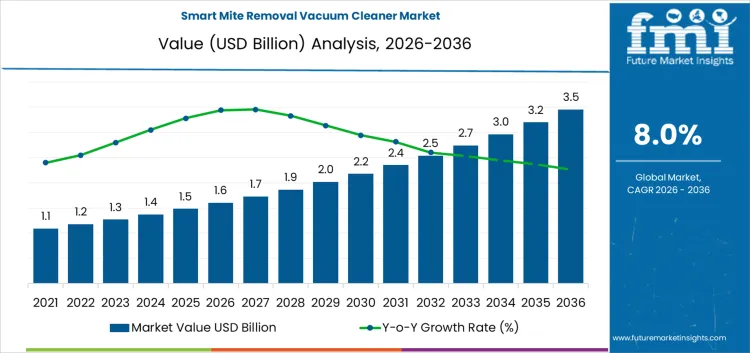
The smart mite removal vacuum cleaner market is projected to grow from USD 1.6 billion in 2026 to USD 3.5 billion by 2036, reflecting a CAGR of 8.0% over the forecast period. Procurement activity in this category is shaped by priorities linked to hygiene performance, filtration credibility, and long term reliability rather than headline pricing. Buyer risk aversion remains high, particularly among households with allergy exposure and institutions where health outcomes influence purchasing accountability. Preference is given to products with validated mite removal efficacy, certified filters, and stable aftersales support.
Vendor lock in is reinforced through proprietary filters, UV modules, batteries, and app based control systems that limit cross brand compatibility. Switching costs increase once replacement consumables and maintenance routines are standardized around a specific supplier. Distribution partnerships, warranty terms, and service availability further narrow vendor choice. Market outcomes are influenced by trust continuity, replacement economics, and perceived performance stability across repeated use cycles.
Quick Stats for Smart Mite Removal Vacuum Cleaner Market
- Smart Mite Removal Vacuum Cleaner Market Value (2026): USD 1.6 Billion
- Smart Mite Removal Vacuum Cleaner Market Forecast Value (2036): USD 3.5 Billion
- Smart Mite Removal Vacuum Cleaner Market Forecast CAGR 2026 to 2036: 8.0%
- Leading Product Type in Smart Mite Removal Vacuum Cleaner Market: Wireless Portable Mite Remover
- Leading Application in Smart Mite Removal Vacuum Cleaner Market: Online Store
- Key Growth Regions in Smart Mite Removal Vacuum Cleaner Market: Asia Pacific, North America
- Top Key Players in Smart Mite Removal Vacuum Cleaner Market: Panasonic, Bissell, Stanley Black & Decker, iRobot, Ecovacs, LG, Samsung
Smart Mite Removal Vacuum Cleaner Market Key Takeaways
| Metric | Value |
|---|---|
| Smart Mite Removal Vacuum Cleaner Market Value (2026) | USD 1.6 Billion |
| Smart Mite Removal Vacuum Cleaner Market Forecast Value (2036) | USD 3.5 Billion |
| Smart Mite Removal Vacuum Cleaner Market Forecast CAGR 2026 to 2036 | 8.0% |
Why is the Smart Mite Removal Vacuum Cleaner Market Growing Across Residential and Commercial Segments?
The smart mite removal vacuum cleaner market is growing as awareness of allergens and indoor air quality increases among consumers and commercial establishments. Households, hospitality services, and healthcare facilities are prioritizing products that remove dust mites, pollen, and other allergens efficiently. Rising incidence of respiratory conditions, allergies, and asthma is creating sustained demand for specialized cleaning appliances that combine hygiene and convenience.
Technological advancements are boosting adoption within the smart mite removal vacuum cleaner market. Devices now integrate high-efficiency particulate filters, UV sterilization, suction optimization, and smart sensors that detect dust and mite concentration. Ergonomic designs, lightweight construction, and automated functions improve usability and maintenance. Integration with mobile apps and IoT-based control is enhancing consumer engagement, making these vacuum cleaners more attractive for daily use and premium household segments.
Lifestyle trends and increasing disposable income are reinforcing growth in the smart mite removal vacuum cleaner market. Urban households and professional cleaning services are investing in multifunctional and health-focused cleaning solutions. Digital marketing, e-commerce availability, and influencer endorsements are accelerating product visibility and adoption. Together, rising health awareness, technological innovation, and changing consumer preferences are driving steady expansion of the market over the forecast period.
What Does The Segment Overview Indicate About The Smart Mite Removal Vacuum Cleaner Market?
The smart mite removal vacuum cleaner market is segmented by product type and distribution channel, showing how consumer preferences influence product design and purchase behavior. Wireless portable mite removers lead the product segment with approximately 58% share, as users prioritize convenience and ease of maneuverability. Wired models serve budget-conscious buyers and continuous-use scenarios. In terms of distribution, online stores dominate with about 65% share, driven by wide product availability, discounts, and direct-to-consumer sales. Offline channels maintain steady demand through electronics retailers and appliance outlets, particularly in regions with lower e-commerce penetration.
Why Do Wireless Portable Mite Removers Hold The Leading Type Share In The Smart Mite Removal Vacuum Cleaner Market?
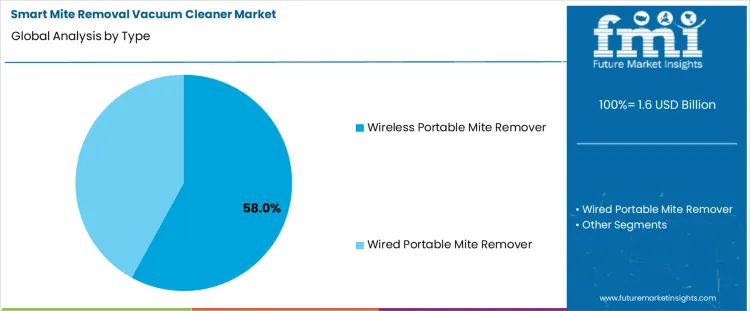
Wireless portable mite removers lead the product segment with an estimated 58% share, as consumers increasingly favor cordless solutions that offer flexible use across bedrooms, sofas, mattresses, and car interiors. Lightweight designs, ergonomic form factors, and USB or rechargeable battery integration enhance portability. These devices appeal to health-conscious users aiming to reduce allergens without the hassle of wires. The segment benefits from tech-savvy consumers seeking quiet operation and high-frequency vibration features. Usage variation is seen across demographics, with young urban households adopting wireless models for compact living spaces. Battery performance improvements and compact charging docks further support this segment’s strong uptake.
How Do Online Stores Drive Application Demand In The Smart Mite Removal Vacuum Cleaner Market?
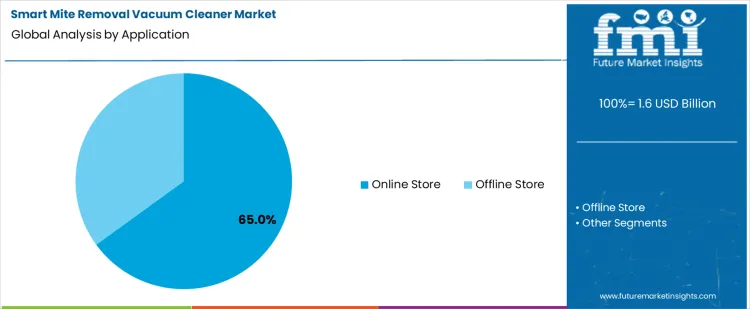
Online stores lead the distribution segment with a dominant 65% share, driven by the convenience of doorstep delivery, wide model selection, and promotional pricing. E-commerce platforms enable detailed product comparisons, access to customer reviews, and integration with lifestyle-based marketing channels. Digital-native consumers prefer buying directly from brand websites or popular retail platforms offering flash deals and combo packs. This channel also supports emerging brands that operate exclusively online. Geographic variation exists, with high penetration in urban regions and tech-forward economies, while offline stores remain relevant in lower internet-access areas. The growth of mobile commerce and influencer-led marketing continues to reinforce the online channel’s lead.
What Consumer Needs Are Accelerating Growth in the Smart Mite Removal Vacuum Cleaner Market?
The smart mite removal vacuum cleaner market is growing as consumers seek effective indoor allergen control, especially for dust mites embedded in bedding, upholstery, and soft furnishings. Demand is increasing in households with infants, asthma patients, or individuals prone to allergic rhinitis. These devices combine suction, UV sterilization, heat, and vibration technologies to detach and neutralize mites. The rise of health-conscious home environments and air-quality concerns is influencing buyer preferences. Integration with sensors and smart control apps is boosting appeal among tech-savvy consumers. Urbanization, smaller living spaces, and multi-surface furniture also favor compact, multi-functional devices designed for targeted mite removal tasks.
Why Are Health Awareness and Lifestyle Shifts Influencing This Segment?
The smart mite removal vacuum cleaner market is benefiting from rising awareness of dust-related allergies and their impact on sleep quality and respiratory health. As consumers prioritize hygiene, especially post-pandemic, household appliances with health-focused features are gaining traction. Lifestyle changes such as remote work, longer indoor hours, and increased fabric use in home interiors are increasing exposure to mites. Growing demand for mattress-cleaning devices and upholstery sanitization tools reflects this shift. Parents with infants and pet owners also form a strong user base. Features like automatic UV activation, allergen detection, and heat-based mite killing are driving product differentiation in this segment.
What Obstacles Are Slowing Widespread Adoption of Smart Mite Removal Devices?
High unit costs and limited awareness are key constraints in the smart mite removal vacuum cleaner market. Many consumers are unfamiliar with dust mite-specific devices or view them as niche, non-essential purchases. Compared to standard vacuum cleaners, smart mite removal units often carry a premium due to specialized components like UV-C lamps, heating elements, and vibration plates. Some users report concerns over surface damage or limited effectiveness on thick fabrics. Availability remains concentrated in online channels or specialty retail, restricting visibility in mass-market outlets. In price-sensitive regions, low-cost non-smart alternatives continue to dominate the dust control segment.
What is the country-wise growth outlook for the smart mite removal vacuum cleaner market?
The smart mite removal vacuum cleaner market is experiencing rapid expansion, particularly in Asia, driven by growing concern over allergen control, mattress hygiene, and air quality. China leads all countries with a CAGR of 11.0%, supported by large urban populations and increasing household health awareness. India follows at 10.2% CAGR, where rising disposable income and pollution-related health concerns drive product demand. The USA records an 8.0% CAGR due to pet ownership, asthma sensitivity, and demand for multi-surface cleaning solutions. The UK grows at 7.8% CAGR, reflecting growing adoption of mattress-specific and handheld cleaning tools. Germany posts a 7.5% CAGR, with demand anchored in anti-allergy preferences and smart home integration.
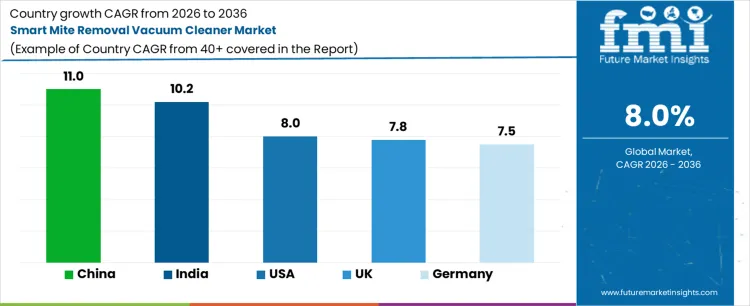
| Country | CAGR |
|---|---|
| China | 11.0% |
| India | 10.2% |
| USA | 8.0% |
| UK | 7.8% |
| Germany | 7.5% |
Why is China leading growth in the smart mite removal vacuum cleaner market?
Demand for the smart mite removal vacuum cleaner market in China is expanding at a CAGR of 11.0%, driven by rising concerns about indoor allergens, mattress hygiene, and respiratory wellness in urban households. As awareness of dust mite–related allergies grows, Chinese consumers increasingly adopt specialized appliances for targeted cleaning of bedding, upholstery, and textile surfaces. High penetration of e-commerce platforms such as JD.com and Tmall accelerates access to a wide range of models, including UV-enabled, HEPA-filtered, and smart sensor-based variants. Product innovation focuses on light weight, low noise, and real-time allergen detection. Domestic manufacturers dominate with localized features and competitive pricing. Middle-class families and health-conscious parents view mite removal appliances as essential for home hygiene, especially in cities with high pollution and humidity. Smart home integration, app-based control, and multi-mode operation also contribute to rising unit sales.
What is driving adoption of smart mite removal vacuum cleaners in India?
Sales for the smart mite removal vacuum cleaner market in India are growing at a CAGR of 10.2%, supported by increasing awareness of dust-related health conditions and improved access to compact, affordable cleaning appliances. Indian households are becoming more conscious of allergens caused by mattresses, cushions, and fabric-covered surfaces, particularly in urban and semi-urban areas. Rising disposable income and changing consumer attitudes toward hygiene enhance the appeal of single-purpose cleaning tools that complement traditional vacuum units. Growth in online marketplaces such as Amazon and Flipkart enables regional buyers to access international and domestic brands offering UV sterilization and hot-air-based mite killing. Smaller apartment sizes and fabric-heavy interiors encourage the use of handheld, corded, or battery-powered units designed for bed and sofa surfaces. New buyers are motivated by product bundling with air purifiers, EMI options, and video-based demonstrations.
Why is the USA showing stable demand in the smart mite removal vacuum cleaner market?
Demand for the smart mite removal vacuum cleaner market in the USA is advancing at a CAGR of 8.0%, supported by growing concern around indoor allergens, pet dander, and asthma triggers. American consumers increasingly adopt specialized cleaning appliances for use on beds, pillows, and furniture where conventional vacuums are ineffective against microscopic allergens. Market growth is driven by high pet ownership, allergy prevalence, and interest in preventive home care solutions. Sales benefit from strong distribution across online and offline channels including Amazon, Walmart, and Target. Premium segment buyers prefer HEPA filtration, UV sterilization, and auto-sensing features. Models compatible with home automation systems or equipped with air-quality indicators gain traction among tech-savvy users. Awareness campaigns from allergy associations and pediatric recommendations reinforce product visibility. These factors contribute to consistent unit growth and upgrade cycles in the USA smart mite removal vacuum cleaner market, particularly among families with children or respiratory sensitivities.
What factors are supporting adoption of smart mite removal vacuum cleaners in the UK?
Sales for the smart mite removal vacuum cleaner market in the UK are increasing at a CAGR of 7.8%, driven by heightened consumer focus on mattress hygiene, allergy reduction, and compact cleaning appliances. British households especially in cities prefer small, efficient cleaning tools that can supplement general-purpose vacuums. Growing use of fabric sofas, rugs, and soft mattresses increases the demand for devices designed to remove dust mites, skin particles, and micro-debris embedded in bedding and furniture. UV-based disinfection and allergen control features resonate with households managing asthma or eczema. Online retailers such as Argos, Currys, and Amazon UK boost sales through targeted promotions and bundled offers. Compact size, plug-and-play functionality, and low-noise performance are key purchasing factors. Health-conscious users and parents of infants form a major customer group, especially when combined with growing seasonal allergy awareness.
Why is Germany showing steady growth in smart mite removal vacuum cleaner usage?
Demand for the smart mite removal vacuum cleaner market in Germany is growing at a CAGR of 7.5%, led by increasing awareness of dust-borne allergens and precision-driven home hygiene preferences. German consumers favor practical, performance-tested solutions to control mites in beds, sofas, and textile upholstery. Buyers look for certified filtration systems, strong suction, and silent operation. Health-related marketing, particularly around sleep quality and allergy prevention, drives trial among middle-income households and older adults. Sales are supported by consistent product availability across electronic chains, pharmacy-linked stores, and online platforms such as MediaMarkt, Saturn, and Otto. Users are highly sensitive to build quality, material safety, and long-term energy efficiency. Brands that emphasize reliability, medical endorsement, and easy filter replacement gain market traction. Use cases expand beyond homes to include daycare centers and elderly care facilities.
How are leading companies competing and positioning themselves in the smart mite removal vacuum cleaner market?
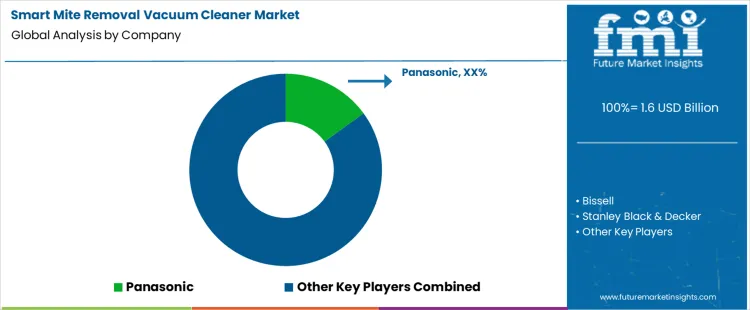
Competition in the smart mite removal vacuum cleaner market is being shaped by filtration efficiency, allergen control, and automation intelligence. Panasonic is being positioned around multi-stage filtration and UV sterilization, with product brochures emphasizing mite elimination, quiet operation, and ergonomic handling. Bissell is being differentiated through deep-clean suction and specialized mite-removal brushes, highlighting portability, ease of maintenance, and pet-safe operation. Stanley Black & Decker focuses on hybrid cordless designs, promoting battery longevity, lightweight form factors, and versatile floor coverage.
Autonomous cleaning and app integration are being leveraged by iRobot, Ecovacs, Neato Robotics, and Infinuvo (Metapo). iRobot promotes smart navigation, programmable schedules, and allergen capture efficiency, with brochures emphasizing consistent cleaning in hard-to-reach areas. Ecovacs and Neato Robotics focus on mapping and AI-assisted path optimization, highlighting precision suction and filter longevity. Infinuvo integrates mite-specific UV and vibration systems for mattress and upholstery care, emphasizing hygiene effectiveness and intelligent operation.
A different competitive angle is being pursued by LG, Samsung, Yujin Robot, Mamirobot, Moneual, and Proscenic. LG and Samsung emphasize multi-surface cleaning, connectivity, and sensor-driven performance. Yujin Robot and Mamirobot promote compact robotic formats for beds and sofas. Moneual and Proscenic focus on value-added features such as hybrid vacuum-mop operation and targeted mite-elimination modes. Across the market, differentiation is being shaped by cleaning precision, allergen control, and intelligent automation, with product brochures translating technical performance into measurable hygiene and convenience benefits for users.
Smart Mite Removal Vacuum Cleaner Market
- Panasonic
- Bissell
- Stanley Black & Decker
- iRobot
- Ecovacs
- Neato Robotics
- Infinuvo (Metapo)
- LG
- Samsung
- Yujin Robot
- Mamirobot
- Moneual
- Proscenic
Scope of Report
| Attributes | Description |
|---|---|
| Quantitative Unit | USD Billion |
| Base Year | 2026 |
| Forecast Period | 2026 to 2036 |
| Type | Wireless Portable Mite Remover, Wired Portable Mite Remover |
| Application | Online Store, Offline Store |
| Regions Covered | Asia Pacific, Europe, North America, Latin America, Middle East & Africa |
| Countries Covered | China, Japan, South Korea, India, Australia & New Zealand, ASEAN, Rest of Asia Pacific, Germany, United Kingdom, France, Italy, Spain, Nordic, BENELUX, Rest of Europe, United States, Canada, Mexico, Brazil, Chile, Rest of Latin America, Kingdom of Saudi Arabia, Other GCC Countries, Turkey, South Africa, Other African Union, Rest of Middle East & Africa |
| Key Companies Profiled | Panasonic, Bissell, Stanley Black & Decker, iRobot, Ecovacs, Neato Robotics, Infinuvo (Metapo), LG, Samsung, Yujin Robot, Mamirobot, Moneual, Proscenic |
| Additional Attributes | Dollar sales by product type and application; regional adoption trends for wireless and wired mite removers; analysis of online vs offline sales channels; revenue contribution by type and region; forecasted market share trends for 2026–2036; evaluation of emerging markets and competitive landscape. |
Smart Mite Removal Vacuum Cleaner Market
Type
- Wireless Portable Mite Remover
- Wired Portable Mite Remover
Application
- Online Store
- Offline Store
Region:
- Asia Pacific
- China
- Japan
- South Korea
- India
- Australia & New Zealand
- ASEAN
- Rest of Asia Pacific
- Europe
- Germany
- United Kingdom
- France
- Italy
- Spain
- Nordic
- BENELUX
- Rest of Europe
- North America
- United States
- Canada
- Mexico
- Latin America
- Brazil
- Chile
- Rest of Latin America
- Middle East & Africa
- Kingdom of Saudi Arabia
- Other GCC Countries
- Turkey
- South Africa
- Other African Union
- Rest of Middle East & Africa
Bibliography
- ECOVACS. (2023-03-26). How HEPA Filter in Robot Vacuums Help Reduce Asthma and Allergies. ECOVACS UK (Blog).
- Klain, A., Senatore, A. A., Licari, A., et al. (2024-04-15). The Prevention of House Dust Mite Allergies in Pediatric Asthma. Children (Basel), 11(4), 469. (Open access via PubMed Central).
- Samsung Electronics. (2023-02-03). VS9500AL Stick Vacuum Cleaner With All In One Clean Station (Product page highlighting multi layered filtration). Samsung India.
- USA Environmental Protection Agency. (2023, April). Asthma Action Plan (PDF). EPA.
- Centers for Disease Control and Prevention. (2024, April 12). Summary of Recommendations: Environmental Control (Infection Control). CDC
Frequently Asked Questions
How big is the smart mite removal vacuum cleaner market in 2026?
The global smart mite removal vacuum cleaner market is estimated to be valued at USD 1.6 billion in 2026.
What will be the size of smart mite removal vacuum cleaner market in 2036?
The market size for the smart mite removal vacuum cleaner market is projected to reach USD 3.5 billion by 2036.
How much will be the smart mite removal vacuum cleaner market growth between 2026 and 2036?
The smart mite removal vacuum cleaner market is expected to grow at a 8.0% CAGR between 2026 and 2036.
What are the key product types in the smart mite removal vacuum cleaner market?
The key product types in smart mite removal vacuum cleaner market are wireless portable mite remover and wired portable mite remover.
Which application segment to contribute significant share in the smart mite removal vacuum cleaner market in 2026?
In terms of application, online store segment to command 65.0% share in the smart mite removal vacuum cleaner market in 2026.
Preview the report firsthand - request a free sample
Get SampleGet the brochure for pricing and purchase details.
Get PDFTable of Content
- Executive Summary
- Global Market Outlook
- Demand-side Trends
- Supply-side Trends
- Technology Roadmap Analysis
- Analysis and Recommendations
- Market Overview
- Market Coverage / Taxonomy
- Market Definition / Scope / Limitations
- Market Background
- Market Dynamics
- Drivers
- Restraints
- Opportunity
- Trends
- Scenario Forecast
- Demand in Optimistic Scenario
- Demand in Likely Scenario
- Demand in Conservative Scenario
- Opportunity Map Analysis
- Product Life Cycle Analysis
- Supply Chain Analysis
- Investment Feasibility Matrix
- Value Chain Analysis
- PESTLE and Porter’s Analysis
- Regulatory Landscape
- Regional Parent Market Outlook
- Production and Consumption Statistics
- Import and Export Statistics
- Market Dynamics
- Global Market Analysis 2021 to 2025 and Forecast, 2026 to 2036
- Historical Market Size Value (USD Million) Analysis, 2021 to 2025
- Current and Future Market Size Value (USD Million) Projections, 2026 to 2036
- Y-o-Y Growth Trend Analysis
- Absolute $ Opportunity Analysis
- Global Market Pricing Analysis 2021 to 2025 and Forecast 2026 to 2036
- Global Market Analysis 2021 to 2025 and Forecast 2026 to 2036, By Type
- Introduction / Key Findings
- Historical Market Size Value (USD Million) Analysis By Type , 2021 to 2025
- Current and Future Market Size Value (USD Million) Analysis and Forecast By Type , 2026 to 2036
- Wireless Portable Mite Remover
- Wired Portable Mite Remover
- Wireless Portable Mite Remover
- Y-o-Y Growth Trend Analysis By Type , 2021 to 2025
- Absolute $ Opportunity Analysis By Type , 2026 to 2036
- Global Market Analysis 2021 to 2025 and Forecast 2026 to 2036, By Application
- Introduction / Key Findings
- Historical Market Size Value (USD Million) Analysis By Application, 2021 to 2025
- Current and Future Market Size Value (USD Million) Analysis and Forecast By Application, 2026 to 2036
- Online Store
- Offline Store
- Online Store
- Y-o-Y Growth Trend Analysis By Application, 2021 to 2025
- Absolute $ Opportunity Analysis By Application, 2026 to 2036
- Global Market Analysis 2021 to 2025 and Forecast 2026 to 2036, By Region
- Introduction
- Historical Market Size Value (USD Million) Analysis By Region, 2021 to 2025
- Current Market Size Value (USD Million) Analysis and Forecast By Region, 2026 to 2036
- North America
- Latin America
- Western Europe
- Eastern Europe
- East Asia
- South Asia and Pacific
- Middle East & Africa
- Market Attractiveness Analysis By Region
- North America Market Analysis 2021 to 2025 and Forecast 2026 to 2036, By Country
- Historical Market Size Value (USD Million) Trend Analysis By Market Taxonomy, 2021 to 2025
- Market Size Value (USD Million) Forecast By Market Taxonomy, 2026 to 2036
- By Country
- USA
- Canada
- Mexico
- By Type
- By Application
- By Country
- Market Attractiveness Analysis
- By Country
- By Type
- By Application
- Key Takeaways
- Latin America Market Analysis 2021 to 2025 and Forecast 2026 to 2036, By Country
- Historical Market Size Value (USD Million) Trend Analysis By Market Taxonomy, 2021 to 2025
- Market Size Value (USD Million) Forecast By Market Taxonomy, 2026 to 2036
- By Country
- Brazil
- Chile
- Rest of Latin America
- By Type
- By Application
- By Country
- Market Attractiveness Analysis
- By Country
- By Type
- By Application
- Key Takeaways
- Western Europe Market Analysis 2021 to 2025 and Forecast 2026 to 2036, By Country
- Historical Market Size Value (USD Million) Trend Analysis By Market Taxonomy, 2021 to 2025
- Market Size Value (USD Million) Forecast By Market Taxonomy, 2026 to 2036
- By Country
- Germany
- UK
- Italy
- Spain
- France
- Nordic
- BENELUX
- Rest of Western Europe
- By Type
- By Application
- By Country
- Market Attractiveness Analysis
- By Country
- By Type
- By Application
- Key Takeaways
- Eastern Europe Market Analysis 2021 to 2025 and Forecast 2026 to 2036, By Country
- Historical Market Size Value (USD Million) Trend Analysis By Market Taxonomy, 2021 to 2025
- Market Size Value (USD Million) Forecast By Market Taxonomy, 2026 to 2036
- By Country
- Russia
- Poland
- Hungary
- Balkan & Baltic
- Rest of Eastern Europe
- By Type
- By Application
- By Country
- Market Attractiveness Analysis
- By Country
- By Type
- By Application
- Key Takeaways
- East Asia Market Analysis 2021 to 2025 and Forecast 2026 to 2036, By Country
- Historical Market Size Value (USD Million) Trend Analysis By Market Taxonomy, 2021 to 2025
- Market Size Value (USD Million) Forecast By Market Taxonomy, 2026 to 2036
- By Country
- China
- Japan
- South Korea
- By Type
- By Application
- By Country
- Market Attractiveness Analysis
- By Country
- By Type
- By Application
- Key Takeaways
- South Asia and Pacific Market Analysis 2021 to 2025 and Forecast 2026 to 2036, By Country
- Historical Market Size Value (USD Million) Trend Analysis By Market Taxonomy, 2021 to 2025
- Market Size Value (USD Million) Forecast By Market Taxonomy, 2026 to 2036
- By Country
- India
- ASEAN
- Australia & New Zealand
- Rest of South Asia and Pacific
- By Type
- By Application
- By Country
- Market Attractiveness Analysis
- By Country
- By Type
- By Application
- Key Takeaways
- Middle East & Africa Market Analysis 2021 to 2025 and Forecast 2026 to 2036, By Country
- Historical Market Size Value (USD Million) Trend Analysis By Market Taxonomy, 2021 to 2025
- Market Size Value (USD Million) Forecast By Market Taxonomy, 2026 to 2036
- By Country
- Kingdom of Saudi Arabia
- Other GCC Countries
- Turkiye
- South Africa
- Other African Union
- Rest of Middle East & Africa
- By Type
- By Application
- By Country
- Market Attractiveness Analysis
- By Country
- By Type
- By Application
- Key Takeaways
- Key Countries Market Analysis
- USA
- Pricing Analysis
- Market Share Analysis, 2025
- By Type
- By Application
- Canada
- Pricing Analysis
- Market Share Analysis, 2025
- By Type
- By Application
- Mexico
- Pricing Analysis
- Market Share Analysis, 2025
- By Type
- By Application
- Brazil
- Pricing Analysis
- Market Share Analysis, 2025
- By Type
- By Application
- Chile
- Pricing Analysis
- Market Share Analysis, 2025
- By Type
- By Application
- Germany
- Pricing Analysis
- Market Share Analysis, 2025
- By Type
- By Application
- UK
- Pricing Analysis
- Market Share Analysis, 2025
- By Type
- By Application
- Italy
- Pricing Analysis
- Market Share Analysis, 2025
- By Type
- By Application
- Spain
- Pricing Analysis
- Market Share Analysis, 2025
- By Type
- By Application
- France
- Pricing Analysis
- Market Share Analysis, 2025
- By Type
- By Application
- India
- Pricing Analysis
- Market Share Analysis, 2025
- By Type
- By Application
- ASEAN
- Pricing Analysis
- Market Share Analysis, 2025
- By Type
- By Application
- Australia & New Zealand
- Pricing Analysis
- Market Share Analysis, 2025
- By Type
- By Application
- China
- Pricing Analysis
- Market Share Analysis, 2025
- By Type
- By Application
- Japan
- Pricing Analysis
- Market Share Analysis, 2025
- By Type
- By Application
- South Korea
- Pricing Analysis
- Market Share Analysis, 2025
- By Type
- By Application
- Russia
- Pricing Analysis
- Market Share Analysis, 2025
- By Type
- By Application
- Poland
- Pricing Analysis
- Market Share Analysis, 2025
- By Type
- By Application
- Hungary
- Pricing Analysis
- Market Share Analysis, 2025
- By Type
- By Application
- Kingdom of Saudi Arabia
- Pricing Analysis
- Market Share Analysis, 2025
- By Type
- By Application
- Turkiye
- Pricing Analysis
- Market Share Analysis, 2025
- By Type
- By Application
- South Africa
- Pricing Analysis
- Market Share Analysis, 2025
- By Type
- By Application
- USA
- Market Structure Analysis
- Competition Dashboard
- Competition Benchmarking
- Market Share Analysis of Top Players
- By Regional
- By Type
- By Application
- Competition Analysis
- Competition Deep Dive
- Panasonic
- Overview
- Product Portfolio
- Profitability by Market Segments (Product/Age /Sales Channel/Region)
- Sales Footprint
- Strategy Overview
- Marketing Strategy
- Product Strategy
- Channel Strategy
- Bissell
- Stanley Black & Decker
- iRobot
- Ecovacs
- Neato Robotics
- Infinuvo (Metapo)
- LG
- Samsung
- Yujin Robot
- Mamirobot
- Moneual
- Proscenic
- Panasonic
- Competition Deep Dive
- Assumptions & Acronyms Used
- Research Methodology


