

- Industry Size (2026)
- USD 35.2 Mn
- Forecast (2036)
- USD 55.5 Mn
- CAGR (2026 to 2036)
- 4.7%
Demand for Cellulose Derivative in South Korea Forecast and Outlook 2026 to 2036
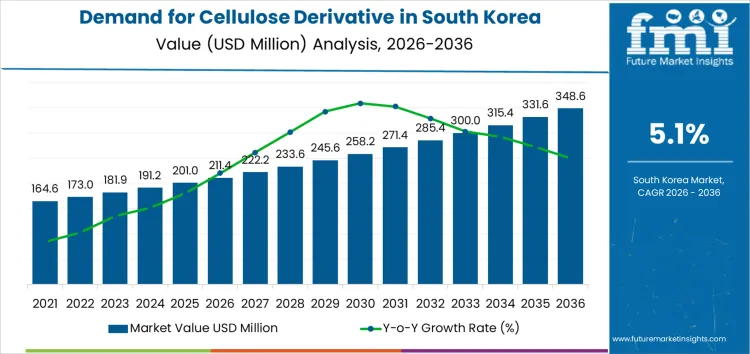
The demand for cellulose derivatives in South Korea is expected to reach USD 211.4 million in 2026 and advance to USD 348.6 million by 2036, reflecting a 5.1% CAGR. Regulatory oversight will shape adoption patterns as end users in pharmaceuticals, food processing, and personal care face tightening documentation and ingredient-level scrutiny. Compliance costs will rise as manufacturers adapt to stricter safety evaluations, expanded traceability requirements, and updated functional performance standards.
Certification complexity will influence vendor positioning, since suppliers capable of meeting multi-industry regulatory frameworks will be preferred by risk-averse buyers seeking assured continuity. Firms operating with advanced quality systems and globally recognized certifications will gain leverage, as their products reduce approval delays for downstream manufacturers. Conversely, suppliers lacking robust compliance infrastructure may face slower adoption due to reformulation risks and additional verification steps required by end users.
Quick Stats for the Demand for Cellulose Derivative in South Korea
- Cellulose Derivative in South Korea Value (2026): USD 211.4 million
- Cellulose Derivative in South Korea Forecast Value (2036): USD 348.6 million
- Cellulose Derivative in South Korea Forecast CAGR (2026 to 2036): 5.1%
- Cellulose Derivative in South Korea Leading Segment: Powder (57%)
- Key Growth Regions of Cellulose Derivative in South Korea: Jeju (leading CAGR 6.2%)
- Top Players of Cellulose Derivative in South Korea: Dow Chemical Company, Ashland Global Holdings Inc., Rayonier Advanced Materials Inc., CP Kelco, Celanese Corporation
What is the Growth Forecast for the Cellulose Derivative Market through 2036?
Growth in cellulose derivatives across South Korea follows an acceleration-deceleration pattern typical of maturing functional materials. Early-period demand from 2026 to 2030 rises at a moderate pace as downstream sectors adjust to evolving standards in pharmaceuticals, food applications, and industrial coatings. Each category absorbs cellulose derivatives at different speeds, creating a layered growth profile. The early stage shows measured acceleration due to increased adoption of high-purity grades and broader interest in sustainable ingredient systems. These forces lift the curve without producing abrupt surges, maintaining a consistent upward slope.
From 2031 forward, the curve adopts a softer gradient as adoption levels stabilize across major end uses. Gains persist through 2036, though the rate reflects typical deceleration observed once baseline applications are fully established. Demand reaches USD 348.6 million at the end of the period, increasing through incremental shifts toward advanced formulations and compliance-driven upgrades. This later-stage movement aligns with structural consumption rather than rapid expansion, forming a predictable long-horizon profile suitable for capacity planning and long-term supply arrangements.
Key Takeaways for Demand for Cellulose Derivative in South Korea
| Metric | Value |
|---|---|
| Industry Sales Value (2026) | USD 211.4 million |
| Industry Forecast Value (2036) | USD 348.6 million |
| Industry Forecast CAGR (2026 to 2036) | 5.1% |
Why is the Demand for Cellulose Derivative Growing in South Korea?
Demand for cellulose derivatives in South Korea is rising as industries seek versatile materials that support performance and sustainability across multiple applications. Cellulose derivatives such as methylcellulose, hydroxypropyl methylcellulose, and carboxymethyl cellulose serve as functional additives in coatings, adhesives, pharmaceuticals, cosmetics, and food products. South Korean manufacturers in coatings and construction chemicals use these derivatives to improve rheology control, water retention, and film formation in products.
In personal care and cosmetics, formulations leverage cellulose derivatives for thickening, stabilizing, and sensory enhancement. Food processors incorporate them as stabilizers, emulsifiers, and texture modifiers, responding to both regulatory standards and consumer expectations for quality. The material’s biodegradable origin and compatibility with diverse formulations support its adoption over certain synthetic alternatives. As companies pursue consistent product performance and regulatory compliance, procurement of cellulose derivatives has become integral in formulation and production workflows across sectors.
Looking ahead, several structural factors are expected to sustain and expand demand for cellulose derivatives in South Korea. Growth in construction activity and investment in high-performance industrial coatings will maintain demand for rheology modifiers that enhance application properties and durability. In pharmaceuticals, trends toward sustained-release drug formulations and excipients that support tablet integrity and controlled dissolution continue to involve cellulose derivatives.
Food and beverage producers are adopting clean-label strategies that favour ingredients perceived as safe and derived from renewable sources, reinforcing the role of cellulose derivatives in stabilizing and texturizing products. Environmental policies aimed at reducing reliance on non-renewable polymers may further encourage use of bio-based materials, expanding opportunities in packaging and paper-related applications. Additionally, advancements in processing technologies and tailored derivative grades allow suppliers to meet specific performance criteria, making cellulose derivatives more relevant to emerging technical requirements. These dynamics collectively underpin continued interest and investment in cellulose derivative supply chains within South Korea.
What Defines the Demand for Cellulose Derivatives in South Korea?
Demand for cellulose derivatives in South Korea is guided by form and derivative type, with powder leading the form segment and methyl derivatives leading the derivative category. Powder accounts for 57 % of total use, driven by widespread application across pharmaceuticals, food processing, and industrial formulations. Methyl derivatives hold a 30 % share, shaped by their compatibility with diverse manufacturing requirements across specialty chemicals, coatings, and regulated formulations.
Why Does the Powder Form Dominate Cellulose Derivative Use in South Korea?
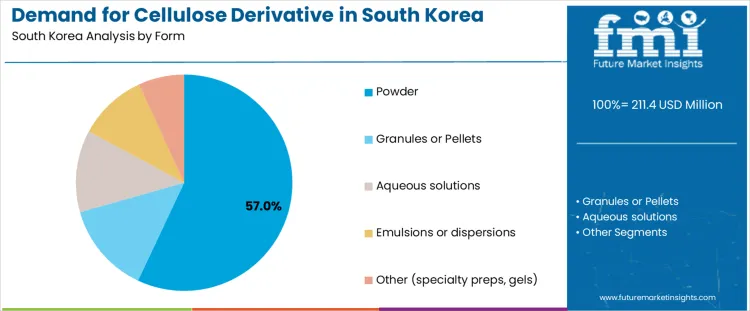
Powder holds a 57% share in South Korea due to its stability, dosing precision, and suitability for automated processing lines. Pharmaceutical manufacturers rely on powdered cellulose derivatives for tablet binding, disintegration control, capsule formulations, and controlled-release matrices. These functions depend on predictable flow, uniform particle size, and controlled hydration, all of which are easier to manage in powder form. South Korea’s strong formulation-driven pharmaceutical sector maintains consistent demand for powder formats because production lines are optimized for powdered excipients that support high-speed compression and coating processes.
Food processors also contribute to this share, using powdered cellulose derivatives for texture modification, emulsion stability, moisture retention, and freeze-thaw stability. Powder formats integrate cleanly into dry mixing systems that support bakery items, plant-based foods, noodles, and processed dairy substitutes. Industrial applications span adhesives, ceramics, construction compounds, and paints where viscosity development, film formation, and rheology control are essential. Powder’s long shelf life and ease of transport strengthen its role across these segments. South Korean manufacturers value minimal batch-to-batch variability, and powdered cellulose derivatives deliver consistent hydration and thickening behavior that suit both large-scale plants and specialized formulators. These attributes keep powder in the leading position as demand expands across pharmaceuticals, packaged foods, coatings, and industrial materials.
Why Do Methyl Cellulose Derivatives Hold the Leading Share in South Korea?
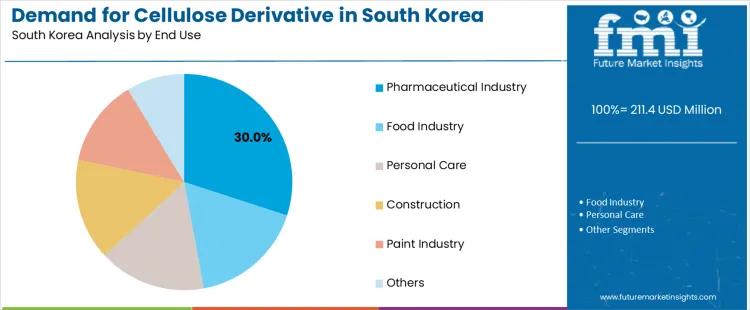
Methyl derivatives represent 30% of the derivative type segment in South Korea due to their versatility across regulated and industrial applications. Methyl cellulose offers stable viscosity, reliable film formation, and controlled thickening across a wide temperature range. Pharmaceutical producers use methyl derivatives in ophthalmic preparations, oral suspensions, tablet coatings, and modified-release systems. These formulations depend on clarity, biocompatibility, and predictable gelation, traits that align well with methyl cellulose performance. Regulatory acceptance across major markets also supports its use in export-oriented pharmaceutical production within South Korea.
Food manufacturers apply methyl cellulose in thermal-gel systems used in meat analogues, frozen entrées, batters, and sauces. Heat-set gelation provides structure retention during cooking, which is especially relevant to South Korea’s expanding plant-based and ready-meal categories. In industrial settings, methyl derivatives improve water retention and workability in cementitious mixes, mortars, joint compounds, and latex paints. These materials benefit from consistent rheology and improved surface finish, both delivered through methyl-based cellulose. The derivative’s compatibility with humid environments and varied processing temperatures also suits South Korea’s manufacturing conditions. As sectors such as pharmaceuticals, specialty foods, engineered materials, and construction products grow, methyl cellulose derivatives retain a central role due to their functional reliability and established supply chains.
What Is the Current Demand for Cellulose Derivative in South Korea?
Demand for cellulose derivative in South Korea is tied to its wide use in pharmaceuticals, food additives, personal care products, coatings, and industrial applications. Cellulose ethers, carboxymethyl cellulose, and microcrystalline cellulose are sourced by chemical manufacturers and formulators as functional ingredients for thickening, stabilizing, and binding. Procurement levels correlate with output in downstream sectors such as cosmetics, processed foods, and specialty chemicals. The preference for bio-based excipients and sustainable raw materials has supported steady uptake, especially among manufacturers orienting formulations toward cleaner labels and regulatory compliance.
What Factors Are Driving Demand for Cellulose Derivative in South Korea?
Several drivers support the demand for cellulose derivative in South Korea. Growth in the personal care and cosmetics sector stimulates needs for rheology modifiers and film formers. Expansion of pharmaceutical production, especially solid dosage forms, underpins demand for binders and disintegrants. The food processing industry uses cellulose derivatives as stabilizers and texture agents in products ranging from bakery items to beverages. Regulatory emphasis on safe, non-toxic additives in consumer goods encourages formulators to select cellulose derivatives over synthetic alternatives. Increasing investment in specialty chemicals and formulation expertise drives technical adoption, while industrial sectors leverage water-soluble cellulose grades for coatings, adhesives, and construction materials.
What Are the Constraints on Demand for Cellulose Derivative in South Korea?
Despite ongoing uptake, constraint factors influence demand for cellulose derivative in South Korea. Price volatility in cellulosic raw materials and energy costs affects manufacturing economics, particularly for grades requiring extensive processing. Substitution by lower-cost synthetic polymers or alternative bio-based materials can limit penetration in cost-sensitive applications. Supply chain disruptions or import dependency for certain grades may affect product availability, especially for high-purity or specialty derivatives. Compliance demands in regulated sectors, such as pharmaceuticals and food, require rigorous testing and documentation, which can slow adoption for new derivative grades. Market saturation in mature segments, such as basic coatings or commodity chemicals, also tempers growth.
What Trends Are Emerging in South Korea’s Cellulose Derivative Market?
Emerging trends in South Korea’s cellulose derivative landscape reflect shifts in formulation practices and sustainability goals. There is growing interest in high-performance and tailored derivatives designed for specific rheological profiles or controlled release in pharmaceutical and specialty applications. Demand for eco-friendly and biodegradable excipients in personal care and food products aligns with consumer preferences for clean formulations. Integration of advanced manufacturing technologies, such as continuous processing and real-time quality monitoring, influences procurement timing and inventory strategies. Collaborations between domestic manufacturers and international specialty chemical producers are shaping availability of novel grades, while research institutions explore innovative cellulose applications in composites and biodegradable films.
What is the Regional Outlook for the Demand for Cellulose Derivative in South Korea?
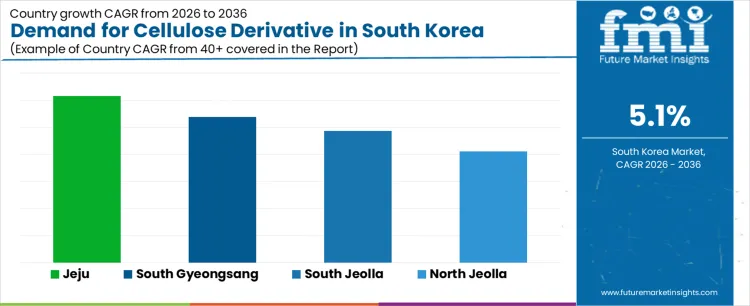
The demand for cellulose derivatives in South Korea reflects growth in pharmaceuticals, food processing, cosmetics, and industrial applications. Jeju shows the fastest expansion, driven by its growing skincare and wellness sectors, where cellulose derivatives are used as thickeners, stabilizers, and film-forming agents. South Gyeongsang and South Jeolla follow with steady demand, supported by their strong manufacturing and food-processing bases. North Jeolla grows more moderately but benefits from its presence in agro-processing and industrial formulations. As industries continue shifting toward biodegradable, plant-based ingredients and safer additives, cellulose derivatives will see consistent demand across these regions, particularly in applications requiring clean-label, stable, and high-performance formulations.
| Province | CAGR (2026 to 2036) |
|---|---|
| South Gyeongsang | 5.4% |
| North Jeolla | 4.1% |
| South Jeolla | 4.9% |
| Jeju | 6.2% |
What drives the demand for Cellulose Derivatives in South Gyeongsang?
South Gyeongsang is projected to grow at a CAGR of 5.4% in the demand for cellulose derivatives from 2026 to 2036. The region’s strength in food processing, pharmaceutical manufacturing, and cosmetics contributes significantly to this demand. Cellulose derivatives are used as stabilizers, emulsifiers, binders, and controlled-release agents, making them essential for product development in these sectors. South Gyeongsang’s expanding pharmaceutical industry, particularly in oral solid dosage production, increases the need for hydroxypropyl methylcellulose and related cellulose derivatives. The region’s food industry relies on these ingredients for texture modification and moisture retention, especially in bakery, dairy, and ready-meal categories. As consumer preferences shift toward cleaner labels and more plant-based additives, South Gyeongsang’s manufacturers continue integrating cellulose derivatives into new product lines. This trend, along with strong industrial capabilities, supports sustained demand growth.
What influences the demand for Cellulose Derivatives in North Jeolla?
North Jeolla is expected to expand at a CAGR of 4.1% through 2036. The region’s agro-processing and food manufacturing sectors are important drivers, as cellulose derivatives are widely used to improve texture, stability, and shelf life in processed foods. North Jeolla’s cosmetics and personal-care manufacturers also contribute to demand, particularly for cellulose-based thickeners and film-formers used in lotions, creams, and gel formulations. The pharmaceutical sector in the region, though smaller than that of other provinces, is adopting cellulose derivatives for tablet binding and controlled-release functions. With increasing consumer and regulatory focus on sustainable, plant-derived ingredients, manufacturers in North Jeolla are shifting from synthetic additives to cellulose derivatives in both food and non-food formulations. This transition supports steady demand for these materials over the forecast period.
What drives the demand for Cellulose Derivatives in South Jeolla?
South Jeolla is projected to grow at a CAGR of 4.9% between 2026 and 2036. The region’s strong presence in food production, marine products processing, and cosmetics contributes to increasing adoption of cellulose derivatives. These ingredients are valued for their thickening, stabilizing, and film-forming properties, which are essential across multiple industrial applications. South Jeolla’s expanding personal-care and skincare manufacturing base relies on cellulose derivatives for viscosity control and product stability, especially in gel creams, serums, and sunscreens. The food industry, which includes dairy, confectionery, and processed foods, integrates cellulose derivatives to achieve consistent texture and moisture control. As companies aim for cleaner ingredient lists, the use of cellulose derivatives grows, reinforcing their role in both established and emerging product categories across the region.
Why is Jeju projected to have the highest demand growth for Cellulose Derivatives?
Jeju is projected to record the highest CAGR, at 6.2% from 2026 to 2036. The island’s rapidly growing cosmetics and skincare industry, supported by its global reputation for natural and plant-based formulations, drives strong demand for cellulose derivatives. These ingredients are widely used in lightweight gel textures, sheet masks, serums, and sunscreens, all of which are key product categories in Jeju’s beauty sector. The island’s food industry, which emphasizes premium and clean-label products aimed at tourists and export markets, also adopts cellulose derivatives for texture modification and stability. As Jeju continues positioning itself as a hub for sustainable beauty and wellness products, cellulose derivatives become increasingly important due to their plant origin and multifunctionality. Rising demand for eco-friendly, high-performance ingredients places Jeju at the forefront of growth in this segment.
How are Competitors Differentiating in the Cellulose Derivative Market in South Korea?
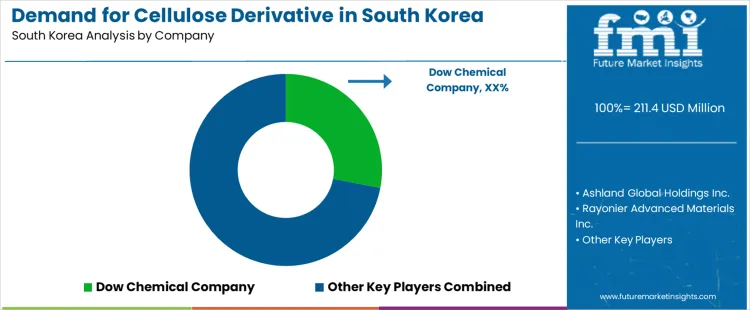
Competitive positioning in South Korea’s cellulose derivative market is shaped by formulation quality, application breadth, and consistency in supply. Dow Chemical Company, the leading player, maintains an advantage through high-purity cellulose ethers used across pharmaceuticals, personal care, construction additives, and food formulations.
Their portfolio is built around performance stability, controlled viscosities, and reliable dispersion behavior, which remain key purchase criteria for South Korean end users. Ashland Global Holdings Inc. competes with a strong focus on cellulose-based excipients and specialty polymers used in oral solid dosage forms and personal care formulations. Their position is reinforced by application-specific grades tailored to binder, thickening, and film-forming requirements. Rayonier Advanced Materials Inc. strengthens its role through cellulose specialties designed for coatings, filtration, and industrial uses, appealing to manufacturers who prioritize uniformity and compliance with technical standards.
The competitive environment deepens as CP Kelco and Celanese Corporation focus on differentiated functional properties and targeted end-use benefits. CP Kelco leverages its expertise in food and beverage hydrocolloids, supplying cellulose derivatives with tailored rheology profiles suitable for South Korean beverage, dairy, and processed-food producers.
Celanese Corporation centers its strategy on industrial and construction applications, offering performance-driven cellulose solutions with stable viscosity and thermal resistance. Across all players, product brochures remain the primary communication tool, presenting technical specifications, application guidance, compatibility ranges, and performance data. These materials allow manufacturers to assess grades efficiently, compare functional behavior, and align purchases with specific formulation or processing needs.
Key Players of the Demand for Cellulose Derivative in South Korea
- Dow Chemical Company
- Ashland Global Holdings Inc.
- Rayonier Advanced Materials Inc.
- CP Kelco
- Celanese Corporation
Scope of the Report
| Items | Values |
|---|---|
| Quantitative Units (2026) | USD Million |
| Form | Powder, Granules or Pellets, Aqueous Solutions, Emulsions or Dispersions, Other (specialty preparations, gels) |
| Derivative Type | Methyl, Carboxymethyl, Hydroxyethyl, Ethyl, Others |
| End Use | Pharmaceutical Industry, Food Industry, Personal Care, Construction, Paint Industry, Others |
| Companies | Dow Chemical Company, Ashland Global Holdings Inc., Rayonier Advanced Materials Inc., CP Kelco, Celanese Corporation |
| Region Covered | South Korea |
| Provinces Covered | South Gyeongsang, North Jeolla, South Jeolla, Jeju |
| Additional Attributes | Dollar sales by form, derivative type, and end use. Demand reflects rising use in pharmaceuticals, food stabilizers, and construction additives, with functional performance, viscosity control, and formulation flexibility shaping adoption across industrial applications. |
Demand for Cellulose Derivative in South Korea
By Form:
- Powder
- Granules or Pellets
- Aqueous Solutions
- Emulsions or Dispersions
- Other (Specialty Preps, Gels)
By Derivative Type:
- Methyl
- Carboxymethyl
- Hydroxyethyl
- Ethyl
- Others
By End Use:
- Pharmaceutical Industry
- Food Industry
- Personal Care
- Construction
- Paint Industry
- Others
By Provinces:
- South Gyeongsang
- North Jeolla
- South Jeolla
- Jeju
Bibliography
- Codex Alimentarius Commission. (2024). General standard for food additives (CXS 192-1995): GSFA online database (updated version). FAO/WHO.
- Korea International Trade Association. (2025). Export & import trends for 2024 & December 2024. Korea International Trade Association.
- Ministry of Food and Drug Safety (Republic of Korea). (2024). Korean pharmacopoeia (Twelfth Edition). Government of the Republic of Korea.
Frequently Asked Questions
How big is the demand for cellulose derivative in south korea in 2026?
The demand for cellulose derivative in south korea is estimated to be valued at USD 211.4 million in 2026.
What will be the size of cellulose derivative in south korea in 2036?
The market size for the cellulose derivative in south korea is projected to reach USD 348.6 million by 2036.
How much will be the demand for cellulose derivative in south korea growth between 2026 and 2036?
The demand for cellulose derivative in south korea is expected to grow at a 5.1% CAGR between 2026 and 2036.
What are the key product types in the cellulose derivative in south korea?
The key product types in cellulose derivative in south korea are powder, granules or pellets, aqueous solutions, emulsions or dispersions and other (specialty preps, gels).
Which derivative type segment is expected to contribute significant share in the cellulose derivative in south korea in 2026?
In terms of derivative type, methyl segment is expected to command 30.0% share in the cellulose derivative in south korea in 2026.
Preview the report firsthand - request a free sample
Get SampleGet the brochure for pricing and purchase details.
Get PDFTable of Content
- Executive Summary
- South Korea Market Outlook
- Demand-side Trends
- Supply-side Trends
- Technology Roadmap Analysis
- Analysis and Recommendations
- Market Overview
- Market Coverage / Taxonomy
- Market Definition / Scope / Limitations
- Market Background
- Market Dynamics
- Drivers
- Restraints
- Opportunity
- Trends
- Scenario Forecast
- Demand in Optimistic Scenario
- Demand in Likely Scenario
- Demand in Conservative Scenario
- Opportunity Map Analysis
- Product Life Cycle Analysis
- Supply Chain Analysis
- Investment Feasibility Matrix
- Value Chain Analysis
- PESTLE and Porter’s Analysis
- Regulatory Landscape
- Regional Parent Market Outlook
- Production and Consumption Statistics
- Import and Export Statistics
- Market Dynamics
- South Korea Market Analysis 2021 to 2025 and Forecast, 2026 to 2036
- Historical Market Size Value (USD Million) Analysis, 2021 to 2025
- Current and Future Market Size Value (USD Million) Projections, 2026 to 2036
- Y-o-Y Growth Trend Analysis
- Absolute $ Opportunity Analysis
- South Korea Market Pricing Analysis 2021 to 2025 and Forecast 2026 to 2036
- South Korea Market Analysis 2021 to 2025 and Forecast 2026 to 2036, By Form
- Introduction / Key Findings
- Historical Market Size Value (USD Million) Analysis By Form , 2021 to 2025
- Current and Future Market Size Value (USD Million) Analysis and Forecast By Form , 2026 to 2036
- Powder
- Granules or Pellets
- Aqueous solutions
- Emulsions or dispersions
- Other (specialty preps, gels)
- Powder
- Y-o-Y Growth Trend Analysis By Form , 2021 to 2025
- Absolute $ Opportunity Analysis By Form , 2026 to 2036
- South Korea Market Analysis 2021 to 2025 and Forecast 2026 to 2036, By Derivative Type
- Introduction / Key Findings
- Historical Market Size Value (USD Million) Analysis By Derivative Type, 2021 to 2025
- Current and Future Market Size Value (USD Million) Analysis and Forecast By Derivative Type, 2026 to 2036
- Methyl
- Carboxymethyl
- Hydroxyethyl
- Ethyl
- Others
- Methyl
- Y-o-Y Growth Trend Analysis By Derivative Type, 2021 to 2025
- Absolute $ Opportunity Analysis By Derivative Type, 2026 to 2036
- South Korea Market Analysis 2021 to 2025 and Forecast 2026 to 2036, By End Use
- Introduction / Key Findings
- Historical Market Size Value (USD Million) Analysis By End Use, 2021 to 2025
- Current and Future Market Size Value (USD Million) Analysis and Forecast By End Use, 2026 to 2036
- Pharmaceutical Industry
- Food Industry
- Personal Care
- Construction
- Paint Industry
- Others
- Pharmaceutical Industry
- Y-o-Y Growth Trend Analysis By End Use, 2021 to 2025
- Absolute $ Opportunity Analysis By End Use, 2026 to 2036
- Market Structure Analysis
- Competition Dashboard
- Competition Benchmarking
- Market Share Analysis of Top Players
- By Regional
- By Form
- By Derivative Type
- By End Use
- Competition Analysis
- Competition Deep Dive
- Dow Chemical Company
- Overview
- Product Portfolio
- Profitability by Market Segments (Product/Age /Sales Channel/Region)
- Sales Footprint
- Strategy Overview
- Marketing Strategy
- Product Strategy
- Channel Strategy
- Ashland Global Holdings Inc.
- Rayonier Advanced Materials Inc.
- CP Kelco
- Celanese Corporation
- Dow Chemical Company
- Competition Deep Dive
- Assumptions & Acronyms Used
- Research Methodology


