

- Market Size (2026)
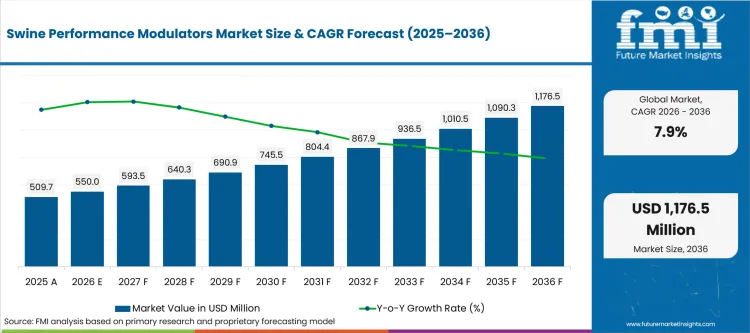
- USD 550.0 million
- Forecast (2036)
- USD 1176.5 million
- CAGR (2026 to 2036)
- 7.9%
How big is the Swine Performance Modulators Market in 2026?
USD 550.0 million in 2026 and USD 1,176.5 million by 2036 at a 7.9% CAGR.
Swine Performance Modulators Market demand is tied to feed economics and animal-performance decisions that buyers need to defend internally. Buyer groups such as feed mills, integrators and farmers are paying closer attention to feed cost and species performance. Processors and formulation teams remain part of the same procurement check. Formulation consistency and supplier proof also affect supplier qualification. Poor product fit can still create waste, delay or approval risk. The purchase case is easier to defend when the market is tied to gain-to-feed consistency and grower-finisher economics. Public livestock and feed data can anchor the demand base, but buyers still need evidence that the product works in their own program. The senior-buyer test is gain-to-feed consistency and grower-finisher economics. Procurement teams need product evidence, local service ownership, and proof that the product can work inside the buyer's current feed program.
| Metric | Value |
|---|---|
| 2025 Market Size | USD 509.7 million |
| 2026 Market Size | USD 550.0 million |
| 2036 Market Size | USD 1,176.5 million |
| Forecast CAGR (2026-2036) | 7.9% |
| Livestock Focus | Swine |
| Swine Share (2026) | 46.0% |
| Form Focus | Dry |
| Dry Share (2026) | 38.6% |
| Source Focus | Synthetic |
| Synthetic Share (2026) | 32.1% |
Summary of the Swine Performance Modulators Market
| Market Signal | Commercial Impact |
|---|---|
| Demand and Growth Drivers | Demand is expected to remain driven by the need to improve swine growth performance, feed efficiency, and commercial production economics, with buyers prioritizing solutions that deliver measurable gain-to-feed consistency.
|
| Product and Segment View | Swine, Dry formulations, and Synthetic sources are estimated to lead their respective categories in 2026 as commercial producers prioritize operational efficiency and consistent nutritional performance.
|
| Geography and Growth Outlook | Regional growth is projected to depend on livestock production intensity, feed economics, supplier support, and the ability to demonstrate measurable commercial performance.
|
| Competitive Landscape | Competition is anticipated to focus on product performance, technical documentation, channel strength, and post-sale support that helps suppliers move beyond trial-stage adoption.
|
| Analyst Perspective | Commercial success is expected to depend on buyer qualification, segment-specific performance, and the ability of suppliers to provide reliable technical support after initial product approval.
|
How is the Swine Performance Modulators Market segmented?
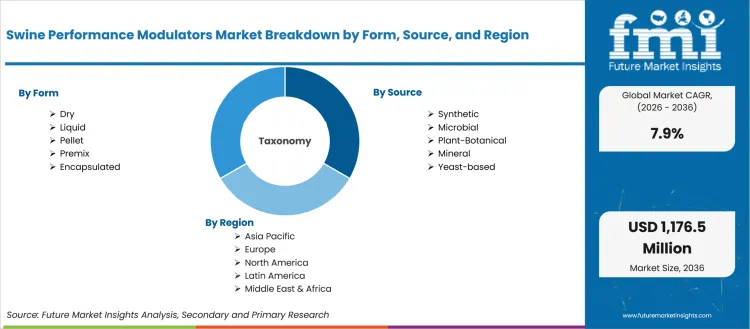
The Swine Performance Modulators Market industry is segmented by Form, Source and Livestock; Function and Region complete the forecast structure.
In Swine Performance Modulators Market, segmentation starts with Form, Source and Livestock. Function and Region then show where use case, channel role, and geography change the buying case. Shares stay in the segment questions, so this view stays focused on how the market is organized.
How does Swine influence buying within Livestock?
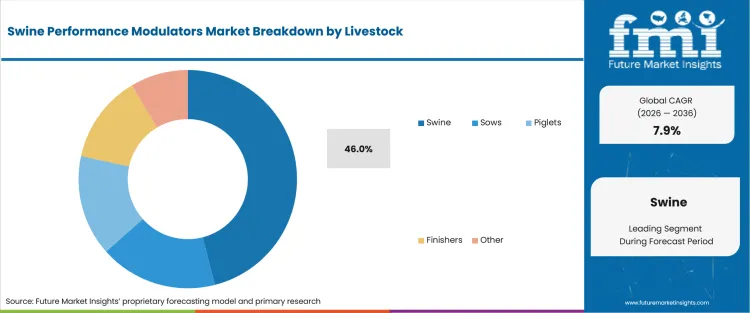
In Swine Performance Modulators Market, Swine creates value within Livestock only when it fits buyer economics and daily operating routines. Procurement usually depends on production stage and supplier support after approval.
- Swine represents 46% of Livestock in 2026, equal to USD 253.0 million. The segment rises from USD 234.5 million in 2025 to USD 541.2 million by 2036. The number matters when the product fits the buyer group's operating economics.
- The Swine Performance Modulators Market buying test is tied to operating economics. Suppliers need to show how gain-to-feed consistency and grower-finisher economics fits the buyer group before procurement expands orders.
Where does Dry create value in the Form category?
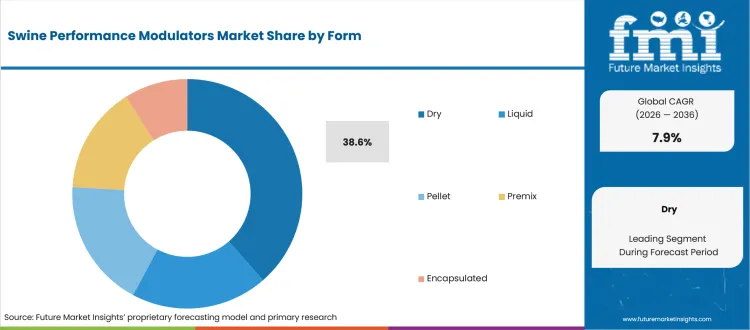
Dry should be read as a handling and usage choice within Form. Buyers look at storage, blending needs and repeat-order routines before treating the share as a procurement priority.
- At USD 212.3 million in 2026, Dry holds 38.6% of Form. The value moves from USD 196.8 million in 2025 to USD 454.1 million by 2036. The share matters when the format fits dosing routines and repeat use.
- Management teams should test whether the format reduces work for users. A supplier that cannot support storage or dosing questions will struggle beyond trial orders.
What keeps Synthetic relevant within Source?
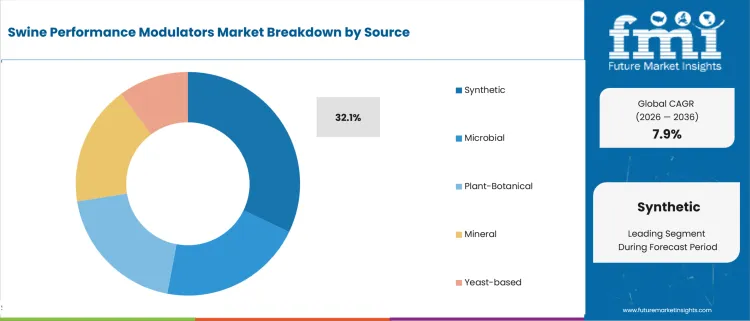
Synthetic matters within Source because origin affects approval comfort and supply continuity. Buyers use this lens to judge whether the sourcing route can stay consistent after qualification.
- Synthetic contributes USD 176.6 million in 2026, or 32.1% of Source, after a 2025 base of USD 163.6 million. By 2036, the segment is projected at USD 377.7 million. Procurement teams still need to test source reliability before wider use.
- Procurement should check consistency before Swine Performance Modulators Market volume expands. Source choice becomes risky when it weakens gain-to-feed consistency and grower-finisher economics.
How should buyers read Swine Performance Modulators Market demand within function?
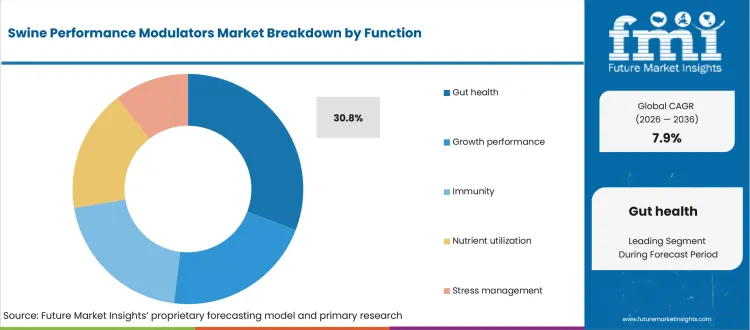
Swine Performance Modulators Market demand within function is tied to gain-to-feed consistency and grower-finisher economics. Buyers need a defined use case before spend moves beyond trial or limited use.
- Gut health accounts for 30.8% of Function in 2026. Its value increases from USD 157.0 million in 2025 to USD 169.4 million in 2026. By 2036, the value is projected at USD 362.3 million. The number becomes useful when the function is tied to a defined use case.
- The decision should be tied to proof in Swine Performance Modulators Market. Suppliers gain ground when trial support shows how gain-to-feed consistency and grower-finisher economics changes the buyer's operating result.
Why is North America still important in Region?
North America should be read through local Swine Performance Modulators Market buying conditions. Service access and buyer maturity matter when gain-to-feed consistency and grower-finisher economics decides repeat orders.
- North America in Swine Performance Modulators Market stands at USD 150.2 million in 2026, equal to 27.3% of Region. It moves from USD 139.1 million in 2025 to USD 321.2 million by 2036. Swine Performance Modulators Market regional value depends on local service access and channel coverage.
- Management teams should test whether the segment changes Swine Performance Modulators Market risk or cost. Share alone is weak guidance unless it connects to gain-to-feed consistency and grower-finisher economics.
What factors shape the Swine Performance Modulators Market?
Swine Performance Modulators Market purchases are being shaped by ration economics, animal-performance proof, and supplier support after field trials.
- Driver: gain-to-feed consistency and grower-finisher economics. Demand strengthens when buyers can connect the purchase to a measurable operating, formulation, compliance; or cost outcome in Swine Performance Modulators Market.
- Restraint: proof burden and implementation risk. Adoption slows when Swine Performance Modulators Market buyers cannot validate gain-to-feed consistency and grower-finisher economics under their own operating conditions.
- Opportunity: supplier programs built around gain-to-feed consistency and grower-finisher economics. The better opening is with vendors that make approval easier through field support, clear proof, and repeatable execution.
Swine Performance Modulators Market demand is strongest where the product changes feed-program economics in a way the buyer can measure. Nutrition teams need proof that the product affects feed conversion, animal health, waste; or output consistency before it becomes part of a recurring ration decision.
The pressure in Swine Performance Modulators Market is visible when procurement compares technical files with service coverage. Buyers need proof that gain-to-feed consistency and grower-finisher economics will hold after supplier change.
The friction in Swine Performance Modulators Market appears after approval when ownership is unclear. Suppliers that define support responsibility early can protect gain-to-feed consistency and grower-finisher economics and compete despite unit-price pressure.
Which country CAGRs are profiled in the Swine Performance Modulators Market?
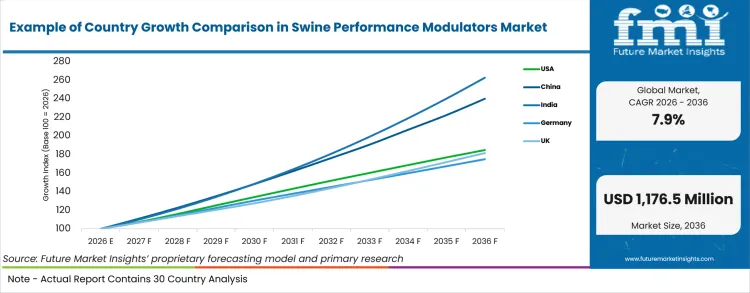
| Country | CAGR |
|---|---|
| United States | 6.34% |
| China | 9.14% |
| India | 10.14% |
| Germany | 5.74% |
| United Kingdom | 6.14% |
| Japan | 5.74% |
| South Korea | 7.34% |
| Rest of World | 8.54% |
How do country-level CAGRs compare in the Swine Performance Modulators Market?
Swine Performance Modulators Market country growth differs by livestock scale, feed-cost exposure, and how quickly buyers formalize ration decisions. Mature markets place more weight on consultant-led proof. Faster-growth markets still need price discipline and local field support before buyers move beyond limited trials.
- United States rises from USD 101.9 million in 2025 to USD 110.0 million in 2026. By 2036, it is projected at USD 203.5 million at a 6.34% CAGR. United States buyers treat Swine Performance Modulators Market as a gain-to-feed consistency and grower-finisher economics decision. Approval usually needs measurable operating proof before volume moves from existing suppliers.
- For Swine Performance Modulators Market, China moves from USD 91.75 million in 2025 to USD 99.00 million in 2026. The 2036 value is USD 237.4 million, supported by an 9.14% CAGR. China's buying condition is scale plus execution discipline in Swine Performance Modulators Market. Suppliers need availability, channel control, and proof that gain-to-feed consistency and grower-finisher economics can hold across fast-ramping accounts.
- For Swine Performance Modulators Market, India is estimated at USD 50.97 million in 2025 and USD 55.00 million in 2026. It is projected at USD 144.5 million by 2036, with a 10.14% CAGR. India demand is tied to formal procurement and wider production activity in Swine Performance Modulators Market. Cost remains a hard filter, so suppliers need a price case that still supports gain-to-feed consistency and grower-finisher economics.
- Germany stands at USD 40.78 million in 2025 and USD 44.00 million in 2026. By 2036, the value is projected at USD 76.92 million at a 5.74% CAGR. Germany is qualification-led for Swine Performance Modulators Market. Technical review focuses on whether gain-to-feed consistency and grower-finisher economics can be proven before commercial negotiation.
- United Kingdom rises from USD 25.48 million in 2025 to USD 27.50 million in 2026. By 2036, it is projected at USD 49.92 million at a 6.14% CAGR. United Kingdom buyers in Swine Performance Modulators Market place more weight on vendor accountability and delivery reliability. Switching costs rise when gain-to-feed consistency and grower-finisher economics is not supported after purchase.
- Japan moves from USD 30.58 million in 2025 to USD 33.00 million in 2026. The 2036 value is USD 57.69 million, supported by an 5.74% CAGR. Japan's approval cycle for Swine Performance Modulators Market favors suppliers that reduce inspection work and keep gain-to-feed consistency and grower-finisher economics consistent across repeat orders.
- South Korea is estimated at USD 20.39 million in 2025 and USD 22.00 million in 2026. It is projected at USD 44.68 million by 2036, with a 7.34% CAGR. South Korea's compact supply chains make Swine Performance Modulators Market feedback fast. Suppliers need responsive support because weak execution on gain-to-feed consistency and grower-finisher economics can affect production schedules.
- Rest of World stands at USD 147.8 million in 2025 and USD 159.5 million in 2026. By 2036, the value is projected at USD 362.0 million at a 8.54% CAGR. Rest of World demand for Swine Performance Modulators Market is uneven. Local service access and import reliability matter where buyers need help proving gain-to-feed consistency and grower-finisher economics without mature support networks.
Who are the notable companies in the Swine Performance Modulators Market?
dsm-firmenich; Cargill; ADM; Evonik; Adisseo; Alltech; Novonesis; Kemin Industries; Lallemand Animal Nutrition; Nutreco and Phibro Animal Health are the notable companies assessed in this market.
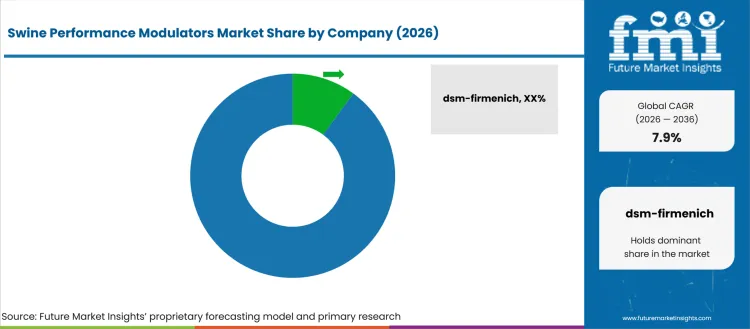
Swine Performance Modulators Market competition is strongest where suppliers can connect nutrition science with farm-level economics. Buyers compare who can help nutritionists prove feed conversion, health, or output benefits without disrupting the approved ration program.
- Swine Performance Modulators Market global feed additive suppliers such as dsm-firmenich, Cargill, ADM and Evonik are strongest when buyers need scale and accountable technical files. Procurement teams use them when approval requires a clear escalation route before wider use.
- Swine Performance Modulators Market specialty nutrition and biosolutions suppliers such as Adisseo, Alltech, Novonesis and Kemin Industries are useful when the purchase depends on technical fit. Buyers rely on them when a standard catalogue answer is not enough for approval.
- Swine Performance Modulators Market animal health and regional support suppliers such as Lallemand Animal Nutrition, Nutreco and Phibro Animal Health matter when buyers need local support and order continuity. They help when field issues must be resolved close to the operating site.
Competitive Benchmarking: Swine Performance Modulators Market
| Company | Application Fit | Technical Support | Channel Reach | Geographic Footprint |
|---|---|---|---|---|
| dsm-firmenich | High | High | Strong | Global |
| Cargill | High | Medium | Strong | Global |
| ADM | Strong | High | Medium | Global or regional |
| Evonik | Medium | High | Medium | Regional |
| Adisseo | Strong | Medium | Medium | Regional or global |
| Alltech | High | High | Strong | Global |
| Novonesis | High | Medium | Strong | Global |
| Kemin Industries | Strong | High | Medium | Global or regional |
| Lallemand Animal Nutrition | Medium | High | Medium | Regional |
| Nutreco | Strong | Medium | Medium | Regional or global |
Source: Future Market Insights competitive analysis, 2026. Ratings for Swine Performance Modulators Market reflect ration-fit support, livestock application depth, feed-channel reach; service accountability; and supplier relevance to recurring feed-program decisions.
Key Players in the Swine Performance Modulators Market
Global feed additive suppliers
- dsm-firmenich
- Cargill
- ADM
- Evonik
Specialty nutrition and biosolutions suppliers
- Adisseo
- Alltech
- Novonesis
- Kemin Industries
Animal health and regional support suppliers
- Lallemand Animal Nutrition
- Nutreco
- Phibro Animal Health
Swine Performance Modulators Market - Report Scope
| Coverage field | Report scope |
|---|---|
| Market breakdown | Swine Performance Modulators Market Breakdown By Form, Source and Livestock; Function and Region |
| Market Definition | Commercial demand for products; services covered under Swine Performance Modulators Market; including country demand; segment demand; and supplier-selection context |
| Regions Covered | North America; Latin America; Europe; East Asia; South Asia and Pacific; Middle East and Africa |
| Countries Covered | United States; United Kingdom; Germany; France; Japan; China; South Korea; India; and 30+ countries |
| Key Companies Profiled | dsm-firmenich; Cargill; ADM; Evonik; Adisseo; Alltech; Novonesis; Kemin Industries; Lallemand Animal Nutrition; Nutreco; and Phibro Animal Health |
| Forecast Period | 2026 to 2036 |
| Approach | Swine Performance Modulators Market: Feed-program demand, livestock category allocation, country production context; and supplier relevance to animal nutrition were used to build the sizing approach. |
Swine Performance Modulators Market - Research Methodology
| Method | Approach |
|---|---|
| Primary Research | FMI analysts reviewed Swine Performance Modulators Market inputs from feed mills; integrators; farmers; processors; and formulation teams. Discussions focused on procurement need and specification fit. Service expectations and adoption barriers were also reviewed. |
| Desk Research | FAOSTAT; FAO Livestock Systems; USDA ERS Feed Grains Database; official company sources |
| Market Sizing and Forecasting | The Swine Performance Modulators Market estimate combines global value, livestock and form shares, country demand allocation; and feed-program use cases. Forecast assumptions are checked against feed-cost pressure, species productivity needs, supplier service depth; and country adoption maturity. |
| Data Validation | Swine Performance Modulators Market values are checked across Form, Livestock, Source; Function; and country totals. Company relevance is reviewed against animal-nutrition fit and service reach, not generic supplier presence. |
Swine Performance Modulators Market by Segments
Swine Performance Modulators Market segmented by Form:
- Dry
- Liquid
- Pellet
- Premix
- Encapsulated
Swine Performance Modulators Market segmented by Source:
- Synthetic
- Microbial
- Plant/Botanical
- Mineral
- Yeast-based
Swine Performance Modulators Market segmented by Livestock:
- Swine
- Sows
- Piglets
- Finishers
- Other swine
Swine Performance Modulators Market segmented by Function:
- Gut health
- Growth performance
- Immunity
- Nutrient utilization
- Stress management
Swine Performance Modulators Market segmented by Region:
- North America
- Europe
- East Asia
- South Asia
- Latin America
Research Sources and Bibliography
Secondary validation for Swine Performance Modulators Market uses animal population data, feed input data, trade exposure and animal-health context together. FAO and USDA data help frame the demand base, OECD and trade data test whether the growth path is plausible, and WOAH context keeps animal-health claims from becoming too broad.
- 1. FAOSTAT.
- 2. FAO Livestock Systems.
- 3. USDA ERS Feed Grains Database.
- 4. USDA FAS Production, Supply and Distribution.
- 5. OECD-FAO Agricultural Outlook.
- 6. WOAH World Animal Health Information System.
- 7. UN Comtrade.
- 8. dsm-firmenich.
- 9. Cargill.
- 10. ADM.
- 11. Evonik.
- 12. Adisseo.
- 13. Alltech.
- 14. Novonesis.
This Report Answers
- What value is forecast for the Swine Performance Modulators Market in 2026 and by 2036?
- What CAGR is forecast for the Swine Performance Modulators Market during the 2026 to 2036 period?
- Which segment groups are used to assess demand across Swine Performance Modulators Market?
- Which buyer problems are creating procurement interest in Swine Performance Modulators Market?
- How do the main segment shares shape Swine Performance Modulators Market decisions in the 2026 base?
- Which countries are profiled in the Swine Performance Modulators Market forecast and how do their CAGRs differ?
- Which companies are assessed in this market?
- What should Swine Performance Modulators Market buyers evaluate before changing suppliers?
- How does FMI size and validate Swine Performance Modulators Market country and segment demand?
- What risks could delay Swine Performance Modulators Market adoption, qualification, or repeat purchasing?
Frequently Asked Questions
Why should executives track the Swine Performance Modulators Market?
Executives should track Swine Performance Modulators Market because gain-to-feed consistency and grower-finisher economics affects procurement risk and operating performance. The value is in knowing where the purchase can reduce cost, avoid disruption, or improve buyer confidence.
What business problem does the Swine Performance Modulators Market address?
Swine Performance Modulators Market addresses gain-to-feed consistency and grower-finisher economics. Buyers use the category when routine procurement cannot defend feed-program performance or supplier accountability.
What should Swine Performance Modulators Market procurement leaders evaluate before selecting suppliers?
Swine Performance Modulators Market procurement leaders should test product fit against ration economics, trial design, local service support; and repeat-batch consistency. A low unit price is weak if the supplier cannot help the farm or feed mill defend the result.
What can limit return on investment for buyers?
Swine Performance Modulators Market payback depends on whether the product changes feed conversion, health outcomes, waste; or output consistency under real operating conditions. Buyers reduce risk by setting herd-stage controls and trial metrics before wider rollout.
How can suppliers build executive confidence?
Swine Performance Modulators Market suppliers build confidence when they can explain how the product performs in the buyer's ration program and stay accountable after approval. Field support, delivery consistency, and nutrition guidance matter after the first order.
Preview the report firsthand - request a free sample
Get SampleGet the brochure for pricing and purchase details.
Get PDFTable of Content
- Key Takeaways
- Market Size and CAGR
- Top Growth Driver
- Fastest Growing Segment
- Leading Region
- Key Companies
- Emerging Opportunities
- Executive Summary
- Global Market Outlook
- Demand-side Trends
- Supply-side Trends
- Technology Roadmap Analysis
- Analysis and Recommendations
- Analyst Perspective (What is happening? Why now? What should investors know?)
- Key Questions Answered
- How large is the market?
- What is the CAGR?
- What are key trends?
- Which region dominates?
- Who are the leaders?
- Market Overview
- Market Coverage / Taxonomy
- Market Definition / Scope / Limitations
- Research Methodology
- Chapter Orientation
- Analytical Lens and Working Hypotheses
- Market Structure, Signals, and Trend Drivers
- Benchmarking and Cross-market Comparability
- Market Sizing, Forecasting, and Opportunity Mapping
- Research Design and Evidence Framework
- Desk Research Programme (Secondary Evidence)
- Expert Input and Fieldwork (Primary Evidence)
- Tooling, Models, and Reference Databases
- Data Engineering and Model Build
- Quality Assurance and Audit Trail
- Market Background
- Market Dynamics (Drivers, Restraints, Opportunity, Trends)
- Scenario Forecast (Optimistic, Likely, Conservative)
- Impact Analysis
- AI Impact
- Sustainability Impact
- Regulatory Impact
- Technology Impact
- Consumer / Buyer Analysis
- Purchase Drivers
- Adoption Barriers
- Buyer Journey
- Opportunity Map Analysis
- Product Life Cycle Analysis
- Supply Chain Analysis
- Investment Feasibility Matrix
- Value Chain Analysis
- PESTLE and Porter's Analysis
- Regulatory Landscape
- Regional Parent Market Outlook
- Production and Consumption Statistics
- Import and Export Statistics
- Global Market Analysis and Forecast, 2021 to 2036
- Historical Market Size Value (USD Million) Analysis, 2021 to 2025
- Current and Future Market Size Value (USD Million) Projections, 2026 to 2036
- Y-o-Y Growth Trend Analysis
- Absolute $ Opportunity Analysis
- Global Market Pricing Analysis, 2021 to 2036
- Global Market Analysis and Forecast, By Form, 2021 to 2036
- Introduction / Key Findings
- Historical Market Size Value (USD Million) Analysis By Form, 2021 to 2025
- Current and Future Market Size Value (USD Million) Analysis and Forecast By Form, 2026 to 2036
- Dry
- Liquid
- Pellet
- Premix
- Encapsulated
- Dry
- Y-o-Y Growth Trend Analysis By Form, 2021 to 2025
- Absolute $ Opportunity Analysis By Form, 2026 to 2036
- Global Market Analysis and Forecast, By Source, 2021 to 2036
- Introduction / Key Findings
- Historical Market Size Value (USD Million) Analysis By Source, 2021 to 2025
- Current and Future Market Size Value (USD Million) Analysis and Forecast By Source, 2026 to 2036
- Synthetic
- Microbial
- Plant-Botanical
- Mineral
- Yeast-based
- Synthetic
- Y-o-Y Growth Trend Analysis By Source, 2021 to 2025
- Absolute $ Opportunity Analysis By Source, 2026 to 2036
- Global Market Analysis and Forecast, By Livestock, 2021 to 2036
- Introduction / Key Findings
- Historical Market Size Value (USD Million) Analysis By Livestock, 2021 to 2025
- Current and Future Market Size Value (USD Million) Analysis and Forecast By Livestock, 2026 to 2036
- Swine
- Sows
- Piglets
- Finishers
- Other
- Swine
- Y-o-Y Growth Trend Analysis By Livestock, 2021 to 2025
- Absolute $ Opportunity Analysis By Livestock, 2026 to 2036
- Global Market Analysis and Forecast, By Function, 2021 to 2036
- Introduction / Key Findings
- Historical Market Size Value (USD Million) Analysis By Function, 2021 to 2025
- Current and Future Market Size Value (USD Million) Analysis and Forecast By Function, 2026 to 2036
- Gut health
- Growth performance
- Immunity
- Nutrient utilization
- Stress management
- Gut health
- Y-o-Y Growth Trend Analysis By Function, 2021 to 2025
- Absolute $ Opportunity Analysis By Function, 2026 to 2036
- Global Market Analysis and Forecast, By Region, 2021 to 2036
- Introduction
- Historical Market Size Value (USD Million) Analysis By Region, 2021 to 2025
- Current Market Size Value (USD Million) Analysis and Forecast By Region, 2026 to 2036
- North America
- Latin America
- Western Europe
- Eastern Europe
- East Asia
- South Asia and Pacific
- Middle East & Africa
- Market Attractiveness Analysis By Region
- North America Market Analysis and Forecast, By Country, 2021 to 2036
- Historical Market Size Value (USD Million) Trend Analysis By Market Taxonomy, 2021 to 2025
- Market Size Value (USD Million) Forecast By Market Taxonomy, 2026 to 2036
- By Country
- USA
- Canada
- By Form
- By Source
- By Livestock
- By Function
- By Country
- Market Attractiveness Analysis
- By Country
- By Form
- By Source
- By Livestock
- By Function
- Key Takeaways
- Latin America Market Analysis and Forecast, By Country
- Historical Market Size Value (USD Million) Trend Analysis By Market Taxonomy, 2021 to 2025
- Market Size Value (USD Million) Forecast By Market Taxonomy, 2026 to 2036
- By Country
- Brazil
- Mexico
- Chile
- Rest of Latin America
- By Form
- By Source
- By Livestock
- By Function
- By Country
- Market Attractiveness Analysis
- By Country
- By Form
- By Source
- By Livestock
- By Function
- Key Takeaways
- Western Europe Market Analysis and Forecast, By Country
- Historical Market Size Value (USD Million) Trend Analysis By Market Taxonomy, 2021 to 2025
- Market Size Value (USD Million) Forecast By Market Taxonomy, 2026 to 2036
- By Country
- Germany
- UK
- Italy
- Spain
- France
- Nordic
- BENELUX
- Rest of Western Europe
- By Form
- By Source
- By Livestock
- By Function
- By Country
- Market Attractiveness Analysis
- By Country
- By Form
- By Source
- By Livestock
- By Function
- Key Takeaways
- Eastern Europe Market Analysis and Forecast, By Country
- Historical Market Size Value (USD Million) Trend Analysis By Market Taxonomy, 2021 to 2025
- Market Size Value (USD Million) Forecast By Market Taxonomy, 2026 to 2036
- By Country
- Russia
- Poland
- Hungary
- Balkan & Baltic
- Rest of Eastern Europe
- By Form
- By Source
- By Livestock
- By Function
- By Country
- Market Attractiveness Analysis
- By Country
- By Form
- By Source
- By Livestock
- By Function
- Key Takeaways
- East Asia Market Analysis and Forecast, By Country
- Historical Market Size Value (USD Million) Trend Analysis By Market Taxonomy, 2021 to 2025
- Market Size Value (USD Million) Forecast By Market Taxonomy, 2026 to 2036
- By Country
- China
- Japan
- South Korea
- By Form
- By Source
- By Livestock
- By Function
- By Country
- Market Attractiveness Analysis
- By Country
- By Form
- By Source
- By Livestock
- By Function
- Key Takeaways
- South Asia and Pacific Market Analysis and Forecast, By Country
- Historical Market Size Value (USD Million) Trend Analysis By Market Taxonomy, 2021 to 2025
- Market Size Value (USD Million) Forecast By Market Taxonomy, 2026 to 2036
- By Country
- India
- ASEAN
- Australia & New Zealand
- Rest of South Asia and Pacific
- By Form
- By Source
- By Livestock
- By Function
- By Country
- Market Attractiveness Analysis
- By Country
- By Form
- By Source
- By Livestock
- By Function
- Key Takeaways
- Middle East & Africa Market Analysis and Forecast, By Country
- Historical Market Size Value (USD Million) Trend Analysis By Market Taxonomy, 2021 to 2025
- Market Size Value (USD Million) Forecast By Market Taxonomy, 2026 to 2036
- By Country
- Kingdom of Saudi Arabia
- Other GCC Countries
- Türkiye
- South Africa
- Other African Union
- Rest of Middle East & Africa
- By Form
- By Source
- By Livestock
- By Function
- By Country
- Market Attractiveness Analysis
- By Country
- By Form
- By Source
- By Livestock
- By Function
- Key Takeaways
- Key Countries Market Analysis
- USA
- Pricing Analysis
- Market Share Analysis, 2025
- By Form
- By Source
- By Livestock
- By Function
- Canada
- Pricing Analysis
- Market Share Analysis, 2025
- By Form
- By Source
- By Livestock
- By Function
- Mexico
- Pricing Analysis
- Market Share Analysis, 2025
- By Form
- By Source
- By Livestock
- By Function
- Brazil
- Pricing Analysis
- Market Share Analysis, 2025
- By Form
- By Source
- By Livestock
- By Function
- Chile
- Pricing Analysis
- Market Share Analysis, 2025
- By Form
- By Source
- By Livestock
- By Function
- Germany
- Pricing Analysis
- Market Share Analysis, 2025
- By Form
- By Source
- By Livestock
- By Function
- UK
- Pricing Analysis
- Market Share Analysis, 2025
- By Form
- By Source
- By Livestock
- By Function
- Italy
- Pricing Analysis
- Market Share Analysis, 2025
- By Form
- By Source
- By Livestock
- By Function
- Spain
- Pricing Analysis
- Market Share Analysis, 2025
- By Form
- By Source
- By Livestock
- By Function
- France
- Pricing Analysis
- Market Share Analysis, 2025
- By Form
- By Source
- By Livestock
- By Function
- India
- Pricing Analysis
- Market Share Analysis, 2025
- By Form
- By Source
- By Livestock
- By Function
- ASEAN
- Pricing Analysis
- Market Share Analysis, 2025
- By Form
- By Source
- By Livestock
- By Function
- Australia & New Zealand
- Pricing Analysis
- Market Share Analysis, 2025
- By Form
- By Source
- By Livestock
- By Function
- China
- Pricing Analysis
- Market Share Analysis, 2025
- By Form
- By Source
- By Livestock
- By Function
- Japan
- Pricing Analysis
- Market Share Analysis, 2025
- By Form
- By Source
- By Livestock
- By Function
- South Korea
- Pricing Analysis
- Market Share Analysis, 2025
- By Form
- By Source
- By Livestock
- By Function
- Russia
- Pricing Analysis
- Market Share Analysis, 2025
- By Form
- By Source
- By Livestock
- By Function
- Poland
- Pricing Analysis
- Market Share Analysis, 2025
- By Form
- By Source
- By Livestock
- By Function
- Hungary
- Pricing Analysis
- Market Share Analysis, 2025
- By Form
- By Source
- By Livestock
- By Function
- Kingdom of Saudi Arabia
- Pricing Analysis
- Market Share Analysis, 2025
- By Form
- By Source
- By Livestock
- By Function
- Türkiye
- Pricing Analysis
- Market Share Analysis, 2025
- By Form
- By Source
- By Livestock
- By Function
- South Africa
- Pricing Analysis
- Market Share Analysis, 2025
- By Form
- By Source
- By Livestock
- By Function
- USA
- Market Structure Analysis
- Competition Dashboard
- Competition Benchmarking
- Market Share Analysis of Top Players
- By Regional
- By Form
- By Source
- By Livestock
- By Function
- Emerging Startups
- Innovation Benchmarking
- Competition Analysis
- Competition Deep Dive
- dsm-firmenich
- Overview
- Product Portfolio
- Profitability by Market Segments
- Sales Footprint
- Strategy Overview
- Marketing Strategy
- Product Strategy
- Channel Strategy
- Cargill
- ADM
- Evonik
- Adisseo
- Alltech
- Novonesis
- Kemin Industries
- Lallemand Animal Nutrition
- Nutreco
- Phibro Animal Health
- dsm-firmenich
- Case Studies
- Success Stories
- Recent Developments
- Competition Deep Dive
- Assumptions & Acronyms Used


