

- Industry Size (2026)
- USD 1190 Mn
- Forecast (2036)
- USD 2131.1 Mn
- CAGR (2026 to 2036)
- 6.0%
Transformer Insulation Pressboards Market Forecast and Outlook 2026 to 2036
The transformer insulation pressboards market is forecast to reach USD 2,131.1 million by 2036 from USD 1,190 million in 2026, expanding at a CAGR of 6.0%. Between 2026 and 2036, purchasing behavior is shaped by reliability assurance rather than price-led selection. Procurement decisions are typically governed by long qualification cycles, where insulation performance data, certification history, and field validation are prioritized. Buyer risk aversion is reinforced by the high cost of transformer failure, resulting in preference for approved suppliers with proven material consistency.
Vendor lock-in is reinforced through design-specific pressboard dimensions, oil compatibility testing, and transformer OEM approvals, limiting supplier substitution once production lines are established. Switching costs are elevated due to requalification requirements, testing expenses, and potential warranty exposure. Value is retained by suppliers embedded early in transformer design and approval stages. Procurement outcomes are influenced more by lifecycle assurance and compliance confidence than by short-term cost optimization over the forecast period.
Quick Stats for Transformer Insulation Pressboards Market
- Transformer Insulation Pressboards Market Value (2026): USD 1,190 Million
- Transformer Insulation Pressboards Market Forecast Value (2036): USD 2,131.1 Million
- Transformer Insulation Pressboards Market Forecast CAGR 2026 to 2036: 6.0%
- Leading Type of Transformer Insulation Pressboards: Laminated Pressboard (40% share)
- Leading Application in Transformer Insulation Pressboards Market: Power Transformers (50% share)
- Key Growth Regions in Transformer Insulation Pressboards Market: Asia Pacific, Europe, North America, Latin America, Middle East & Africa
- Top Key Players in Transformer Insulation Pressboards Market: Weidmann Electrical Technology AG, Ahlstrom-Munksjö Oyj, Mitsubishi Paper Mills, Ltd., DuPont de Nemours, Inc., Hitachi Energy Ltd, MGM Transformer Components Pvt. Ltd., Shandong Zhongyuan Electric Insulation Co., Ltd., Henan Special Paper Co., Ltd.
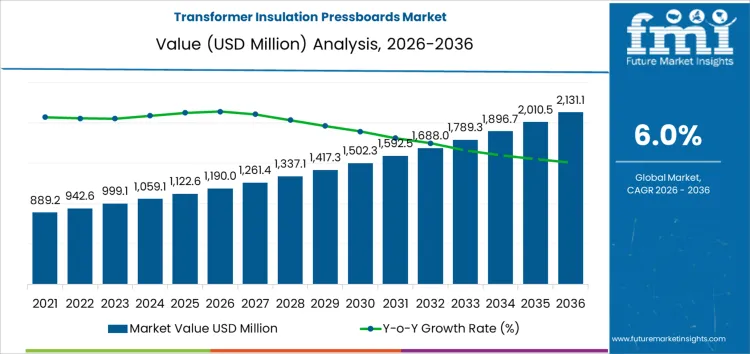
Transformer Insulation Pressboards Market Key Takeaways
| Metric | Value |
|---|---|
| Transformer Insulation Pressboards Market Value (2026) | USD 1,190 Million |
| Transformer Insulation Pressboards Market Forecast Value (2036) | USD 2,131.1 Million |
| Transformer Insulation Pressboards Market Forecast CAGR 2026 to 2036 | 6.0% |
What Factors Are Driving Demand for Transformer Insulation Pressboards?
Demand for transformer insulation pressboards is increasing due to continuous expansion and upgrading of global power infrastructure. Rising electricity consumption across residential, commercial, and industrial sectors is driving investments in new power transformers and refurbishment of existing units. Insulation pressboards are essential for maintaining dielectric integrity, mechanical strength, and thermal stability within transformers, which makes them a standard material choice for utility-scale and industrial transformer manufacturing. This steady requirement supports consistent demand across both developed and developing power markets.
Modernization of transmission and distribution networks is further strengthening market growth. Utilities are adopting higher-capacity and higher-voltage transformers to reduce transmission losses and improve grid efficiency. These advanced transformer designs require insulation materials that can withstand higher electrical stress and extended operating life. Transformer insulation pressboards offer dimensional stability, oil compatibility, and long-term reliability, making them suitable for modern grid applications. Ongoing improvements in material processing and quality control are also enhancing product performance, encouraging broader adoption.
Rapid electrification and renewable energy integration are creating additional demand opportunities. Expansion of wind and solar power generation requires reliable transformers capable of managing fluctuating loads and grid variability. Emerging economies are investing heavily in electrification, smart grids, and industrial development, leading to increased transformer installations. At the same time, stricter regulatory standards related to safety, efficiency, and durability are influencing transformer manufacturers to use high-quality insulation materials.
What Is The Segment Overview Of The Transformer Insulation Pressboards Market?
The transformer insulation pressboards market is segmented by type and application, with clear leadership observed in specific categories. By type, laminated pressboard holds the leading position, supported by its extensive use in electrical insulation and structural reinforcement within transformers. Other types in the transformer insulation pressboards market include molded pressboard, creped pressboard, and specialized variants designed for niche insulation requirements. By application, power transformers represent the dominant segment, driven by continuous investments in transmission infrastructure and grid reliability. Additional applications such as distribution transformers, HVDC transformers, rail and transportation systems, and other electrical equipment contribute to diversified demand across power and industrial sectors.
Why Does Laminated Pressboard Lead The Transformer Insulation Pressboards Market By Type?
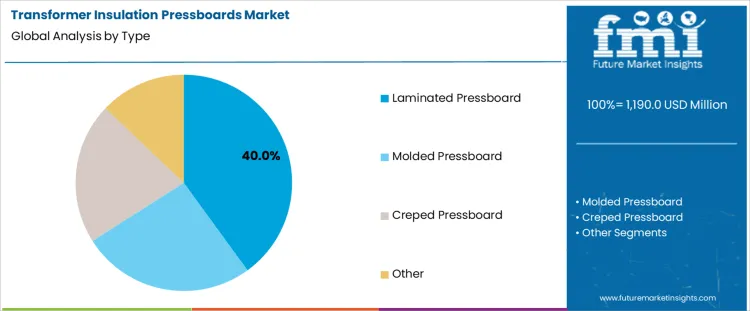
Laminated pressboard leads the transformer insulation pressboards market by type with 40% share due to its superior mechanical strength, dielectric performance, and dimensional stability. This material is widely used for spacers, barriers, and support structures inside transformers, where long-term insulation reliability is critical. Laminated pressboard withstands high thermal and electrical stress, making it suitable for both medium-voltage and high-voltage transformer designs. Its layered structure provides consistent thickness control and predictable insulation behavior during prolonged operation. Manufacturers prefer laminated pressboard because it integrates well with insulating oils and resins used in transformer assemblies. These performance advantages explain why laminated pressboard remains the most widely adopted type.
Why Do Power Transformers Dominate The Transformer Insulation Pressboards Market By Application?
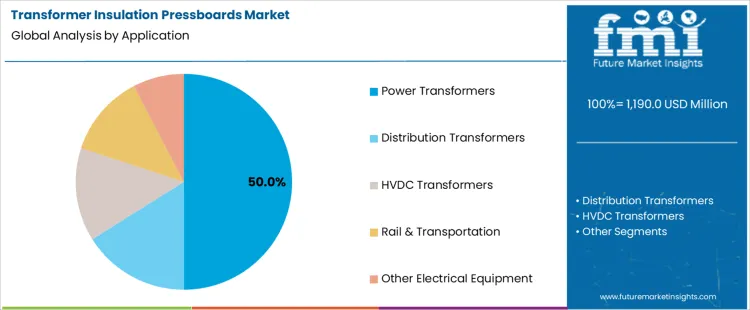
Power transformers dominate the transformer insulation pressboards market by application with 50% share because they require extensive insulation systems to manage high voltage and thermal loads. These transformers use pressboards for electrical separation, mechanical support, and oil flow control within the core and winding assembly. Expansion of transmission networks, renewable energy integration, and cross-border power interconnections increase demand for large power transformers. Insulation reliability directly influences transformer lifespan and grid stability, driving consistent consumption of high-quality pressboards. Upgrades of aging power infrastructure also support replacement demand. These factors explain why power transformers remain the largest application segment in the transformer insulation pressboards market.
What Are The Key Dynamics Of The Transformer Insulation Pressboards Market?
Transformer insulation pressboards are valued for their dielectric strength, mechanical stability, and thermal endurance under long-term operating conditions. Expansion of transmission and distribution networks, grid modernization initiatives, and replacement of aging transformers are sustaining demand. Material purity requirements, moisture resistance performance, and compliance with international electrical insulation standards influence product adoption. Supply chain stability for cellulose raw materials and manufacturing process efficiency remain critical factors shaping competitive positioning in the transformer insulation pressboards market.
Why Do Cost And Operational Constraints Challenge The Transformer Insulation Pressboards Market?
Cost and operational constraints continue to challenge growth in the transformer insulation pressboards market. Fluctuating prices of high-quality cellulose pulp directly impact manufacturing costs and pricing stability. Energy-intensive drying and impregnation processes increase production expenses. Small and mid-scale transformer manufacturers face margin pressure due to rising insulation material costs. Strict quality control requirements extend production lead times and raise rejection risks. Dependence on skilled labor for precision fabrication further adds to operational complexity. These factors collectively limit faster penetration of premium insulation pressboards across cost-sensitive transformer manufacturing segments.
What Regulatory and Performance Requirements Shape the Transformer Insulation Pressboards Market?
Regulatory and performance requirements play a critical role in shaping the transformer insulation pressboards market. Compliance with international electrical insulation standards for dielectric strength, thermal class, and moisture content is mandatory for grid-connected transformers. Utilities increasingly demand proven long-term aging performance to reduce transformer failure risks. Fire safety and environmental compliance standards are influencing material selection and manufacturing practices. Testing, certification, and documentation requirements add to supplier responsibilities. These regulatory expectations drive continuous product refinement while increasing entry barriers for new insulation pressboard manufacturers.
What Is the Country-Wise Outlook of the Transformer Insulation Pressboards Market?
Demand for transformer insulation pressboards varies by country based on power infrastructure investment, transformer manufacturing capacity, and grid modernization activity. Asia Pacific leads growth, supported by expanding electricity networks and rising transformer installations, while North America and Europe show steady replacement-led demand. China is projected to expand at a CAGR of 7.2% between 2026 and 2036, driven by large-scale grid expansion and equipment upgrades. India follows closely with a CAGR of 7.0% due to transmission and distribution capacity additions. The United States, Germany, and Japan are expected to grow at CAGRs of 5.8%, 5.4%, and 5.1%, respectively, reflecting mature but stable transformer demand environments.
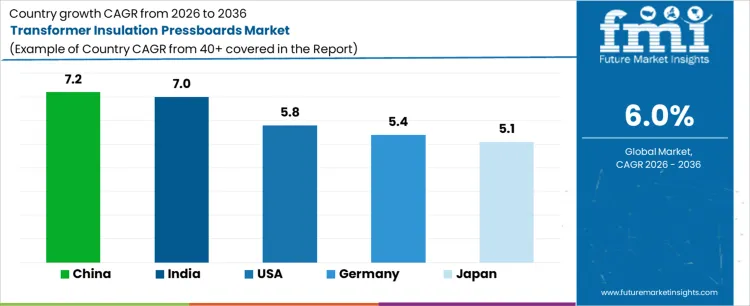
| Country | CAGR (%) |
|---|---|
| China | 7.2% |
| India | 7.0% |
| USA | 5.8% |
| Germany | 5.4% |
| Japan | 5.1% |
How Is Demand for Transformer Insulation Pressboards Shaping Growth in China?
Demand for transformer insulation pressboards in China, expanding at a CAGR of 7.2% during 2026 to 2036, is driven by large-scale power transmission and distribution infrastructure expansion. The transformer insulation pressboards market in China benefits from rising production of power and distribution transformers used across utility and industrial applications. Grid modernization programs and high-voltage transmission projects are increasing demand for high-quality electrical insulation materials. Domestic transformer manufacturers emphasize thermal stability, dielectric strength, and mechanical durability, supporting consistent pressboard adoption. Replacement of aging transformers also contributes to recurring demand. Strong local manufacturing capabilities ensure supply continuity and cost competitiveness. These factors collectively position China as the largest and fastest-expanding contributor to the transformer insulation pressboards market over the forecast period.
Why Are Sales of Transformer Insulation Pressboards Increasing in India?
Sales of transformer insulation pressboards in India, growing at a CAGR of 7.0% from 2026 to 2036, are supported by accelerated expansion of electricity transmission and distribution networks. The transformer insulation pressboards market in India is driven by new transformer installations across urban infrastructure, renewable energy integration, and rural electrification projects. Rising power consumption and grid reliability initiatives are increasing transformer procurement, strengthening insulation material demand. Domestic transformer manufacturers prioritize cost efficiency and performance reliability when sourcing insulation components. Policy support for power infrastructure investment and domestic manufacturing improves procurement visibility. The increasing presence of regional pressboard suppliers is also improving supply availability. These factors position India as a high-growth country market during the forecast period.
What Is Driving Demand for Transformer Insulation Pressboards in the USA?
Demand for transformer insulation pressboards in the USA, registering a CAGR of 5.8% between 2026 and 2036, is primarily driven by replacement of aging power transformers. The transformer insulation pressboards market in the USA is characterized by refurbishment of grid infrastructure rather than large-scale new capacity additions. Utilities focus on improving transformer reliability, thermal performance, and service life, sustaining demand for insulation materials. Investments are aligned with grid resilience programs and substation upgrades. Domestic transformer manufacturing and refurbishment facilities support steady pressboard consumption. Limited Greenfield transmission projects keep growth moderate, while consistent maintenance requirements ensure recurring demand. As a result, the USA market reflects stable, value-driven expansion.
How Does Germany Sustain Demand for Transformer Insulation Pressboards?
Demand for transformer insulation pressboards in Germany, expanding at a CAGR of 5.4% over the forecast period, is sustained by modernization of power transmission equipment and emphasis on grid efficiency. The transformer insulation pressboards market in Germany benefits from replacement demand across utility and industrial transformer segments. Manufacturers prioritize high dielectric performance, precision engineering, and compliance with stringent quality standards. Investments focus on upgrading existing transformers to support renewable energy integration and voltage stability. Export-oriented transformer production also supports insulation material demand. Structured capital planning and long equipment lifecycles limit rapid volume growth. Consequently, Germany maintains steady but moderate expansion within the transformer insulation pressboards market.
Why Is Demand for Transformer Insulation Pressboards Stable in Japan?
Demand for transformer insulation pressboards in Japan, growing at a CAGR of 5.1% during 2026 to 2036, reflects a mature power infrastructure and conservative investment approach. The transformer insulation pressboards market in Japan is driven mainly by refurbishment and life-extension of existing transformers. Utilities emphasize operational reliability, safety, and thermal stability, supporting consistent insulation material usage. Limited new transmission capacity additions constrain volume growth, while grid maintenance programs sustain baseline demand. Domestic manufacturers focus on high-quality materials with long service life, extending replacement cycles. These factors result in steady but controlled growth, positioning Japan as a stable contributor to the transformer insulation pressboards market.
How Are Leading Manufacturers Competing in the Transformer Insulation Pressboards Market?
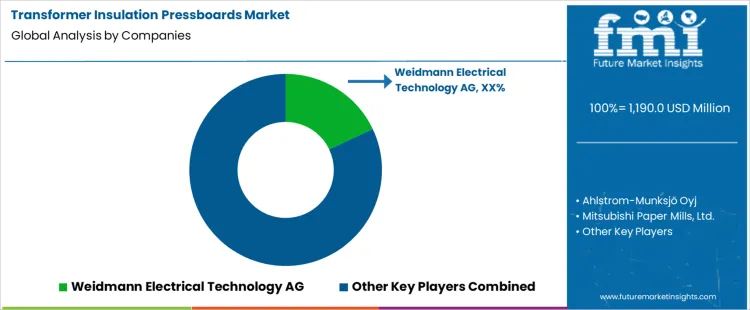
Competition in the transformer insulation pressboards market is driven by material purity, electrical reliability, and long-term mechanical stability highlighted in official product brochures. Weidmann Electrical Technology AG is positioned as a reference supplier through high-density cellulose pressboards developed for power and ultra-high-voltage transformers. Product literature emphasizes dielectric consistency, oil impregnation behavior, and dimensional stability under thermal stress. Ahlstrom-Munksjö Oyj competes through specialty cellulose insulation grades designed for distribution and power transformers, with brochures focusing on fiber uniformity and process reliability. Mitsubishi Paper Mills, Ltd. positions its pressboards around precision manufacturing and mechanical strength, targeting applications where tight tolerances and endurance are critical.
Strategic positioning increasingly reflects system-level insulation offerings. DuPont de Nemours, Inc. differentiates through advanced insulation materials and composite pressboard solutions described in official technical brochures, addressing higher thermal classes and extended transformer lifecycles. Hitachi Energy Ltd competes by integrating pressboards into a broader transformer insulation components portfolio, with brochures stressing chemical purity, high compressive strength, and suitability for extra-high-voltage designs. Pressboards are positioned as part of coordinated insulation systems rather than standalone materials.
Regional manufacturers compete through scale and customization. MGM Transformer Components Pvt. Ltd. focuses on dimensionally precise pressboard components aligned with transformer OEM drawings, promoted for consistency and cost efficiency. Shandong Zhongyuan Electric Insulation Co., Ltd. and Henan Special Paper Co., Ltd. emphasize broad pressboard thickness ranges and volume production capabilities in product brochures. Across the competitive landscape, differentiation is achieved through brochure-verified performance parameters, manufacturing control, and alignment with evolving transformer insulation standards.
Key Players in Transformer Insulation Pressboards Market
- Weidmann Electrical Technology AG
- Ahlstrom-Munksjö Oyj
- Mitsubishi Paper Mills, Ltd.
- DuPont de Nemours, Inc.
- Hitachi Energy Ltd
- MGM Transformer Components Pvt. Ltd.
- Shandong Zhongyuan Electric Insulation Co., Ltd.
- Henan Special Paper Co., Ltd.
Scope of Report
| Attribute | Description |
|---|---|
| Quantitative Unit | USD Million |
| Type | Laminated Pressboard, Molded Pressboard, Creped Pressboard, Other |
| Application | Power Transformers, Distribution Transformers, HVDC Transformers, Rail & Transportation, Other Electrical Equipment |
| Countries Covered | China, Japan, South Korea, India, Australia & New Zealand, ASEAN, Rest of Asia Pacific, Germany, United Kingdom, France, Italy, Spain, Nordic, BENELUX, Rest of Europe, United States, Canada, Mexico, Brazil, Chile, Rest of Latin America, Kingdom of Saudi Arabia, Other GCC Countries, Turkey, South Africa, Other African Union, Rest of Middle East & Africa |
| Regions Covered | Asia Pacific, Europe, North America, Latin America, Middle East & Africa |
| Key Companies Profiled | Weidmann Electrical Technology AG, Ahlstrom-Munksjö Oyj, Mitsubishi Paper Mills, Ltd., DuPont de Nemours, Inc., Hitachi Energy Ltd, MGM Transformer Components Pvt. Ltd., Shandong Zhongyuan Electric Insulation Co., Ltd., Henan Special Paper Co., Ltd. |
| Additional Attributes | Dollar sales by type and application are assessed across transformer voltage classes and end-use equipment. The report includes country-level demand analysis, evaluation of insulation material performance standards, assessment of manufacturing and processing technologies, competitive benchmarking of leading suppliers, and analysis of procurement patterns across power and grid infrastructure projects. |
Transformer Insulation Pressboards Market by Key Segments
Type:
- Laminated Pressboard
- Molded Pressboard
- Creped Pressboard
- Other
Application
- Power Transformers
- Distribution Transformers
- HVDC Transformers
- Rail & Transportation
- Other Electrical Equipment
Region:
- Asia Pacific
- China
- Japan
- South Korea
- India
- Australia & New Zealand
- ASEAN
- Rest of Asia Pacific
- Europe
- Germany
- United Kingdom
- France
- Italy
- Spain
- Nordic
- BENELUX
- Rest of Europe
- North America
- United States
- Canada
- Mexico
- Latin America
- Brazil
- Chile
- Rest of Latin America
- Middle East & Africa
- Kingdom of Saudi Arabia
- Other GCC Countries
- Turkey
- South Africa
- Other African Union
- Rest of Middle East & Africa
Bibliography
- International Electrotechnical Commission. (2024). IEC 60641-3:2024 Pressboard and presspaper for electrical purposes – Part 3: Specifications for individual materials. IEC.
- International Organization for Standardization. (2024). ISO 9001:2024 Quality management systems – Requirements. ISO.
- ASTM International. (2025). ASTM D202-25: Standard test methods for sampling and testing pressboard and electrical insulating paper. ASTM International.
Frequently Asked Questions
How big is the transformer insulation pressboards market in 2026?
The global transformer insulation pressboards market is estimated to be valued at USD 1,190.0 million in 2026.
What will be the size of transformer insulation pressboards market in 2036?
The market size for the transformer insulation pressboards market is projected to reach USD 2,131.1 million by 2036.
How much will be the transformer insulation pressboards market growth between 2026 and 2036?
The transformer insulation pressboards market is expected to grow at a 6.0% CAGR between 2026 and 2036.
What are the key product types in the transformer insulation pressboards market?
The key product types in transformer insulation pressboards market are laminated pressboard, molded pressboard, creped pressboard and other.
Which application segment to contribute significant share in the transformer insulation pressboards market in 2026?
In terms of application, power transformers segment to command 50.0% share in the transformer insulation pressboards market in 2026.
Preview the report firsthand - request a free sample
Get SampleGet the brochure for pricing and purchase details.
Get PDFTable of Content
- Executive Summary
- Global Market Outlook
- Demand-side Trends
- Supply-side Trends
- Technology Roadmap Analysis
- Analysis and Recommendations
- Market Overview
- Market Coverage / Taxonomy
- Market Definition / Scope / Limitations
- Market Background
- Market Dynamics
- Drivers
- Restraints
- Opportunity
- Trends
- Scenario Forecast
- Demand in Optimistic Scenario
- Demand in Likely Scenario
- Demand in Conservative Scenario
- Opportunity Map Analysis
- Product Life Cycle Analysis
- Supply Chain Analysis
- Investment Feasibility Matrix
- Value Chain Analysis
- PESTLE and Porter’s Analysis
- Regulatory Landscape
- Regional Parent Market Outlook
- Production and Consumption Statistics
- Import and Export Statistics
- Market Dynamics
- Global Market Analysis 2021 to 2025 and Forecast, 2026 to 2036
- Historical Market Size Value (USD Million) Analysis, 2021 to 2025
- Current and Future Market Size Value (USD Million) Projections, 2026 to 2036
- Y-o-Y Growth Trend Analysis
- Absolute $ Opportunity Analysis
- Global Market Pricing Analysis 2021 to 2025 and Forecast 2026 to 2036
- Global Market Analysis 2021 to 2025 and Forecast 2026 to 2036, By Type
- Introduction / Key Findings
- Historical Market Size Value (USD Million) Analysis By Type , 2021 to 2025
- Current and Future Market Size Value (USD Million) Analysis and Forecast By Type , 2026 to 2036
- Laminated Pressboard
- Molded Pressboard
- Creped Pressboard
- Other
- Laminated Pressboard
- Y-o-Y Growth Trend Analysis By Type , 2021 to 2025
- Absolute $ Opportunity Analysis By Type , 2026 to 2036
- Global Market Analysis 2021 to 2025 and Forecast 2026 to 2036, By Application
- Introduction / Key Findings
- Historical Market Size Value (USD Million) Analysis By Application, 2021 to 2025
- Current and Future Market Size Value (USD Million) Analysis and Forecast By Application, 2026 to 2036
- Power Transformers
- Distribution Transformers
- HVDC Transformers
- Rail & Transportation
- Other Electrical Equipment
- Power Transformers
- Y-o-Y Growth Trend Analysis By Application, 2021 to 2025
- Absolute $ Opportunity Analysis By Application, 2026 to 2036
- Global Market Analysis 2021 to 2025 and Forecast 2026 to 2036, By Region
- Introduction
- Historical Market Size Value (USD Million) Analysis By Region, 2021 to 2025
- Current Market Size Value (USD Million) Analysis and Forecast By Region, 2026 to 2036
- North America
- Latin America
- Western Europe
- Eastern Europe
- East Asia
- South Asia and Pacific
- Middle East & Africa
- Market Attractiveness Analysis By Region
- North America Market Analysis 2021 to 2025 and Forecast 2026 to 2036, By Country
- Historical Market Size Value (USD Million) Trend Analysis By Market Taxonomy, 2021 to 2025
- Market Size Value (USD Million) Forecast By Market Taxonomy, 2026 to 2036
- By Country
- USA
- Canada
- Mexico
- By Type
- By Application
- By Country
- Market Attractiveness Analysis
- By Country
- By Type
- By Application
- Key Takeaways
- Latin America Market Analysis 2021 to 2025 and Forecast 2026 to 2036, By Country
- Historical Market Size Value (USD Million) Trend Analysis By Market Taxonomy, 2021 to 2025
- Market Size Value (USD Million) Forecast By Market Taxonomy, 2026 to 2036
- By Country
- Brazil
- Chile
- Rest of Latin America
- By Type
- By Application
- By Country
- Market Attractiveness Analysis
- By Country
- By Type
- By Application
- Key Takeaways
- Western Europe Market Analysis 2021 to 2025 and Forecast 2026 to 2036, By Country
- Historical Market Size Value (USD Million) Trend Analysis By Market Taxonomy, 2021 to 2025
- Market Size Value (USD Million) Forecast By Market Taxonomy, 2026 to 2036
- By Country
- Germany
- UK
- Italy
- Spain
- France
- Nordic
- BENELUX
- Rest of Western Europe
- By Type
- By Application
- By Country
- Market Attractiveness Analysis
- By Country
- By Type
- By Application
- Key Takeaways
- Eastern Europe Market Analysis 2021 to 2025 and Forecast 2026 to 2036, By Country
- Historical Market Size Value (USD Million) Trend Analysis By Market Taxonomy, 2021 to 2025
- Market Size Value (USD Million) Forecast By Market Taxonomy, 2026 to 2036
- By Country
- Russia
- Poland
- Hungary
- Balkan & Baltic
- Rest of Eastern Europe
- By Type
- By Application
- By Country
- Market Attractiveness Analysis
- By Country
- By Type
- By Application
- Key Takeaways
- East Asia Market Analysis 2021 to 2025 and Forecast 2026 to 2036, By Country
- Historical Market Size Value (USD Million) Trend Analysis By Market Taxonomy, 2021 to 2025
- Market Size Value (USD Million) Forecast By Market Taxonomy, 2026 to 2036
- By Country
- China
- Japan
- South Korea
- By Type
- By Application
- By Country
- Market Attractiveness Analysis
- By Country
- By Type
- By Application
- Key Takeaways
- South Asia and Pacific Market Analysis 2021 to 2025 and Forecast 2026 to 2036, By Country
- Historical Market Size Value (USD Million) Trend Analysis By Market Taxonomy, 2021 to 2025
- Market Size Value (USD Million) Forecast By Market Taxonomy, 2026 to 2036
- By Country
- India
- ASEAN
- Australia & New Zealand
- Rest of South Asia and Pacific
- By Type
- By Application
- By Country
- Market Attractiveness Analysis
- By Country
- By Type
- By Application
- Key Takeaways
- Middle East & Africa Market Analysis 2021 to 2025 and Forecast 2026 to 2036, By Country
- Historical Market Size Value (USD Million) Trend Analysis By Market Taxonomy, 2021 to 2025
- Market Size Value (USD Million) Forecast By Market Taxonomy, 2026 to 2036
- By Country
- Kingdom of Saudi Arabia
- Other GCC Countries
- Turkiye
- South Africa
- Other African Union
- Rest of Middle East & Africa
- By Type
- By Application
- By Country
- Market Attractiveness Analysis
- By Country
- By Type
- By Application
- Key Takeaways
- Key Countries Market Analysis
- USA
- Pricing Analysis
- Market Share Analysis, 2025
- By Type
- By Application
- Canada
- Pricing Analysis
- Market Share Analysis, 2025
- By Type
- By Application
- Mexico
- Pricing Analysis
- Market Share Analysis, 2025
- By Type
- By Application
- Brazil
- Pricing Analysis
- Market Share Analysis, 2025
- By Type
- By Application
- Chile
- Pricing Analysis
- Market Share Analysis, 2025
- By Type
- By Application
- Germany
- Pricing Analysis
- Market Share Analysis, 2025
- By Type
- By Application
- UK
- Pricing Analysis
- Market Share Analysis, 2025
- By Type
- By Application
- Italy
- Pricing Analysis
- Market Share Analysis, 2025
- By Type
- By Application
- Spain
- Pricing Analysis
- Market Share Analysis, 2025
- By Type
- By Application
- France
- Pricing Analysis
- Market Share Analysis, 2025
- By Type
- By Application
- India
- Pricing Analysis
- Market Share Analysis, 2025
- By Type
- By Application
- ASEAN
- Pricing Analysis
- Market Share Analysis, 2025
- By Type
- By Application
- Australia & New Zealand
- Pricing Analysis
- Market Share Analysis, 2025
- By Type
- By Application
- China
- Pricing Analysis
- Market Share Analysis, 2025
- By Type
- By Application
- Japan
- Pricing Analysis
- Market Share Analysis, 2025
- By Type
- By Application
- South Korea
- Pricing Analysis
- Market Share Analysis, 2025
- By Type
- By Application
- Russia
- Pricing Analysis
- Market Share Analysis, 2025
- By Type
- By Application
- Poland
- Pricing Analysis
- Market Share Analysis, 2025
- By Type
- By Application
- Hungary
- Pricing Analysis
- Market Share Analysis, 2025
- By Type
- By Application
- Kingdom of Saudi Arabia
- Pricing Analysis
- Market Share Analysis, 2025
- By Type
- By Application
- Turkiye
- Pricing Analysis
- Market Share Analysis, 2025
- By Type
- By Application
- South Africa
- Pricing Analysis
- Market Share Analysis, 2025
- By Type
- By Application
- USA
- Market Structure Analysis
- Competition Dashboard
- Competition Benchmarking
- Market Share Analysis of Top Players
- By Regional
- By Type
- By Application
- Competition Analysis
- Competition Deep Dive
- Weidmann Electrical Technology AG
- Overview
- Product Portfolio
- Profitability by Market Segments (Product/Age /Sales Channel/Region)
- Sales Footprint
- Strategy Overview
- Marketing Strategy
- Product Strategy
- Channel Strategy
- Ahlstrom-Munksjö Oyj
- Mitsubishi Paper Mills, Ltd.
- DuPont de Nemours, Inc.
- Hitachi Energy Ltd
- MGM Transformer Components Pvt. Ltd.
- Shandong Zhongyuan Electric Insulation Co., Ltd.
- Henan Special Paper Co., Ltd.
- Weidmann Electrical Technology AG
- Competition Deep Dive
- Assumptions & Acronyms Used
- Research Methodology


