

- Industry Size (2026)
- USD 0.9 Bn
- Forecast (2036)
- USD 1.8 Bn
- CAGR (2026 to 2036)
- 7%
Turquoise Bracelets Market Forecast and Outlook 2026 to 2036
The turquoise bracelets market is set to garner USD 0.9 billion in 2026 and is projected to reach USD 1.8 billion by 2036, implying a CAGR of 7%. This category sits firmly in the fashion and accessory space rather than in any functional or necessity driven segment. Purchase decisions are guided by color trends, design cycles, and seasonal styling rather than by replacement needs. Demand therefore fluctuates with fashion calendars and media exposure. Production and sourcing costs remain secondary to design positioning and brand narrative. Regions with strong jewelry design clusters and established gemstone processing retain an advantage in setting styles and controlling collections.
Sales momentum depends heavily on gifting behavior and impulse purchasing rather than on repeat functional use. Tourist destinations, lifestyle retail districts, and online marketplaces account for a large share of volume, since buyers often associate turquoise jewelry with travel, personal expression, or occasion based purchases. Online channels allow rapid testing of designs and quick turnover of collections, while physical tourist retail benefits from location driven demand. Inventory risk and trend forecasting matter more than manufacturing scale. The market expands through style renewal and channel reach, not through steady, predictable consumption patterns.
Quick Stats for Turquoise Bracelets Market
- Turquoise Bracelets Market Value (2026): USD 0.9 billion
- Turquoise Bracelets Market Forecast Value (2036): USD 1.8 billion
- Turquoise Bracelets Market Forecast CAGR 2026 to 2036: 7%
- Leading Type in Turquoise Bracelets Market: Natural turquoise bracelets
- Key Growth Regions in Turquoise Bracelets Market: Asia Pacific, North America, Europe
- Top Players in Turquoise Bracelets Market: Baccarat, Tiffany & Co., Van Cleef & Arpels, David Yurman, Macy’s (private label jewelry), Pandora
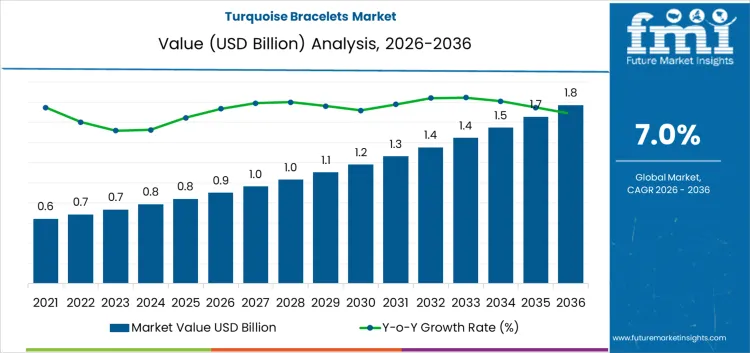
What is the Growth Forecast for Turquoise Bracelets Market through 2036?
Demand for turquoise bracelets does not expand in a straight global line. In 2020 the market stood near USD 0.6 billion and remained at roughly the same level through 2023, reflecting its dependence on tourism flows, regional craft economies, and cultural buying patterns rather than on mass jewelry consumption. Momentum only becomes visible as the market moves past USD 0.7 billion and then approaches USD 0.9 billion by 2026, driven mainly by recovery in travel retail, heritage craft channels, and lifestyle gifting segments. Even by 2030, when the market reaches about USD 1.0 to 1.1 billion, growth remains uneven, with some regions expanding steadily while others stay flat. This unevenness is structural, not cyclical.
By the time the market moves through the USD 1.3 to 1.5 billion range and approaches USD 1.8 billion toward the end of the period, the same dual structure still dominates. One side consists of handcrafted products rooted in regional artisan traditions, where output growth is slow and constrained by skills, stone availability, and workshop scale. The other side is made up of mass-produced bracelets that pass through tourist retail, gift shops, and online marketplaces, where volumes respond quickly to trends and travel flows but prices remain highly sensitive. This wide quality and price spectrum prevents consolidation into a single dominant tier. Value growth therefore comes more from broader participation across tiers than from any sustained upward shift in average pricing.
Turquoise Bracelets Market Key Takeaways
| Metric | Value |
|---|---|
| Market Value (2026) | USD 0.9 billion |
| Forecast Value (2036) | USD 1.8 billion |
| Forecast CAGR 2026 to 2036 | 7% |
How Is the Turquoise Bracelets Market Influenced by Fashion and Style Cycles?
Turquoise bracelets are increasingly adopted as accessories to complement contemporary fashion trends and personal style preferences. Historically, jewelry designs were influenced by traditional patterns and seasonal collections, which dictated consumer demand and styling choices. Modern turquoise bracelets combine classic gemstone appeal with contemporary design elements, metals, and finishes to appeal to evolving aesthetic preferences. Jewelry designers, retailers, and e-commerce platforms prioritize design versatility, gemstone quality, and trend responsiveness. Early adoption focused on premium collections and specialty boutiques, while current demand spans mainstream fashion retailers, online marketplaces, and custom jewelry segments, driven by changing seasonal trends, influencer-driven popularity, and cultural influences. Gemstone quality, design uniqueness, and finish consistency influence supplier and retailer selection.
Fashion and lifestyle trends significantly shape market growth by influencing color palettes, material combinations, and design motifs. Compared with conventional jewelry, modern turquoise bracelets integrate adaptive styling to respond to seasonal cycles, cultural trends, and consumer preferences. Cost structures depend on gemstone sourcing, craftsmanship, and design complexity, concentrating margins among suppliers capable of producing high-quality, trend-aligned products. Retailers adopt these designs to capture seasonal demand, cater to shifting style preferences, and differentiate product offerings. By 2036, turquoise bracelets are expected to maintain enduring popularity, with designs evolving in response to fashion cycles, consumer aesthetics, and cultural influences in the global jewelry market.
What Factors Are Shaping the Demand for Turquoise Bracelets Segment wise Analysis by Product Positioning and Sales Channel in 2026?
The turquoise bracelets market in 2026 is segmented by product type and by distribution channel. By product positioning, demand is divided into natural turquoise bracelets, stabilized turquoise bracelets, dyed turquoise bracelets, and beaded or mixed gemstone designs, each addressing different price points, authenticity expectations, and styling preferences. By sales channel, demand is organized around online retail, specialty jewelry stores, department stores, and artisan or craft markets, which differ in assortment depth, price transparency, and storytelling. These segments reflect a market where affordable, repeat purchase designs drive unit volume, while higher grade natural stone pieces concentrate value rather than volume.
Why Do Stabilized, Dyed, and Mixed Designs Lead Unit Volumes Through Affordable, Mass Appeal?
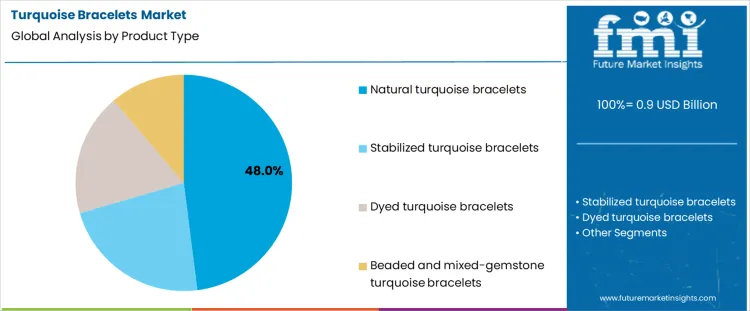
Although natural turquoise bracelets hold about 48% of value attention, the largest share of unit volume comes from stabilized, dyed, and mixed gemstone designs because they are easier to source and price more accessibly. These products allow consistent color, predictable supply, and large scale production without dependence on limited quality stone. Retailers can offer wide design variety at lower price points, which supports impulse purchases and frequent replacement. For many buyers, visual appeal and coordination with outfits matter more than geological purity. This favors mass designs that can be refreshed each season. The result is a volume structure where accessible products dominate shipments even though they do not command the highest per unit prices.
These categories also fit better with fashion driven retail cycles. Designers can introduce new shapes, bead combinations, and finishes without being constrained by stone availability. Manufacturing yield is higher and quality control is simpler, which supports large batch production. Returns and customer complaints are also easier to manage because expectations are aligned with fashion jewelry rather than with collectible stones. This keeps affordable, treated, and composite products as the backbone of unit sales, even while the narrative value of natural turquoise remains important for brand positioning.
Why Is Online Retail Growing Faster Than Physical Stores?
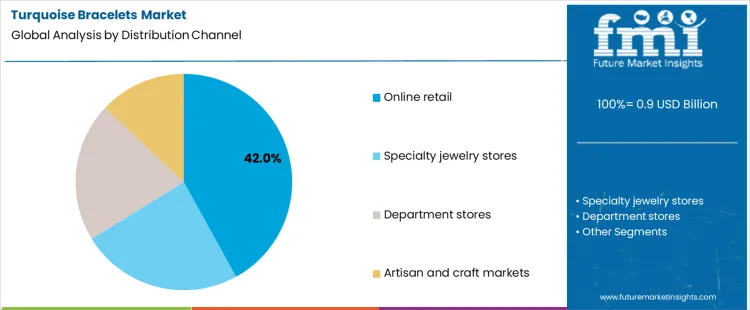
Online retail accounts for about 42% of demand in 2026 and is growing faster than physical channels because it aligns well with how consumers browse and compare jewelry. Turquoise bracelets are visual products, and customers often want to see many designs, colors, and styles before deciding. Online platforms offer broader assortment, clearer price comparison, and easier access to reviews. Delivery logistics are simple because products are small and low risk to ship. Social media and marketplace exposure also funnel demand directly into online checkout rather than into store visits.
Specialty stores, department stores, and artisan markets remain important for discovery and for higher trust purchases, especially in natural stone segments. Yet their reach is limited by location and shelf space. Online channels remove these limits and allow both mass designs and premium pieces to reach national or global buyers. This structural advantage keeps digital channels as the fastest growing route to market, even though offline retail continues to play a role in branding and experiential shopping.
How Are the Key Dynamics of Everyday Wear Adoption, Digital Commerce Expansion, and Handcrafted Design Revival Reshaping the Turquoise Bracelets Market through 2036?
The category is being shaped by changes in how jewelry is worn, bought, and valued. Turquoise bracelets are moving from occasional accessories to everyday items, which expands usage frequency and normalizes repeat purchases. At the same time, online marketplaces are widening access to regional makers and niche styles, changing how demand is discovered and fulfilled. Parallel to this, buyers show growing interest in handcrafted and ethnic designs that carry visible individuality rather than standardized fashion cues. Together, these forces shift the market away from seasonal gifting cycles toward continuous, style driven consumption, where visibility, authenticity, and convenience matter more than formal jewelry buying occasions.
Why Is the Growing Preference for Casual and Everyday Jewelry Driving the Turquoise Bracelets Market?
Demand is increasingly linked to daily styling habits rather than special occasions. Consumers now treat bracelets as part of regular attire, similar to watches or simple accessories, which raises wear frequency and replacement cycles. Turquoise fits this shift because it offers color and character without looking formal or heavy. It pairs easily with casual clothing and mixed material stacks, making it suitable for work, travel, and leisure. As wardrobes become more informal, jewelry choices follow the same direction. This turns turquoise bracelets from gift or statement items into routine purchases, anchoring volume to everyday usage patterns rather than to festivals, ceremonies, or fashion season peaks.
Why Are Rising Online and Marketplace Sales Reshaping How This Market Grows?
The main change is in discovery and access. Online platforms allow small brands and individual artisans to reach global buyers without physical retail presence. This widens the range of styles, price points, and origins visible to consumers. Buyers can compare designs, read stories, and see real use images, which reduces dependence on traditional jewelry stores. Marketplaces also support impulse and repeat purchases because entry prices are lower and selection is broader. For the category, this shifts growth toward long tail demand rather than a few mass designs. It also makes marketing, reviews, and visual presentation as important as shelf space once was.
How Is the Popularity of Handcrafted and Ethnic Designs Changing the Structure of the Category?
The category is moving away from uniform fashion jewelry toward origin and craft driven products. Buyers increasingly value visible handwork, cultural references, and small batch production because these signal individuality and authenticity. Turquoise has strong associations with specific regions and traditions, which makes it well suited to this shift. This favors artisans, small workshops, and brands that can tell a clear story about materials and process. Standardized, factory like designs face more comparison pressure. Over time, demand becomes more fragmented across many styles and makers, and competition shifts toward design identity, craftsmanship perception, and narrative rather than pure price or scale alone.
What is the Demand for Turquoise Bracelets by Country?
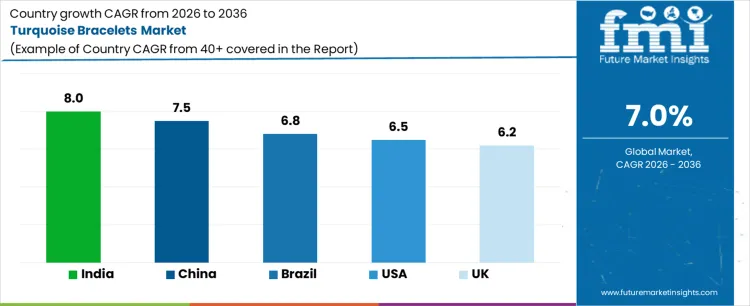
| Country | CAGR (%) |
|---|---|
| USA | 6.5% |
| UK | 6.2% |
| China | 7.5% |
| India | 8.0% |
| Brazil | 6.8% |
Demand for turquoise bracelets is rising as jewelry manufacturers and retailers focus on consumer preferences for decorative, fashionable, and culturally significant accessories. India leads with an 8.0% CAGR, driven by growing consumer interest in gemstone jewelry, increasing retail distribution, and cultural affinity for decorative bracelets. China follows at 7.5%, supported by expanding jewelry manufacturing and growing consumer spending on gemstone accessories. Brazil records 6.8% growth, shaped by rising retail penetration and demand for handcrafted jewelry. The USA grows at 6.5%, influenced by fashion trends and adoption of gemstone bracelets. The UK shows 6.2% CAGR, reflecting steady consumer demand for ornamental and cultural jewelry items.
How is the United States experiencing growth in the turquoise bracelets market?
United States is experiencing growth at a CAGR of 6.5%, driven by fashion adoption and a rising interest in artisanal and bohemian-style accessories among younger consumers. Urban fashion trends in cities such as New York, Los Angeles, and Chicago support demand for turquoise bracelets as statement pieces. Investments focus on quality, design differentiation, and online and offline retail distribution. Growth reflects the popularity of seasonal fashion trends, celebrity influence, and social media promotion of unique jewelry styles.
- Youth fashion preferences accelerate sales velocity.
- Urban centers concentrate demand.
- Design quality and differentiation guide investment.
- Consumer preference toward online and offline retail channels supports growth.
How is the United Kingdom witnessing growth in the turquoise bracelets market?
United Kingdom is witnessing growth at a CAGR of 6.2%, supported by tourism and souvenir demand in cities such as London, Edinburgh, and Bath. Turquoise bracelets are often purchased by visitors as cultural or artisanal souvenirs. Demand is concentrated in tourist hubs, craft markets, and museum shops. Investments focus on locally inspired designs, packaging for gifting, and retail placement in tourist-heavy areas. Growth reflects the continued appeal of artisanal jewelry among domestic buyers and international visitors.
- Tourism and souvenir demand drive adoption.
- Tourist hubs concentrate sales.
- Locally inspired designs enhance appeal.
- Retail placement in high-footfall areas supports growth.
How is China experiencing growth in the turquoise bracelets market?
China is experiencing growth at a CAGR of 7.5%, fueled by rising online shopping penetration and e-commerce platforms that connect jewelry artisans with consumers nationwide. Major cities like Beijing, Shanghai, and Guangzhou exhibit high digital engagement and rapid adoption of fashion accessories online. Demand is concentrated through e-commerce portals, social media marketing, and digital influencer promotion. Investments prioritize high-quality images, efficient logistics, and digital marketing strategies. Growth reflects the shift from traditional retail to online channels for jewelry shopping.
- Online shopping penetration drives adoption.
- Major metropolitan cities concentrate demand.
- Digital marketing and influencer campaigns enhance sales.
- E-commerce logistics and fulfillment support growth.
How is India witnessing growth in the turquoise bracelets market?
India is witnessing growth at a CAGR of 8%, supported by a strong local craft and jewelry culture in regions such as Rajasthan, Gujarat, and Karnataka. Turquoise bracelets are integrated into traditional and contemporary jewelry collections, appealing to domestic buyers seeking artisanal craftsmanship. Demand is concentrated in local markets, craft bazaars, and cultural fairs. Investments focus on supporting artisan networks, quality certification, and unique designs. Growth reflects cultural appreciation for handcrafted jewelry and rising interest in fusion fashion accessories.
- Artisan heritage and local sourcing shape consumer choice.
- Artisan markets and cultural fairs concentrate demand.
- Design uniqueness and craftsmanship guide investment.
- Supporting artisan networks enhances growth.
How is Brazil experiencing growth in the turquoise bracelets market?
Brazil is experiencing growth at a CAGR of 6.8%, fueled by increasing income levels and discretionary spending on fashion and accessories in São Paulo, Rio de Janeiro, and Brasília. Turquoise bracelets appeal to middle- and upper-income consumers seeking casual, stylish jewelry for everyday wear. Demand is concentrated in shopping malls, fashion boutiques, and online retail. Investments focus on affordable yet high-quality materials, design variety, and visibility in both physical and digital channels. Growth reflects rising disposable income and willingness to spend on personal adornments.
- Income levels and discretionary spending drive adoption.
- Shopping malls and boutiques concentrate demand.
- Design variety and quality influence purchasing.
- Online and offline retail channels support growth.
Who Competes in the Turquoise Bracelets Market and How Do Their Offerings Differ?
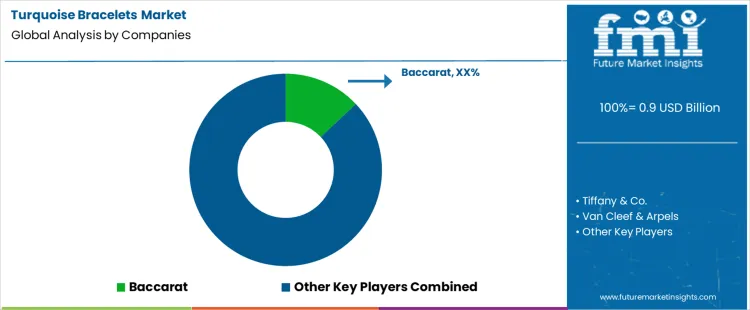
Competition in the turquoise bracelets market is shaped by design positioning, gemstone quality, and brand heritage. Baccarat offers gemstone bracelets that incorporate high-grade turquoise within fine jewelry collections, supported by craftsmanship and precision setting. Tiffany & Co. supplies bracelets that combine turquoise with precious metals in designs that reflect established luxury standards. Van-Cleef & Arpels delivers artisan-crafted bracelets where turquoise appears alongside other gemstones in signature motifs, emphasizing aesthetic refinement. David-Yurman provides designs that pair turquoise with cable-inspired metalwork and contemporary styling. Macy’s private-label jewelry includes turquoise bracelets aimed at accessible price points with varied design options. Pandora markets charm-style and beaded bracelets featuring turquoise elements that integrate with its modular system.
Market differentiation arises from gemstone sourcing, design complexity, and brand positioning. Baccarat, Tiffany & Co., and Van-Cleef & Arpels prioritize high-end luxury appeal, using calibrated turquoise specimens and meticulous finishing suited to collectors and connoisseurs. David-Yurman emphasizes distinctive metalwork paired with turquoise for fashion-oriented buyers. Macy’s private-label offerings target value-conscious consumers seeking turquoise bracelets with broad style variety. Pandora’s modular approach allows customers to combine turquoise elements with charms and motifs, appealing to personalized styling. Other regional and artisan jewelers provide bespoke or handcrafted turquoise bracelets with local gemstone variations. Competitive differences are defined by design narrative, gemstone quality grading, metal type, and perceived brand value, with luxury names often commanding premium positioning relative to mass-market and mid-tier alternatives.
Key Players in the Turquoise Bracelets Market
- Baccarat
- Tiffany & Co.
- Van Cleef & Arpels
- David Yurman
- Macy’s (private label jewelry)
- Pandora
Scope of the Report
| Items | Values |
|---|---|
| Quantitative Units (2026) | USD billion |
| Product Type | Natural Turquoise Bracelets, Stabilized Turquoise Bracelets, Dyed Turquoise Bracelets, Beaded and Mixed-Gemstone Turquoise Bracelets |
| Distribution Channel | Online Retail, Specialty Jewelry Stores, Department Stores, Artisan and Craft Markets |
| Regions Covered | Asia Pacific, Europe, North America, Latin America, Middle East & Africa |
| Countries Covered | China, Japan, South Korea, India, Australia & New Zealand, ASEAN, Germany, United Kingdom, France, Italy, Spain, Nordic, BENELUX, United States, Canada, Mexico, Brazil, Chile, Saudi Arabia, Turkey, South Africa, and other regional markets |
| Key Companies Profiled | Baccarat, Tiffany & Co., Van Cleef & Arpels, David Yurman, Macy’s (Private Label Jewelry), Pandora |
| Additional Attributes | Dollar sales by product type and sales channel; unit volumes dominated by stabilized, dyed, and mixed designs; online retail as the fastest growing channel; demand driven by fashion cycles, gifting, and tourism; market split between handcrafted artisan products and mass designs; growth shaped by trend renewal, digital marketplaces, and every day-wear adoption rather than replacement cycles. |
Turquoise Bracelets Market Segmentation
Product Type:
- Natural turquoise bracelets
- Stabilized turquoise bracelets
- Dyed turquoise bracelets
- Beaded and mixed-gemstone turquoise bracelets
Distribution Channel:
- Online retail
- Specialty jewelry stores
- Department stores
- Artisan and craft markets
Region
- Asia Pacific
- China
- Japan
- South Korea
- India
- Australia & New Zealand
- ASEAN
- Rest of Asia Pacific
- Europe
- Germany
- United Kingdom
- France
- Italy
- Spain
- Nordic
- BENELUX
- Rest of Europe
- North America
- United States
- Canada
- Mexico
- Latin America
- Brazil
- Chile
- Rest of Latin America
- Middle East & Africa
- Kingdom of Saudi Arabia
- Other GCC Countries
- Turkey
- South Africa
- Other African Union
- Rest of Middle East & Africa
Bibliography
- United States Geological Survey. (2023). Gemstones statistics and information: Turquoise and related ornamental stones. USA Department of the Interior.
- United States Geological Survey. (2024). Mineral commodity summaries: Gemstones. USA Department of the Interior.
- UNESCO. (2023). The global handicrafts and artisan sector in the cultural economy. United Nations Educational, Scientific and Cultural Organization.
- United Nations Conference on Trade and Development. (2023). Creative economy outlook: Cultural goods and handicrafts trade. UNCTAD.
- Organisation for Economic Co-operation and Development. (2023). The cultural and creative sectors and local economic development. OECD.
Frequently Asked Questions
How big is the turquoise bracelets market in 2026?
The global turquoise bracelets market is estimated to be valued at USD 0.9 billion in 2026.
What will be the size of turquoise bracelets market in 2036?
The market size for the turquoise bracelets market is projected to reach USD 1.8 billion by 2036.
How much will be the turquoise bracelets market growth between 2026 and 2036?
The turquoise bracelets market is expected to grow at a 7.0% CAGR between 2026 and 2036.
What are the key product types in the turquoise bracelets market?
The key product types in turquoise bracelets market are natural turquoise bracelets , stabilized turquoise bracelets, dyed turquoise bracelets and beaded and mixed‑gemstone turquoise bracelets.
Which distribution channel segment to contribute significant share in the turquoise bracelets market in 2026?
In terms of distribution channel, online retail segment to command 42.0% share in the turquoise bracelets market in 2026.
Preview the report firsthand - request a free sample
Get SampleGet the brochure for pricing and purchase details.
Get PDFTable of Content
- Executive Summary
- Global Market Outlook
- Demand-side Trends
- Supply-side Trends
- Technology Roadmap Analysis
- Analysis and Recommendations
- Market Overview
- Market Coverage / Taxonomy
- Market Definition / Scope / Limitations
- Market Background
- Market Dynamics
- Drivers
- Restraints
- Opportunity
- Trends
- Scenario Forecast
- Demand in Optimistic Scenario
- Demand in Likely Scenario
- Demand in Conservative Scenario
- Opportunity Map Analysis
- Product Life Cycle Analysis
- Supply Chain Analysis
- Investment Feasibility Matrix
- Value Chain Analysis
- PESTLE and Porter’s Analysis
- Regulatory Landscape
- Regional Parent Market Outlook
- Production and Consumption Statistics
- Import and Export Statistics
- Market Dynamics
- Global Market Analysis 2021 to 2025 and Forecast, 2026 to 2036
- Historical Market Size Value (USD Million) Analysis, 2021 to 2025
- Current and Future Market Size Value (USD Million) Projections, 2026 to 2036
- Y-o-Y Growth Trend Analysis
- Absolute $ Opportunity Analysis
- Global Market Pricing Analysis 2021 to 2025 and Forecast 2026 to 2036
- Global Market Analysis 2021 to 2025 and Forecast 2026 to 2036, By Product Type
- Introduction / Key Findings
- Historical Market Size Value (USD Million) Analysis By Product Type, 2021 to 2025
- Current and Future Market Size Value (USD Million) Analysis and Forecast By Product Type, 2026 to 2036
- Natural turquoise bracelets
- Stabilized turquoise bracelets
- Dyed turquoise bracelets
- Beaded and mixed‑gemstone turquoise bracelets
- Natural turquoise bracelets
- Y-o-Y Growth Trend Analysis By Product Type, 2021 to 2025
- Absolute $ Opportunity Analysis By Product Type, 2026 to 2036
- Global Market Analysis 2021 to 2025 and Forecast 2026 to 2036, By Distribution Channel
- Introduction / Key Findings
- Historical Market Size Value (USD Million) Analysis By Distribution Channel, 2021 to 2025
- Current and Future Market Size Value (USD Million) Analysis and Forecast By Distribution Channel, 2026 to 2036
- Online retail
- Specialty jewelry stores
- Department stores
- Artisan and craft markets
- Online retail
- Y-o-Y Growth Trend Analysis By Distribution Channel, 2021 to 2025
- Absolute $ Opportunity Analysis By Distribution Channel, 2026 to 2036
- Global Market Analysis 2021 to 2025 and Forecast 2026 to 2036, By Region
- Introduction
- Historical Market Size Value (USD Million) Analysis By Region, 2021 to 2025
- Current Market Size Value (USD Million) Analysis and Forecast By Region, 2026 to 2036
- North America
- Latin America
- Western Europe
- Eastern Europe
- East Asia
- South Asia and Pacific
- Middle East & Africa
- Market Attractiveness Analysis By Region
- North America Market Analysis 2021 to 2025 and Forecast 2026 to 2036, By Country
- Historical Market Size Value (USD Million) Trend Analysis By Market Taxonomy, 2021 to 2025
- Market Size Value (USD Million) Forecast By Market Taxonomy, 2026 to 2036
- By Country
- USA
- Canada
- Mexico
- By Product Type
- By Distribution Channel
- By Country
- Market Attractiveness Analysis
- By Country
- By Product Type
- By Distribution Channel
- Key Takeaways
- Latin America Market Analysis 2021 to 2025 and Forecast 2026 to 2036, By Country
- Historical Market Size Value (USD Million) Trend Analysis By Market Taxonomy, 2021 to 2025
- Market Size Value (USD Million) Forecast By Market Taxonomy, 2026 to 2036
- By Country
- Brazil
- Chile
- Rest of Latin America
- By Product Type
- By Distribution Channel
- By Country
- Market Attractiveness Analysis
- By Country
- By Product Type
- By Distribution Channel
- Key Takeaways
- Western Europe Market Analysis 2021 to 2025 and Forecast 2026 to 2036, By Country
- Historical Market Size Value (USD Million) Trend Analysis By Market Taxonomy, 2021 to 2025
- Market Size Value (USD Million) Forecast By Market Taxonomy, 2026 to 2036
- By Country
- Germany
- UK
- Italy
- Spain
- France
- Nordic
- BENELUX
- Rest of Western Europe
- By Product Type
- By Distribution Channel
- By Country
- Market Attractiveness Analysis
- By Country
- By Product Type
- By Distribution Channel
- Key Takeaways
- Eastern Europe Market Analysis 2021 to 2025 and Forecast 2026 to 2036, By Country
- Historical Market Size Value (USD Million) Trend Analysis By Market Taxonomy, 2021 to 2025
- Market Size Value (USD Million) Forecast By Market Taxonomy, 2026 to 2036
- By Country
- Russia
- Poland
- Hungary
- Balkan & Baltic
- Rest of Eastern Europe
- By Product Type
- By Distribution Channel
- By Country
- Market Attractiveness Analysis
- By Country
- By Product Type
- By Distribution Channel
- Key Takeaways
- East Asia Market Analysis 2021 to 2025 and Forecast 2026 to 2036, By Country
- Historical Market Size Value (USD Million) Trend Analysis By Market Taxonomy, 2021 to 2025
- Market Size Value (USD Million) Forecast By Market Taxonomy, 2026 to 2036
- By Country
- China
- Japan
- South Korea
- By Product Type
- By Distribution Channel
- By Country
- Market Attractiveness Analysis
- By Country
- By Product Type
- By Distribution Channel
- Key Takeaways
- South Asia and Pacific Market Analysis 2021 to 2025 and Forecast 2026 to 2036, By Country
- Historical Market Size Value (USD Million) Trend Analysis By Market Taxonomy, 2021 to 2025
- Market Size Value (USD Million) Forecast By Market Taxonomy, 2026 to 2036
- By Country
- India
- ASEAN
- Australia & New Zealand
- Rest of South Asia and Pacific
- By Product Type
- By Distribution Channel
- By Country
- Market Attractiveness Analysis
- By Country
- By Product Type
- By Distribution Channel
- Key Takeaways
- Middle East & Africa Market Analysis 2021 to 2025 and Forecast 2026 to 2036, By Country
- Historical Market Size Value (USD Million) Trend Analysis By Market Taxonomy, 2021 to 2025
- Market Size Value (USD Million) Forecast By Market Taxonomy, 2026 to 2036
- By Country
- Kingdom of Saudi Arabia
- Other GCC Countries
- Turkiye
- South Africa
- Other African Union
- Rest of Middle East & Africa
- By Product Type
- By Distribution Channel
- By Country
- Market Attractiveness Analysis
- By Country
- By Product Type
- By Distribution Channel
- Key Takeaways
- Key Countries Market Analysis
- USA
- Pricing Analysis
- Market Share Analysis, 2025
- By Product Type
- By Distribution Channel
- Canada
- Pricing Analysis
- Market Share Analysis, 2025
- By Product Type
- By Distribution Channel
- Mexico
- Pricing Analysis
- Market Share Analysis, 2025
- By Product Type
- By Distribution Channel
- Brazil
- Pricing Analysis
- Market Share Analysis, 2025
- By Product Type
- By Distribution Channel
- Chile
- Pricing Analysis
- Market Share Analysis, 2025
- By Product Type
- By Distribution Channel
- Germany
- Pricing Analysis
- Market Share Analysis, 2025
- By Product Type
- By Distribution Channel
- UK
- Pricing Analysis
- Market Share Analysis, 2025
- By Product Type
- By Distribution Channel
- Italy
- Pricing Analysis
- Market Share Analysis, 2025
- By Product Type
- By Distribution Channel
- Spain
- Pricing Analysis
- Market Share Analysis, 2025
- By Product Type
- By Distribution Channel
- France
- Pricing Analysis
- Market Share Analysis, 2025
- By Product Type
- By Distribution Channel
- India
- Pricing Analysis
- Market Share Analysis, 2025
- By Product Type
- By Distribution Channel
- ASEAN
- Pricing Analysis
- Market Share Analysis, 2025
- By Product Type
- By Distribution Channel
- Australia & New Zealand
- Pricing Analysis
- Market Share Analysis, 2025
- By Product Type
- By Distribution Channel
- China
- Pricing Analysis
- Market Share Analysis, 2025
- By Product Type
- By Distribution Channel
- Japan
- Pricing Analysis
- Market Share Analysis, 2025
- By Product Type
- By Distribution Channel
- South Korea
- Pricing Analysis
- Market Share Analysis, 2025
- By Product Type
- By Distribution Channel
- Russia
- Pricing Analysis
- Market Share Analysis, 2025
- By Product Type
- By Distribution Channel
- Poland
- Pricing Analysis
- Market Share Analysis, 2025
- By Product Type
- By Distribution Channel
- Hungary
- Pricing Analysis
- Market Share Analysis, 2025
- By Product Type
- By Distribution Channel
- Kingdom of Saudi Arabia
- Pricing Analysis
- Market Share Analysis, 2025
- By Product Type
- By Distribution Channel
- Turkiye
- Pricing Analysis
- Market Share Analysis, 2025
- By Product Type
- By Distribution Channel
- South Africa
- Pricing Analysis
- Market Share Analysis, 2025
- By Product Type
- By Distribution Channel
- USA
- Market Structure Analysis
- Competition Dashboard
- Competition Benchmarking
- Market Share Analysis of Top Players
- By Regional
- By Product Type
- By Distribution Channel
- Competition Analysis
- Competition Deep Dive
- Baccarat
- Overview
- Product Portfolio
- Profitability by Market Segments (Product/Age /Sales Channel/Region)
- Sales Footprint
- Strategy Overview
- Marketing Strategy
- Product Strategy
- Channel Strategy
- Tiffany & Co.
- Van Cleef & Arpels
- David Yurman
- Macy’s (private‑label jewelry)
- Pandora
- Baccarat
- Competition Deep Dive
- Assumptions & Acronyms Used
- Research Methodology


