

- Industry Size (2026)
- USD 807.4 Mn
- Forecast (2036)
- USD 1403.4 Mn
- CAGR (2026 to 2036)
- 5.7%
Demand for Cellulose Derivative in United Kingdom Forecast and Outlook 2026 to 2036
The cellulose derivative market in the United Kingdom is expected to grow from USD 807.4 million in 2026 to USD 1,403.4 million by 2036, at a CAGR of 5.7%. Regulatory oversight will play a critical role in shaping market dynamics, as stricter environmental and health-related standards increase the compliance burden on manufacturers. This pressure will raise certification complexity, especially for products used in food, pharmaceuticals, and personal care, demanding significant investment in quality assurance systems.
The associated compliance costs may drive smaller vendors out of the market, consolidating power among larger companies that can absorb these expenses. Vendors that prioritize adherence to evolving regulations will be better positioned to capture market share, as consumers and industries increasingly demand certified, compliant products. Companies that streamline the certification process while maintaining product quality will likely gain a competitive advantage, allowing them to navigate regulatory pressures with greater efficiency.
Quick Stats for the Demand for Cellulose Derivative in United Kingdom:
- Cellulose Derivative in United Kingdom Value (2026): USD 807.4 million
- Cellulose Derivative in United Kingdom Forecast Value (2036): USD 1,403.4 million
- Cellulose Derivative in United Kingdom Global Forecast CAGR (2026 to 2036): 5.7%
- Cellulose Derivative in United Kingdom Leading Segment: Powder (54.2% share)
- Key Growth Regions of Cellulose Derivative in United Kingdom: England
- Top Players of Cellulose Derivative in United Kingdom: Dow Chemical Company, Ashland Global Holdings Inc., Rayonier Advanced Materials Inc., CP Kelco, Celanese Corporation

What is the Growth Forecast for Cellulose Derivative in United Kingdom through 2036?
The demand for cellulose derivatives in the United Kingdom is expected to grow steadily from 2026 to 2036. The market value will increase from USD 807.4 million in 2026 to USD 1,403.4 million by 2036, reflecting a compound annual growth rate (CAGR) of 5.7%. The market will follow an acceleration and deceleration pattern over the forecast period. From 2026 to 2031, the market will experience consistent growth, with values increasing from USD 807.4 million to USD 1,064.5 million, reflecting steady acceleration.
In the later part of the forecast period, from 2031 to 2036, the market is expected to experience a slower growth rate. The values will continue to rise, from USD 1,064.5 million to USD 1,403.4 million, but at a decelerated pace compared to the earlier years. This deceleration reflects market maturity as demand stabilizes after a period of rapid expansion. The demand for cellulose derivatives will continue to grow, driven by ongoing applications in industries like pharmaceuticals, food, and cosmetics. However, the pace of growth will moderate as the market approaches its peak.
Key Takeaways for Demand for Cellulose Derivative in United Kingdom
| Metric | Value |
|---|---|
| Industry Sales Value (2026) | USD 807.4 million |
| Industry Forecast Value (2036) | USD 1,403.4 million |
| Industry Forecast CAGR (2026 to 2036) | 5.7% |
Why is Demand for Cellulose Derivative in United Kingdom Growing?
Demand for cellulose derivative in the United Kingdom has increased from earlier levels as manufacturers across industries incorporated these ingredients into a wider range of products. Historically, cellulose derivatives such as methylcellulose, hydroxypropyl methylcellulose, and carboxymethyl cellulose were used mainly in specialized industrial applications and some food products. The food processing sector began using cellulose derivatives to improve texture, stability, and moisture retention in processed foods, which broadened usage beyond niche categories. Pharmaceutical and personal care producers adopted these ingredients for controlled release in tablets and as thickeners in lotions and creams. Packaging firms also integrated cellulose derivatives into coatings and films that enhance barrier properties. Demand tracked growth in sectors where formulation performance and functional properties such as thickening, binding, and emulsification were valued. Distribution networks adjusted to supply derivatives with consistent quality, which supported integration into manufacturing lines. Procurement teams placed greater emphasis on reliable supply and specification compliance as part of quality management. Steady uptake across multiple end uses contributed to overall expansion of demand.
Looking forward, demand for cellulose derivative in the United Kingdom is expected to continue rising as product development priorities evolve. Food manufacturers will seek solutions that support clean labels and consumer expectations for ingredient transparency while maintaining functional performance. Pharmaceutical formulators will require derivatives that deliver consistent behavior in controlled release and suspension systems. Other industries including paints, adhesives, and construction materials may expand use where rheology control and film formation are beneficial. Emerging applications in sustainable packaging and biodegradable materials could attract interest as firms explore alternatives to traditional polymers. Research into new derivative grades with tailored properties may stimulate broader adoption. Changing regulatory frameworks around food and chemical safety will influence sourcing and specification practices, reinforcing the role of cellulose derivatives in UK manufacturing.
What Are the Key Segments in the Demand for Cellulose Derivative in the United Kingdom?
Demand for cellulose derivatives in the United Kingdom is influenced by derivative type and form. Methyl cellulose leads the derivative type segment with a 30% share, while powder form is the dominant form, accounting for 54.2%. Other forms, such as granules, aqueous solutions, emulsions, and specialty preparations, also contribute significantly. These trends are driven by the diverse applications of cellulose derivatives in industries such as pharmaceuticals, food, and personal care.
What Is the Derivative Type Segment of Demand for Cellulose Derivative in the United Kingdom?

The derivative type segment for cellulose derivatives in the United Kingdom is primarily led by methyl cellulose, which holds a 30% share of the market. Methyl cellulose is highly valued for its ability to form gels, its solubility in cold water, and its use in a wide range of applications, including pharmaceuticals, food, and personal care. In pharmaceuticals, methyl cellulose serves as a binder, thickener, and stabilizer in tablet formulations.
The food industry also relies on methyl cellulose for its gelling and emulsifying properties, particularly in food products like sauces, dressings, and ice cream. Carboxymethyl cellulose, another prominent derivative, is used extensively in the production of detergents, food, and personal care products, where its water retention properties enhance the texture and viscosity of various formulations. Hydroxyethyl cellulose, though in a smaller share compared to methyl and carboxymethyl, is gaining popularity in the personal care sector, particularly in shampoos and skincare products due to its ability to act as a thickening agent and film-former. Ethyl cellulose finds applications in coatings, adhesives, and films, valued for its water-repellent properties. Other cellulose derivatives, including specialty preparations and gels, cater to niche applications in industries like cosmetics, where customized formulations are required. The demand for these derivatives is primarily driven by their versatility, functionality, and growing consumer preference for natural, safe ingredients in everyday products.
What Is the Form Segment of Demand for Cellulose Derivative in the United Kingdom?
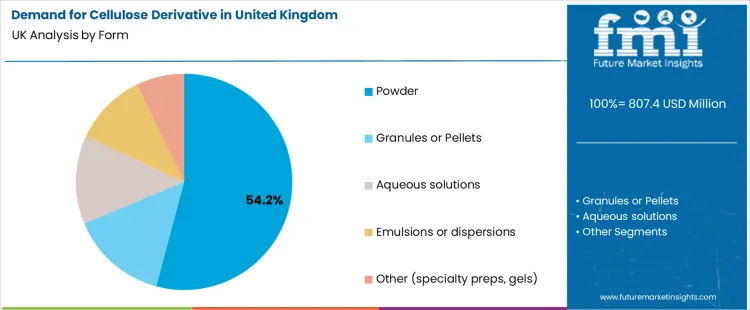
The form segment for cellulose derivatives in the United Kingdom is dominated by powder form, which accounts for 54.2% of the market share. Powdered cellulose derivatives are widely used due to their ease of handling, stability, and ease of incorporation into various formulations. The powder form is especially popular in the pharmaceutical industry, where it is used as an excipient for tablet production. The powder's flowability and uniformity make it ideal for efficient manufacturing processes. In food applications, powdered cellulose derivatives are utilized for their ability to control the texture, moisture retention, and viscosity of food products.
Granules or pellets follow, though they are typically used in applications that require controlled release or where the solid form provides a more convenient method of storage and transport. Granules are often used in the production of detergents, where controlled dissolution is required. Aqueous solutions are also in demand, particularly for applications in personal care products, such as shampoos, lotions, and other liquid formulations. These solutions are valued for their ability to create thick, stable gels without requiring additional stabilizers. Emulsions or dispersions, while representing a smaller portion of the market, are important for use in emulsified systems, such as lotions and creams, where uniform dispersion is key to product performance. Other specialty preparations and gels cater to niche needs in industries that require specific texture or functional properties. The preference for powder form reflects its broad applicability and versatility across multiple industries, while other forms serve specialized roles in targeted applications.
What is the Demand for Cellulose Derivative in the United Kingdom?
Demand for cellulose derivative in the United Kingdom remains steady, supported by applications in pharmaceuticals, personal care, food processing, paints, coatings, and construction materials. Cellulose derivatives, including carboxymethyl cellulose, methylcellulose, and hydroxypropyl methylcellulose, are valued for thickening, stabilising, and binding properties. Demand aligns with growth in downstream sectors that prioritise functional additives and performance polymers. Use in tablet formulation, film coating, and viscosity control underpins industry uptake. The market reflects global trends in bio based polymers and sustainable materials, with manufacturers and formulators maintaining consistent procurement to meet production and regulatory requirements.
What are the Key Drivers for Cellulose Derivative Demand in the United Kingdom?
Several factors drive demand for cellulose derivative in the United Kingdom. The pharmaceutical sector’s need for excipients in controlled release and tablet formulation sustains consumption. Personal care and cosmetics industries use cellulose derivatives to enhance texture and stability, reinforcing demand. Food and beverage processors incorporate hydrocolloids for thickening, moisture retention, and product uniformity. Construction and paint sectors use derivatives for rheology modification and adhesion enhancement. Consumer preference for products with natural or bio based ingredients supports adoption. Regulatory emphasis on product safety and quality bolsters use in compliant formulations across industries.
What are the Restraints on Cellulose Derivative Demand in the United Kingdom?
Despite ongoing demand, the cellulose derivative market in the United Kingdom faces restraints. Volatility in raw material supply, including pulp and regenerated cellulose sources, can affect production costs and lead times. Price sensitivity in end use industries may limit uptake of higher grade or speciality derivatives. Competition from synthetic polymers and alternative thickeners or stabilisers can constrain demand where performance differences are marginal. Regulatory burden related to chemical registration, handling, and labelling adds compliance cost for manufacturers and formulators. Economic variability in key sectors, such as construction or consumer goods, can moderate near term demand for additive materials.
What are the Key Trends in Cellulose Derivative Demand in the United Kingdom?
Key trends in the United Kingdom’s cellulose derivative demand include increasing interest in sustainable and bio based materials, with formulators seeking alternatives to fully synthetic polymers. Innovation in derivative grades that deliver enhanced performance at lower dosage supports efficiency gains in formulations. Cross industry use of functional additives, such as rheology modifiers and film formers, continues to expand into emerging segments like plant based foods and advanced coatings. Investment in research and development around tailored solutions for specific performance attributes, such as temperature stability or moisture control, is evident. Supply chain emphasis on traceability and quality assurance also shapes purchasing decisions in downstream industries.
What is the Country-Wise Demand for Cellulose Derivatives in the United Kingdom?
The country-wise demand for cellulose derivatives in the United Kingdom shows varying growth patterns across its regions. England leads the market, supported by its large pharmaceutical, food, and industrial sectors, where cellulose derivatives are widely used for applications such as drug formulation, food additives, and coatings. Scotland, Wales, and Northern Ireland follow with steady demand growth, driven by their respective pharmaceutical and manufacturing industries. The demand across all regions is fueled by increasing usage in food and beverage products, pharmaceuticals, and cosmetics, where cellulose derivatives offer essential properties like stabilizing, thickening, and controlled release. England dominates the market, but growth in the other regions is driven by continued industrialization and rising demand for sustainable, eco-friendly ingredients.

| Country | CAGR (2026 to 2036) |
|---|---|
| England | 6.3% |
| Scotland | 5.6% |
| Wales | 5.2% |
| Northern Ireland | 4.5% |
What is Driving the Demand for Cellulose Derivatives in England?
The demand for cellulose derivatives in England is expected to grow at a CAGR of 6.3% from 2026 to 2036. England remains the largest market due to its diverse industrial base, including pharmaceuticals, food production, and cosmetics. Cellulose derivatives play a vital role in drug formulation as stabilizers, binders, and controlled release agents, which are essential in modern medicine. The food and beverage industry also contributes significantly to demand, as cellulose derivatives are used for thickening, gelling, and enhancing texture in various products. The growing focus on sustainable and plant-based ingredients is further driving the adoption of cellulose derivatives, as they are natural, biodegradable, and eco-friendly. As the demand for pharmaceutical products and functional food ingredients continues to rise, the market for cellulose derivatives in England is expected to maintain robust growth throughout the forecast period.
How is the Demand for Cellulose Derivatives Performing in Scotland?
In Scotland, the demand for cellulose derivatives is projected to grow at a CAGR of 5.6% from 2026 to 2036. Scotland’s pharmaceutical and food industries are key contributors to the demand, with cellulose derivatives being widely used for controlled drug release, food preservation, and texture modification. The growing emphasis on natural and sustainable ingredients in the food and beverage sector has driven the adoption of cellulose derivatives as functional ingredients in various formulations. Scotland's strong focus on healthcare and pharmaceutical innovation has also created a steady market for cellulose derivatives in drug manufacturing. The demand for environmentally friendly and plant-based ingredients is likely to continue driving growth in the region, with cellulose derivatives being seen as a preferred choice for sustainable product formulations.
What Are the Growth Drivers for Cellulose Derivatives in Wales?
The demand for cellulose derivatives in Wales is expected to grow at a CAGR of 5.2% through 2036. The pharmaceutical and food industries in Wales are major drivers of demand for cellulose derivatives, which are used for a variety of functions such as stabilizing, thickening, and controlling the release of active ingredients in medications and food products. As consumer preferences increasingly shift towards natural and sustainable ingredients, the demand for plant-derived cellulose derivatives is rising. Wales' food processing industry, which is focused on health-conscious products, is particularly focused on improving texture and shelf life through the use of cellulose derivatives. The growing importance of sustainable, eco-friendly ingredients in formulations, coupled with the expansion of the pharmaceutical sector, is expected to drive steady growth in the demand for cellulose derivatives in Wales.
What is the Outlook for Cellulose Derivative Demand in Northern Ireland?
Northern Ireland’s demand for cellulose derivatives is projected to grow at a CAGR of 4.5% from 2026 to 2036. While it represents the smallest market in the United Kingdom, Northern Ireland’s pharmaceutical and food manufacturing sectors are increasingly adopting cellulose derivatives for their unique properties. In the pharmaceutical industry, cellulose derivatives are used as excipients in drug formulations, helping with controlled release and stability. The food industry in Northern Ireland is also increasingly using cellulose derivatives for their thickening, stabilizing, and gelling properties. As sustainability becomes more critical across all industries, the preference for natural, biodegradable ingredients like cellulose derivatives is expected to drive steady growth in Northern Ireland. Though the market is smaller compared to other regions, the growing demand for functional ingredients in both the pharmaceutical and food sectors indicates a positive growth trajectory.
What is the Competitive Landscape for Demand for Cellulose Derivative in the United Kingdom?

Demand for cellulose derivative in the United Kingdom is shaped by requirements from pharmaceuticals, food and beverage, personal care, and industrial applications. Cellulose ethers, carboxymethyl cellulose, and other derivatives are specified for thickening, stabilizing, and film forming functions. Dow Chemical Company is positioned as a leading supplier, with product brochures detailing viscosity grades, substitution levels, and recommended use cases. Technical sheets describe performance under specified temperatures and pH ranges, with handling instructions referenced by formulation scientists and procurement teams. Ashland Global Holdings Inc. competes with branded cellulose derivatives, with documentation that lists molecular weight distributions, functional properties in emulsions, and compatibility with other excipients. Selection criteria are drawn from these published product specifications during supplier evaluations. Rayonier Advanced Materials Inc. supplies specialty cellulose products, with brochures focusing on purity levels, particle size distributions, and application notes for coatings and specialty chemicals. Procurement professionals in the United Kingdom refer to these details when aligning material properties with end use performance requirements.
CP Kelco participates through tailored hydrocolloid systems that include modified cellulose derivatives, and product literature from CP Kelco describes rheology curves, shear stability data, and recommended concentration ranges for target textures. Celanese Corporation offers cellulose acetate and related derivatives, with technical books that describe thermal properties, degree of substitution, and processing conditions. In the United Kingdom, demand decisions are influenced by documented product attributes, regulatory compliance notes, and supply chain reliability. Buyers compare grades on quantified performance metrics such as gel strength, hydration rates, and clarity in final formulations. Lead times and service levels are outlined in supplier materials, with contract terms reflecting documented delivery commitments. Product brochures act as reference points in tender processes, guiding specification alignment for sectors that require certified material performance. Procurement cycles in food and pharmaceutical segments place emphasis on hygiene standards and traceability documentation, with cellulose derivative selections tied to published technical data and quality certificates provided by each manufacturer. Demand forecasts in industrial formulations are influenced by production schedules and documented material performance across application conditions.
Key Players of the Demand for Cellulose Derivative in United Kingdom
- Dow Chemical Company
- Ashland Global Holdings Inc.
- Rayonier Advanced Materials Inc.
- CP Kelco
- Celanese Corporation
Scope of the Report
| Items | Values |
|---|---|
| Quantitative Units (2026) | USD Million |
| Derivative Type | Methyl, Carboxymethyl, Hydroxyethyl, Ethyl, Others |
| Form | Powder, Granules or Pellets, Aqueous Solutions, Emulsions or Dispersions, Other (specialty preps, gels) |
| End Use | Pharmaceutical Industry, Food Industry, Personal Care, Construction, Paint Industry, Others |
| Companies | Dow Chemical Company, Ashland Global Holdings Inc., Rayonier Advanced Materials Inc., CP Kelco, Celanese Corporation |
| Regions Covered | United Kingdom |
| Countries Covered | England, Scotland, Wales, Northern Ireland |
| Additional Attributes | Dollar by sales by derivative type, form, end use, and region. Includes market trends towards sustainability, regulatory compliance, and the role of cellulose derivatives in various industries. |
Demand for Cellulose Derivative in United Kingdom
Derivative Type:
- Methyl
- Carboxymethyl
- Hydroxyethyl
- Ethyl
- Others
Form:
- Powder
- Granules or Pellets
- Aqueous solutions
- Emulsions or dispersions
- Other (specialty preps, gels)
End Use:
- Pharmaceutical Industry
- Food Industry
- Personal Care
- Construction
- Paint Industry
- Others
Countries:
- England
- Scotland
- Wales
- Northern Ireland
Bibliography
- Dow Chemical Company. (2023). Cellulose derivatives for pharmaceuticals, food, and industrial applications.
- Ashland Global Holdings Inc. (2023). Methylcellulose, carboxymethylcellulose, and other cellulose derivatives for various industries.
- Rayonier Advanced Materials Inc. (2023). Specialty cellulose products for coatings and specialty chemicals.
- CP Kelco. (2023). Modified cellulose derivatives for hydrocolloid systems and rheology applications.
- Celanese Corporation. (2023). Cellulose acetate and derivatives for industrial and pharmaceutical uses.
Frequently Asked Questions
How big is the demand for cellulose derivative in United Kingdom in 2026?
The demand for cellulose derivative in United Kingdom is estimated to be valued at USD 807.4 million in 2026.
What will be the size of cellulose derivative in United Kingdom in 2036?
The market size for the cellulose derivative in United Kingdom is projected to reach USD 1,403.4 million by 2036.
How much will be the demand for cellulose derivative in United Kingdom growth between 2026 and 2036?
The demand for cellulose derivative in United Kingdom is expected to grow at a 5.7% CAGR between 2026 and 2036.
What are the key product types in the cellulose derivative in United Kingdom?
The key product types in cellulose derivative in United Kingdom are methyl, carboxymethyl, hydroxyethyl, ethyl and others.
Which form segment is expected to contribute significant share in the cellulose derivative in United Kingdom in 2026?
In terms of form, powder segment is expected to command 54.2% share in the cellulose derivative in United Kingdom in 2026.
Preview the report firsthand - request a free sample
Get SampleGet the brochure for pricing and purchase details.
Get PDFTable of Content
- Executive Summary
- UK Market Outlook
- Demand-side Trends
- Supply-side Trends
- Technology Roadmap Analysis
- Analysis and Recommendations
- Market Overview
- Market Coverage / Taxonomy
- Market Definition / Scope / Limitations
- Market Background
- Market Dynamics
- Drivers
- Restraints
- Opportunity
- Trends
- Scenario Forecast
- Demand in Optimistic Scenario
- Demand in Likely Scenario
- Demand in Conservative Scenario
- Opportunity Map Analysis
- Product Life Cycle Analysis
- Supply Chain Analysis
- Investment Feasibility Matrix
- Value Chain Analysis
- PESTLE and Porter’s Analysis
- Regulatory Landscape
- Regional Parent Market Outlook
- Production and Consumption Statistics
- Import and Export Statistics
- Market Dynamics
- UK Market Analysis 2021 to 2025 and Forecast, 2026 to 2036
- Historical Market Size Value (USD Million) Analysis, 2021 to 2025
- Current and Future Market Size Value (USD Million) Projections, 2026 to 2036
- Y-o-Y Growth Trend Analysis
- Absolute $ Opportunity Analysis
- UK Market Pricing Analysis 2021 to 2025 and Forecast 2026 to 2036
- UK Market Analysis 2021 to 2025 and Forecast 2026 to 2036, By Derivative Type
- Introduction / Key Findings
- Historical Market Size Value (USD Million) Analysis By Derivative Type , 2021 to 2025
- Current and Future Market Size Value (USD Million) Analysis and Forecast By Derivative Type , 2026 to 2036
- Methyl
- Carboxymethyl
- Hydroxyethyl
- Ethyl
- Others
- Methyl
- Y-o-Y Growth Trend Analysis By Derivative Type , 2021 to 2025
- Absolute $ Opportunity Analysis By Derivative Type , 2026 to 2036
- UK Market Analysis 2021 to 2025 and Forecast 2026 to 2036, By Form
- Introduction / Key Findings
- Historical Market Size Value (USD Million) Analysis By Form, 2021 to 2025
- Current and Future Market Size Value (USD Million) Analysis and Forecast By Form, 2026 to 2036
- Powder
- Granules or Pellets
- Aqueous solutions
- Emulsions or dispersions
- Other (specialty preps, gels)
- Powder
- Y-o-Y Growth Trend Analysis By Form, 2021 to 2025
- Absolute $ Opportunity Analysis By Form, 2026 to 2036
- UK Market Analysis 2021 to 2025 and Forecast 2026 to 2036, By End Use
- Introduction / Key Findings
- Historical Market Size Value (USD Million) Analysis By End Use, 2021 to 2025
- Current and Future Market Size Value (USD Million) Analysis and Forecast By End Use, 2026 to 2036
- Pharmaceutical Industry
- Food Industry
- Personal Care
- Construction
- Paint Industry
- Others
- Pharmaceutical Industry
- Y-o-Y Growth Trend Analysis By End Use, 2021 to 2025
- Absolute $ Opportunity Analysis By End Use, 2026 to 2036
- Market Structure Analysis
- Competition Dashboard
- Competition Benchmarking
- Market Share Analysis of Top Players
- By Regional
- By Derivative Type
- By Form
- By End Use
- Competition Analysis
- Competition Deep Dive
- Dow Chemical Company
- Overview
- Product Portfolio
- Profitability by Market Segments (Product/Age /Sales Channel/Region)
- Sales Footprint
- Strategy Overview
- Marketing Strategy
- Product Strategy
- Channel Strategy
- Ashland Global Holdings Inc.
- Rayonier Advanced Materials Inc.
- CP Kelco
- Celanese Corporation
- Dow Chemical Company
- Competition Deep Dive
- Assumptions & Acronyms Used
- Research Methodology


