

- Industry Size (2026)
- USD 76.6 Mn
- Forecast (2036)
- USD 112.3 Mn
- CAGR (2026 to 2036)
- 3.9%
Demand for Massoia Bark Essential Oil in United Kingdom Forecast and Outlook 2026 to 2036
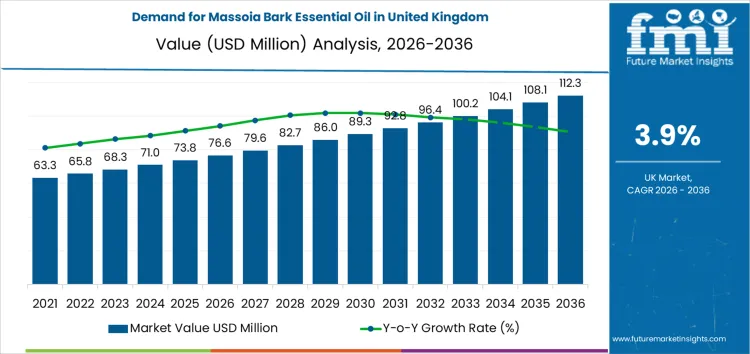
The massoia bark essential oil market in the United Kingdom is projected to grow from USD 76.6 million in 2026 to USD 112.3 million by 2036, at a CAGR of 3.9%. Decision-makers should immediately recognize that economic exposure in this market is influenced by fluctuations in raw material availability and the increasing demand for natural, plant-based ingredients in cosmetics and personal care. Prioritization should focus on establishing strong supply chains and securing long-term relationships with key suppliers, as Massoia Bark is not widely cultivated. Timing is critical as consumer interest in niche, sustainable ingredients continues to grow, but market growth remains steady rather than rapid. Companies looking to capitalize on this demand must be agile, with a clear strategy for product differentiation and sustainability. Investment in securing a reliable supply and aligning with evolving consumer trends will be crucial to maintaining a competitive edge and fostering long-term growth in this specialized market.
Quick Stats for the Demand for Massoia Bark Essential Oil in United Kingdom:
- Massoia Bark Essential Oil in United Kingdom Value (2026): USD 76.6 million
- Massoia Bark Essential Oil in United Kingdom Forecast Value (2036): USD 112.3 million
- Massoia Bark Essential Oil in United Kingdom Global Forecast CAGR (2026 to 2036): 3.9%
- Massoia Bark Essential Oil in United Kingdom Leading Segment: Conventional Massoia Bark Essential Oil (75% share)
- Key Growth Regions of Massoia Bark Essential Oil in United Kingdom: England
- Top Players of Massoia Bark Essential Oil in United Kingdom: PT. Scent Indonesia, Nusaroma, Alabama Essential Oil, Penta Manufacturing Company, Berjé
What is the Growth Forecast for Massoia Bark Essential Oil in United Kingdom through 2036?
The demand for Massoia bark essential oil in the United Kingdom is projected to increase from USD 76.6 million in 2026 to USD 112.3 million by 2036, reflecting a compound annual growth rate (CAGR) of 3.9%. Between 2026 and 2031, the market will experience steady growth, increasing from USD 76.6 million to USD 92.8 million. From 2031 to 2036, growth will continue, reaching USD 112.3 million by the end of the forecast period.
The contribution of volume vs. price growth in this market will be a key factor in driving demand. While volume growth will play a significant role in expanding the market, the price growth will also contribute to the overall market increase as demand for high-quality, premium essential oils continues to rise. As the popularity of natural and high-value ingredients grows, a portion of the market expansion will be driven by higher prices due to the increasing perceived value of Massoia bark essential oil in the fragrance and wellness industries.
Key Takeaways for Demand for Massoia Bark Essential Oil in United Kingdom
| Metric | Value |
|---|---|
| Industry Sales Value (2026) | USD 76.6 million |
| Industry Forecast Value (2036) | USD 112.3 million |
| Industry Forecast CAGR (2026 to 2036) | 3.9% |
Why is Demand for Massoia Bark Essential Oil in United Kingdom Growing?
Demand for massoia bark essential oil in the United Kingdom has increased from earlier levels as interest in exotic and natural aromatics expanded among fragrance and personal care manufacturers. Historically, essential oil sourcing was dominated by familiar extracts such as lavender, citrus, and eucalyptus, with niche aromatics like massoia bark oil occupying a limited role. Over recent years UK perfumers and cosmetic formulators began exploring a wider palette of scent ingredients to differentiate products and respond to consumer interest in unique sensory experiences. Massoia bark essential oil, valued for its creamy, sweet, and lactonic aromatic profile, found application in premium fragrances, fine perfumery accords, and bespoke personal care blends. Its adoption was supported by specialised ingredient suppliers able to meet quality and consistency expectations. Demand also reflected broader shifts toward natural and plant derived components in formulations where botanical sourcing stories can add perceived value in a crowded marketplace.
Looking ahead, demand for massoia bark essential oil in the United Kingdom is expected to continue evolving as product developers integrate distinctive aromatic materials into emerging product concepts. Growth will be underpinned by sustained interest in natural scent bases as well as innovation in niche and artisanal fragrance segments. Expansion of natural and organic personal care lines may reinforce uptake among formulators seeking alternatives to mainstream aromatics. In addition, application in luxury home fragrance and scented wellness products could broaden its use beyond traditional perfumery. Regulatory frameworks governing botanical ingredient use and sustainability considerations in raw material sourcing will influence how manufacturers select and deploy massoia bark essential oil in future product portfolios. These factors point to a continued, measured expansion of demand within the UK aromatic ingredients landscape.
What Are the Key Segments in the Demand for Massoia Bark Essential Oil in the United Kingdom?
Demand for Massoia bark essential oil in the United Kingdom is influenced by nature and product division. Conventional Massoia bark essential oil leads the nature segment with 75%, while essential oils dominate the product division segment at 60%. Organic Massoia bark essential oil also holds a smaller share. These trends reflect the growing demand for natural and sustainable ingredients in aromatherapy, personal care, and other industries that utilize essential oils.
What Is the Nature Segment of Demand for Massoia Bark Essential Oil in the United Kingdom?
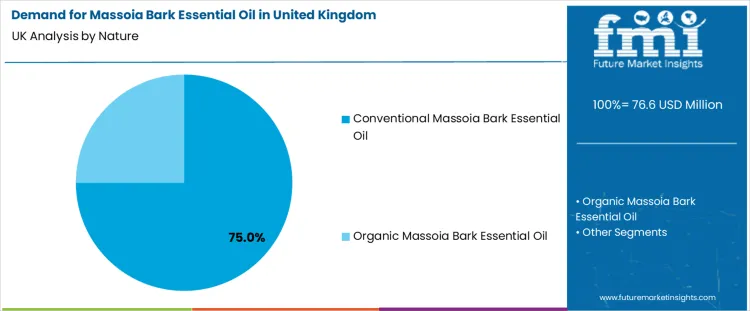
The nature segment for Massoia bark essential oil in the United Kingdom is predominantly led by conventional Massoia bark essential oil, which accounts for 75% of the market share. Conventional Massoia bark oil is widely used in the fragrance industry, as well as in personal care and aromatherapy products. It is favored for its rich, sweet, and woody aroma, which makes it a popular ingredient in perfumes, lotions, and candles. The relatively higher availability and cost-effectiveness of conventional Massoia bark oil contribute to its dominance in the market. Organic Massoia bark essential oil, while representing a smaller share, is gaining popularity due to the growing consumer demand for organic and eco-friendly products. Organic oils are produced without the use of synthetic pesticides or fertilizers, making them a preferred choice for consumers who prioritize sustainability and natural ingredients in their wellness and beauty products. Despite the smaller market share, the interest in organic Massoia bark oil is expected to grow as the trend for clean-label and natural products continues to rise in the United Kingdom. The continued dominance of conventional Massoia bark oil reflects its widespread use, while the organic segment represents a growing shift toward more sustainable and health-conscious options.
What Is the Product Division Segment of Demand for Massoia Bark Essential Oil in the United Kingdom?
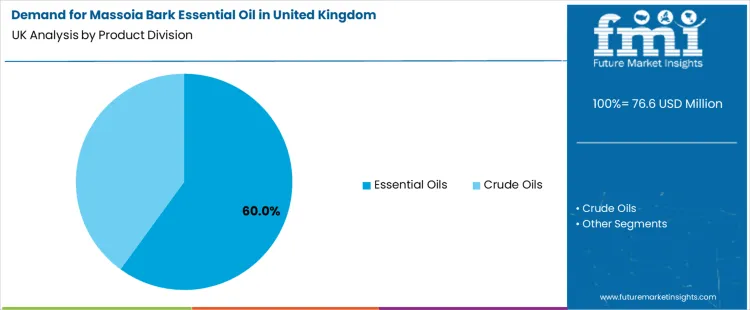
The product division segment for Massoia bark essential oil in the United Kingdom is led by essential oils, which capture 60% of the market share. Essential oils are highly concentrated extracts that are primarily used in aromatherapy, cosmetics, and fragrance products. Massoia bark essential oil, as an essential oil, is valued for its aromatic properties and its ability to promote relaxation, reduce stress, and enhance mood. It is also used in skin care products for its moisturizing and soothing effects. The essential oil division remains dominant due to the broad applicability of essential oils in various industries, especially in the wellness, cosmetics, and personal care sectors. Crude oils, which are less processed and contain a wider range of compounds, represent a smaller portion of the market. While they are used in some industrial applications, crude Massoia bark oil has a more limited role compared to its refined counterpart. The demand for essential oils is expected to continue growing, driven by consumer preferences for natural, plant-based ingredients and the increasing use of essential oils in wellness practices. As consumer awareness of the benefits of natural essential oils rises, the essential oil segment remains the largest and most significant portion of the Massoia bark oil market in the United Kingdom.
What is the Demand for Massoia Bark Essential Oil in the United Kingdom?
Demand for massoia bark essential oil in the United Kingdom remains modest and specialised, reflecting its niche use in high-end perfumery, flavouring, aromatherapy, and cosmetic formulations. Buyers seek this natural essential oil for its creamy, lactonic aroma and functional properties in fragrance blends and sensory products. Procurement volume correlates with activity in artisanal fragrance houses, natural personal care brands, and niche ingredient sourcing. Demand also reflects consumer interest in unique botanical extracts and premium aromatic compounds. Overall consumption is concentrated in premium segments rather than mass markets.
What are the Key Drivers for Massoia Bark Essential Oil Demand in the United Kingdom?
Several factors support demand for massoia bark essential oil in the United Kingdom. Growth in natural and botanical fragrance development drives interest in unique aromatic ingredients that differentiate products. Cosmetic and personal care formulators prioritise naturally derived essential oils that align with clean label and botanical ingredient positioning. Specialist perfumers value massoia bark essential oil for its distinctive creamy and warm aromatic profile, which enhances niche fragrance compositions. Consumer awareness of artisanal and small-batch product lines also reinforces procurement by boutique brands. Trade activity in specialised ingredient supply channels ensures availability for formulators.
What are the Restraints on Massoia Bark Essential Oil Demand in the United Kingdom?
Despite interest in botanical extracts, the market for massoia bark essential oil in the United Kingdom faces several restraints. Supply constraints limit availability, as massoia bark is a relatively rare source and extraction yields for the essential oil are low. Higher unit cost compared with commodity essential oils can deter price-sensitive formulators and limit use to premium applications. Regulatory scrutiny of botanical extracts and essential oils for safety, labelling, and allergen content increases compliance requirements for manufacturers. Smaller end-use segments, such as niche perfumery, constrain volume demand relative to broader essential oil categories.
What are the Key Trends in Massoia Bark Essential Oil Demand in the United Kingdom?
Key trends shaping demand in the United Kingdom include sustained interest in natural and speciality aroma chemicals among perfumers and cosmetic formulators. There is a shift toward botanical diversity in fragrance palettes, with niche brands exploring less common essential oils such as massoia bark to create signature scents. Sustainable sourcing and traceability of botanical materials are rising priorities, influencing supplier selection and inventory planning. The wellness market’s interest in aromatherapy and premium sensory experiences also supports occasional use of massoia bark essential oil in high-end diffusers and ritual products. Ingredient innovation in blending techniques is expanding creative applications in premium formulations.
What is the Country-Wise Demand for Massoia Bark Essential Oil in the United Kingdom?
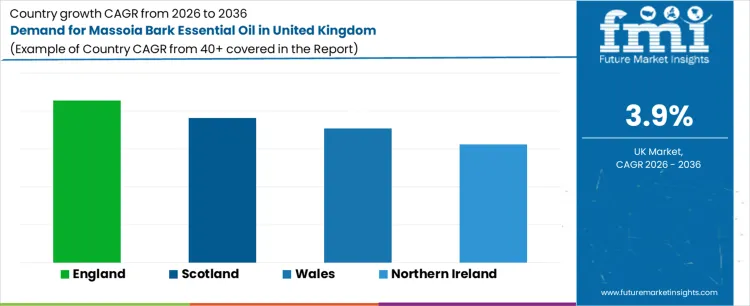
The country-wise demand for massoia bark essential oil in the United Kingdom varies across its regions. England leads the market, driven by its expanding fragrance, cosmetics, and aromatherapy industries, where massoia bark essential oil is valued for its unique scent and therapeutic properties. Scotland, Wales, and Northern Ireland also show steady demand, supported by growing consumer interest in natural and organic products. As industries increasingly turn to plant-based, eco-friendly ingredients, the demand for massoia bark essential oil is expected to rise across all regions. While England remains the largest market, the other regions are experiencing gradual growth driven by the rising popularity of essential oils in personal care and wellness sectors.
| Country | CAGR (2026 to 2036) |
|---|---|
| England | 4.3% |
| Scotland | 3.8% |
| Wales | 3.5% |
| Northern Ireland | 3.1% |
What is Driving the Demand for Massoia Bark Essential Oil in England?
The demand for massoia bark essential oil in England is projected to grow at a CAGR of 4.3% from 2026 to 2036. England’s large fragrance, cosmetics, and wellness industries are key drivers of this demand. Massoia bark essential oil, with its unique sweet, creamy aroma, is increasingly used in high-end perfumes, skincare, and aromatherapy products. As consumer preferences shift towards natural, sustainable ingredients, massoia bark essential oil is gaining popularity as a premium, plant-based alternative to synthetic fragrances. The growing focus on organic and eco-friendly personal care products is further boosting demand. Additionally, as wellness and aromatherapy continue to trend in England, the market for massoia bark essential oil is expected to grow steadily, fueled by its versatility in therapeutic and cosmetic applications.
How is the Demand for Massoia Bark Essential Oil Performing in Scotland?
In Scotland, the demand for massoia bark essential oil is expected to grow at a CAGR of 3.8% from 2026 to 2036. The demand in Scotland is driven by the increasing interest in natural and organic personal care products, where massoia bark essential oil is used for its pleasant fragrance and skin benefits. The growing wellness and aromatherapy market in Scotland, with a focus on plant-based and therapeutic products, is also contributing to the rise in demand. Additionally, as Scotland continues to embrace eco-conscious consumerism, the preference for sustainable ingredients like massoia bark essential oil is expected to increase. The expanding use of this essential oil in natural perfumes, lotions, and wellness products suggests steady market growth in Scotland over the forecast period.
What Are the Growth Drivers for Massoia Bark Essential Oil in Wales?
The demand for massoia bark essential oil in Wales is projected to grow at a CAGR of 3.5% through 2036. As in other regions, the demand in Wales is driven by the increasing adoption of natural ingredients in cosmetics, skincare, and wellness products. Massoia bark essential oil is gaining recognition for its sweet, creamy fragrance and its use in aromatherapy for relaxation and stress relief. The Welsh market is seeing a growing preference for eco-friendly, organic, and cruelty-free products, which is fueling the demand for massoia bark essential oil. Additionally, as more consumers in Wales turn to natural remedies and products that promote well-being, the demand for essential oils like massoia bark is expected to rise steadily.
What is the Outlook for Massoia Bark Essential Oil Demand in Northern Ireland?
Northern Ireland’s demand for massoia bark essential oil is expected to grow at a CAGR of 3.1% from 2026 to 2036. While Northern Ireland represents the smallest market compared to other parts of the United Kingdom, the demand for massoia bark essential oil is steadily increasing. The growing consumer interest in aromatherapy and wellness products, coupled with the rising focus on organic and plant-based personal care, is contributing to the gradual adoption of massoia bark essential oil. The oil’s use in fragrances, lotions, and other skincare products is helping to fuel growth in the region. As Northern Ireland continues to align with broader UK trends toward sustainable and natural products, the demand for massoia bark essential oil is expected to increase over the next decade, although at a slower pace compared to other regions.
What is the Competitive Landscape for Demand for Massoia Bark Essential Oil in the United Kingdom?
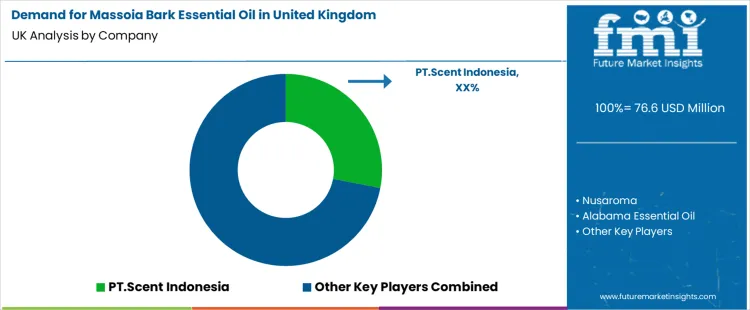
Demand for Massoia bark essential oil in the United Kingdom is shaped by its niche use in fine fragrance, high-end perfumery, aromatherapy blends, and select cosmetic applications. Procurement teams in perfumery houses and specialty ingredient buyers specify oil based on aroma profile, lactone content, and solvent-free extraction indicators. Brochures supplied by PT.Scent Indonesia outline oil grades, organoleptic descriptions, and documentation of lactone percentages that influence scent character. These materials are consulted by product developers when matching ingredient attributes with scent design briefs. Nusaroma’s offerings include technical sheets that list origin, batch analysis, and recommended use levels, which inform formulation decisions and compliance checks. Alabama Essential Oil provides specification sheets detailing extraction methods, olfactory notes, and recommended handling conditions that buyers reference during ingredient evaluation. Demand from niche perfumers and boutique cosmetic brands in the United Kingdom is addressed through these detailed documents that guide supplier selection.
Competing suppliers are evaluated by buyers on quality metrics and supply reliability. Penta Manufacturing Company’s documentation describes distillation parameters and typical lactone ranges, assisting formulation scientists in aligning sensory goals with material performance. Brojé’s product brochures present lactone content data and extraction process descriptions that are reviewed during tendering and sampling phases. Procurement cycles in the United Kingdom consider documented assay results, storage stability notes, and purity data before contract commitments are made. Lead times and minimum order quantities appear in supplier literature and are used by supply planners to schedule inventory. Buyers compare sensory evaluations and technical attributes to ensure that selected oil grades meet project specifications. Competitive activity is grounded in product performance and supply terms that are captured in official brochures and technical guides. Decisions are anchored in measurable material properties and compatibility with existing formulation frameworks used within the United Kingdom fragrance and specialty ingredient sectors.
Key Players of the Demand for Massoia Bark Essential Oil in United Kingdom
- PT.Scent Indonesia
- Nusaroma
- Alabama Essential Oil
- Penta Manufacturing Company
- Berjé
Scope of the Report
| Items | Values |
|---|---|
| Quantitative Units (2026) | USD Million |
| Nature | Organic Massoia Bark Essential Oil, Conventional Massoia Bark Essential Oil |
| Product Division | Essential Oils, Crude Oils |
| Application | Pharmaceuticals, Flavoring Agent, Aromatherapy, Dairy Industry, Fragrances and Deodorants |
| Grade | 40%-50%, 51%-65%, 66%-90%, 91%-95% |
| Companies | PT.Scent Indonesia, Nusaroma, Alabama Essential Oil, Penta Manufacturing Company, Berjé |
| Regions Covered | United Kingdom |
| Countries Covered | England, Scotland, Wales, Northern Ireland |
| Additional Attributes | Dollar by sales by nature, product division, application, grade, and region. Includes market trends towards sustainability, cost-effectiveness, and the role of Massoia Bark Essential Oil in various applications. |
Demand for Massoia Bark Essential Oil in United Kingdom
Nature
- Organic Massoia Bark Essential Oil
- Conventional Massoia Bark Essential Oil
Product Division
- Essential Oils
- Crude Oils
Application
- Pharmaceuticals
- Flavoring Agent
- Aromatherapy
- Dairy Industry
- Fragrances and Deodorants
Grade
- 40%-50%
- 51%-65%
- 66%-90%
- 91%-95%
Countries
- England
- Scotland
- Wales
- Northern Ireland
Bibliography
- Food Standards Agency. (2023).Guidance on flavourings and botanical extracts used in food and cosmetics.
- European Commission. (2023).Cosmetic ingredients and botanical substances: Regulatory status and safety framework.
- International Organization for Standardization (ISO). (2023).ISO standards for essential oils - terminology, purity, and analytical requirements.
- World Health Organization. (2022).WHO guidelines on safety evaluation of plant-derived ingredients used in consumer products.
- European Medicines Agency. (2023).Assessment of herbal substances and botanical preparations in medicinal and wellness products.
Frequently Asked Questions
How big is the demand for massoia bark essential oil in United Kingdom in 2026?
The demand for massoia bark essential oil in United Kingdom is estimated to be valued at USD 76.6 million in 2026.
What will be the size of massoia bark essential oil in United Kingdom in 2036?
The market size for the massoia bark essential oil in United Kingdom is projected to reach USD 112.3 million by 2036.
How much will be the demand for massoia bark essential oil in United Kingdom growth between 2026 and 2036?
The demand for massoia bark essential oil in United Kingdom is expected to grow at a 3.9% CAGR between 2026 and 2036.
What are the key product types in the massoia bark essential oil in United Kingdom?
The key product types in massoia bark essential oil in United Kingdom are conventional massoia bark essential oil and organic massoia bark essential oil.
Which product division segment is expected to contribute significant share in the massoia bark essential oil in United Kingdom in 2026?
In terms of product division, essential oils segment is expected to command 60.0% share in the massoia bark essential oil in United Kingdom in 2026.
Preview the report firsthand - request a free sample
Get SampleGet the brochure for pricing and purchase details.
Get PDFTable of Content
- Executive Summary
- UK Market Outlook
- Demand-side Trends
- Supply-side Trends
- Technology Roadmap Analysis
- Analysis and Recommendations
- Market Overview
- Market Coverage / Taxonomy
- Market Definition / Scope / Limitations
- Market Background
- Market Dynamics
- Drivers
- Restraints
- Opportunity
- Trends
- Scenario Forecast
- Demand in Optimistic Scenario
- Demand in Likely Scenario
- Demand in Conservative Scenario
- Opportunity Map Analysis
- Product Life Cycle Analysis
- Supply Chain Analysis
- Investment Feasibility Matrix
- Value Chain Analysis
- PESTLE and Porter’s Analysis
- Regulatory Landscape
- Regional Parent Market Outlook
- Production and Consumption Statistics
- Import and Export Statistics
- Market Dynamics
- UK Market Analysis 2021 to 2025 and Forecast, 2026 to 2036
- Historical Market Size Value (USD Million) Analysis, 2021 to 2025
- Current and Future Market Size Value (USD Million) Projections, 2026 to 2036
- Y-o-Y Growth Trend Analysis
- Absolute $ Opportunity Analysis
- UK Market Pricing Analysis 2021 to 2025 and Forecast 2026 to 2036
- UK Market Analysis 2021 to 2025 and Forecast 2026 to 2036, By Nature
- Introduction / Key Findings
- Historical Market Size Value (USD Million) Analysis By Nature , 2021 to 2025
- Current and Future Market Size Value (USD Million) Analysis and Forecast By Nature , 2026 to 2036
- Conventional Massoia Bark Essential Oil
- Organic Massoia Bark Essential Oil
- Conventional Massoia Bark Essential Oil
- Y-o-Y Growth Trend Analysis By Nature , 2021 to 2025
- Absolute $ Opportunity Analysis By Nature , 2026 to 2036
- UK Market Analysis 2021 to 2025 and Forecast 2026 to 2036, By Product Division
- Introduction / Key Findings
- Historical Market Size Value (USD Million) Analysis By Product Division, 2021 to 2025
- Current and Future Market Size Value (USD Million) Analysis and Forecast By Product Division, 2026 to 2036
- Essential Oils
- Crude Oils
- Essential Oils
- Y-o-Y Growth Trend Analysis By Product Division, 2021 to 2025
- Absolute $ Opportunity Analysis By Product Division, 2026 to 2036
- UK Market Analysis 2021 to 2025 and Forecast 2026 to 2036, By Application
- Introduction / Key Findings
- Historical Market Size Value (USD Million) Analysis By Application, 2021 to 2025
- Current and Future Market Size Value (USD Million) Analysis and Forecast By Application, 2026 to 2036
- Fragrances and Deodorants
- Pharmaceuticals
- Flavoring Agent
- Aromatherapy
- Dairy Industry
- Fragrances and Deodorants
- Y-o-Y Growth Trend Analysis By Application, 2021 to 2025
- Absolute $ Opportunity Analysis By Application, 2026 to 2036
- UK Market Analysis 2021 to 2025 and Forecast 2026 to 2036, By Grade
- Introduction / Key Findings
- Historical Market Size Value (USD Million) Analysis By Grade, 2021 to 2025
- Current and Future Market Size Value (USD Million) Analysis and Forecast By Grade, 2026 to 2036
- 66%-90%
- 40%-50%
- 51%-65%
- 91%-95%
- 66%-90%
- Y-o-Y Growth Trend Analysis By Grade, 2021 to 2025
- Absolute $ Opportunity Analysis By Grade, 2026 to 2036
- Market Structure Analysis
- Competition Dashboard
- Competition Benchmarking
- Market Share Analysis of Top Players
- By Regional
- By Nature
- By Product Division
- By Application
- By Grade
- Competition Analysis
- Competition Deep Dive
- PT.Scent Indonesia
- Overview
- Product Portfolio
- Profitability by Market Segments (Product/Age /Sales Channel/Region)
- Sales Footprint
- Strategy Overview
- Marketing Strategy
- Product Strategy
- Channel Strategy
- Nusaroma
- Alabama Essential Oil
- Penta Manufacturing Company
- Berjé
- PT.Scent Indonesia
- Competition Deep Dive
- Assumptions & Acronyms Used
- Research Methodology


