

- Industry Size (2026)
- USD 313.2 Mn
- Forecast (2036)
- USD 812.4 Mn
- CAGR (2026 to 2036)
- 10%
Demand for Online Clothing Rental in United Kingdom Forecast and Outlook 2026 to 2036
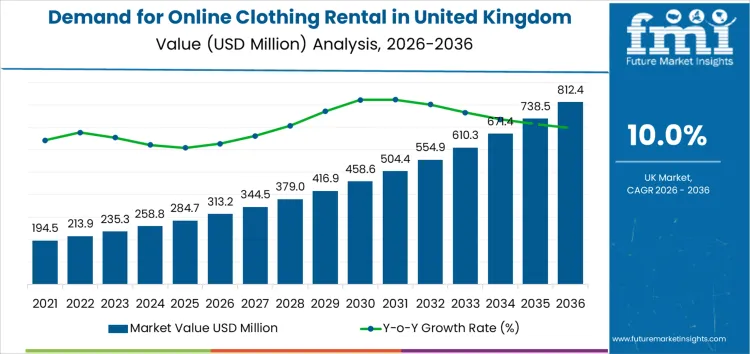
The online clothing rental market in the United Kingdom is expected to grow from USD 313.2 million in 2026 to USD 812.4 million by 2036, at a CAGR of 10%. Demand quality in this market is marked by a shift towards repeat usage, as consumers increasingly adopt subscription models and rental services for special occasions or everyday wear. Stability in demand is driven by the growing trend toward sustainable fashion, with consumers seeking to reduce their environmental footprint. Buyer commitment is strong, particularly among younger, environmentally conscious segments, who value convenience, variety, and flexibility.
The sector growth is poised to be influenced by customer retention strategies, as companies must ensure seamless experiences and high-quality offerings to prevent churn. This evolving customer loyalty presents both opportunities and challenges for service providers. Firms that can align with consumer values, improve product turnover, and offer consistently reliable service will capture sustained demand.
Quick Stats for the Demand for Online Clothing Rental in United Kingdom
- Online Clothing Rental in United Kingdom Value (2026): USD 313.2 million
- Online Clothing Rental in United Kingdom Forecast Value (2036): USD 812.4 million
- Online Clothing Rental in United Kingdom Forecast CAGR (2026 to 2036): 10%
- Online Clothing Rental in United Kingdom Leading Segment: Business-to-Business (B2B) (89.4% share)
- Key Growth Regions of Online Clothing Rental in United Kingdom: England
- Top Players of Online Clothing Rental in United Kingdom: Rent the Runway, H&M (H&M Rental), My WardrobeHQ, Le Tote, Glam Corner
What is the Growth Forecast for Online Clothing Rental in United Kingdom through 2036?
The demand for online clothing rental in the United Kingdom is projected to rise from USD 313.2 million in 2026 to USD 812.4 million by 2036, reflecting a compound annual growth rate (CAGR) of 10%. Between 2026 and 2031, the market will experience steady growth, with values increasing from USD 313.2 million to USD 458.6 million. From 2031 to 2036, growth will continue, reaching USD 812.4 million by the end of the forecast period.
The rolling CAGR analysis reveals that the market will experience accelerated growth over the first half of the forecast period (2026-2031), driven by increasing consumer acceptance and the expansion of online clothing rental platforms. The second half of the forecast period (2031-2036) will also see strong growth, but at a slightly moderated pace as the market matures. However, the long-term growth trajectory remains robust, supported by the continued shift towards sustainable consumption and the increasing availability of rental options across diverse clothing categories.
Key Takeaways for Demand for Online Clothing Rental in United Kingdom
| Metric | Value |
|---|---|
| Industry Sales Value (2026) | USD 313.2 million |
| Industry Forecast Value (2036) | USD 812.4 million |
| Industry Forecast CAGR (2026 to 2036) | 10% |
Why is Demand for Online Clothing Rental in United Kingdom Growing?
Demand for online clothing rental in the United Kingdom has strengthened as consumer behavior and retail economics shifted toward access over ownership. The UK rental apparel market was forecast to reach significant growth in recent years, with projections indicating robust expansion through the mid 2020s as platforms gained traction among fashion conscious consumers. Consumer trends toward fashion variety without long term commitment have driven growth in services that provide access to premium, occasion wear, and everyday garments without the cost and storage burden of ownership. Younger demographics in particular show higher engagement with rental platforms, valuing flexibility and frequent wardrobe changes. Retail and hospitality events such as weddings, parties, and corporate functions also contribute to periodic spikes in demand for rented outfits and accessories. Against a backdrop of subdued overall apparel spending, rental services capture a segment of discretionary fashion interest that coexists with conventional purchases.
For companies, manufacturers, and suppliers in the United Kingdom, demand for online clothing rental is likely to continue evolving as technology and sustainability considerations influence strategic planning. Rental platforms that offer seamless digital interfaces, reliable sizing and fit information, and efficient logistics for delivery and return will differentiate themselves in a competitive landscape. Retail buyers and brand managers may integrate rental options into broader omnichannel strategies to capture consumer interest early in the purchase journey and to leverage rental data for assortment planning. Sustainability credentials associated with circular fashion practices reinforce value for stakeholders aiming to reduce waste and extend product lifecycles, although operational considerations such as cleaning, repair, and inventory turnover remain critical. Suppliers and manufacturers that establish partnerships with rental platforms can benefit from recurring utilization of garments and data driven insights into trending styles and seasonal demand patterns. Continued growth in online rental usage and consumer acceptance suggests opportunities for refined product planning and service enhancements across the UK fashion ecosystem.
What Are the Key Segments in the Demand for Online Clothing Rental in the United Kingdom?
Demand for online clothing rental in the United Kingdom is primarily influenced by product type and end-user. Ethnic wear leads the product type segment with 30%, while Business-to-Business (B2B) dominates the end-user segment with 89.4%. Other product types, including knitwear, trousers & jeans, jumpsuits, coats & jackets, and performance wear, contribute to the market. These trends highlight the growing interest in sustainable fashion and the expanding role of online clothing rental services in both business and consumer markets.
What Is the Product Type Segment of Demand for Online Clothing Rental in the United Kingdom?
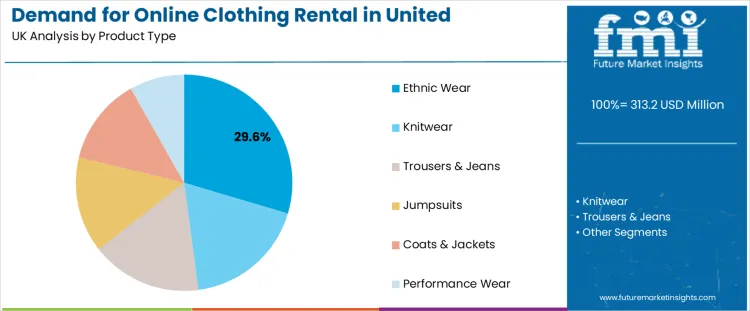
The product type segment for online clothing rental in the United Kingdom is predominantly led by ethnic wear, which captures 30% of the market share. Ethnic wear, particularly for occasions such as weddings, festivals, and cultural events, is a major driver of demand for clothing rental services. Consumers are increasingly opting to rent rather than buy high-cost, infrequently worn ethnic garments, particularly as fashion trends shift toward sustainability. Renting allows customers to wear designer or high-quality traditional outfits for short-term use, without the financial and environmental costs of ownership. Knitwear follows as a significant product type in the rental market, especially as colder seasons approach. Knitwear items like sweaters, cardigans, and knitted dresses are often rented for both casual and formal occasions, offering a cost-effective solution for consumers who want variety without the long-term commitment. Trousers & jeans, jumpsuits, and coats & jackets are also commonly rented, with rental services offering customers the opportunity to access premium or seasonal styles without having to purchase them. The growing popularity of performance wear rental, especially for sports events or activewear, is another trend, as consumers seek high-performance clothing without the need for ownership. As the demand for diverse and occasion-based clothing continues to rise, the online clothing rental market in the UK is expected to see growth across these product types, with ethnic wear maintaining its dominance due to its high value and occasional use.
What Is the End-User Segment of Demand for Online Clothing Rental in the United Kingdom?
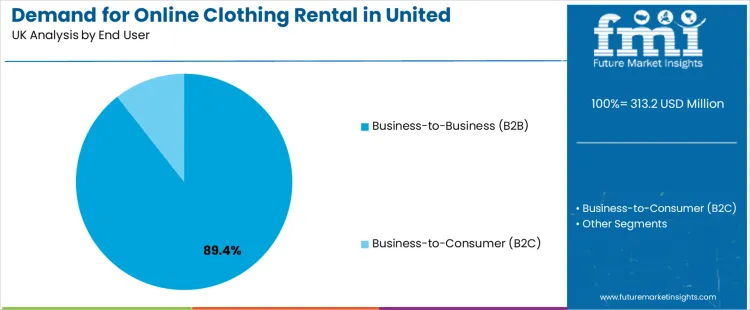
The end-user segment for online clothing rental in the United Kingdom is overwhelmingly dominated by Business-to-Business (B2B), which accounts for 89.4% of the market share. B2B rental services cater to businesses, including event organizers, production companies, corporate clients, and retailers, who rent clothing in bulk for specific needs such as staff uniforms, event wear, or fashion shows. This sector has seen significant growth due to its cost-effective solutions, particularly in industries that require a large volume of clothing for temporary use. Online rental services offer businesses the flexibility to rent high-quality garments for short-term needs, ensuring that they maintain a professional image while keeping costs low. Business-to-Consumer (B2C) rental services, while representing a smaller portion of the market, are also growing rapidly. B2C rental caters to individual consumers who seek occasional access to premium or designer clothing without the cost and commitment of ownership. This market is driven by consumers’ desire for variety, sustainability, and affordability. As more consumers embrace sustainable fashion and the idea of renting over buying, the demand for B2C rental services continues to rise, particularly for event-specific or seasonal clothing. The B2B segment, however, remains dominant, with online clothing rental platforms focusing on offering tailored services to businesses while also expanding their offerings to meet the growing B2C demand. As consumer behavior shifts and awareness of sustainable fashion grows, both B2B and B2C markets are expected to expand further in the coming years.
What are the Key Dynamics in the Demand for Online Clothing Rental in the United Kingdom?
Demand for online clothing rental in the United Kingdom is evolving within a broader shift toward access based fashion rather than ownership. Consumers increasingly seek flexible wardrobe options that reduce the need for frequent purchases, particularly for special occasions, professional wardrobes, and transitional seasonal use. This demand intersects with sustainability narratives and digital consumption habits, creating a market where rental platforms, peer to peer services, and subscription wardrobes compete for user attention. Retailers, platform operators, and logistics partners must navigate consumer expectations for quality, convenience, return processing, and sizing accuracy to maintain engagement and repeat usage.
What are the Key Drivers for Online Clothing Rental Demand in the United Kingdom?
Several factors are driving uptake of online clothing rental in the United Kingdom. Consumer preferences are shifting toward experiences and access, encouraging trial of designer and high end fashion without the capital outlay of ownership. Sustainability concerns, particularly among younger cohorts, support rental as a means to reduce fashion waste and extend garment utilisation. Urban working professionals and event attendees favour rental solutions that simplify access to diverse wardrobe options without long term storage requirements. Digital platforms with intuitive interfaces, flexible booking periods, and transparent pricing improve market appeal. Social media influence and trend cycles also reinforce consumption of varied looks through rental rather than purchase.
What are the Restraints on Online Clothing Rental Demand in the United Kingdom?
Despite market potential, the online clothing rental sector in the United Kingdom faces several constraints. Operational costs associated with cleaning, repair, inventory turnover, and returns logistics can erode margin for rental providers, particularly those offering premium garments. Consumer concerns around hygiene, fit inconsistency, and potential damage liability influence conversion rates and repeat rentals. Size standardisation remains a challenge, requiring platforms to manage extensive size ranges and return rates that can increase operational burden. Market education is also ongoing, as some consumer segments remain unfamiliar or hesitant to adopt rental over ownership. Platform competition and price sensitivity in broader apparel spending further complicate customer acquisition.
What are the Key Trends in Online Clothing Rental Demand in the United Kingdom?
Key trends shaping demand for online clothing rental in the United Kingdom include expansion of subscription based wardrobes that allow frequent rotation of garments for a recurring fee, enhancing customer lifetime value. Partnerships between rental platforms and fashion brands or influencers extend reach and introduce curated collections to loyal communities. Investment in data analytics to personalise recommendations and optimise inventory allocation improves customer satisfaction and operational efficiency. There is also movement toward integrating rental services with resale and upcycling channels, enabling platforms to capture value across the garment lifecycle. Logistics innovations that streamline pick up, drop off, and garment care further strengthen market propositions for both urban and regional users.
What is the Country-Wise Demand for Online Clothing Rental in the United Kingdom?
The demand for online clothing rental in the United Kingdom shows substantial regional differences, with England leading the market. The increasing consumer preference for sustainable fashion, coupled with the rising interest in cost-effective clothing solutions, is driving the demand for online clothing rental services. In England, the demand is particularly high due to its larger population, fashion-forward culture, and higher concentration of consumers seeking variety without committing to full ownership. Scotland, Wales, and Northern Ireland follow with significant demand, driven by growing awareness of the environmental benefits of clothing rental services and the increasing popularity of rental models for special occasions and everyday wear. As online clothing rental services become more mainstream, the demand is expected to grow across all regions, with England remaining the dominant market.
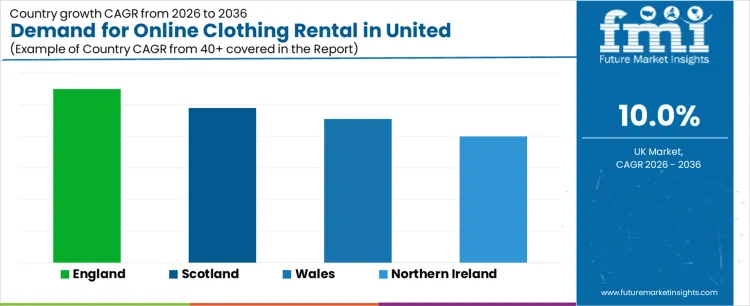
| Country | CAGR (2026 to 2036) |
|---|---|
| England | 11.0% |
| Scotland | 9.8% |
| Wales | 9.1% |
| Northern Ireland | 8.0% |
What is Driving the Demand for Online Clothing Rental in England?
The demand for online clothing rental in England is projected to grow at a CAGR of 11.0% from 2026 to 2036. England's fashion-conscious consumers, coupled with an increasing focus on sustainability and affordability, are the primary drivers of this demand. The growing popularity of rental models, especially for high-end, special-occasion, and seasonal wear, is changing consumer behavior. As fashion cycles shorten and the desire for variety increases, more consumers in England are turning to online clothing rental services to access a wide range of options without the long-term financial commitment. Additionally, the ease of use, convenience, and eco-friendly benefits associated with clothing rental platforms are fueling the market’s growth. The increasing use of digital platforms for fashion consumption, along with rising awareness of the environmental impact of fast fashion, will continue to drive demand for online clothing rental services in England.
How is the Demand for Online Clothing Rental Performing in Scotland?
In Scotland, the demand for online clothing rental is expected to grow at a CAGR of 9.8% from 2026 to 2036. The increasing demand for sustainable and versatile fashion solutions is the primary factor driving this growth. Consumers in Scotland are increasingly aware of the environmental impact of fast fashion, which is encouraging them to turn to clothing rental services. Special occasion wear, such as dresses and suits, as well as casual and everyday wear, are driving growth in the rental market. The rise of sustainable fashion initiatives, along with growing e-commerce penetration, is helping to make clothing rental more accessible to Scottish consumers. As the trend toward sustainability continues to rise, the market for online clothing rental in Scotland is expected to see steady growth, particularly among younger consumers and those seeking eco-friendly alternatives to traditional shopping.
What Are the Growth Drivers for Online Clothing Rental in Wales?
The demand for online clothing rental in Wales is projected to grow at a CAGR of 9.1% through 2036. The growing interest in sustainable living and eco-conscious shopping habits are key drivers of this demand. With the fashion industry being one of the largest polluters globally, more consumers in Wales are turning to rental services as an alternative to buying new clothing. Online platforms offering a variety of rental options for both everyday wear and special occasions are attracting a wide range of consumers. Furthermore, the increasing popularity of rental models among younger demographics, driven by affordability and convenience, is helping to push the demand for these services. As more Welsh consumers embrace the benefits of clothing rental, the market is expected to continue expanding, especially with the growing emphasis on sustainability and conscious consumption.
What is the Outlook for Online Clothing Rental Demand in Northern Ireland?
Northern Ireland’s demand for online clothing rental is expected to grow at a CAGR of 8.0% from 2026 to 2036. Although Northern Ireland represents the smallest market for online clothing rental in the United Kingdom, it is experiencing steady growth driven by increasing interest in sustainable fashion and cost-effective clothing options. Consumers in Northern Ireland are becoming more aware of the environmental and financial benefits of clothing rental services, which are helping to drive market growth. The demand for special occasion wear, such as wedding attire and formal dresses, along with the growing need for versatile and affordable everyday wear, is contributing to this increase. With rising awareness of the environmental impact of fast fashion and the growing presence of rental platforms in the region, Northern Ireland is expected to see steady growth in the online clothing rental market.
What is the Competitive Landscape for Demand for Online Clothing Rental in the United Kingdom?
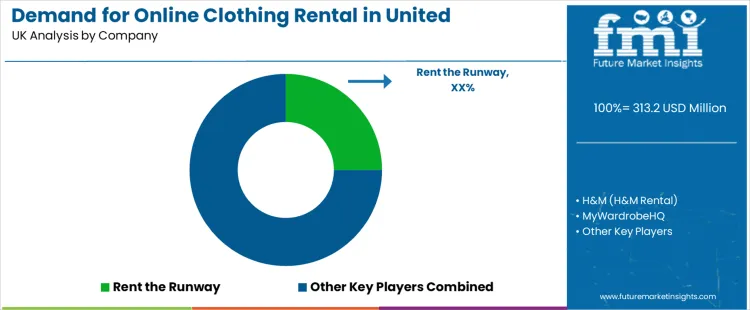
Demand for online clothing rental in the United Kingdom is influenced by shifts in consumer behaviour, sustainability preferences, and flexibility in wardrobe access without ownership. Retail buyers, platform operators, and brand partners evaluate service models, garment assortment depth, and logistical integration capabilities when considering supplier relationships. Rent the Runway is positioned as a leading platform, with service documentation that outlines catalogue breadth, garment turnover rates, and quality control processes used by category planners and partnership teams to assess fit with market demand. Providers of digital rentals evaluate performance data to align inventory decisions with seasonal trends and user engagement metrics.
H&M (H&M Rental) competes by leveraging established brand recognition and retail footprint to support online rental programmes. Internal documentation from H&M includes garment lifecycle assessments, fit data, and return compliance metrics that assist operations teams in reconciling rental availability with fulfilment capacity. MyWardrobeHQ offers rental services focused on designer and occasion wear, supported by materials that list curated inventory profiles, condition grading standards, and turnaround timelines for cleaning and redistribution. These specification documents are used by logistics planners and merchandising teams in the United Kingdom to ensure that inventory matches anticipated rental demand and quality expectations.
Le Tote’s documentation outlines flexible membership plans, garment rotation strategies, and technology integrations for user management, giving business development stakeholders insights into user retention patterns and subscription economics. GlamCorner supplies data on garment categories, rental durations, and cleaning protocols that are referenced by operational leads when planning garment flow and service level agreements. Buyers and platform managers in the United Kingdom assess metrics such as utilisation rates, return rates, and documented maintenance turnaround times during vendor evaluations. Lead times for inventory deployment, documented quality assurance checks, and documented hygiene and care standards feature prominently in service agreements. Competitive activity in the UK online clothing rental market is grounded in measurable service performance data, documented supply terms, and inventory quality benchmarks, providing clarity for platform operators, brand partners, and logistics providers during strategic planning and procurement cycles.
Key Players of the Demand for Online Clothing Rental in United Kingdom
- Rent the Runway
- H&M (H&M Rental)
- MyWardrobeHQ
- Le Tote
- GlamCorner
Scope of the Report
| Items | Values |
|---|---|
| Quantitative Units (2026) | USD Million |
| Product Type | Ethnic Wear, Knitwear, Trousers & Jeans, Jumpsuits, Coats & Jackets, Performance Wear |
| End User | Business-to-Business (B2B), Business-to-Consumer (B2C) |
| Companies | Rent the Runway, H&M (H&M Rental), MyWardrobeHQ, Le Tote, GlamCorner |
| Regions Covered | United Kingdom |
| Countries Covered | England, Scotland, Wales, Northern Ireland |
| Additional Attributes | Dollar by sales by product type, end user, and region. Includes market trends towards sustainability, convenience, and the role of online clothing rental services in the fashion industry. |
Key Segments of Demand for Online Clothing Rental in United Kingdom
Product Type:
- Ethnic Wear
- Knitwear
- Trousers & Jeans
- Jumpsuits
- Coats & Jackets
- Performance Wear
End User:
- Business-to-Business (B2B)
- Business-to-Consumer (B2C)
Countries:
- England
- Scotland
- Wales
- Northern Ireland
Bibliography
- Department for Environment, Food & Rural Affairs. (2024). Textiles, waste reduction, and circular economy strategy for England. UK Government.
- Department for Business and Trade. (2024). UK retail, e‑commerce, and consumer services: Structural shifts and digital adoption. UK Government.
- Office for National Statistics. (2024). Household expenditure, online retail behaviour, and clothing consumption patterns in the United Kingdom. ONS.
- Organisation for Economic Co-operation and Development. (2024). Circular business models, rental platforms, and consumer adoption in advanced economies. OECD Publishing.
- United Nations Environment Programme. (2024). Sustainability and circularity in the fashion and textiles sector. UNEP.
Frequently Asked Questions
How big is the demand for online clothing rental in united kingdom in 2026?
The demand for online clothing rental in united kingdom is estimated to be valued at USD 313.2 million in 2026.
What will be the size of online clothing rental in united kingdom in 2036?
The market size for the online clothing rental in united kingdom is projected to reach USD 812.4 million by 2036.
How much will be the demand for online clothing rental in united kingdom growth between 2026 and 2036?
The demand for online clothing rental in united kingdom is expected to grow at a 10.0% CAGR between 2026 and 2036.
What are the key product types in the online clothing rental in united kingdom?
The key product types in online clothing rental in united kingdom are ethnic wear, knitwear, trousers & jeans, jumpsuits, coats & jackets and performance wear.
Which end user segment is expected to contribute significant share in the online clothing rental in united kingdom in 2026?
In terms of end user, business-to-business (b2b) segment is expected to command 89.4% share in the online clothing rental in united kingdom in 2026.
Preview the report firsthand - request a free sample
Get SampleGet the brochure for pricing and purchase details.
Get PDFTable of Content
- Executive Summary
- UK Market Outlook
- Demand-side Trends
- Supply-side Trends
- Technology Roadmap Analysis
- Analysis and Recommendations
- Market Overview
- Market Coverage / Taxonomy
- Market Definition / Scope / Limitations
- Market Background
- Market Dynamics
- Drivers
- Restraints
- Opportunity
- Trends
- Scenario Forecast
- Demand in Optimistic Scenario
- Demand in Likely Scenario
- Demand in Conservative Scenario
- Opportunity Map Analysis
- Product Life Cycle Analysis
- Supply Chain Analysis
- Investment Feasibility Matrix
- Value Chain Analysis
- PESTLE and Porter’s Analysis
- Regulatory Landscape
- Regional Parent Market Outlook
- Production and Consumption Statistics
- Import and Export Statistics
- Market Dynamics
- UK Market Analysis 2021 to 2025 and Forecast, 2026 to 2036
- Historical Market Size Value (USD Million) Analysis, 2021 to 2025
- Current and Future Market Size Value (USD Million) Projections, 2026 to 2036
- Y-o-Y Growth Trend Analysis
- Absolute $ Opportunity Analysis
- UK Market Pricing Analysis 2021 to 2025 and Forecast 2026 to 2036
- UK Market Analysis 2021 to 2025 and Forecast 2026 to 2036, By Product Type
- Introduction / Key Findings
- Historical Market Size Value (USD Million) Analysis By Product Type , 2021 to 2025
- Current and Future Market Size Value (USD Million) Analysis and Forecast By Product Type , 2026 to 2036
- Ethnic Wear
- Knitwear
- Trousers & Jeans
- Jumpsuits
- Coats & Jackets
- Performance Wear
- Ethnic Wear
- Y-o-Y Growth Trend Analysis By Product Type , 2021 to 2025
- Absolute $ Opportunity Analysis By Product Type , 2026 to 2036
- UK Market Analysis 2021 to 2025 and Forecast 2026 to 2036, By End User
- Introduction / Key Findings
- Historical Market Size Value (USD Million) Analysis By End User, 2021 to 2025
- Current and Future Market Size Value (USD Million) Analysis and Forecast By End User, 2026 to 2036
- Business-to-Business (B2B)
- Business-to-Consumer (B2C)
- Business-to-Business (B2B)
- Y-o-Y Growth Trend Analysis By End User, 2021 to 2025
- Absolute $ Opportunity Analysis By End User, 2026 to 2036
- Market Structure Analysis
- Competition Dashboard
- Competition Benchmarking
- Market Share Analysis of Top Players
- By Regional
- By Product Type
- By End User
- Competition Analysis
- Competition Deep Dive
- Rent the Runway
- Overview
- Product Portfolio
- Profitability by Market Segments (Product/Age /Sales Channel/Region)
- Sales Footprint
- Strategy Overview
- Marketing Strategy
- Product Strategy
- Channel Strategy
- H&M (H&M Rental)
- MyWardrobeHQ
- Le Tote
- GlamCorner
- Rent the Runway
- Competition Deep Dive
- Assumptions & Acronyms Used
- Research Methodology


