

- Industry Size (2026)
- USD 39.2 Mn
- Forecast (2036)
- USD 70.2 Mn
- CAGR (2026 to 2036)
- 6.0%
Optical Spectrum Analyzer Industry Forecast and Outlook in the UK 2026 to 2036
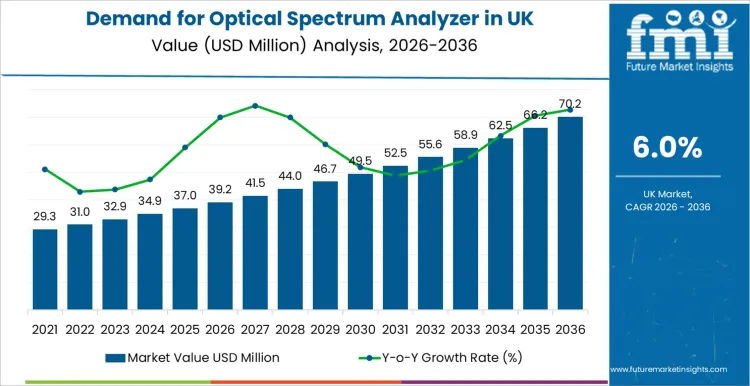
Demand for optical spectrum analyzers in the UK is projected to reach a valuation of USD 39.2 million in 2026. This sector is anticipated to achieve a size of USD 70.2 million by 2036, advancing at a compound annual growth rate CAGR of 6.0%. This expansion is fundamentally anchored in the UK's position as a global leader in advanced research, telecommunications innovation, and high-value manufacturing.
The critical need for precision optical measurement is being driven by massive investments in nationwide full-fibre and 5G standalone network rollouts, alongside pioneering work in quantum technologies, photonics, and defense systems. This creates a concentrated, high-specification demand for instrumentation capable of validating component performance, ensuring signal integrity, and accelerating R&D across both public institutions and private enterprise.
Quick Stats for Optical Spectrum Analyzer Demand in the UK
- Optical Spectrum Analyzer Sales Valuation in the UK (2026):USD 39.2 million
- Optical Spectrum Analyzer Sales Forecast Valuation in the UK (2036):USD 70.2 million
- Optical Spectrum Analyzer Industry in the UK Forecast CAGR (2026-2036):6.0%
- Leading Regional Growth: England (CAGR 6.6%)
- Leading Product Type: Portable Optical Spectrum Analyzers (40.0%)
- Leading Mode Type:;Spectrometer Mode (55.0%)
- Leading End Use:IT & Telecommunication (25.0%)
- Key Companies Profiled:Yokogawa Electric Corporation, Anritsu Corporation, EXFO Inc., Keysight Technologies, VIAVI Solutions Inc.
Why is the UK a Sophisticated Hub for Optical Spectrum Analysis?
The UK's demand for optical spectrum analyzers stems from its deep-rooted strengths in scientific discovery and its strategic drive to build next-generation digital infrastructure. The nation's ambitious goals for nationwide gigabit-capable broadband and secure 5/6G networks require unparalleled precision in testing the optical components that form the backbone of these systems.
Beyond telecommunications, the UK's world-class university and research institution ecosystem, engaged in cutting-edge photonics and quantum computing research, depends on these tools for experimental validation. Furthermore, thriving industries in aerospace, defense, and automotive LiDAR development utilize spectrum analysis to characterize lasers and sensors, ensuring performance and compliance in critical applications.
How is the Optical Spectrum Analyzer Landscape Segmented by Type, Function, and Application?
This sector is categorized by the physical design of the instrument, its core operational methodology, and the industry in which it is deployed. This segmentation reveals a market where mobility for field applications and detailed spectral analysis for lab work are equally prized, tailored to solve distinct challenges from network commissioning to benchtop research. The end-use distribution highlights how this specialized technology permeates industries where light-based measurement is non-negotiable for progress, quality, and safety.
Which Product Type Balances Capability with Field Readiness?
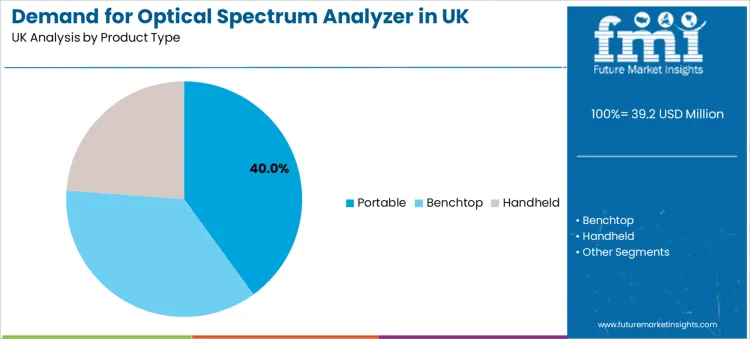
Portable optical spectrum analyzers hold a significant 40.0% share. Their prominence is driven by the extensive field deployment and maintenance requirements of the UK's expanding fibre and wireless networks.Engineers require robust, accurate instruments they can transport to cell sites, data centre interconnects, and remote installation points to perform live network diagnostics and commissioning without sacrificing analytical depth, making portability a key operational asset.
Which Operational Mode is Indispensable for Detailed Characterization?
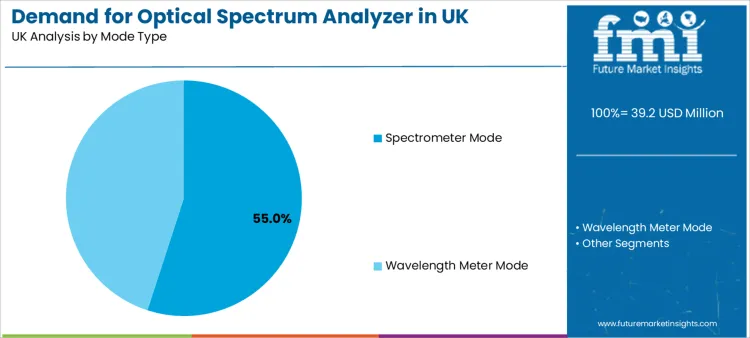
Spectrometer Mode commands the leading share among mode types, estimated at 55.0%. This mode is the fundamental tool for displaying optical power as a function of wavelength, making it essential for analysing signal-to-noise ratios, identifying sources of interference, and characterizing lasers and LEDs. Its dominance underscores that detailed spectral analysis remains the cornerstone application for these devices in both telecom infrastructure expansion and advanced photonics research and development.
Which End-Use Sector is the Foremost Investor in this Technology?
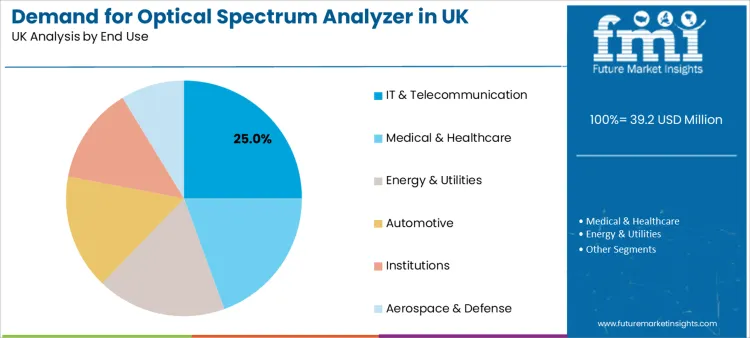
The IT & Telecommunication sector stands as the largest end-user, with an estimated 25.0% share. This is a direct result of continuous capital expenditure by network operators to build and validate new optical transport networks.The aerospace, defense, and security testing sector is a critical high-value segment, utilizing analyzers for laser rangefinder validation, free-space optical communication, and sensor development. Academic and government research institutions, along with the medical and automotive sectors, contribute substantial and growing demand for specialized applications.
What are the Dynamics, Restraints, Opportunities, and Threats Shaping this Sector?
How are Network Expansion and Research Frontiers Driving Consistent Demand?
The primary growth driver is the sustained, large-scale investment in national full-fibre and 5G/6G infrastructure projects, which mandate extensive optical testing at every phase. Concurrently, the UK's strong public and private investment in quantum technology and photonics research creates a continuous need for high-precision, often customized, analytical instrumentation in laboratory settings. The transition to more complex network architectures like dense wavelength division multiplexing (DWDM) further escalates the requirement for sophisticated analysis to manage channel capacity and performance.
Do High Capital Costs and Technical Complexity Restrain Wider Deployment?
A significant restraint is the substantial upfront capital required for high-performance benchtop analyzers, which can be prohibitive for smaller enterprises, universities, or startups. The technical complexity of operating advanced instruments and interpreting their data creates a reliance on highly skilled personnel, potentially limiting their use to specialized teams. Long procurement cycles, especially within public sector and institutional buyers, can also slow the pace of technology refresh and adoption.
How are Emerging Technologies and Service Models Creating New Potential?
Substantial opportunities are emerging from the development of application-specific analyzers for new fields like quantum key distribution (QKD) and silicon photonics testing. The growth of Robotics and Autonomous Vehicle sensing systems, which rely on LiDAR, presents a new frontier for optical component validation. Furthermore, the expansion of rental and calibration service models lowers the entry barrier for intermittent users and helps organizations manage capital expenditure while accessing the latest technology.
What External Factors Could Challenge Sector Growth?
The sector faces threats from global supply chain fragility affecting the availability of specialized optical components and semiconductors needed for manufacturing. Economic austerity measures could delay or cancel large public infrastructure projects, which are key demand drivers. Rapid technological evolution also risks obsolescence, requiring continuous R&D investment from manufacturers to stay competitive. Geopolitical factors influencing international research collaboration could also impact demand from the academic sector.
How is Optical Spectrum Analyzer Demand Evolving across Key Regions in the UK?
Growth is influenced by regional economic specialization, the concentration of research hubs, and the geographic rollout of national infrastructure projects. The projected compound annual growth rates from 2026 to 2036 illustrate these geographic distinctions.
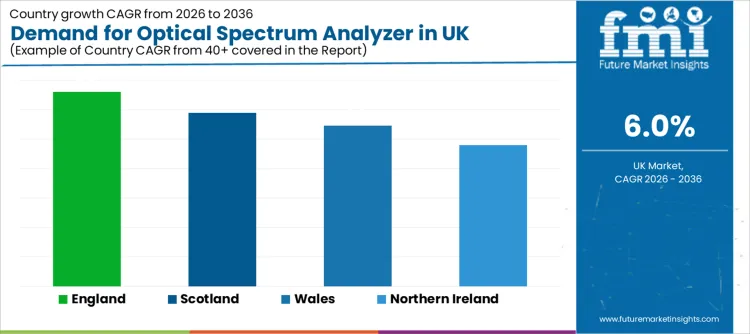
| Region | CAGR (2026-2036) |
|---|---|
| England | 6.6% |
| Scotland | 5.9% |
| Wales | 5.5% |
| Northern Ireland | 4.8% |
What is Fuelling Premier Growth in England?
England leads with a projected CAGR of 6.6%. This is driven by its concentration of telecom network operators' headquarters, major R&D centres for defence and aerospace, and world-renowned university clusters in the Golden Triangle of London, Oxford, and Cambridge.It is the primary hub for both the deployment of national infrastructure and the cutting-edge research that creates future demand, serving as the central nexus for the UK's test and measurement equipment sector.
Why is Scotland a Key Centre for Advanced Research and Development?
Scotland exhibits a strong CAGR of 5.9%, powered by its leading academic institutions in photonics and engineering, such as the University of Glasgow and Heriot-Watt University. The presence of a significant technology and space industry cluster, alongside submarine fibre cable landing stations, creates demand for both research-grade instrumentation and field-ready tools for network monitoring and validation.
What Factors Underpin Steady Demand in Wales and Northern Ireland?
Wales and Northern Ireland show stable, positive growth. Wales, with a CAGR of 5.5%, benefits from investments in compound semiconductor manufacturing and its own academic strengths, driving demand for process monitoring and research analyzers.Northern Ireland, with a projected CAGR of 4.8%, reflects growth supported by its universities, cybersecurity industry, and the ongoing regional upgrade of telecom and utility networks, aligning with broader regional digital infrastructure development initiatives.
What Defines the Competitive Landscape of the Optical Spectrum Analyzer Industry?
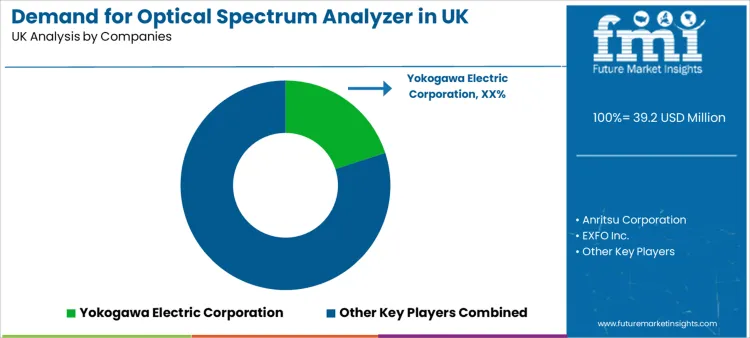
The competitive environment is characterized by intense rivalry on the basis of measurement accuracy, speed, sensitivity, and application-specific software solutions. Established global giants compete with specialized firms, where differentiation is achieved through deep expertise in niche areas like ultra-high-resolution measurements or ruggedized field deployment.
Success depends not only on hardware excellence but on providing comprehensive software for data analysis, seamless integration with automation systems, and robust global support and calibration services. Forming strategic partnerships with key industrial and academic research centres is a critical tactic for influencing specifications and securing large institutional contracts.
Key Industry Participants
- Yokogawa Electric Corporation
- Anritsu Corporation
- EXFO Inc.
- Keysight Technologies
- VIAVI Solutions Inc.
Scope of Report
| Items | Values |
|---|---|
| Quantitative Units | USD Million |
| Product Type | Portable, Benchtop, Handheld |
| Mode Type | Spectrometer Mode, Wavelength Meter Mode |
| End Use | IT & Telecommunication, Medical & Healthcare, Energy & Utilities, Automotive, Institutions, Aerospace & Defense |
| Regions Covered | England, Scotland, Wales, Northern Ireland |
| Key Companies Profiled | Yokogawa Electric Corporation, Anritsu Corporation, EXFO Inc., Keysight Technologies, VIAVI Solutions Inc. |
Optical Spectrum Analyzer in the UK by Segment
By Product Type
- Portable
- Benchtop
- Handheld
By Mode Type
- Spectrometer Mode
- Wavelength Meter Mode
By End Use
- IT & Telecommunication
- Medical & Healthcare
- Energy & Utilities
- Automotive
- Institutions (Academic/Research)
- Aerospace & Defense
By Region
- England
- Scotland
- Wales
- Northern Ireland
Bibliography
- Department for Science, Innovation & Technology (DSIT), UK. (2023). UK Wireless Infrastructure Strategy and Future Telecoms Research.
- Institute of Physics (IOP). (2024). UK Photonics and Optics Industry Report: Capabilities and Infrastructure.
- TechUK. (2023). The Test, Measurement & Verification Sector: Enabling UK Innovation and Infrastructure.
Frequently Asked Questions
How big is the demand for optical spectrum analyzer in uk in 2026?
The demand for optical spectrum analyzer in uk is estimated to be valued at USD 39.2 million in 2026.
What will be the size of optical spectrum analyzer in uk in 2036?
The market size for the optical spectrum analyzer in uk is projected to reach USD 70.2 million by 2036.
How much will be the demand for optical spectrum analyzer in uk growth between 2026 and 2036?
The demand for optical spectrum analyzer in uk is expected to grow at a 6.0% CAGR between 2026 and 2036.
What are the key product types in the optical spectrum analyzer in uk ?
The key product types in optical spectrum analyzer in uk are portable, benchtop and handheld.
Which mode type segment is expected to contribute significant share in the optical spectrum analyzer in uk in 2026?
In terms of mode type, spectrometer mode segment is expected to command 55.0% share in the optical spectrum analyzer in uk in 2026.
Preview the report firsthand - request a free sample
Get SampleGet the brochure for pricing and purchase details.
Get PDFTable of Content
- Executive Summary
- UK Market Outlook
- Demand-side Trends
- Supply-side Trends
- Technology Roadmap Analysis
- Analysis and Recommendations
- Market Overview
- Market Coverage / Taxonomy
- Market Definition / Scope / Limitations
- Market Background
- Market Dynamics
- Drivers
- Restraints
- Opportunity
- Trends
- Scenario Forecast
- Demand in Optimistic Scenario
- Demand in Likely Scenario
- Demand in Conservative Scenario
- Opportunity Map Analysis
- Product Life Cycle Analysis
- Supply Chain Analysis
- Investment Feasibility Matrix
- Value Chain Analysis
- PESTLE and Porter’s Analysis
- Regulatory Landscape
- Regional Parent Market Outlook
- Production and Consumption Statistics
- Import and Export Statistics
- Market Dynamics
- UK Market Analysis 2021 to 2025 and Forecast, 2026 to 2036
- Historical Market Size Value (USD Million) Analysis, 2021 to 2025
- Current and Future Market Size Value (USD Million) Projections, 2026 to 2036
- Y-o-Y Growth Trend Analysis
- Absolute $ Opportunity Analysis
- UK Market Pricing Analysis 2021 to 2025 and Forecast 2026 to 2036
- UK Market Analysis 2021 to 2025 and Forecast 2026 to 2036, By Product Type
- Introduction / Key Findings
- Historical Market Size Value (USD Million) Analysis By Product Type , 2021 to 2025
- Current and Future Market Size Value (USD Million) Analysis and Forecast By Product Type , 2026 to 2036
- Portable
- Benchtop
- Handheld
- Portable
- Y-o-Y Growth Trend Analysis By Product Type , 2021 to 2025
- Absolute $ Opportunity Analysis By Product Type , 2026 to 2036
- UK Market Analysis 2021 to 2025 and Forecast 2026 to 2036, By Mode Type
- Introduction / Key Findings
- Historical Market Size Value (USD Million) Analysis By Mode Type, 2021 to 2025
- Current and Future Market Size Value (USD Million) Analysis and Forecast By Mode Type, 2026 to 2036
- Spectrometer Mode
- Wavelength Meter Mode
- Spectrometer Mode
- Y-o-Y Growth Trend Analysis By Mode Type, 2021 to 2025
- Absolute $ Opportunity Analysis By Mode Type, 2026 to 2036
- UK Market Analysis 2021 to 2025 and Forecast 2026 to 2036, By End Use
- Introduction / Key Findings
- Historical Market Size Value (USD Million) Analysis By End Use, 2021 to 2025
- Current and Future Market Size Value (USD Million) Analysis and Forecast By End Use, 2026 to 2036
- IT & Telecommunication
- Medical & Healthcare
- Energy & Utilities
- Automotive
- Institutions
- Aerospace & Defense
- IT & Telecommunication
- Y-o-Y Growth Trend Analysis By End Use, 2021 to 2025
- Absolute $ Opportunity Analysis By End Use, 2026 to 2036
- Market Structure Analysis
- Competition Dashboard
- Competition Benchmarking
- Market Share Analysis of Top Players
- By Regional
- By Product Type
- By Mode Type
- By End Use
- Competition Analysis
- Competition Deep Dive
- Yokogawa Electric Corporation
- Overview
- Product Portfolio
- Profitability by Market Segments (Product/Age /Sales Channel/Region)
- Sales Footprint
- Strategy Overview
- Marketing Strategy
- Product Strategy
- Channel Strategy
- Anritsu Corporation
- EXFO Inc.
- Keysight Technologies
- VIAVI Solutions Inc.
- Yokogawa Electric Corporation
- Competition Deep Dive
- Assumptions & Acronyms Used
- Research Methodology


