

- Industry Size (2026)
- USD 12.5 Mn
- Forecast (2036)
- USD 21.2 Mn
- CAGR (2026 to 2036)
- 5.4%
Optical Spectrum Analyzers Sector in South Korea: Forecast and Outlook 2026 to 2036
The optical spectrum analyzers landscape in South Korea is projected to reach a valuation of USD 12.5 million in 2026. This sector is anticipated to achieve a size of USD 21.2 million by 2036, advancing at a steady compound annual growth rate of 5.4%. This growth trajectory is firmly anchored in the country's aggressive investment in next-generation digital and physical infrastructure.
Demand is driven by the critical need for precision measurement in deploying and maintaining advanced optical networks, which form the backbone of high-speed communication and industrial innovation. The concentration of leading electronics manufacturers and relentless research and development activities further solidifies South Korea's role as a sophisticated market for high-end test and measurement equipment.
Quick Stats for Optical Spectrum Analyzers in South Korea:
- Optical Spectrum Analyzers Industry Valuation in South Korea (2026): USD 12.5 million
- Optical Spectrum Analyzers Sector Forecast Valuation in South Korea (2036): USD 21.2 million
- Optical Spectrum Analyzers Sector in South Korea Forecast CAGR: 5.4%
- Leading Regional Demand: Jeju (6.5%)
- Leading Product Type: Portable Optical Spectrum Analyzers (40.0%)
- Leading Mode Type: Spectrometer Mode (55.0%)
- Leading End-Use Sector: IT & Telecommunication (25.0%)
- Key Participants in the Optical Spectrum Analyzers Industry in South Korea: Yokogawa Electric Corporation, Anritsu Corporation; EXFO Inc.; Keysight Technologies; VIAVI Solutions Inc.
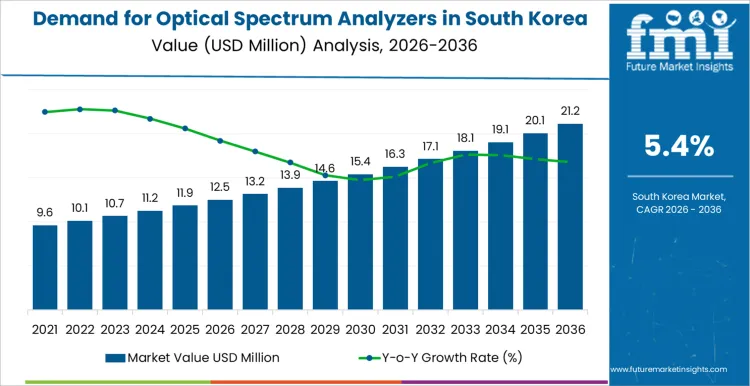
Why is South Korea Prioritizing Optical Spectrum Analyzer Deployment?
The strategic adoption of optical spectrum analyzers is a direct response to South Korea's position at the forefront of the global digital economy. The nationwide rollout and densification of 5G infrastructure deployment require meticulous verification of optical component performance and signal integrity.
Furthermore, the massive expansion of data centers and fiber-to-the-home networks necessitates rigorous testing to ensure bandwidth capacity and minimal signal loss. This overarching demand for validation and quality assurance across multiple industries mirrors trends observed in the broader test and measurement equipment sector. Beyond telecommunications, sectors like advanced manufacturing and healthcare are leveraging these analyzers for quality control and research, utilizing their capability to characterize lasers and light-based systems with extreme accuracy.
How is the Optical Spectrum Analyzers Arena Structured across Key Segments?
Product type, operational mode, and end-use industry, each addressing specific measurement scenarios and environmental requirements segment the optical spectrum analyzers industry in South Korea.
This segmentation reflects the diverse applications, from field service engineering to benchtop laboratory research, and highlights the varying performance priorities across different industries. Understanding this structure is essential for grasping how technological capabilities meet practical, on-the-ground demands in a high-tech economy.
Which Product Type Balances Mobility and Performance?
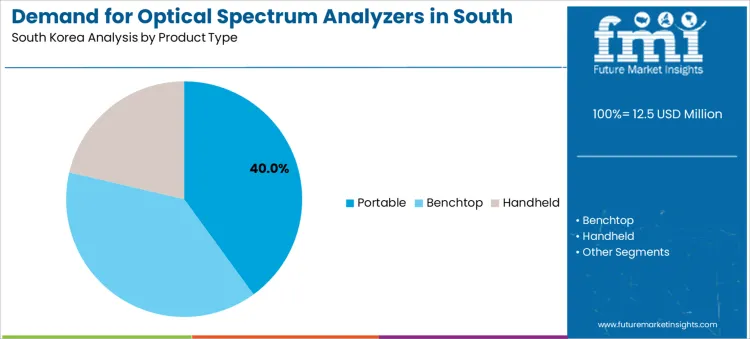
Portable optical spectrum analyzers hold a significant share, estimated at 40.0%. Their dominance is attributed to the growing need for field-based testing and maintenance across widespread telecommunication networks and industrial sites.
These devices offer a compelling balance of performance and mobility, allowing technicians to conduct critical measurements directly at cell towers, data center interconnects, or remote installation sites without sacrificing essential analytical capabilities.
Which Operational Mode is Most Critical for Analytical Depth?
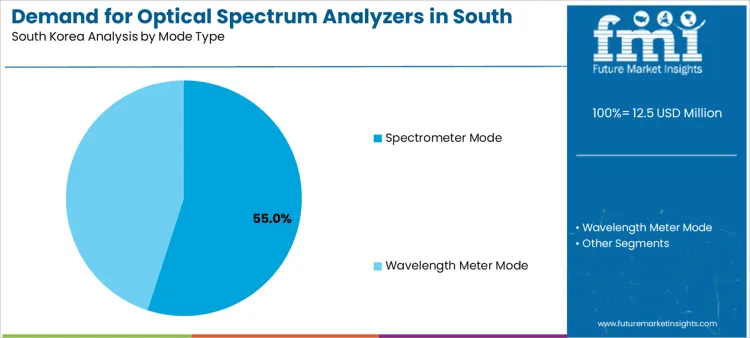
Spectrometer mode commands the leading share among mode types, estimated at 55.0%. This mode is fundamental for its ability to provide detailed spectral analysis, displaying optical power as a function of wavelength.
It is indispensable for tasks such as characterizing light sources, measuring signal-to-noise ratios, and identifying spectral impurities in Fiber Optic Network Expansion projects, making it the cornerstone mode for both development and troubleshooting.
Which End-Use Sector is the Primary Demand Driver?
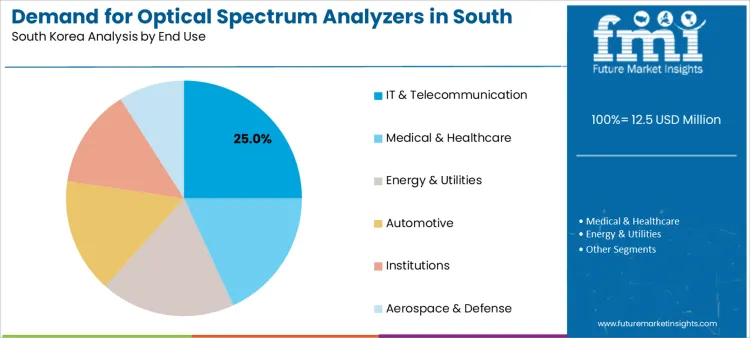
The IT & Telecommunication sector is the largest end-user, with an estimated 25.0% share. This dominance is driven by continuous network upgrades, the deployment of 5G standalone cores, and the maintenance of existing fiber optic infrastructure.
Analyzers in this sector ensure network reliability and performance. The medical and healthcare diagnostics sector is a key growth area, utilizing these tools for optical coherence tomography and biomedical sensing applications.
What are the Dynamics, Restraints, Opportunities, and Threats Shaping the Sector?
How is Massive Digital Infrastructure Investment Driving Growth?
The primary growth driver is the unprecedented investment in digital infrastructure, including 5G, cloud data centers, and national broadband projects. Government initiatives and private sector spending mandate the use of precise optical testing to guarantee service level agreements and network reliability. The rise of automotive LiDAR and sensing technologies in the electric and autonomous vehicle space is creating a new wave of demand for spectrum analysis in manufacturing validation.
Do High Costs and Specialized Expertise Restrain Broader Adoption?
A significant restraint is the substantial capital investment required for high-performance analyzers, particularly for bench-top models with advanced features. This can be a barrier for small and medium-sized enterprises or academic institutions. Furthermore, operating these sophisticated instruments requires specialized technical knowledge, creating a dependency on skilled personnel and potentially slowing down widespread operational integration.
How are Emerging Technologies Creating New Application Frontiers?
Substantial opportunities are emerging from the development of new photonic technologies and applied research. The growth of quantum computing research, silicon photonics, and advanced photovoltaics relies heavily on precise optical characterization.
The expansion of aerospace and defense testing applications, where optical systems are used in communications and sensing, presents a high-value, niche market for specialized analyzer capabilities.
What External Factors Could Challenge Sector Stability?
The sector faces threats from global supply chain disruptions affecting the availability of specialized optical components and semiconductors needed to manufacture these analyzers. Intense competition among established global players could lead to price pressures, squeezing margins. Rapid technological obsolescence requires continuous R&D investment to keep product offerings at the cutting edge, posing a challenge for all market participants.
How is Demand for Optical Spectrum Analyzers Distributed across South Korean Regions?
Demand within South Korea exhibits clear geographic patterns, closely aligned with the location of technology hubs, research institutes, and major infrastructure projects. The following table outlines the estimated demand share across key provinces:
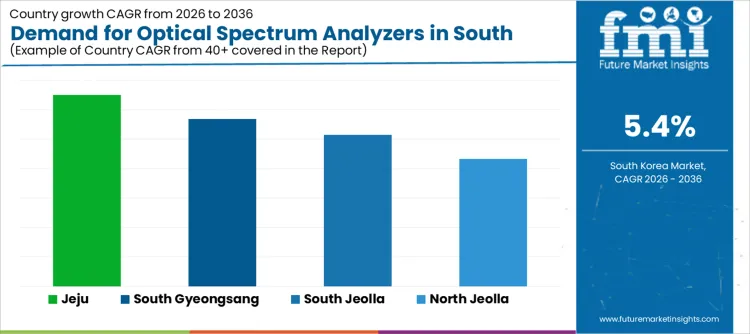
| Region | CAGR (2026 to 2036) |
|---|---|
| Jeju | 6.5% |
| South Gyeongsang | 5.7% |
| South Jeolla | 5.1% |
| North Jeolla | 4.3% |
What makes Jeju a Leading Region for Optical Spectrum Analyzer Demand?
Jeju Island leads regional demand with a 6.5% share. This prominence is largely due to its unique ecosystem as a testbed for smart grid technologies, renewable energy projects, and its focus on becoming a smart city and IoT hub. These initiatives involve dense deployments of sensor networks and communication systems that require rigorous optical testing and monitoring, driving consistent demand for portable and benchtop analyzers in both deployment and maintenance phases.
Why is South Gyeongsang a Key Consumption Center?
South Gyeongsang holds a strong demand share of 5.7%, fueled by its robust industrial manufacturing base, particularly in optics and precision machinery. The presence of large industrial complexes and manufacturing plants necessitates quality control and research applications for optical components. Ongoing infrastructure development in the region supports demand from the construction and utilities sectors for related testing equipment.
What Factors Underpin Demand in the Jeolla Provinces?
The combined demand from South and North Jeolla provinces is noteworthy. South Jeolla, with a 5.1% share, benefits from significant investments in renewable energy infrastructure and regional research parks. North Jeolla, at 4.3%, is home to several universities and institutions engaged in advanced materials and photonics research, fostering demand for high-precision benchtop analyzers in academic and applied research settings, a trend supported by extensive academic and institutional research and development.
What Defines the Competitive Landscape of the Optical Spectrum Analyzers Industry?
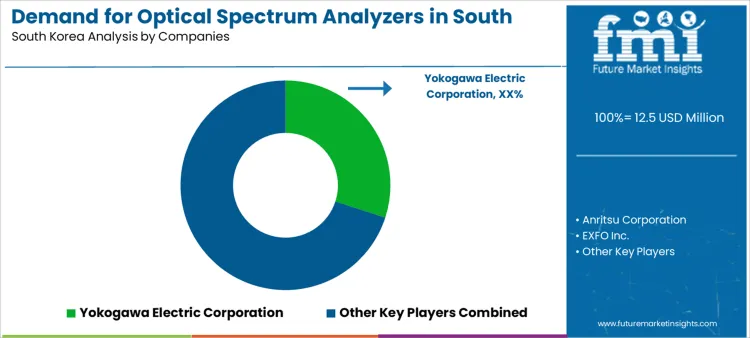
The competitive environment is defined by technological prowess, measurement accuracy, and application-specific expertise. Companies compete on the basis of instrument resolution, sensitivity, speed, and the sophistication of their analytical software. Strong after-sales support, calibration services, and deep partnerships with key industrial and telecommunications players are critical for long-term success.
The landscape features global giants competing with specialized firms, where innovation in miniaturization for portable units and software algorithms for automated analysis are key battlegrounds. Navigating the complex requirements of different end-use sectors, from telecom to defense, requires both broad and deep product portfolios.
Key Industry Participants
- Yokogawa Electric Corporation
- Anritsu Corporation
- EXFO Inc.
- Keysight Technologies
- VIAVI Solutions Inc.
Scope of Report
| Items | Values |
|---|---|
| Quantitative Units | USD Million |
| Product Type | Portable; Benchtop; Handheld |
| Mode Type | Spectrometer Mode; Wavelength Meter Mode |
| End-Use Sector | IT & Telecommunication; Medical & Healthcare; Energy & Utilities; Automotive; Institutions; Aerospace & Defense |
| Regions Covered | Jeju; South Gyeongsang; South Jeolla; North Jeolla |
| Key Companies Profiled | Yokogawa Electric Corporation; Anritsu Corporation; EXFO Inc.; Keysight Technologies; VIAVI Solutions Inc. |
Optical Spectrum Analyzers Sector in South Korea by Segment
By Product Type:
- Portable Optical Spectrum Analyzers
- Benchtop Optical Spectrum Analyzers
- Handheld Optical Spectrum Analyzers
By Mode Type:
- Spectrometer Mode
- Wavelength Meter Mode
By End-Use Sector:
- IT & Telecommunication
- Medical & Healthcare
- Energy & Utilities
- Automotive
- Institutions (Research & Academia)
- Aerospace & Defense
By Region:
- Jeju
- South Gyeongsang
- South Jeolla
- North Jeolla
Bibliography
- Korea Communications Commission (KCC). (2023). National Broadband and 5G Deployment White Paper.
- The Institute of Electronics and Information Engineers (IEIE). (2024). Journal on Optical Communication and Sensing Technologies.
- Ministry of Trade, Industry and Energy (MOTIE), South Korea. (2023). Strategic Roadmap for Advanced Test and Measurement Equipment.
Frequently Asked Questions
How big is the demand for optical spectrum analyzers in south korea in 2026?
The demand for optical spectrum analyzers in south korea is estimated to be valued at USD 12.5 million in 2026.
What will be the size of optical spectrum analyzers in south korea in 2036?
The market size for the optical spectrum analyzers in south korea is projected to reach USD 21.2 million by 2036.
How much will be the demand for optical spectrum analyzers in south korea growth between 2026 and 2036?
The demand for optical spectrum analyzers in south korea is expected to grow at a 5.4% CAGR between 2026 and 2036.
What are the key product types in the optical spectrum analyzers in south korea?
The key product types in optical spectrum analyzers in south korea are portable, benchtop and handheld.
Which mode type segment is expected to contribute significant share in the optical spectrum analyzers in south korea in 2026?
In terms of mode type, spectrometer mode segment is expected to command 55.0% share in the optical spectrum analyzers in south korea in 2026.
Preview the report firsthand - request a free sample
Get SampleGet the brochure for pricing and purchase details.
Get PDFTable of Content
- Executive Summary
- South Korea Market Outlook
- Demand-side Trends
- Supply-side Trends
- Technology Roadmap Analysis
- Analysis and Recommendations
- Market Overview
- Market Coverage / Taxonomy
- Market Definition / Scope / Limitations
- Market Background
- Market Dynamics
- Drivers
- Restraints
- Opportunity
- Trends
- Scenario Forecast
- Demand in Optimistic Scenario
- Demand in Likely Scenario
- Demand in Conservative Scenario
- Opportunity Map Analysis
- Product Life Cycle Analysis
- Supply Chain Analysis
- Investment Feasibility Matrix
- Value Chain Analysis
- PESTLE and Porter’s Analysis
- Regulatory Landscape
- Regional Parent Market Outlook
- Production and Consumption Statistics
- Import and Export Statistics
- Market Dynamics
- South Korea Market Analysis 2021 to 2025 and Forecast, 2026 to 2036
- Historical Market Size Value (USD Million) Analysis, 2021 to 2025
- Current and Future Market Size Value (USD Million) Projections, 2026 to 2036
- Y-o-Y Growth Trend Analysis
- Absolute $ Opportunity Analysis
- South Korea Market Pricing Analysis 2021 to 2025 and Forecast 2026 to 2036
- South Korea Market Analysis 2021 to 2025 and Forecast 2026 to 2036, By Product Type
- Introduction / Key Findings
- Historical Market Size Value (USD Million) Analysis By Product Type, 2021 to 2025
- Current and Future Market Size Value (USD Million) Analysis and Forecast By Product Type, 2026 to 2036
- Portable
- Benchtop
- Handheld
- Portable
- Y-o-Y Growth Trend Analysis By Product Type, 2021 to 2025
- Absolute $ Opportunity Analysis By Product Type, 2026 to 2036
- South Korea Market Analysis 2021 to 2025 and Forecast 2026 to 2036, By Mode Type
- Introduction / Key Findings
- Historical Market Size Value (USD Million) Analysis By Mode Type, 2021 to 2025
- Current and Future Market Size Value (USD Million) Analysis and Forecast By Mode Type, 2026 to 2036
- Spectrometer Mode
- Wavelength Meter Mode
- Spectrometer Mode
- Y-o-Y Growth Trend Analysis By Mode Type, 2021 to 2025
- Absolute $ Opportunity Analysis By Mode Type, 2026 to 2036
- South Korea Market Analysis 2021 to 2025 and Forecast 2026 to 2036, By End Use
- Introduction / Key Findings
- Historical Market Size Value (USD Million) Analysis By End Use, 2021 to 2025
- Current and Future Market Size Value (USD Million) Analysis and Forecast By End Use, 2026 to 2036
- IT & Telecommunication
- Medical & Healthcare
- Energy & Utilities
- Automotive
- Institutions
- Aerospace & Defense
- IT & Telecommunication
- Y-o-Y Growth Trend Analysis By End Use, 2021 to 2025
- Absolute $ Opportunity Analysis By End Use, 2026 to 2036
- Market Structure Analysis
- Competition Dashboard
- Competition Benchmarking
- Market Share Analysis of Top Players
- By Regional
- By Product Type
- By Mode Type
- By End Use
- Competition Analysis
- Competition Deep Dive
- Yokogawa Electric Corporation
- Overview
- Product Portfolio
- Profitability by Market Segments (Product/Age /Sales Channel/Region)
- Sales Footprint
- Strategy Overview
- Marketing Strategy
- Product Strategy
- Channel Strategy
- Anritsu Corporation
- EXFO Inc.
- Keysight Technologies
- VIAVI Solutions Inc.
- Yokogawa Electric Corporation
- Competition Deep Dive
- Assumptions & Acronyms Used
- Research Methodology


