

- Industry Size (2026)
- USD 349.3 Mn
- Forecast (2036)
- USD 571.8 Mn
- CAGR (2026 to 2036)
- 5.1%
Vertical Immersion Pump Industry Forecast and Outlook in the UK 2026 to 2036
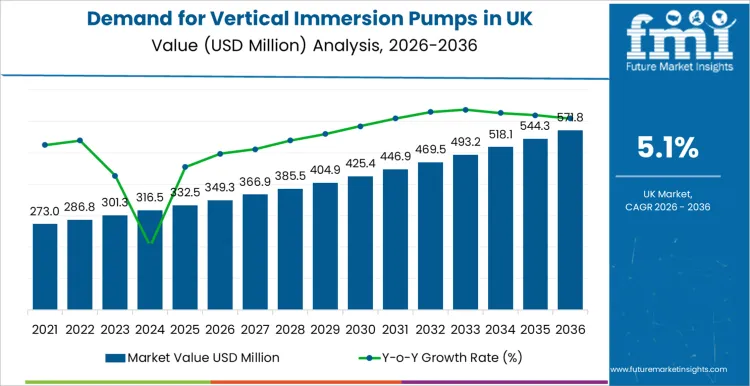
The demand for vertical immersion pumps in UK is projected to reach a valuation of USD 349.3 million in 2026. This sector is anticipated to achieve a size of USD 571.8 million by 2036, advancing at a compound annual growth rate of 5.1%. This expansion is fundamentally anchored in the UK's critical and ongoing investments in national water infrastructure, agricultural efficiency, industrial process cooling, and the development of renewable geothermal energy sources.
The need for reliable, high-efficiency pumping solutions is being driven by ageing water utility infrastructure requiring renewal, stringent regulations on water conservation and quality, and the push towards sustainable industrial processes. This creates a sustained demand for robust pumping equipment capable of operating in challenging sump, well, and tank conditions across public utilities, manufacturing, and the energy sector.
Quick Stats for Vertical Immersion Pump Demand in the UK
- Vertical Immersion Pump Industry Valuation in the UK (2026): USD 349.3 million
- Vertical Immersion Pump Industry Forecast Valuation in the UK (2036): USD 571.8 million
- Vertical Immersion Pump Industry in the UK Forecast CAGR (2026-2036): 5.1%
- Leading Regional Growth: England (CAGR 5.6%)
- Leading Product Type: Line Shaft Pump (55.0%)
- Leading Capacity: Up to 100m³/hr (38.0%)
- Leading Application: Irrigation (30.0%)
- Key Companies Profiled: Grundfos Holding A/S, KSB SE & Co. KGaA, Sulzer Ltd., Flowserve Corporation, ITT Inc.
Why is the UK a Sophisticated Hub for Vertical Immersion Pump Demand?
The UK's demand for vertical immersion pumps stems from its complex water management challenges and its advanced industrial base. The nation faces increasing pressure on water resources, driving investment in efficient irrigation systems for agriculture and modern, leak-resistant potable water supply networks.
The UK's significant manufacturing and power generation sectors rely on these pumps for critical cooling and dewatering applications to ensure operational continuity and environmental compliance.
Beyond traditional uses, the UK's pioneering work in geothermal energy exploration, particularly in regions with suitable geology, creates specialized demand for pumps capable of handling high-temperature geothermal brines. This combination of utility-led infrastructure renewal, industrial process needs, and emerging renewable energy projects establishes a mature and technically demanding market for pump manufacturers.
How is the Vertical Immersion Pump Landscape Segmented by Type, Capacity, and Application?
This sector is categorized by the mechanical design of the pump, its volumetric output, and its primary end-use function. This segmentation reveals a market where rugged reliability for deep wells and high-flow capabilities for industrial duties are equally critical, tailored to solve distinct challenges from field irrigation to plant-wide cooling systems.
Which Product Type Dominates in Deep-Well and High-Reliability Applications?
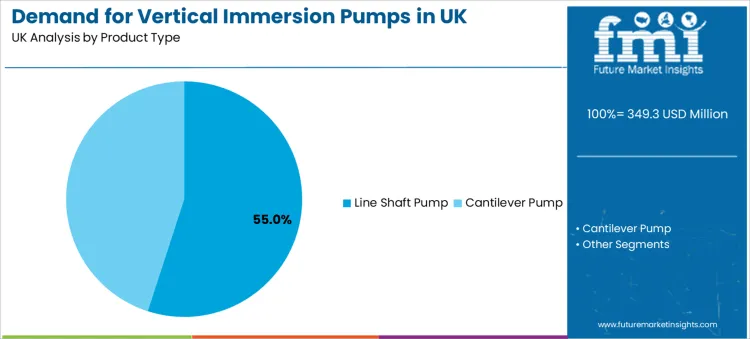
Line shaft pumps hold a commanding 55.0% share. Their prominence is driven by their fundamental design, which is ideal for deep-well applications common in municipal water supply, agricultural abstraction, and geothermal projects.
The separated motor and pump column provide exceptional reliability and serviceability in submerged conditions, making them the go-to solution for high-head, continuous-duty operations where failure is not an option.
Which Capacity Range Meets the Broadest Market Needs?
Pumps with a capacity of up to 100m³/hr constitute the leading segment at 38.0%. This range effectively serves a vast array of applications; including medium-scale agricultural irrigation, potable water supply for communities and commercial buildings, and various industrial dewatering and process fluid transfer tasks. Its dominance underscores the prevalence of distributed, mid-sized pumping requirements across the UK's infrastructure and industrial landscape.
Which Application is the Foremost Driver of Demand?
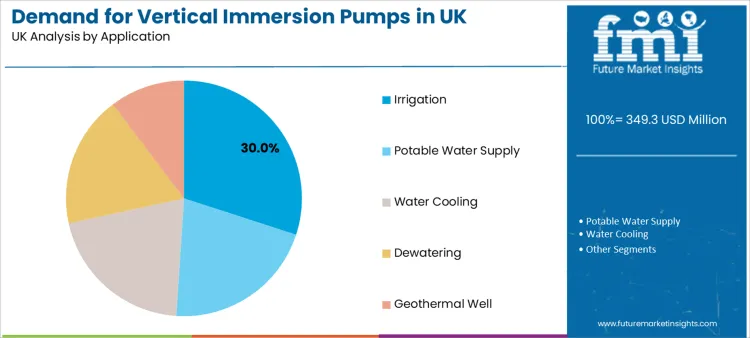
The Irrigation application stands as the largest end-use, with an estimated 30.0% share. This is a direct result of the agricultural sector's need for efficient water management and the modernisation of irrigation systems to enhance crop yield and conserve water.
The potable water supply sector is another critical high-volume segment, utilizing immersion pumps for raw water abstraction, treatment plant processes, and clean water boosting. Industrial applications such as water cooling for manufacturing and power generation, along with mine and construction dewatering, contribute substantial and consistent demand.
What are the Dynamics, Restraints, Opportunities, and Threats Shaping this Sector?
How are Infrastructure Renewal and Sustainability Goals Driving Consistent Demand?
The primary growth driver is the sustained, multi-billion-pound investment programme by UK water utilities to replace ageing assets, reduce leakage, and enhance treatment capacity, all of which require extensive new pumping equipment.
The push for agricultural water efficiency and the exploration of geothermal energy as a renewable baseload source create specialized demand. Stricter environmental regulations on industrial discharge and water usage also necessitate the installation of more efficient and controlled pumping systems.
Do High Capital Costs and Technical Site Challenges Restrain Wider Deployment?
A significant restraint is the substantial upfront capital and installation cost for large, custom-engineered vertical immersion pump systems, which can impact procurement timelines for public and private projects.
The technical complexity of site preparation, deep well drilling, and integration with control systems creates a reliance on specialized engineering consultancies and contractors. Long lead times for major projects and economic uncertainty can also delay final investment decisions in key sectors.
How are Smart Technology and Energy Efficiency Creating New Potential?
Substantial opportunities are emerging from the integration of smart pump systems with VFDs and IoT sensors for predictive maintenance and optimal energy use. The growth of the geothermal sector presents a new frontier for high-temperature, corrosion-resistant pump designs.
The increasing focus on life-cycle cost over initial purchase price favours manufacturers who can demonstrate superior energy efficiency and longer service intervals, opening doors for premium, sustainable solutions.
What External Factors Could Challenge Sector Growth?
The sector faces threats from volatility in raw material costs (e.g., special alloys, copper) affecting manufacturing margins. Economic downturns or public spending cuts could delay large-scale infrastructure projects, which are key demand drivers. Intense competition, particularly from global suppliers, pressures pricing. Supply chain disruptions for critical components like specialty motors or bearings could also impact project delivery schedules.
How is Vertical Immersion Pump Demand Evolving across Key Regions in the UK?
Growth is influenced by regional agricultural profiles, industrial concentration, water resource challenges, and the geographic focus of infrastructure spending. The projected compound annual growth rates from 2026 to 2036 illustrate these geographic distinctions.
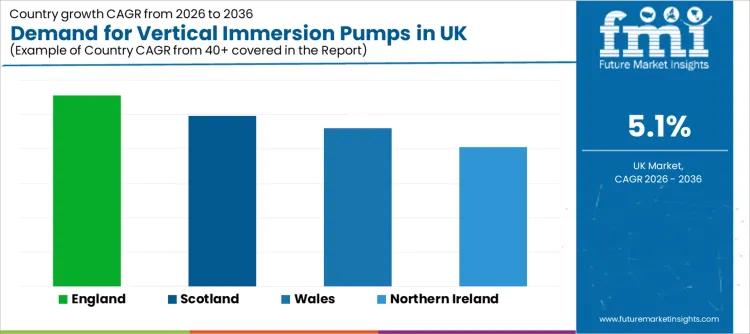
| Region | CAGR (2026-2036) |
|---|---|
| England | 5.6% |
| Scotland | 5.0% |
| Wales | 4.6% |
| Northern Ireland | 4.0% |
What is Fuelling Premier Growth in England?
England leads with a projected CAGR of 5.6%. This is driven by its large, concentrated population centres requiring extensive water supply and wastewater treatment infrastructure, its significant agricultural belt in the East reliant on irrigation, and the high density of manufacturing and power generation facilities needing process cooling. It is the primary hub for major utility capital projects and industrial investment.
Why is Scotland a Key Centre for Water and Energy Applications?
Scotland exhibits a solid CAGR of 5.0%, powered by its substantial investment in water infrastructure, a strong presence in whisky distilling and related process industries requiring pumping, and active development in hydro and geothermal energy projects. The region's focus on natural resource management and renewable energy creates a stable demand for both standard and specialized pumps.
What Factors Underpin Steady Demand in Wales and Northern Ireland?
Wales and Northern Ireland show stable, positive growth. Wales, with a CAGR of 4.6%, benefits from ongoing water utility investments, its industrial heritage in metals and chemicals, and agricultural activities. Northern Ireland, with a projected CAGR of 4.0%, reflects growth supported by regional water infrastructure upgrades and a strong agricultural sector, aligning with broader regional development initiatives for resource management.
What Defines the Competitive Landscape of the Vertical Immersion Pump Industry?
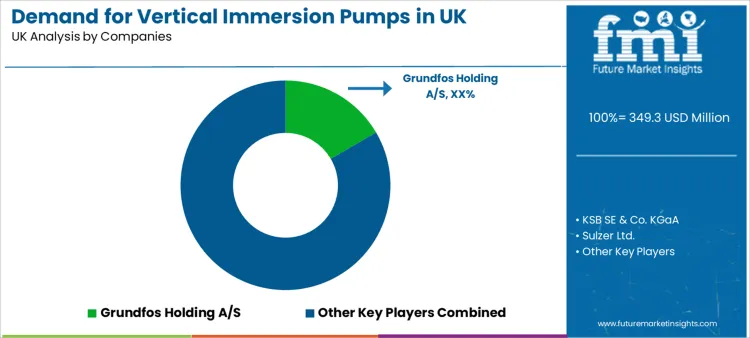
The competitive environment is characterized by intense rivalry on the basis of engineering expertise, energy efficiency, material durability, and after-sales service networks. Established global engineering conglomerates compete with specialized pump manufacturers, where differentiation is achieved through deep application knowledge in niches like geothermal, high-head water supply, or abrasive slurry handling.
Success depends not only on product reliability but on providing comprehensive system design support, advanced digital monitoring solutions, and robust local service and maintenance partnerships. Forming strategic alliances with major EPC firms and water utilities is a critical tactic for securing large, long-term framework agreements and influencing specification standards.
Key Industry Participants
- Grundfos Holding A/S
- KSB SE & Co. KGaA
- Sulzer Ltd.
- Flowserve Corporation
- ITT Inc.
Scope of Report
| Items | Values |
|---|---|
| Quantitative Units | USD Million |
| Product Type | Line Shaft Pump, Cantilever Pump |
| Capacity | Up to 100m³/hr, 100 to 500m³/hr, 500 to 1000m³/hr, Above 1000m³/hr |
| Application | Irrigation, Potable Water Supply, Water Cooling, Dewatering, Geothermal Well |
| Regions Covered | England, Scotland, Wales, Northern Ireland |
| Key Companies Profiled | Grundfos Holding A/S, KSB SE & Co. KGaA, Sulzer Ltd., Flowserve Corporation, ITT Inc. |
Vertical Immersion Pump Demand in the UK by Segment
By Product Type:
- Line Shaft Pump
- Cantilever Pump
By Capacity:
- Up to 100m³/hr
- 100 to 500m³/hr
- 500 to 1000m³/hr
- Above 1000m³/hr
By Application:
- Irrigation
- Potable Water Supply
- Water Cooling
- Dewatering
- Geothermal Well
By Region:
- England
- Scotland
- Wales
- Northern Ireland
Bibliography
- British Pump Manufacturers Association (BPMA). (2023). UK Pump Market Industry Report.
- Water UK. (2024). Water Industry National Environment Programme and Investment Outlook.
- Environment Agency. (2023). Water Resources and Infrastructure Planning for the Future.
- Department for Energy Security and Net Zero. (2024). Geothermal Energy Development in the UK.
Frequently Asked Questions
How big is the demand for vertical immersion pumps in uk in 2026?
The demand for vertical immersion pumps in uk is estimated to be valued at USD 349.3 million in 2026.
What will be the size of vertical immersion pumps in uk in 2036?
The market size for the vertical immersion pumps in uk is projected to reach USD 571.8 million by 2036.
How much will be the demand for vertical immersion pumps in uk growth between 2026 and 2036?
The demand for vertical immersion pumps in uk is expected to grow at a 5.1% CAGR between 2026 and 2036.
What are the key product types in the vertical immersion pumps in uk?
The key product types in vertical immersion pumps in uk are line shaft pump and cantilever pump.
Which capacity segment is expected to contribute significant share in the vertical immersion pumps in uk in 2026?
In terms of capacity, up to 100m³/hr segment is expected to command 38.0% share in the vertical immersion pumps in uk in 2026.
Preview the report firsthand - request a free sample
Get SampleGet the brochure for pricing and purchase details.
Get PDFTable of Content
- Executive Summary
- UK Market Outlook
- Demand-side Trends
- Supply-side Trends
- Technology Roadmap Analysis
- Analysis and Recommendations
- Market Overview
- Market Coverage / Taxonomy
- Market Definition / Scope / Limitations
- Market Background
- Market Dynamics
- Drivers
- Restraints
- Opportunity
- Trends
- Scenario Forecast
- Demand in Optimistic Scenario
- Demand in Likely Scenario
- Demand in Conservative Scenario
- Opportunity Map Analysis
- Product Life Cycle Analysis
- Supply Chain Analysis
- Investment Feasibility Matrix
- Value Chain Analysis
- PESTLE and Porter’s Analysis
- Regulatory Landscape
- Regional Parent Market Outlook
- Production and Consumption Statistics
- Import and Export Statistics
- Market Dynamics
- UK Market Analysis 2021 to 2025 and Forecast, 2026 to 2036
- Historical Market Size Value (USD Million) Analysis, 2021 to 2025
- Current and Future Market Size Value (USD Million) Projections, 2026 to 2036
- Y-o-Y Growth Trend Analysis
- Absolute $ Opportunity Analysis
- UK Market Pricing Analysis 2021 to 2025 and Forecast 2026 to 2036
- UK Market Analysis 2021 to 2025 and Forecast 2026 to 2036, By Product Type
- Introduction / Key Findings
- Historical Market Size Value (USD Million) Analysis By Product Type , 2021 to 2025
- Current and Future Market Size Value (USD Million) Analysis and Forecast By Product Type , 2026 to 2036
- Line Shaft Pump
- Cantilever Pump
- Line Shaft Pump
- Y-o-Y Growth Trend Analysis By Product Type , 2021 to 2025
- Absolute $ Opportunity Analysis By Product Type , 2026 to 2036
- UK Market Analysis 2021 to 2025 and Forecast 2026 to 2036, By Capacity
- Introduction / Key Findings
- Historical Market Size Value (USD Million) Analysis By Capacity, 2021 to 2025
- Current and Future Market Size Value (USD Million) Analysis and Forecast By Capacity, 2026 to 2036
- Up to 100m³/hr
- 100 to 500m³/hr
- 500 to 1000m³/hr
- Above 1000m³/hr
- Up to 100m³/hr
- Y-o-Y Growth Trend Analysis By Capacity, 2021 to 2025
- Absolute $ Opportunity Analysis By Capacity, 2026 to 2036
- UK Market Analysis 2021 to 2025 and Forecast 2026 to 2036, By Application
- Introduction / Key Findings
- Historical Market Size Value (USD Million) Analysis By Application, 2021 to 2025
- Current and Future Market Size Value (USD Million) Analysis and Forecast By Application, 2026 to 2036
- Irrigation
- Potable Water Supply
- Water Cooling
- Dewatering
- Geothermal Well
- Irrigation
- Y-o-Y Growth Trend Analysis By Application, 2021 to 2025
- Absolute $ Opportunity Analysis By Application, 2026 to 2036
- Market Structure Analysis
- Competition Dashboard
- Competition Benchmarking
- Market Share Analysis of Top Players
- By Regional
- By Product Type
- By Capacity
- By Application
- Competition Analysis
- Competition Deep Dive
- Grundfos Holding A/S
- Overview
- Product Portfolio
- Profitability by Market Segments (Product/Age /Sales Channel/Region)
- Sales Footprint
- Strategy Overview
- Marketing Strategy
- Product Strategy
- Channel Strategy
- KSB SE & Co. KGaA
- Sulzer Ltd.
- Flowserve Corporation
- ITT Inc.
- Grundfos Holding A/S
- Competition Deep Dive
- Assumptions & Acronyms Used
- Research Methodology


