

- Industry Size (2026)
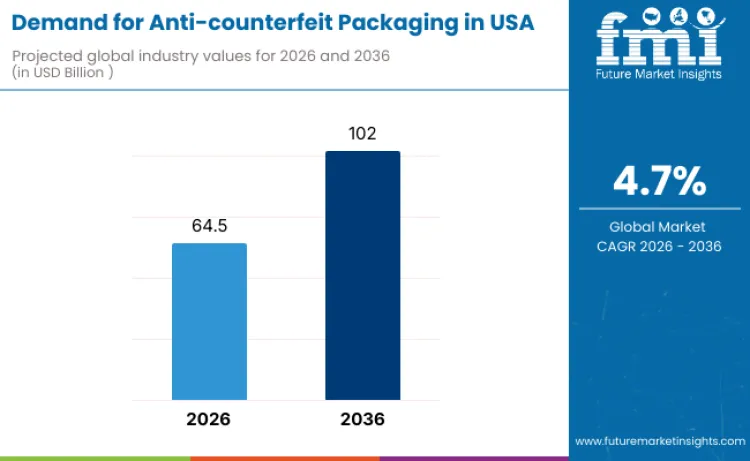
- USD 64.5 Bn
- Forecast (2036)
- USD 102.0 Bn
- CAGR (2026 to 2036)
- 4.7%
Demand for Anti-counterfeit Packaging in USA 2026 to 2036
Demand for Anti-counterfeit Packaging in USA is valued at USD 64.5 billion in 2026 and is projected to reach USD 102.0 billion by 2036, reflecting a CAGR of 4.7%. Demand grows as pharmaceutical, food, beverage, and personal care manufacturers address rising risks of counterfeiting, diversion, and product tampering. Regulatory enforcement, patient safety requirements, and brand-protection priorities accelerate adoption of advanced authentication and traceability solutions across regulated supply chains.
Bottles and jars lead packaging-format usage because these formats dominate pharmaceuticals, nutraceuticals, spirits, and personal care categories that face high counterfeiting exposure. Integration of tamper-evident closures, serialized labels, covert inks, holographic elements, and digital authentication features strengthens product security without disrupting existing filling lines. Compatibility with track-and-trace systems and consumer verification tools further supports widespread implementation.
Quick Stats for Demand for Anti-counterfeit Packaging in USA
- USA Anti-counterfeit Packaging Sales Value (2026): USD 64.5 billion
- USA Anti-counterfeit Packaging Forecast Value (2036): USD 102.0 billion
- USA Anti-counterfeit Packaging Forecast CAGR (2026 to 2036): 4.7%
- Leading Packaging Format in USA Demand: Bottles and Jars
- Key Growth Regions in USA Demand: West USA, South USA, Northeast USA, Midwest USA
- Top Players in USA Demand: Avery Dennison, CCL Industries, SICPA, Authentix, DuPont
West USA, South USA, Northeast USA, and Midwest USA represent key growth regions due to concentration of pharmaceutical manufacturing, consumer goods production, and distribution hubs. Avery Dennison, CCL Industries, SICPA, Authentix, and DuPont anchor competitive activity through material science innovation, secure printing technologies, and end-to-end authentication platforms aligned with regulatory compliance and brand protection requirements across USA packaging ecosystems.
USA Anti-counterfeit Packaging Key Takeaways
| Metric | Value |
|---|---|
| USA Anti-counterfeit Packaging Sales Value (2026) | USD 64.5 billion |
| USA Anti-counterfeit Packaging Forecast Value (2036) | USD 102.0 billion |
| USA Anti-counterfeit Packaging Forecast CAGR (2026 to 2036) | 4.7% |
How Are the Segments Classified in the Demand for Anti-counterfeit Packaging in the USA?
Demand for anti-counterfeit packaging in the USA is shaped by regulatory enforcement, product authentication requirements, and rising risks associated with counterfeit goods. Brand owners and regulators evaluate traceability features, tamper evidence, serialization compatibility, and integration with existing packaging lines. Adoption patterns reflect strong use across regulated sectors, where packaging plays a central role in protecting patient safety, brand integrity, and supply-chain transparency within USA distribution systems.
Which Packaging Format Accounts for the Largest Share of Demand in the USA?
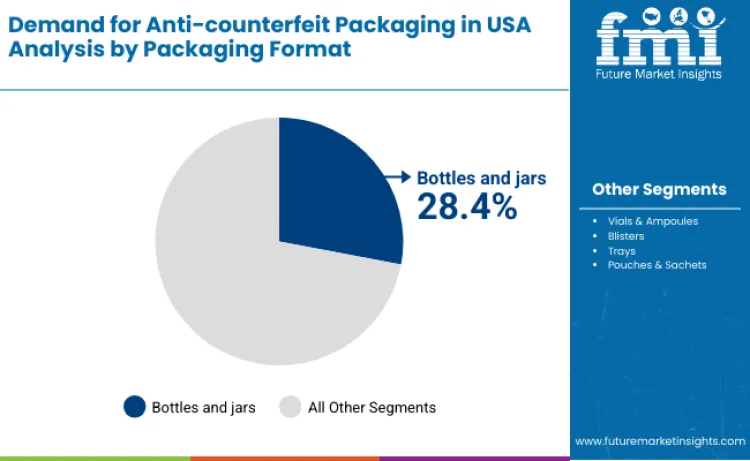
Bottles and jars hold 28.4%, making them the leading packaging-format segment in the USA. These formats are widely used in pharmaceuticals, nutraceuticals, and personal care products requiring authentication features such as tamper-evident seals and serialized labels. Blisters hold 23.5%, supporting unit-dose protection and traceability in solid-dose pharmaceuticals. Vials and ampoules account for 22.6%, where anti-counterfeit features protect injectable drugs. Pouches and sachets hold 13.0%, while trays account for 12.5%, serving food and specialty applications. Format distribution reflects concentration of authentication needs in container-based healthcare packaging.
Key Points:
- Bottles and jars dominate due to high healthcare usage.
- Blisters support unit-dose traceability requirements.
- Vials and ampoules require strong authentication for injectable.
Which End-Use Industry Accounts for the Largest Share of Demand in the USA?
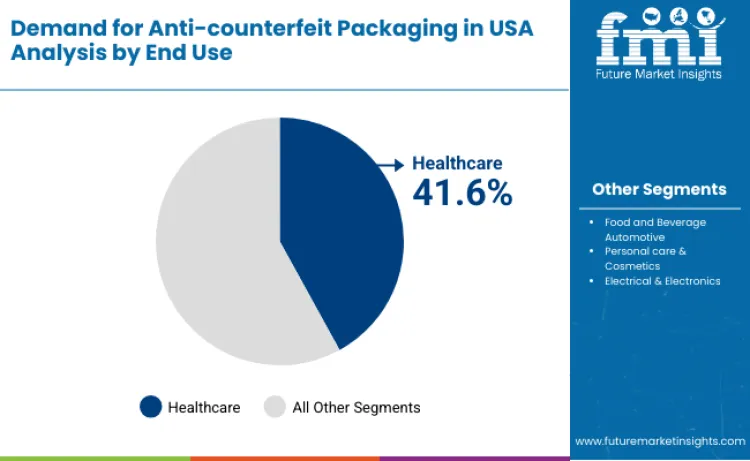
Healthcare holds 41.6%, making it the leading end-use industry in the USA. Pharmaceutical manufacturers apply anti-counterfeit packaging to meet serialization, track-and-trace, and patient-safety requirements. Food and beverage accounts for 21.4%, addressing brand protection and product authenticity concerns. Automotive applications hold 17.0%, focusing on counterfeit spare-parts prevention. Personal care and cosmetics hold 10.0%, protecting premium brands. Electrical and electronics also hold 10.0%, targeting component authenticity. End-use distribution reflects strict regulatory pressure and safety risk concentration within healthcare supply chains.
Key Points:
- Healthcare drives demand due to regulatory and safety needs.
- Food and beverage adopt protection for brand integrity.
- Automotive and electronics address counterfeit component risks.
What are the Key Dynamics in the Anti-counterfeit Packaging Industry in USA?
Demand increases as pharmaceutical, food, beverage, electronics, and consumer goods manufacturers strengthen protection against product diversion, fraud, and brand erosion in USA. Anti-counterfeit packaging solutions include serialization, tamper-evident features, track-and-trace systems, and digital authentication tools. Adoption aligns with regulatory compliance, patient safety, and supply-chain transparency requirements. Growth concentrates in regulated industries and high-value goods where authenticity assurance directly affects public safety and revenue integrity.
How do regulatory compliance and brand protection need drive demand in USA?
USA pharmaceutical manufacturers implement serialization and traceability to comply with Drug Supply Chain Security Act requirements. Unit-level identification, aggregation, and verification systems support visibility across wholesale and retail channels. Food and beverage brands apply tamper-evident seals and authentication labels to address contamination risk and recall management. Electronics and luxury goods companies use covert markers, QR-based verification, and RFID to deter grey-market activity. E-commerce expansion increases need for authentication at distribution and last-mile stages. Brand owners invest in packaging features that integrate with enterprise systems for monitoring and enforcement. Legal liability and consumer trust considerations reinforce continued adoption across regulated and premium product categories.
How do cost pressure, technology integration, and operational complexity influence demand stability?
Implementation requires capital investment in printing, inspection, and data management infrastructure. Smaller manufacturers face budget constraints when deploying advanced serialization or digital authentication. Integration with legacy packaging lines and IT systems increases deployment complexity. Data governance and cybersecurity requirements add operational overhead for track-and-trace platforms. Consumer engagement varies for overt authentication features, affecting perceived value. Counterfeiters adapt methods, requiring continuous technology updates. Regulatory audits and enforcement timelines shape rollout schedules. Demand remains stable in compliance-driven sectors, while broader expansion depends on cost efficiency, interoperability, and measurable return on investment across USA manufacturing and distribution networks.
How Is Demand for Anti-counterfeit Packaging in USA Evolving by Region?
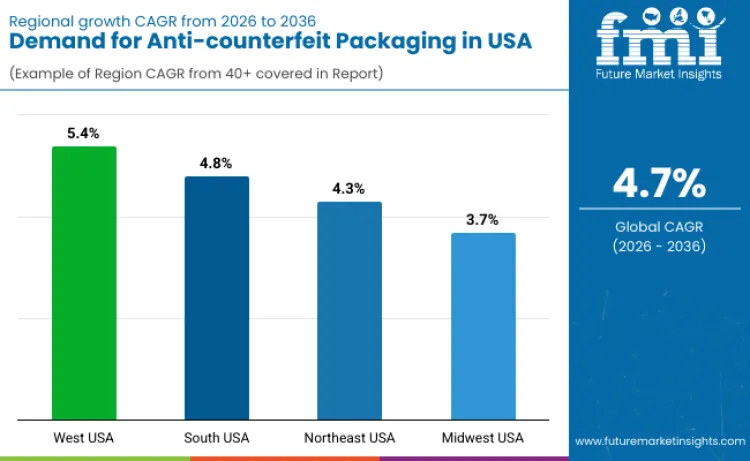
Demand for anti-counterfeit packaging in the USA is increasing due to rising product authentication requirements, brand protection priorities, and regulatory pressure across pharmaceuticals, food, beverages, and consumer goods. West USA leads with a 5.4% CAGR, supported by technology adoption, premium brands, and digital authentication pilots. South USA follows at 4.8%, driven by large-scale manufacturing, logistics exposure, and food and beverage distribution. Northeast USA records a 4.3% CAGR, shaped by pharmaceutical concentration, compliance requirements, and track-and-trace implementation. Midwest USA posts a 3.7% CAGR, reflecting steady adoption across industrial goods, packaged foods, and replacement-driven upgrades. Regional variation reflects brand density, regulatory exposure, and supply-chain complexity across the USA.
| Region | CAGR (2026-2036) |
|---|---|
| West USA | 5.4% |
| South USA | 4.8% |
| Northeast USA | 4.3% |
| Midwest USA | 3.7% |
How is West USA driving demand for Anti-counterfeit Packaging?
West USA demand is driven by high brand value concentration, technology-led packaging innovation, and exposure to global supply chains. The region’s CAGR of 5.4% reflects strong adoption of digital anti-counterfeit solutions such as QR-based authentication, serialized codes, and tamper-evident features. Pharmaceutical, cosmetics, and premium beverage brands deploy multi-layer security to protect intellectual property and consumer trust. Technology firms collaborate with packaging converters to pilot smart labels and cloud-based verification platforms. Demand favors flexible solutions compatible with e-commerce and omnichannel distribution. Growth remains innovation-led rather than compliance-only.
- Digital authentication and serialized coding adoption
- Premium pharmaceutical and cosmetics packaging usage
- Smart label and verification platform pilots
- Strong e-commerce and omnichannel exposure
How is South USA driving demand for Anti-counterfeit Packaging?
South USA demand is volume-driven and linked to large manufacturing and distribution footprints. The region’s CAGR of 4.8% reflects use of anti-counterfeit packaging in food, beverages, OTC products, and personal care items moving through high-throughput logistics networks. Manufacturers apply tamper-evident seals, holographic labels, and security inks to deter diversion and replication. Cost efficiency and scalability influence solution selection. Large contract packagers adopt standardized anti-counterfeit features compatible with existing lines. Demand growth aligns with distribution scale and risk exposure rather than premium positioning.
- High-volume food and beverage packaging protection
- Tamper-evident and security label adoption
- Scalable solutions for contract packaging
- Focus on logistics and diversion risk mitigation
How is Northeast USA driving demand for Anti-counterfeit Packaging?
Northeast USA demand reflects pharmaceutical concentration, regulatory scrutiny, and track-and-trace mandates. The region’s CAGR of 4.3% is supported by implementation of serialization, aggregation, and verification systems aligned with DSCSA requirements. Pharmaceutical manufacturers and specialty healthcare companies prioritize high-integrity anti-counterfeit packaging with documented compliance. Packaging solutions emphasize data accuracy, auditability, and integration with enterprise systems. Adoption remains structured and compliance-driven, with limited experimentation beyond validated technologies.
- Pharmaceutical serialization and DSCSA compliance
- High-integrity track-and-trace systems
- Strong regulatory and audit requirements
- Enterprise system integration focus
How is Midwest USA driving demand for Anti-counterfeit Packaging?
Midwest USA demand is steady and manufacturing-focused, reflecting packaged goods, industrial products, and regional brand protection needs. The region’s CAGR of 3.7% reflects adoption of basic anti-counterfeit measures such as tamper-evident packaging, security printing, and batch coding. Manufacturers prioritize reliability, cost control, and ease of integration with existing equipment. Adoption is often replacement-driven or customer-mandated rather than innovation-led. Growth remains moderate, supported by gradual upgrades across established production facilities.
- Packaged goods and industrial product protection
- Basic security printing and tamper-evident features
- Cost-focused and equipment-compatible solutions
- Incremental adoption through replacement cycles
What is the competitive landscape of demand for anti-counterfeit packaging in the USA?
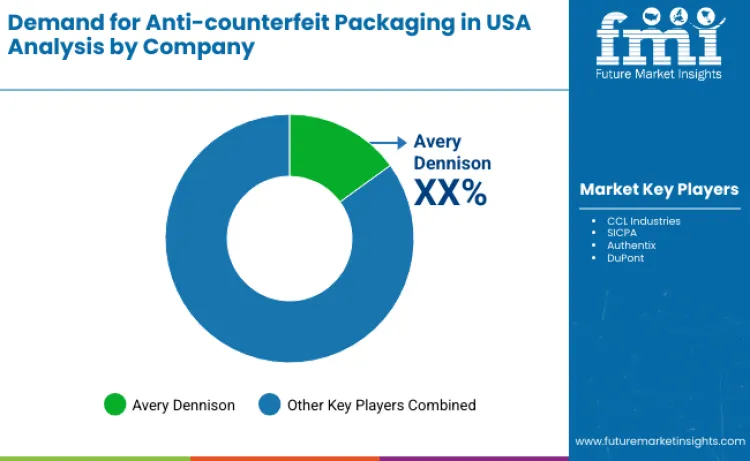
Demand for anti-counterfeit packaging in the USA is driven by brand protection requirements across pharmaceuticals, medical devices, food and beverages, cosmetics, and consumer electronics. Applications rely on overt and covert security features that deter diversion, product tampering, and gray-market circulation. Buyers evaluate serialization capability, track-and-trace integration, authentication reliability, and compatibility with high-speed packaging lines. Procurement teams prioritize compliance with USA regulatory frameworks, data security, and scalability across national distribution networks. Trend in the USA market reflects stricter drug supply chain security enforcement, rising ecommerce fraud exposure, and broader adoption of digital authentication tools.
Avery Dennison maintains strong adoption through intelligent labeling, RFID, and serialized security labels integrated into USA brand supply chains. CCL Industries operates USA facilities supplying secure labels, holographic elements, and tamper-evident packaging components. SICPA supports demand through security inks, covert markers, and authentication technologies used in regulated and high-value packaging. Authentix provides digital authentication, forensic markers, and track-and-trace platforms deployed by USA manufacturers and brand owners. DuPont contributes material-based security solutions, specialty polymers, and packaging technologies that enhance resistance to counterfeiting and tampering. Competitive positioning in the USA reflects technology robustness, regulatory alignment, integration with packaging operations, and ability to support large-scale brand protection programs.
Key Players in USA Anti-counterfeit Packaging Demand
- Avery Dennison
- CCL Industries
- SICPA
- Authentix
- DuPont
Scope of the Report
| Items | Values |
|---|---|
| Quantitative Units | USD billion |
| Packaging Format | Bottles and Jars; Vials & Ampoules; Blisters; Trays; Pouches & Sachets |
| End-use Industry | Healthcare; Food and Beverage; Automotive; Personal Care & Cosmetics; Electrical & Electronics |
| Regions Covered | West USA; South USA; Northeast USA; Midwest USA |
| Key Companies Profiled | Avery Dennison; CCL Industries; SICPA; Authentix; DuPont |
| Additional Attributes | Dollar sales by packaging format and end-use industry; regional adoption trends across regulated USA industries; increasing focus on serialization, tamper evidence, and track-and-trace solutions; technology differentiation through inks, digital codes, and authentication features; compliance-driven demand from healthcare and premium consumer goods sectors. |
USA Anti-counterfeit Packaging Demand by Segments
Packaging Format:
- Bottles and Jars
- Vials & Ampoules
- Blisters
- Trays
- Pouches & Sachets
End-use Industry:
- Healthcare
- Food and Beverage
- Automotive
- Personal care & Cosmetics
- Electrical & Electronics
Region:
- West USA
- South USA
- Northeast USA
- Midwest USA
Frequently Asked Questions
How big is the demand for anti-counterfeit packaging in USA in 2026?
The demand for anti-counterfeit packaging in USA is estimated to be valued at USD 64.5 billion in 2026.
What will be the size of anti-counterfeit packaging demand in USA in 2036?
The demand size for anti-counterfeit packaging in USA is projected to reach USD 102.0 billion by 2036.
How much will the demand for anti-counterfeit packaging in USA grow between 2026 and 2036?
The demand for anti-counterfeit packaging in USA is expected to grow at a 4.7% CAGR between 2026 and 2036.
What are the key packaging formats in the anti-counterfeit packaging demand in USA?
The key packaging formats in anti-counterfeit packaging demand in USA include bottles and jars, cartons, labels, and blister packs.
Which end-use industry segment is expected to contribute a significant share in the anti-counterfeit packaging demand in USA in 2026?
In terms of end-use industry, healthcare is expected to command 41.6% share in the anti-counterfeit packaging demand in USA in 2026.
Preview the report firsthand - request a free sample
Get SampleGet the brochure for pricing and purchase details.
Get PDFTable of Content
- Executive Summary
- USA Market Outlook
- Demand Side Trends
- Supply Side Trends
- Regulatory and Compliance Landscape
- Analysis and Recommendations
- Market Overview
- Market Coverage and Taxonomy
- Market Definition Scope and Limitations
- Market Background
- Market Dynamics
- Drivers
- Restraints
- Opportunities
- Trends
- Scenario Forecast
- Demand in Optimistic Scenario
- Demand in Likely Scenario
- Demand in Conservative Scenario
- Opportunity Map Analysis
- Product Life Cycle Analysis
- Supply Chain and Authentication Technology Analysis
- Investment Feasibility Matrix
- Value Chain Analysis
- PESTLE and Porter Analysis
- Packaging Security and Traceability Framework
- Regional Parent Market Outlook
- Production and Distribution Risk Analysis
- USA Anti-counterfeit Packaging Demand Analysis 2020 to 2024 and Forecast 2025 to 2035
- Historical Demand Value USD Billion Analysis 2020 to 2024
- Current and Future Demand Value USD Billion Projections 2025 to 2035
- Year on Year Growth Trend Analysis
- Absolute Dollar Opportunity Analysis
- USA Anti-counterfeit Packaging Pricing Analysis 2020 to 2024 and Forecast 2025 to 2035
- USA Anti-counterfeit Packaging Demand Analysis 2020 to 2024 and Forecast 2025 to 2035 By Packaging Format
- Introduction and Key Findings
- Historical Demand Value USD Billion Analysis by Packaging Format 2020 to 2024
- Current and Future Demand Value USD Billion Analysis and Forecast by Packaging Format 2025 to 2035
- Bottles and Jars
- Vials and Ampoules
- Blisters
- Trays
- Pouches and Sachets
- Year on Year Growth Trend Analysis by Packaging Format
- Absolute Dollar Opportunity Analysis by Packaging Format
- USA Anti-counterfeit Packaging Demand Analysis 2020 to 2024 and Forecast 2025 to 2035 By End-use Industry
- Healthcare
- Food and Beverage
- Automotive
- Personal Care and Cosmetics
- Electrical and Electronics
- USA Anti-counterfeit Packaging Demand Analysis 2020 to 2024 and Forecast 2025 to 2035 By Region
- West USA
- South USA
- Northeast USA
- Midwest USA
- Market Structure Analysis
- Competition Dashboard
- Competition Benchmarking
- Market Share Analysis of Key Players
- By Packaging Format
- By End-use Industry
- By Region
- Competition Analysis
- Competition Deep Dive
- Avery Dennison
- CCL Industries
- SICPA
- Authentix
- DuPont
- Assumptions and Acronyms Used
- Research Methodology


