

- Industry Size (2025)
- USD 11 Bn
- Forecast (2035)
- USD 25.1 Bn
- CAGR (2025 to 2035)
- 8.6%
Demand for Biosensors in USA Forecast and Outlook 2025 to 2035
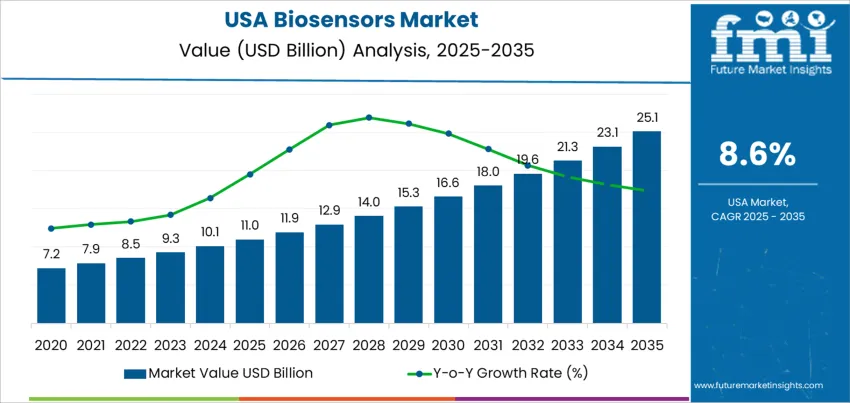
The demand for biosensors in the USA is expected to grow from USD 11.0 billion in 2025 to USD 25.1 billion by 2035, reflecting a compound annual growth rate (CAGR) of 8.6%. Biosensors, which detect and analyze biological information, are widely used in healthcare, environmental monitoring, food safety, and industrial applications. The increasing demand for personalized healthcare, rapid diagnostics, and continuous health monitoring will drive the market growth, with innovations in wearable biosensors and point-of-care diagnostics playing a key role in expanding the applications of these devices.
The market will experience steady growth, starting at USD 11.0 billion in 2025 and rising to USD 11.9 billion in 2026, USD 12.9 billion in 2027, and USD 14.0 billion in 2028. By 2029, demand for biosensors will rise to USD 15.3 billion, continuing its upward trajectory through the 2030s. By 2035, the demand for biosensors is projected to reach USD 25.1 billion, driven by advancements in technology, increased healthcare spending, and the growing adoption of biosensors in various sectors such as healthcare diagnostics, food quality control, and environmental monitoring.
Quick Stats of the Demand for Biosensors in USA
- Demand for Biosensors in USA Value (2025): USD 11 billion
- Demand for Biosensors in USA Forecast Value (2035): USD 25.1 billion
- Demand for Biosensors in USA Forecast CAGR (2025-2035): 8.6%
- Demand for Biosensors in USA Leading Technology: Electrochemical (38%)
- Demand for Biosensors in USA Key Growth Regions: West USA, South USA, Northeast USA, Midwest USA
- Demand for Biosensors in USA Key Players: Abbott Laboratories, Medtronic plc, Roche Diagnostics, Bio-Rad Laboratories, Siemens Healthineers
What is the Growth Forecast for the Biosensor Industry in USA through 2035?
The rolling CAGR analysis for biosensors highlights steady growth over the forecast period, with the market experiencing an average annual growth rate of 8.6%. In the early years (2025–2029), the rolling CAGR will remain relatively consistent, driven by an increase in demand for biosensors in medical diagnostics and healthcare monitoring. During this period, the market will see incremental growth as technological advancements in biosensor technologies, such as the integration of wearable devices and continuous glucose monitoring systems, drive adoption.
From 2029 to 2035, the rolling CAGR will continue to reflect sustained growth, though the rate of acceleration may decelerate slightly as the market matures. The introduction of more sophisticated biosensors for personalized healthcare, environmental monitoring, and industrial applications will continue to fuel market demand. The rolling CAGR analysis indicates that while the growth rate remains strong throughout the forecast period, the pace may moderate in the later years due to market maturity and the saturation of certain biosensor applications. However, the overall market trajectory will remain positive, reflecting the increasing role of biosensors in various sectors and ongoing innovations in sensor technology.
USA Biosensors Industry Key Takeaways
| Metric | Value |
|---|---|
| Industry Sales Value (2025) | USD 11 billion |
| Industry Forecast Value (2035) | USD 25.1 billion |
| Industry Forecast CAGR (2025-2035) | 8.6% |
Why is the Demand for Biosensors in USA Growing?
Demand for biosensors in the USA is increasing as the prevalence of chronic diseases, including diabetes, cardiovascular disorders, and other long term health conditions, rises and creates need for frequent monitoring and early detection. The growth in point of care testing, home health monitoring, and remote diagnostics drives demand for compact, reliable biosensor devices that deliver rapid and accurate results. Wearable biosensors and self testing devices allow individuals to track glucose, heart rate, oxygen levels, and other health metrics outside traditional clinical settings. As healthcare shifts toward preventive care and personalized medicine, biosensors become a practical tool for ongoing health management.
At the same time technological advances and broader application scope expand demand. Improvements in biosensor technology, including electrochemical, optical, and non invasive sensor designs, increase sensitivity, reliability, and ease of use. These advances make biosensors suitable not only for medical diagnostics but also for environmental monitoring, food safety, drug development, and research applications. The trend toward miniaturization, portability, and integration with digital health platforms and wearables supports wider adoption. As demand for convenient diagnostics, continuous health monitoring, and real time data grows across healthcare, wellness, and industrial sectors, demand for biosensors in the USA is expected to grow steadily in coming years.
What Is the Current State of the Demand for Biosensors in the USA in Terms of Product Type and Technology?
The demand for biosensors in the USA is primarily driven by product type and technology. The leading product type is food toxicity biosensors, which account for 30% of the market share, while electrochemical biosensors dominate the technology segment, capturing 38% of the demand. Biosensors are widely used across industries like healthcare, agriculture, and environmental monitoring for detecting biological signals and ensuring safety and quality. As the need for precise, real-time detection in these sectors grows, both food toxicity detection and electrochemical technology continue to drive market expansion.
How Are Food Toxicity Biosensors Leading the Product Type Demand for Biosensors in the USA?
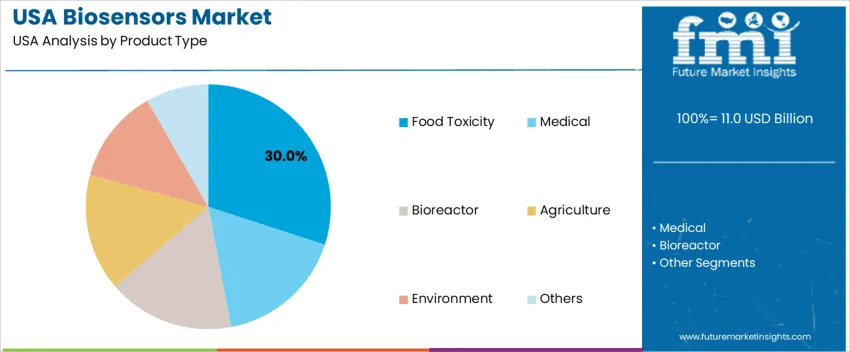
Food toxicity biosensors lead the demand for biosensors in the USA, holding 30% of the market share. Food toxicity sensors are critical in the food industry to detect harmful substances such as pathogens, allergens, and contaminants that may pose health risks to consumers. These biosensors are used for quality control, ensuring that food products are safe for consumption, which is crucial for preventing foodborne illnesses and ensuring compliance with food safety regulations.
The demand for food toxicity biosensors is driven by increasing concerns over food safety, rising foodborne diseases, and stricter regulatory standards. As the food industry continues to adopt advanced technologies to ensure the safety and quality of its products, the use of biosensors in detecting contaminants is becoming more widespread. Additionally, as the market for organic and minimally processed foods expands, the need for precise and rapid food testing solutions is expected to increase. These factors ensure that food toxicity biosensors will remain a significant segment in the biosensor market in the USA.
How Are Electrochemical Biosensors Leading the Technology Demand for Biosensors in the USA?
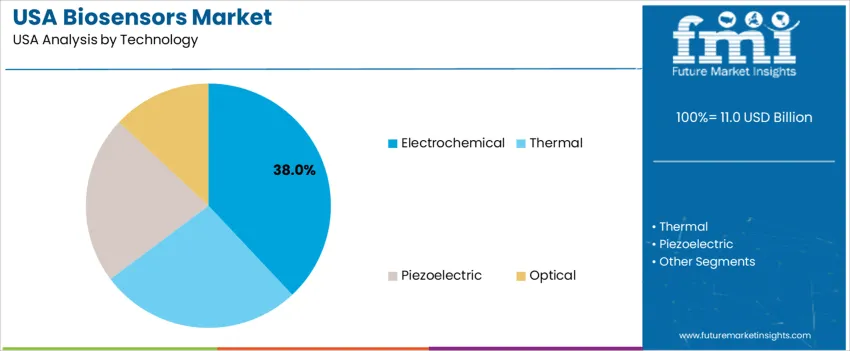
Electrochemical biosensors lead the technology demand for biosensors in the USA, capturing 38% of the market share. Electrochemical biosensors use electrodes to measure biological responses, often producing an electrical signal that is directly proportional to the concentration of the analyte. These biosensors are widely used due to their high sensitivity, fast response times, and ability to detect a wide range of substances, including glucose, pathogens, and toxins.
The demand for electrochemical biosensors is driven by their versatility and reliability in various applications, particularly in the medical and environmental monitoring sectors. In medical diagnostics, electrochemical biosensors are essential for point-of-care testing, such as glucose monitoring for diabetic patients. They are also used for environmental monitoring to detect pollutants and in food safety applications. The ongoing advances in electrochemical biosensor technology, such as miniaturization and improved sensitivity, further fuel their adoption. As industries continue to require precise, real-time biosensing capabilities, electrochemical biosensors are expected to maintain their dominant position in the market.
What is the Summary of Demand for Biosensors in the USA?
Demand for biosensors in the USA is increasing as the adoption of these devices expands across healthcare, environmental, and consumer applications. Biosensors are used for diagnostics, chronic-disease monitoring, point-of-care testing, and real-time health data tracking. The shift towards preventive care, remote monitoring, and convenient, portable testing solutions is driving the demand for biosensors. Their ability to provide quick and accurate results, often at a lower cost than traditional methods, makes them an attractive option in various sectors. As healthcare practices evolve and consumer interest in wellness grows, biosensors are becoming an integral part of healthcare systems in the USA.
What are the Drivers of Demand for Biosensors in the USA?
Several factors are driving the growing demand for biosensors in the USA. Rising rates of chronic diseases, such as diabetes, cardiovascular conditions, and metabolic disorders, require regular monitoring, which biosensors can provide in a quick and cost-effective manner. The shift toward point-of-care testing and home diagnostics is increasing as patients and healthcare providers seek faster, more convenient ways to manage health. Technological advances in biosensor design, including improved sensitivity, miniaturization, and integration into wearable devices, are also making them more accessible and user-friendly. In addition, increased healthcare spending and a focus on personalized and preventive care are encouraging broader use of biosensors in healthcare settings.
What are the Restraints on Demand for Biosensors in the USA?
Despite growing demand, certain factors are limiting the adoption of biosensors in the USA. One major restraint is the concern over the accuracy and reliability of biosensors, especially in complex or multi-analyte tests. Variations in performance, the need for calibration, and limited sensor stability can impact their effectiveness. High costs, especially for advanced biosensors and wearable devices, can also limit their accessibility to low-income patients or smaller healthcare facilities. Additionally, regulatory hurdles and data privacy concerns, particularly with the integration of biosensors into existing healthcare infrastructure, can slow adoption. In non-medical applications, such as environmental monitoring or food safety, a lack of standardization and regulatory inconsistencies may hinder widespread use.
What are the Key Trends Influencing Demand for Biosensors in the USA?
Key trends shaping the demand for biosensors include the growing adoption of wearable devices and home-use sensors for managing chronic conditions and tracking wellness. There is also an increasing focus on point-of-care testing, where rapid diagnostic results can be obtained outside traditional lab settings. Advances in biosensor technology, such as higher sensitivity, miniaturization, and integration with digital health platforms, are making biosensors more practical and efficient. Additionally, the expansion of biosensor applications beyond healthcare into areas like environmental monitoring, food safety, and public health surveillance is broadening the market. As biosensors become more affordable and integrated into everyday health practices, their demand is expected to continue growing.
What is the Regional Demand Outlook for Biosensors in the USA?
The demand for biosensors in the USA is projected to grow across all regions, with the West leading at a CAGR of 9.9%. The South follows with 8.9%, the Northeast at 8%, and the Midwest at 6.9%. These variations reflect the adoption of biosensors in industries such as healthcare, environmental monitoring, and food safety. The increasing use of biosensors for diagnostics, wearable health devices, and disease prevention, combined with advancements in sensor technology, is driving market growth across the country.
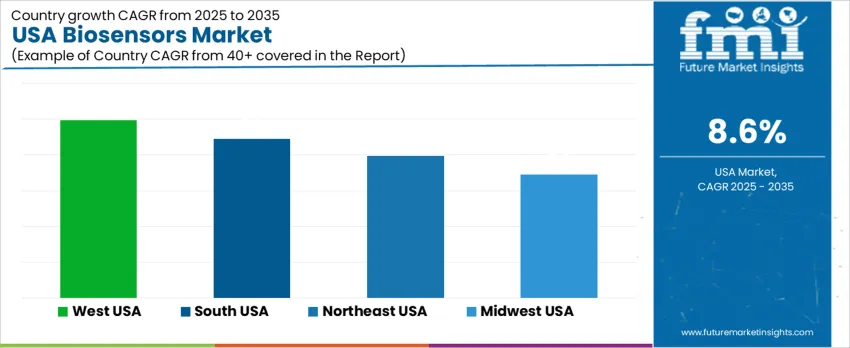
| Region | CAGR (%) |
|---|---|
| West USA | 9.9 |
| South USA | 8.9 |
| Northeast USA | 8.0 |
| Midwest USA | 6.9 |
What Drives Demand for Biosensors in the West USA?
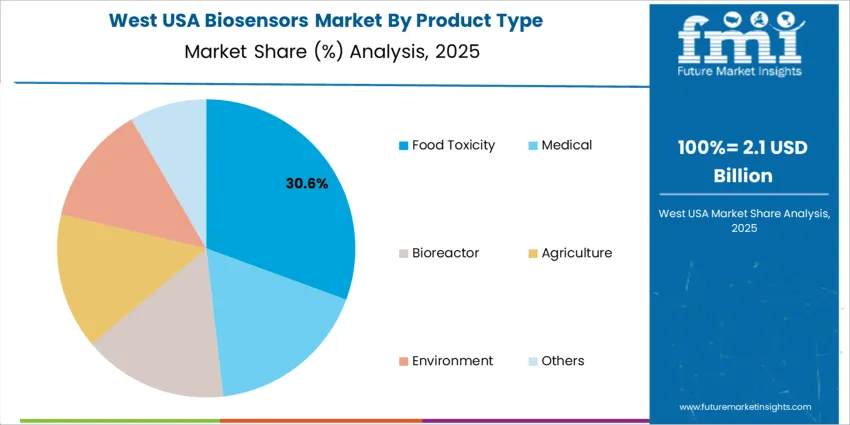
In the West USA, the demand for biosensors is projected to grow at a CAGR of 9.9%. The region’s robust healthcare, biotechnology, and tech industries contribute significantly to this growth. California, in particular, is a hub for health-tech startups and established companies that are integrating biosensors into diagnostic tools, wearable health monitors, and medical devices. Biosensors play a crucial role in real-time monitoring of health metrics such as glucose levels, heart rate, and other biometrics, which are increasingly integrated into consumer electronics. The West’s focus on innovation, coupled with its emphasis on digital health and telemedicine, accelerates the adoption of biosensors. As personalized healthcare becomes more popular, the demand for biosensors in both medical and consumer applications is expected to continue to grow at a rapid pace.
Why is Demand for Biosensors Growing in the South USA?
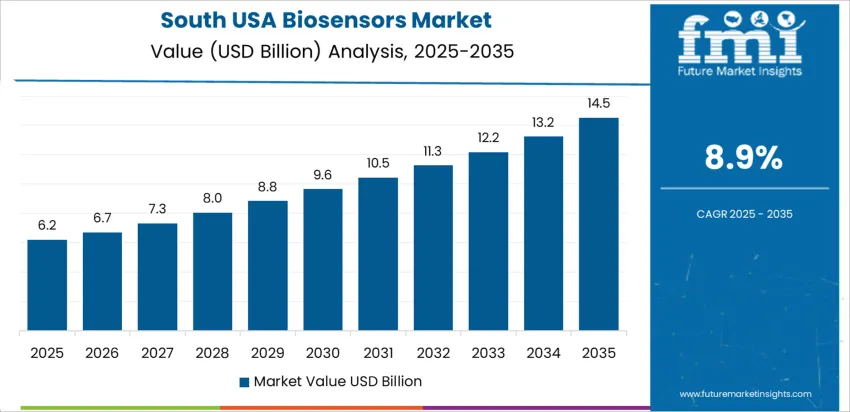
In the South USA, the projected CAGR for biosensors is 8.9%, driven by the growing adoption of biosensors in healthcare and agriculture. The region has a strong presence in agricultural biotechnology, where biosensors are used for monitoring crop health, pest control, and environmental conditions. Additionally, the healthcare sector in the South is rapidly expanding, with more hospitals and research facilities incorporating biosensors for diagnostic and patient monitoring applications. As awareness of chronic diseases such as diabetes, heart disease, and cancer increases, biosensors that offer early detection and continuous monitoring become essential tools. The South’s focus on healthcare innovation, combined with an increasing number of hospitals and medical research centers adopting biosensors for non-invasive diagnostics, drives steady growth in the market for these devices.
What Supports the Growth of Biosensors in the Northeast USA?
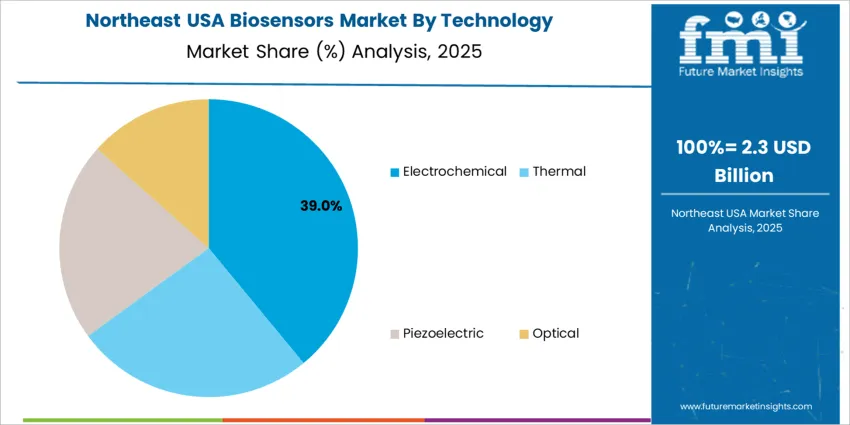
In the Northeast USA, the demand for biosensors is projected to grow at a CAGR of 8%. The region’s established healthcare infrastructure, coupled with its focus on biomedical research and innovation, makes it a key player in the biosensor market. Medical institutions and universities in the Northeast are at the forefront of research and development in diagnostic technologies, and biosensors are critical for applications ranging from disease detection to personalized medicine. The region is home to some of the world’s leading hospitals and research centers that use biosensors for diagnostics, patient monitoring, and lab-based analysis. As the healthcare sector continues to prioritize early detection, non-invasive monitoring, and personalized treatment options, the demand for biosensors is expected to remain strong in the Northeast.
How is Demand for Biosensors Evolving in the Midwest USA?
In the Midwest USA, the demand for biosensors is projected to grow at a CAGR of 6.9%. While growth is slower compared to other regions, the Midwest remains a key market due to its strong manufacturing base and growing adoption of biosensors in industrial and healthcare applications. The healthcare sector in the Midwest is increasingly incorporating biosensors for patient monitoring, diagnostics, and disease management. Additionally, industries such as food safety and environmental monitoring are adopting biosensors to detect contaminants and ensure compliance with safety standards. The region’s agricultural sector is also utilizing biosensors for precision farming, where real-time monitoring of soil health and crop conditions is crucial. As these applications grow, the demand for biosensors is expected to increase steadily in the Midwest.
What is the Competitive Landscape for the Biosensors Market in the USA?
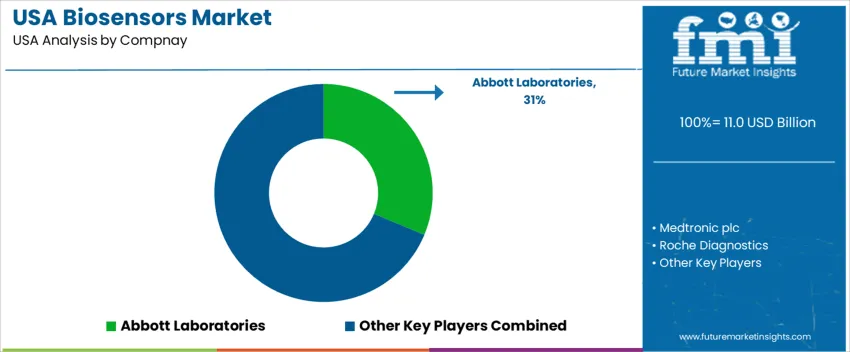
Demand for biosensors in the USA has risen significantly in recent years. Growth is supported by rising prevalence of chronic diseases such as diabetes and cardiovascular disorders, increasing adoption of point of care diagnostics, and expanding use of wearable health monitoring devices. The global biosensors market was valued around USD 30.0 billion in 2024 and is projected to grow rapidly through the coming decade. North America accounted for more than 40 % of the global revenue share in 2024, indicating a strong base of demand and early adoption in the USA. Medical applications remain dominant, though environmental monitoring, food safety, and consumer health segments also contribute to overall demand.
Several large firms compete for share in the USA biosensors market. According to your list, Abbott Laboratories leads with about 31.3 % share. Other major players include Medtronic plc, Roche Diagnostics, Bio-Rad Laboratories and Siemens Healthineers. These companies offer a range of biosensor based products including glucose monitoring systems, diagnostic assays, point of care devices, and continuous monitoring wearables. Competition among them is shaped by factors such as sensor accuracy, ease of use, integration with health platforms, regulatory compliance, and scalability. Firms that deliver reliable, fast, and easy to use biosensor solutions for both clinical and home use settings tend to capture larger market shares. As demand continues to rise, competition remains dynamic and innovation driven.
Key Players of the Biosensors Industry in USA
- Abbott Laboratories
- Medtronic plc
- Roche Diagnostics
- Bio-Rad Laboratories
- Siemens Healthineers
Scope of the Report
| Items | Details |
|---|---|
| Quantitative Units | USD Billion |
| Regions Covered | USA |
| Product Type | Food Toxicity, Medical, Bioreactor, Agriculture, Environment, Others |
| Technology | Electrochemical, Thermal, Piezoelectric, Optical |
| End-Use | Home Healthcare Diagnostics, Point Testing, Food Industry, Research Laboratories, Security & Biodefense |
| Key Companies Profiled | Abbott Laboratories, Medtronic plc, Roche Diagnostics, Bio-Rad Laboratories, Siemens Healthineers |
| Additional Attributes | Dollar sales by product type, technology, and end-use indicate strong demand for medical biosensors, particularly in home healthcare diagnostics and research laboratories. Electrochemical biosensors lead the market, especially in medical and food industry applications. Companies like Abbott Laboratories and Siemens Healthineers are key players, providing a range of biosensor solutions. The market is expected to grow due to the increasing adoption of biosensors in healthcare, food safety, and environmental monitoring, driven by advances in technology and increasing awareness of health diagnostics. |
Key Segments in the Demand for Biosensors in USA
Product Type
- Food Toxicity
- Medical
- Bioreactor
- Agriculture
- Environment
- Others
Technology
- Electrochemical
- Thermal
- Piezoelectric
- Optical
End-Use
- Home Healthcare Diagnostics
- Point Testing
- Food Industry
- Research Laboratories
- Security & Biodefense
Region
- Northeast USA
- West USA
- Midwest USA
- South USA
Frequently Asked Questions
How big is the demand for biosensors in USA in 2025?
The demand for biosensors in USA is estimated to be valued at USD 11.0 billion in 2025.
What will be the size of biosensors in USA in 2035?
The market size for the biosensors in USA is projected to reach USD 25.1 billion by 2035.
How much will be the demand for biosensors in USA growth between 2025 and 2035?
The demand for biosensors in USA is expected to grow at a 8.6% CAGR between 2025 and 2035.
What are the key product types in the biosensors in USA?
The key product types in biosensors in USA are food toxicity, medical, bioreactor, agriculture, environment and others.
Which technology segment is expected to contribute significant share in the biosensors in USA in 2025?
In terms of technology, electrochemical segment is expected to command 38.0% share in the biosensors in USA in 2025.
Preview the report firsthand - request a free sample
Get SampleGet the brochure for pricing and purchase details.
Get PDFTable of Content
- Executive Summary
- USA Market Outlook
- Demand-side Trends
- Supply-side Trends
- Technology Roadmap Analysis
- Analysis and Recommendations
- Market Overview
- Market Coverage / Taxonomy
- Market Definition / Scope / Limitations
- Market Background
- Market Dynamics
- Drivers
- Restraints
- Opportunity
- Trends
- Scenario Forecast
- Demand in Optimistic Scenario
- Demand in Likely Scenario
- Demand in Conservative Scenario
- Opportunity Map Analysis
- Product Life Cycle Analysis
- Supply Chain Analysis
- Investment Feasibility Matrix
- Value Chain Analysis
- PESTLE and Porter’s Analysis
- Regulatory Landscape
- Regional Parent Market Outlook
- Production and Consumption Statistics
- Import and Export Statistics
- Market Dynamics
- USA Market Analysis 2020 to 2024 and Forecast, 2025 to 2035
- Historical Market Size Value (USD Million) Analysis, 2020 to 2024
- Current and Future Market Size Value (USD Million) Projections, 2025 to 2035
- Y-o-Y Growth Trend Analysis
- Absolute $ Opportunity Analysis
- USA Market Pricing Analysis 2020 to 2024 and Forecast 2025 to 2035
- USA Market Analysis 2020 to 2024 and Forecast 2025 to 2035, By Product Type
- Introduction / Key Findings
- Historical Market Size Value (USD Million) Analysis By Product Type , 2020 to 2024
- Current and Future Market Size Value (USD Million) Analysis and Forecast By Product Type , 2025 to 2035
- Food Toxicity
- Medical
- Bioreactor
- Agriculture
- Environment
- Others
- Y-o-Y Growth Trend Analysis By Product Type , 2020 to 2024
- Absolute $ Opportunity Analysis By Product Type , 2025 to 2035
- USA Market Analysis 2020 to 2024 and Forecast 2025 to 2035, By Technology
- Introduction / Key Findings
- Historical Market Size Value (USD Million) Analysis By Technology, 2020 to 2024
- Current and Future Market Size Value (USD Million) Analysis and Forecast By Technology, 2025 to 2035
- Electrochemical
- Thermal
- Piezoelectric
- Optical
- Y-o-Y Growth Trend Analysis By Technology, 2020 to 2024
- Absolute $ Opportunity Analysis By Technology, 2025 to 2035
- USA Market Analysis 2020 to 2024 and Forecast 2025 to 2035, By End-Use
- Introduction / Key Findings
- Historical Market Size Value (USD Million) Analysis By End-Use, 2020 to 2024
- Current and Future Market Size Value (USD Million) Analysis and Forecast By End-Use, 2025 to 2035
- Home Healthcare Diagnostics
- Pock Testing
- Food Industry
- Research Laboratories
- Security & Biodefense
- Y-o-Y Growth Trend Analysis By End-Use, 2020 to 2024
- Absolute $ Opportunity Analysis By End-Use, 2025 to 2035
- Market Structure Analysis
- Competition Dashboard
- Competition Benchmarking
- Market Share Analysis of Top Players
- By Regional
- By Product Type
- By Technology
- By End-Use
- Competition Analysis
- Competition Deep Dive
- Abbott Laboratories
- Overview
- Product Portfolio
- Profitability by Market Segments (Product/Age /Sales Channel/Region)
- Sales Footprint
- Strategy Overview
- Marketing Strategy
- Product Strategy
- Channel Strategy
- Medtronic plc
- Roche Diagnostics
- Bio-Rad Laboratories
- Siemens Healthineers
- Abbott Laboratories
- Competition Deep Dive
- Assumptions & Acronyms Used
- Research Methodology


