

- Industry Size (2025)
- USD 6.4 Bn
- Forecast (2035)
- USD 11.0 Bn
- CAGR (2025 to 2035)
- 5.6%
Demand for Eccentric Tip Syringe in USA 2025 to 2035
The USA eccentric tip syringe demand is valued at USD 6.4 billion in 2025 and is projected to reach USD 11.0 billion by 2035, reflecting a CAGR of 5.6%. Growth is supported by increased usage in aspiration, wound irrigation, and procedures requiring clear visibility and needle alignment. Hospitals, outpatient centers, and specialty clinics continue to adopt syringes designed to improve precision in procedural workflows.
The above 10 ml capacity segment leads adoption because larger-volume syringes are essential for irrigation, flushing, and drug reconstitution tasks. Eccentric tips provide improved access to shallow angles and reduce obstruction of the clinician’s line of sight. Manufacturers refine barrel calibration, ergonomics, and latex-free materials to ensure consistent performance across high-frequency clinical applications.
The West, South, and Northeast regions demonstrate strong demand driven by large healthcare networks, higher procedural volumes, and expanded outpatient services. Key suppliers include Novo Nordisk A.S., Terumo Corp., Nipro Medical Corporation, Vita Needle Company, and B. Braun Imaxeon Pty. Their strategies focus on sterile manufacturing capability, customizable syringe configurations, and enhanced supply chain resilience to support reliable availability for diverse medical procedures.
Quick Stats for USA Eccentric Tip Syringe Demand
- USA Eccentric Tip Syringe Sales Value (2025): USD 6.4 billion
- USA Eccentric Tip Syringe Forecast Value (2035): USD 11.0 billion
- USA Eccentric Tip Syringe Forecast CAGR (2025–2035): 5.6%
- Leading Capacity Segment in USA Eccentric Tip Syringe Demand: Above 10 ml
- Key Growth Regions in USA Eccentric Tip Syringe Demand: West USA, South USA, Northeast USA
- Top Players in USA Eccentric Tip Syringe Demand: Novo Nordisk A.S., Terumo Corp., Nipro Medical Corporation, Vita Needle Company, B. Braun Imaxeon Pty
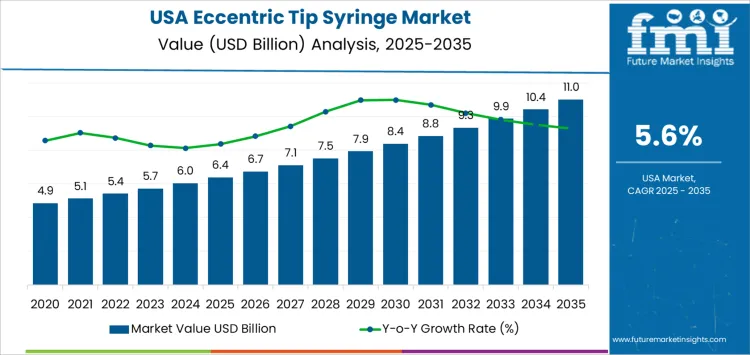
What is the Growth Forecast for Eccentric Tip Syringe Industry in USA through 2035?
The 10-Year Growth Comparison for eccentric tip syringes in the United States shows varied expansion phases shaped by procedural requirements, care delivery patterns, and device standardization. Early demand during the initial part of the decade reflects stable usage in outpatient procedures, minor surgical interventions, and precision-oriented clinical tasks. Growth during this phase maintains moderate intensity because procurement practices remain aligned with established syringe formats across hospitals and ambulatory centers. The contribution from dental and dermatology settings strengthens this baseline, creating a consistent early trajectory.
Later-period growth shows stronger activity as procedural volumes rise in chronic disease management and minimally invasive care. Expanded use in wound care, aspiration tasks, and medication preparation increases the relative weight of later-period contributions. Device standardization across integrated delivery networks increases purchasing consistency, creating a more pronounced uplift during the second half of the comparison window. Regulatory focus on device quality and traceability supports broader adoption of standardized syringe types, contributing to later-period acceleration. The comparison shows a transition from steady early growth supported by established clinical routines to a more intensive later pattern driven by procedural diversification and system-level purchasing alignment. The decade reflects a cumulative shift toward higher utilization across specialized clinical settings.
USA Eccentric Tip Syringe Key Takeaways
| Metric | Value |
|---|---|
| USA Eccentric Tip Syringe Sales Value (2025) | USD 6.4 billion |
| USA Eccentric Tip Syringe Forecast Value (2035) | USD 11.0 billion |
| USA Eccentric Tip Syringe Forecast CAGR (2025-2035) | 5.6% |
Why is the Demand for Eccentric Tip Syringe in USA Growing?
Demand for eccentric tip syringes in the United States expands due to consistent use in medical, dental, and laboratory settings that require precision during parallel approach procedures. Clinical practitioners select this design for applications where the needle must align close to a surface, including wound irrigation, intradermal administration, and specialty injections. Dental clinics rely on eccentric tips for accessing confined areas during anesthetic delivery and irrigation of periodontal pockets. Outpatient care centers use these syringes due to the need for controlled directional flow in minor procedures.
Growth in home healthcare supports wider distribution of products designed for ease of handling and reduced obstruction of the visual field during use. Veterinary facilities adopt eccentric tips for injections performed at shallow angles on small and large animals. Pharmaceutical compounding centers maintain steady consumption due to requirements for angled attachment in specific formulations. Supply chain standardization across distributors supports regular procurement of sterile, single use designs. Regulatory attention to safety and precision encourages healthcare providers to adopt formats that reduce administration errors and improve maneuverability in procedure specific environments.
Which Capacity and End User Segments Lead Demand for Eccentric Tip Syringes in USA?
Demand for eccentric tip syringes in the USA is shaped by requirements for angled fluid delivery, precision positioning, and compatibility with procedures needing parallel alignment to the skin surface. Adoption depends on syringe capacity, usage workflow, and institutional needs across diagnostic, therapeutic, and specimen-handling activities. Distribution reflects procedural volume, handling preferences, and the structural benefits of eccentric-tip geometry in clinical environments.
By Capacity, Above 10 ml Syringes Account for the Largest Share of Demand
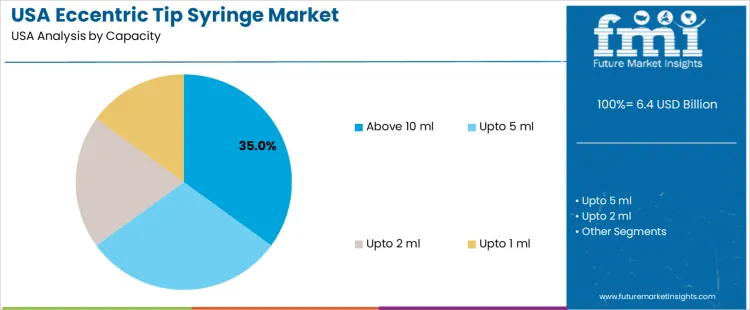
Above 10 ml syringes hold 35.0%, making them the leading capacity segment. These units support high-volume fluid administration, irrigation procedures, and tasks requiring stable control during larger draws. Their design suits emergency care, wound management, and specimen processing where increased capacity reduces handling frequency. Upto 5 ml syringes hold 30.0%, serving general injection needs and medium-volume withdrawals. Upto 2 ml syringes hold 20.0%, used in precision dosing for intradermal, pediatric, and sensitivity-based procedures. Upto 1 ml syringes hold 15.0%, supporting high-accuracy micro-dosing. Capacity distribution reflects procedural intensity and accuracy requirements across clinical settings.
Key Points:
- Above 10 ml supports high-volume administration and irrigation.
- Upto 5 ml serves general injection workflows.
- Upto 2 ml and 1 ml support precision dosing.
- Capacity selection aligns with procedure volume and accuracy needs.
By End User, Hospitals Represent the Largest Segment
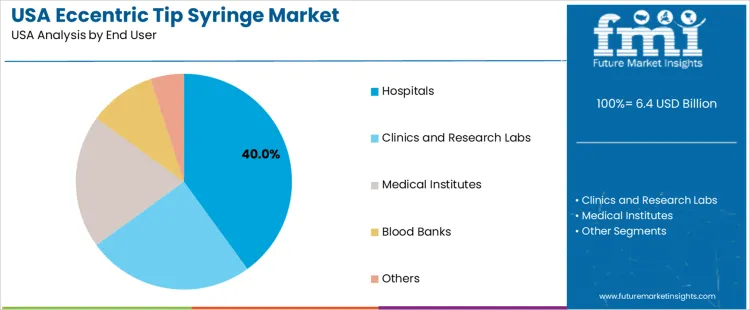
Hospitals hold 40.0%, making them the leading end-user segment for eccentric tip syringes in the USA. High patient throughput, emergency care volume, and multi-department procedures drive consistent consumption. Clinics and research labs hold 25.0%, supported by diagnostic testing, sample preparation, and controlled laboratory workflows requiring angled syringe placement. Medical institutes hold 20.0%, reflecting educational and procedural training environments with structured syringe usage patterns. Blood banks hold 10.0%, using eccentric tip designs for specimen transfers requiring parallel alignment with collection containers. Others hold 5.0%, representing limited but specific procedural use. End-user distribution reflects workflow complexity, sample handling, and procedural demand intensity.
Key Points:
- Hospitals maintain highest usage due to multi-department procedures.
- Clinics and labs rely on angled syringes for diagnostic workflows.
- Medical institutes support training and structured procedural use.
- Usage reflects procedural frequency and sample-handling needs.
What are the Key Dynamics in the Eccentric Tip Syringe Industry?
Clinical workflows, precision requirements, and procedural demand are driving adoption.
Demand increases as US healthcare facilities use eccentric tip syringes for procedures requiring parallel alignment with the injection surface. Dental clinics rely on these syringes for accessing posterior regions with improved visibility and reduced hand obstruction. Outpatient dermatology and minor surgical centers integrate eccentric tips for controlled delivery of anesthetics during routine interventions. Vaccination programs require devices that support accurate intradermal and subcutaneous administration. Veterinary practices adopt eccentric formats for procedures involving angled access. Medical distributors expand inventories of sterile, single-use syringes to match clinical hygiene standards. Ambulatory care growth raises procedural volumes that depend on precise needle orientation.
Procurement costs, supply variability, and operational limitations restrain wider use.
Healthcare providers experience cost sensitivity when comparing eccentric formats with standard syringes that offer broader availability. Domestic supply chains face intermittent pressure created by resin pricing and production scheduling across molding facilities. Smaller clinics report limited storage capacity for multiple syringe variants, which influences purchase decisions. Several states maintain procurement rules emphasizing unit cost efficiency, which reduces adoption of specialized formats. Staff training requirements increase when facilities introduce device variations into clinical routines. Waste-disposal protocols for single-use devices add operational expenditure that influences syringe selection during annual budget cycles.
Specialized procedures, safety engineering, and automation trends shape current dynamics.
US hospitals evaluate eccentric tip syringes compatible with safety-engineered needles that reduce needlestick incidents. Dental practices introduce syringes with improved grip profiles to support ergonomic procedures during extended sessions. Dermatology clinics incorporate fine-gauge eccentric designs for controlled cosmetic injections. Distributors expand offerings aligned with color-coded volume indicators that support accurate dosage preparation. Automated filling systems in compounding pharmacies influence demand for syringes with consistent barrel geometry and reliable tip alignment. Veterinary hospitals adopt reinforced barrels for procedures requiring higher pressure flow. Clinicians request devices packaged for rapid procedural turnover in busy outpatient settings.
Analysis of the Demand for Eccentric Tip Syringes in the USA by Region
Demand for eccentric tip syringes in the USA is increasing due to expanding usage across dental procedures, wound care, and precision medication applications. West USA records a CAGR of 6.4% supported by strong healthcare service intensity and wider adoption of specialized syringe formats. South USA shows a 5.8% CAGR driven by growing healthcare infrastructure and rising procedure volumes. Northeast USA posts a 5.2% CAGR supported by dense clinical networks and consistent requirements for controlled medication delivery. Midwest USA holds a 4.5% CAGR due to its extensive hospital systems and stable demand for procedural consumables requiring angled syringe tips.
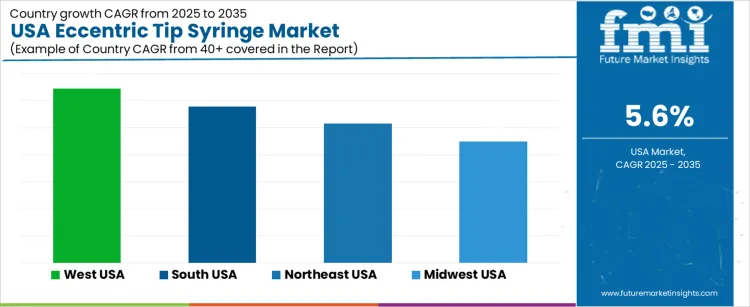
| Region | CAGR (2025-2035) |
|---|---|
| West USA | 6.4% |
| South USA | 5.8% |
| Northeast USA | 5.2% |
| Midwest USA | 4.5% |
How is the West USA driving demand for Eccentric Tip Syringes?
West USA drives demand through its extensive clinical ecosystem, which relies on precision-aligned syringe formats for dental care, minor procedures, and controlled medication administration. The region’s CAGR of 6.4% reflects steady use across outpatient centers, emergency departments, and surgical facilities where angled tips support access to restricted injection sites. Dental service providers within the region maintain high consumption due to frequent procedures requiring accurate delivery in confined oral areas. The region experiences strong circulation of sterile, single-use syringes due to regulatory expectations surrounding clinical safety. Demand stays consistent as healthcare operators emphasize procedural accuracy supported by eccentric tip configurations.
- High usage across dental and outpatient procedures
- Strong regulatory compliance with sterile consumables
- Wide use in controlled medication administration
- Consistent procurement across hospitals and clinics
How is the South USA driving demand for Eccentric Tip Syringes?
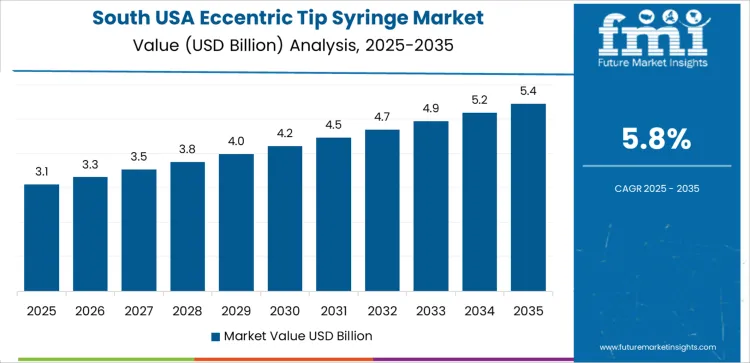
South USA supports rising demand as healthcare networks expand their service capacity across urban and suburban areas. The region’s CAGR of 5.8% reflects increased volumes of clinical procedures requiring reliable access to angled injection points. Dental practices continue to broaden their consumable inventories due to persistent patient flow and frequent restorative treatments. Ambulatory centers rely on eccentric tip syringes for wound care, minor surgical procedures, and medication administration that requires directional control. The presence of large hospital systems sustains procurement cycles for sterile, single-use syringes aligned with regional safety protocols.
- Expanded suburban healthcare activity
- Strong demand across dental practices
- Use in wound care and minor procedures
- Continuous procurement by large hospital networks
How is the Northeast USA driving demand for Eccentric Tip Syringes?
Northeast USA contributes to sustained demand due to its dense concentration of hospitals, specialty clinics, and dental care providers. The region’s CAGR of 5.2% reflects steady procedure frequency across emergency care, restorative dentistry, and controlled medication delivery. Urban healthcare systems maintain structured procurement processes for sterile syringes required in high-volume clinical environments. Dental networks continue to rely on angled syringe tips to support accurate access during root canals, fillings, and irrigation procedures. Consistent adherence to safety and sterilization standards supports ongoing circulation of single-use syringes designed for precision tasks.
- Dense concentration of clinical facilities
- Strong demand across dentistry and emergency care
- Structured procurement of sterile consumables
- High procedure frequency in urban centers
How is the Midwest USA driving demand for Eccentric Tip Syringes?
Midwest USA maintains steady demand due to its extensive hospital systems, outpatient facilities, and dental networks that rely on angled syringes for accurate delivery. The region’s CAGR of 4.5% reflects stable usage across wound management, minor surgical procedures, and targeted medication administration. Healthcare providers across mid-sized cities continue integrating standardized sterile consumables to support consistent procedural workflows. Dental centers utilize eccentric tip syringes for irrigation and restorative activities in confined areas. The presence of broad clinical infrastructure supports regular procurement of single-use consumables aligned with safety-focused operational practices.
- Broad hospital and outpatient facility presence
- Routine dental use for precision procedures
- Stable procurement of sterile syringes
- Consistent usage across wound and medication tasks
What is the competitive landscape of the demand for eccentric tip syringes in the USA?
Demand for eccentric tip syringes in the USA is influenced by requirements for angled nozzle alignment, dosage accuracy, sterile-barrier integrity, and compatibility with parenteral drugs, contrast agents, and laboratory procedures. Healthcare providers evaluate barrel clarity, plunger resistance, gasket performance, and needle attachment strength. Procurement decisions rely on reliable sterilization methods, consistent lot quality, and compliance with clinical safety standards across hospitals, diagnostic laboratories, and outpatient centers. Buyers prioritize predictable supply chains, regulatory conformity, and compatibility with automated dispensing and infusion workflows. Nipro Medical Corporation participates through sterile disposable syringes with standardized luer configurations suited for routine hospital use. B. Braun Imaxeon Pty provides syringe products within broader clinical supply portfolios serving imaging departments and medication delivery units. Competitive positioning in the USA reflects sterile manufacturing capability, regulatory compliance, and inventory reliability across healthcare networks.
Key Players in USA Eccentric Tip Syringe Demand
- Novo Nordisk A.S.
- Terumo Corp.
- Nipro Medical Corporation
- Vita Needle Company
- B. Braun Imaxeon Pty
Scope of the Report
| Items | Values |
|---|---|
| Quantitative Units | USD billion |
| Capacity | Above 10 ml, Upto 5 ml, Upto 2 ml, Upto 1 ml |
| End Use | Hospitals, Clinics and Research Labs, Medical Institutes, Blood Banks, Others |
| Regions Covered | West USA, South USA, Northeast USA, Midwest USA |
| Countries Covered | USA |
| Key Companies Profiled | Novo Nordisk A.S., Terumo Corp., Nipro Medical Corporation, Vita Needle Company, B. Braun Imaxeon Pty |
| Additional Attributes | Dollar sales by syringe capacity and end-user categories; regional procurement trends across hospitals, research labs, and blood banks; adoption patterns for eccentric-tip syringes in precision medication delivery; compliance requirements influencing product demand; supply characteristics for sterile single-use medical syringes; competitive positioning of syringe manufacturers offering varied capacities and specialty needle configurations. |
USA Eccentric Tip Syringe Demand by Segments
Capacity:
- Above 10 ml
- Upto 5 ml
- Upto 2 ml
- Upto 1 ml
End User:
- Hospitals
- Clinics and Research Labs
- Medical Institutes
- Blood Banks
- Others
Region:
- West USA
- South USA
- Northeast USA
- Midwest USA
Frequently Asked Questions
How big is the demand for eccentric tip syringe in USA in 2025?
The demand for eccentric tip syringe in USA is estimated to be valued at USD 6.4 billion in 2025.
What will be the size of eccentric tip syringe in USA in 2035?
The market size for the eccentric tip syringe in USA is projected to reach USD 11.0 billion by 2035.
How much will be the demand for eccentric tip syringe in USA growth between 2025 and 2035?
The demand for eccentric tip syringe in USA is expected to grow at a 5.6% CAGR between 2025 and 2035.
What are the key product types in the eccentric tip syringe in USA?
The key product types in eccentric tip syringe in USA are above 10 ml, upto 5 ml, upto 2 ml and upto 1 ml.
Which end user segment is expected to contribute significant share in the eccentric tip syringe in USA in 2025?
In terms of end user, hospitals segment is expected to command 40.0% share in the eccentric tip syringe in USA in 2025.
Preview the report firsthand - request a free sample
Get SampleGet the brochure for pricing and purchase details.
Get PDFTable of Content
- Executive Summary
- USA Market Outlook
- Demand-side Trends
- Supply-side Trends
- Technology Roadmap Analysis
- Analysis and Recommendations
- Market Overview
- Market Coverage / Taxonomy
- Market Definition / Scope / Limitations
- Market Background
- Market Dynamics
- Drivers
- Restraints
- Opportunity
- Trends
- Scenario Forecast
- Demand in Optimistic Scenario
- Demand in Likely Scenario
- Demand in Conservative Scenario
- Opportunity Map Analysis
- Product Life Cycle Analysis
- Supply Chain Analysis
- Investment Feasibility Matrix
- Value Chain Analysis
- PESTLE and Porter’s Analysis
- Regulatory Landscape
- Regional Parent Market Outlook
- Production and Consumption Statistics
- Import and Export Statistics
- Market Dynamics
- USA Market Analysis 2020 to 2024 and Forecast, 2025 to 2035
- Historical Market Size Value (USD Million) Analysis, 2020 to 2024
- Current and Future Market Size Value (USD Million) Projections, 2025 to 2035
- Y-o-Y Growth Trend Analysis
- Absolute $ Opportunity Analysis
- USA Market Pricing Analysis 2020 to 2024 and Forecast 2025 to 2035
- USA Market Analysis 2020 to 2024 and Forecast 2025 to 2035, By Capacity
- Introduction / Key Findings
- Historical Market Size Value (USD Million) Analysis By Capacity , 2020 to 2024
- Current and Future Market Size Value (USD Million) Analysis and Forecast By Capacity , 2025 to 2035
- Above 10 ml
- Upto 5 ml
- Upto 2 ml
- Upto 1 ml
- Y-o-Y Growth Trend Analysis By Capacity , 2020 to 2024
- Absolute $ Opportunity Analysis By Capacity , 2025 to 2035
- USA Market Analysis 2020 to 2024 and Forecast 2025 to 2035, By End User
- Introduction / Key Findings
- Historical Market Size Value (USD Million) Analysis By End User, 2020 to 2024
- Current and Future Market Size Value (USD Million) Analysis and Forecast By End User, 2025 to 2035
- Hospitals
- Clinics and Research Labs
- Medical Institutes
- Blood Banks
- Others
- Y-o-Y Growth Trend Analysis By End User, 2020 to 2024
- Absolute $ Opportunity Analysis By End User, 2025 to 2035
- Market Structure Analysis
- Competition Dashboard
- Competition Benchmarking
- Market Share Analysis of Top Players
- By Regional
- By Capacity
- By End User
- Competition Analysis
- Competition Deep Dive
- Novo Nordisk A.S.
- Overview
- Product Portfolio
- Profitability by Market Segments (Product/Age /Sales Channel/Region)
- Sales Footprint
- Strategy Overview
- Marketing Strategy
- Product Strategy
- Channel Strategy
- Terumo Corp.
- Nipro Medical Corporation
- Vita Needle Company
- B. Braun Imaxeon Pty
- Novo Nordisk A.S.
- Competition Deep Dive
- Assumptions & Acronyms Used
- Research Methodology


