

- Industry Size (2025)
- USD 101.7 Mn
- Forecast (2035)
- USD 151.8 Mn
- CAGR (2025 to 2035)
- 4.1%
Demand for L-Lysine Hydrochloride (HCL) in USA 2025 to 2035
The USA L-lysine hydrochloride (HCL) demand is valued at USD 101.7 million in 2025 and is projected to reach USD 151.8 million by 2035, registering a CAGR of 4.1%. Growth is driven by increased supplementation in animal nutrition to improve feed efficiency, coupled with growing utilization in pharmaceuticals and dietary supplements supporting protein synthesis and metabolic health. Expanded livestock production and quality feed formulations continue to influence steady consumption.
Fruit-derived L-lysine HCL leads usage as buyers prioritize natural sourcing and higher product purity for both feed-grade and human nutrition applications. The segment benefits from clean-label preferences and reliable amino acid bioavailability in intensive poultry and swine operations. Manufacturers emphasize fermentation-based production routes that offer consistent amino acid yield and reduce reliance on synthetic pathways.
The West, South, and Northeast regions reflect strong demand supported by large livestock clusters, bioprocessing capabilities, and established nutraceutical distribution networks. Key suppliers include Ajinomoto Co., Inc., CJ CheilJedang Corporation, Kyowa Hakko Bio Co., Ltd., Evonik Industries AG, and Meihua Holdings Group Co., Ltd. Their strategies focus on capacity expansions, cost-efficient fermentation technologies, and product lines tailored for species-specific feed optimization and human clinical nutrition.
Quick Stats for USA L-Lysine Hydrochloride (HCL) Demand
- USA L-Lysine Hydrochloride (HCL) Sales Value (2025): USD 101.7 million
- USA L-Lysine Hydrochloride (HCL) Forecast Value (2035): USD 151.8 million
- USA L-Lysine Hydrochloride (HCL) Forecast CAGR (2025–2035): 4.1%
- Leading Source in USA L-Lysine Hydrochloride (HCL) Demand: Fruit-Derived L-Lysine HCL
- Key Growth Regions in USA L-Lysine Hydrochloride (HCL) Demand: West USA, South USA, Northeast USA
- Top Players in USA L-Lysine Hydrochloride (HCL) Demand: Ajinomoto Co., Inc., CJ CheilJedang Corporation, Kyowa Hakko Bio Co., Ltd., Evonik Industries AG, Meihua Holdings Group Co., Ltd
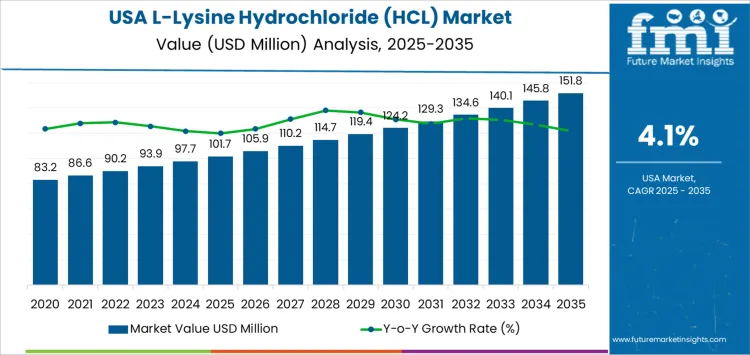
What is the Growth Forecast for L-Lysine Hydrochloride (HCL) Industry in USA through 2035?
Demand for L-Lysine Hydrochloride in the United States is primarily driven by the livestock and poultry nutrition sector. Animal feed manufacturers rely on supplemental lysine to support protein synthesis and improve growth efficiency. This application accounts for the majority of incremental gains, so feed industry expansion and productivity optimization practices represent the highest growth contribution within the category. Adoption intensity increases as producers aim to reduce soybean meal dependency and improve feed conversion ratios. These efficiency goals translate into consistent purchasing behavior that stabilizes long-term demand. The growing preference for high-quality meat proteins also strengthens the contribution from poultry and swine producers to overall revenue increases.
Secondary contributions arise from food fortification and pharmaceutical-grade lysine used in therapeutic formulations for nutritional deficiencies. These segments expand gradually because consumer health trends continue to shift toward enhanced amino acid supplementation. Nonetheless, their impact remains modest compared with animal nutrition. The growth contribution index concentrates heavily in feed applications with strong structural importance to US protein production. Incremental contributions from human nutrition and specialty formulations provide diversification but have a lower overall effect on total growth.
USA L-Lysine Hydrochloride (HCL) Key Takeaways
| Metric | Value |
|---|---|
| USA L-Lysine Hydrochloride (HCL) Sales Value (2025) | USD 101.7 million |
| USA L-Lysine Hydrochloride (HCL) Forecast Value (2035) | USD 151.8 million |
| USA L-Lysine Hydrochloride (HCL) Forecast CAGR (2025-2035) | 4.1% |
Why is the Demand for L-Lysine Hydrochloride in the USA Growing?
Demand for L-Lysine Hydrochloride in the USA is increasing because it plays an essential role in nutrition across both animal feed and human dietary supplement sectors. In livestock and poultry feed, lysine helps balance amino acid profiles in corn and grain based diets. This improves feed efficiency, growth performance and protein utilization, which is valuable for producers managing cost and productivity. Pet food manufacturers also incorporate lysine to support muscle development and immune health in companion animals.
In human consumption, demand rises in sports nutrition, wellness supplements and fortified foods. Health conscious consumers look for essential amino acids that support muscle recovery and overall metabolic function. Aging populations add to demand as nutritional products target muscle maintenance and recovery support in older adults. Food manufacturers value lysine HCl for its stability, solubility and ease of blending into powders, beverages and capsules. Constraints include price sensitivity in the feed industry when raw material costs fluctuate and competition from dietary protein alternatives. Regulatory oversight of supplement labeling and recommended intake levels also shapes industry growth.
Which Sources and Applications Lead Demand for L-Lysine Hydrochloride (HCL) in the USA?
Demand for L-lysine hydrochloride in the United States is supported by its essential role in nutrition, protein synthesis, and fortified dietary intake. Consumer health awareness, processed food usage, and livestock nutrition drive sustained utilization across the country. USA manufacturers prioritize dependable raw material supply, safety compliance, and solubility performance for scalable integration. Increased adoption in functional beverages and pharmaceutical supplements reinforces usage beyond traditional feed and food sectors.
By Source, Fruit-Derived L-Lysine HCL Represents the Largest Share
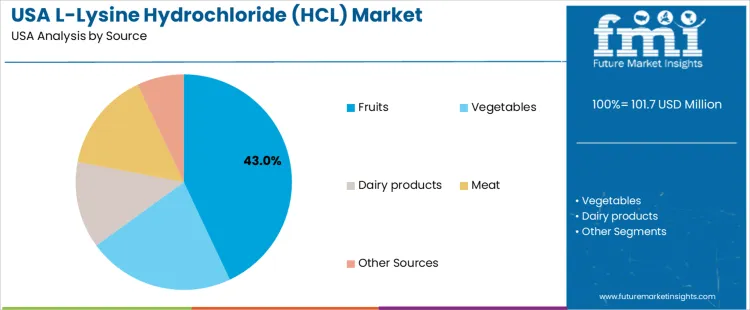
Fruit-based L-lysine HCL accounts for 43.0%, driven by clean-label ingredient preferences, high consumer trust in natural sourcing, and compatibility with health-focused formulations. Vegetable sources hold 22.0%, supporting plant-based product development and regulated nutritional enrichment. Meat-derived lysine accounts for 15.0%, serving specialized clinical and performance nutrition categories where bioavailability standards are high. Dairy sources hold 13.0%, utilized in infant formula fortification and functional food formats requiring high-purity amino acids. Other sources represent 7.0%, consisting of niche extraction routes used in processing where cost flexibility matters. Source allocation in the USA reflects traceability requirements, allergen control, and sustainability-oriented sourcing initiatives driven by major consumer goods companies.
Key Points:
- Fruit-sourced lysine supports clean-label and premium nutritional applications
- Vegetable-based supply aligns with growing plant-forward product formulation
- Animal-derived lysine retained in specialized nutrition due to high absorption efficiency
By Application, Processed Food Products Lead Demand
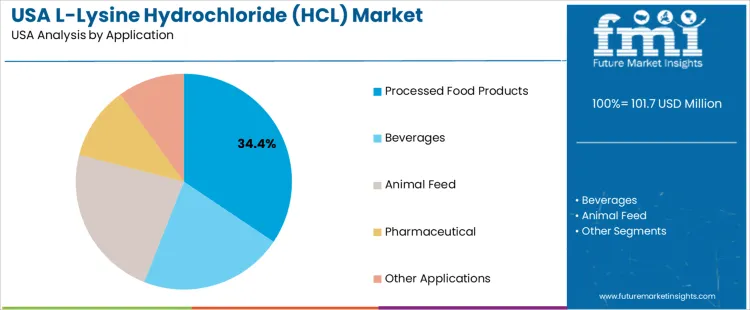
Processed food products account for 34.4%, maintaining widespread use in protein-fortified snacks, bakery items, and ready-to-eat meals. Animal feed represents 23.0%, with lysine supplementation essential for livestock amino acid balance, efficiency growth, and feed cost optimization. Beverage applications hold 21.6%, driven by energy drinks, meal replacements, and sports hydration formats requiring stable nutrient enhancement. Pharmaceuticals represent 11.0%, where lysine contributes to immune and bone-supportive therapies. Other applications make up 10.0%, covering nutraceuticals and personal nutrition categories undergoing measured expansion. Application patterns align with dietary enrichment priorities, regulatory protein labeling requirements, and rising consumer adoption of functional packaged foods across the United States.
Key Points:
- Processed foods remain the primary outlet due to broad consumer penetration
- Feed usage supports livestock nutrition and efficiency improvements
- Beverage formulations expand through wellness-focused product innovation
What are the Key Dynamics in the L-Lysine Hydrochloride (HCL) Industry?
Growth of animal protein production, increased focus on feed efficiency and rising demand for balanced amino acid nutrition drive demand.
In the United States, L-lysine HCL is widely used in poultry and swine feed to support muscle development and improve feed conversion ratios. Large animal producers in states such as Iowa, North Carolina and Arkansas rely on lysine supplementation to optimize protein utilization in corn-dominant rations. Domestic consumption of chicken and pork supports continuous demand for feed-grade lysine throughout the year. Integrators upgrade nutrition programs to manage rising feed costs, leading to increased use of amino acid balancing to reduce reliance on soybean meal. Food companies promoting high-quality animal protein products reinforce steady livestock production and sustained procurement of essential feed additives such as L-lysine HCL.
Price volatility in raw materials, regulatory compliance in feed formulations and competition from alternative amino acid sources restrain demand.
Lysine pricing is influenced by global fermentation capacity and commodity input costs, creating purchasing uncertainty for feed mills with narrow margins. Animal nutrition regulations require precise formulation documentation, which increases administrative effort and can slow reformulation changes. Some livestock producers substitute partial lysine supplementation with synthetic threonine or methionine adjustments when cost advantages shift. Economic pressure on small farms may reduce adoption of precision nutrition strategies and delay optimization programs that depend on supplemental lysine. These financial and operational considerations moderate accelerated uptake across all producer segments.
Shift toward precision livestock nutrition, increased growth in poultry exports and rising use of lysine in food and dietary supplements define key trends.
Producers adopt digital feeding systems that calculate amino acid requirements by growth stage, supporting consistent use of lysine for performance improvements. Poultry export activity strengthens production levels and encourages investment in optimal feed formulations. Human-nutrition applications expand demand for L-lysine HCL in tablets, powders and fortified foods aimed at immune support and muscle maintenance, especially among active adults. Sustainability initiatives highlight reduced nitrogen excretion from diets with balanced amino acids, supporting lysine inclusion in environmental compliance programs. These developments indicate steady, protein-driven demand for L-lysine HCL across the United States supported by feed optimization and evolving nutrition needs.
Analysis of the Demand for L-Lysine Hydrochloride (HCL) in the USA by Region
Demand for L-lysine hydrochloride (HCL) in the United States is steadily expanding due to its essential role in animal nutrition, food fortification, and nutraceutical product formulations. Poultry and swine feed segments represent the dominant consumption share, supported by protein-demand growth and livestock efficiency requirements. Human nutrition applications continue rising through amino acid supplements used for immunity and muscle-health support. West USA leads with 4.7% CAGR, followed by South USA (4.2%), Northeast USA (3.8%), and Midwest USA (3.3%). Regional variations reflect livestock density, consumer-health product demand, ingredient-sourcing logistics, and the availability of contract-manufacturing capabilities across feed and food supply chains.
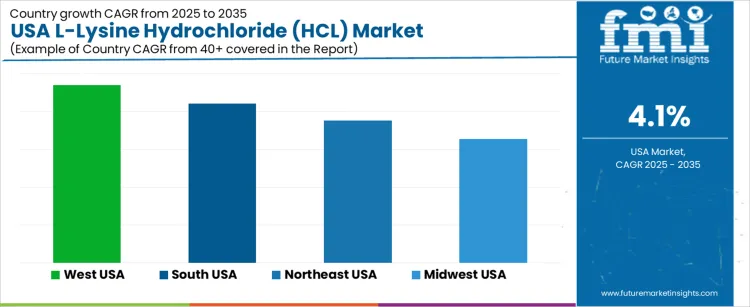
| Region | CAGR (2025-2035) |
|---|---|
| West USA | 4.7% |
| South USA | 4.2% |
| Northeast USA | 3.8% |
| Midwest USA | 3.3% |
How is the West USA driving demand for L-lysine HCL?
West USA grows at 4.7% CAGR, supported by large feed production hubs supplying poultry and dairy operations in California, Washington, and the Southwest. Intensive livestock operations incorporate lysine supplementation to optimize feed-conversion ratios amid fluctuating corn-and-soy nutrition profiles. Supplement manufacturers serving sports-nutrition and wellness retail industries maintain procurement volumes aligned with rising consumer purchases of amino acid blends. Port-based import access at Long Beach and Seattle ensures timely inbound logistics from major global producers. Buyers evaluate stable purity levels and compatibility with automated mixing equipment used in high-volume feed mills and food-processing lines. Sustainable sourcing expectations encourage documentation of responsible-supply practices throughout shipment channels.
- Livestock efficiency improvements sustaining feed-additive demand
- Performance-nutrition products expanding consumer uptake
- Strong import-logistics networks stabilizing supply
- Quality and mixing-compatibility guiding procurement preferences
How is the South USA shaping demand?
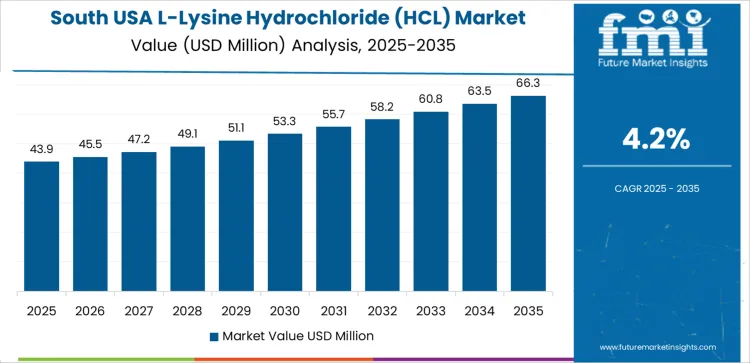
The South USA records 4.2% CAGR, driven by extensive poultry-and-swine industries concentrated in Texas, Arkansas, Georgia, and North Carolina. Vertical integration in meat production systems ensures continuous lysine inclusion to support muscle-gain efficiency and animal-health targets. Feed manufacturers scale automated blending operations to address high-volume consumption throughout the region. Retail supplement demand rises as consumers prioritize immune support, recovery, and plant-based protein balancing. Gulf Coast ports enhance ingredient flow to feed-milling clusters. Procurement teams prioritize affordable pricing and transportation reliability given the sizable throughput of animal-nutrition inputs.
- Poultry and swine production dominating additive usage
- Large-scale feed mills maintaining stable demand cycles
- Wellness supplements adding complementary consumption streams
- Port-supported logistics ensuring dependable inbound supply
How is the Northeast USA contributing to demand?
Northeast USA expands at 3.8% CAGR, influenced by diversified food-processing activity and strong nutraceutical retail channels in New York, New Jersey, and Pennsylvania. Dietary-supplement manufacturers purchase lysine for tablets, powders, and fortified food products marketed to active-lifestyle consumers. Dairy producers apply amino-acid supplementation selectively within herd-health strategies. Urban economic density supports direct-to-consumer distribution models that maintain product visibility across pharmacy, online, and specialty-retail networks. Feed applications grow gradually due to more moderate livestock concentration compared with the South and Midwest. Buyers emphasize documented purity, regulatory compliance, and label-claim integrity for consumer-facing nutrition formats.
- Supplement and fortified-food production supporting steady demand
- Urban distribution channels boosting consumer access
- Selective livestock usage maintaining baseline volumes
- Compliance and certification driving supplier selection
How is the Midwest USA sustaining procurement activity?
Midwest USA grows at 3.3% CAGR, driven by established livestock and feed-processing industries across Iowa, Illinois, Minnesota, and Missouri. High corn-and-soy output coupled with cost-driven nutrition management supports continued application of lysine to improve feed conversion and lean-meat output. Large feed integrators maintain predictable purchasing cycles aligned with livestock population stability. Supplement use increases gradually as retail health-and-nutrition channels expand in suburban industries. Distribution networks through Chicago and Kansas City strengthen accessibility for rural feed-manufacturing facilities. Purchasers assess per-ton feed-efficiency gains against material acquisition pricing to preserve operating margins.
- Strong livestock density supporting continuous additive use
- Value-oriented purchasing guiding bulk procurement
- Expanding retail-nutrition channels aiding incremental growth
- Reliable transport corridors serving feed-processing hubs
What is the competitive landscape of the demand for L-lysine hydrochloride (HCl) in the USA?
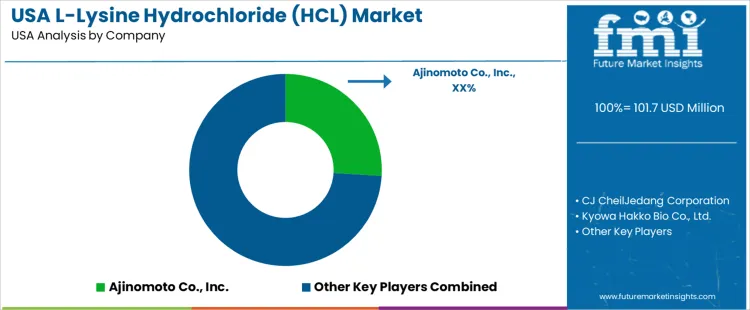
Competitive strength in the USA L-lysine HCl segment depends on producers’ ability to supply consistent-quality amino-acid feed supplements, maintain supply-chain reliability for livestock and aquaculture customers, and meet regulatory standards for feed-grade purity. Ajinomoto Co., Inc. holds an estimated 26.0% share, supported by global-scale production capacity, long-standing distribution relationships, and consistent quality that aligns with feed-mill specifications in poultry, swine, and livestock operations. CJ CheilJedang Corporation competes through cost-effective bulk production and flexible supply contracts, appealing to large-scale feed compounders managing input-cost pressures. Its share reflects strength in commodity-grade amino-acid supply where price sensitivity is high.
Kyowa Hakko Bio Co., Ltd. maintains presence through higher-purity, non-GMO-derived lysine grades favored by specialty feed producers and aquaculture formulators focused on traceability and ingredient origin transparency. Evonik Industries AG participates with advanced amino-acid technologies and consistent international logistic support, offering supply continuity for integrated USA feed networks. Meihua Holdings Group Co., Ltd. serves niche demand, including smaller compounders or regional distributors seeking competitive pricing and flexible order volumes. Competitive advantage increasingly depends on consistent assay purity, supply reliability during raw-material price fluctuations, and regulatory compliance for feed additive use in the United States. Suppliers offering volume flexibility, global logistic support, and validated ingredient quality remain best positioned to retain share in L-lysine HCl demand.
Key Players in USA L-Lysine Hydrochloride (HCL) Demand
- Ajinomoto Co., Inc.
- CJ CheilJedang Corporation
- Kyowa Hakko Bio Co., Ltd.
- Evonik Industries AG
- Meihua Holdings Group Co., Ltd.
Scope of the Report
| Items | Values |
|---|---|
| Quantitative Units | USD million |
| Source | Fruits, Vegetables, Dairy products, Meat, Other Sources |
| Application | Processed Food Products, Beverages, Animal Feed, Pharmaceutical, Other Applications |
| Regions Covered | West USA, South USA, Northeast USA, Midwest USA |
| Key Companies Profiled | Ajinomoto Co., Inc., CJ CheilJedang Corporation, Kyowa Hakko Bio Co., Ltd., Evonik Industries AG, Meihua Holdings Group Co., Ltd. |
| Additional Attributes | Dollar sales by source and application categories; regional CAGR performance within animal feed and pharmaceutical-grade usage; demand shifts toward amino-acid fortified formulations; increased inclusion of lysine HCL in poultry and swine nutrition; strengthened distribution through domestic ingredient suppliers; regulatory compliance with US FDA feed additive specifications and clean-label movement in human nutrition. |
USA L-Lysine Hydrochloride (HCL) Demand by Segments
Source:
- Fruits
- Vegetables
- Dairy products
- Meat
- Other Sources
Application:
- Processed Food Products
- Beverages
- Animal Feed
- Pharmaceutical
- Other Applications
Region:
- West USA
- South USA
- Northeast USA
- Midwest USA
Frequently Asked Questions
How big is the demand for l-lysine hydrochloride (HCL) in USA in 2025?
The demand for l-lysine hydrochloride (HCL) in USA is estimated to be valued at USD 101.7 million in 2025.
What will be the size of l-lysine hydrochloride (HCL) in USA in 2035?
The market size for the l-lysine hydrochloride (HCL) in USA is projected to reach USD 151.8 million by 2035.
How much will be the demand for l-lysine hydrochloride (HCL) in USA growth between 2025 and 2035?
The demand for l-lysine hydrochloride (HCL) in USA is expected to grow at a 4.1% CAGR between 2025 and 2035.
What are the key product types in the l-lysine hydrochloride (HCL) in USA?
The key product types in l-lysine hydrochloride (HCL) in USA are fruits, vegetables, dairy products, meat and other sources.
Which application segment is expected to contribute significant share in the l-lysine hydrochloride (HCL) in USA in 2025?
In terms of application, processed food products segment is expected to command 34.4% share in the l-lysine hydrochloride (HCL) in USA in 2025.
Preview the report firsthand - request a free sample
Get SampleGet the brochure for pricing and purchase details.
Get PDFTable of Content
- Executive Summary
- USA Market Outlook
- Demand-side Trends
- Supply-side Trends
- Technology Roadmap Analysis
- Analysis and Recommendations
- Market Overview
- Market Coverage / Taxonomy
- Market Definition / Scope / Limitations
- Market Background
- Market Dynamics
- Drivers
- Restraints
- Opportunity
- Trends
- Scenario Forecast
- Demand in Optimistic Scenario
- Demand in Likely Scenario
- Demand in Conservative Scenario
- Opportunity Map Analysis
- Product Life Cycle Analysis
- Supply Chain Analysis
- Investment Feasibility Matrix
- Value Chain Analysis
- PESTLE and Porter’s Analysis
- Regulatory Landscape
- Regional Parent Market Outlook
- Production and Consumption Statistics
- Import and Export Statistics
- Market Dynamics
- USA Market Analysis 2020 to 2024 and Forecast, 2025 to 2035
- Historical Market Size Value (USD Million) Analysis, 2020 to 2024
- Current and Future Market Size Value (USD Million) Projections, 2025 to 2035
- Y-o-Y Growth Trend Analysis
- Absolute $ Opportunity Analysis
- USA Market Pricing Analysis 2020 to 2024 and Forecast 2025 to 2035
- USA Market Analysis 2020 to 2024 and Forecast 2025 to 2035, By Source
- Introduction / Key Findings
- Historical Market Size Value (USD Million) Analysis By Source , 2020 to 2024
- Current and Future Market Size Value (USD Million) Analysis and Forecast By Source , 2025 to 2035
- Fruits
- Vegetables
- Dairy products
- Meat
- Other Sources
- Y-o-Y Growth Trend Analysis By Source , 2020 to 2024
- Absolute $ Opportunity Analysis By Source , 2025 to 2035
- USA Market Analysis 2020 to 2024 and Forecast 2025 to 2035, By Application
- Introduction / Key Findings
- Historical Market Size Value (USD Million) Analysis By Application, 2020 to 2024
- Current and Future Market Size Value (USD Million) Analysis and Forecast By Application, 2025 to 2035
- Processed Food Products
- Beverages
- Animal Feed
- Pharmaceutical
- Other Applications
- Y-o-Y Growth Trend Analysis By Application, 2020 to 2024
- Absolute $ Opportunity Analysis By Application, 2025 to 2035
- Market Structure Analysis
- Competition Dashboard
- Competition Benchmarking
- Market Share Analysis of Top Players
- By Regional
- By Source
- By Application
- Competition Analysis
- Competition Deep Dive
- Ajinomoto Co., Inc.
- Overview
- Product Portfolio
- Profitability by Market Segments (Product/Age /Sales Channel/Region)
- Sales Footprint
- Strategy Overview
- Marketing Strategy
- Product Strategy
- Channel Strategy
- CJ CheilJedang Corporation
- Kyowa Hakko Bio Co., Ltd.
- Evonik Industries AG
- Meihua Holdings Group Co., Ltd.
- Ajinomoto Co., Inc.
- Competition Deep Dive
- Assumptions & Acronyms Used
- Research Methodology


