

- Industry Size (2025)
- USD 2.0 Bn
- Forecast (2035)
- USD 3.7 Bn
- CAGR (2025 to 2035)
- 6.7%
Demand for Microfined Graphite Powder in USA 2025 to 2035
The demand for microfined graphite powder in the USA is valued at USD 2.0 billion in 2025 and is forecasted to reach USD 3.7 billion by 2035, recording a CAGR of 6.7%. Demand benefits from its role in conductive additives, high-temperature lubricants, thermal interface products, batteries, and engineered plastics. Growth reflects increasing use of conductive fillers in electronics, refractory components in metal processing, and additives that enhance strength and thermal stability in polymer systems. Expanded microfined graphite represents the leading product type. It offers improved surface area, thermal conductivity, and insulation properties, making it suitable for energy-storage components and flame-retardant composites. Adoption in lithium-ion battery cathodes and advanced sealing materials supports higher-performance industrial applications with consistent quality requirements.
Demand concentrates in the West, South, and Northeast, where electronics manufacturing clusters, chemical processing facilities, and energy-system upgrades remain active. These regions also support innovation in thermal management solutions for mobility, data-center infrastructure, and renewable-energy technologies. Key suppliers include Imerys Graphite & Carbon, SGL Carbon, AMG, Merck Group, and Graphite India Limited. Their focus includes purity enhancement, controlled particle sizing, and reliable supply for high-performance industrial processes.
Quick Stats for USA Microfined Graphite Powder Demand
- USA Microfined Graphite Powder Sales Value (2025): USD 2.0 billion
- USA Microfined Graphite Powder Forecast Value (2035): USD 3.7 billion
- USA Microfined Graphite Powder Forecast CAGR (2025–2035): 6.7%
- Leading Product Type in USA Microfined Graphite Powder Demand: Expanded Microfined Graphite
- Key Growth Regions in USA Microfined Graphite Powder Demand: West USA, South USA, Northeast USA
- Top Players in USA Microfined Graphite Powder Demand: Imerys Graphite & Carbon, SGL Carbon, AMG, Merck Group, Graphite India Limited

What is the Growth Forecast for Microfined Graphite Powder Industry in USA through 2035?
Demand for microfined graphite powder in the United States presents a moderate growth-rate volatility profile. Industrial consumption shows steady strength in lubricants, metalworking, refractories, and battery components, which supports a reliable baseline. These applications follow predictable production cycles across manufacturing and energy sectors. As a result, major fluctuations remain limited in most years. Volatility increases when demand links to emerging battery uses. Growth in domestic lithium-ion and fuel-cell production introduces variability because investment cycles depend on electrification incentives and capital spending from automotive and energy firms. Shifts in supply policy for critical minerals also influence procurement timing. Any transition from synthetic to natural graphite grades may temporarily affect product mix and volume.
Aerospace and defense projects generate intermittent spikes tied to procurement approvals and material qualification timelines. Commodity price swings influence sourcing behavior, but downstream users generally maintain inventory policies that prevent sharp short-term drops. The overall index indicates mild cyclicality, with higher-amplitude movements concentrated in energy-storage linked consumption. Long-term demand stability is maintained by broad industrial reliance and incremental substitution of microfined grades in precision applications.
USA Microfined Graphite Powder Key Takeaways
| Metric | Value |
|---|---|
| USA Microfined Graphite Powder Sales Value (2025) | USD 2.0 billion |
| USA Microfined Graphite Powder Forecast Value (2035) | USD 3.7 billion |
| USA Microfined Graphite Powder Forecast CAGR (2025-2035) | 6.7% |
Why is the Demand for Microfined Graphite Powder in the USA Growing?
Demand for microfined graphite powder in the USA is increasing because advanced manufacturing industries require fine grade conductive materials for high performance applications. Battery producers rely on microfined graphite powder as a primary anode material for lithium-ion cells used in electric vehicles, consumer electronics and stationary energy storage. Growth in EV production capacity across the USA supports sustained demand for graphite suitable for battery assembly.
Electronics and thermal management suppliers use microfined graphite powder to enhance heat dissipation in circuit boards, LEDs and high power devices. Industrial coatings, lubricants and brake linings incorporate graphite to improve wear resistance and friction control. The fine particle structure allows consistent dispersion in composites and polymers, which is important for lightweight components that need electrical and thermal conductivity.
Steelmaking and metallurgical operations maintain baseline consumption by using graphite additives in refractory linings and molten process control. Constraints include fluctuations in natural graphite supply, energy intensive processing requirements and import dependence for higher purity grades. Manufacturers evaluate synthetic graphite alternatives when cost or availability challenges affect supply planning. Environmental regulations related to mining and upgrading may also shape future sourcing strategies.
Which Product Types, Particle Sizes, and End-Use Industries Lead Demand for Microfined Graphite Powder in the USA?
Demand for microfined graphite powder in the United States is shaped by industrial applications requiring high conductivity, superior lubrication, thermal resistance, and chemical stability. USA manufacturers rely on fine-grade graphite for electronic manufacturing, defense equipment, specialty coatings, and polymer reinforcement. Growth is supported by electric vehicle production, semiconductor investments, and ongoing infrastructure development. Product selection depends on purity requirements, thermal behavior, and cost structure across advanced materials, automotive components, and high-performance engineering applications.
By Product Type, Expanded Microfined Graphite Holds the Largest Share

Expanded microfined graphite holds 49.4%, driven by its enhanced surface area, strong thermal stability, and effectiveness in flame-retardant coatings used across aerospace, automotive, and insulation manufacturing. Natural microfined graphite represents 40.1%, favored in lubricants, refractories, and conductive polymer compounds where cost efficiency and stable conductivity matter. Synthetic microfined graphite holds 10.5%, supporting high-purity applications in lithium-ion batteries and semiconductor components requiring contamination-controlled performance. Product adoption follows USA demand for lightweight composites, precise current conductivity, and compliance with advanced manufacturing standards across industrial sectors.
Key Points:
- Expanded graphite dominates for flame-resistant and thermal-conductive uses
- Natural graphite supports cost-efficient performance applications
- Synthetic grades supply high-purity electronics and battery materials
By Particle Size, 5–20 Microns Are Most Widely Used

Particle sizes between 5 to 20 microns represent 37.0%, aligning with USAge in polymer reinforcement, EMI shielding, and sealants, where balanced flow characteristics are essential. Sizes between 20–50 microns hold 26.0%, serving coatings and lubricants that require strong friction-reducing characteristics. Particles 50 microns and above represent 22.0%, used in gaskets and refractory applications requiring bulk strength. Particles below 5 microns account for 15.0%, driven by precision electronics and high-surface-area additives for energy storage. Granularity determines dispersibility, smoothness, and conductivity across diverse manufacturing environments.
Key Points:
- Mid-size particles ensure compatibility with industrial composite systems
- Larger particles support refractories and high-friction durability
- Ultra-fine sizes meet semiconductor and high-efficiency battery needs
By End-Use Industry, Construction and Electronics Drive Demand

Construction applications account for 25.0%, supported by demand for fire-retardant materials, concrete additives, and insulation coatings. Electronics and semiconductors hold 24.0%, driven by conductive adhesives and circuit protection uses. Aerospace and defense represent 20.0%, requiring lightweight thermal-resistant materials for sensitive components. Chemical processing accounts for 17.0%, where resistance to corrosion and reactive materials is critical. Automotive holds 14.0%, tied to EV battery component production and friction products. Industrial deployment reflects the USA shift toward electrification, urban infrastructure, and mission-critical equipment performance.
Key Points:
- Construction and electronics remain core high-volume consumers
- Defense and aerospace require stable thermal and structural properties
- Automotive gains momentum from EV battery and friction component USAge
What are the Drivers, Restraints, and Key Trends of the Demand for Microfined Graphite Powder in the USA?
Growth in battery manufacturing, expansion of industrial applications, and rising demand from renewable energy technologies drive demand.
In the United States, microfined graphite powder sees strong demand as a key anode material for lithium-ion batteries used in electric vehicles (EVs), energy storage systems, and consumer electronics. As EV adoption increases and battery gigafactories expand, battery manufacturers require fine-particle graphite to meet performance and purity standards. Beyond batteries, industries such as metallurgy, foundries, friction materials, lubricants, and brake linings continue to use graphite powder for its thermal conductivity, chemical stability, and lubricating properties. Steel and aluminum producers rely on graphite in refractory linings and as recarburizer in melting furnaces. These wide-ranging uses maintain a stable baseline demand for high-quality microfined graphite across manufacturing, energy, and heavy-industry sectors.
Supply chain constraints, high purity requirements and cyclic demand patterns in commodities restrain growth.
Microfined graphite for high-performance applications must meet strict purity and particle-size specifications, which increases processing costs. Domestic graphite ore deposits often have lower graphite content compared with major global producers, complicating cost-effective local sourcing. Demand volatility in downstream sectors such as automotive and steel manufacturing can produce swings in procurement volumes. In addition, lead times for coated or spherical graphite (used for battery anodes) remain long, prompting manufacturers to manage inventory tightly which may dampen growth for smaller buyers.
Shift toward battery-grade spherical graphite, increased use in energy storage and growing demand from clean-energy legislation define key trends.
Manufacturers are increasingly sourcing microfined graphite that can be further processed into spherical or coated forms for high-energy-density batteries. Growth in renewable energy and stationary storage driven by clean energy policies and utility-scale storage deployment expands demand for battery anode materials beyond EVs. Domestic efforts to secure graphite supply chains under federal incentives and to reduce dependence on imported materials support investment in USA-based graphite purification and processing. Refinement technologies aim to improve carbon purity and reduce environmental impact. Traditional uses in lubrication, refractory materials, and friction products continue to benefit from the fine particle size and thermal stability of microfined graphite powder.
Analysis of the Demand for Microfined Graphite Powder in the USA by Region
Demand for microfined graphite powder in the United States continues to expand due to its use in lithium-ion batteries, high-temperature lubricants, conductive coatings, additive manufacturing, and industrial sealing compounds. Growth reflects increased investments in domestic energy-storage manufacturing and advanced materials that support electrification, aerospace innovation, and automotive component durability. West USA leads at 7.6% CAGR, followed by South USA at 6.8%, aligned with EV-gigafactory deployment and electronics fabrication shifts. Northeast USA grows at 6.1%, driven by R&D and specialty chemical processing, while Midwest USA advances at 5.3% with strong metalworking and factory automation needs.

| Region | CAGR (2025-2035) |
|---|---|
| West USA | 7.6% |
| South USA | 6.8% |
| Northeast USA | 6.1% |
| Midwest USA | 5.3% |
How is the West USA driving demand for microfined graphite powder?

West USA demonstrates 7.6% CAGR, the fastest national rate, supported by expanding battery-production hubs in California and Nevada that rely on microfined graphite powder for anode material formulations. Aerospace contractors in Washington integrate conductive composites into thermal-management assemblies. The semiconductor ecosystem strengthens demand for ultra-pure graphite grades used in high-precision tools and thermal interface materials. Industrial coatings utilizing graphite-based lubricants align with sustainability requirements for reduced-friction machinery. Procurement focuses on secure sourcing, domestic refinement scaling, and consistent micro-particle uniformity to serve high-performance engineering workflows. Growth continues as Western states accelerate manufacturing repatriation and clean-energy material investments.
- EV-battery manufacturing driving anode-grade graphite demand
- Aerospace composites requiring thermal-management performance
- Semiconductor industry expanding high-purity material use
- Industrial lubricants aligning with efficiency and durability needs
How is the South USA shaping adoption?

South USA grows at 6.8% CAGR, driven by automotive part production, petrochemical facility operations, and EV-supply-chain expansion in Texas, Georgia, and Tennessee. Microfined graphite powder is incorporated into seals, gaskets, brake pads, and friction materials essential for mass-market vehicle assembly. Chemical processing plants use graphite-enhanced lubricants to improve equipment life in corrosive-temperature environments. The region’s logistics infrastructure enables efficient distribution to aerospace subcontractors and battery-component importers. Buyers prioritize cost-controlled procurement, proof of particle consistency, and supplier capability to maintain regulatory compliance for advanced-material manufacturing across varied industrial sites.
- Automotive friction materials sustaining stable volume demand
- Chemical plants requiring heat-resistant lubricant enhancements
- Logistics networks supporting raw-material distribution efficiency
- Compliance and consistency driving procurement evaluation
How is the Northeast USA contributing to demand?

Northeast USA registers 6.1% CAGR, supported by advanced-manufacturing activity in New York, Massachusetts, and New Jersey. Graphite materials are used in research-grade additive manufacturing and conductive coatings for electronics and medical-device prototyping. Battery research programs evaluate micro-particle treatments to enhance conductivity and cycle performance. Industrial machinery suppliers deploy graphite-reinforced compounds in bearings and motion-control assemblies. The region emphasizes verifiable purity and traceable supply chains aligned with stringent regulatory expectations. Demand also grows through defense-contractor participation in thermal-shielding and EMI-mitigation technologies used in aerospace electronics.
- R&D-driven adoption in advanced material applications
- Electronics prototyping increasing conductive-coating demand
- Defense sectors using EMI-control and thermal-protection solutions
- Quality assurance and certification shaping supplier selection
How is the Midwest USA supporting broader industry needs?
Midwest USA increases at 5.3% CAGR, driven by steelmaking, metal fabrication, and agricultural machinery production across Ohio, Indiana, and Michigan. Microfined graphite powder enhances die-casting lubricants and anti-seize pastes used in heavy-equipment assembly. Industrial-bearing producers incorporate graphite for friction reduction in high-load mechanical settings. Battery-component suppliers emerging near regional EV manufacturing use graphite anode materials for pilot-scale production. Procurement teams emphasize cost stability and compatibility with existing lubrication and coating systems. Strong transportation corridors support predictable supply despite slower expansion relative to coastal technology hubs.
- Die-casting and metalworking sustaining recurring consumption
- Mechanical systems requiring reliable high-load lubrication
- EV-supply-chain additions supporting modest material adoption
- Transportation networks maintaining dependable distribution
How does competitive concentration shape supply strategies for microfined graphite powder in the United States?
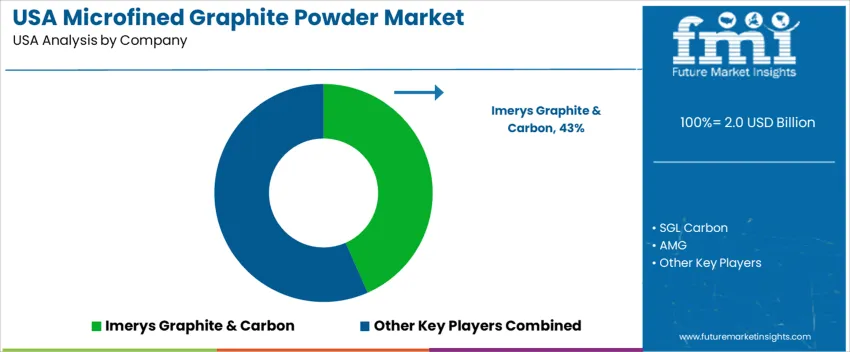
Competitive dynamics for microfined graphite powder in the United States reflect control over processing capability, purity assurance, and supply continuity to battery materials, lubricants, coatings, and refractories. Imerys Graphite & Carbon holds an estimated 43.4%, supported by established purification processes and particle-size consistency necessary for energy storage and industrial additive applications. Its position strengthens where qualification cycles and technical documentation drive long vendor relationships.
SGL Carbon competes through specialty grades suited to thermal-management components, high-temperature operations, and polymer-matrix integration. Its share reflects direct engineering support for USA customers requiring predictable conductivity and compatibility with composite manufacturing. AMG focuses on tailored particle distributions and controlled surface chemistry. Participation links to clients with application-specific dispersion needs in coatings and lubricants.
Merck Group supplies microfined grades positioned for laboratory and high-value industrial uses where tight purity ranges and trace-metal control matter. Demand arises from categories advancing toward improved battery-system efficiency and chemical stability. Graphite India Limited serves cost-sensitive applications and achieves access through distribution channels supporting general-purpose industrial consumption where performance criteria are less stringent.
Key Players in USA Microfined Graphite Powder Demand
- Imerys Graphite & Carbon
- SGL Carbon
- AMG
- Merck Group
- Graphite India Limited
Scope of the Report
| Items | Values |
|---|---|
| Quantitative Units | USD billion |
| Product Type | Expanded Microfined Graphite, Natural Microfined Graphite, Synthetic Microfined Graphite |
| Particle Size | 5 to 20 microns, Below 5 microns, 20 to 50 microns, 50 microns and above |
| End Use Industry | Construction, Automotive, Aerospace & Defense, Electronics & Semiconductors, Chemical Processing |
| Regions Covered | West USA, South USA, Northeast USA, Midwest USA |
| Key Companies Profiled | Imerys Graphite & Carbon, SGL Carbon, AMG, Merck Group, Graphite India Limited |
| Additional Attributes | Dollar sales by product type, particle size, and end-use industries; regional adoption trends across West, South, Northeast, and Midwest USA; application growth in EV batteries, thermal management components, lubricants, coatings, and conductive materials; competitive landscape of natural vs. synthetic microfined graphite suppliers; integration with advanced composites and semiconductor-grade applications; demand drivers in lightweight automotive parts and corrosion-resistant industrial materials. |
USA Microfined Graphite Powder Demand by Segments
Product Type:
- Expanded Microfined Graphite
- Natural Microfined Graphite
- Synthetic Microfined Graphite
Particle Size:
- 5 to 20 microns
- Below 5 microns
- 20 to 50 microns
- 50 microns and above
End Use Industry:
- Construction
- Automotive
- Aerospace & Defense
- Electronics & Semiconductors
- Chemical Processing
Region:
- West USA
- South USA
- Northeast USA
- Midwest USA
Frequently Asked Questions
How big is the demand for microfined graphite powder in USA in 2025?
The demand for microfined graphite powder in USA is estimated to be valued at USD 2.0 billion in 2025.
What will be the size of microfined graphite powder in USA in 2035?
The market size for the microfined graphite powder in USA is projected to reach USD 3.7 billion by 2035.
How much will be the demand for microfined graphite powder in USA growth between 2025 and 2035?
The demand for microfined graphite powder in USA is expected to grow at a 6.7% CAGR between 2025 and 2035.
What are the key product types in the microfined graphite powder in USA?
The key product types in microfined graphite powder in USA are expanded microfined graphite, natural microfined graphite and synthetic microfined graphite.
Which particle size segment is expected to contribute significant share in the microfined graphite powder in USA in 2025?
In terms of particle size, 5 to 20 microns segment is expected to command 37.0% share in the microfined graphite powder in USA in 2025.
Preview the report firsthand - request a free sample
Get SampleGet the brochure for pricing and purchase details.
Get PDFTable of Content
- Executive Summary
- USA Market Outlook
- Demand-side Trends
- Supply-side Trends
- Technology Roadmap Analysis
- Analysis and Recommendations
- Market Overview
- Market Coverage / Taxonomy
- Market Definition / Scope / Limitations
- Market Background
- Market Dynamics
- Drivers
- Restraints
- Opportunity
- Trends
- Scenario Forecast
- Demand in Optimistic Scenario
- Demand in Likely Scenario
- Demand in Conservative Scenario
- Opportunity Map Analysis
- Product Life Cycle Analysis
- Supply Chain Analysis
- Investment Feasibility Matrix
- Value Chain Analysis
- PESTLE and Porter’s Analysis
- Regulatory Landscape
- Regional Parent Market Outlook
- Production and Consumption Statistics
- Import and Export Statistics
- Market Dynamics
- USA Market Analysis 2020 to 2024 and Forecast, 2025 to 2035
- Historical Market Size Value (USD Million) Analysis, 2020 to 2024
- Current and Future Market Size Value (USD Million) Projections, 2025 to 2035
- Y-o-Y Growth Trend Analysis
- Absolute $ Opportunity Analysis
- USA Market Pricing Analysis 2020 to 2024 and Forecast 2025 to 2035
- USA Market Analysis 2020 to 2024 and Forecast 2025 to 2035, By Product Type
- Introduction / Key Findings
- Historical Market Size Value (USD Million) Analysis By Product Type , 2020 to 2024
- Current and Future Market Size Value (USD Million) Analysis and Forecast By Product Type , 2025 to 2035
- Expanded Microfined Graphite
- Natural Microfined Graphite
- Synthetic Microfined Graphite
- Y-o-Y Growth Trend Analysis By Product Type , 2020 to 2024
- Absolute $ Opportunity Analysis By Product Type , 2025 to 2035
- USA Market Analysis 2020 to 2024 and Forecast 2025 to 2035, By Particle Size
- Introduction / Key Findings
- Historical Market Size Value (USD Million) Analysis By Particle Size, 2020 to 2024
- Current and Future Market Size Value (USD Million) Analysis and Forecast By Particle Size, 2025 to 2035
- 5 to 20 microns
- Below 5 microns
- 20 to 50 microns
- 50 microns and above
- Y-o-Y Growth Trend Analysis By Particle Size, 2020 to 2024
- Absolute $ Opportunity Analysis By Particle Size, 2025 to 2035
- USA Market Analysis 2020 to 2024 and Forecast 2025 to 2035, By End Use Industry
- Introduction / Key Findings
- Historical Market Size Value (USD Million) Analysis By End Use Industry, 2020 to 2024
- Current and Future Market Size Value (USD Million) Analysis and Forecast By End Use Industry, 2025 to 2035
- Construction
- Automotive
- Aerospace & Defense
- Electronics & Semiconductors
- Chemical Processing
- Y-o-Y Growth Trend Analysis By End Use Industry, 2020 to 2024
- Absolute $ Opportunity Analysis By End Use Industry, 2025 to 2035
- Market Structure Analysis
- Competition Dashboard
- Competition Benchmarking
- Market Share Analysis of Top Players
- By Regional
- By Product Type
- By Particle Size
- By End Use Industry
- Competition Analysis
- Competition Deep Dive
- Imerys Graphite & Carbon
- Overview
- Product Portfolio
- Profitability by Market Segments (Product/Age /Sales Channel/Region)
- Sales Footprint
- Strategy Overview
- Marketing Strategy
- Product Strategy
- Channel Strategy
- SGL Carbon
- AMG
- Merck Group
- Graphite India Limited
- Imerys Graphite & Carbon
- Competition Deep Dive
- Assumptions & Acronyms Used
- Research Methodology


