

- Industry Size (2026)
- USD 309.6 Mn
- Forecast (2036)
- USD 529.4 Mn
- CAGR (2026 to 2036)
- 5.5%
Demand for Partially Hydrogenated Oil in USA 2026 to 2036
Demand for Partially Hydrogenated Oil in USA is valued at USD 309.6 million in 2026 and is projected to reach USD 529.4 million by 2036, reflecting a CAGR of 5.5%. Demand persists due to continued use in selected industrial and food-related applications where functional stability, oxidative resistance, and texture control remain important. Regulatory-compliant formulations and non-food diversification support measured expansion despite restrictions in edible use.
Lubricants lead application usage because partially hydrogenated oils provide viscosity stability, thermal resistance, and oxidation control in specialty industrial lubricant formulations. These oils perform effectively in metalworking fluids, greases, and processing lubricants where consistency under stress conditions is required. Controlled hydrogenation profiles enable tailored performance across varied operating environments. Bakery remains a leading end user where permitted formulations rely on partially hydrogenated oils for aeration control, shelf stability, and textural consistency in shortenings and fillings. Reformulated blends address regulatory limits while maintaining functional performance in industrial baking operations.
West USA, South USA, Northeast USA, and Midwest USA represent key growth regions supported by food processing infrastructure and industrial manufacturing activity. Cargill, Bunge, ADM, AAK, and Wilmar anchor competitive activity through formulation expertise, compliant sourcing strategies, and diversified application portfolios aligned with evolving regulatory and functional requirements across USA end-use sectors.
Quick Stats for Demand for Partially Hydrogenated Oil in USA
- USA Partially Hydrogenated Oil Sales Value (2026): USD 309.6 million
- USA Partially Hydrogenated Oil Forecast Value (2036): USD 529.4 million
- USA Partially Hydrogenated Oil Forecast CAGR (2026 to 2036): 5.5%
- Leading Application in USA Demand: Lubricants
- Key Growth Regions in USA Demand: West USA, South USA, Northeast USA, Midwest USA
- Top Players in USA Demand: Cargill, Bunge, ADM, AAK, Wilmar
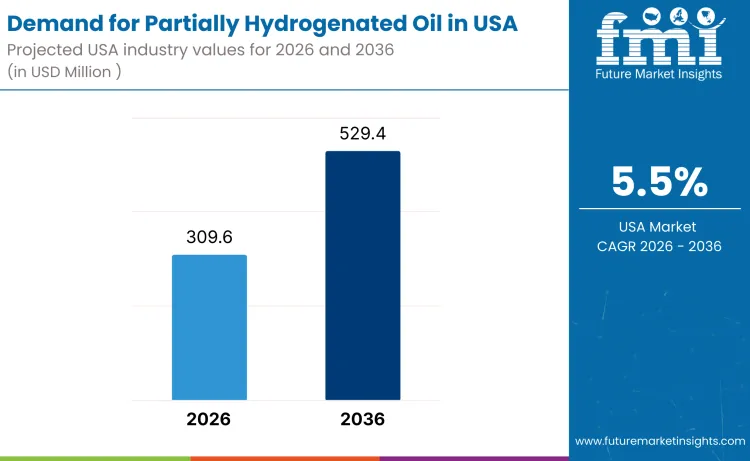
USA Partially Hydrogenated Oil Key Takeaways
| Metric | Value |
|---|---|
| USA Partially Hydrogenated Oil Sales Value (2026) | USD 309.6 million |
| USA Partially Hydrogenated Oil Forecast Value (2036) | USD 529.4 million |
| USA Partially Hydrogenated Oil Forecast CAGR (2026 to 2036) | 5.5% |
How Are the Segments Classified in the Demand for Partially Hydrogenated Oil in the USA?
Demand for partially hydrogenated oil in the USA is shaped by functional performance requirements, stability needs, and controlled usage across industrial and food-related applications. Buyers evaluate oxidative stability, consistency, melting behavior, and compatibility with specific processing environments. Adoption patterns reflect differentiated use between non-food industrial applications and regulated food formulations, where performance characteristics remain relevant within permitted use frameworks and reformulated product categories.
Which Application Accounts for the Largest Share of Demand in the USA?
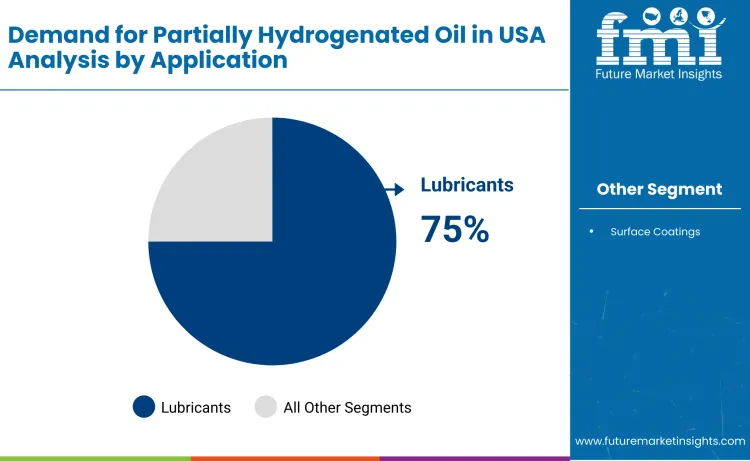
Lubricants hold 75.0%, making them the leading application segment in the USA. Partially hydrogenated oils are used in lubricant formulations to provide viscosity stability, oxidative resistance, and consistent performance under mechanical stress. These oils support industrial lubrication systems requiring controlled thermal behavior. Surface coatings hold 25.0%, using partially hydrogenated oils to improve film formation, flexibility, and surface protection characteristics. Application distribution reflects dominant non-food industrial usage driven by functional performance needs in USA manufacturing and maintenance operations.
Key Points:
- Lubricants dominate due to viscosity and stability requirements.
- Oxidative resistance supports mechanical performance.
- Surface coatings represent a secondary functional application.
Which End-User Segment Accounts for the Largest Share of Demand in the USA?
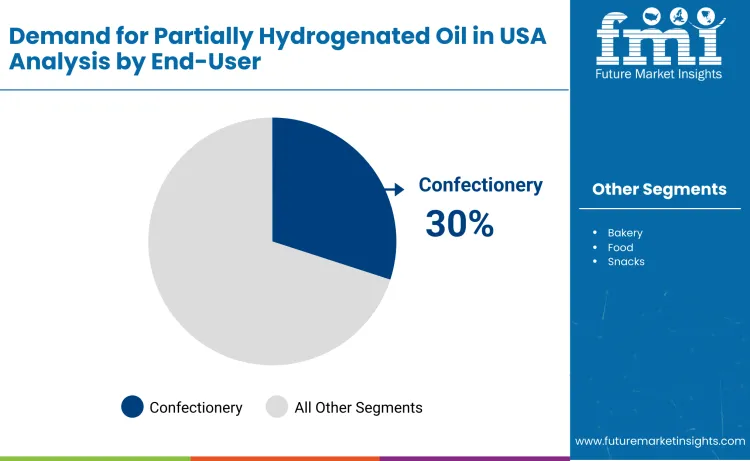
Confectionery holds 30.0%, making it the leading end-user segment in the USA. Partially hydrogenated oils are used to achieve texture stability, shelf-life consistency, and mouthfeel control in specific confectionery formulations. Bakery applications hold 25.0%, relying on functional fats for structure and processing tolerance. Food applications account for 15.0%, supporting controlled-use formulations. Beverages hold 18.0%, using partially hydrogenated components in niche formulation roles. Snacks account for 12.0%, applying oils for texture and stability. End-user distribution reflects selective use in confectionery and bakery segments under regulatory constraints.
Key Points:
- Confectionery leads due to texture and shelf-life needs.
- Bakery relies on functional fat performance.
- Other food segments represent controlled, limited usage.
What are the Key Dynamics in the Partially Hydrogenated Oil Industry in USA?
Demand remains severely constrained in USA due to regulatory prohibition in food applications and limited acceptable uses. Partially hydrogenated oils are no longer permitted as GRAS ingredients in foods, following FDA action targeting industrially produced trans fats. Residual demand persists only in tightly controlled, non-food, or technical contexts. Market activity reflects regulatory compliance management rather than growth-oriented consumption.
How do regulatory prohibition and legacy formulation phase-outs define demand conditions in USA?
FDA determination that partially hydrogenated oils are not generally recognized as safe eliminated their use in conventional food manufacturing. Food processors completed reformulation toward fully hydrogenated oils, interesterified fats, and alternative lipid systems. Remaining activity relates to regulatory compliance, inventory clearance, and documentation within legacy supply chains. Some technical-grade applications outside food remain subject to separate regulatory frameworks, though volumes are limited. Import controls and compliance audits reinforce restrictions. Industry focus centers on replacement technologies rather than continued PHO utilization. Demand characteristics reflect enforcement outcomes, reformulation timelines, and ongoing monitoring rather than active procurement by food manufacturers.
How do compliance costs, substitution availability, and public health scrutiny affect demand stability?
Strict enforcement creates high compliance risk for any attempted food use, eliminating commercial incentive. Availability of functional substitutes with comparable texturizing performance reduces need for PHOs. Public health scrutiny surrounding trans fats influences corporate risk management and brand policies. Documentation, testing, and liability exposure further deter usage. Non-food technical applications face evaluation under occupational and environmental standards, limiting expansion. Supply chains have largely exited routine production, affecting availability. Demand remains minimal and structurally constrained, shaped by regulatory controls, effective substitutes, and sustained public health priorities within USA.
How Is Demand for Partially Hydrogenated Oil in USA Evolving by Region?
Demand for partially hydrogenated oil in the USA shows selective growth within controlled industrial and specialty food applications, shaped by regulatory compliance pathways and limited permitted uses. West USA leads with a 6.3% CAGR, supported by specialty food manufacturing, export-oriented processing, and non-food industrial formulations. South USA follows at 5.7%, driven by large-scale food processing, bakery fats for regulated uses, and industrial shortening applications. Northeast USA records a 5.1% CAGR, reflecting controlled pharmaceutical, confectionery, and specialty ingredient demand. Midwest USA posts a 4.4% CAGR, supported by industrial food manufacturing, feedstock processing, and replacement-driven consumption. Regional variation reflects compliance strategies, permitted-use concentration, and industrial processing intensity across the USA.
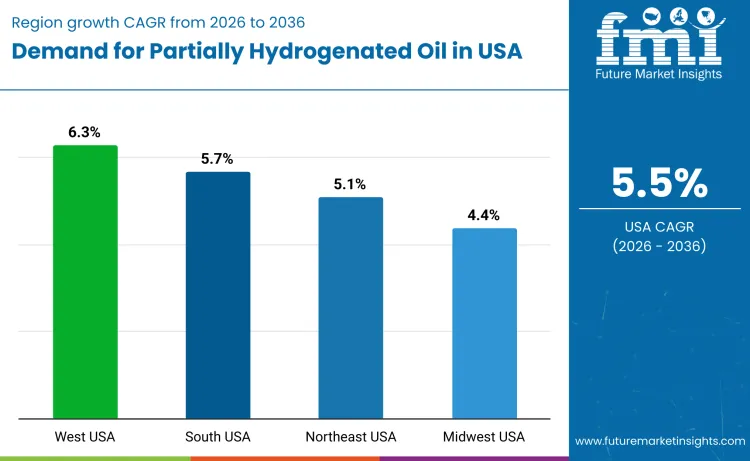
| Region | CAGR (2026 to 2036) |
|---|---|
| West USA | 6.3% |
| South USA | 5.7% |
| Northeast USA | 5.1% |
| Midwest USA | 4.4% |
How is West USA driving demand for Partially Hydrogenated Oil?
West USA demand is shaped by specialty processing, regulated-use compliance, and diversified industrial applications. The region’s CAGR of 6.3% reflects controlled use of partially hydrogenated oil in specific food formulations produced for export markets and permitted applications requiring functional stability. Manufacturers rely on PHO for texture control, oxidative stability, and shelf-life performance in niche formulations. Non-food applications, including industrial lubricants, coatings, and process aids, support additional consumption. Regulatory compliance management remains central, with strict documentation and segregation of PHO-containing production lines. Demand favors consistent quality grades supplied in controlled logistics channels.
- Export-oriented and specialty food processing usage
- Functional stability requirements in niche formulations
- Non-food industrial and process-aid applications
- Strong emphasis on regulatory documentation and segregation
How is South USA driving demand for Partially Hydrogenated Oil?
South USA demand is volume-oriented and linked to large-scale processing infrastructure. The region’s CAGR of 5.7% reflects use of partially hydrogenated oil in permitted bakery fats, industrial shortenings, and non-food manufacturing processes. Large processing facilities maintain PHO usage where functional performance requirements outweigh substitution feasibility. Integrated oil processing and storage infrastructure supports bulk handling under compliance-controlled conditions. Industrial buyers prioritize supply continuity, functional consistency, and cost efficiency. Demand remains structured around regulated allowances and industrial-scale operations.
- Permitted bakery and industrial shortening applications
- Large-scale oil processing and storage infrastructure
- Bulk handling under compliance-controlled systems
- Cost and functionality-driven procurement
How is Northeast USA driving demand for Partially Hydrogenated Oil?
Northeast USA demand reflects controlled, high-compliance usage across specialty food, pharmaceutical, and ingredient manufacturing. The region’s CAGR of 5.1% is supported by limited PHO use in confectionery components, pharmaceutical excipients, and specialty fats requiring precise melting profiles. Manufacturers operate under strict regulatory oversight, emphasizing traceability and controlled sourcing. Smaller batch sizes and higher specification requirements influence procurement. Demand growth aligns with specialty product lines rather than mass-market food applications.
- Specialty confectionery and ingredient formulations
- Pharmaceutical excipient and controlled-use demand
- High compliance and traceability requirements
- Smaller batch, high-specification procurement
How is Midwest USA driving demand for Partially Hydrogenated Oil?
Midwest USA demand is stable and replacement-driven, reflecting established industrial food manufacturing and processing operations. The region’s CAGR of 4.4% reflects use of partially hydrogenated oil in regulated industrial applications, feedstock processing, and legacy formulations maintained under compliance allowances. Proximity to oilseed processing supports supply reliability. Manufacturers emphasize cost control, functional consistency, and compatibility with existing equipment. Growth remains moderate, supported by incremental demand within permitted-use boundaries.
- Industrial food and processing applications
- Feedstock and oilseed processing proximity
- Replacement-driven, compliance-bound consumption
- Emphasis on functional consistency and cost efficiency
What is the competitive landscape of demand for partially hydrogenated oil in the USA?
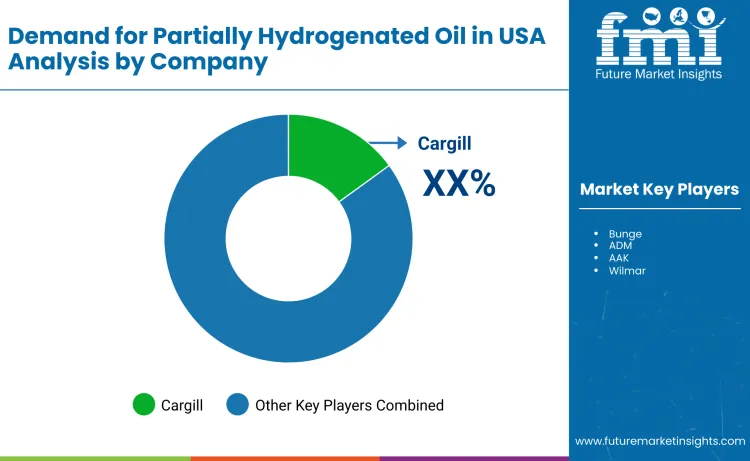
Demand for partially hydrogenated oil in the USA is shaped by legacy industrial uses, niche food applications permitted under specific regulatory exemptions, and non-food applications requiring controlled melting behavior and oxidative stability. Usage persists in selected bakery shortenings, frying compounds for export-oriented production, oleochemical intermediates, and industrial lubricants where functional properties remain relevant. Buyers evaluate trans-fat compliance status, hydrogenation control, consistency of fatty acid profiles, and adherence to FDA regulations governing restricted use.
Procurement teams prioritize suppliers with strong regulatory management, traceable feedstock sourcing, and capability to reformulate products to meet evolving compliance thresholds. Trend in the USA market reflects gradual volume contraction, reformulation toward interesterified and fully hydrogenated alternatives, and continued limited demand in industrial and specialty segments.
Cargill operates USA oil processing facilities supplying hydrogenated and specialty fats aligned with regulatory allowances and industrial specifications. Bunge maintains USA refining and processing operations supporting food and industrial customers requiring tailored fat functionality. ADM participates through domestic oilseed crushing and hydrogenation capacity serving food ingredient and technical fat applications. AAK USA supports demand with specialty fat systems, including hydrogenated components used within controlled formulations. Wilmar USA contributes through edible oil refining and specialty fat production supporting regulated and export-oriented applications. Competitive positioning in the USA reflects regulatory expertise, formulation flexibility, domestic processing scale, and ability to manage transition pathways toward compliant fat alternatives.
Key Players in USA Partially Hydrogenated Oil Demand
- Cargill
- Bunge
- ADM
- AAK
- Wilmar
Scope of the Report
| Items | Values |
|---|---|
| Quantitative Units | USD million |
| Application | Surface Coatings; Lubricants |
| End User | Bakery; Food; Snacks; Beverages; Confectionery |
| Regions Covered | West USA; South USA; Northeast USA; Midwest USA |
| Key Companies Profiled | Cargill; Bunge; ADM; AAK; Wilmar |
| Additional Attributes | Dollar sales by application and end-user category; regional consumption patterns across food processing and industrial lubricant uses; regulatory influence on formulation adjustments; substitution trends toward alternative fats; supply dynamics shaped by raw material availability, pricing volatility, and compliance-driven demand shifts. |
USA Partially Hydrogenated Oil Demand by Segments
By Application:
- Surface Coatings
- Lubricants
By End User:
- Bakery
- Food
- Snacks
- Beverages
- Confectionery
By Region:
- West USA
- South USA
- Northeast USA
- Midwest USA
Frequently Asked Questions
How big is the demand for partially hydrogenated oil in USA in 2026?
The demand for partially hydrogenated oil in USA is estimated to be valued at USD 309.6 million in 2026.
What will be the size of partially hydrogenated oil demand in USA in 2036?
The demand size for partially hydrogenated oil in USA is projected to reach USD 529.4 million by 2036.
How much will the demand for partially hydrogenated oil in USA grow between 2026 and 2036?
The demand for partially hydrogenated oil in USA is expected to grow at a 5.5% CAGR between 2026 and 2036.
What are the key application areas in the partially hydrogenated oil demand in USA?
The key application areas in partially hydrogenated oil demand in USA include surface coatings, industrial lubricants, and controlled food applications.
Which end-user segment is expected to contribute a significant share in the partially hydrogenated oil demand in USA in 2026?
In terms of end user, bakery segment is expected to command 25.0% share in the partially hydrogenated oil demand in USA in 2026.
Preview the report firsthand - request a free sample
Get SampleGet the brochure for pricing and purchase details.
Get PDFTable of Content
- Executive Summary
- USA Market Outlook
- Demand Side Trends
- Supply Side Trends
- Regulatory and Compliance Landscape
- Analysis and Recommendations
- Market Overview
- Market Coverage and Taxonomy
- Market Definition, Scope, and Limitations
- Market Background
- Market Dynamics
- Drivers
- Restraints
- Opportunities
- Trends
- Scenario Forecast
- Demand in Optimistic Scenario
- Demand in Likely Scenario
- Demand in Conservative Scenario
- Opportunity Map Analysis
- Product Life Cycle Analysis
- Supply Chain Analysis
- Investment Feasibility Matrix
- Value Chain Analysis
- PESTLE and Porter Analysis
- Regulatory Framework and FDA Compliance Review
- Regional Parent Market Outlook
- Production and Consumption Statistics
- Import and Export Statistics
- USA Partially Hydrogenated Oil Demand Analysis 2020 to 2024 and Forecast 2025 to 2035
- Historical Market Size Value (USD Million) Analysis 2020 to 2024
- Current and Future Market Size Value (USD Million) Projections 2025 to 2035
- Year-on-Year Growth Trend Analysis
- Absolute Dollar Opportunity Analysis
- USA Partially Hydrogenated Oil Pricing Analysis 2020 to 2024 and Forecast 2025 to 2035
- USA Partially Hydrogenated Oil Demand Analysis 2020 to 2024 and Forecast 2025 to 2035, By Application
- Introduction and Key Findings
- Historical Market Size Value (USD Million) Analysis by Application 2020 to 2024
- Current and Future Market Size Value (USD Million) Analysis and Forecast by Application 2025 to 2035
- Lubricants
- Surface Coatings
- Year-on-Year Growth Trend Analysis by Application
- Absolute Dollar Opportunity Analysis by Application
- USA Partially Hydrogenated Oil Demand Analysis 2020 to 2024 and Forecast 2025 to 2035, By End User
- Introduction and Key Findings
- Historical Market Size Value (USD Million) Analysis by End User 2020 to 2024
- Current and Future Market Size Value (USD Million) Analysis and Forecast by End User 2025 to 2035
- Bakery
- Confectionery
- Food
- Snacks
- Beverages
- Year-on-Year Growth Trend Analysis by End User
- Absolute Dollar Opportunity Analysis by End User
- USA Partially Hydrogenated Oil Demand Analysis 2020 to 2024 and Forecast 2025 to 2035, By Region
- West USA
- South USA
- Northeast USA
- Midwest USA
- Market Structure Analysis
- Competition Dashboard
- Competition Benchmarking
- Market Share Analysis of Key Players
- By Application
- By End User
- By Region
- Competition Analysis
- Competition Deep Dive
- Cargill
- Bunge
- ADM
- AAK
- Wilmar
- Assumptions and Acronyms Used
- Research Methodology


