

- Industry Size (2025)
- USD 5.8 Bn
- Forecast (2035)
- USD 9.0 Bn
- CAGR (2025 to 2035)
- 4.6%
Demand for Phthalate and Non-Phthalate Plasticizers in USA 2025 to 2035
The USA phthalate and non-phthalate plasticizers demand is valued at USD 5.8 billion in 2025 and is projected to reach USD 9.0 billion by 2035, reflecting a CAGR of 4.6%. Growth is supported by steady consumption in flexible PVC production for construction materials, automotive interiors, and consumer goods. Replacement of rigid materials with lightweight polymer applications sustains long-term usage across industrial and commercial sectors.
Phthalate plasticizers remain the leading product type due to established performance advantages in flexibility, durability, and cost efficiency. Their continued use in cables, flooring, and coated fabrics maintains dominant volume share. Gradual adoption of non-phthalate alternatives progresses in medical, toys, and food-contact applications where regulatory scrutiny and corporate sustainability objectives encourage the shift toward safer chemistries.
The West, South, and Northeast regions show high consumption linked to construction activity, large-scale manufacturing, and PVC converting operations. Key suppliers include BASF SE, Exxon Mobil Corporation, Evonik Industries AG, Eastman Chemical Company, and Lanxess AG. Strategic focus includes capacity expansion for high-purity grades, development of low-migration formulations, and product portfolios aligned with evolving regulatory requirements in sensitive end-use sectors.
Quick Stats for USA Phthalate and Non-Phthalate Plasticizers Demand
- USA Phthalate and Non-Phthalate Plasticizers Sales Value (2025): USD 5.8 billion
- USA Phthalate and Non-Phthalate Plasticizers Forecast Value (2035): USD 9.0 billion
- USA Phthalate and Non-Phthalate Plasticizers Forecast CAGR (2025-2035): 4.6%
- Leading Product Type in USA Phthalate and Non-Phthalate Plasticizers Demand: Phthalate Plasticizers
- Key Growth Regions in USA Phthalate and Non-Phthalate Plasticizers Demand: West USA, South USA, Northeast USA
- Top Players in USA Phthalate and Non-Phthalate Plasticizers Demand: BASF SE, Exxon Mobil Corporation, Evonik Industries AG, Eastman Chemical Company, Lanxess AG
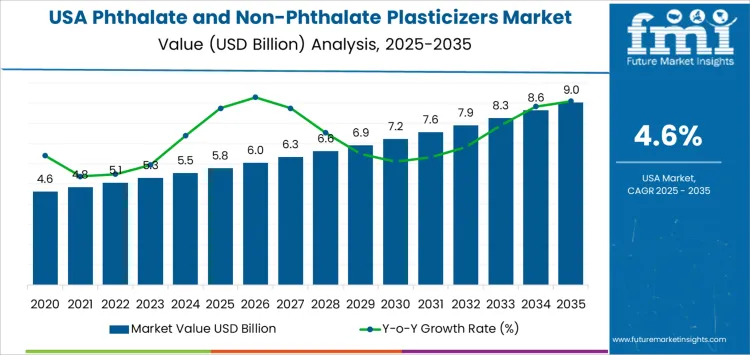
What is the Growth Forecast for Phthalate and Non-Phthalate Plasticizers Industry in USA through 2035?
Demand for phthalate and non-phthalate plasticizers in the United States presents moderate variability across multiple end-use channels. Replacement of phthalate-based additives in consumer goods accelerates regulatory-driven transitions. Volatility increases whenever compliance timelines tighten or health risk assessments change. Price fluctuations in petrochemical feedstocks contribute to short-term instability. Domestic construction and automotive production cycles also affect demand intensity, since both sectors rely heavily on flexible PVC applications.
Non-phthalate plasticizers maintain a stronger growth trajectory. Adoption rates shift upward when sustainability requirements and brand-led material reforms intensify. Volatility remains present because innovation pipelines and availability of bio-based alternatives fluctuate with investment cycles. Industry behavior displays defined swings when new formulations enter large-volume product portfolios.
The variability stays within a controlled band. The presence of long-term PVC infrastructure ensures recurring base consumption. Regulatory evolution keeps growth momentum intact while intermittently adjusting yearly performance. The United States positions non-phthalate solutions as the forward engine of expansion, while phthalate materials retain a diminishing yet stable share that dampens severe volatility in combined demand.
USA Phthalate and Non-Phthalate Plasticizers Key Takeaways
| Metric | Value |
|---|---|
| USA Phthalate and Non-Phthalate Plasticizers Sales Value (2025) | USD 5.8 billion |
| USA Phthalate and Non-Phthalate Plasticizers Forecast Value (2035) | USD 9.0 billion |
| USA Phthalate and Non-Phthalate Plasticizers Forecast CAGR (2025-2035) | 4.6% |
Why is the Demand for Phthalate and Non-Phthalate Plasticizers in the USA Growing?
Demand for plasticizers in the USA is increasing because manufacturers across industries require flexible and durable plastic materials for products such as flooring, vinyl siding, wire insulation, medical devices and packaging films. Phthalate plasticizers remain widely used for PVC and other plastics where low cost and proven performance are priorities. Regulatory pressure and consumer preference for safer chemicals has raised interest in non-phthalate plasticizers. These alternatives offer lower migration risk and improved environmental profiles while providing flexibility and longevity in end products. Growing retrofit and construction activity drives use of plasticized materials in homes and commercial buildings.
Medical device producers rely on non-phthalate plasticizers to meet stricter safety standards for long-term patient contact applications. Automobile manufacturers expand use in interior trim, seat covers and wiring components, which supports demand from the mobility sector. Constraints include volatility in raw material costs for both phthalate and non-phthalate formulations. Supply chain pressure may delay procurement when demand surges. Some applications requiring high flexibility and low stiffness continue to depend on traditional phthalate plasticizers due to cost or performance trade-offs.
Which Product Types and Applications Lead Demand for Phthalate and Non-Phthalate Plasticizers in the USA?
Demand for phthalate and non-phthalate plasticizers in the United States reflects regulatory compliance requirements, widespread polymer processing usage, and consumer safety expectations. Manufacturers balance performance needs with evolving restrictions on high-molecular-weight phthalates in sensitive applications. This topic links closely with PVC compounding, durability enhancement, and flexibility requirements in construction, consumer goods, and electrical insulation. Industrial sourcing decisions reflect cost efficiency, resin compatibility, and adherence to USA chemical safety programs targeting reduced exposure risk in products designed for homes, infrastructure, and packaged goods.
By Product Type, Phthalate Plasticizers Hold the Largest Share
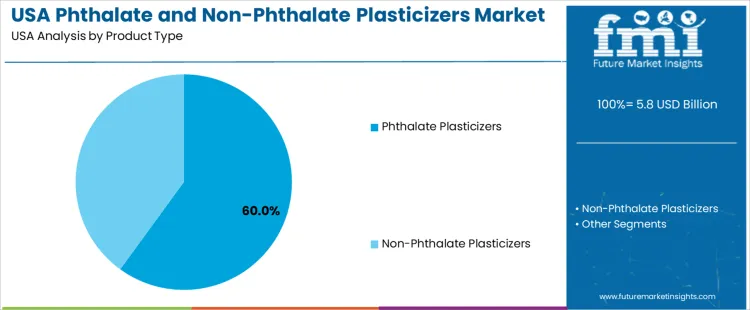
Phthalate plasticizers account for 60.0% of total consumption in the United States. These additives provide flexibility improvements, aging resistance, and processing ease in PVC-based infrastructure components. They remain widely utilized in industrial installations with limited direct human contact, including protective coatings and outdoor-grade polymer structures. Non-phthalate plasticizers hold 40.0%. These alternatives support packaging, medical items, and consumer products that must meet stringent safety certification criteria in the United States. Their suitability aligns with material performance standards under exposure-sensitive environments, high-purity processing, and consumer-facing designs with low migration requirements.
Key Points:
- Phthalates used in durable goods and industrial-focused construction items
- Non-phthalates aligned with sensitive-use compliance priorities
- Shift influenced by regulatory oversight and exposure-reduction policies
By Application, Wire and Cables Lead Consumption

Wire and cables represent 28.0% due to ongoing electrification upgrades, insulation flexibility requirements, and reinforced safety standards across commercial and residential installations in the United States. Flooring and wall coverings hold 24.0%, driven by remodeling activity and resilient sheet-vinyl adoption. Coatings stand at 18.0%, supporting industrial corrosion protection performance. Films and sheets hold 16.0%, including wrapping materials used in regional manufacturing hubs. Consumer and industrial goods account for 14.0%, spanning accessories, injection-molded components, and utility-driven polymer items requiring controlled flexibility and toughness.
Key Points:
- Wire and cable insulation supports secure electric network performance
- Building products supported by strong installation and renovation cycles
- Films and molded polymer goods contribute steady industrial demand
What are the Key Dynamics in the Phthalate and Non-Phthalate Plasticizers Industry?
Growth of construction and automotive production, strong demand for flexible PVC materials and expansion of regulated healthcare packaging drive demand.
In the United States, plasticizers remain essential in vinyl flooring, wiring insulation and wall coverings widely used in residential and commercial buildings. Infrastructure improvements and housing renovation sustain large orders from flooring and cable manufacturers. Automotive suppliers use flexible PVC in interior trim, sealing systems and under-hood components that require durability across temperature variation. Healthcare packaging and medical device production rely on plasticized film and tubing to maintain performance and sterilization requirements. Non-phthalate plasticizers gain additional procurement due to institutional preferences for materials aligned with safety policies used in schools and hospitals. These application sectors provide recurring volume for both traditional and alternative plasticizer chemistries.
Regulated use of certain phthalates, price sensitivity among converters and technical transition barriers restrain demand.
Federal and state regulations restrict classified phthalates in childcare products and medical segments, which creates costly reformulation tasks for manufacturers. Converters managing large production runs evaluate price differences closely and may delay switching to new materials when margins are limited. Processing adjustments are necessary to maintain clarity, strength and flexibility in final PVC products and development cycles slow adoption in smaller facilities with limited technical teams. Public awareness of chemical exposure prompts some buyers to reduce purchases of products made with legacy phthalates, affecting demand unevenly across product categories. These constraints reduce uniform growth in traditional plasticizers and increase scrutiny of future material choices.
Shift toward non-phthalate alternatives, increased testing for regulatory compliance and rising use in recyclable PVC formulations define key trends.
Suppliers expand non-phthalate plasticizer portfolios to match performance criteria in wires, flooring and consumer goods while addressing regulatory expectations. End-users request more compliance documentation and analytical verification that supports procurement under health and environmental purchasing programs. Development of PVC products compatible with mechanical recycling encourages selection of plasticizers that maintain performance after repeated processing. Packaging producers explore bio-based plasticizers aligned with sustainability objectives marketed by large retailers. Investment in domestic compounding facilities improves supply reliability for industrial buyers. These shifts indicate ongoing demand for plasticizers across the United States guided by construction activity, automotive production needs and regulatory-driven material evolution.
Analysis of the Demand for Phthalate and Non-Phthalate Plasticizers in the USA by Region
Demand for phthalate and non-phthalate plasticizers in the United States reflects steady growth through expanding flexible-packaging production, medical tubing requirements, automotive interiors, flooring, and wire-and-cable applications. Regulatory compliance, resin conversion capabilities, and sustainability preferences influence procurement patterns. West USA shows a 5.2% CAGR, followed by South USA at 4.7%. Northeast USA records 4.2% growth supported by industrial coatings and healthcare manufacturing. Midwest USA grows at 3.6%, aligned with established production lines and cost-focused purchasing decisions. Transformation toward non-phthalate formulations progresses at different speeds across each region due to varying certification standards and conversion timelines inside manufacturing facilities.

| Region | CAGR (2025-2035) |
|---|---|
| West USA | 5.2% |
| South USA | 4.7% |
| Northeast USA | 4.2% |
| Midwest USA | 3.6% |
How is the West USA driving demand for phthalate and non-phthalate plasticizers?
West USA expands at a 5.2% CAGR driven by flexible-packaging producers, medical device manufacturing, and continuous infrastructure investment across California, Washington, Oregon, and neighboring states. Plasticizers remain essential in PVC compounds used for cables, flooring, and building components purchased by construction networks supplying urban renovation work. Healthcare product demand supports procurement of medical-grade compounds for tubing and film applications requiring validated safety profiles. Sustainability programs encourage voluntary shifts toward non-phthalate options in brands operating from coastal metros. Resin converters invest in compounding capabilities that maintain mechanical flexibility while aiming for improved migration resistance under varying climate conditions. Supply chain flows through Pacific ports reinforce availability of raw materials.
- Healthcare and packaging usage driving stable ordering volume
- Construction procurement supporting PVC compound consumption
- Investments targeting non-phthalate formulation compatibility
- Ports strengthening raw-material logistics access
How is the South USA shaping demand for phthalate and non-phthalate plasticizers?
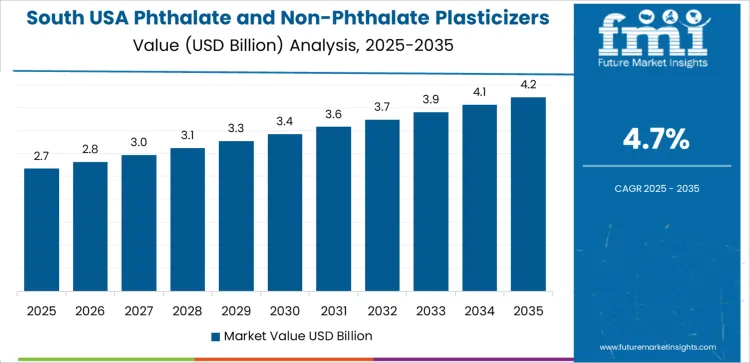
South USA records 4.7% CAGR supported by large resin-production hubs, automotive suppliers, and floor-covering manufacturers in Texas, Louisiana, Georgia, and nearby states. Household goods and durable consumer items produced in regional industrial zones sustain continuous PVC plasticizer utilization. Chemical plants located near Gulf Coast petrochemical clusters maintain strong feedstock sourcing and cost efficiencies. Cable coatings needed for electronics and utilities add incremental volume. Conversion toward non-phthalate grades increases where retail buyers request compliance alignment with evolving regulatory expectations. Warehouse and distribution facilities maintain steady material movement tied to national shipment lanes.
- Proximity to petrochemical feedstock enhancing supply stability
- Automotive interiors sustaining consistent flexible-PVC needs
- Retail-driven compliance trends supporting non-phthalate adoption
- Logistics hubs improving supplier coverage for converters
How is the Northeast USA influencing demand trends?
Northeast USA grows at 4.2% CAGR driven by packaging supply chains, hospital-linked procurement, and built-environment renovation projects. Production of coated materials and healthcare equipment components supports recurring plasticizer demand aligned with regional consumption patterns. Interior products used in commercial buildings require formulations that maintain flexibility across temperature shifts common in transit-oriented cities. Urban recycling initiatives encourage interest in lower-migration solutions for specific applications in consumer-facing items. Distributor networks operating in dense metro corridors handle frequent deliveries suited to multi-SKU converters. Purchasing teams evaluate certification documentation and lifecycle testing for performance validation.
- Healthcare components supporting ongoing flexible-PVC usage
- Commercial renovation sustaining interior-application demand
- Product-safety alignment shaping selection of plasticizers
- Dense distribution networks enabling reliable replenishment
How is the Midwest USA contributing to demand stability?
Midwest USA reports a 3.6% CAGR connected to automotive manufacturing, appliance production, and utilities infrastructure across Illinois, Michigan, Ohio, and surrounding states. Plasticizers play a role in cable jacketing and gasket materials used in energy and industrial facilities requiring durability. Procurement decisions emphasize predictable pricing and compatibility with existing compounding assets that follow long qualification cycles. Residential construction activity maintains needs for flooring and wall-covering products distributed through regional retailers. Adoption of non-phthalate types progresses gradually where purchasers confirm adequate mechanical strength under repetitive stress. Transportation corridors support continuous material distribution to industrial parks.
- Automotive and appliance production maintaining baseline consumption
- Cost-driven purchasing influencing formulation preferences
- Retail channels supporting residential-application volumes
- Transportation routes preserving supply consistency
What is the competitive landscape of the demand for phthalate and non-phthalate plasticizers in the United States?
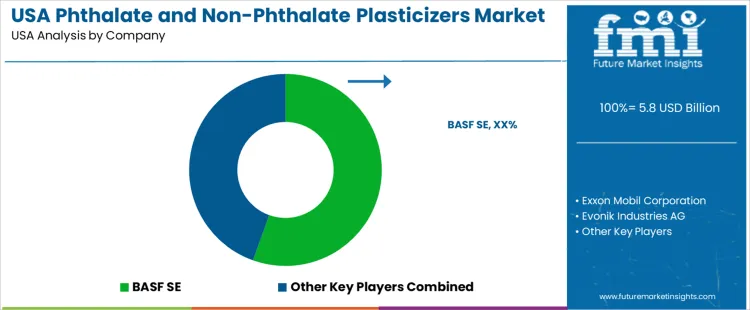
Demand for phthalate and non-phthalate plasticizers in the United States reflects established usage in PVC processing, wires and cables, flooring, roofing membranes, medical tubing, and consumer goods. Procurement priorities concentrate on formulation compatibility, migration resistance, toxicology profiles, and compliance with USA regulatory frameworks that restrict specific phthalate categories in sensitive applications. Product traceability and technical support from suppliers also influence purchasing decisions.
BASF SE holds an estimated 55.5% share supported by broad production capabilities that cover both legacy phthalate products and advanced non-phthalate solutions used in healthcare, construction materials, and regulated packaging. Exxon Mobil Corporation competes through integrated feedstock operations and supply continuity that appeals to high-volume PVC converters within durable goods and industrial manufacturing. Evonik Industries AG focuses on differentiated non-phthalate chemistry that meets performance needs in medical devices and specialty polymer systems with strict compliance requirements.
Eastman Chemical Company supplies general-purpose and specialty plasticizers used in automotive interiors, resilient flooring, and consumer products requiring reliable processing characteristics. Lanxess AG participates with additive technologies aligned to targeted polymer performance and application-specific safety requirements. Core competitive levers involve production scale, domestic logistics, REACH and FDA-aligned certifications, and formulation expertise that shortens qualification cycles for USA converters. Suppliers maintaining extensive product stewardship and consistency in quality hold stronger positioning in current purchasing activity.
Key Players in USA Phthalate and Non-Phthalate Plasticizers Demand
- BASF SE
- Exxon Mobil Corporation
- Evonik Industries AG
- Eastman Chemical Company
- Lanxess AG
Scope of the Report
| Items | Values |
|---|---|
| Quantitative Units | USD billion |
| Product Type | Phthalate Plasticizers, Non-Phthalate Plasticizers |
| Application | Wire and Cables, Flooring and Wall Coverings, Coatings, Films and Sheets, Consumer and Industrial Goods |
| End-use Industry | Building and Construction, Healthcare, Aerospace, Automotive, Food and Beverage |
| Regions Covered | West USA, South USA, Northeast USA, Midwest USA |
| Key Companies Profiled | BASF SE, Exxon Mobil Corporation, Evonik Industries AG, Eastman Chemical Company, Lanxess AG |
| Additional Attributes | Dollar sales by phthalate and non-phthalate classifications; application penetration across flooring, wire insulation, and industrial films; compliance influence from federal safety and environmental standards; supply shift toward bio-based and low-VOC substitutes; vendor initiatives in healthcare-grade plasticizers and high-durability automotive compounds. |
USA Phthalate and Non-Phthalate Plasticizers Demand by Segments
Product Type:
- Phthalate Plasticizers
- Non-Phthalate Plasticizers
Application:
- Wire and Cables
- Flooring and Wall Coverings
- Coatings
- Films and Sheets
- Consumer and Industrial Goods
End-use Industry:
- Building and Construction
- Healthcare
- Aerospace
- Automotive
- Food and Beverage
Region:
- West USA
- South USA
- Northeast USA
- Midwest USA
Frequently Asked Questions
How big is the demand for phthalate and non-phthalate plasticizers in USA in 2025?
The demand for phthalate and non-phthalate plasticizers in USA is estimated to be valued at USD 5.8 billion in 2025.
What will be the size of phthalate and non-phthalate plasticizers in USA in 2035?
The market size for the phthalate and non-phthalate plasticizers in USA is projected to reach USD 9.0 billion by 2035.
How much will be the demand for phthalate and non-phthalate plasticizers in USA growth between 2025 and 2035?
The demand for phthalate and non-phthalate plasticizers in USA is expected to grow at a 4.6% CAGR between 2025 and 2035.
What are the key product types in the phthalate and non-phthalate plasticizers in USA?
The key product types in phthalate and non-phthalate plasticizers in USA are phthalate plasticizers and non-phthalate plasticizers.
Which application segment is expected to contribute significant share in the phthalate and non-phthalate plasticizers in USA in 2025?
In terms of application, wire and cables segment is expected to command 28.0% share in the phthalate and non-phthalate plasticizers in USA in 2025.
Preview the report firsthand - request a free sample
Get SampleGet the brochure for pricing and purchase details.
Get PDFTable of Content
- Executive Summary
- USA Market Outlook
- Demand-side Trends
- Supply-side Trends
- Technology Roadmap Analysis
- Analysis and Recommendations
- Market Overview
- Market Coverage / Taxonomy
- Market Definition / Scope / Limitations
- Market Background
- Market Dynamics
- Drivers
- Restraints
- Opportunity
- Trends
- Scenario Forecast
- Demand in Optimistic Scenario
- Demand in Likely Scenario
- Demand in Conservative Scenario
- Opportunity Map Analysis
- Product Life Cycle Analysis
- Supply Chain Analysis
- Investment Feasibility Matrix
- Value Chain Analysis
- PESTLE and Porter’s Analysis
- Regulatory Landscape
- Regional Parent Market Outlook
- Production and Consumption Statistics
- Import and Export Statistics
- Market Dynamics
- USA Market Analysis 2020 to 2024 and Forecast, 2025 to 2035
- Historical Market Size Value (USD Million) Analysis, 2020 to 2024
- Current and Future Market Size Value (USD Million) Projections, 2025 to 2035
- Y-o-Y Growth Trend Analysis
- Absolute $ Opportunity Analysis
- USA Market Pricing Analysis 2020 to 2024 and Forecast 2025 to 2035
- USA Market Analysis 2020 to 2024 and Forecast 2025 to 2035, By Product Type
- Introduction / Key Findings
- Historical Market Size Value (USD Million) Analysis By Product Type , 2020 to 2024
- Current and Future Market Size Value (USD Million) Analysis and Forecast By Product Type , 2025 to 2035
- Phthalate Plasticizers
- Non-Phthalate Plasticizers
- Y-o-Y Growth Trend Analysis By Product Type , 2020 to 2024
- Absolute $ Opportunity Analysis By Product Type , 2025 to 2035
- USA Market Analysis 2020 to 2024 and Forecast 2025 to 2035, By Application
- Introduction / Key Findings
- Historical Market Size Value (USD Million) Analysis By Application, 2020 to 2024
- Current and Future Market Size Value (USD Million) Analysis and Forecast By Application, 2025 to 2035
- Wire and Cables
- Flooring and Wall Coverings
- Coatings
- Films and Sheets
- Consumer and Industrial Goods
- Y-o-Y Growth Trend Analysis By Application, 2020 to 2024
- Absolute $ Opportunity Analysis By Application, 2025 to 2035
- USA Market Analysis 2020 to 2024 and Forecast 2025 to 2035, By End-use Industry
- Introduction / Key Findings
- Historical Market Size Value (USD Million) Analysis By End-use Industry, 2020 to 2024
- Current and Future Market Size Value (USD Million) Analysis and Forecast By End-use Industry, 2025 to 2035
- Building and Construction
- Healthcare
- Aerospace
- Automotive
- Food and Beverage
- Y-o-Y Growth Trend Analysis By End-use Industry, 2020 to 2024
- Absolute $ Opportunity Analysis By End-use Industry, 2025 to 2035
- Market Structure Analysis
- Competition Dashboard
- Competition Benchmarking
- Market Share Analysis of Top Players
- By Regional
- By Product Type
- By Application
- By End-use Industry
- Competition Analysis
- Competition Deep Dive
- BASF SE
- Overview
- Product Portfolio
- Profitability by Market Segments (Product/Age /Sales Channel/Region)
- Sales Footprint
- Strategy Overview
- Marketing Strategy
- Product Strategy
- Channel Strategy
- Exxon Mobil Corporation
- Evonik Industries AG
- Eastman Chemical Company
- Lanxess AG
- BASF SE
- Competition Deep Dive
- Assumptions & Acronyms Used
- Research Methodology


