

- Industry Size (2025)
- USD 734.1 Mn
- Forecast (2035)
- USD 1045.5 Mn
- CAGR (2025 to 2035)
- 3.6%
Demand for Phthalate and Non-Phthalate Plasticizers in Japan Forecast and Outlook 2025 to 2035
Demand for phthalate and non-phthalate plasticizers in Japan is expected to grow from USD 734.1 million in 2025 to USD 1,045.5 million by 2035, reflecting a compound annual growth rate (CAGR) of 3.6%. Plasticizers, which are added to polymers to increase flexibility, are crucial in the production of a wide range of products, including medical devices, automotive parts, flooring, and cables. As environmental concerns and regulations surrounding phthalate-based plasticizers grow, there is an increasing shift toward non-phthalate alternatives. Shift is expected to drive the market, particularly as industries look for safer, more sustainable options for plasticizing materials.
Japan’s strict regulatory environment and strong emphasis on health and safety standards contribute to the growing demand for non-phthalate plasticizers. Ongoing advancement in industries such as automotive, construction, and healthcare, where plastic materials require greater flexibility and durability, will sustain demand for both phthalate and non-phthalate plasticizers over the coming decade. As new, more efficient non-phthalate plasticizers are developed, their adoption will likely increase, driving further market expansion.
Quick Stats of the Demand for Phthalate and Non-Phthalate Plasticizers in Japan
- Demand for Phthalate and Non-Phthalate Plasticizers in Japan Value (2025): USD 734.1 million
- Demand for Phthalate and Non-Phthalate Plasticizers in Japan Forecast Value (2035): USD 1,045.5 million
- Demand for Phthalate and Non-Phthalate Plasticizers in Japan Forecast CAGR (2025-2035): 3.6%
- Demand for Phthalate and Non-Phthalate Plasticizers in Japan Leading Product Type: Phthalate Plasticizers (60%)
- Demand for Phthalate and Non-Phthalate Plasticizers in Japan Key Growth Regions: Kyushu & Okinawa, Kanto, Kansai, Chubu, Tohoku, Rest of Japan
- Demand for Phthalate and Non-Phthalate Plasticizers in Japan Key Players: BASF SE, Exxon Mobil Corporation, Evonik Industries AG, Eastman Chemical Company, Lanxess AG
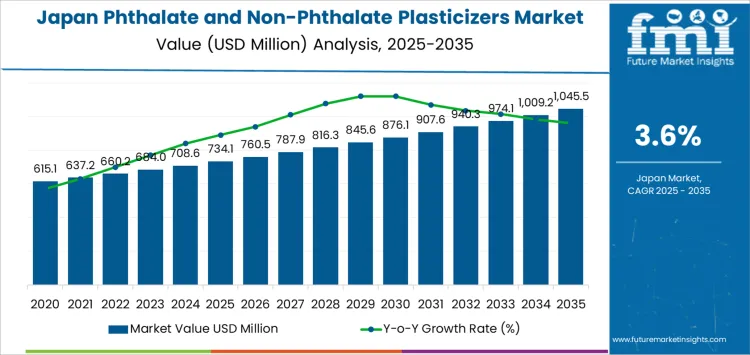
What is the Growth Forecast for the Phthalate and Non-Phthalate Plasticizers Market through 2035?
Long-term value accumulation curve for the phthalate and non-phthalate plasticizers market in Japan shows steady, incremental growth over the forecast period. Starting at USD 734.1 million in 2025, the market grows gradually to USD 760.5 million in 2026 and USD 787.9 million in 2027. This initial growth phase reflects the ongoing demand for both phthalate and non-phthalate plasticizers, as industries continue to incorporate these materials into their production processes.
From 2027 to 2030, the market continues to increase steadily, reaching USD 816.3 million in 2028, USD 845.6 million in 2029, and USD 876.1 million in 2030. This phase indicates a consistent rise in demand as industries transition to non-phthalate alternatives and expand the use of plasticizers in more sustainable and flexible products. By 2035, the market is projected to reach USD 1,045.5 million, reflecting gradual but consistent growth driven by regulatory changes, technological advancements in plasticizer formulations, and increasing applications across multiple sectors.
Key Takeaways of Phthalate and Non-Phthalate Plasticizers Industry in Japan
| Metric | Value |
|---|---|
| Industry Sales Value (2025) | USD 734.1 million |
| Industry Forecast Value (2035) | USD 1,045.5 million |
| Industry Forecast CAGR (2025-2035) | 3.6% |
What Is Driving the Demand for Phthalate and Non-Phthalate Plasticizers in Japan?
The demand for plasticizers in Japan is primarily driven by the widespread use of flexible PVC and other plastic materials across various industries, including construction, automotive, electronics, medical devices, and packaging. Phthalate plasticizers have historically been the dominant choice due to their ability to enhance the flexibility, durability, and processability of plastics. These properties make them essential in applications such as wiring insulation, flooring, tubing, and cables. The infrastructure supporting plastic processing and the ongoing demand for PVC-based materials in industries like automotive production and consumer goods manufacturing continue to drive the use of phthalate plasticizers. However, growing health concerns related to phthalates, alongside regulatory scrutiny, has prompted a shift toward non-phthalate and bio-based alternatives. Non-phthalate plasticizers are increasingly used in products like medical devices, food-contact packaging, and consumer goods, where safety and regulatory compliance are critical. This trend reflects the changing preferences of consumers and manufacturers for safer, more environmentally friendly materials.
As Japan’s regulatory landscape tightens and global markets push for safer chemicals, future demand for non-phthalate plasticizers is expected to increase. This demand is particularly relevant in industries such as medical, food packaging, and electronics, where high safety standards are essential. At the same time, traditional phthalate plasticizers will continue to be used in industries that prioritize performance and cost, such as construction and automotive applications. However, as non-phthalate solutions become more advanced and cost-competitive, their uptake is likely to accelerate. Additionally, the growing trend toward sustainability and clean-label products will further encourage the use of non-phthalate and bio-based alternatives. The pace of this transition will depend on several factors, including the cost-effectiveness of new materials, raw material supply stability, and continued regulatory support. As these factors align, the demand for non-phthalate plasticizers in Japan will likely outpace that of phthalates, particularly in markets sensitive to health and environmental concerns.
What Are the Key Segments in Phthalate and Non-Phthalate Plasticizers Market in Japan?
Phthalate and non-phthalate plasticizers market in Japan is segmented by product type and application. Phthalate plasticizers dominate the product type segment, accounting for 60% of the market share. In terms of application, wire and cables lead, representing 28% of the market. The growing demand for flexible materials across various industries is driving the adoption of plasticizers in Japan, particularly in construction, electronics, and consumer goods.
Which Product Type Drives Plasticizers Demand in Japan?
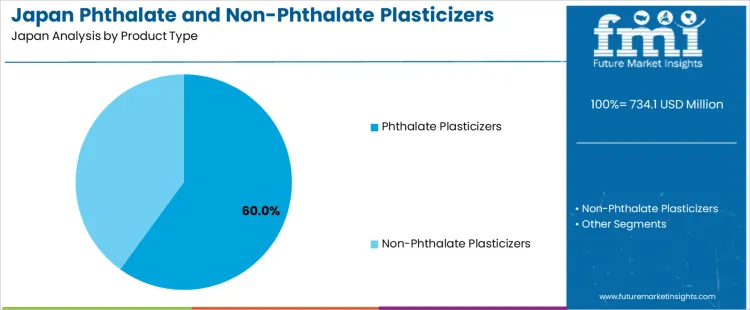
Phthalate plasticizers are the most widely used in Japan, representing 60% of the market share. Phthalates are commonly used to increase the flexibility, durability, and workability of plastics, particularly in applications like wire and cables, flooring, and consumer goods. Despite growing concerns over health and environmental impacts, phthalate plasticizers continue to dominate the market due to their effectiveness and cost-efficiency. However, non-phthalate plasticizers are gaining popularity as safer alternatives, driven by regulatory pressures and consumer demand for more environmentally friendly options. Despite the rise of non-phthalates, phthalate plasticizers remain the dominant product due to their long-standing use in various industrial applications.
Which Application Drives Plasticizers Demand in Japan?
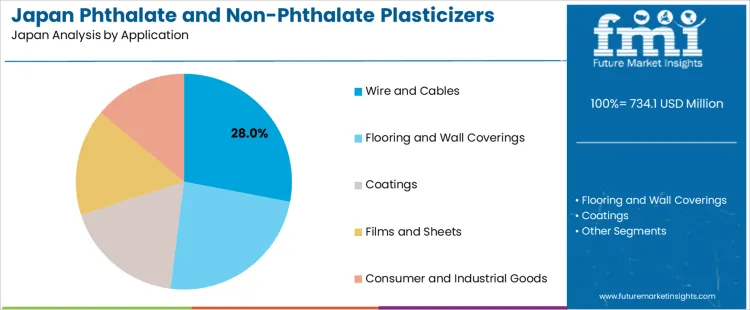
Wire and cables are the leading application for plasticizers, accounting for 28% of the market share. The demand for plasticizers in wire and cables is driven by the need for flexibility, insulation, and durability in electrical and communication cables. Plasticizers help to enhance the flexibility of cables, making them easier to handle, install, and use in various environments. The growth of the electronics, telecommunications, and construction industries is contributing to the increased demand for plasticizers in wire and cable manufacturing. While other applications such as flooring and wall coverings, coatings, and films and sheets also contribute significantly to the market, the wire and cable segment remains the largest due to the continuous need for high-performance, flexible materials in electrical and communications infrastructure.
What is the Summary of the Demand for Phthalate and Non-Phthalate Plasticizers in Japan?
The demand for plasticizers in Japan is driven by the need for flexible and durable plastics in various industries like construction, automotive, medical, and consumer goods. Phthalate plasticizers continue to be used, but there is a significant shift toward non-phthalate and bio-based alternatives due to growing safety and regulatory concerns. Rising demand for safer, eco-friendly, and health-conscious products supports the transition to non-phthalate plasticizers, especially in sectors like food packaging, medical devices, and children’s products.
What are the Key Drivers for the Demand for Phthalate and Non-Phthalate Plasticizers in Japan?
The key drivers for plasticizer demand in Japan include the continuous need for flexible and durable materials in various sectors like automotive, construction, and medical products. Strict regulatory standards for product safety, particularly in sensitive applications such as food packaging, medical devices, and children's goods, are encouraging the use of non-phthalate and bio-based plasticizers. Additionally, growing consumer preference for health-conscious, eco-friendly products and the increasing shift towards sustainability in manufacturing processes support the growing use of non-phthalate plasticizers in Japan’s market.
What are the Restraints for the Demand for Phthalate and Non-Phthalate Plasticizers in Japan?
One restraint is the continued dominance of phthalate-based plasticizers in legacy and low-cost applications, especially where regulations are less stringent. Non-phthalate and bio-based alternatives often come at a higher cost, which may deter adoption in price-sensitive markets. Additionally, supply chain volatility and fluctuations in raw material prices can create uncertainty for manufacturers, further limiting demand for non-phthalate options. For smaller companies, the investment required to upgrade production systems and meet new regulatory standards can be a barrier, especially for those with limited resources.
What are the Key Trends in the Demand for Phthalate and Non-Phthalate Plasticizers in Japan?
A major trend is the increasing shift towards non-phthalate and bio-based plasticizers driven by regulatory pressure and consumer demand for safer, cleaner products. The demand for high-performance plasticizers in sensitive applications like medical devices, food packaging, and personal care products is pushing the market toward alternatives to traditional phthalates. Additionally, manufacturers are focusing on creating more sustainable and eco-friendly plasticizers that meet strict regulatory standards. The trend toward green chemistry is leading to innovations in hybrid plasticizer solutions that combine performance and environmental benefits, catering to both safety and sustainability.
What is the Regional Demand Outlook for Phthalate and Non-Phthalate Plasticizers in Japan?
The demand for phthalate and non-phthalate plasticizers in Japan is expected to grow at a moderate pace across various regions. Kyushu & Okinawa is projected to lead the growth with a CAGR of 4.5%, followed by Kanto at 4.1%. Kansai is anticipated to grow at 3.6%, while Chubu is expected to grow at a rate of 3.2%. Tohoku and Rest of Japan are projected to see more moderate growth, with CAGRs of 2.8% and 2.7%, respectively. The demand for these plasticizers, driven by their wide applications in industries such as automotive, construction, and packaging, is being supported by the growing emphasis on more sustainable and safer alternatives to phthalates.
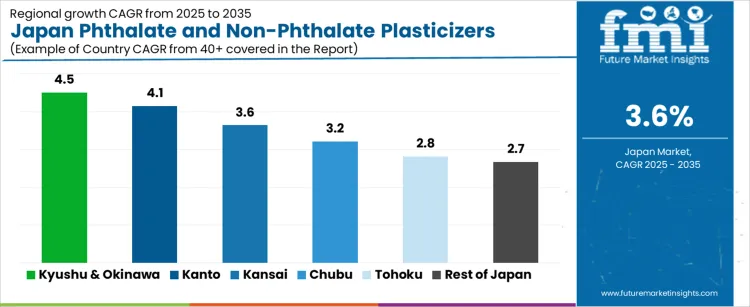
| Region | CAGR (2025-2035) |
|---|---|
| Kyushu & Okinawa | 4.5% |
| Kanto | 4.1% |
| Kansai | 3.6% |
| Chubu | 3.2% |
| Tohoku | 2.8% |
| Rest of Japan | 2.7% |
What is Driving the Growth of Phthalate and Non-Phthalate Plasticizers in Kyushu & Okinawa?
Kyushu & Okinawa is projected to experience the highest growth in the plasticizers market, with a projected CAGR of 4.5%. The region's expanding manufacturing base, particularly in industries like automotive, electronics, and construction, is a key driver of this growth. As the demand for safer and more sustainable alternatives to traditional plasticizers, such as non-phthalate options, rises, the need for high-quality plasticizers in these sectors is increasing. The region's growing focus on environmental sustainability, coupled with the expansion of industrial activities and infrastructure development, further contributes to the rising demand for phthalate and non-phthalate plasticizers. Additionally, the growing automotive sector in Kyushu & Okinawa is also driving the demand for plasticizers used in the production of flexible automotive parts and components.
Why is the Phthalate and Non-Phthalate Plasticizers Market Expanding in Kanto?
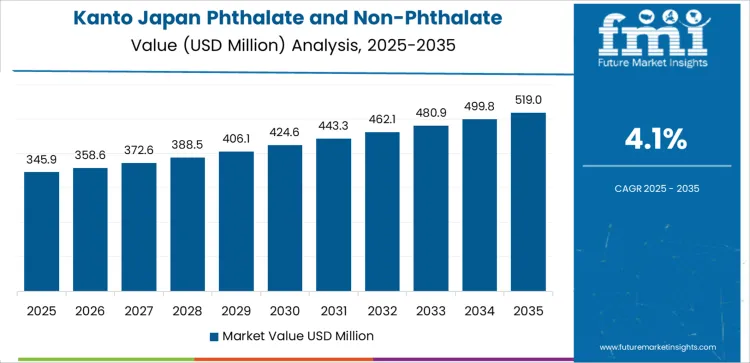
In Kanto, the demand for phthalate and non-phthalate plasticizers is projected to grow at a CAGR of 4.1%. Kanto, which includes Tokyo, is Japan's most populous and economically advanced region. The growth of industries such as packaging, automotive, and construction in Kanto is a significant contributor to the demand for plasticizers. As Kanto continues to push for cleaner, safer, and more sustainable manufacturing processes, the adoption of non-phthalate plasticizers is on the rise. Additionally, Kanto's strong focus on environmental regulations and consumer safety is driving the shift toward safer alternatives in various products, including medical devices, packaging, and automotive components. The region's manufacturing capabilities and its position as a hub for industrial innovation are expected to continue supporting the growth of plasticizer demand.
How is the Phthalate and Non-Phthalate Plasticizers Market Growing in Kansai?
In Kansai, the phthalate and non-phthalate plasticizers market is projected to grow at a CAGR of 3.6%. Kansai, which includes Osaka and Kyoto, has a strong industrial base, particularly in the automotive, electronics, and packaging sectors. The increasing demand for flexible plastics in these industries is driving the need for plasticizers. Kansai’s growing interest in sustainability, coupled with the increasing regulation of harmful chemicals, is pushing manufacturers toward safer and more eco-friendly plasticizer alternatives. The adoption of non-phthalate plasticizers in food packaging, medical applications, and consumer goods is also contributing to the region's market growth. As Kansai continues to modernize its industries and prioritize safety, the demand for plasticizers is expected to continue rising.
What is Contributing to the Growth of Phthalate and Non-Phthalate Plasticizers in Chubu?
In Chubu, the phthalate and non-phthalate plasticizers market is expected to grow at a CAGR of 3.2%. Chubu, home to Nagoya, is a key industrial region with a strong automotive and manufacturing presence. The automotive sector, in particular, plays a crucial role in driving the demand for plasticizers used in vehicle interiors, flexible components, and electrical systems. As the region's manufacturers prioritize compliance with stricter environmental regulations and consumer demand for safer materials, the use of non-phthalate plasticizers is becoming more prevalent. Chubu's growing interest in environmentally friendly alternatives and its shift toward more sustainable manufacturing practices will contribute to the continued growth of the plasticizer market in the region.
What is Influencing the Growth of Phthalate and Non-Phthalate Plasticizers in Tohoku?
In Tohoku, the demand for phthalate and non-phthalate plasticizers is projected to grow at a CAGR of 2.8%. While the growth rate is slower compared to more industrialized regions, Tohoku’s growing interest in sustainability and eco-friendly manufacturing is contributing to the demand for these plasticizers. As the region’s industries, particularly in automotive and food packaging, adopt more sustainable and safer materials, the use of non-phthalate plasticizers is expected to increase. The rise in awareness of the environmental and health impacts of phthalate-based plasticizers is also contributing to the shift toward non-phthalate alternatives. Tohoku's focus on improving industrial processes and adopting cleaner technologies will support the continued growth of plasticizer demand.
What is Contributing to the Growth of Phthalate and Non-Phthalate Plasticizers in Rest of Japan?
In Rest of Japan, the demand for phthalate and non-phthalate plasticizers is expected to grow at a more moderate rate of 2.7%. While the market in these regions is smaller compared to urbanized areas, the growing adoption of safer plasticizer alternatives is contributing to steady growth. As businesses in rural areas adopt more sustainable manufacturing practices and seek eco-friendly alternatives to phthalate-based plasticizers, the demand for non-phthalate solutions is expected to rise gradually. The increased focus on environmental sustainability and the need for compliance with stricter regulations are expected to support the growth of the plasticizer market in Rest of Japan.
What is the Competitive Landscape for Demand for Phthalate and Non Phthalate Plasticizers in Japan?
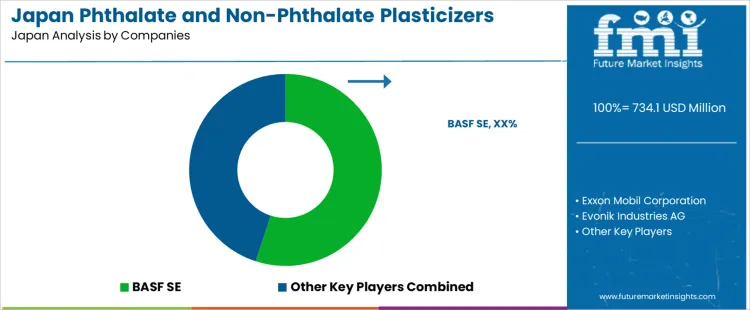
Demand for plasticizers in Japan is significant as industries continue to rely on flexible PVC and other polymers for products like construction materials, packaging, medical devices, and automotive parts. Flexible PVC is essential for various sectors, including building, electronics, and healthcare, where plasticizers provide the necessary flexibility and durability. However, increased awareness of the environmental and health impacts of phthalates has led to a growing shift toward non phthalate alternatives. As a result, the market for non phthalate and bio based plasticizers is growing, driven by stricter regulations and consumer preference for safer, more sustainable materials, particularly in sensitive applications such as food packaging and medical devices.
Several major chemical companies are competing in the Japanese market for plasticizers. BASF SE holds the largest market share, followed by other global players like Exxon Mobil Corporation, Evonik Industries AG, Eastman Chemical Company, and Lanxess AG. These companies offer a range of plasticizers, including traditional phthalates and non phthalate alternatives like adipates, citrates, and epoxidized oils. Competition among these firms centers on product performance, environmental compliance, and the ability to meet the growing demand for safer, sustainable solutions. Companies that provide high quality, regulatory compliant, and cost competitive plasticizers are best positioned to capture ongoing growth as industries in Japan continue to shift toward more sustainable and safer plasticizing options.
Key Players of the Phthalate and Non-Phthalate Plasticizers Industry in Japan
- BASF SE
- Exxon Mobil Corporation
- Evonik Industries AG
- Eastman Chemical Company
- Lanxess AG
Scope of the Report
| Items | Values |
|---|---|
| Quantitative Units (2025) | USD Million |
| Product Type | Phthalate Plasticizers, Non-Phthalate Plasticizers |
| Application | Wire and Cables, Flooring and Wall Coverings, Coatings, Films and Sheets, Consumer and Industrial Goods |
| End-Use Industry | Healthcare, Aerospace, Automotive, Building and Construction, Food and Beverage |
| Companies | BASF SE, Exxon Mobil Corporation, Evonik Industries AG, Eastman Chemical Company, Lanxess AG |
| Regions Covered | Kyushu & Okinawa, Kanto, Kansai, Chubu, Tohoku, Rest of Japan |
| Additional Attributes | Dollar by sales by product type, application, end-use industry, and region. Includes performance of plasticizers in various applications, market trends towards non-phthalate alternatives, regulatory compliance, impact of environmental and health concerns on demand, cost-effectiveness, sustainability practices, market share and competitive positioning of key companies, and the role of plasticizers in improving material properties in healthcare, aerospace, automotive, and other industries. |
Key Segments in the Demand for Phthalate and Non-Phthalate Plasticizers in Japan
Product Type
- Phthalate Plasticizers
- Non-Phthalate Plasticizers
Application
- Wire and Cables
- Flooring and Wall Coverings
- Coatings
- Films and Sheets
- Consumer and Industrial Goods
End-Use Industry
- Healthcare
- Aerospace
- Automotive
- Building and Construction
- Food and Beverage
Region
- Kyushu & Okinawa
- Kanto
- Kansai
- Chubu
- Tohoku
- Rest of Japan
Frequently Asked Questions
How big is the demand for phthalate and non-phthalate plasticizers in Japan in 2025?
The demand for phthalate and non-phthalate plasticizers in Japan is estimated to be valued at USD 734.1 million in 2025.
What will be the size of phthalate and non-phthalate plasticizers in Japan in 2035?
The market size for the phthalate and non-phthalate plasticizers in Japan is projected to reach USD 1,045.5 million by 2035.
How much will be the demand for phthalate and non-phthalate plasticizers in Japan growth between 2025 and 2035?
The demand for phthalate and non-phthalate plasticizers in Japan is expected to grow at a 3.6% CAGR between 2025 and 2035.
What are the key product types in the phthalate and non-phthalate plasticizers in Japan?
The key product types in phthalate and non-phthalate plasticizers in Japan are phthalate plasticizers and non-phthalate plasticizers.
Which application segment is expected to contribute significant share in the phthalate and non-phthalate plasticizers in Japan in 2025?
In terms of application, wire and cables segment is expected to command 28.0% share in the phthalate and non-phthalate plasticizers in Japan in 2025.
Preview the report firsthand - request a free sample
Get SampleGet the brochure for pricing and purchase details.
Get PDFTable of Content
- Executive Summary
- Japan Market Outlook
- Demand-side Trends
- Supply-side Trends
- Technology Roadmap Analysis
- Analysis and Recommendations
- Market Overview
- Market Coverage / Taxonomy
- Market Definition / Scope / Limitations
- Market Background
- Market Dynamics
- Drivers
- Restraints
- Opportunity
- Trends
- Scenario Forecast
- Demand in Optimistic Scenario
- Demand in Likely Scenario
- Demand in Conservative Scenario
- Opportunity Map Analysis
- Product Life Cycle Analysis
- Supply Chain Analysis
- Investment Feasibility Matrix
- Value Chain Analysis
- PESTLE and Porter’s Analysis
- Regulatory Landscape
- Regional Parent Market Outlook
- Production and Consumption Statistics
- Import and Export Statistics
- Market Dynamics
- Japan Market Analysis 2020 to 2024 and Forecast, 2025 to 2035
- Historical Market Size Value (USD Million) Analysis, 2020 to 2024
- Current and Future Market Size Value (USD Million) Projections, 2025 to 2035
- Y-o-Y Growth Trend Analysis
- Absolute $ Opportunity Analysis
- Japan Market Pricing Analysis 2020 to 2024 and Forecast 2025 to 2035
- Japan Market Analysis 2020 to 2024 and Forecast 2025 to 2035, By Product Type
- Introduction / Key Findings
- Historical Market Size Value (USD Million) Analysis By Product Type , 2020 to 2024
- Current and Future Market Size Value (USD Million) Analysis and Forecast By Product Type , 2025 to 2035
- Phthalate Plasticizers
- Non-Phthalate Plasticizers
- Y-o-Y Growth Trend Analysis By Product Type , 2020 to 2024
- Absolute $ Opportunity Analysis By Product Type , 2025 to 2035
- Japan Market Analysis 2020 to 2024 and Forecast 2025 to 2035, By Application
- Introduction / Key Findings
- Historical Market Size Value (USD Million) Analysis By Application, 2020 to 2024
- Current and Future Market Size Value (USD Million) Analysis and Forecast By Application, 2025 to 2035
- Wire and Cables
- Flooring and Wall Coverings
- Coatings
- Films and Sheets
- Consumer and Industrial Goods
- Y-o-Y Growth Trend Analysis By Application, 2020 to 2024
- Absolute $ Opportunity Analysis By Application, 2025 to 2035
- Japan Market Analysis 2020 to 2024 and Forecast 2025 to 2035, By End-use Industry
- Introduction / Key Findings
- Historical Market Size Value (USD Million) Analysis By End-use Industry, 2020 to 2024
- Current and Future Market Size Value (USD Million) Analysis and Forecast By End-use Industry, 2025 to 2035
- Healthcare
- Aerospace
- Automotive
- Building and Construction
- Food and Beverage
- Y-o-Y Growth Trend Analysis By End-use Industry, 2020 to 2024
- Absolute $ Opportunity Analysis By End-use Industry, 2025 to 2035
- Market Structure Analysis
- Competition Dashboard
- Competition Benchmarking
- Market Share Analysis of Top Players
- By Regional
- By Product Type
- By Application
- By End-use Industry
- Competition Analysis
- Competition Deep Dive
- BASF SE
- Overview
- Product Portfolio
- Profitability by Market Segments (Product/Age /Sales Channel/Region)
- Sales Footprint
- Strategy Overview
- Marketing Strategy
- Product Strategy
- Channel Strategy
- Exxon Mobil Corporation
- Evonik Industries AG
- Eastman Chemical Company
- Lanxess AG
- BASF SE
- Competition Deep Dive
- Assumptions & Acronyms Used
- Research Methodology


