

- Industry Size (2026):
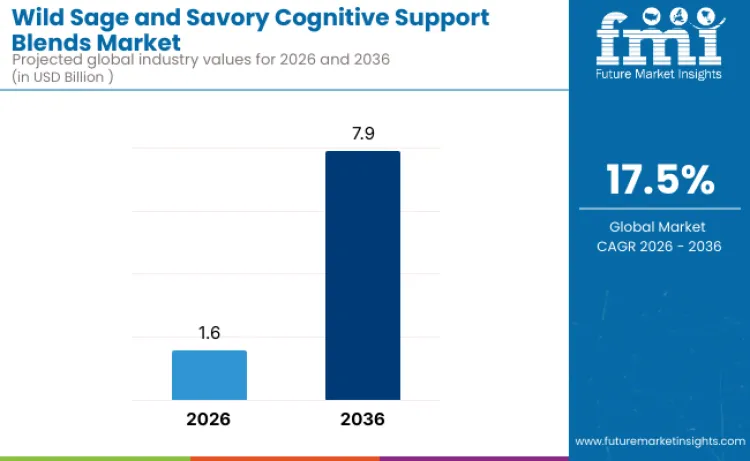
- USD 1.6 Bn
- Forecast (2036):
- USD 7.9 Bn
- CAGR (2026 to 2036)
- 17.5%
Wild Sage and Savory Cognitive Support Blends Market Forecast and Outlook 2026 to 2036
The wild sage and savory cognitive support blends market is valued at USD 1.6 billion in 2026 and is projected to reach USD 7.9 billion by 2036, reflecting a CAGR of 17.5%. Demand increases as cognitive wellness products shift toward Mediterranean herb complexes with documented neuroprotective, memory-support, and anti-inflammatory properties. Interest in natural focus and mood-support actives strengthens adoption across supplements, functional beverages, and nootropic formulations.
Wild sage and savory cognitive support extract blends lead blend-type usage because synergistic combinations of thujone-modulated sage actives and rosmarinic-acid–rich savory enhance cholinergic activity, antioxidant capacity, and cerebral blood flow. Standardized extracts improve potency and batch consistency, while gentle extraction maintains aromatic compounds and bioactive integrity for diversified applications.
China, India, USA, and Japan serve as key growth regions due to rising demand for botanical nootropics and expanding functional wellness markets. Naturex (Givaudan), Martin Bauer Group, Indena, Nexira, and Greentech guide competitive development through clinically informed herb complexes, validated supply chains, and application support for nutraceutical and beverage formulators using wild sage–savory cognitive blends.
Quick Stats for Wild Sage and Savory Cognitive Support Blends Market
- Market Value (2026): USD 1.6 billion
- Market Forecast Value (2036): USD 7.9 billion
- Market Forecast CAGR (2026-2036): 17.5%
- Leading Blend Type in Global Demand: Wild sage + savory cognitive support extract blends
- Key Growth Regions in Global Demand: China, India, USA, Japan
- Top Players in Global Demand: Naturex (Givaudan), Martin Bauer Group, Indena, Nexira, Greentech
Wild Sage and Savory Cognitive Support Blends Market Key Takeaways
| Metric | Value |
|---|---|
| Market Value (2026) | USD 1.6 billion |
| Market Forecast Value (2036) | USD 7.9 billion |
| Forecast CAGR (2026-2036) | 17.5% |
How Are the Segments Classified in the Wild Sage and Savory Cognitive Support Blends Market?
Demand for wild sage and savory cognitive-support blends is shaped by interest in traditional Mediterranean botanicals, increased use of natural nootropic ingredients, and preference for high-potency polyphenolic and essential-oil fractions. Buyers evaluate flavonoid stability, terpene concentration, extraction purity, and suitability for supplement, beverage, and aromatherapy applications. Adoption patterns reflect growing reliance on synergistic sage–savory formulations that support memory, focus, and stress-modulation functions.
Which Blend Type Accounts for the Largest Share of Global Demand?
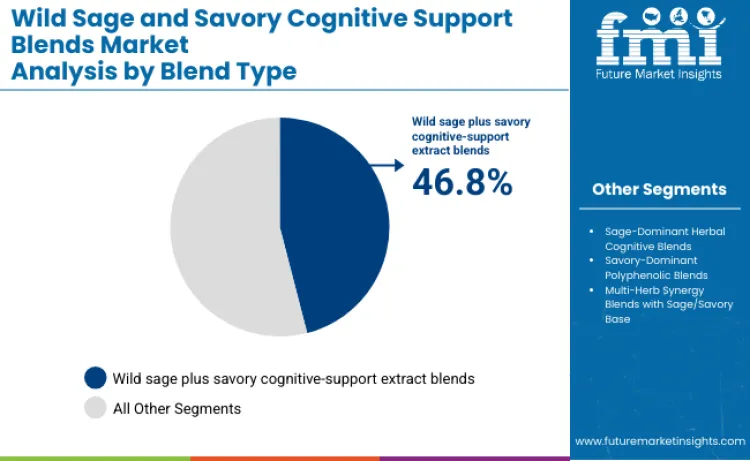
Wild sage plus savory cognitive-support extract blends hold 46.8%, making them the leading blend-type segment globally. These blends combine rosmarinic acid, carnosic compounds, and savory-derived phenolics for synergistic cognitive benefits. Sage-dominant herbal blends deliver strong cholinergic and antioxidant activity. Savory-dominant polyphenolic blends support antimicrobial and circulatory functions that complement cognitive effects. Multi-herb synergy blends use sage–savory bases with additional botanicals to broaden nootropic activity. Blend-type distribution reflects strong demand for balanced dual-herb formulations with complementary bioactivity.
Key Points:
- Sage–savory blends offer synergistic cognitive-support activity.
- Sage-dominant blends supply strong cholinergic effects.
- Savory-dominant blends contribute phenolic and circulatory support.
- Multi-herb blends expand nootropic coverage.
Which Extraction Method Represents the Largest Share of Global Demand?
Supercritical CO₂ herbal cognitive extraction holds 45.2%, making it the largest extraction-method segment globally. This method preserves heat-sensitive diterpenes and phenolics while producing solvent-free extracts suitable for regulated nutraceutical products. Steam distillation provides essential-oil fractions containing thujone, carvacrol, and related aromatics for cognitive and stress-modulation functions. Solvent-free bioactive retention extraction maintains polyphenolic integrity for clean-label applications. Advanced polyphenol-enrichment processes concentrate flavonoids and phenolic acids for targeted cognitive-support uses. Extraction-method distribution reflects preference for high-purity CO₂ methods.
Key Points:
- Supercritical CO₂ preserves sensitive cognitive-active compounds.
- Steam distillation yields aromatic essential-oil fractions.
- Solvent-free retention supports clean-label formulations.
- Polyphenol enrichment boosts flavonoid concentration.
Which Application Accounts for the Largest Share of Global Demand?
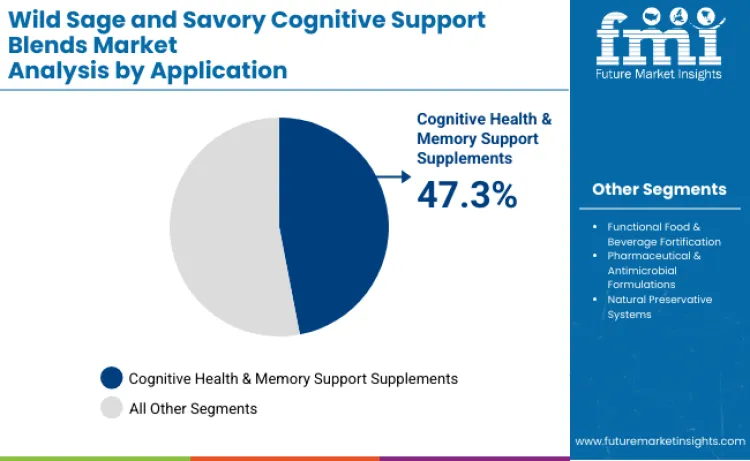
Cognitive health and memory-support supplements hold 47.3%, making them the leading application segment globally. These formulations use sage–savory extracts for memory enhancement, focus improvement, and oxidative-stress mitigation. Functional beverages and herbal shots incorporate blends for natural nootropic positioning. Nootropic nutrition and wellness products apply polyphenol-rich fractions for sustained cognitive support. Aromatherapy and stress-modulation products use essential-oil profiles for relaxation and mental clarity. Application distribution reflects strong reliance on sage–savory blends in core cognitive-support supplement categories.
Key Points:
- Supplements rely on extracts for memory and cognitive performance.
- Functional beverages use blends for natural nootropic positioning.
- Wellness products incorporate polyphenol-rich nootropic ingredients.
- Aromatherapy adopts essential oils for stress and clarity benefits.
What are the Key Dynamics in the Wild Sage and Savory Cognitive Support Blends Market?
Global demand rises as nutraceutical, functional beverage, and wellness brands adopt blends combining wild sage and savory extracts known for cognitive, antioxidant, and neuroprotective activity. Sun-exposed Mediterranean habitats drive elevated concentrations of terpenoids and phenolics, contributing to focus, memory, and stress-support positioning. Suppliers standardize active fractions to deliver reproducible efficacy across capsules, tinctures, powdered blends, and herbal infusion formats. Interest expands as consumers seek botanically derived cognitive aids with clean-label and traditional-use credibility.
How are trends in cognitive wellness and the benefits of botanical synergy affecting the use of wild sage and savory blends?
Wild sage and savory contain rosmarinic acid, carnosol, and monoterpenes studied for neurotransmitter modulation, oxidative stress reduction, and mental clarity support. Nutraceutical brands blend these extracts to enhance complementary mechanisms associated with alertness and cognitive resilience. Beverage producers introduce herbal infusions leveraging aromatic profiles linked to relaxation and focus balance. Functional powder manufacturers use stabilized extracts to create daily-use cognitive formulations. Traditional Mediterranean use strengthens consumer trust in these botanicals. Suppliers refine extraction to optimize terpene retention and standardize phenolic content. Demand grows as wellness consumers shift toward plant-based cognitive solutions with transparent sourcing and minimal processing.
How do sourcing variability, compositional consistency, and regulatory constraints influence scalability?
Wild sage and savory composition varies across altitude, soil, and climate, requiring strict standardization to maintain predictable active compound profiles. Foraged supply depends on controlled harvesting and habitat preservation, influencing long-term volume stability. Extraction must preserve volatile aromatic compounds while achieving purity for ingestible use. Regulatory frameworks differ across markets regarding allowable concentrations and cognitive-related claims, that shape formulation strategies. Brands require documentation on botanical identity, residue status, and regional origin. Scaling production depends on sustainable cultivation partnerships that complement wild harvesting to secure reliable feedstock for expanding global wellness demand.
How is Demand for Wild Sage and Savory Cognitive Support Blends Market Evolving Across Key Countries?
Demand for wild sage and savory cognitive support blends is growing because more people are interested in plant-based nootropics, there are more clean-label cognitive health supplements, and more natural essential oils and polyphenol ingredients are being used. China records a CAGR of 18.4%, supported by rapid nutraceutical and functional-food growth. India shows a 17.8% CAGR driven by herbal wellness expansion. USA posts a 16.5% CAGR supported by strong supplement and cognitive-health trends. Japan holds a 15.6% CAGR linked with precision botanical-processing systems. UK records a 15.0% CAGR supported by clean-label and wellness-focused product development.
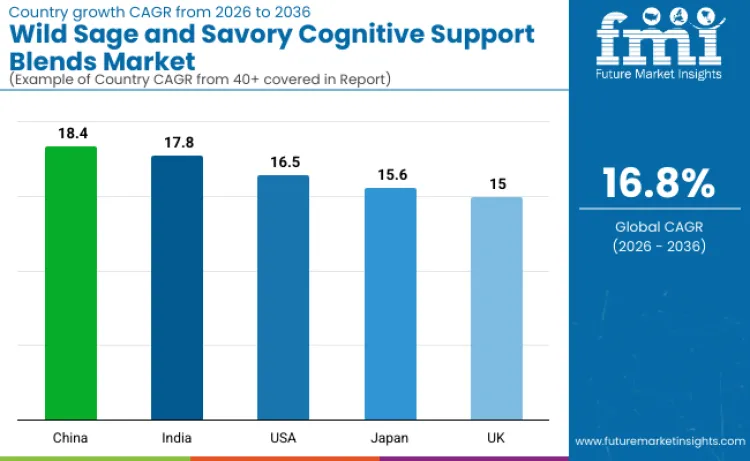
| Country | CAGR (%) |
|---|---|
| China | 18.4% |
| India | 17.8% |
| USA | 16.5% |
| Japan | 15.6% |
| UK | 15.0% |
How is China driving demand for Wild Sage and Savory Cognitive Support Blends?
China drives demand due to strong expansion of cognitive-health supplements, nutraceuticals, and functional beverages incorporating high-potency botanical blends. The country’s CAGR of 18.4% reflects increased use of wild sage and savory extracts rich in diterpenes, flavonoids, and essential oils linked with cognitive-support functions. Extraction firms expand supercritical CO₂, hydrodistillation, and membrane-filtration processes to preserve active compounds. Food and beverage brands incorporate these blends for memory support, antioxidant activity, and flavor positioning. Personal-care companies explore aromatherapeutic applications. National emphasis on natural nootropic ingredients supports sustained growth.
- Growth in cognitive-health nutraceuticals
- Advanced extraction preserving diterpenes and essential oils
- Adoption in functional foods and beverages
- Increased interest in aromatherapy-based cognitive support
How is India driving demand for Wild Sage and Savory Cognitive Support Blends?
India supports rising demand due to the expansion of herbal wellness traditions, increased interest in botanical nootropics, and broader adoption of Mediterranean and wild-foraged herbs in formulations. The country’s CAGR of 17.8% reflects the use of wild sage and savory extracts in Ayurvedic cognitive-support blends, functional foods, and natural supplements. Extraction firms refine CO₂ and solvent-free methods improving bioactive concentration. Food producers adopt blends for flavor complexity and antioxidant enhancement. Personal-care brands use aromatic sage and savory extracts in stress-relief and clarity-focused formulations. Herbal-industry growth reinforces long-term demand.
- Use in Ayurvedic cognitive-support formulations
- Improved extraction enhancing bioactive potency
- Food adoption for flavor and antioxidant roles
- Aromatherapeutic use in stress-relief personal care
How is the USA driving demand for Wild Sage and Savory Cognitive Support Blends?
USA drives demand through strong cognitive-health supplement activity, interest in natural nootropics, and clean-label product trends across food and personal care. The country’s CAGR of 16.5% reflects adoption of standardized sage and savory extracts providing consistent polyphenol and essential-oil profiles. Supplement brands incorporate blends for memory, focus, and stress-mitigation support. Food and beverage firms explore botanical combinations for functional positioning. Personal-care producers apply aromatic fractions in mood-support and clarity-focused formulations. Growth in botanical R&D supports continued expansion.
- Adoption in memory- and focus-support supplements
- Standardized extracts delivering consistent bioactive profiles
- Functional-food and beverage integration
- Personal-care use in aromatherapeutic clarity formulations
How is Japan driving demand for Wild Sage and Savory Cognitive Support Blends?
Japan drives demand due to strict quality standards, advanced botanical-processing technologies, and interest in natural cognitive-support ingredients. The country’s CAGR of 15.6% reflects the development of purified sage and savory blends used in functional foods, beverages, and aromatherapeutic products. Producers apply CO₂ extraction, hydrodistillation, and membrane concentration to deliver high-purity essential-oil and polyphenol fractions. Food companies adopt blends for flavor enhancement and cognitive-support positioning. Personal-care brands integrate aromatic botanicals in relaxation and mental-clarity formulations. High formulation standards support continued growth.
- Precision extraction ensuring high-purity blends
- Use in functional foods and beverages
- Aromatherapy and personal-care adoption for clarity effects
- Quality-focused development of botanical nootropic ingredients
How is the UK driving demand for Wild Sage and Savory Cognitive Support Blends?
UK supports demand through strong clean-label wellness trends, increased interest in natural cognitive-support ingredients, and broader integration of botanical formulations in supplements and beverages. The country’s CAGR of 15.0% reflects adoption of wild sage and savory blends in nootropic supplements, herbal infusions, and mood-support products. Food brands incorporate these botanicals for natural flavor and cognitive-health positioning. Personal-care companies deploy aromatic extracts in mental-clarity and relaxation applications. Regulatory support for natural ingredients reinforces broader usage.
- Use in nootropic supplements and herbal teas
- Food-industry adoption for natural cognitive-support positioning
- Personal-care integration in clarity and relaxation formulas
- Regulatory support enabling clean-label botanical development
What is the competitive landscape of demand for wild sage and savory cognitive support blends globally?
Demand for wild sage and savory cognitive support blends grows as nutraceutical and herbal wellness producers increase use of Mediterranean aromatics associated with cognitive function, antioxidant activity, and traditional ethnobotanical applications. Requirements center on validated botanical identity for Salvia and Satureja species, controlled wild-harvest practices, and extraction methods that preserve diterpenes, polyphenols, and volatile compounds relevant to cognitive formulations.
Buyers evaluate purity, sensory attributes, active-compound standardization, and microbial stability, supporting capsules, tinctures, powders, and functional beverage systems. Procurement teams prioritize source traceability, pesticide-free verification, and reproducible extraction quality aligned with regulatory frameworks governing herbal supplements. The trend in the global market reflects interest in natural nootropic ingredients, clean-label botanical blends, and Mediterranean forage-sourced actives positioned for cognitive support.
Naturex, part of Givaudan, maintains leadership through standardized sage and savory extracts with validated phytochemical profiles for nutraceutical applications, while Martin Bauer Group contributes through wild-foraged and cultivated Mediterranean herbs used in cognitive and wellness formulations.
Indena maintains visibility through high-purity botanical actives produced from structured Mediterranean sourcing networks. Nexira provides plant-based extracts that have antioxidants and flavors, which are mixed into cognitive-support blends that need Greentech supports demand with bioactive herbal fractions formulated for dermocosmetic and wellness markets, emphasizing natural aroma and polyphenol content. Competitive positioning globally reflects extraction efficiency, phytochemical standardization, sustainable sourcing, and regulatory conformity, which supports cognitive formulations.
Key Players in the Wild Sage and Savory Cognitive Support Blends Market
- Naturex (Givaudan)
- Martin Bauer Group
- Indena
- Nexira
- Greentech
Scope of the Report
| Items | Values |
|---|---|
| Quantitative Units | USD billion |
| Blend Type | Wild Sage + Savory Cognitive Support Extract Blends; Sage-Dominant Herbal Cognitive Blends; Savory-Dominant Polyphenolic Blends; Multi-Herb Synergy Blends with Sage/Savory Base |
| Extraction Method | Supercritical CO₂ Herbal Cognitive Extraction; Steam Distillation for Essential Oil Fractions; Solvent-Free Bioactive Retention Extraction; Advanced Polyphenol-Enrichment Processes |
| Application | Cognitive Health & Memory Support Supplements; Functional Beverages & Herbal Shots; Nootropic Nutrition & Wellness Products; Aromatherapy & Stress-Modulation Products |
| End-User | Nutraceutical & Brain-Health Supplement Brands; Functional Beverage Manufacturers; Herbal Extract & Ingredient Suppliers; Cosmetics & Aromatherapy Product Companies |
| Regions Covered | Asia Pacific, Europe, North America, Latin America, Middle East & Africa |
| Countries Covered | India, China, USA, Germany, South Korea, Japan, Italy, and 40+ countries |
| Key Companies Profiled | Naturex (Givaudan); Martin Bauer Group; Indena; Nexira; Greentech |
| Additional Attributes | Dollar sales by blend type and extraction method; polyphenol- and essential-oil–based cognitive support adoption trends across supplements and functional beverages; demand patterns in nootropic and stress-modulation formulations; technology penetration of solvent-free and supercritical CO₂ extraction; cross-category uptake in aromatherapy and cosmetic wellness applications; supplier landscape for sage, savory, and Mediterranean herbal cognitive complexes; regulatory considerations for herbal neuroactive ingredient blends. |
Wild Sage and Savory Cognitive Support Blends Market by Segment
By Blend Type:
- Wild Sage + Savory Cognitive Support Extract Blends
- Sage-Dominant Herbal Cognitive Blends
- Savory-Dominant Polyphenolic Blends
- Multi-Herb Synergy Blends with Sage/Savory Base
By Extraction Method:
- Supercritical CO₂ Herbal Cognitive Extraction
- Steam Distillation for Essential Oil Fractions
- Solvent-Free Bioactive Retention Extraction
- Advanced Polyphenol-Enrichment Processes
By Application:
- Cognitive Health & Memory Support Supplements
- Functional Beverages & Herbal Shots
- Nootropic Nutrition & Wellness Products
- Aromatherapy & Stress-Modulation Products
By End-User:
- Nutraceutical & Brain-Health Supplement Brands
- Functional Beverage Manufacturers
- Herbal Extract & Ingredient Suppliers
- Cosmetics & Aromatherapy Product Companies
Region:
- Asia Pacific
- China
- Japan
- South Korea
- India
- Australia & New Zealand
- ASEAN
- Rest of Asia Pacific
- Europe
- Germany
- United Kingdom
- France
- Italy
- Spain
- Nordic
- BENELUX
- Rest of Europe
- North America
- United States
- Canada
- Mexico
- Latin America
- Brazil
- Chile
- Rest of Latin America
- Middle East & Africa
- Kingdom of Saudi Arabia
- Other GCC Countries
- Turkey
- South Africa
- Other African Union
- Rest of Middle East & Africa
Frequently Asked Questions
How big is the wild sage and savory cognitive support blends market in 2026?
The global wild sage and savory cognitive support blends market is valued at USD 1.6 billion in 2026.
What will be the size of the wild sage and savory cognitive support blends market in 2036?
The wild sage and savory cognitive support blends market is projected to reach USD 7.9 billion by 2036.
How fast will the wild sage and savory cognitive support blends market grow between 2026 and 2036?
The market will grow at a CAGR of 17.5% from 2026 to 2036.
Which blend type leads the wild sage and savory cognitive support blends market in 2026?
Wild sage plus savory cognitive support extract blends lead the market with a 46.8% share in 2026.
Who are the major players in the wild sage and savory cognitive support blends market?
Key players include Naturex (Givaudan), Martin Bauer Group, Indena, Nexira, and Greentech.
Preview the report firsthand - request a free sample
Get SampleGet the brochure for pricing and purchase details.
Get PDFTable of Content
- Executive Summary
- Wild Sage and Savory Cognitive Support Blends Market Overview
- Global Market Size and Value Analysis, 2020 to 2026
- Global Market Forecast and Growth Outlook, 2026 to 2036
- Role of Sage and Savory Botanicals in Cognitive Wellness
- Natural Nootropic and Brain-Health Ingredient Adoption Trends
- Market Dynamics and Industry Fundamentals
- Key Growth Drivers Shaping Cognitive Support Blend Demand
- Sourcing, Standardization, and Regulatory Considerations
- Opportunities in Supplements, Functional Beverages, and Nootropics
- Impact of Polyphenol and Essential-Oil Stability on Product Performance
- Market Segmentation Analysis by Blend Type
- Wild Sage plus Savory Cognitive Support Extract Blends
- Sage-Dominant Herbal Cognitive Blends
- Savory-Dominant Polyphenolic Blends
- Multi-Herb Synergy Blends with Sage and Savory Base
- Market Segmentation Analysis by Extraction Method
- Supercritical CO₂ Herbal Cognitive Extraction
- Steam Distillation for Essential Oil Fractions
- Solvent-Free Bioactive Retention Extraction
- Advanced Polyphenol-Enrichment Processes
- Market Segmentation Analysis by Application
- Cognitive Health and Memory Support Supplements
- Functional Beverages and Herbal Shots
- Nootropic Nutrition and Wellness Products
- Aromatherapy and Stress-Modulation Products
- Regional Market Analysis
- North America Market Analysis
- Latin America Market Analysis
- Western Europe Market Analysis
- Eastern Europe Market Analysis
- South Asia and Pacific Market Analysis
- East Asia Market Analysis
- Middle East and Africa Market Analysis
- Country-Level Market Analysis
- United States
- Canada
- Mexico
- Brazil
- Argentina
- Germany
- France
- United Kingdom
- Italy
- Spain
- Netherlands
- China
- India
- Japan
- South Korea
- ANZ
- GCC Countries
- South Africa
- Competitive Landscape Analysis
- Global Competitive Structure
- Botanical Sourcing and Standardization Strategies
- Extraction Technology and Formulation Differentiation
- Application Support and Customer Positioning
- Company Profiles
- Scope of the Report
- Research Methodology
- Assumptions and Acronyms


