
- Market Size (2026)
- USD 4.12 Bn
- Forecast (2036)
- USD 6.99 Bn
- CAGR (2026 to 2036)
- 5.4%
How Big Is the Yoga Mat Market in 2026?
The global yoga mat market is valued at USD 4.12 billion in 2026, up from USD 3.91 billion in 2025, and is projected by Future Market Insights (FMI) to reach USD 6.99 billion by 2036, expanding at a 5.4% CAGR from 2026 to 2036 and generating USD 2.87 billion in incremental revenue over the 10-year forecast period.
| Market Metric | Valuation / Share / Forecast Benchmark |
|---|---|
| 2025 Market Size (Historical) | USD 3.91 billion |
| 2026 Market Size (Estimated) | USD 4.12 billion |
| 2036 Market Size (Projected) | USD 6.99 billion |
| Compound Annual Growth Rate (2026 to 2036) | 5.4% CAGR |
| Incremental Dollar Opportunity (2026 to 2036) | USD 2.87 billion |
| Dominant Material (2026 to 2036 Share) | PVC (34.7% in 2026, easing to 27.2% by 2036) |
| Leading & Fastest-Growing Product Types | Standard Mats (3 mm to 5 mm) (48.3% share in 2026, 4.1% CAGR) │ Large-Format and Hybrid Training Mats (10.2% CAGR) |
| Leading & Fastest-Growing Channels | Online Retail (37.9% share in 2026 and fastest growth at a 6.8% CAGR) |
| Largest Country Markets (2026 Global Share) | United States (28.6%), Germany (6.4%), Japan (5.8%) |
| Fastest-Growing Country Markets (2026 to 2036) | Indonesia (7.9% CAGR), Brazil (6.7% CAGR), South Korea (5.7% CAGR) |
| Leading Tier-1 Companies | Lululemon Athletica, Manduka, JadeYoga, Decathlon |
Source: Future Market Insights analysis of the yoga mat market, 2026.
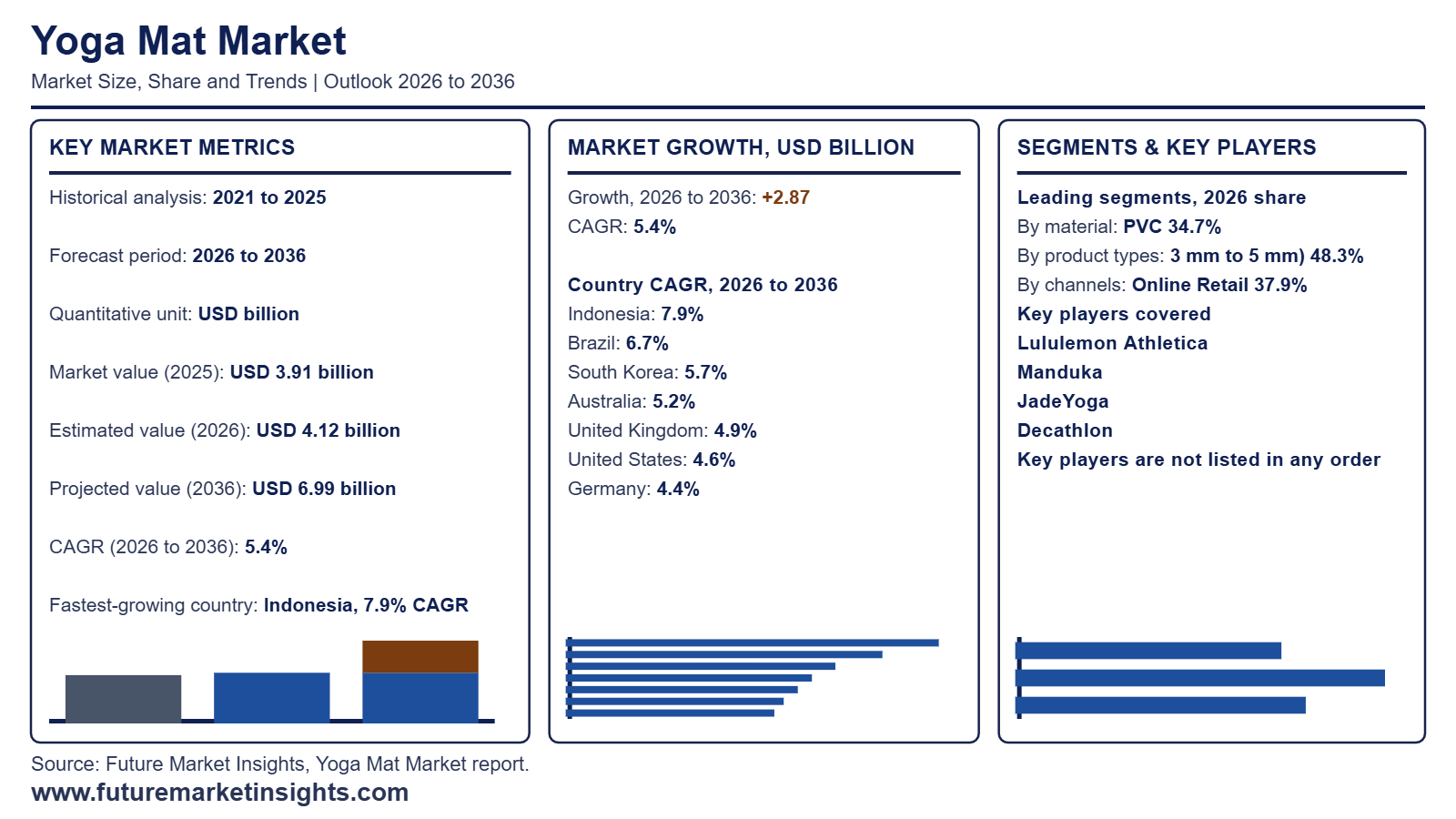
Executive Market Overview
Sales of yoga mats are driven by record fitness facility membership along with the spread of mat-based classes into mainstream gyms and studios. FMI estimates that the United States accounts for 28.6% of global sales in 2026, with Germany next at 6.4%. PVC mats remain the largest material group at 34.7%, and online retail handles 37.9% of sales. The Health & Fitness Association (April 2026) recorded 81 million US fitness facility members in 2025, an all-time high. Among those members, yoga remained the most widely practiced activity, with 17.7 million participants. Activity is rising in Europe too, as Sport England (April 2026) reported 15.3 million adults in fitness activities, up by 921,000 in one year. As a result, gyms and home exercisers are buying mats for yoga and Pilates, along with stretching and recovery sessions.
Regular practitioners buy yoga mats for grip and cushioning, along with durability. As practice becomes weekly, many users replace a basic PVC mat with a better one. At the premium end, Manduka (December 2025) lists the recycled-PVC PRO Terra 6 mm mat at USD 144 and the PRO Lite Terra at USD 103. This price spread means material and size upgrades are likely to add more value than extra units. FMI projects PU-topped rubber mats to expand at a 7.7% CAGR and online retail at 6.8%, both faster than the 5.4% overall market CAGR. By comparison, PVC mats are expected to grow at a 2.9% CAGR. Market sizing covers yoga mats in synthetic and natural materials, along with travel mats and large-format training mats. Yoga blocks, straps and bolsters are excluded, as are mat bags, yoga apparel, Pilates reformers and gym floor tiles.
Analyst Perspective
"Yoga mat brands are likely to see revenue grow faster than unit volume as shoppers trade up to natural rubber and PU-topped surfaces, along with wider training formats. A weaker premium shopper in the Americas is the main threat to that outlook, after Lululemon reported an 8% drop in sales in the Americas for the second quarter of fiscal 2026."
- Rahul Pandita, Principal Consultant, Future Market Insights (FMI)
Major Market Trends and Insights
Yoga Mat Brands Move into Hybrid Training: Mat makers are selling to people who mix yoga with strength and conditioning work. Manduka (April 2026) launched the P/ROX Hybrid Fitness Mat, a 6 mm, 76 cm by 200 cm mat built to handle footwear and weights, with a global debut at FIBO 2026. Studios are mixing formats in the same way. Fitt Insider (September 2026) reports, citing Playlist, that more than 40% of yoga studios have added Pilates classes.
Recycled and Certified Materials Reach Premium Lines: Premium brands are adding recycled content and third-party certification to flagship mats. The PRO Terra uses recycled PVC, and the PRO Series has OEKO-TEX STANDARD 100 certification, according to Manduka (December 2025). In natural rubber, JadeYoga (May 2026) builds new mats on the Harmony 2.0 base with FSC-certified materials and plants a tree for every mat sold. Mass retail is moving the same way, as ecodesigned products made up 53.9% of sales at Decathlon in 2025, per Decathlon (April 2026).
Licensing and Store Openings Reach New Shoppers: Brands are using character licenses and new stores to reach buyers outside core yoga circles. JadeYoga (May 2026) released a licensed Peanuts collection featuring Snoopy, Linus and Charlie Brown. In Europe, SGI Europe (July 2026) reported that Alo Yoga planned first stores in five German cities, along with a flagship in Paris. These stores are likely to add shelf space for mats next to the wider athleisure market.
What Are the Main Drivers, Restraints, and Opportunities?
Gym membership and mind-body class growth are lifting the number of regular mat users, but softer sales of premium apparel and trade costs are slowing growth at the top of the market. Online channels and fast-growing markets in Asia and Latin America offer the clearest growth.
Driver: Record Gym Membership and Mind-Body Class Growth
Fitness facility use reached a new high in 2025, with nearly 7 billion visits to US gyms and studios, according to the Health & Fitness Association (April 2026). Mind-body formats gained from this activity. The Sports & Fitness Industry Association (June 2026) reported that yoga and Pilates are experiencing some of the strongest momentum in years, based on 2025 participation data. Pilates alone reached 13.8 million US participants, per SFIA data cited by Fitt Insider (September 2026), adding floor-mat users next to yoga classes and the pilates equipment market.
Restraint: Premium Apparel Slowdown and Trade Costs
Premium yoga brands are reporting weaker sales in North America. Lululemon Athletica (September 2026) reported a 4% fall in second-quarter sales to USD 2.4 billion for fiscal 2026, with comparable sales down 9%. The company cut the full-year outlook to a decline of 5% to 7%. Trade rules add a second source of cost uncertainty. The same release lists changes to US tariff and customs policy, including the end of the de minimis exemption, among the risks to the business. Lululemon received USD 134.5 million in refunds of tariffs imposed under the International Emergency Economic Powers Act during that quarter.
Opportunity: Online Retail and Asia-Pacific Pilates Growth
Fast-growing activity in Asia-Pacific is creating new mat buyers. The Australian Sports Commission (November 2025) listed Pilates among the fastest-growing physical activities in the latest AusPlay results. FMI projects Indonesia to expand at a 7.9% CAGR and Brazil at 6.7%, the two fastest rates among the ten core countries. Online retail is expected to account for 43.1% of global sales by 2036, giving direct-to-consumer brands a route into these markets.
How Is the Yoga Mat Market Segmented?
The global yoga mat market is segmented by material, product type, distribution channel, and region, with all formats measured in units of finished mats for volume comparison.
| Segmentation Axis | Sub-Segments Covered | 2026 Leading Segment & Share | Main Growth Benchmark (2026 to 2036) |
|---|---|---|---|
| Material | PVC, TPE, Natural Rubber, PU-Topped Rubber, Cork, Jute and Cotton | PVC (34.7% share) | PU-Topped Rubber grows fastest at a 7.7% CAGR |
| Product Type | Standard Mats (3 mm to 5 mm), Thick and Cushioned Mats (6 mm and Above), Travel and Foldable Mats (Under 3 mm), Hot Yoga and Mat-Towel Hybrids, Large-Format and Hybrid Training Mats | Standard Mats (3 mm to 5 mm) (48.3% share) | Large-Format and Hybrid Training Mats grow fastest at a 10.2% CAGR |
| Distribution Channel | Online Retail, Sporting Goods Stores, Mass Merchants and Hypermarkets, Brand-Owned Stores, Studios, Gyms and Institutional Supply | Online Retail (37.9% share) | Online Retail grows fastest at a 6.8% CAGR |
| Region | North America, Latin America, Europe, East Asia, South Asia & Pacific, Middle East & Africa | North America (led by the United States at 28.6% global share) | Indonesia and Brazil grow fastest at 7.9% and 6.7% CAGR |
Source: Future Market Insights analysis of the yoga mat market, 2026.
Why Does the PVC Segment Lead by Material?
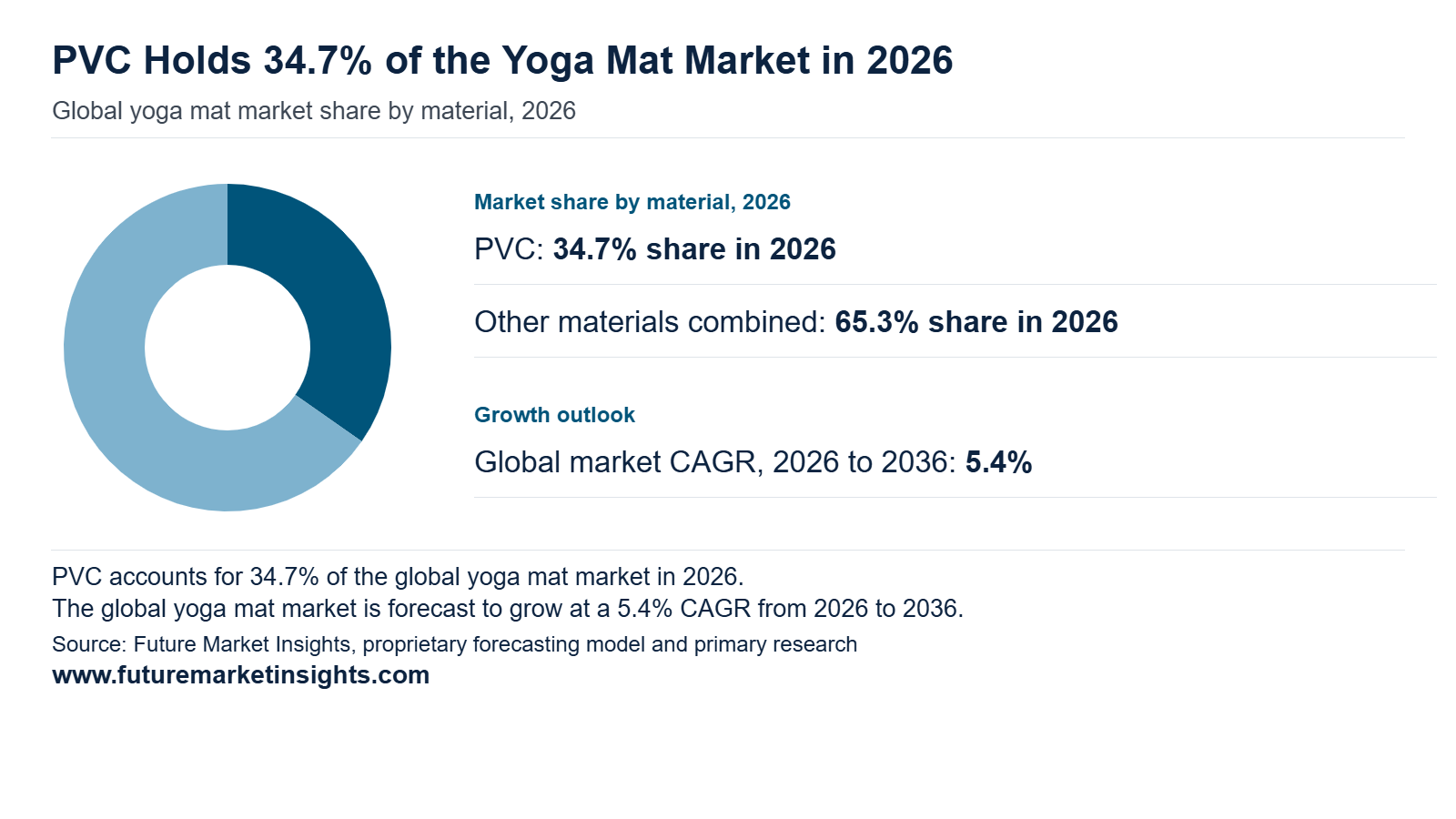
PVC is the largest material in the global yoga mat market, with 34.7% of 2026 sales, and is projected to hold 27.2% by 2036. Closed-cell PVC is used in both low-priced mass mats and long-life studio mats, so the material sells across every price band. Manduka (December 2025) states that the PRO Series is made in Germany from OEKO-TEX certified PVC and comes with a lifetime guarantee. PU-topped rubber is expected to grow at the quickest pace by material, a 7.7% CAGR, as hot yoga and alignment-focused users pay more for a dry-grip surface. Natural rubber is projected to grow at 6.5%, drawing on supply from the natural rubber market.
Why Does the Standard Mat Segment Lead by Product Type?
Standard mats of 3 mm to 5 mm hold 48.3% of 2026 sales by product type and are projected to grow at a 4.1% CAGR through 2036. Studio classes and beginner kits are built around this thickness, so standard mats remain the main item in mass retail ranges. Large-format and hybrid training mats are set to grow fastest, at a 10.2% CAGR, as brands such as Manduka are adding wider mats built for shoes and weights. Thick and cushioned mats of 6 mm and above take 24.1% of 2026 sales, supported by home users who exercise on hard floors.
Why Does the Online Retail Segment Lead by Distribution Channel?
Online retail accounts for 37.9% of global sales of yoga mats in 2026, the largest share of any channel. Light parcels and detailed customer reviews make yoga mats well suited to brand websites and marketplaces. Sales through online retail are projected to post the fastest channel growth, a 6.8% CAGR, taking the channel to 43.1% of sales by 2036. Sporting goods stores remain the second channel at 21.3%, with Decathlon selling 1.23 billion products across all categories in 2025, per Decathlon (April 2026).
Yoga Mat Market by Region and Country (2026 to 2036)
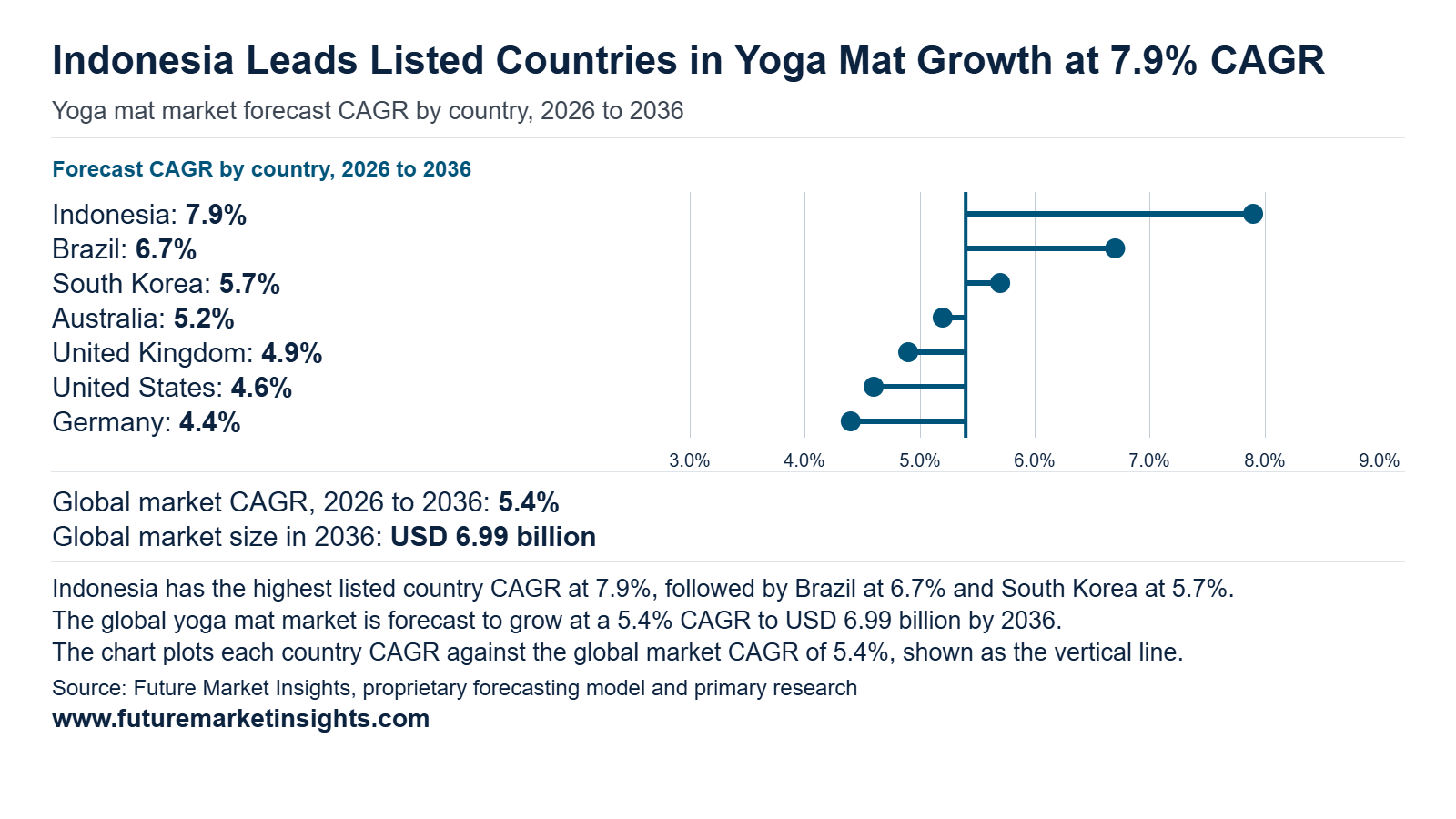
North America remains the largest region for yoga mats through 2036, though the region's share eases from 32.3% in 2026 to 29.6% by 2036 as Asia-Pacific and Latin America gain. The ten core countries below account for 61.9% of global sales in 2026 and are projected to hold 57.8% by 2036. South Asia & Pacific is expected to be the fastest-growing region, at a 7.8% CAGR. In absolute terms, the United States adds USD 670.0 million, or 23.3% of total global growth, the largest single-country gain.
| Country | 2026 Revenue | 2036 Revenue | 10-Year Addition | 2026 to 2036 CAGR | Global Share (2026 → 2036) |
|---|---|---|---|---|---|
| Indonesia | USD 70.0 million | USD 149.7 million | +USD 79.7 million | 7.9% | 1.7% → 2.1% |
| Brazil | USD 92.0 million | USD 176.0 million | +USD 84.0 million | 6.7% | 2.2% → 2.5% |
| South Korea | USD 96.0 million | USD 167.1 million | +USD 71.1 million | 5.7% | 2.3% → 2.4% |
| Australia | USD 118.0 million | USD 195.9 million | +USD 77.9 million | 5.2% | 2.9% → 2.8% |
| United Kingdom | USD 214.0 million | USD 345.3 million | +USD 131.3 million | 4.9% | 5.2% → 4.9% |
| United States | USD 1.18 billion | USD 1.85 billion | +USD 670.0 million | 4.6% | 28.6% → 26.5% |
| Germany | USD 262.0 million | USD 403.0 million | +USD 141.0 million | 4.4% | 6.4% → 5.8% |
| France | USD 128.0 million | USD 193.1 million | +USD 65.1 million | 4.2% | 3.1% → 2.8% |
| Canada | USD 152.0 million | USD 222.8 million | +USD 70.8 million | 3.9% | 3.7% → 3.2% |
| Japan | USD 238.0 million | USD 339.0 million | +USD 101.0 million | 3.6% | 5.8% → 4.8% |
Source: Future Market Insights analysis of the yoga mat market, 2026.
United States
Sales of yoga mats in the United States, the largest national market, are projected to rise from USD 1.18 billion in 2026 to USD 1.85 billion by 2036 (4.6% CAGR). The country's share of global sales eases from 28.6% to 26.5% over the period. Gym membership gives the market a large base, with 26.1% of the US population aged six and older holding a fitness facility membership in 2025, per the Health & Fitness Association (April 2026). FMI expects slower sales of premium apparel to hold back growth in the brand-owned store channel.
Germany
Germany is the largest European market, growing at a 4.4% CAGR from USD 262.0 million in 2026 to USD 403.0 million by 2036. The country adds USD 141.0 million over the decade. New brand stores are planned, with Alo Yoga preparing to enter five German cities, per SGI Europe (July 2026). Germany is home to FIBO, the trade fair that Manduka chose for the global debut of the P/ROX mat in 2026.
Japan
Sales in Japan are set to rise at a 3.6% CAGR from USD 238.0 million in 2026 to USD 339.0 million by 2036, the slowest rate in the country table. Studio chains set much of the demand. LAVA International (November 2026) lists 450 studios nationwide, including the YUKALA brand, and states that 80% of members are new to yoga. Monthly LAVA plans start at JPY 6,800 (USD 42.7), and FMI expects hot yoga mats and mat-towel hybrids to remain the main products bought by these members.
United Kingdom
Sales in the United Kingdom are forecast to rise at a 4.9% CAGR from USD 214.0 million in 2026 to USD 345.3 million by 2036, adding USD 131.3 million. Participation data in England is supportive. Sport England (April 2026) recorded 30.9 million adults, or 64.6% of the adult population, meeting activity guidelines in the 12 months to November 2025. FMI expects online marketplaces and sporting goods chains to account for most of the volume.
Canada
Canada is set to expand at a 3.9% CAGR from USD 152.0 million in 2026 to USD 222.8 million by 2036, with the country's share easing from 3.7% to 3.2%. Retail conditions were soft in 2026, as Lululemon Athletica (September 2026) recorded an 11% fall in sales in Canada in the quarter ended 2 August 2026. FMI expects replacement purchases by regular practitioners to keep volumes stable.
France
France is forecast to expand at a 4.2% CAGR from USD 128.0 million in 2026 to USD 193.1 million by 2036, adding USD 65.1 million. Decathlon, based in France, sells low-priced own-brand mats through a large national store network. Alo Yoga has announced a Paris flagship, noted by SGI Europe (July 2026), that is likely to add a premium store option in the capital.
Australia
Australia is likely to grow at a 5.2% CAGR from USD 118.0 million in 2026 to USD 195.9 million by 2036, adding USD 77.9 million. AusPlay surveys 40,000 people a year and ranks Pilates among the fastest-growing activities, per the Australian Sports Commission (November 2025). FMI expects studio and gym mats for Pilates mat classes to grow faster than mats for home yoga.
South Korea
South Korea is forecast to grow at a 5.7% CAGR from USD 96.0 million in 2026 to USD 167.1 million by 2036, lifting the country's share from 2.3% to 2.4%. Dense urban studio networks and strong online shopping habits favor thick TPE mats and foldable formats for small apartments.
Brazil
Brazil is the second-fastest-growing core market, with sales rising from USD 92.0 million in 2026 to USD 176.0 million by 2036 at a 6.7% CAGR. The country adds USD 84.0 million as gym chains and marketplaces increase access to low-priced TPE and PVC mats.
Indonesia
Indonesia records the fastest growth rate in the country table, a 7.9% CAGR, with sales rising from USD 70.0 million in 2026 to USD 149.7 million by 2036. The country's share increases from 1.7% to 2.1%. FMI expects e-commerce platforms to account for most first-time mat purchases from a low per-capita base.
Competitive Environment and Notable Companies

Notable companies in the global yoga mat market include Lululemon Athletica and Manduka, along with JadeYoga and Liforme. Alo Yoga sells mats through a growing store network. Mass sports retailer Decathlon, along with Gaiam and Hugger Mugger, sells mats at entry and mid-range prices. Two groups compete in the category. Premium brands sell on material and grip, along with long warranties, through brand websites and studios. Mass retailers sell on price and store reach. Unbranded marketplace sellers add price pressure in PVC and TPE.
How Are Companies Positioned in the Yoga Mat Market?
Manduka (April 2026) is extending the PRO Series into hybrid fitness with the P/ROX mat. JadeYoga (May 2026) is selling natural rubber mats with a tree-planting pledge and licensed character designs. Lululemon Athletica and Alo Yoga sell mats next to apparel in brand-owned stores, and Decathlon (April 2026) reaches buyers through 1,902 stores in 82 countries and regions.
What Matters When a Buyer Selects a Yoga Mat Supplier?
Studio and gym buyers compare grip in wet conditions and durability under daily use, along with ease of cleaning. Closed-cell surfaces that resist sweat absorption are a common requirement, and Manduka (April 2026) cites closed-cell construction for hygiene on the P/ROX. Households look at thickness and weight for storage. Material safety labels such as OEKO-TEX certification are becoming a baseline for premium buyers.
Which Capabilities Distinguish Product Offers?
Product ranges differ by material, surface and size. Manduka relies on dense PVC with a lifetime guarantee on the PRO, and JadeYoga builds on open-cell natural rubber. Liforme sells mats with printed alignment markers, and lifestyle brands focus on color and design. Large-format mats for shoes and weights are a newer line that links the category to the home fitness equipment market.
How Does Geographic Reach Affect Competition?
Premium mat brands are based mainly in the United States and Europe, yet the fastest growth rates are in Indonesia and Brazil. Store networks give mass retailers an advantage in reach, and online marketplaces let smaller brands sell across borders. Lululemon Athletica (September 2026) reported that sales outside the Americas rose 4% in the second quarter of fiscal 2026, compared with an 8% fall in the Americas.
| Verified Company Evidence (2026) | Commercial Effect | Buyer Action |
|---|---|---|
| 15 April 2026: Manduka launched the P/ROX Hybrid Fitness Mat, a 6 mm, 76 cm by 200 cm mat with a reinforced top layer for footwear and weights, debuting at FIBO 2026 (Manduka, April 2026). | Moves a premium yoga brand into gym and hybrid training floors. | Review mat specifications for mixed yoga and strength classes. |
| 21 May 2026: JadeYoga launched a licensed Peanuts collection on the Harmony 2.0 natural rubber mat, with FSC-certified materials (JadeYoga, May 2026). | Uses character licensing to reach gift and beginner buyers. | Test licensed designs in gift and youth ranges. |
| 16 July 2026: SGI Europe reported that Alo Yoga planned first stores in five German cities, along with a flagship in Paris (SGI Europe, July 2026). | Points to more premium brand-owned shelf space for mats in Germany. | Monitor premium price points in German city centers. |
| 3 September 2026: Lululemon reported a 4% fall in sales to USD 2.4 billion for the second quarter of fiscal 2026 and cut the full-year outlook (Lululemon Athletica, September 2026). | Signals softer premium demand in the Americas. | Plan promotions and price tiers for premium mats in North America. |
Source: Verified corporate disclosures and Future Market Insights analysis, 2026.
| Company | Core Positioning | Verified Activity & Source Attribution |
|---|---|---|
| Lululemon Athletica | Premium yoga apparel and accessories, including mats | Sales of USD 2.4 billion in the second quarter of fiscal 2026, down 4%, with 825 company-operated stores (Lululemon Athletica, September 2026). |
| Manduka | Premium PVC and natural rubber yoga mats (PRO, PRO Terra, P/ROX) | Launched the P/ROX Hybrid Fitness Mat in April 2026 (Manduka, April 2026) and lists the recycled-PVC PRO Terra at USD 144 (Manduka, December 2025). |
| JadeYoga | Natural rubber yoga mats (Harmony 2.0) | Launched a licensed Peanuts collection on 21 May 2026 and reports more than 2.5 million trees planted (JadeYoga, May 2026). |
| Alo Yoga | Premium yoga apparel and lifestyle accessories | Planned first stores in five German cities, along with a flagship in Paris (SGI Europe, July 2026). |
| Decathlon | Mass-market sports retail and own-brand mats | 2025 net sales of EUR 16.8 billion (USD 18.45 billion) and 1,902 stores (Decathlon, April 2026). |
| LAVA International | Hot yoga studio chain that sells mats and towels | 450 studios nationwide in Japan as of November 2026 (LAVA International, November 2026). |
Source: Verified corporate disclosures and Future Market Insights analysis, 2026.
Yoga Mat Market Report Scope and Research Methodology
FMI builds the yoga mat estimates from mat unit sales and the prices buyers pay online, in stores and through studios in each country. Company results and product launches are compared with national sport and fitness participation surveys to test each country total. Gym membership and participation figures for the United States and England give the most detailed starting point, so those markets are sized first. All formats are converted to mat units, so travel, standard and large-format mats sit on a single volume basis. Each sale is assigned to the country of use, and the material, product type and channel splits sum to the same global total each year. Company releases serve to confirm product positioning and launch dates, and FMI does not use them to estimate company sales.
| Coverage Field | Report Scope |
|---|---|
| Market definition | Mats sold for yoga, Pilates mat work, stretching and floor-based training, for household, studio and gym use. |
| Materials | PVC, TPE and natural rubber, along with PU-topped rubber and natural fibers (cork, jute and cotton). |
| Product types | Standard mats (3 mm to 5 mm) and thick mats (6 mm and above), along with travel and foldable mats (under 3 mm), hot yoga mat-towel hybrids and large-format training mats. |
| Distribution channels | Online retail and sporting goods stores, along with mass merchants, brand-owned stores and studio, gym and institutional supply. |
| Surface finishes included | Smooth and textured closed-cell surfaces and open-cell rubber, along with PU coatings and printed alignment markers. |
| Price tiers | Entry-level mass mats, mid-range branded mats and premium mats with long warranties. |
| End users | Home practitioners and yoga and Pilates studios, along with gyms, schools and physical therapy clinics. |
| Exclusions | Yoga blocks, straps and bolsters are excluded, as are mat bags and towels sold alone, yoga apparel, Pilates reformers, smart mats with sensors and gym floor tiles. |
| Quantitative units | USD million for value, million units for volume. |
| Volume basis | Units of finished mats, with each mat-towel hybrid recorded as one unit. |
| Value basis | Sales to buyers in each country, measured in the country of consumption. |
| Regions covered | North America and Latin America, along with Europe and East Asia, as well as South Asia and Pacific and Middle East and Africa. |
| National coverage | United States, Germany, Japan, United Kingdom, Canada, France, Australia, South Korea, Brazil and Indonesia. |
| Companies covered | Lululemon Athletica, Manduka, JadeYoga, Liforme, Alo Yoga, Decathlon, Gaiam and Hugger Mugger, along with LAVA International. |
Source: Future Market Insights analysis of the yoga mat market, 2026.
Research Sources and Bibliography
- Australian Sports Commission. (2025, November 14). New AusPlay data released: Aussies embracing sport for life.
- Decathlon. (2026, April 2). DECATHLON Group's 2025 performance.
- Fitt Insider. (2026, September 15). Fitness operators adapt to the Pilates boom.
- Health & Fitness Association. (2026, April 9). 81 million Americans were members of a fitness facility in 2025, new HFA report finds.
- JadeYoga. (2026, May 21). JadeYoga launches licensed Peanuts collection, bringing joy, mindfulness, and a touch of humor to the mat.
- LAVA International. (Accessed 2026, November 18). Hot Yoga Studio LAVA official site, studio network and membership plans. https://yoga-lava.com
- Lululemon Athletica. (2026, September 3). lululemon athletica inc. announces second quarter fiscal 2026 results. https://corporate.lululemon.com/newsroom/press-releases/2026/09-03-2026-210528733
- Manduka. (2025, December 9). Meet the Manduka PRO Terra, why it's redefining sustainable yoga mats. https://www.manduka.com/blogs/mandukamag/pro-terra-sustainable-yoga-mat
- Manduka. (2026, April 15). Manduka expands beyond the yoga studio with the launch of the P/ROX Hybrid Fitness Mat. https://www.prnewswire.co.uk/news-releases/manduka-expands-beyond-the-yoga-studio-with-the-launch-of-the-prox-hybrid-fitness-mat-302743659.html
- SGI Europe. (2026, July 16). Alo Yoga picks luxury streets for German stores. https://www.sgieurope.com/retail/alo-yoga-picks-luxury-streets-for-german-stores/122218.article
- Sport England. (2026, April 23). England is getting more active but not everyone is benefiting. https://www.sportengland.org/news-and-inspiration/england-getting-more-active-not-everyone-benefiting
- Sports & Fitness Industry Association. (2026, June 30). 2026 fitness participation trends, what SFIA's latest research reveals about strength training, yoga, Pilates, and the return of cardio. https://sfia.org/resources/2026-fitness-participation-trends-what-sfias-latest-research-reveals-about-strength-training-yoga-pilates-and-the-return-of-cardio/
Table of Content
- Key Takeaways
- Market Size and CAGR
- Top Growth Driver
- Fastest Growing Segment
- Leading Region
- Key Companies
- Emerging Opportunities
- Executive Summary
- Global Market Outlook
- Demand-side Trends
- Supply-side Trends
- Technology Roadmap Analysis
- Analysis and Recommendations
- Analyst Perspective (What is happening? Why now? What should investors know?)
Read More...
- Key Questions Answered
- How large is the market?
- What is the CAGR?
- What are key trends?
- Which region dominates?
- Who are the leaders?
- Market Overview
- Market Coverage / Taxonomy
- Market Definition / Scope / Limitations
- Research Methodology
- Chapter Orientation
- Analytical Lens and Working Hypotheses
- Market Structure, Signals, and Trend Drivers
- Benchmarking and Cross-market Comparability
- Market Sizing, Forecasting, and Opportunity Mapping
- Research Design and Evidence Framework
- Desk Research Program (Secondary Evidence)
- Expert Input and Fieldwork (Primary Evidence)
- Tooling, Models, and Reference Databases
- Data Engineering and Model Build
- Quality Assurance and Audit Trail
- Market Background
- Market Dynamics (Drivers, Restraints, Opportunity, Trends)
- Scenario Forecast (Optimistic, Likely, Conservative)
- Impact Analysis
- AI Impact
- Sustainability Impact
- Regulatory Impact
- Technology Impact
- Consumer / Buyer Analysis
- Purchase Drivers
- Adoption Barriers
- Buyer Journey
- Opportunity Map Analysis
- Product Life Cycle Analysis
- Supply Chain Analysis
- Investment Feasibility Matrix
- Value Chain Analysis
- PESTLE and Porter's Analysis
- Regulatory Landscape
- Regional Parent Market Outlook
- Production and Consumption Statistics
- Import and Export Statistics
- Global Market Analysis and Forecast, 2021 to 2036
- Historical Market Size Value (USD Million) Analysis, 2021 to 2025
- Current and Future Market Size Value (USD Million) Projections, 2026 to 2036
- Y-o-Y Growth Trend Analysis
- Absolute $ Opportunity Analysis
- Global Market Pricing Analysis, 2021 to 2036
- Global Market Analysis and Forecast, By Material, 2021 to 2036
- Introduction / Key Findings
- Historical Market Size Value (USD Million) Analysis By Material, 2021 to 2025
- Current and Future Market Size Value (USD Million) Analysis and Forecast By Material, 2026 to 2036
- PVC
- TPE
- Natural Rubber
- PU-Topped Rubber
- Cork, Jute and Cotton
- Y-o-Y Growth Trend Analysis By Material, 2021 to 2025
- Absolute $ Opportunity Analysis By Material, 2026 to 2036
- Global Market Analysis and Forecast, By Product Type, 2021 to 2036
- Introduction / Key Findings
- Historical Market Size Value (USD Million) Analysis By Product Type, 2021 to 2025
- Current and Future Market Size Value (USD Million) Analysis and Forecast By Product Type, 2026 to 2036
- Standard Mats (3 mm to 5 mm)
- Thick and Cushioned Mats (6 mm and Above)
- Travel and Foldable Mats (Under 3 mm)
- Hot Yoga and Mat-Towel Hybrids
- Large-Format and Hybrid Training Mats
- Y-o-Y Growth Trend Analysis By Product Type, 2021 to 2025
- Absolute $ Opportunity Analysis By Product Type, 2026 to 2036
- Global Market Analysis and Forecast, By Distribution Channel, 2021 to 2036
- Introduction / Key Findings
- Historical Market Size Value (USD Million) Analysis By Distribution Channel, 2021 to 2025
- Current and Future Market Size Value (USD Million) Analysis and Forecast By Distribution Channel, 2026 to 2036
- Online Retail
- Sporting Goods Stores
- Mass Merchants and Hypermarkets
- Brand-Owned Stores
- Studios, Gyms and Institutional Supply
- Y-o-Y Growth Trend Analysis By Distribution Channel, 2021 to 2025
- Absolute $ Opportunity Analysis By Distribution Channel, 2026 to 2036
- Global Market Analysis and Forecast, By Region, 2021 to 2036
- Introduction
- Historical Market Size Value (USD Million) Analysis By Region, 2021 to 2025
- Current Market Size Value (USD Million) Analysis and Forecast By Region, 2026 to 2036
- North America
- Latin America
- Europe
- East Asia
- South Asia and Pacific
- Middle East and Africa
- Market Attractiveness Analysis By Region
- North America Market Analysis and Forecast, By Country, 2021 to 2036
- Historical Market Size Value (USD Million) Trend Analysis By Market Taxonomy, 2021 to 2025
- Market Size Value (USD Million) Forecast By Market Taxonomy, 2026 to 2036
- By Country
- United States
- Canada
- By Material
- By Product Type
- By Distribution Channel
- By Country
- Market Attractiveness Analysis
- By Country
- By Material
- By Product Type
- By Distribution Channel
- Key Takeaways
- Europe Market Analysis and Forecast, By Country, 2021 to 2036
- Historical Market Size Value (USD Million) Trend Analysis By Market Taxonomy, 2021 to 2025
- Market Size Value (USD Million) Forecast By Market Taxonomy, 2026 to 2036
- By Country
- Germany
- United Kingdom
- France
- Rest of Europe
- By Material
- By Product Type
- By Distribution Channel
- By Country
- Market Attractiveness Analysis
- By Country
- By Material
- By Product Type
- By Distribution Channel
- Key Takeaways
- East Asia Market Analysis and Forecast, By Country, 2021 to 2036
- Historical Market Size Value (USD Million) Trend Analysis By Market Taxonomy, 2021 to 2025
- Market Size Value (USD Million) Forecast By Market Taxonomy, 2026 to 2036
- By Country
- Japan
- South Korea
- Rest of East Asia
- By Material
- By Product Type
- By Distribution Channel
- By Country
- Market Attractiveness Analysis
- By Country
- By Material
- By Product Type
- By Distribution Channel
- Key Takeaways
- South Asia and Pacific Market Analysis and Forecast, By Country, 2021 to 2036
- Historical Market Size Value (USD Million) Trend Analysis By Market Taxonomy, 2021 to 2025
- Market Size Value (USD Million) Forecast By Market Taxonomy, 2026 to 2036
- By Country
- Australia
- Indonesia
- Rest of South Asia and Pacific
- By Material
- By Product Type
- By Distribution Channel
- By Country
- Market Attractiveness Analysis
- By Country
- By Material
- By Product Type
- By Distribution Channel
- Key Takeaways
- Latin America Market Analysis and Forecast, By Country, 2021 to 2036
- Historical Market Size Value (USD Million) Trend Analysis By Market Taxonomy, 2021 to 2025
- Market Size Value (USD Million) Forecast By Market Taxonomy, 2026 to 2036
- By Country
- Brazil
- Rest of Latin America
- By Material
- By Product Type
- By Distribution Channel
- By Country
- Market Attractiveness Analysis
- By Country
- By Material
- By Product Type
- By Distribution Channel
- Key Takeaways
- Key Countries Market Analysis
- United States
- Pricing Analysis
- Market Share Analysis, 2025
- By Material
- By Product Type
- By Distribution Channel
- Germany
- Pricing Analysis
- Market Share Analysis, 2025
- By Material
- By Product Type
- By Distribution Channel
- Japan
- Pricing Analysis
- Market Share Analysis, 2025
- By Material
- By Product Type
- By Distribution Channel
- United Kingdom
- Pricing Analysis
- Market Share Analysis, 2025
- By Material
- By Product Type
- By Distribution Channel
- Canada
- Pricing Analysis
- Market Share Analysis, 2025
- By Material
- By Product Type
- By Distribution Channel
- France
- Pricing Analysis
- Market Share Analysis, 2025
- By Material
- By Product Type
- By Distribution Channel
- Australia
- Pricing Analysis
- Market Share Analysis, 2025
- By Material
- By Product Type
- By Distribution Channel
- South Korea
- Pricing Analysis
- Market Share Analysis, 2025
- By Material
- By Product Type
- By Distribution Channel
- Brazil
- Pricing Analysis
- Market Share Analysis, 2025
- By Material
- By Product Type
- By Distribution Channel
- Indonesia
- Pricing Analysis
- Market Share Analysis, 2025
- By Material
- By Product Type
- By Distribution Channel
- United States
- Market Structure Analysis
- Competition Dashboard
- Competition Benchmarking
- Market Share Analysis of Top Players
- By Regional
- By Material
- By Product Type
- By Distribution Channel
- Emerging Startups
- Innovation Benchmarking
- Competition Analysis
- Competition Deep Dive
- Lululemon Athletica
- Overview
- Product Portfolio
- Profitability by Market Segments
- Sales Footprint
- Strategy Overview
- Marketing Strategy
- Product Strategy
- Channel Strategy
- Manduka
- JadeYoga
- Liforme
- Alo Yoga
- Decathlon
- Gaiam
- Hugger Mugger
- LAVA International
- Lululemon Athletica
- Competition Deep Dive
- Case Studies
- Success Stories
- Recent Developments
- Assumptions & Acronyms Used
List of Tables
- Table 1: Global Market Value (USD Million) Forecast by Region, 2021 to 2036
- Table 2: Global Market Value (USD Million) Forecast by Material, 2021 to 2036
- Table 3: Global Market Value (USD Million) Forecast by Product Type, 2021 to 2036
- Table 4: Global Market Value (USD Million) Forecast by Distribution Channel, 2021 to 2036
- Table 5: Global Market Volume (Million Units) Forecast by Region, 2021 to 2036
- Table 6: North America Market Value (USD Million) Forecast by Country, 2021 to 2036
- Table 7: North America Market Value (USD Million) Forecast by Material, 2021 to 2036
- Table 8: North America Market Value (USD Million) Forecast by Product Type, 2021 to 2036
- Table 9: North America Market Value (USD Million) Forecast by Distribution Channel, 2021 to 2036
- Table 10: Europe Market Value (USD Million) Forecast by Country, 2021 to 2036
- Table 11: Europe Market Value (USD Million) Forecast by Material, 2021 to 2036
- Table 12: Europe Market Value (USD Million) Forecast by Product Type, 2021 to 2036
- Table 13: Europe Market Value (USD Million) Forecast by Distribution Channel, 2021 to 2036
- Table 14: East Asia Market Value (USD Million) Forecast by Country, 2021 to 2036
- Table 15: East Asia Market Value (USD Million) Forecast by Material, 2021 to 2036
- Table 16: East Asia Market Value (USD Million) Forecast by Product Type, 2021 to 2036
- Table 17: East Asia Market Value (USD Million) Forecast by Distribution Channel, 2021 to 2036
- Table 18: South Asia and Pacific Market Value (USD Million) Forecast by Country, 2021 to 2036
- Table 19: South Asia and Pacific Market Value (USD Million) Forecast by Material, 2021 to 2036
- Table 20: South Asia and Pacific Market Value (USD Million) Forecast by Product Type, 2021 to 2036
- Table 21: South Asia and Pacific Market Value (USD Million) Forecast by Distribution Channel, 2021 to 2036
- Table 22: Latin America Market Value (USD Million) Forecast by Country, 2021 to 2036
- Table 23: Latin America Market Value (USD Million) Forecast by Material, 2021 to 2036
- Table 24: Latin America Market Value (USD Million) Forecast by Product Type, 2021 to 2036
- Table 25: Latin America Market Value (USD Million) Forecast by Distribution Channel, 2021 to 2036
List of Figures
- Figure 1: Global Market Pricing Analysis
- Figure 2: Global Market Value (USD Million) Forecast 2021-2036
- Figure 3: Global Market Value Share and BPS Analysis by Material, 2026 and 2036
- Figure 4: Global Market Y-o-Y Growth Comparison by Material, 2026-2036
- Figure 5: Global Market Attractiveness Analysis by Material
- Figure 6: Global Market Value Share and BPS Analysis by Product Type, 2026 and 2036
- Figure 7: Global Market Y-o-Y Growth Comparison by Product Type, 2026-2036
- Figure 8: Global Market Attractiveness Analysis by Product Type
- Figure 9: Global Market Value Share and BPS Analysis by Distribution Channel, 2026 and 2036
- Figure 10: Global Market Y-o-Y Growth Comparison by Distribution Channel, 2026-2036
- Figure 11: Global Market Attractiveness Analysis by Distribution Channel
- Figure 12: Global Market Value (USD Million) Share and BPS Analysis by Region, 2026 and 2036
- Figure 13: Global Market Y-o-Y Growth Comparison by Region, 2026-2036
- Figure 14: Global Market Attractiveness Analysis by Region
- Figure 15: North America Market Incremental Dollar Opportunity, 2026-2036
- Figure 16: Europe Market Incremental Dollar Opportunity, 2026-2036
- Figure 17: East Asia Market Incremental Dollar Opportunity, 2026-2036
- Figure 18: South Asia and Pacific Market Incremental Dollar Opportunity, 2026-2036
- Figure 19: Latin America Market Incremental Dollar Opportunity, 2026-2036
- Figure 20: North America Market Value Share and BPS Analysis by Country, 2026 and 2036
- Figure 21: North America Market Value Share and BPS Analysis by Material, 2026 and 2036
- Figure 22: North America Market Y-o-Y Growth Comparison by Material, 2026-2036
- Figure 23: North America Market Attractiveness Analysis by Material
- Figure 24: North America Market Value Share and BPS Analysis by Product Type, 2026 and 2036
- Figure 25: North America Market Y-o-Y Growth Comparison by Product Type, 2026-2036
- Figure 26: North America Market Attractiveness Analysis by Product Type
- Figure 27: North America Market Value Share and BPS Analysis by Distribution Channel, 2026 and 2036
- Figure 28: North America Market Y-o-Y Growth Comparison by Distribution Channel, 2026-2036
- Figure 29: North America Market Attractiveness Analysis by Distribution Channel
- Figure 30: Europe Market Value Share and BPS Analysis by Country, 2026 and 2036
- Figure 31: Europe Market Value Share and BPS Analysis by Material, 2026 and 2036
- Figure 32: Europe Market Y-o-Y Growth Comparison by Material, 2026-2036
- Figure 33: Europe Market Attractiveness Analysis by Material
- Figure 34: Europe Market Value Share and BPS Analysis by Product Type, 2026 and 2036
- Figure 35: Europe Market Y-o-Y Growth Comparison by Product Type, 2026-2036
- Figure 36: Europe Market Attractiveness Analysis by Product Type
- Figure 37: Europe Market Value Share and BPS Analysis by Distribution Channel, 2026 and 2036
- Figure 38: Europe Market Y-o-Y Growth Comparison by Distribution Channel, 2026-2036
- Figure 39: Europe Market Attractiveness Analysis by Distribution Channel
- Figure 40: East Asia Market Value Share and BPS Analysis by Country, 2026 and 2036
- Figure 41: East Asia Market Value Share and BPS Analysis by Material, 2026 and 2036
- Figure 42: East Asia Market Y-o-Y Growth Comparison by Material, 2026-2036
- Figure 43: East Asia Market Attractiveness Analysis by Material
- Figure 44: East Asia Market Value Share and BPS Analysis by Product Type, 2026 and 2036
- Figure 45: East Asia Market Y-o-Y Growth Comparison by Product Type, 2026-2036
- Figure 46: East Asia Market Attractiveness Analysis by Product Type
- Figure 47: East Asia Market Value Share and BPS Analysis by Distribution Channel, 2026 and 2036
- Figure 48: East Asia Market Y-o-Y Growth Comparison by Distribution Channel, 2026-2036
- Figure 49: East Asia Market Attractiveness Analysis by Distribution Channel
- Figure 50: South Asia and Pacific Market Value Share and BPS Analysis by Country, 2026 and 2036
- Figure 51: South Asia and Pacific Market Value Share and BPS Analysis by Material, 2026 and 2036
- Figure 52: South Asia and Pacific Market Y-o-Y Growth Comparison by Material, 2026-2036
- Figure 53: South Asia and Pacific Market Attractiveness Analysis by Material
- Figure 54: South Asia and Pacific Market Value Share and BPS Analysis by Product Type, 2026 and 2036
- Figure 55: South Asia and Pacific Market Y-o-Y Growth Comparison by Product Type, 2026-2036
- Figure 56: South Asia and Pacific Market Attractiveness Analysis by Product Type
- Figure 57: South Asia and Pacific Market Value Share and BPS Analysis by Distribution Channel, 2026 and 2036
- Figure 58: South Asia and Pacific Market Y-o-Y Growth Comparison by Distribution Channel, 2026-2036
- Figure 59: South Asia and Pacific Market Attractiveness Analysis by Distribution Channel
- Figure 60: Latin America Market Value Share and BPS Analysis by Country, 2026 and 2036
- Figure 61: Latin America Market Value Share and BPS Analysis by Material, 2026 and 2036
- Figure 62: Latin America Market Y-o-Y Growth Comparison by Material, 2026-2036
- Figure 63: Latin America Market Attractiveness Analysis by Material
- Figure 64: Latin America Market Value Share and BPS Analysis by Product Type, 2026 and 2036
- Figure 65: Latin America Market Y-o-Y Growth Comparison by Product Type, 2026-2036
- Figure 66: Latin America Market Attractiveness Analysis by Product Type
- Figure 67: Latin America Market Value Share and BPS Analysis by Distribution Channel, 2026 and 2036
- Figure 68: Latin America Market Y-o-Y Growth Comparison by Distribution Channel, 2026-2036
- Figure 69: Latin America Market Attractiveness Analysis by Distribution Channel
- Figure 70: Global Market - Tier Structure Analysis
- Figure 71: Global Market - Company Share Analysis
Frequently Asked Questions
How big is the yoga mat market in 2026?
Future Market Insights estimates the global yoga mat market at USD 4.12 billion in 2026, up from USD 3.91 billion in 2025.
How fast is the yoga mat market expected to grow through 2036?
FMI projects a 5.4% CAGR from 2026 to 2036 for the yoga mat market, taking global sales to USD 6.99 billion by 2036 and adding USD 2.87 billion over the period.
Which material leads the yoga mat market?
PVC holds the largest share of the yoga mat market by material, 34.7% of 2026 sales, and PU-topped rubber is projected to expand fastest, at a 7.7% CAGR through 2036.
Which product type leads the yoga mat market?
Standard mats of 3 mm to 5 mm hold 48.3% of sales of yoga mats in 2026, growing at a 4.1% CAGR, as large-format and hybrid training mats grow fastest at 10.2% per year.
Which distribution channel leads the yoga mat market?
Online retail holds 37.9% of sales of yoga mats in 2026 and is the fastest-growing channel as well, at 6.8% per year from 2026 to 2036.
Which country is the largest yoga mat market?
The United States is the largest yoga mat market, with 28.6% of global sales in 2026 (USD 1.18 billion), followed by Germany at 6.4% (USD 262.0 million) and Japan at 5.8% (USD 238.0 million).
Which countries are expected to grow fastest in the yoga mat market?
Indonesia is expected to expand at the quickest pace in the yoga mat market, a 7.9% CAGR from 2026 to 2036, followed by Brazil at 6.7% and South Korea at 5.7%.
What drives demand for yoga mats?
Purchases of yoga mats are largely driven by record gym membership along with growing yoga and Pilates class attendance. In the United States, 17.7 million fitness facility members practiced yoga in 2025, per the Health & Fitness Association, and upwards of 40% of yoga studios have introduced Pilates, according to Playlist.
Preview the report firsthand - request a free sample
Get SampleGet the brochure for pricing and purchase details.
Get PDF
