

- Market Size (2026)
- USD 560.60 Mn
- Forecast (2036)
- USD 1255.90 Mn
- CAGR (2026 to 2036)
- 8.4%
How big is the Automated Ball Feeders Market in 2026?
USD 560.60 million in 2026 and USD 1,255.90 million by 2036 at an 8.4% CAGR.
The automated ball feeders industry value is anticipated to grow from USD 517.16 million in 2025 to USD 1,255.90 million by 2036 at 8.4% CAGR, reflected by schools and home users shifting repeat drill work toward guided ball delivery. Portable systems are projected to hold 52.2% share in 2026, guided by storage needs across shared courts and home practice spaces. Programmable feeders are expected to secure 46.5% share in 2026, influenced by drill variety and lower complexity than sensor-heavy systems.
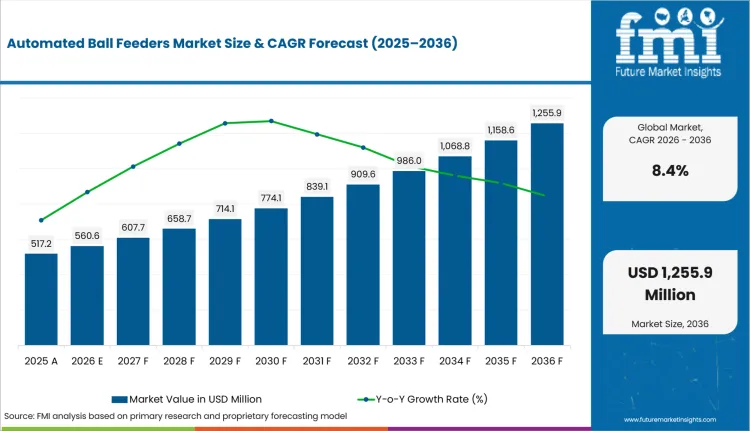
| Metric | Value |
|---|---|
| 2026 Market Size | USD 560.60 million |
| 2036 Market Size | USD 1,255.90 million |
| Forecast CAGR | 8.4% from 2026 to 2036 |
| Leading Mobility | Portable |
| Portable Share in 2026 | 52.2% |
| Leading Automation Level | Programmable |
| Programmable Share in 2026 | 46.5% |
| Leading CAGR Country | China |
| China CAGR | 10.2% by 2036 |
Summary of the Automated Ball Feeders Market
| Market Signal | Commercial Impact |
|---|---|
| Demand and Growth Drivers | Automated ball feeder demand is increasing as sports academies and clubs invest in technology to improve training efficiency and player development.
|
| Product and Segment View | Portable systems, programmable feeders, and tennis ball feeders lead the market.
|
| Geography and Growth Outlook | China and India are expected to remain key growth markets for automated ball feeders.
|
| Competitive Landscape | Competition is focused on portability, programmable training features, and multi-sport practice solutions.
|
| Analyst Perspective | Automated ball feeders are becoming performance-focused training systems rather than simple practice equipment.
— Nikhil Kaitwade, Principal Consultant, Industrial Automation, Future Market Insights |
Training-equipment adoption is being shaped by participation and connected product design. International tennis reporting placed global tennis participation at 106 million players in 2024. China’s national statistics office reported 2024 sports industry output of 3.8421 trillion yuan and value added of 1.6033 trillion yuan.
BOLA Manufacturing’s 2026 Pro Feeder update allows electronic feed-delay adjustment from 5 to 13 seconds, strengthening cricket academy use cases for timed solo batting sessions.Automated ball feeders demand is forecast to expand through 2036, supported by academy repetition work and service-led equipment buying.
Which factors support expansion in the Automated Ball Feeders Market?
Repeat drill consistency and service-linked product programs support market value across academies and home users.
- Market value rises as coaches need repeatable feeds for stroke correction and skill reinforcement across mixed ability groups.
- Portable units support adoption as clubs can test automated practice on one court before funding larger multi-court equipment plans.
- Tennis and cricket academies influence steady demand through lesson packages and coach-led equipment recommendations.
- Connected feeders promote premium demand as app control and remote shot selection make solo sessions easier for consumers and instructors.
Why is the Automated Ball Feeders Market growing?
High-repeat training increases feeder demand as coaches seek controlled repetition without assigning staff to manual ball delivery.
Automated ball feeder buyers spend more on guided machines as repeat sessions expose coaching labor gaps and setup delays. United States Tennis Association reported 616 million tennis play occasions in 2025, equal to 23 occasions per player on average. Repeated play supports feeder purchases across clubs and home courts, since buyers need machines that convert open practice windows into structured sessions. Suppliers able to pair portable machines with service guidance gain stronger acceptance in academy and consumer buying decisions.
How is the Automated Ball Feeders Market segmented?
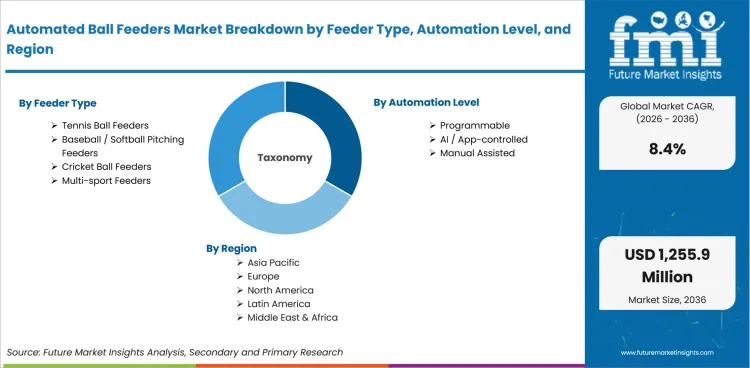
Automated Ball Feeders Market is segmented by feeder type, automation level, end use, mobility, and sales channel.
- Tennis ball feeders are projected to account for 42% share in 2026, influenced by strong machine availability and regular solo-practice use.
- Programmable feeders are expected to hold 46.5% share in 2026, shaped by buyer preference for stored drills and stable feed settings.
- Training academies are anticipated to account for 38.4% share in 2026, led by coach-managed repetition across junior and adult programs.
- Portable systems are projected to hold 52.2% share in 2026, guided by storage limits and shared court use across homes and clubs.
- Retail and e-commerce is expected to represent 38.6% share in 2026, supported by online comparison of speed and warranty.
Why do tennis ball feeders dominate the Automated Ball Feeders Market by feeder type?
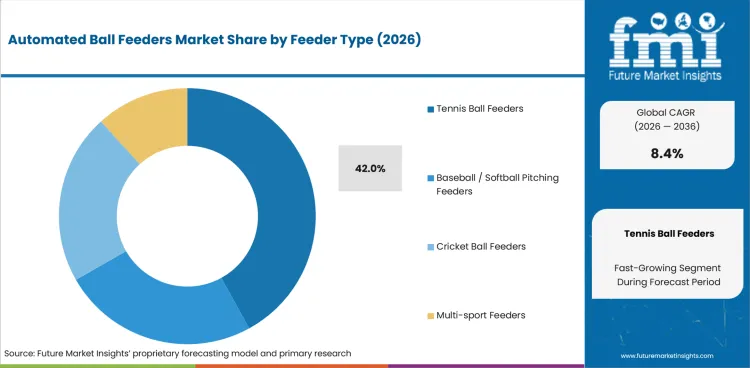
- Tennis ball feeders are projected to account for 42% share in 2026, driven by mature portable machine portfolios across clubs and home users.
- Baseball and softball pitching feeders gain demand as batting cages and schools add automatic releases to existing pitching-machine setups.
Which automation level leads the Automated Ball Feeders Market?
- Programmable feeders are expected to hold 46.5% share in 2026, shaped by stored drill patterns that remain easier to support than full sensor guidance.
- AI and app-controlled feeders gain use as premium academies and serious players seek mobile setup and session memory.
Which end use leads the Automated Ball Feeders Market?
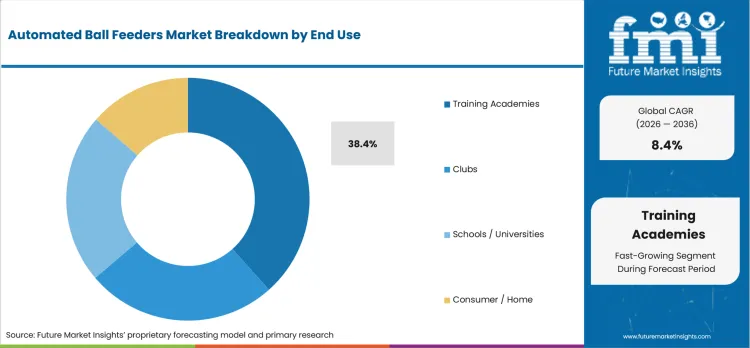
- Training academies are anticipated to account for 38.4% share in 2026, led by paid coaching programs requiring repeated feeds during group sessions.
- Clubs promote added demand as shared equipment improves court use between lessons and supports member practice packages.
Which mobility format leads the Automated Ball Feeders Market?
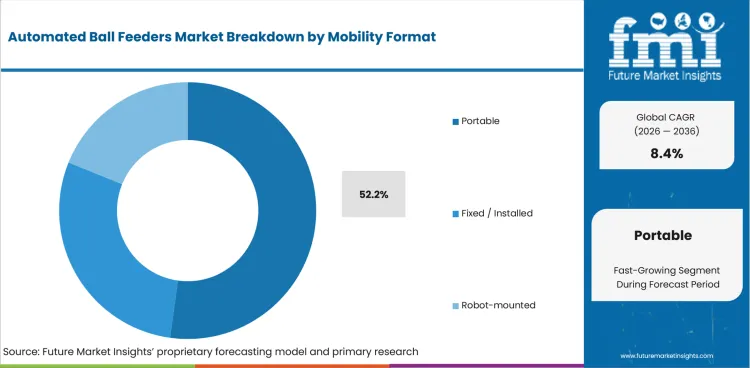
- Portable systems are projected to hold 52.2% share in 2026, reflected by mixed-use courts and demo-led academy selling.
- Fixed and installed systems remain active in batting cages and dedicated academy spaces that require frequent daily operation.
Which sales channel leads the Automated Ball Feeders Market?
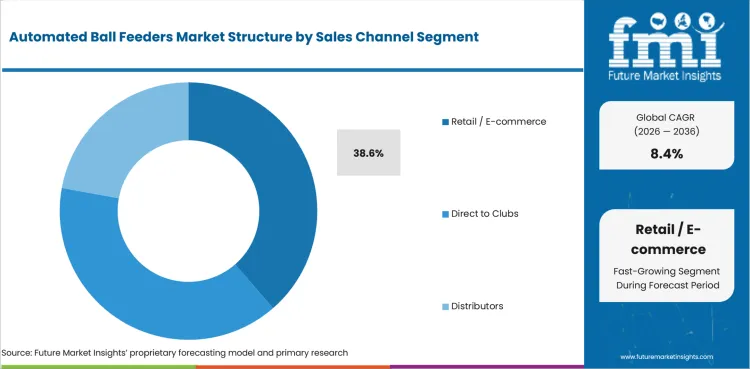
- Retail and e-commerce is expected to represent 38.6% share in 2026, guided by buyer comparison of feed rate and warranty.
- Direct-to-club selling remains active across academies and schools needing installation advice and post-sale support.
What are the drivers, restraints, and opportunities in the Automated Ball Feeders Market?
Sports training automation and service-led equipment programs are shaping automated ball feeder buying decisions.
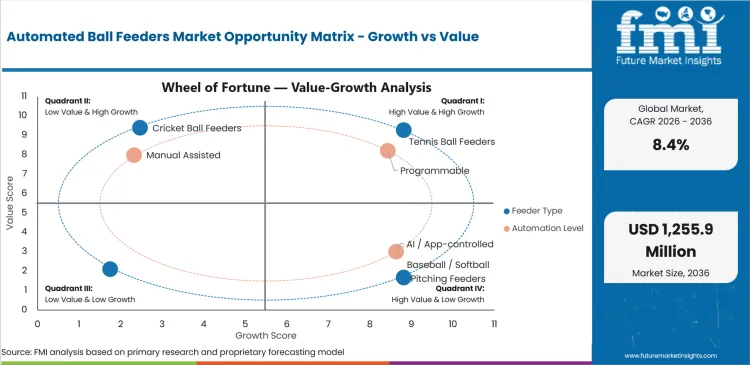
- Driver: Coach-led training programs need repeatable feeds before skill consistency can improve across mixed ability groups.
- Restraint: Premium connected feeders can face hesitation if battery service or sensor calibration adds support burden.
- Opportunity: App-guided practice programs can improve renewal demand as buyers request measurable drill variety and easier solo setup.
Repeat Practice Load Strengthens Machine Demand
Court and cage operators gain a clearer reason to adopt feeders as participation influences more demand for structured lessons and solo sessions. United States Tennis Association reported 27.3 million tennis players in 2025 after a 1.6 million player annual increase. Automated ball feeders help clubs handle more repetitions without assigning staff to every ball. Supplier portfolios proving stable feed timing and low downtime can translate participation depth into repeat equipment purchases.
Connected Support Burden Limits Premium Adoption
Advanced feeders face slower acceptance among budget-limited clubs if software support and battery service create extra work after purchase. Sport England’s latest adult activity release recorded 11.8 million inactive adults in England, showing uneven participation and cautious facility spending. Smaller clubs may delay premium smart machines until suppliers prove local repair access and simple app setup. Demo-led selling can reduce hesitation by showing stable operation on buyer-owned courts.
App-Guided Training Creates Expansion
Connected training creates a stronger opening for feeders that turn open court time into programmable sessions. South Korea’s Ministry of Culture, Sports and Tourism raised the sports R&D budget for AI adoption and digital transformation from KRW 800 million in 2025 to KRW 6.5 billion in 2026. App-led control raises commercial value as coaches adjust feeds without crossing the court. Suppliers can convert premium interest through reliable firmware support and clear drill libraries.
Which countries are growing in the Automated Ball Feeders Market?
China 10.2% CAGR, India 9.6% CAGR, South Korea 8.9% CAGR, United States 8.7% CAGR, United Kingdom 8.1% CAGR, France 7.9% CAGR, Germany 7.8% CAGR, and Japan 7.2% CAGR through 2036.
.webp "Top Country Growth Comparison Automated Ball Feeders Market Cagr (2026 2036)")
| Country | CAGR |
|---|---|
| China | 10.2% |
| India | 9.6% |
| South Korea | 8.9% |
| United States | 8.7% |
| United Kingdom | 8.1% |
| France | 7.9% |
| Germany | 7.8% |
| Japan | 7.2% |
Source: Future Market Insights, 2026.
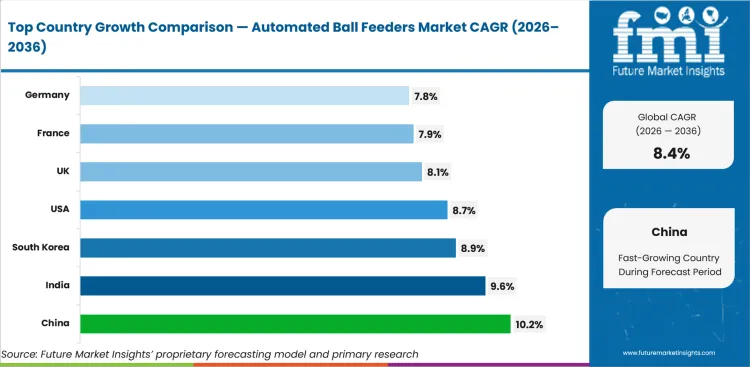
How do country-level CAGRs compare in the Automated Ball Feeders Market?
China leads country expansion while Japan records the most cautious pace among profiled markets.
- China is forecast to record 10.2% CAGR by 2036, supported by sports venue expansion and domestic smart training supply.
- India is forecast to record 9.6% CAGR by 2036, driven by cricket academy expansion and metro tennis programs.
- South Korea is forecast to record 8.9% CAGR by 2036, shaped by compact urban sport settings and premium service needs.
- United States is forecast to record 8.7% CAGR by 2036, reflected by tennis participation and baseball cage-practice demand.
- United Kingdom is forecast to record 8.1% CAGR by 2036, aligned to tennis and local feeder supply.
- France is forecast to record 7.9% CAGR by 2036, backed by licensed tennis participation and club coaching programs.
- Germany is forecast to record 7.8% CAGR by 2036, linked to member-club governance and specialist dealer influence.
- Japan is forecast to record 7.2% CAGR by 2036, guided by compact urban courts and reliability-led equipment choices.
How fast is the Automated Ball Feeders Market growing in China?
A 10.2% CAGR through 2036 reflects sports venue expansion and smart-equipment supply.
Country Market Snapshot Table
| Parameter | Value |
|---|---|
| Market Size in 2025 (Value) | USD 87.1 million |
| Market Size in 2026 (Value) | USD 96.0 million |
| Market Forecast in 2036 (Value) | USD 253.2 million |
| CAGR (2026 to 2036) | 10.2% |
| Years Considered | 2021 to 2036 |
| Base Year | 2025 |
| Forecast Period | 2026 to 2036 |
| Units Considered | Value (USD million) |
| Leading Sub-Region | Yangtze River Delta, Guangdong, Shanghai, and Beijing sports-equipment corridors |
China Automated Ball Feeders Market Outlook
- Sports venue buildout and domestic smart training equipment supply place China in a premium position for feeder adoption. Clubs and academies need programmable machines supporting repeat tennis and multi-sport drills.
- Buyers are expected to favor sellers combining Chinese-language support and quick field service. Domestic smart-sport brands can convert online discovery into product trials across urban training centers.
Key Growth Drivers
- Sports venue density creates feeder demo sites, backed by over 4.84 million sports venues in 2024 and over 3.03 million ball-game venues.
- Sports industry scale supports training equipment spending after national output reached 3.8421 trillion yuan in 2024.
- Domestic smart-equipment sellers can shorten online promotion cycles through app-led product launches and coach demonstrations.
- Urban clubs prefer programmable machines that support adult lessons and paid solo-practice periods.
Key Restraints
- Price competition can compress service quality if buyers compare smart feeders only by machine cost.
- Imported parts can raise repair delays for smaller academies outside tier-one cities.
- Consumer caution can slow premium upgrades, as retail sales of goods rose 3.8% in 2025 against careful discretionary spending patterns.
What makes China unique
China stands apart through sports venue density and domestic smart-equipment brands serving academies and home users.
Key Companies
- Pongbot
- Siboasi
- Double Fish Sports
- DHS Sports
- Decathlon China
Sales & Marketing Channels
- Specialist sports retailers
- Brand-owned online stores
- Academy demonstrations
- School and university equipment buying
- Coach-led referrals
- Distributor service partners
Country Segment Breakdown Table
| Segment | Sub-Segments |
|---|---|
| By Feeder Type | Tennis Ball Feeders · Baseball / Softball Pitching Feeders · Cricket Ball Feeders · Multi-sport Feeders |
| By Automation Level | Programmable · AI / App-controlled · Manual Assisted |
| By End Use | Training Academies · Clubs · Schools / Universities · Consumer / Home |
| By Mobility | Portable · Fixed / Installed · Robot-mounted |
| By Sales Channel | Retail / E-commerce · Direct to Clubs · Distributors |
| Key Sub-Regions Covered, Sports Corridors | Guangdong · Zhejiang · Shanghai · Beijing · Jiangsu · Shandong |
Frequently Asked Questions
How fast is China Automated Ball Feeders Market growing?
China automated ball feeders market is forecast to grow at 10.2% CAGR by 2036 as urban venues and smart sports devices support feeder trials.
Who leads China Automated Ball Feeders Market?
Pongbot, Siboasi, Double Fish Sports, DHS Sports, Decathlon China are important local manufacturers or channel participants across automated ball feeding equipment.
What is driving adoption in China Automated Ball Feeders Market?
China adoption is led by domestic smart-equipment promotion and coach demand for repeatable session control.
What is the Automated Ball Feeders Market outlook in India?
A 9.6% CAGR through 2036 reflects cricket academy expansion and metro tennis programs.
Country Market Snapshot Table
| Parameter | Value |
|---|---|
| Market Size in 2025 (Value) | USD 52.9 million |
| Market Size in 2026 (Value) | USD 58.0 million |
| Market Forecast in 2036 (Value) | USD 144.9 million |
| CAGR (2026 to 2036) | 9.6% |
| Years Considered | 2021 to 2036 |
| Base Year | 2025 |
| Forecast Period | 2026 to 2036 |
| Units Considered | Value (USD million) |
| Leading Sub-Region | Mumbai, Bengaluru, Delhi-NCR, Pune, and North-East academy corridors |
India Automated Ball Feeders Market Outlook
- Cricket batting practice and urban tennis coaching define India automated ball feeders demand. Academy buyers need reliable programmable delivery that can reduce manual ball feeding during paid sessions.
- Factories and sellers are expected to use demonstration-led sales, since coaches want proof on local balls and playing surfaces. Portable tennis units and cricket feeders can grow through dealer support across metro and academy corridors.
Key Growth Drivers
- Cricket infrastructure raises feeder visibility following BCCI’s inauguration of 6 indoor cricket academies across North-East India in April 2026.
- Institutional sports programs support academy equipment demand, with official reporting citing 1,045 Khelo India Centres and 306 accredited academies in August 2025.
- Metro tennis academies need portable programmable feeders for private coaching and repeatable junior drills.
- Sports-equipment dealers can explain bowling-machine feeders faster than general retailers through coach-led demonstrations.
Key Restraints
- Premium connected feeders can face price hesitation outside metro academies and established private clubs.
- Service gaps in smaller cities can delay repeat purchases if spare parts and trained technicians remain limited.
- Import competition keeps price pressure high, given India’s 2026 sports equipment strategy noted global sports-equipment exports of about USD 52 billion in 2024.
What makes India unique
India combines cricket feeder demand with tennis feeder demand across academies and metro clubs.
Key Companies
- KD Sports & Fitness
- Topspin India
- Stag International
- Sportsjam
- Decathlon India
Sales & Marketing Channels
- Specialist sports retailers
- Brand-owned online stores
- Academy demonstrations
- School and university equipment buying
- Coach-led referrals
- Distributor service partners
Country Segment Breakdown Table
| Segment | Sub-Segments |
|---|---|
| By Feeder Type | Tennis Ball Feeders · Baseball / Softball Pitching Feeders · Cricket Ball Feeders · Multi-sport Feeders |
| By Automation Level | Programmable · AI / App-controlled · Manual Assisted |
| By End Use | Training Academies · Clubs · Schools / Universities · Consumer / Home |
| By Mobility | Portable · Fixed / Installed · Robot-mounted |
| By Sales Channel | Retail / E-commerce · Direct to Clubs · Distributors |
| Key Sub-Regions Covered, Sports Corridors | Mumbai · Bengaluru · Delhi-NCR · Pune · Chennai · Guwahati |
Frequently Asked Questions
How fast is India Automated Ball Feeders Market growing?
India automated ball feeders market is forecast to grow at 9.6% CAGR by 2036 as cricket academies and metro tennis coaching create separate feeder lanes.
Who leads India Automated Ball Feeders Market?
KD Sports & Fitness, Topspin India, Stag International, Sportsjam, Decathlon India are important local manufacturers or channel participants across automated ball feeding equipment.
What is driving adoption in India Automated Ball Feeders Market?
India adoption is led by cricket batting practice and dealer-led trials across academy corridors.
What is the Automated Ball Feeders Market outlook in South Korea?
An 8.9% CAGR through 2036 reflects compact club layouts and premium training expectations.
Country Market Snapshot Table
| Parameter | Value |
|---|---|
| Market Size in 2025 (Value) | USD 27.5 million |
| Market Size in 2026 (Value) | USD 30.0 million |
| Market Forecast in 2036 (Value) | USD 70.4 million |
| CAGR (2026 to 2036) | 8.9% |
| Years Considered | 2021 to 2036 |
| Base Year | 2025 |
| Forecast Period | 2026 to 2036 |
| Units Considered | Value (USD million) |
| Leading Sub-Region | Seoul, Gyeonggi, Busan, and Daegu club-sport corridors |
South Korea Automated Ball Feeders Market Outlook
- Urban sports settings and quality-sensitive coaching programs guide South Korea automated ball feeders demand. Compact tennis and baseball practice spaces support programmable machines that can move quickly between sessions.
- Sellers are expected to compete on service access and product education along with speed. Premium buyers need Korean-language instructions and reliable parts support before upgrading.
Key Growth Drivers
- Regular sport participation supports feeder trials amid a 62.9% national sports participation rate in 2025 and a 2.2 percentage-point annual gain.
- Sports industry scale aids equipment channels; 2024 sports industry revenue reached KRW 84.7 trillion.
- Urban tennis clubs value compact machines that store quickly between lessons and member play.
- Baseball training centers create a secondary channel for automatic release units and cage equipment.
Key Restraints
- Imported machines can face service delays if local parts inventories remain thin.
- Premium app-controlled units require Korean-language onboarding and strong after-sales support before smaller clubs upgrade.
- Export-market softness can affect business sentiment, marked by annual exports to China falling 1.7% in 2025.
What makes South Korea unique
South Korea differs through compact urban sport settings and premium-service expectations around imported machines.
Key Companies
- Tennis Korea Shop
- Sports Korea
- Tennis Metro
- Decathlon Korea
- local baseball training suppliers
Sales & Marketing Channels
- Specialist sports retailers
- Brand-owned online stores
- Academy demonstrations
- School and university equipment buying
- Coach-led referrals
- Distributor service partners
Country Segment Breakdown Table
| Segment | Sub-Segments |
|---|---|
| By Feeder Type | Tennis Ball Feeders · Baseball / Softball Pitching Feeders · Cricket Ball Feeders · Multi-sport Feeders |
| By Automation Level | Programmable · AI / App-controlled · Manual Assisted |
| By End Use | Training Academies · Clubs · Schools / Universities · Consumer / Home |
| By Mobility | Portable · Fixed / Installed · Robot-mounted |
| By Sales Channel | Retail / E-commerce · Direct to Clubs · Distributors |
| Key Sub-Regions Covered, Sports Corridors | Seoul · Gyeonggi · Busan · Daegu · Incheon · Daejeon |
Frequently Asked Questions
How fast is South Korea Automated Ball Feeders Market growing?
South Korea automated ball feeders market is forecast to grow at 8.9% CAGR by 2036 as compact clubs favor portable machines with strong service access.
Who leads South Korea Automated Ball Feeders Market?
Tennis Korea Shop, Sports Korea, Tennis Metro, Decathlon Korea, local baseball training suppliers are important local manufacturers or channel participants across automated ball feeding equipment.
What is driving adoption in South Korea Automated Ball Feeders Market?
South Korea adoption is guided by quality-sensitive coaches and localized support for premium imported feeders.
How is the Automated Ball Feeders Market performing in the United States?
An 8.7% CAGR through 2036 reflects tennis participation and baseball cage-practice demand.
Country Market Snapshot Table
| Parameter | Value |
|---|---|
| Market Size in 2025 (Value) | USD 151.8 million |
| Market Size in 2026 (Value) | USD 165.0 million |
| Market Forecast in 2036 (Value) | USD 379.8 million |
| CAGR (2026 to 2036) | 8.7% |
| Years Considered | 2021 to 2036 |
| Base Year | 2025 |
| Forecast Period | 2026 to 2036 |
| Units Considered | Value (USD million) |
| Leading Sub-Region | California, Florida, Texas, Southeast baseball cages, and New York club corridors |
United States Automated Ball Feeders Market Outlook
- Tennis clubs, home courts, baseball programs, and softball training centers support United States automated ball feeders demand. Multiple sport pathways create a wider equipment base than tennis-only countries.
- Direct online channels are expected to remain important as consumers compare warranty terms and battery life. Clubs still need demonstrations before approving higher-priced programmable units.
Key Growth Drivers
- Tennis feeder demand is reinforced by USTA reporting 27.3 million tennis players in 2025 after a 1.6 million player annual increase.
- School sports strengthen baseball and softball channels, as NFHS recorded 8,260,891 high-school sports participants in the 2024-25 school year.
- Brand-owned online stores help home users compare feed rate and session-control functions.
- Batting cages support automatic feeder attachments that work with existing pitching-machine fleets.
Key Restraints
- Premium AI feeders face support risk if app onboarding or calibration fails during club sessions.
- School and club buyers can delay purchases if maintenance budgets focus on core field and facility needs.
- Discretionary equipment budgets face scrutiny, considering BLS reported average 2024 household spending of USD 225 on sports and exercise equipment.
What makes United States unique
United States has a rare overlap between tennis ball machines and baseball or softball pitching feeders.
Key Companies
- Lobster Sports
- Sports Tutor
- JUGS Sports
- ATEC Sports
- Heater Sports
- Hydrogen Sports
Sales & Marketing Channels
- Specialist sports retailers
- Brand-owned online stores
- Academy demonstrations
- School and university equipment buying
- Coach-led referrals
- Distributor service partners
Country Segment Breakdown Table
| Segment | Sub-Segments |
|---|---|
| By Feeder Type | Tennis Ball Feeders · Baseball / Softball Pitching Feeders · Cricket Ball Feeders · Multi-sport Feeders |
| By Automation Level | Programmable · AI / App-controlled · Manual Assisted |
| By End Use | Training Academies · Clubs · Schools / Universities · Consumer / Home |
| By Mobility | Portable · Fixed / Installed · Robot-mounted |
| By Sales Channel | Retail / E-commerce · Direct to Clubs · Distributors |
| Key Sub-Regions Covered, Sports Corridors | California · Florida · Texas · New York · Southeast · Midwest |
Frequently Asked Questions
How fast is United States Automated Ball Feeders Market growing?
United States automated ball feeders market is forecast to grow at 8.7% CAGR by 2036 as tennis participation and batting-cage routines support multi-sport feeder sales.
Who leads United States Automated Ball Feeders Market?
Lobster Sports, Sports Tutor, JUGS Sports, ATEC Sports, Heater Sports, Hydrogen Sports are important local manufacturers or channel participants across automated ball feeding equipment.
What is driving adoption in United States Automated Ball Feeders Market?
United States adoption is led by tennis clubs and direct online comparison of machine specifications.
What is the Automated Ball Feeders Market outlook in the United Kingdom?
An 8.1% CAGR through 2036 reflects tennis and cricket club equipment demand.
Country Market Snapshot Table
| Parameter | Value |
|---|---|
| Market Size in 2025 (Value) | USD 40.7 million |
| Market Size in 2026 (Value) | USD 44.0 million |
| Market Forecast in 2036 (Value) | USD 95.9 million |
| CAGR (2026 to 2036) | 8.1% |
| Years Considered | 2021 to 2036 |
| Base Year | 2025 |
| Forecast Period | 2026 to 2036 |
| Units Considered | Value (USD million) |
| Leading Sub-Region | London, Midlands, North West, Scotland, and county cricket corridors |
United Kingdom Automated Ball Feeders Market Outlook
- Tennis clubs, padel interest, cricket academies, and indoor practice guide United Kingdom automated ball feeders demand. BOLA gives cricket buyers a local feeder connection alongside imported tennis machines.
- Dealer support will shape adoption across small clubs and schools. Buyers are expected to prefer portable units that handle storage limits and multi-use spaces.
Key Growth Drivers
- Tennis club demand draws on LTA’s annual adult tennis participation of 5.8 million in summer 2025.
- School-sport equipment interest benefits from 49.1% of children and young people meeting activity guidelines in 2024-25.
- Cricket academies create a feeder route through BOLA bowling-machine and feeder portfolios.
- Specialist distributors support clubs needing demos and weather-suitable portable equipment.
Key Restraints
- Outdoor weather reduces year-round use for some consumer and small-club buyers.
- Shared club machines can face maintenance pressure across busy coaching schedules and school use.
- Capital constraints remain important, since grassroots facility programs must spread £400 million across multi-sport community needs.
What makes United Kingdom unique
United Kingdom stands out through a local cricket feeder supplier alongside tennis and padel demand.
Key Companies
- BOLA Manufacturing
- Net World Sports
- Slinger Bag UK
- Durant Cricket
- Tennis-Point UK
Sales & Marketing Channels
- Specialist sports retailers
- Brand-owned online stores
- Academy demonstrations
- School and university equipment buying
- Coach-led referrals
- Distributor service partners
Country Segment Breakdown Table
| Segment | Sub-Segments |
|---|---|
| By Feeder Type | Tennis Ball Feeders · Baseball / Softball Pitching Feeders · Cricket Ball Feeders · Multi-sport Feeders |
| By Automation Level | Programmable · AI / App-controlled · Manual Assisted |
| By End Use | Training Academies · Clubs · Schools / Universities · Consumer / Home |
| By Mobility | Portable · Fixed / Installed · Robot-mounted |
| By Sales Channel | Retail / E-commerce · Direct to Clubs · Distributors |
| Key Sub-Regions Covered, Sports Corridors | London · Midlands · North West · Scotland · Wales · South East |
Frequently Asked Questions
How fast is United Kingdom Automated Ball Feeders Market growing?
United Kingdom automated ball feeders market is expected to expand at 8.1% CAGR by 2036, driven by tennis and cricket clubs expanding practice equipment use.
Who leads United Kingdom Automated Ball Feeders Market?
BOLA Manufacturing, Net World Sports, Slinger Bag UK, Durant Cricket, Tennis-Point UK are important local manufacturers or channel participants across automated ball feeding equipment.
What is driving adoption in United Kingdom Automated Ball Feeders Market?
United Kingdom adoption is led by portable tennis machines and dealer support for small-club buyers.
What is driving Automated Ball Feeders Market growth in France?
A 7.9% CAGR through 2036 reflects licensed tennis participation and club coaching programs.
Country Market Snapshot Table
| Parameter | Value |
|---|---|
| Market Size in 2025 (Value) | USD 36.1 million |
| Market Size in 2026 (Value) | USD 39.0 million |
| Market Forecast in 2036 (Value) | USD 83.4 million |
| CAGR (2026 to 2036) | 7.9% |
| Years Considered | 2021 to 2036 |
| Base Year | 2025 |
| Forecast Period | 2026 to 2036 |
| Units Considered | Value (USD million) |
| Leading Sub-Region | Paris Region, Auvergne-Rhone-Alpes, Occitanie, and club tennis corridors |
France Automated Ball Feeders Market Outlook
- Club tennis, padel activity, and coaching programs define France automated ball feeders demand. Portable machines can support junior lessons and adult practice across club networks.
- Retailers and specialist tennis shops are expected to remain important as clubs need demos and service confidence. Buyers are expected to prefer programmable machines that simplify feed patterns for group coaching.
Key Growth Drivers
- Licensed participation supports feeder demand, reflected in FFT materials listing 1,169,834 license holders for the 2024 sporting year.
- Multi-racket momentum supports practice tools, alongside FFT communications citing over 1.2 million license holders in 2025.
- Coaching-led club culture favors repeatable feeds for junior programs and adult lessons.
- Specialty tennis sellers can link product demonstrations with after-sales support across club networks.
Key Restraints
- Padel court upgrades can compete with premium tennis feeder budgets across some clubs.
- Imported premium machines face price resistance if warranty terms and parts access are unclear.
- Club investment can slow if equipment budgets compete with facility renewal, under EU pressure shown by 2026 clothing and textile imports of EUR 122 billion.
What makes France unique
France combines licensed tennis scale with a club system that turns coaching needs into equipment orders.
Key Companies
- Decathlon France
- Tennis Achat
- Extreme Tennis
- Tennis Warehouse Europe
- Sports System France
Sales & Marketing Channels
- Specialist sports retailers
- Brand-owned online stores
- Academy demonstrations
- School and university equipment buying
- Coach-led referrals
- Distributor service partners
Country Segment Breakdown Table
| Segment | Sub-Segments |
|---|---|
| By Feeder Type | Tennis Ball Feeders · Baseball / Softball Pitching Feeders · Cricket Ball Feeders · Multi-sport Feeders |
| By Automation Level | Programmable · AI / App-controlled · Manual Assisted |
| By End Use | Training Academies · Clubs · Schools / Universities · Consumer / Home |
| By Mobility | Portable · Fixed / Installed · Robot-mounted |
| By Sales Channel | Retail / E-commerce · Direct to Clubs · Distributors |
| Key Sub-Regions Covered, Sports Corridors | Paris Region · Auvergne-Rhone-Alpes · Occitanie · Nouvelle-Aquitaine · Hauts-de-France · Grand Est |
Frequently Asked Questions
How fast is France Automated Ball Feeders Market growing?
France automated ball feeders market is anticipated to scale at 7.9% CAGR by 2036 due to licensed tennis clubs using feeders for junior and adult coaching.
Who leads France Automated Ball Feeders Market?
Decathlon France, Tennis Achat, Extreme Tennis, Tennis Warehouse Europe, Sports System France are important local manufacturers or channel participants across automated ball feeding equipment.
What is driving adoption in France Automated Ball Feeders Market?
What is the Automated Ball Feeders Market forecast for Germany?
A 7.8% CAGR through 2036 reflects member clubs and specialist dealer influence.
Country Market Snapshot Table
| Parameter | Value |
|---|---|
| Market Size in 2025 (Value) | USD 47.3 million |
| Market Size in 2026 (Value) | USD 51.0 million |
| Market Forecast in 2036 (Value) | USD 108.2 million |
| CAGR (2026 to 2036) | 7.8% |
| Years Considered | 2021 to 2036 |
| Base Year | 2025 |
| Forecast Period | 2026 to 2036 |
| Units Considered | Value (USD million) |
| Leading Sub-Region | North Rhine-Westphalia, Bavaria, Baden-Wurttemberg, and club-tennis corridors |
Germany Automated Ball Feeders Market Outlook
- Member clubs, tennis schools, and specialty dealers guide Germany automated ball feeders demand. Buyers place higher value on service reliability and proven durability.
- Committee-led buying favors machines with clear warranty terms and demonstrations. Portable tennis feeders can gain preference if dealers support training and parts availability.
Key Growth Drivers
- Club density supports shared equipment demand, indicated by more than 1.5 million tennis members across 18 state associations.
- European tennis density supports product trials, underpinned by 27.9 million players across Europe in 2024.
- Junior training programs favor programmable feeders during group coaching and technique repetition.
- Distributor-led selling supports buyers needing demonstrations and warranty guidance before purchase.
Key Restraints
- Committee-led club buying can lengthen replacement cycles for premium machines.
- Connected feeders require local-language support and clear repair routes before smaller clubs upgrade.
- Macroeconomic caution can slow discretionary sport-equipment purchases, against a price-adjusted GDP rise of only 0.2% in 2025 reported by Destatis.
What makes Germany unique
Germany differs through member-club governance and a specialist dealer base that shapes training-equipment purchases.
Key Companies
- Spinshot Sports Germany
- Tennis-Point
- Tennis Peters
- Sportega Germany
- Decathlon Germany
Sales & Marketing Channels
- Specialist sports retailers
- Brand-owned online stores
- Academy demonstrations
- School and university equipment buying
- Coach-led referrals
- Distributor service partners
Country Segment Breakdown Table
| Segment | Sub-Segments |
|---|---|
| By Feeder Type | Tennis Ball Feeders · Baseball / Softball Pitching Feeders · Cricket Ball Feeders · Multi-sport Feeders |
| By Automation Level | Programmable · AI / App-controlled · Manual Assisted |
| By End Use | Training Academies · Clubs · Schools / Universities · Consumer / Home |
| By Mobility | Portable · Fixed / Installed · Robot-mounted |
| By Sales Channel | Retail / E-commerce · Direct to Clubs · Distributors |
| Key Sub-Regions Covered, Sports Corridors | North Rhine-Westphalia · Bavaria · Baden-Wurttemberg · Hesse · Lower Saxony · Hamburg |
Frequently Asked Questions
How fast is Germany Automated Ball Feeders Market growing?
Germany automated ball feeders market is likely to rise at 7.8% CAGR by 2036, led by member clubs and specialist dealers shaping equipment choices.
Who leads Germany Automated Ball Feeders Market?
Spinshot Sports Germany, Tennis-Point, Tennis Peters, Sportega Germany, Decathlon Germany are important local manufacturers or channel participants across automated ball feeding equipment.
What is driving adoption in Germany Automated Ball Feeders Market?
Germany adoption is led by German-language service expectations and durable portable feeder preferences.
What is the Automated Ball Feeders Market forecast for Japan?
A 7.2% CAGR through 2036 reflects compact urban clubs and reliability-led equipment choices.
Country Market Snapshot Table
| Parameter | Value |
|---|---|
| Market Size in 2025 (Value) | USD 43.8 million |
| Market Size in 2026 (Value) | USD 47.0 million |
| Market Forecast in 2036 (Value) | USD 94.2 million |
| CAGR (2026 to 2036) | 7.2% |
| Years Considered | 2021 to 2036 |
| Base Year | 2025 |
| Forecast Period | 2026 to 2036 |
| Units Considered | Value (USD million) |
| Leading Sub-Region | Tokyo, Osaka, Aichi, Kanto, and Kansai urban-sport corridors |
Japan Automated Ball Feeders Market Outlook
- Compact courts, school sport programs, and premium consumer expectations define Japan automated ball feeders demand. Buyers need predictable feed timing and easy storage.
- Sellers are expected to compete through reliability and localized support. Portable machines with clear instructions and careful service backing can gain preference in urban clubs.
Key Growth Drivers
- Urban sport participation supports compact practice tools, measured by Tokyo’s 68.9% sports participation rate from a November 2024 resident survey.
- Sports-life research supports equipment planning through a 2024 national survey of 3,000 adults across 300 locations.
- Schools and academies need safe, easy-to-supervise machines for junior practice.
- Premium consumers value predictable feed timing and accessible parts support.
Key Restraints
- Mature urban markets can limit replacement demand compared with younger academy markets.
- Imported machines can face support delays if parts and documentation are not localized.
- Age structure affects active-sport demand, according to Japan’s 36,243 thousand residents aged 65 and over in 2024.
What makes Japan unique
Japan favors compact quiet operation and premium service expectations for training products.
Key Companies
- KPI Tennis
- Tennis365 Japan
- Rakuten Sports sellers
- Yodobashi Camera
- Decathlon Japan
- Sales & Marketing Channels
Specialist sports retailers
- Brand-owned online stores
- Academy demonstrations
- School and university equipment buying
- Coach-led referrals
- Distributor service partners
Country Segment Breakdown Table
| Segment | Sub-Segments |
|---|---|
| By Feeder Type | Tennis Ball Feeders · Baseball / Softball Pitching Feeders · Cricket Ball Feeders · Multi-sport Feeders |
| By Automation Level | Programmable · AI / App-controlled · Manual Assisted |
| By End Use | Training Academies · Clubs · Schools / Universities · Consumer / Home |
| By Mobility | Portable · Fixed / Installed · Robot-mounted |
| By Sales Channel | Retail / E-commerce · Direct to Clubs · Distributors |
| Key Sub-Regions Covered, Sports Corridors | Tokyo · Osaka · Aichi · Kanagawa · Hyogo · Fukuoka |
Frequently Asked Questions
How fast is Japan Automated Ball Feeders Market growing?
Japan automated ball feeders market is anticipated to increase at 7.2% CAGR by 2036, influenced by compact courts and quiet-machine preferences guiding product selection.
Who leads Japan Automated Ball Feeders Market?
KPI Tennis, Tennis365 Japan, Rakuten Sports sellers, Yodobashi Camera, Decathlon Japan are important local manufacturers or channel participants across automated ball feeding equipment.
What is driving adoption in Japan Automated Ball Feeders Market?
Japan adoption is guided by urban storage limits and localized documentation for imported machines.
Who are the leading companies in the Automated Ball Feeders Market?
Lobster Sports, Spinshot Sports, Sports Tutor, Slinger, JUGS Sports, ATEC Sports, Heater Sports, BOLA Manufacturing, Hydrogen Sports, and Pongbot.
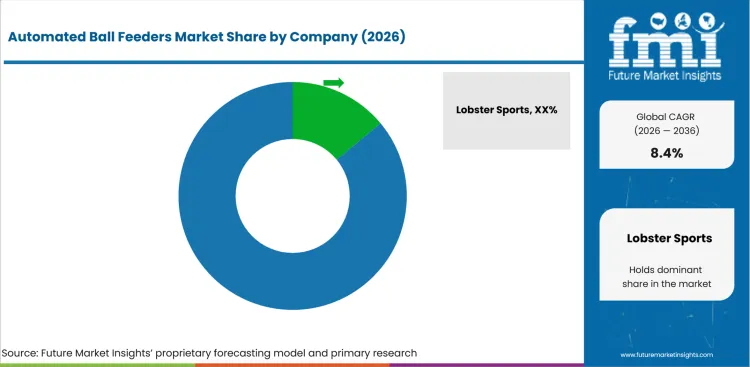
- Tennis feeder specialists hold an advantage through portable design and direct online channels.
- Baseball and softball suppliers gain buyer trust through feeder attachments working with pitching machines and cage-practice routines.
- Cricket feeder companies build value through timed delivery and academy-specific service knowledge.
- Smart feeder suppliers compete depending on drill customization and support that reduces setup delays for coaches.
Automated ball feeder suppliers compete by combining sport-specific machines and service programs. Lobster Sports has a strong position through portable tennis feeder portfolios and club familiarity. Spinshot Sports competes through app-linked drills and remote control. Sports Tutor and Slinger hold value across club and home-user channels.
Sport-specific service depth has become a stronger competitive separator as buyers move beyond basic ball delivery. JUGS Sports and ATEC Sports compete through baseball and softball feeder compatibility. BOLA Manufacturing strengthens cricket feeder competition through timed bowling-machine delivery. Buyers compare supplier performance through battery reliability and local support records.
Smaller and regional suppliers can win through local coaching relationships and faster field support. China, India, and South Korea create opportunities for sellers operating demonstrations and trained service partners. United States and Europe create stronger demand for portable machines suited to club and home use. Companies proving lower setup time across changing drill sessions should gain more durable buyer relationships.
How do top Automated Ball Feeders companies compare?
Lobster Sports and Spinshot Sports score on tennis feeder depth while JUGS Sports and BOLA Manufacturing lead through sport-specific feeder capability.
| Company | Relevance to Market Title | Machine Portfolio Depth | Feeder Service Strength | Automation Support | Channel Reach | Geographic Footprint |
|---|---|---|---|---|---|---|
| Lobster Sports | Very High | Very Strong | Strong | Strong | Very Strong | North America and international dealers |
| Spinshot Sports | Very High | Strong | Strong | Very Strong | Strong | Global online and distributors |
| Sports Tutor | High | Strong | Strong | Moderate | Strong | United States and international dealers |
| Slinger | High | Moderate | Moderate | Moderate | Strong | North America and Europe |
| JUGS Sports | Very High | Very Strong | Strong | Moderate | Strong | United States and international baseball channels |
| ATEC Sports | High | Strong | Strong | Moderate | Moderate | United States and baseball channels |
| BOLA Manufacturing | Very High | Strong | Strong | Strong | Strong | United Kingdom and cricket markets |
| Hydrogen Sports | High | Moderate | Moderate | Very Strong | Strong | United States and online channels |
| Pongbot | High | Strong | Moderate | Very Strong | Strong | China and international online channels |
Source: Future Market Insights competitive analysis, 2026.
Who are the key players in the Automated Ball Feeders Market?
Lobster Sports, Spinshot Sports and JUGS Sports are listed with BOLA Manufacturing and Hydrogen Sports among other suppliers.
Key global companies leading the Automated Ball Feeders Market include:
- Lobster Sports
- Spinshot Sports
- Sports Tutor
- Slinger
- JUGS Sports
- ATEC Sports
- Heater Sports
- BOLA Manufacturing
- Hydrogen Sports
- Pongbot
Key Developments in Automated Ball Feeders Market
- In 2026, BOLA Manufacturing updated its Pro Feeder with electronic control from the machine panel and adjustable delivery delay from 5 to 13 seconds.
- In June 2026, Hydrogen Sports app materials added Coach mode on Apple Watch and improved calibration for Proton and Electron users.
- In May 2026, Pongbot’s Pace Series campaign described an AI-powered tennis robot with position-aware sensing, app control, 300+ drills, and 150-ball capacity.
Key Players in the Automated Ball Feeders Market
Tennis Feeder Specialists
- Lobster Sports
- Spinshot Sports
- Sports Tutor
- Slinger
- Hydrogen Sports
- Pongbot
Baseball and Softball Feeder Specialists
- JUGS Sports
- ATEC Sports
- Heater Sports
Cricket and Academy Feeder Specialists
- BOLA Manufacturing
- KD Sports & Fitness
- Topspin India
Automated Ball Feeders Market - Scope & Definition
| Attribute | Detail |
|---|---|
| Market Definition | Training machines and automated units used to deliver tennis balls, baseballs, softballs, cricket balls, or multi-sport balls at controlled intervals for repeat practice |
| Functions Covered | Ball loading, timed feed delivery, oscillation, programmable shot patterns, app control, feed-speed control, remote operation, and portable practice setup |
| Applications Covered | Tennis stroke practice, baseball batting cages, softball hitting drills, cricket batting practice, school sport sessions, academy coaching, and home training |
| End-Use Industries | Training academies, clubs, schools, universities, consumer home users, cricket coaching centers, baseball facilities, and multi-sport training centers |
| Grades Covered | Manual assisted feeders, programmable feeders, app-controlled machines, premium smart feeders, fixed feeders, portable systems, and robot-mounted units |
| Inclusions | All commercially traded automated ball feeders across feeder type, automation level, end use, mobility, sales channel, and country-level training use |
| Exclusions | Manual baskets, ball carts, standard nets, rebound walls, handheld throwers, ball collectors, coaching apps without equipment, and venue automation unrelated to ball delivery |
Automated Ball Feeders Market - Research Methodology
| Method | Description |
|---|---|
| Primary Research | FMI analyst interviews with tennis academies, cricket coaching centers, baseball training facilities, school athletic departments, clubs, online dealers, and sports equipment distributors across selected markets |
| Desk Research | Review of federation participation signals, sports infrastructure data, official company product information, verified equipment portfolios, and country-level training indicators |
| Market Sizing & Forecasting | Bottom-up equipment revenue approach using feeder shipment estimates, average system pricing, sport-specific use rates, country-level participation signals, and channel structure |
| Data Validation | Cross-verification using company portfolios, official sports data, academy expansion indicators, e-commerce availability, dealer feedback, and country-level sports equipment exposure |
Automated Ball Feeders Market - Report Scope
| Parameter | Details |
|---|---|
| Forecast period | 2026 to 2036 |
| Historical period | 2021 to 2025 |
| Quantitative unit | Revenue in USD million |
| By feeder type | Tennis Ball Feeders, Baseball / Softball Pitching Feeders, Cricket Ball Feeders, Multi-sport Feeders |
| By automation level | Programmable, AI / App-controlled, Manual Assisted |
| By end use | Training Academies, Clubs, Schools / Universities, Consumer / Home |
| By mobility | Portable, Fixed / Installed, Robot-mounted |
| By sales channel | Retail / E-commerce, Direct to Clubs, Distributors |
| Regions covered | North America, Latin America, Europe, East Asia, South Asia and Pacific, Middle East and Africa |
| Countries covered | China, India, South Korea, United States, United Kingdom, France, Germany, Japan |
| Key companies profiled | Lobster Sports, Spinshot Sports, Sports Tutor, Slinger, JUGS Sports, ATEC Sports, Heater Sports, BOLA Manufacturing, Hydrogen Sports, Pongbot |
| Approach | Bottom-up equipment revenue approach using machine shipments, average system pricing, installation support share, channel mix, and country-level sports training exposure |
Source: Future Market Insights competitive analysis, 2026.
Automated Ball Feeders Market Breakdown by Feeder Type, Automation Level, End Use, Mobility, Sales Channel, and Region
Automated Ball Feeders Market Segmented by Feeder Type
- Tennis Ball Feeders
- Baseball / Softball Pitching Feeders
- Cricket Ball Feeders
- Multi-sport Feeders
Automated Ball Feeders Market Segmented by Automation Level
- Programmable
- AI / App-controlled
- Manual Assisted
Automated Ball Feeders Market Segmented by End Use
- Training Academies
- Clubs
- Schools / Universities
- Consumer / Home
Automated Ball Feeders Market Segmented by Mobility
- Portable
- Fixed / Installed
- Robot-mounted
Automated Ball Feeders Market Segmented by Sales Channel
- Retail / E-commerce
- Direct to Clubs
- Distributors
Automated Ball Feeders Market by Region
- North America
- Latin America
- Europe
- East Asia
- South Asia and Pacific
- Middle East and Africa
Research Sources and Bibliography
- ATEC Sports. (2026). Bucket Feeder.
- Board of Control for Cricket in India. (2026, April 28). Hon’ble Prime Minister Shri Narendra Modi inaugurates six BCCI indoor cricket academies across North-East India.
- BOLA Manufacturing. (2026). New Professional Bowling Machine and Pro Feeder.
- Bureau of Labor Statistics. (2026, January 5). The New Year and household spending.
- China State Council. (2025, March 19). China’s per capita sports venue area reaches 3 sq m in 2024.
- Department for Culture, Media and Sport. (2025). Grassroots sports facilities investment statement.
- Fédération Française de Tennis. (2025). Statistical materials for 2024 sporting year and 2025 license-holder communications.
- Hydrogen Sports. (2026, June 6). Hydrogen Sports app for Proton and Electron machines.
- International Tennis Federation. (2024, November). Global Tennis Report 2024.
- JUGS Sports. (2026). JUGS Carousel Feeder.
- Lawn Tennis Association. (2026, May 20). LTA Annual Report and Accounts show growth of tennis and padel in 2025.
- Ministry of Culture, Sports and Tourism, Republic of Korea. (2026, January 12). Sports industry revenue for 2024 reaches KRW 84.7 trillion.
- Ministry of Trade, Industry and Energy, Republic of Korea. (2026, January 2). Korea’s annual exports reach new highs in 2025.
- National Bureau of Statistics of China. (2026, January 8). Announcement on total scale and value-added data of national sports industry in 2024.
- National Bureau of Statistics of China. (2026, January 20). Total Retail Sales of Consumer Goods in December 2025.
- National Federation of State High School Associations. (2025, September 9). Participation in high school sports hits record high with sizable increase in 2024-25.
- NITI Aayog. (2026, March). Realising the Export Potential of India’s Sports Equipment Manufacturing Sector.
- Pongbot Sports. (2026, May 21). Pace Series AI-powered tennis robot campaign.
- Press Information Bureau. (2025, August 28). Khelo India achievements and infrastructure project progress.
- Press Information Bureau. (2026, February 1). Union Budget 2026-27 announces launch of Khelo India Mission.
- Sasakawa Sports Foundation. (2024, December). The 2024 SSF National Sports-Life Survey.
- Sport England. (2026, April 23). Active Lives Adult Survey November 2024-25 Report.
- Sport England. (2025, December). Active Lives Children and Young People Survey: Academic year 2024-25 report.
- Tokyo Metropolitan Government. (2025, January 24). Results of surveys on Tokyo residents’ involvement in sports activities.
- United States Tennis Association. (2026, February). 2026 USA Tennis Participation Report.
- German Federal Statistical Office. (2026, January 15). Gross domestic product up 0.2% in 2025.
This bibliography is provided for reader reference and is not exhaustive. The full report contains the complete reference list and detailed citations.
This Report Answers
- Market size estimates for 2026 and forecasts through 2036 for the Automated Ball Feeders Market.
- Insights across regional and country-level automated sports training equipment markets.
- Analysis of demand drivers and purchasing behavior across academies and home users.
- Evaluation of feeder types, automation levels, end uses, mobility formats, and sales channels.
- Assessment of tennis and softball training requirements.
- Identification of opportunities across programmable feeders and app-controlled training machines.
- Evaluation of retail and distributor-led machinery channels.
- Country-level analysis covering China, India, South Korea, United States, United Kingdom, France, Germany, and Japan.
- Assessment of competition, including tennis feeder specialists and cricket feeder manufacturers.
- Analysis of buyer decision drivers including portability and app support.
- Regional outlooks across North America, Europe, East Asia, South Asia and Pacific, Latin America, and Middle East and Africa.
- Delivery of market data, forecasts, and supporting analysis in report-ready format.
Frequently Asked Questions
What is the growth prospect for automated ball feeders?
Demand for automated ball feeders is expected to rise at a considerable pace as academies and clubs automate repeat practice sessions and reduce manual ball-feeding labor.
Which companies are expected to shape the automated ball feeders market?
Lobster Sports, Spinshot Sports, Sports Tutor, JUGS Sports, BOLA Manufacturing, Hydrogen Sports, and Pongbot are expected to shape market competition due to machine portfolios and service support.
Why are sports equipment companies investing in automated ball feeders?
Sports equipment companies are investing in automated ball feeders to support coaches managing repeat practice and solo training sessions.
Why are retail and e-commerce sales channels important in the automated ball feeders market?
Retail and e-commerce channels support adoption by helping consumer buyers compare weight and warranty terms.
Which feeder formats are gaining attention in automated ball feeders?
Tennis ball feeders and cricket ball feeders are gaining attention as clubs and academies target repeatable training without manual feeding support.
How does sports training automation influence automated ball feeder demand?
Sports training automation influences demand through controlled repetition and higher use of paid practice windows.
Why is mobility important for automated ball feeders?
Mobility is important since shared courts and school programs need machines that can be stored and moved quickly.
What role does programmable automation play in automated ball feeder adoption?
automation
Preview the report firsthand - request a free sample
Get SampleGet the brochure for pricing and purchase details.
Get PDFTable of Content
- Key Takeaways
- Market Size and CAGR
- Top Growth Driver
- Fastest Growing Segment
- Leading Region
- Key Companies
- Emerging Opportunities
- Executive Summary
- Global Market Outlook
- Demand-side Trends
- Supply-side Trends
- Technology Roadmap Analysis
- Analysis and Recommendations
- Analyst Perspective (What is happening? Why now? What should investors know?)
- Key Questions Answered
- How large is the market?
- What is the CAGR?
- What are key trends?
- Which region dominates?
- Who are the leaders?
- Market Overview
- Market Coverage / Taxonomy
- Market Definition / Scope / Limitations
- Research Methodology
- Chapter Orientation
- Analytical Lens and Working Hypotheses
- Market Structure, Signals, and Trend Drivers
- Benchmarking and Cross-market Comparability
- Market Sizing, Forecasting, and Opportunity Mapping
- Research Design and Evidence Framework
- Desk Research Programme (Secondary Evidence)
- Expert Input and Fieldwork (Primary Evidence)
- Tooling, Models, and Reference Databases
- Data Engineering and Model Build
- Quality Assurance and Audit Trail
- Market Background
- Market Dynamics (Drivers, Restraints, Opportunity, Trends)
- Scenario Forecast (Optimistic, Likely, Conservative)
- Impact Analysis
- AI Impact
- Sustainability Impact
- Regulatory Impact
- Technology Impact
- Consumer / Buyer Analysis
- Purchase Drivers
- Adoption Barriers
- Buyer Journey
- Opportunity Map Analysis
- Product Life Cycle Analysis
- Supply Chain Analysis
- Investment Feasibility Matrix
- Value Chain Analysis
- PESTLE and Porter's Analysis
- Regulatory Landscape
- Regional Parent Market Outlook
- Production and Consumption Statistics
- Import and Export Statistics
- Global Market Analysis and Forecast, 2021 to 2036
- Historical Market Size Value (USD Million) & Volume (Unit) Analysis, 2021 to 2025
- Current and Future Market Size Value (USD Million) & Volume (Unit) Projections, 2026 to 2036
- Y-o-Y Growth Trend Analysis
- Absolute $ Opportunity Analysis
- Global Market Pricing Analysis, 2021 to 2036
- Global Market Analysis and Forecast, By Feeder Type, 2021 to 2036
- Introduction / Key Findings
- Historical Market Size Value (USD Million) & Volume (Unit) Analysis By Feeder Type, 2021 to 2025
- Current and Future Market Size Value (USD Million) & Volume (Unit) Analysis and Forecast By Feeder Type, 2026 to 2036
- Tennis Ball Feeders
- Baseball / Softball Pitching Feeders
- Cricket Ball Feeders
- Multi-sport Feeders
- Tennis Ball Feeders
- Y-o-Y Growth Trend Analysis By Feeder Type, 2021 to 2025
- Absolute $ Opportunity Analysis By Feeder Type, 2026 to 2036
- Global Market Analysis and Forecast, By Automation Level, 2021 to 2036
- Introduction / Key Findings
- Historical Market Size Value (USD Million) & Volume (Unit) Analysis By Automation Level, 2021 to 2025
- Current and Future Market Size Value (USD Million) & Volume (Unit) Analysis and Forecast By Automation Level, 2026 to 2036
- Programmable
- AI / App-controlled
- Manual Assisted
- Programmable
- Y-o-Y Growth Trend Analysis By Automation Level, 2021 to 2025
- Absolute $ Opportunity Analysis By Automation Level, 2026 to 2036
- Global Market Analysis and Forecast, By End Use, 2021 to 2036
- Introduction / Key Findings
- Historical Market Size Value (USD Million) & Volume (Unit) Analysis By End Use, 2021 to 2025
- Current and Future Market Size Value (USD Million) & Volume (Unit) Analysis and Forecast By End Use, 2026 to 2036
- Training Academies
- Clubs
- Schools / Universities
- Consumer / Home
- Training Academies
- Y-o-Y Growth Trend Analysis By End Use, 2021 to 2025
- Absolute $ Opportunity Analysis By End Use, 2026 to 2036
- Global Market Analysis and Forecast, By Mobility Format, 2021 to 2036
- Introduction / Key Findings
- Historical Market Size Value (USD Million) & Volume (Unit) Analysis By Mobility Format, 2021 to 2025
- Current and Future Market Size Value (USD Million) & Volume (Unit) Analysis and Forecast By Mobility Format, 2026 to 2036
- Portable
- Fixed / Installed
- Robot-mounted
- Portable
- Y-o-Y Growth Trend Analysis By Mobility Format, 2021 to 2025
- Absolute $ Opportunity Analysis By Mobility Format, 2026 to 2036
- Global Market Analysis and Forecast, By Sales Channel, 2021 to 2036
- Introduction / Key Findings
- Historical Market Size Value (USD Million) & Volume (Unit) Analysis By Sales Channel, 2021 to 2025
- Current and Future Market Size Value (USD Million) & Volume (Unit) Analysis and Forecast By Sales Channel, 2026 to 2036
- Retail / E-commerce
- Direct to Clubs
- Distributors
- Retail / E-commerce
- Y-o-Y Growth Trend Analysis By Sales Channel, 2021 to 2025
- Absolute $ Opportunity Analysis By Sales Channel, 2026 to 2036
- Global Market Analysis and Forecast, By Region, 2021 to 2036
- Introduction
- Historical Market Size Value (USD Million) & Volume (Unit) Analysis By Region, 2021 to 2025
- Current Market Size Value (USD Million) & Volume (Unit) Analysis and Forecast By Region, 2026 to 2036
- North America
- Latin America
- Western Europe
- Eastern Europe
- East Asia
- South Asia and Pacific
- Middle East & Africa
- Market Attractiveness Analysis By Region
- North America Market Analysis and Forecast, By Country, 2021 to 2036
- Historical Market Size Value (USD Million) & Volume (Unit) Trend Analysis By Market Taxonomy, 2021 to 2025
- Market Size Value (USD Million) & Volume (Unit) Forecast By Market Taxonomy, 2026 to 2036
- By Country
- USA
- Canada
- Mexico
- By Feeder Type
- By Automation Level
- By End Use
- By Mobility Format
- By Sales Channel
- By Country
- Market Attractiveness Analysis
- By Country
- By Feeder Type
- By Automation Level
- By End Use
- By Mobility Format
- By Sales Channel
- Key Takeaways
- Latin America Market Analysis and Forecast, By Country
- Historical Market Size Value (USD Million) & Volume (Unit) Trend Analysis By Market Taxonomy, 2021 to 2025
- Market Size Value (USD Million) & Volume (Unit) Forecast By Market Taxonomy, 2026 to 2036
- By Country
- Brazil
- Chile
- Rest of Latin America
- By Feeder Type
- By Automation Level
- By End Use
- By Mobility Format
- By Sales Channel
- By Country
- Market Attractiveness Analysis
- By Country
- By Feeder Type
- By Automation Level
- By End Use
- By Mobility Format
- By Sales Channel
- Key Takeaways
- Western Europe Market Analysis and Forecast, By Country
- Historical Market Size Value (USD Million) & Volume (Unit) Trend Analysis By Market Taxonomy, 2021 to 2025
- Market Size Value (USD Million) & Volume (Unit) Forecast By Market Taxonomy, 2026 to 2036
- By Country
- Germany
- UK
- Italy
- Spain
- France
- Nordic
- BENELUX
- Rest of Western Europe
- By Feeder Type
- By Automation Level
- By End Use
- By Mobility Format
- By Sales Channel
- By Country
- Market Attractiveness Analysis
- By Country
- By Feeder Type
- By Automation Level
- By End Use
- By Mobility Format
- By Sales Channel
- Key Takeaways
- Eastern Europe Market Analysis and Forecast, By Country
- Historical Market Size Value (USD Million) & Volume (Unit) Trend Analysis By Market Taxonomy, 2021 to 2025
- Market Size Value (USD Million) & Volume (Unit) Forecast By Market Taxonomy, 2026 to 2036
- By Country
- Russia
- Poland
- Hungary
- Balkan & Baltic
- Rest of Eastern Europe
- By Feeder Type
- By Automation Level
- By End Use
- By Mobility Format
- By Sales Channel
- By Country
- Market Attractiveness Analysis
- By Country
- By Feeder Type
- By Automation Level
- By End Use
- By Mobility Format
- By Sales Channel
- Key Takeaways
- East Asia Market Analysis and Forecast, By Country
- Historical Market Size Value (USD Million) & Volume (Unit) Trend Analysis By Market Taxonomy, 2021 to 2025
- Market Size Value (USD Million) & Volume (Unit) Forecast By Market Taxonomy, 2026 to 2036
- By Country
- China
- Japan
- South Korea
- By Feeder Type
- By Automation Level
- By End Use
- By Mobility Format
- By Sales Channel
- By Country
- Market Attractiveness Analysis
- By Country
- By Feeder Type
- By Automation Level
- By End Use
- By Mobility Format
- By Sales Channel
- Key Takeaways
- South Asia and Pacific Market Analysis and Forecast, By Country
- Historical Market Size Value (USD Million) & Volume (Unit) Trend Analysis By Market Taxonomy, 2021 to 2025
- Market Size Value (USD Million) & Volume (Unit) Forecast By Market Taxonomy, 2026 to 2036
- By Country
- India
- ASEAN
- Australia & New Zealand
- Rest of South Asia and Pacific
- By Feeder Type
- By Automation Level
- By End Use
- By Mobility Format
- By Sales Channel
- By Country
- Market Attractiveness Analysis
- By Country
- By Feeder Type
- By Automation Level
- By End Use
- By Mobility Format
- By Sales Channel
- Key Takeaways
- Middle East & Africa Market Analysis and Forecast, By Country
- Historical Market Size Value (USD Million) & Volume (Unit) Trend Analysis By Market Taxonomy, 2021 to 2025
- Market Size Value (USD Million) & Volume (Unit) Forecast By Market Taxonomy, 2026 to 2036
- By Country
- Kingdom of Saudi Arabia
- Other GCC Countries
- Türkiye
- South Africa
- Other African Union
- Rest of Middle East & Africa
- By Feeder Type
- By Automation Level
- By End Use
- By Mobility Format
- By Sales Channel
- By Country
- Market Attractiveness Analysis
- By Country
- By Feeder Type
- By Automation Level
- By End Use
- By Mobility Format
- By Sales Channel
- Key Takeaways
- Key Countries Market Analysis
- USA
- Pricing Analysis
- Market Share Analysis, 2025
- By Feeder Type
- By Automation Level
- By End Use
- By Mobility Format
- By Sales Channel
- Canada
- Pricing Analysis
- Market Share Analysis, 2025
- By Feeder Type
- By Automation Level
- By End Use
- By Mobility Format
- By Sales Channel
- Mexico
- Pricing Analysis
- Market Share Analysis, 2025
- By Feeder Type
- By Automation Level
- By End Use
- By Mobility Format
- By Sales Channel
- Brazil
- Pricing Analysis
- Market Share Analysis, 2025
- By Feeder Type
- By Automation Level
- By End Use
- By Mobility Format
- By Sales Channel
- Chile
- Pricing Analysis
- Market Share Analysis, 2025
- By Feeder Type
- By Automation Level
- By End Use
- By Mobility Format
- By Sales Channel
- Germany
- Pricing Analysis
- Market Share Analysis, 2025
- By Feeder Type
- By Automation Level
- By End Use
- By Mobility Format
- By Sales Channel
- UK
- Pricing Analysis
- Market Share Analysis, 2025
- By Feeder Type
- By Automation Level
- By End Use
- By Mobility Format
- By Sales Channel
- Italy
- Pricing Analysis
- Market Share Analysis, 2025
- By Feeder Type
- By Automation Level
- By End Use
- By Mobility Format
- By Sales Channel
- Spain
- Pricing Analysis
- Market Share Analysis, 2025
- By Feeder Type
- By Automation Level
- By End Use
- By Mobility Format
- By Sales Channel
- France
- Pricing Analysis
- Market Share Analysis, 2025
- By Feeder Type
- By Automation Level
- By End Use
- By Mobility Format
- By Sales Channel
- India
- Pricing Analysis
- Market Share Analysis, 2025
- By Feeder Type
- By Automation Level
- By End Use
- By Mobility Format
- By Sales Channel
- ASEAN
- Pricing Analysis
- Market Share Analysis, 2025
- By Feeder Type
- By Automation Level
- By End Use
- By Mobility Format
- By Sales Channel
- Australia & New Zealand
- Pricing Analysis
- Market Share Analysis, 2025
- By Feeder Type
- By Automation Level
- By End Use
- By Mobility Format
- By Sales Channel
- China
- Pricing Analysis
- Market Share Analysis, 2025
- By Feeder Type
- By Automation Level
- By End Use
- By Mobility Format
- By Sales Channel
- Japan
- Pricing Analysis
- Market Share Analysis, 2025
- By Feeder Type
- By Automation Level
- By End Use
- By Mobility Format
- By Sales Channel
- South Korea
- Pricing Analysis
- Market Share Analysis, 2025
- By Feeder Type
- By Automation Level
- By End Use
- By Mobility Format
- By Sales Channel
- Russia
- Pricing Analysis
- Market Share Analysis, 2025
- By Feeder Type
- By Automation Level
- By End Use
- By Mobility Format
- By Sales Channel
- Poland
- Pricing Analysis
- Market Share Analysis, 2025
- By Feeder Type
- By Automation Level
- By End Use
- By Mobility Format
- By Sales Channel
- Hungary
- Pricing Analysis
- Market Share Analysis, 2025
- By Feeder Type
- By Automation Level
- By End Use
- By Mobility Format
- By Sales Channel
- Kingdom of Saudi Arabia
- Pricing Analysis
- Market Share Analysis, 2025
- By Feeder Type
- By Automation Level
- By End Use
- By Mobility Format
- By Sales Channel
- Türkiye
- Pricing Analysis
- Market Share Analysis, 2025
- By Feeder Type
- By Automation Level
- By End Use
- By Mobility Format
- By Sales Channel
- South Africa
- Pricing Analysis
- Market Share Analysis, 2025
- By Feeder Type
- By Automation Level
- By End Use
- By Mobility Format
- By Sales Channel
- USA
- Market Structure Analysis
- Competition Dashboard
- Competition Benchmarking
- Market Share Analysis of Top Players
- By Regional
- By Feeder Type
- By Automation Level
- By End Use
- By Mobility Format
- By Sales Channel
- Emerging Startups
- Innovation Benchmarking
- Competition Analysis
- Competition Deep Dive
- Lobster Sports
- Overview
- Product Portfolio
- Profitability by Market Segments (Product/Region/Sales Channel)
- Sales Footprint
- Strategy Overview
- Marketing Strategy
- Product Strategy
- Channel Strategy
- Spinshot Sports
- Sports Tutor
- Slinger
- JUGS Sports
- ATEC Sports
- BOLA Manufacturing
- Hydrogen Sports
- Pongbot
- Lobster Sports
- Case Studies
- Success Stories
- Recent Developments
- Competition Deep Dive
- Assumptions & Acronyms Used


