

- Industry Size (2026)
- USD 21.5 Bn
- Forecast (2036)
- USD 33.0 Bn
- CAGR (2026 to 2036)
- 5.5%
Professional Gear Bags Market Forecast and Outlook 2026 to 2036
The professional gear bags market is valued at USD 21.5 billion in 2026 and is projected to reach USD 33.0 billion by 2036, expanding at a 5.5% CAGR. As per Future Market Insights, market expansion is being driven by a structural pivot from utility luggage toward smart, sustainable mobility platforms, where professional bags are increasingly positioned as intelligent infrastructure for mobile workforces rather than passive storage accessories. The category is shifting from rugged storage toward smart, sustainable mobility, supported by rising integration of GPS tracking, biometric locks, insurance-linked asset protection, and modular carry ecosystems across technician, photographer, and fieldwork segments.
Product activity between 2025 and 2026 reflects a pronounced shift toward mono-material construction and smart gear integration, as brands respond to tightening EU circularity mandates and growing demand for recyclable, high-durability professional carry systems. Industrial players are acquiring specialist soft goods brands to scale premium tool storage globally, while venture-backed entrants are commercializing trackable and app-integrated professional gear bags to address rising equipment theft and asset loss risks.
The shift toward intelligent mobility infrastructure and circular material design is contributing to stronger uptake of professional gear bags across logistics, field services, outdoor photography, and technical trades. These products align with hybrid work patterns, extended field deployment, and rising reliance on mobile, high-value equipment ecosystems, strengthening their relevance across industrial, professional, and prosumer use scenarios.
Modular ecosystem narratives are increasingly influencing how brands position new launches, with bags, pouches, and electronic tracking offered as unified systems rather than standalone products. As stated by Rich Benninghoff, CEO of The Malco Group, following the acquisition of Veto Pro Pac, “This acquisition not only enhances the solutions we offer to our customers but also reinforces our leadership position in the industry,” underscoring the consolidation trend around specialist professional storage platforms. Future Market Insights notes that premiumization is accelerating as mono-material circularity, smart tracking, and industrial-grade ruggedization become central purchase criteria, supporting sustained value growth and deeper integration of professional gear bags into daily work infrastructure through 2036.
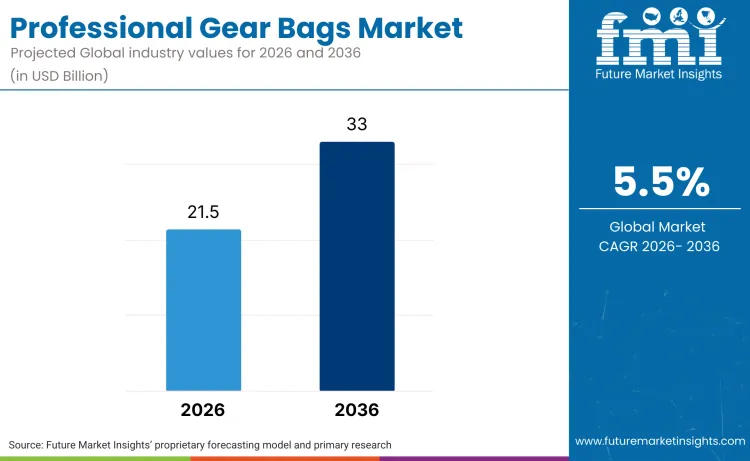
Summary of the Professional Gear Bags Market
What Is Growth Outlook for the Professional Gear Bags Market as per Future Market Insights Projection?
Future Market Insights projects the professional gear bags market to grow at a 5.5% CAGR from 2026 to 2036, expanding from USD 21.5 billion in 2026 to USD 33.0 billion by 2036.
FMI Research Approach: FMI proprietary forecasting model based on bottom-up revenue estimation, tracking adoption of professional gear bags across technician, logistics, field services, photography, and mobile workforce segments, and demand modeling linked to smart tracking integration, insurance-linked protection, and modular carry system uptake.
How Do FMI Analysts Perceive the Professional Gear Bags Market to Evolve?
FMI analysts perceive the market shifting from utility luggage toward intelligence-driven professional infrastructure, where bags function as active nodes within professional ecosystems rather than standalone carry solutions. Professional gear bags are increasingly positioned around smart tracking, asset protection, modular product architectures, and circular material design, supporting longer replacement cycles and higher lifetime value per professional user.
FMI Research Approach: Assessment of product positioning centered on smart mobility, mono-material sustainability, and modular ecosystems, evaluation of professional adoption of trackable and insurance-linked gear solutions, and analysis of replacement cycle dynamics across technician and fieldwork use cases.
Which Country or Region Holds the Largest Share in the Global Professional Gear Bags Market?
Asia-Pacific holds the largest share of the global professional gear bags market by value, supported by strong manufacturing-consumption convergence, rapid professionalization of field services, and rising adoption of smart and modular gear solutions across China and India.
FMI Research Approach: FMI region-level demand assessment across professional workforce hubs, evaluation of smart gear adoption in industrial and prosumer segments, and tracking of domestic brand expansion and premiumization across Asia-Pacific markets.
How Large Will the Professional Gear Bags Market Be by 2036?
The global professional gear bags market is projected to reach USD 33.0 billion by 2036.
FMI Research Approach: FMI long-term forecast by region, product type, end-user segment, and sales channel, incorporating scaling assumptions for smart tracking penetration, mono-material adoption, and modular ecosystem integration across professional carry platforms.
What Is the Definition of the Professional Gear Bags Market?
The professional gear bags market comprises purpose-built bags and carry systems designed for transporting tools, technical equipment, electronics, and professional assets, positioned around durability, ergonomic performance, asset protection, and mobility support for professional and fieldwork use cases.
FMI Research Approach: FMI market taxonomy and inclusion-exclusion framework covering technician tool bags, professional backpacks, laptop and equipment carry systems, modular professional gear platforms, and smart-enabled bags, while excluding casual fashion backpacks and non-specialized travel luggage.
What Are Globally Unique Trends Shaping the Professional Gear Bags Market?
Globally unique trends include the integration of GPS and biometric security features, growth of insurance-linked asset protection models, adoption of mono-material circular designs aligned with EU sustainability mandates, and the rise of modular gear ecosystems for mobile professionals.
FMI Research Approach: Analysis of feature-level adoption trends, contribution of smart tracking and circular material platforms to revenue growth, region-wise differentials in professional mobility demand, and expansion of professional gear bags as core infrastructure for hybrid and field-based work patterns.
Professional Gear Bags Market Key Takeaways
| Metric | Details |
|---|---|
| Industry Size (2026) | USD 21.5 Billion |
| Industry Value (2036) | USD 33.0 Billion |
| CAGR (2026-2036) | 5.5% |
Source: Future Market Insights (FMI) analysis, based on proprietary forecasting model and primary research.
Why Is the Demand for Professional Gear Bags Growing?
Expectations around professional carry solutions are shifting as gear bags move from simple rugged storage toward intelligent mobility infrastructure embedded within daily work routines. According to Future Market Insights, professional users increasingly prioritize asset security, ergonomic load distribution, and digital integration that supports extended field deployment across logistics, technical services, and mobile workforces. Earlier professional bags were largely evaluated on durability and compartment capacity, which limited their perceived role within broader professional ecosystems. That view is changing as smart tracking, insurance-linked protection, and modular configurations gain relevance across technician, photography, and fieldwork applications.
Brand and platform strategies reflect this transition. Velocity Pro Gear has advanced app-integrated, trackable tool bag concepts aligned with theft prevention and equipment recovery needs in urban trade environments, reinforcing the shift toward security-as-a-service positioning. ProAmpac’s mono-material innovations for high-durability, recyclable bag components illustrate how material science is shaping purchasing decisions among sustainability-conscious professional buyers. FMI notes that vendors embedding smart functionality and circular material design into core professional bag platforms, with clear workflow and compliance benefits, are better positioned to drive repeat adoption as professional gear bags evolve from utility accessories into long-term mobility infrastructure.
How Is the Professional Gear Bags Market Segmented?
The professional gear bags market is segmented by product type, material type, sales channel, end user, and region, reflecting how professionals select, purchase, and use carry solutions within mobile work environments. By product type, laptop and work backpacks dominate with around 52% share, driven by their role as the primary everyday carry format for mobile professionals, technicians, and hybrid workers. Tool bags account for nearly 21%, supported by sustained demand from skilled trades requiring structured storage and rugged protection. By material type, nylon and synthetic fabrics lead with close to 79% share, reflecting preference for lightweight, abrasion resistant, and weather durable constructions over leather or canvas. By sales channel, specialty stores lead with about 44% share, supported by the need for physical fit testing and ergonomic evaluation. By end user, adult professional users represent over 92% of demand, reflecting the work centric nature of the category. Regionally, Asia Pacific holds the largest share at nearly 39%, supported by large working age populations, expanding gig economies, and rising adoption of tech integrated professional carry formats.
Why Do Laptop and Work Backpacks Hold a Dominant Share?
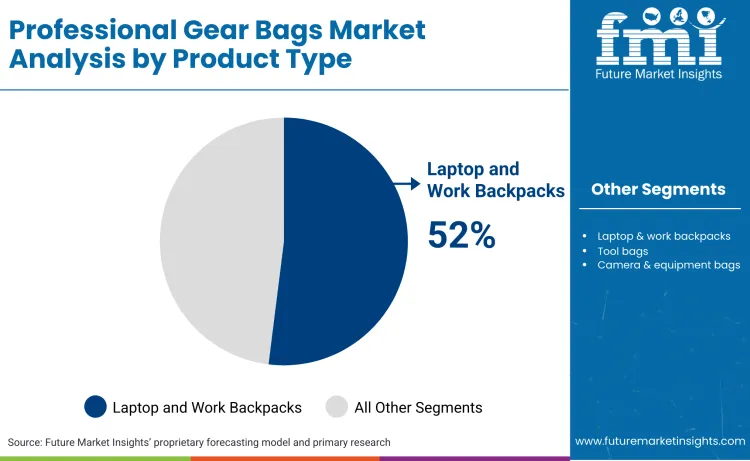
Laptop and work backpacks account for approximately 52% of professional gear bag revenues, driven by their compatibility with hybrid work, field deployment, and multi device carrying needs. Professionals increasingly consolidate laptops, power banks, tools, and personal items into a single carry platform to reduce switching between multiple bags during daily routines. Balanced weight distribution improves comfort during extended commuting and site visits, supporting higher usage frequency than shoulder bags or rolling cases. Modular compartments allow customization for different professions, including IT technicians, photographers, and field engineers. Their alignment with everyday carry habits positions backpacks as essential work infrastructure rather than discretionary accessories, anchoring sustained replacement cycles and repeat purchasing.
Why Do Nylon and Synthetic Materials Lead the Market?
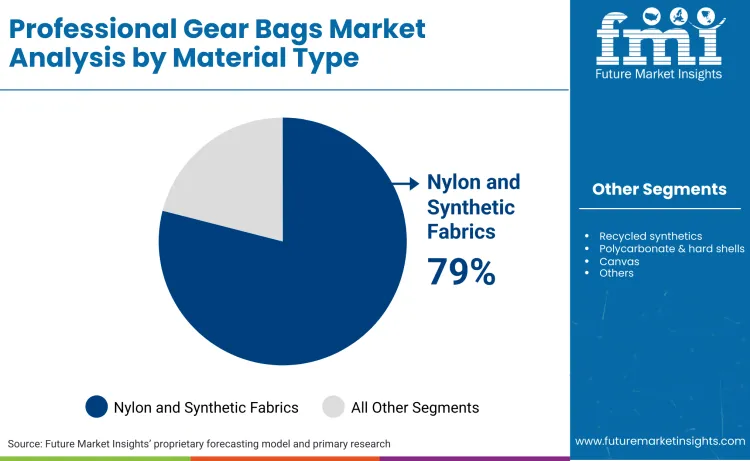
Nylon and synthetic materials represent nearly 79% of total professional gear bag volume due to their superior strength to weight ratio and resistance to abrasion, moisture, and impact. These materials support professional requirements for long service life under heavy load conditions, including exposure to outdoor environments, industrial sites, and frequent travel. Advances in recycled and coated synthetic textiles have improved durability while meeting sustainability expectations, reinforcing continued preference over leather or canvas alternatives. Lightweight construction reduces user fatigue during extended carry periods, improving functional value for technicians and mobile professionals. The material category benefits from compatibility with modular attachment systems and reinforced stitching, making synthetics the default choice for performance oriented professional gear designs.
Why Do Specialty Stores Lead the Sales Channel?
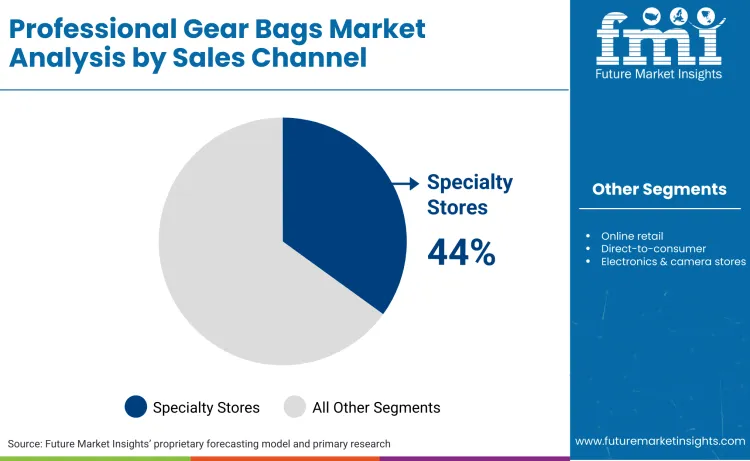
Specialty retail accounts for approximately 44% of professional gear bag sales because buyers prioritize physical inspection, fit testing, and ergonomic assessment before committing to higher value carry systems. Professionals transporting sensitive equipment or tools evaluate compartment layouts, harness comfort, and load stability in store, reducing the risk of post purchase dissatisfaction. In store guidance supports adoption of modular ecosystems, where compatibility across accessories influences total spend. While online channels account for roughly 31% of purchases, these are primarily driven by repeat buying and accessory upgrades after initial fit preferences are established. Specialty retail continues to anchor first time and premium purchases through consultative selling and product demonstration.
What Trends Are Shaping Industry Evolution Through Smart Professional Gear Bag Formats?
Professional gear bags are evolving as brands respond to demand for asset protection, modular organization, and frictionless mobility across hybrid work and field deployment environments. Smart gear bags now support integrated tracking, RFID shielding, and compartmentalized layouts that reduce loss risk and handling inefficiencies compared with conventional soft luggage. Brands such as Targus are strengthening this shift by introducing business backpacks with embedded tracking compatibility, anti-theft zippers, and device-specific protection zones designed for mobile professionals. These formats are increasingly positioned for daily professional infrastructure use rather than occasional travel carry. Their structured layouts, load-balancing harness systems, and tamper-resistant closures lower operational friction during repeated use, which is accelerating adoption of smart professional gear bags as practical, work-critical equipment within technician, IT services, and field engineering workflows.
How Is Portfolio Expansion Creating Stronger Professional Carry Ecosystems?
Portfolio expansion is reinforcing competitive positioning by enabling companies to integrate backpacks, modular pouches, rolling cases, and protective sleeves into unified professional carry ecosystems rather than standalone products. Manufacturers are extending their professional lines to cover tool transport, mobile workstation setups, and device protection, allowing users to standardize carry systems across work contexts. Brands such as Thule Group have expanded beyond outdoor backpacks into professional-grade laptop packs, camera carriers, and rolling business luggage, supporting cross-category attachment systems and consistent durability standards. This portfolio layering strengthens channel leverage and improves customer lifetime value, as users remain within a single ecosystem when upgrading or replacing components. Integrating multiple formats into one platform accelerates enterprise and institutional adoption by aligning with procurement preferences for standardized equipment solutions across distributed workforces.
Why Is Material and Structural Refinement Driving Product and Format Innovation?
Cost sensitivity, durability requirements, and regulatory pressure are pushing manufacturers to refine materials, load architecture, and structural reinforcement in professional gear bags while maintaining user comfort and long service life. Advanced textiles, reinforced seams, and modular frame systems are being optimized to withstand repeated high-load cycles across logistics, field service, and technical trade use. Brands such as Victorinox are refining internal frame geometry and abrasion-resistant shells to balance rigidity with lightweight portability, improving long-duration carry comfort under heavy equipment loads. Small variations in material thickness, stitch density, and harness construction materially affect fatigue levels during extended shifts. As competition intensifies, formulation discipline in materials engineering supports consistent performance across climates and work conditions, positioning professional gear bags as reliable daily infrastructure assets rather than discretionary accessories.
What Is the Country-Wise Outlook for the Professional Gear Bags Market?
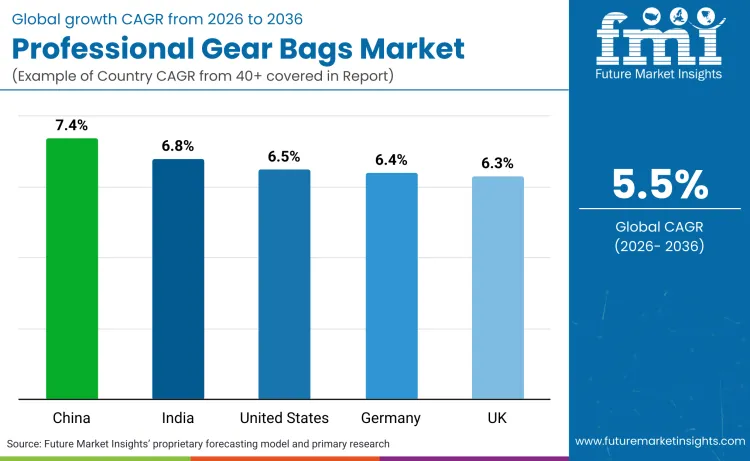
Country-level growth for professional gear bags shows clear variation, influenced by workforce mobility demands, professional adoption of advanced carry solutions, and regional economic dynamics. China leads with a 7.4% CAGR, propelled by rapid urbanization and expansion of technical and field services roles. India follows at 6.8%, supported by rising participation in fieldwork, logistics, and gig economy employment requiring rugged backpacks and tool bags. The United States posts 6.5%, reflecting strong replacement cycles and premium upgrades in a mature market. The UK records 6.3% growth, shaped by increased demand across photography, outdoor professions, and mobile services. Germany grows at 6.4%, supported by structured professional purchasing and durability-driven adoption of specialized gear. These growth differentials reflect diverse professional use cases and evolving mobility patterns.
| Country | CAGR (2026 to 2036) |
|---|---|
| China | 7.4% |
| India | 6.8% |
| United States | 6.5% |
| Germany | 6.4% |
| UK | 6.3 % |
Source: FMI historical analysis and forecast data.
Why Is China Leading Growth in Professional Gear Bags?
China’s 7.4% CAGR is driven by strong demand from expanding industrial, logistics, and creative sectors that require purpose-built gear bags for daily operational use. Rapid urbanization and substantial deployment of field service personnel are increasing the frequency and complexity of equipment that needs to be transported securely. Tech-integrated backpacks with protective compartments, organizational modules, and ergonomic harness systems are becoming essential for mobile professionals across manufacturing, utilities, and media. E-commerce penetration further supports market expansion by broadening access to advanced gear bags beyond tier-1 cities. Adoption is shaped by both replacements and upgrades from generic bags to specialist solutions, as workers prioritize durability, comfort, and modular functionality in everyday professional contexts.
What Is Supporting Growth in India’s Professional Gear Bags Market?
India’s 6.8% CAGR reflects expanding participation in mobile and field-oriented professions, including logistics, maintenance, telecommunications, and digital content creation. Professional gear bags that offer ergonomic comfort, compartmentalized storage, and rugged build quality are increasingly adopted by both formal workforce and gig economy workers who carry tools, devices, and protective equipment daily. Improved access through e-commerce platforms is enabling broader trial and repeat purchases beyond tier-1 urban centers. Rising disposable income and increased professional mobility are prompting more frequent upgrades from basic backpacks to purpose-built gear solutions with reinforced stitching, device protection, and adjustable harness systems. Growing awareness of ergonomic safety and workplace standards further reinforces growth, making professional gear bags a practical, work-enabling accessory across various sectors.
Why Is Growth Strong in the United States?
The United States posts a 6.5% CAGR, reflecting sustained replacement demand and premiumization in a mature professional gear bags market. Growth is supported by professionals in field services, photography, emergency response, and corporate technical roles who upgrade to ergonomic, feature-rich models with protective padding and modular organization. Digital retail channels support frequent replenishment and experimentation with advanced formats such as anti-theft pockets, RFID protection, and smart compartment systems. While the baseline penetration of professional gear bags is high, value expansion is driven by upgrades to higher-end materials and designs that improve comfort and durability under frequent use. Corporate procurement for standardized backpacks and specialized tool bags also contributes, anchoring long-term demand.
Why Is Germany Showing Consistent Expansion in Professional Gear Bags?
Germany’s 6.4% CAGR is shaped by structured professional purchasing and strong preference for technical performance, durability, and organizational features in gear bags. Industries such as automotive service, electrical maintenance, and outdoor technical trades require rugged backpacks and tool bags that maintain shape, protect equipment, and withstand frequent wear. German consumers emphasize quality and reliability, choosing solutions with reinforced build, ergonomic harness systems, and weather-resistant materials. Steady replacement demand is supported by specialty retail and digital channels that facilitate in-store evaluation and repeat purchases. Sustainability preferences also influence material selection, supporting growth in eco-friendly, long-lasting gear formats. This measured adoption supports consistent expansion aligned with broader professional utility needs.
What Is Driving Growth in the UK’s Professional Gear Bags Market?
The UK records a 6.3% CAGR as professionals increasingly adopt purpose-built gear bags that balance daily work requirements with mobility and comfort. Demand is strong among field technicians, photographers, outdoor professionals, and mobile consultants who rely on organized compartments, protective sleeves, and ergonomic harness designs for frequent travel and equipment transport. Growth is reinforced by rising interest in modular ecosystems that integrate backpacks with pouches and accessory kits tailored to specific workflows. E-commerce and specialty retail channels support both discovery and replenishment, allowing users to explore advanced designs and upgrade from generic bags to professional solutions. Continued investment in small business and creative sectors also underpins sustained demand across major UK urban centers.
What Is the Competitive Outlook for the Professional Gear Bags Market?
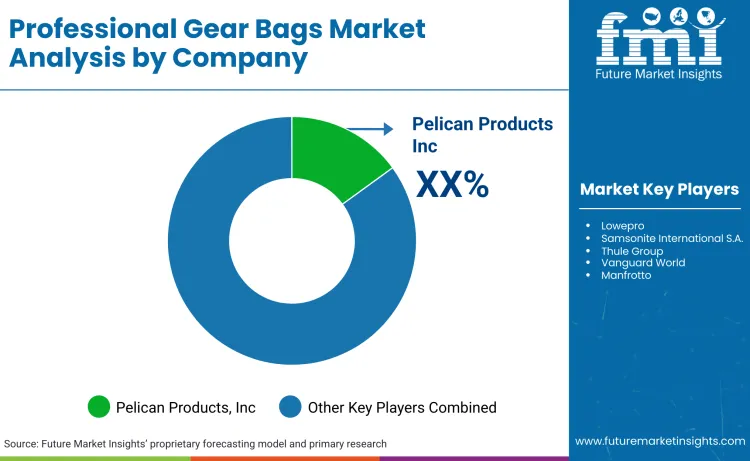
The competitive landscape for professional gear bags is shaped by global carry-solution brands and equipment-focused specialists that extend beyond basic luggage to protect high-value tools, electronics, and camera systems. Players such as Samsonite International, Thule Group, and Targus benefit from broad retail access, strong brand recall, and established portfolios across business travel and everyday carry. Samsonite maintains scale advantages across professional backpacks and tech cases through deep distribution and product refresh cycles aligned with commuter mobility needs. Competitive positioning centers less on sheer shipment volume and more on delivering durable, ergonomic carry platforms that integrate device protection, organization systems, and travel-ready compliance for mobile professionals.
Future Market Insights observes that competition increasingly revolves around build integrity, load ergonomics, and protection performance rather than rapid capacity expansion. Specialist brands such as Lowepro, Manfrotto, and Tenba emphasize precision fit for camera and video equipment, modular interiors, and impact protection for field use. At the same time, Pelican Products, Crumpler, and Thule Group reinforce ruggedization, weather resistance, and hybrid travel utility to support outdoor and industrial users. Long-term advantage is expected to depend on how effectively professional gear bags integrate into broader mobility ecosystems, combining protective hardware, modular add-ons, and compatibility with evolving professional workflows rather than functioning as standalone carry products.
Recent Developments:
- In June 2025, Peak Design expanded its Outdoor Line with new 18L backpacks and modular slings engineered for professional photographers and field creators. The updated range introduced vest-style load distribution, weather-sealed compartments, and modular camera cubes, reflecting growing demand for ergonomic carry systems that support long-duration fieldwork across outdoor and commercial assignments.
- In July 2025, Malco Tools completed the acquisition of Veto Pro Pac, strengthening its presence in professional tool storage and technician carry solutions. The transaction expanded Malco’s distribution footprint across North America and Europe, enabling wider access to Veto’s vertical tool organization designs that support electricians, HVAC technicians, and maintenance professionals working in mobile and high-frequency service environments.
- In March 2025, ProAmpac secured multiple patents for mono-material bag structures, enabling the production of high-durability professional gear bags using single-polymer constructions designed for easier recyclability. This development supports the shift toward circular material design in professional carry solutions, particularly for laptop bags and equipment backpacks sold in European markets with tightening sustainability compliance requirements.
Key Players in Professional Gear Bags Market
- Pelican Products, Inc.
- Lowepro
- Samsonite International S.A.
- Thule Group
- Vanguard World
- Manfrotto
Market Definition
The professional gear bags market captures revenue from purpose-built carry solutions designed to transport, protect, and organize equipment used in professional, technical, and field-based work. In this assessment, the market covers commercially available gear bags positioned for daily professional use, secure equipment carriage, and mobile work support across trades, photography, logistics, field services, and technical occupations. Market sizing reflects the value of finished consumer products sold through physical retail, specialty stores, and online platforms, analyzed by product type, end user, sales channel, and region, and reported in USD billion.
The scope includes backpacks, tool bags, camera and equipment bags, laptop and tech backpacks, modular carry systems, and hard protective cases marketed for professional or semi-professional use. Products designed for frequent transport of tools, devices, instruments, or field equipment are included when positioned for occupational mobility, durability, and organization. Sales through specialty retailers, professional equipment distributors, direct-to-consumer platforms, and general retail channels are counted. Geographic coverage spans North America, Europe, Asia Pacific, Latin America, and the Middle East & Africa.
The market excludes casual fashion backpacks, school bags, standard travel luggage, handbags, briefcases without professional equipment positioning, and non-protective soft totes. Revenues from raw materials, contract manufacturing services, packaging supply, component hardware, logistics services, and aftermarket accessories sold independently are excluded. Products manufactured solely for military procurement, institutional uniforms, or internal corporate distribution without commercial retail availability fall outside the defined market scope.
Scope of Report
| Items | Values |
|---|---|
| Quantitative Units (2026) | USD 21.5 Billion |
| Product Type | Laptop & work backpacks; Tool bags; Camera & equipment bags; Modular carry systems; Hard protective cases; Others |
| Material Type | Nylon & synthetic fabrics; Recycled synthetics; Polycarbonate & hard shells; Canvas; Others |
| Sales Channel | Specialty stores; Online retail; Direct-to-consumer; Electronics & camera stores; Others |
| End User | Technicians & skilled trades; Photographers & videographers; Field services & logistics; Corporate mobile workforce; Prosumer users |
| Regions Covered | North America, Europe, Asia Pacific, Latin America, Middle East & Africa |
| Countries Covered | United States, Germany, United Kingdom, India, China, Brazil, and 40+ countries |
| Key Companies Profiled | Samsonite International; Thule Group; Pelican Products; Lowepro; Manfrotto; Vanguard World; Targus; Tenba |
| Additional Attributes | Dollar sales by product type and end user; country-wise growth analysis; adoption trends for smart tracking and modular carry ecosystems; penetration of mono-material and recyclable constructions; application patterns across technician, photography, logistics, and mobile professional use cases; competitive positioning across mass, premium, and ruggedized professional carry segments |
Source: FMI historical analysis and forecast data
Professional Gear Bags Market by Segments
By Product Type:
- Laptop & work backpacks
- Tool bags
- Camera & equipment bags
- Modular carry systems
- Hard protective cases
- Others
By Material Type:
- Nylon & synthetic fabrics
- Recycled synthetics
- Polycarbonate & hard shells
- Canvas
- Others
By Sales Channel:
- Specialty stores
- Online retail
- Direct-to-consumer
- Electronics & camera stores
- Others
By End User:
- Technicians & skilled trades
- Photographers & videographers
- Field services & logistics
- Corporate mobile workforce
- Prosumer users
By Region:
- North America
- Europe
- Asia Pacific
- Latin America
- Middle East & Africa
Bibliography
- Mechanical Business. (2025). The Malco Group completes acquisition of Veto Pro Pac to expand professional tool storage portfolio. Mechanical Business Trade Journal, July 2025 Edition, 1-6.
- HVAC Insider. (2025). Malco Group acquires Veto Pro Pac to strengthen vertical tool storage solutions for HVAC and electrical trades. HVAC Insider Industry News, July 2025, 1-4.
- Velocity Pro Gear. (2025). Rogue 600 Wheeler launch: App-integrated trackable tool bag with insurance-linked protection. Company Product Release and Technical Briefing, January 2025, 1-12.
- Danske Bank UK. (2025). Growth capital financing for Velocity Pro Gear to support smart professional carry systems. Danske Bank UK Corporate Finance Update, January 2025, 1-5.
- Peak Design. (2025). Outdoor Line expansion: Modular backpacks and slings for professional photographers and field creators. Peak Design Press Release and Product Dossier, June 2025, 1-18.
- ProAmpac. (2025). ProActive Sustainability® mono-material technologies for recyclable high-durability bags. ProAmpac Patent Disclosure and Innovation Brief, March 2025, 1-22.
Frequently Asked Questions
What is the current global market size for Professional Gear Bags?
The global professional gear bags market is valued at USD 21.5 billion in 2026, supported by rising demand for durable carry systems used by technicians, photographers, logistics staff, and mobile professionals requiring secure equipment transport.
What is the projected CAGR for the Professional Gear Bags market?
Market revenues are projected to grow at a 5.5% CAGR from 2026 to 2036, reaching USD 33.0 billion by the end of the forecast period, supported by premiumization and wider adoption of modular, ergonomic carry formats.
Which segment currently dominates the industry?
Laptop and work backpacks dominate the market with around 52% share, driven by their role as primary everyday carry solutions for hybrid workers, field engineers, and mobile professionals handling multiple devices.
What are the primary risks or barriers to adoption?
Key barriers include price sensitivity in cost constrained professional segments, slower replacement cycles due to long product lifespans, and resistance from users who continue to rely on generic backpacks or basic tool bags.
Who are the leading players in the Professional Gear Bags space?
Leading companies include Samsonite International, Thule Group, Pelican Products, Lowepro, Manfrotto, and Targus, supported by strong distribution, professional grade durability positioning, and specialized equipment protection portfolios.
Preview the report firsthand - request a free sample
Get SampleGet the brochure for pricing and purchase details.
Get PDFTable of Content
- Executive Summary
- Global Professional Gear Bags Market Outlook
- Demand Side Trends
- Supply Side Trends
- Smart Mobility and Product Intelligence Roadmap
- Strategic Analysis and Recommendations
- Market Overview
- Market Coverage and Taxonomy
- Market Definition, Scope, and Limitations
- Research Methodology
- Chapter Orientation
- Analytical Framework and Assumptions
- Market Structure and Signal Identification
- Benchmarking and Cross-Market Comparability
- Market Sizing and Forecast Modeling
- Research Design and Evidence Framework
- Secondary Research Sources
- Primary Research Inputs
- Data Validation and Triangulation
- Quality Control and Audit Trail
- Market Background
- Market Dynamics
- Drivers
- Restraints
- Opportunities
- Trends
- Scenario Forecast Analysis
- Opportunity Mapping
- Product Life Cycle Analysis
- Value Chain Analysis
- Supply Chain Analysis
- Regulatory and Sustainability Landscape
- Market Dynamics
- Global Professional Gear Bags Market Analysis 2021 to 2025 and Forecast 2026 to 2036
- Historical Market Size Value Analysis
- Current and Future Market Size Projections
- Y-o-Y Growth Trend Analysis
- Absolute Dollar Opportunity Analysis
- Global Professional Gear Bags Market Analysis by Product Type
- Laptop and Work Backpacks
- Tool Bags
- Camera and Equipment Bags
- Modular Carry Systems
- Hard Protective Cases
- Others
- Global Professional Gear Bags Market Analysis by Material Type
- Nylon and Synthetic Fabrics
- Recycled Synthetic Materials
- Polycarbonate and Hard Shell Materials
- Canvas
- Others
- Global Professional Gear Bags Market Analysis by Sales Channel
- Specialty Stores
- Online Retail
- Direct-to-Consumer
- Electronics and Camera Stores
- Others
- Global Professional Gear Bags Market Analysis by End User
- Technicians and Skilled Trades
- Photographers and Videographers
- Field Services and Logistics
- Corporate Mobile Workforce
- Prosumer Users
- Global Professional Gear Bags Market Analysis by Region
- North America
- Europe
- Asia Pacific
- Latin America
- Middle East and Africa
- North America Professional Gear Bags Market Analysis
- Market Size and Forecast by Country
- Market Analysis by Product Type
- Market Analysis by Material Type
- Market Analysis by Sales Channel
- Market Analysis by End User
- Market Attractiveness Analysis
- Europe Professional Gear Bags Market Analysis
- Market Size and Forecast by Country
- Market Analysis by Product Type
- Market Analysis by Material Type
- Market Analysis by Sales Channel
- Market Analysis by End User
- Market Attractiveness Analysis
- Asia Pacific Professional Gear Bags Market Analysis
- Market Size and Forecast by Country
- Market Analysis by Product Type
- Market Analysis by Material Type
- Market Analysis by Sales Channel
- Market Analysis by End User
- Market Attractiveness Analysis
- Latin America Professional Gear Bags Market Analysis
- Market Size and Forecast by Country
- Market Attractiveness Analysis
- Middle East and Africa Professional Gear Bags Market Analysis
- Market Size and Forecast by Country
- Market Attractiveness Analysis
- Key Countries Analysis
- China
- India
- United States
- Germany
- United Kingdom
- Brazil
- Market Structure and Competition Analysis
- Competition Dashboard
- Competitive Benchmarking
- Market Share Analysis of Leading Players
- Company Profiles
- Samsonite International S.A.
- Thule Group
- Pelican Products, Inc.
- Lowepro
- Manfrotto
- Vanguard World
- Targus
- Tenba
- Assumptions and Acronyms Used


