

- Industry Size (2025)
- USD 3.9 Bn
- Forecast (2035)
- USD 5.9 Bn
- CAGR (2025 to 2035)
- 4.4%
Sauces, Dressings, and Condiments in Europe - Size, Share, and Forecast Outlook 2025 to 2035
Sales of sauces, dressings, and condiments in Europe are estimated at USD 3.9 billion in 2025, with projections indicating a rise to USD 5.9 billion by 2035, reflecting a CAGR of 4.4% over the forecast period. This growth is attributed to rising adoption of international cuisines, expanding applications in food service establishments, and increasing consumer demand for convenience foods and flavor enhancement.
Quick Stats for Europe Sauces, Dressings, and Condiments Market
- Europe Sauces, Dressings, and Condiments Sales Value (2025): USD 3.9 billion
- Europe Sauces, Dressings, and Condiments Forecast Value (2035): USD 5.9 billion
- Europe Sauces, Dressings, and Condiments Forecast CAGR (2025 to 2035): 4.4%
- Leading Segment by End-Use Application Europe Sauces, Dressings, and Condiments (2025): Food Service HoReCa (30% share)
- Fastest Growing Countries in Europe: United Kingdom, Romania
- Top Key Players in Europe: Nestle SA, Unilever Group, Fuchs Gewürze GmbH Co, The Kraft Heinz Company, McCormick & Company Inc., Paulig Group, Develey Senf & Feinkost GmbH, Barilla Group, Orkla ASA, Mutti S.p.A., GBfoods, General Mills Inc., Hormel Foods Corp, Mars Incorporated
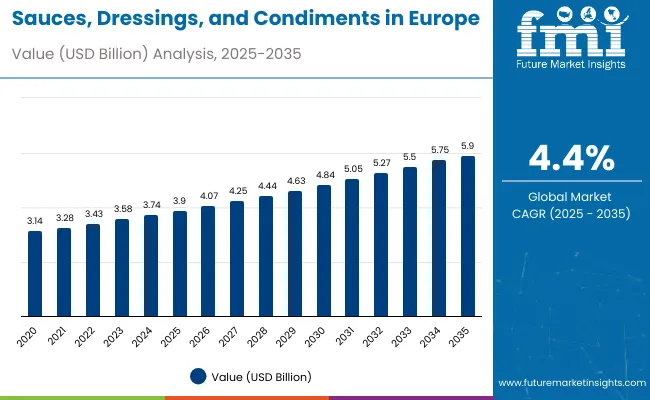
Key Takeaways, Market Size, and Forecast
| Metric | Value |
|---|---|
| Market Size (2025) | USD 3.9 Billion |
| Market Size (2035) | USD 5.9 Billion |
| CAGR (2025–2035) | 4.4% |
| Leading Product Type | Ketchup and Tomato Sauces (25%) |
| Leading End Use Application (2025) | Food Service / HoReCa (30%) |
| Metric | Value |
|---|---|
| Estimated Size (2025E) | USD 3.9 billion |
| Projected Value (2035F) | USD 5.9 billion |
| CAGR (2025 to 2035) | 4.4% |
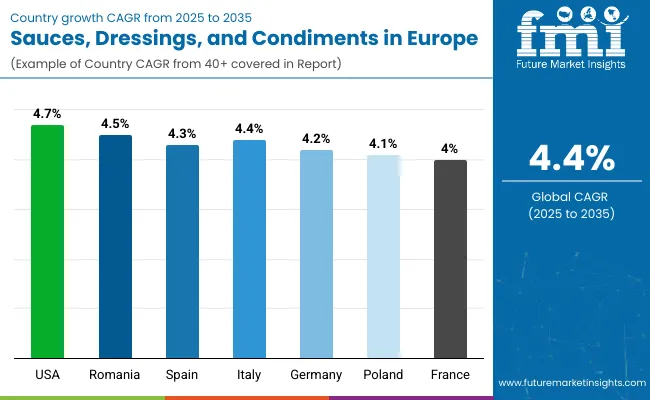
The United Kingdom is expected to generate the highest growth rate at 4.7% CAGR by 2035, followed by Romania at 4.5%, Spain is expected to grow at 4.3% CAGR, while Italy will expand at 4.4% CAGR, Germany (4.2% CAGR), Poland (4.1% CAGR), and France (4.0% CAGR).
Ketchup and tomato sauces continue to contribute the most to demand, expected to account for 25% of total sales in 2025, owing to their high repeat use, broad food service applications, and strong retail availability. By end use, food service (HoReCa) represents the dominant segment, responsible for 30% of sales, while retail and food processing applications are expanding steadily.
Consumer adoption is concentrated in restaurants, cafes, hotels, food processors, and retail chains. Demand is primarily driven by functionality, taste enhancement, and convenience trends. Premium positioning supports value growth, but food service and retail applications remain the key volume drivers. Regional disparities persist, though consumption patterns in emerging markets such as Romania and Poland are narrowing the gap with mature markets like Germany and France.
Segmental Analysis
The sauces, dressings, and condiments segment in Europe is classified by product type, end-use, and country. By product type, it includes dry sauces, pasta sauces, barbecue sauces, cocktail sauces, ketchup, mayonnaise, mustard, salad dressings, table sauces, dips, and salsa.
By end use, categories include food processing, food service (HoReCa), retail and household consumption, institutional catering, and private-label manufacturing. Leading countries include Germany, France, Italy, Spain, the United Kingdom, Poland, and Romania.
By Product Type, Ketchup and Tomato Sauces to Lead with 25% Share
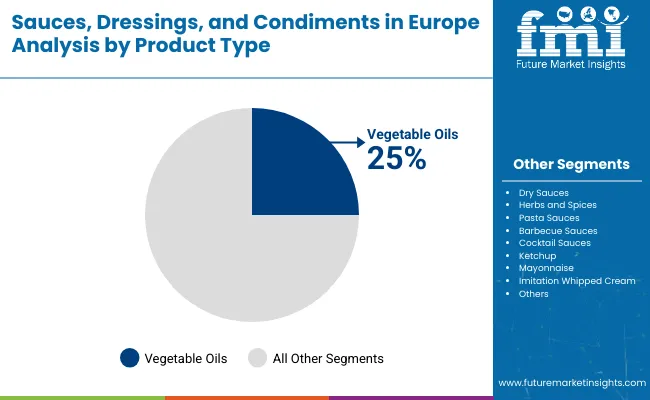
By product type, ketchup and tomato sauces are projected to account for 25% of total sales in 2025, reflecting their broad use across retail shelves, food service menus, and packaged-food formulations.
- The food service segment benefits from ketchup and tomato sauces because they support menu standardization, portion control, and high-frequency use across quick-service and casual dining formats.
- Retail sales benefit from repeat household purchases, private-label expansion, and demand for convenient flavor additions in everyday meals.
- Food processing applications use tomato-based sauces in ready meals, frozen foods, snacks, and prepared dishes, supporting consistent industrial demand.
- Private-label programs are expanding as retailers launch value and premium sauce ranges to defend margins and capture repeat household demand.
By End-use, Food Service (HoReCa) to Lead with 30% Share
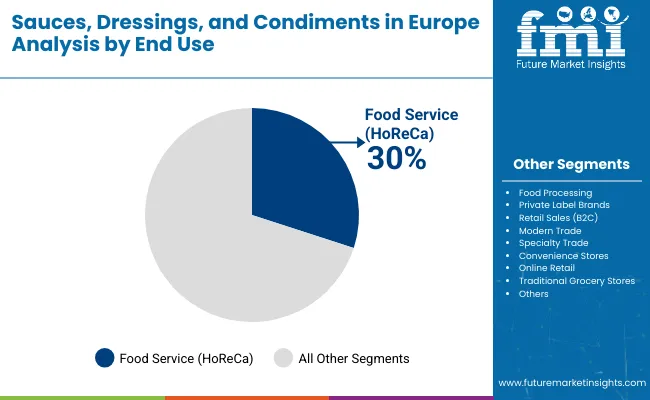
Sauces, dressings, and condiments end-use applications in Europe span a variety of sectors, including food service, retail sales, food processing, and private label brands. Food service (HoReCa) is projected to account for 30% of total sales in 2025, reflecting strong adoption across hotels, restaurants, cafes, and catering services.
- The food service segment benefits from sauces' ability to enhance flavor profiles, improve menu variety, and increase customer satisfaction in dining establishments.
- Retail sales applications leverage consumer demand for home cooking convenience, flavor enhancement, and meal preparation efficiency, contributing to steady growth.
- Food processing applications utilize sauces and condiments for product formulation, taste enhancement, and commercial food production.
- Private label and modern trade applications are gradually increasing as retailers develop their own branded products to capture margin and customer loyalty.
Sales of Sauces, Dressings, and Condiments in Europe by Country
| Countries | CAGR (2025 to 2035) |
|---|---|
| United Kingdom | 4.7% |
| Romania | 4.5% |
| Spain | 4.3% |
| Italy | 4.4% |
| Germany | 4.2% |
| Poland | 4.1% |
| France | 4.0% |
Between 2025 and 2035, demand for sauces, dressings, and condiments is projected to expand across all major European countries. Still, the pace of growth will vary based on food service innovation, retail capabilities, and consumer adoption trends. Among the seven countries analyzed, the United Kingdom and Romania are expected to register the fastest compound annual growth rates of 4.7% and 4.5% respectively, outpacing other established European markets. This acceleration is underpinned by factors such as expanding food service industries, rising consumer income levels, and increasing adoption of international cuisines and convenience foods. In both countries, per capita consumption is projected to increase steadily from 2025 to 2035, driven by enhanced culinary diversity and food service integration.
The UK is expected to grow at a CAGR of 4.7%, supported by increasing demand for premium condiments and expanding multicultural food preferences. Per capita consumption is projected to rise from 12.5 kg in 2025 to 18.2 kg by 2035, with total market value reaching USD 892.4 million. Romania is forecast to grow at a CAGR of 4.5%, driven by rising urbanization and growing food service adoption. Per capita consumption is projected to increase from 8.2 kg to 12.1 kg over the same period, with market value reaching USD 267.8 million by 2035. Spain and Italy are expected to expand at a CAGR of 4.3% each, underpinned by traditional culinary heritage and moderate retail growth. Spain's per capita consumption is projected to increase from 14.1 kg to 20.5 kg, with total market value reaching USD 645.3 million. Italy's consumption is expected to rise from 13.8 kg to 20.0 kg, with market value reaching USD 712.6 million.
Germany is projected to grow at a CAGR of 4.2%, driven by stable consumer demand and established food processing capabilities. Per capita consumption is expected to rise from 15.2 kg in 2025 to 21.8 kg in 2035, with total market value reaching USD 1.124 billion. Poland is forecast to grow at a CAGR of 4.1%, supported by emerging market dynamics and increasing food service adoption. Per capita consumption is projected to increase from 9.6 kg to 13.8 kg, with market value reaching USD 298.7 million. France is expected to expand at a CAGR of 4.0%, reflecting mature market conditions with steady growth patterns. Per capita consumption is projected to increase from 16.3 kg to 23.2 kg, with total market value reaching USD 967.5 million.
Collectively, these seven countries represent the core of the demand for sauces, dressings, and condiments in Europe. Remaining value is allocated to other European markets not shown separately in this summary, which reconciles the seven-country view with the wider regional total. Still, individual growth paths highlight the importance of country-specific strategies in product development, distribution partnerships, and food service integration.
Notable Players and Strategies in the European Sauces, Dressings, and Condiments Space
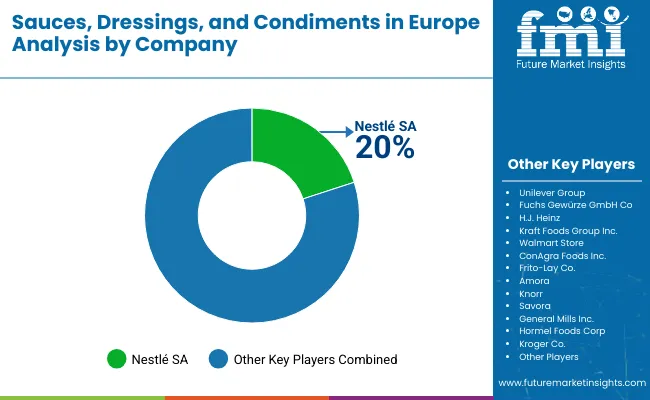
A mix of established food manufacturers and specialized condiment providers defines the competitive environment in the European sauces, dressings, and condiments space. Operational excellence, brand recognition, and strategic distribution management, rather than product innovation alone, remain decisive success factors: the leading suppliers collectively serve a wide range of food service and retail clients across Europe and maintain strong market presence.
Nestlé SA holds a dominant position with 20% market share through its comprehensive sauce and seasoning portfolios. The company leverages robust brand recognition and extensive distribution networks to deliver consistent quality solutions, ensuring reliable performance in both food service and retail applications. Its focus on flavor innovation strengthens relationships with European consumers seeking convenient meal solutions.
Unilever Group emphasizes brand portfolio management and consumer-focused product development tailored for retail and food service sectors. By integrating established brands with consumer-specific taste preferences, the company reinforces its presence across traditional and premium segments while enhancing adoption in high-value applications.
The Kraft Heinz Company capitalizes on brand heritage to provide specialized ketchup and sauce offerings for both institutional and consumer markets. Its strategic emphasis on quality consistency and sector-specific applications enables strong penetration in the food service, retail, and food processing industries, supporting growth across multiple European regions.
Kraft Foods Group focuses on integrated ingredient solutions targeting retail and food processing applications. Through a combination of brand strength, functional performance, and supply chain efficiency, the company strengthens its position as a trusted partner for food manufacturers and retailers seeking consistency and market appeal.
Private-label programs and ongoing market consolidation trends are reshaping the competitive landscape, with brand strength and distribution excellence emerging as critical differentiators for players aiming to maintain market relevance in the European sauces, dressings, and condiments sector.
Scope of Report
| Items | Values |
|---|---|
| Quantitative Units (2025) | USD 3.9 Billion |
| Product Type | Dry Sauces, Pasta Sauces, Barbecue Sauces, Cocktail Sauces, Ketchup, Mayonnaise, Mustard, Salad Dressings, Table Sauces, Dips and Salsa |
| End Use Application | Food Processing, Food Service (HoReCa), Retail and Household Consumption, Institutional Catering, Private-label Manufacturing |
| Key Region | Europe |
| Countries Covered | Germany, France, Italy, Spain, the United Kingdom, Poland, Romania |
| Key Companies Profiled | Nestle SA, Unilever Group, Fuchs Gewürze GmbH Co, The Kraft Heinz Company, McCormick & Company Inc., Paulig Group, Develey Senf & Feinkost GmbH, Barilla Group, Orkla ASA, Mutti S.p.A., GBfoods, General Mills Inc., Hormel Foods Corp, Mars Incorporated |
| Additional Attributes | Dollar sales by product type and end use, country demand trends, competitive landscape, food service adoption, retail and private-label dynamics, clean-label formulations, and evolving consumer preferences toward convenient flavor formats |
Key Segments
By Product Type:
The industry can be segmented by product type into dry sauces, pasta sauces, barbecue sauces, cocktail sauces, ketchup, mayonnaise, mustard, salad dressings, table sauces, dips, salsa, and other sauce or condiment formats.
By End-use:
Segmentation by end-use application includes food processing, food service (HoReCa), retail and household consumption, institutional catering, private-label manufacturing, and other commercial users.
Research Sources and Bibliography
- Eurostat food retail, hospitality, and household consumption statistics used for country demand context.
- FoodDrinkEurope industry data and European food manufacturing publications used for market structure and food processing context.
- European Commission food labelling and food safety publications used for regulatory context.
- Company annual reports, product portfolio disclosures, and European brand portfolio pages used for company-roster validation.
Frequently Asked Questions
What is the projected sales value of sauces, dressings, and condiments in Europe by 2025?
In 2025, the total sales of sauces, dressings, and condiments in Europe will be valued at USD 3.9 billion.
What is the outlook on sauces, dressings, and condiments sales in Europe by 2035?
By 2035, the sales of sauces, dressings, and condiments in Europe are forecasted to reach USD 5.9 billion, reflecting a CAGR of 4.4%.
Which product type dominates the sauces, dressings, and condiments space in Europe in 2025?
Ketchup and tomato sauces will lead the product category with a 25% share in 2025.
Which country is projected to have the fastest-growing demand for sauces, dressings, and condiments in Europe?
The UK is anticipated to grow at the fastest pace with a CAGR of 4.7% from 2025 to 2035, closely followed by Romania at 4.5%.
Which end-use segment will lead the sauces, dressings, and condiments innovation in Europe?
The food service (HoReCa) sector is projected to lead the end-use segment with a 30% share in 2025.
Preview the report firsthand - request a free sample
Get SampleGet the brochure for pricing and purchase details.
Get PDFTable of Content
- Executive Summary
- Europe Market Outlook
- Demand-side Trends
- Supply-side Trends
- Technology Roadmap Analysis
- Analysis and Recommendations
- Market Overview
- Market Coverage / Taxonomy
- Market Definition / Scope / Limitations
- Market Background
- Market Dynamics
- Drivers
- Restraints
- Opportunity
- Trends
- Scenario Forecast
- Demand in Optimistic Scenario
- Demand in the Likely Scenario
- Demand in Conservative Scenario
- Opportunity Map Analysis
- Product Life Cycle Analysis
- Supply Chain Analysis
- Supply Side Participants and their Roles
- Producers
- Mid-Level Participants (Traders/ Agents/ Brokers)
- Wholesalers and Distributors
- Value Added and Value Created at Node in the Supply Chain
- List of Raw Material Suppliers
- List of Existing and Potential Buyer’s
- Supply Side Participants and their Roles
- Investment Feasibility Matrix
- Value Chain Analysis
- Profit Margin Analysis
- Wholesalers and Distributors
- Retailers
- PESTLE and Porter’s Analysis
- Regulatory Landscape
- By Key Regions
- By Key Countries
- Regional Parent Market Outlook
- Production and Consumption Statistics
- Import and Export Statistics
- Market Dynamics
- Europe Sauces, Dressings, and Condiments Market Analysis 2020 to 2024 and Forecast, 2025 to 2035
- Historical Market Size Value (USD Billion) & Volume (Kilotons) Analysis, 2020 to 2024
- Current and Future Market Size Value (USD Billion) & Volume (Kilotons) Projections, 2025 to 2035
- Y-o-Y Growth Trend Analysis
- Absolute $ Opportunity Analysis
- Europe Sauces, Dressings, and Condiments Pricing Analysis 2020 to 2024 and Forecast 2025 to 2035
- Europe Sauces, Dressings, and Condiments Market Analysis 2020 to 2024 and Forecast 2025 to 2035, By Product Type
- Introduction / Key Findings
- Historical Market Size Value (USD Billion) & Volume (Kilotons) Analysis By Product Type, 2020 to 2024
- Current and Future Market Size Value (USD Billion) & Volume (Kilotons) Analysis and Forecast By Product Type, 2025 to 2035
- Dry Sauces
- Salad Dressings
- Mustard
- Pasta Sauces
- Barbecue Sauces
- Cocktail Sauces
- Ketchup
- Mayonnaise
- Dips and Salsa
- Y-o-Y Growth Trend Analysis By Product Type, 2020 to 2024
- Absolute $ Opportunity Analysis By Product Type, 2025 to 2035
- Europe Sauces, Dressings, and Condiments Market Analysis 2020 to 2024 and Forecast 2025 to 2035, By End Use
- Introduction / Key Findings
- Historical Market Size Value (USD Billion) & Volume (Kilotons) Analysis By End Use, 2020 to 2024
- Current and Future Market Size Value (USD Billion) & Volume (Kilotons) Analysis and Forecast By End Use, 2025 to 2035
- Food Processing
- Private-label Manufacturing
- Food Service (HoReCa)
- Retail and Household Consumption
- Institutional Catering
- Y-o-Y Growth Trend Analysis By End Use, 2020 to 2024
- Absolute $ Opportunity Analysis By End Use, 2025 to 2035
- Europe Sauces, Dressings, and Condiments Market Analysis 2020 to 2024 and Forecast 2025 to 2035, By Region
- Introduction
- Historical Market Size Value (USD Billion) & Volume (Kilotons) Analysis By Region, 2020 to 2024
- Current Market Size Value (USD Billion) & Volume (Kilotons) Analysis and Forecast By Region, 2025 to 2035
- Europe
- Market Attractiveness Analysis By Region
- Europe Sauces, Dressings, and Condiments Market Analysis 2020 to 2024 and Forecast 2025 to 2035, By Country
- Historical Market Size Value (USD Billion) & Volume (Kilotons) Trend Analysis By Market Taxonomy, 2020 to 2024
- Market Size Value (USD Billion) & Volume (Kilotons) Forecast By Market Taxonomy, 2025 to 2035
- By Country
- Germany
- France
- Italy
- United Kingdom
- Spain
- Poland
- Romania
- By Product Type
- By End Use
- By Country
- Market Attractiveness Analysis
- By Country
- By Product Type
- By End Use
- Key Takeaways
- Key Countries Sauces, Dressings & Condiments Market Analysis
- Germany
- Pricing Analysis
- Market Share Analysis, 2024
- By Product Type
- By End Use
- France
- Pricing Analysis
- Market Share Analysis, 2024
- By Product Type
- By End Use
- Italy
- Pricing Analysis
- Market Share Analysis, 2024
- By Product Type
- By End Use
- United Kingdom
- Pricing Analysis
- Market Share Analysis, 2024
- By Product Type
- By End Use
- Spain
- Pricing Analysis
- Market Share Analysis, 2024
- By Product Type
- By End Use
- Poland
- Pricing Analysis
- Market Share Analysis, 2024
- By Product Type
- By End Use
- Romania
- Pricing Analysis
- Market Share Analysis, 2024
- By Product Type
- By End Use
- Germany
- Market Structure Analysis
- Competition Dashboard
- Competition Benchmarking
- Market Share Analysis of Top Players
- By Regional
- By Product Type
- By End Use
- Competition Analysis
- Competition Deep Dive
- Nestle SA
- Overview
- Product Portfolio
- Profitability by Market Segments (Product/Age /Sales Channel/Region)
- Sales Footprint
- Strategy Overview
- Marketing Strategy
- Product Strategy
- Channel Strategy
- Unilever Group
- Overview
- Product Portfolio
- Profitability by Market Segments (Product/Age /Sales Channel/Region)
- Sales Footprint
- Strategy Overview
- Marketing Strategy
- Product Strategy
- Channel Strategy
- Fuchs Gewürze GmbH Co
- Overview
- Product Portfolio
- Profitability by Market Segments (Product/Age /Sales Channel/Region)
- Sales Footprint
- Strategy Overview
- Marketing Strategy
- Product Strategy
- Channel Strategy
- The Kraft Heinz Company
- Overview
- Product Portfolio
- Profitability by Market Segments (Product/Age /Sales Channel/Region)
- Sales Footprint
- Strategy Overview
- Marketing Strategy
- Product Strategy
- Channel Strategy
- McCormick & Company Inc.
- Overview
- Product Portfolio
- Profitability by Market Segments (Product/Age /Sales Channel/Region)
- Sales Footprint
- Strategy Overview
- Marketing Strategy
- Product Strategy
- Channel Strategy
- Paulig Group
- Overview
- Product Portfolio
- Profitability by Market Segments (Product/Age /Sales Channel/Region)
- Sales Footprint
- Strategy Overview
- Marketing Strategy
- Product Strategy
- Channel Strategy
- Develey Senf & Feinkost GmbH
- Overview
- Product Portfolio
- Profitability by Market Segments (Product/Age /Sales Channel/Region)
- Sales Footprint
- Strategy Overview
- Marketing Strategy
- Product Strategy
- Channel Strategy
- Barilla Group
- Overview
- Product Portfolio
- Profitability by Market Segments (Product/Age /Sales Channel/Region)
- Sales Footprint
- Strategy Overview
- Marketing Strategy
- Product Strategy
- Channel Strategy
- Orkla ASA
- Overview
- Product Portfolio
- Profitability by Market Segments (Product/Age /Sales Channel/Region)
- Sales Footprint
- Strategy Overview
- Marketing Strategy
- Product Strategy
- Channel Strategy
- Mutti S.p.A.
- Overview
- Product Portfolio
- Profitability by Market Segments (Product/Age /Sales Channel/Region)
- Sales Footprint
- Strategy Overview
- Marketing Strategy
- Product Strategy
- Channel Strategy
- GBfoods
- Overview
- Product Portfolio
- Profitability by Market Segments (Product/Age /Sales Channel/Region)
- Sales Footprint
- Strategy Overview
- Marketing Strategy
- Product Strategy
- Channel Strategy
- General Mills Inc.
- Overview
- Product Portfolio
- Profitability by Market Segments (Product/Age /Sales Channel/Region)
- Sales Footprint
- Strategy Overview
- Marketing Strategy
- Product Strategy
- Channel Strategy
- Hormel Foods Corp
- Overview
- Product Portfolio
- Profitability by Market Segments (Product/Age /Sales Channel/Region)
- Sales Footprint
- Strategy Overview
- Marketing Strategy
- Product Strategy
- Channel Strategy
- Mars Incorporated
- Overview
- Product Portfolio
- Profitability by Market Segments (Product/Age /Sales Channel/Region)
- Sales Footprint
- Strategy Overview
- Marketing Strategy
- Product Strategy
- Channel Strategy
- Nestle SA
- Competition Deep Dive
- Assumptions & Acronyms Used
- Research Methodology


